
© ABB Inc.
October 23, 2015 | Slide 1
Arc Flash as it relates to AC Drives
Larry Stanley, ABB Regional Sales Engineer
Five Main Topics
1. What is arc flash
2. OSHA, NFPA 70E
3. Codes and standards
4. Protective clothing and equipment
5. Prevention
Arc Flash Basics
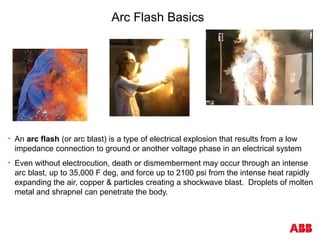
• An arc flash (or arc blast) is a type of electrical explosion that results from a low
impedance connection to ground or another voltage phase in an electrical system
• Even without electrocution, death or dismemberment may occur through an intense
arc blast, up to 35,000 F deg, and force up to 2100 psi from the intense heat rapidly
expanding the air, copper & particles creating a shockwave blast. Droplets of molten
metal and shrapnel can penetrate the body.
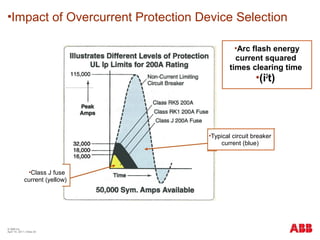
Impact of Overcurrent Protection Device Selection
Arc flash energy
current squared
times clearing time
(i2
t)
Typical circuit breaker
current (blue)
Class J fuse
current (yellow)
© ABB Inc.
April 19, 2011 | Slide 24
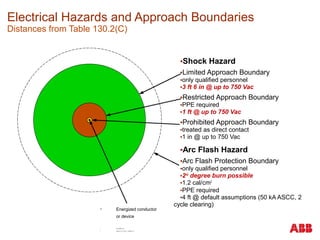
Electrical Hazards and Approach Boundaries
Distances from Table 130.2(C)
•Shock Hazard
•Limited Approach Boundary
•only qualified personnel
•3 ft 6 in @ up to 750 Vac
•Restricted Approach Boundary
•PPE required
•1 ft @ up to 750 Vac
•Prohibited Approach Boundary
•treated as direct contact
•1 in @ up to 750 Vac
•Arc Flash Hazard
•Arc Flash Protection Boundary
•only qualified personnel
•2nd
degree burn possible
•1.2 cal/cm2
•PPE required
•4 ft @ default assumptions (50 kA ASCC, 2
cycle clearing)
 Energized conductor
or device
 © ABB Inc.
 April 19, 2011 | Slide 17
Electrical Workplace Safety Standards
The OSHA / NFPA 70E mix
OSHA sets the functional requirements but does not provide procedural detail
(what must be done)
NFPA 70E provides procedural recommendations for how to meet functional
electrical safety goals (how to recommendations)
NFPA 70E procedural provisions are based on OSHA requirements and OSHA
citations reference NFPA 70E recommendations
Thus, although OSHA is law and NFPA 70E is not, NFPA 70E recommendations are
effectively de facto requirements
OSHA - Basic facts
 OSHA – Occupational and Safety Health Administration
 Established in accordance with the Occupational and Safety Health Act of 1970
 Requires that employers provide a place of employment
free from recognized hazards that are likely to cause death or serious injury
 Sets personal safety requirements
 Primarily written in performance language: (what must be achieved, not how
to achieve it)
© ABB Inc.
April 19, 2011 | Slide 7
OSHA and Workplace Electrical Safety
One level deeper
© ABB Inc.
April 19, 2011 | Slide
8
•OSHA 29 Code of Federal Regulations Part 1926
•Construction industry
•New installations, often temporary situations
•OSHA 29 Code of Federal Regulations Part 1910
•General industry / general commercial sites
•Existing installations, often maintenance or repair related
•Sets personal protective equipment (PPE) requirements
•Sets PPE training requirements
•Sets safety related work practice training requirements
•Sets lockout / tagout
requirements
NFPA 70E - Basic facts
•NFPA – National Fire Protection Association
•NFPA 70E: Standard for Electrical Safety in the Workplace (2009 Edition)
•All industries; all installations (with exceptions, e.g. utility sites)
•Prescriptive language – how to achieve
•Personnel safety emphasis
•Electrical shock hazards
•Arc flash / arc blast hazards
•Provides specific practices and procedures
•Electrical work practices
•Maintenance procedures
•Electrical hazard evaluation
•Personal protective equipment (PPE) evaluation and selection
© ABB Inc.
April 19, 2011 | Slide 9
NEC®
Article - 110.16 Flash Protection
 Equipment such as switchboards, panel boards, industrial control
panels, meter socket enclosures, and motor control centers that are in
other than dwelling occupancies and are likely to require examination,
adjustment, servicing, or maintenance while energized shall be field
marked to warn “qualified persons” of potential electric arc flash hazards.
 The marking shall be located so as to be clearly visible to qualified
persons before examination, adjustment, servicing, or maintenance of
the equipment.
© ABB Inc.
October 23, 2015 | Slide 12
NEC®
Article - 110.16 Flash Protection
FPN No. 1: NFPA 70E-2009, Standard for Electrical Safety
in the Workplace, provides assistance in determining severity
of potential exposure, planning safe work practices, and
selecting personal protective equipment.
FPN No. 2: ANSI Z535.4-1998, Product Safety Signs and
Labels, provides guidelines for the design of safety signs and
labels for application to products.
© ABB Inc.
October 23, 2015 | Slide 13
Arc Flash Hazard Labels
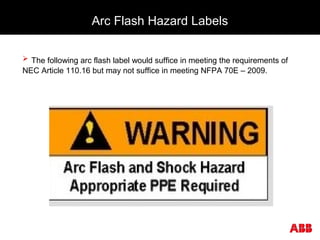
 The following arc flash label would suffice in meeting the requirements of
NEC Article 110.16 but may not suffice in meeting NFPA 70E – 2009.
Arc Flash Hazard Labels
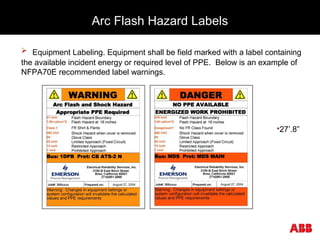
 Equipment Labeling. Equipment shall be field marked with a label containing
the available incident energy or required level of PPE. Below is an example of
NFPA70E recommended label warnings.
27’.8”
NEC®
Definition - Motor Control Center
An assembly of one or more enclosed sections having a common
power bus and principally containing motor control units.
ARTICLE 312
Cabinets, Cutout Boxes, and Meter Socket Enclosures
312.1 Scope. This article covers the installation and construction
specifications of cabinets, cutout boxes, and meter socket enclosures
© ABB Inc.
October 23, 2015 | Slide 16
NEC®
Article 409.2- Industrial Control Panel
An assembly of two or more components consisting of one of the following:
(1) Power circuit components only, such as motor controllers, overload relays,
fused disconnect switches, and circuit breakers
(2) Control circuit components only, such as pushbuttons, pilot lights, selector
switches, timers, switches, control relays
(3) A combination of power and control circuit components
These components, with associated wiring and terminals, are mounted on or
contained within an enclosure or mounted on a sub-panel. The industrial control
panel does not include the controlled equipment.
© ABB Inc.
October 23, 2015 | Slide 17
Electrical Safety — Who‘s Responsible
Employer responsibilities
•Establish / provide safety related work practices / procedures
•Safety awareness and self-discipline
•Safety measurement and monitoring controls
•Specific written safety procedures
•Hazard assessments
•Personal protective equipment (select and provide)
•Job briefings
•Safety auditing
•Establish / provide training
•Safety related work practices
•Emergency procedures
•Release of victims from electrical contact
•Resuscitation methods
•Knowledge of equipment specific electrical hazards
•Proper use of PPE
•Proper use of insulated tools and test equipment
© ABB Inc.
April 19, 2011 | Slide 11
Employer
Formal procedures,
documentation and training
Electrical Safety — Who‘s Responsible
Employee responsibilities
• Cultivate and maintain an earnest safety attitude
• Be alert to potential safety hazards —think proactively
• Implement all established safety practices, procedures, and
policies —exercise diligence
• Never make assumptions, when not sure, verify intension
and status
• Don‘t cut corners or skip steps —be meticulous
• Conscientiously utilize prescribed PPE without exception
Employee
Attitude is vital
Ardent implementation is critical
© ABB Inc.
April 19, 2011 | Slide 12
NEC®
Definition
NFPA 70 National Electrical Code®
, 2011 Edition
Qualified Person. One who has skills and knowledge related to the construction
and operation of the electrical equipment and installations and has received
safety training to recognize and avoid the hazards involved.
FPN: Refer to NFPA 70E®-2009, Standard for Electrical Safety in the
Workplace, for electrical safety training requirements.
Qualified Person
NFPA 70 E Standard for Electrical Safety in the Workplace,
2009 Edition
Qualified Person. A qualified person shall be:
Trained and knowledgeable of the construction and operation of equipment
or a specific work method
Trained to recognize and avoid the electrical hazards that might be present
with respect to that equipment or work method.
Qualified Person
NFPA 70 E Standard for Electrical Safety in the Workplace,
2009 Edition
The employer shall document that each employee has received the
training required. This documentation shall be made when the employee
demonstrates proficiency in the work practices involved and shall be
maintained for the duration of the employee’s employment. The
documentation shall contain each employee’s name and dates of training.
Safety Principle
De energize power unless infeasible
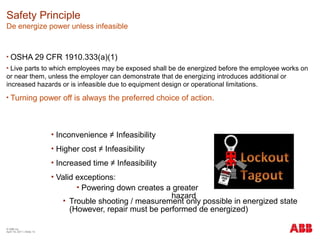
 OSHA 29 CFR 1910.333(a)(1)
 Live parts to which employees may be exposed shall be de energized before the employee works on
or near them, unless the employer can demonstrate that de energizing introduces additional or
increased hazards or is infeasible due to equipment design or operational limitations.
 Turning power off is always the preferred choice of action.
 Inconvenience ≠ Infeasibility
 Higher cost ≠ Infeasibility
 Increased time ≠ Infeasibility
 Valid exceptions:
 Powering down creates a greater
hazard
 Trouble shooting / measurement only possible in energized state
(However, repair must be performed de energized)
© ABB Inc.
April 19, 2011 | Slide 13
Safety Principle No
Ensure an electrically safe work condition
Electrically safe work condition - A state in which an electrical conductor or circuit part
has been disconnected from energized parts, locked / tagged in accordance with
established standards, tested to insure the absence of voltage, and grounded if
determined necessary.
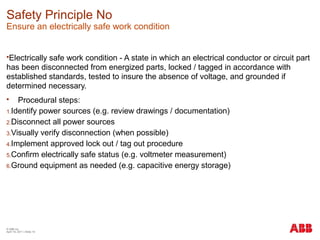
 Procedural steps:
1.Identify power sources (e.g. review drawings / documentation)
2.Disconnect all power sources
3.Visually verify disconnection (when possible)
4.Implement approved lock out / tag out procedure
5.Confirm electrically safe status (e.g. voltmeter measurement)
6.Ground equipment as needed (e.g. capacitive energy storage)
© ABB Inc.
April 19, 2011 | Slide 14
Backup Safety Strategy
What to do when energized work can‘t be avoided
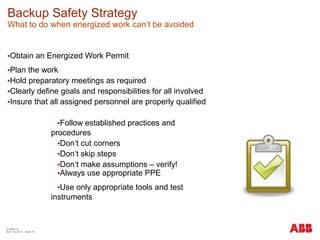
•Obtain an Energized Work Permit
•Plan the work
•Hold preparatory meetings as required
•Clearly define goals and responsibilities for all involved
•Insure that all assigned personnel are properly qualified
•Follow established practices and
procedures
•Don‘t cut corners
•Don‘t skip steps
•Don‘t make assumptions – verify!
•Always use appropriate PPE
•Use only appropriate tools and test
instruments
© ABB Inc.
April 19, 2011 | Slide 15
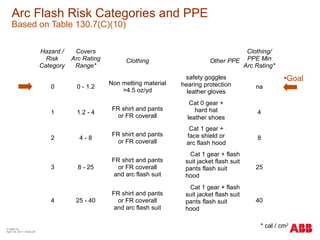
Arc Flash Risk Categories and PPE
Based on Table 130.7(C)(10)
Hazard /
Risk
Category
Covers
Arc Rating
Range*
Clothing Other PPE
Clothing/
PPE Min
Arc Rating*
0 0 - 1.2
Non melting material
>4.5 oz/yd
safety goggles
hearing protection
leather gloves
na
1 1.2 - 4
FR shirt and pants
or FR coverall
Cat 0 gear +
hard hat
leather shoes
4
2 4 - 8
FR shirt and pants
or FR coverall
Cat 1 gear +
face shield or
arc flash hood
8
3 8 - 25
FR shirt and pants
or FR coverall
and arc flash suit
Cat 1 gear + flash
suit jacket flash suit
pants flash suit
hood
25
4 25 - 40
FR shirt and pants
or FR coverall
and arc flash suit
Cat 1 gear + flash
suit jacket flash suit
pants flash suit
hood
40
Goal
© ABB Inc.
April 19, 2011 | Slide 20
* cal / cm2
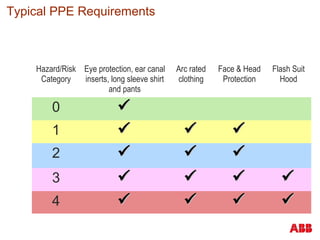
Typical PPE Requirements
Hazard/Risk
Category
Eye protection, ear canal
inserts, long sleeve shirt
and pants
Arc rated
clothing
Face & Head
Protection
Flash Suit
Hood
0 
1   
2   
3    
4    
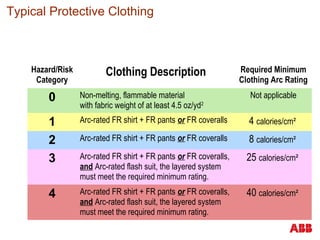
Typical Protective Clothing
Hazard/Risk
Category
Clothing Description Required Minimum
Clothing Arc Rating
0 Non-melting, flammable material
with fabric weight of at least 4.5 oz/yd2
Not applicable
1 Arc-rated FR shirt + FR pants or FR coveralls 4 calories/cm²
2 Arc-rated FR shirt + FR pants or FR coveralls 8 calories/cm²
3 Arc-rated FR shirt + FR pants or FR coveralls,
and Arc-rated flash suit, the layered system
must meet the required minimum rating.
25 calories/cm²
4 Arc-rated FR shirt + FR pants or FR coveralls,
and Arc-rated flash suit, the layered system
must meet the required minimum rating.
40 calories/cm²

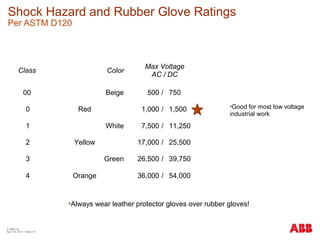
Shock Hazard and Rubber Glove Ratings
Per ASTM D120
Class Color
Max Voltage
AC / DC
00 Beige 500 / 750
0 Red 1,000 / 1,500
1 White 7,500 / 11,250
2 Yellow 17,000 / 25,500
3 Green 26,500 / 39,750
4 Orange 36,000 / 54,000
Good for most low voltage
industrial work
Always wear leather protector gloves over rubber gloves!
© ABB Inc.
April 19, 2011 | Slide 18
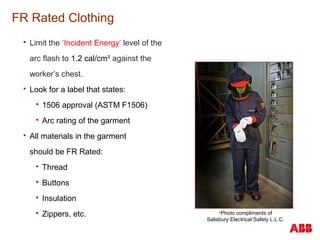
 Limit the ‘Incident Energy’ level of the
arc flash to 1.2 cal/cm² against the
worker’s chest.
 Look for a label that states:
 1506 approval (ASTM F1506)
 Arc rating of the garment
 All materials in the garment
should be FR Rated:
 Thread
 Buttons
 Insulation
 Zippers, etc.
FR Rated Clothing
Photo compliments of
Salisbury Electrical Safety L.L.C.
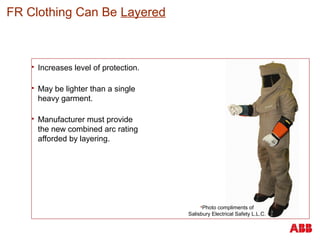
 Increases level of protection.
 May be lighter than a single
heavy garment.
 Manufacturer must provide
the new combined arc rating
afforded by layering.
FR Clothing Can Be Layered
Photo compliments of
Salisbury Electrical Safety L.L.C.
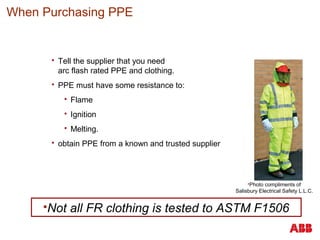
 Tell the supplier that you need
arc flash rated PPE and clothing.
 PPE must have some resistance to:
 Flame
 Ignition
 Melting.
 obtain PPE from a known and trusted supplier
When Purchasing PPE
Not all FR clothing is tested to ASTM F1506
Photo compliments of
Salisbury Electrical Safety L.L.C.
Synthetic Clothing
 Synthetic clothing that melts shall not be worn, such as:
 Acetate
 Nylon
 Polyester
 Polypropylene
 Spandex
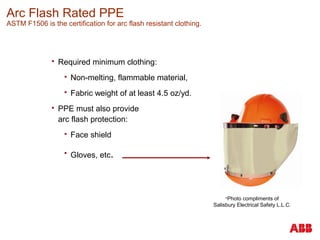
Arc Flash Rated PPE
ASTM F1506 is the certification for arc flash resistant clothing.
 Required minimum clothing:
 Non-melting, flammable material,
 Fabric weight of at least 4.5 oz/yd.
 PPE must also provide
arc flash protection:
 Face shield
 Gloves, etc.
Photo compliments of
Salisbury Electrical Safety L.L.C.
Hazard Reduction via Design
•Shock Hazards
•Covers and barriers
•Remote monitoring
•Arc Flash Hazards
•Covers and barriers
•Remote monitoring
•Door mounted keypad
•Overcurrent protective device (OCPD) selection
•Current limiting fuses vs. circuit breakers
•Clearing time is critical
•I2
t let through provides a hazard measurement standard
•Circuit breaker zone selective interlocking
•Maintenance switching
•High impedance grounding systems
•Phase to ground faults (not phase to phase)
© ABB Inc.
April 19, 2011 | Slide 21
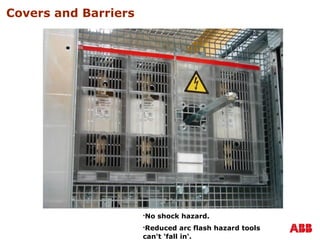
Covers and Barriers
No shock hazard.
Reduced arc flash hazard tools
can't 'fall in'.
Some elements to consider regarding arc flash
related to AC drives
 1. Arc flash analysis is required to evaluate the available short circuit current to
the facility and the individual panels within the facility. A new analysis is
required after a change in the power distribution system.
 2. Available certified & maintained personal protection equipment (PPE)
 3. Proper warning labels applied to panel or drive
 Defined personal safety boundary areas
 Required personal protection equipment (PPE)
 4. Current limiting line reactors are sometimes beneficial to lower the available
short circuit current levels at installation point
 5. Ultra-fast clearing time of an arc flash fault is essential. Techniques include:
fast acting current limiting fuses, coordinated circuit breakers and optical arc
flash detection relay control systems. A dedicated flash control system can be
stand alone on a feeder circuit and does not have to be part of a coordinated
system. Flash relay sensors can trigger by either a light flash only or light flash
plus fault current to minimize nuisance trips.
© ABB Inc.
October 23, 2015 | Slide 37

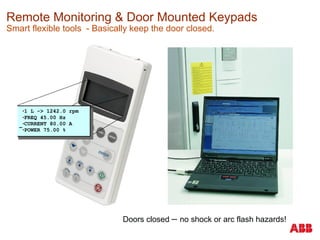
Remote Monitoring & Door Mounted Keypads
Smart flexible tools - Basically keep the door closed.
1 L -> 1242.0 rpm
FREQ 45.00 Hz
CURRENT 80.00 A
POWER 75.00 %
Doors closed – no shock or arc flash hazards!
© ABB Group
October 23, 2015 | Slide 39

Arc Flash as it Relates to AC Drives

  • 1.
    © ABB Inc. October23, 2015 | Slide 1 Arc Flash as it relates to AC Drives Larry Stanley, ABB Regional Sales Engineer
  • 2.
    Five Main Topics 1.What is arc flash 2. OSHA, NFPA 70E 3. Codes and standards 4. Protective clothing and equipment 5. Prevention
  • 3.
    Arc Flash Basics •An arc flash (or arc blast) is a type of electrical explosion that results from a low impedance connection to ground or another voltage phase in an electrical system • Even without electrocution, death or dismemberment may occur through an intense arc blast, up to 35,000 F deg, and force up to 2100 psi from the intense heat rapidly expanding the air, copper & particles creating a shockwave blast. Droplets of molten metal and shrapnel can penetrate the body.
  • 4.
    Impact of OvercurrentProtection Device Selection Arc flash energy current squared times clearing time (i2 t) Typical circuit breaker current (blue) Class J fuse current (yellow) © ABB Inc. April 19, 2011 | Slide 24
  • 5.
    Electrical Hazards andApproach Boundaries Distances from Table 130.2(C) •Shock Hazard •Limited Approach Boundary •only qualified personnel •3 ft 6 in @ up to 750 Vac •Restricted Approach Boundary •PPE required •1 ft @ up to 750 Vac •Prohibited Approach Boundary •treated as direct contact •1 in @ up to 750 Vac •Arc Flash Hazard •Arc Flash Protection Boundary •only qualified personnel •2nd degree burn possible •1.2 cal/cm2 •PPE required •4 ft @ default assumptions (50 kA ASCC, 2 cycle clearing)  Energized conductor or device  © ABB Inc.  April 19, 2011 | Slide 17
  • 8.
    Electrical Workplace SafetyStandards The OSHA / NFPA 70E mix OSHA sets the functional requirements but does not provide procedural detail (what must be done) NFPA 70E provides procedural recommendations for how to meet functional electrical safety goals (how to recommendations) NFPA 70E procedural provisions are based on OSHA requirements and OSHA citations reference NFPA 70E recommendations Thus, although OSHA is law and NFPA 70E is not, NFPA 70E recommendations are effectively de facto requirements
  • 9.
    OSHA - Basicfacts  OSHA – Occupational and Safety Health Administration  Established in accordance with the Occupational and Safety Health Act of 1970  Requires that employers provide a place of employment free from recognized hazards that are likely to cause death or serious injury  Sets personal safety requirements  Primarily written in performance language: (what must be achieved, not how to achieve it) © ABB Inc. April 19, 2011 | Slide 7
  • 10.
    OSHA and WorkplaceElectrical Safety One level deeper © ABB Inc. April 19, 2011 | Slide 8 •OSHA 29 Code of Federal Regulations Part 1926 •Construction industry •New installations, often temporary situations •OSHA 29 Code of Federal Regulations Part 1910 •General industry / general commercial sites •Existing installations, often maintenance or repair related •Sets personal protective equipment (PPE) requirements •Sets PPE training requirements •Sets safety related work practice training requirements •Sets lockout / tagout requirements
  • 11.
    NFPA 70E -Basic facts •NFPA – National Fire Protection Association •NFPA 70E: Standard for Electrical Safety in the Workplace (2009 Edition) •All industries; all installations (with exceptions, e.g. utility sites) •Prescriptive language – how to achieve •Personnel safety emphasis •Electrical shock hazards •Arc flash / arc blast hazards •Provides specific practices and procedures •Electrical work practices •Maintenance procedures •Electrical hazard evaluation •Personal protective equipment (PPE) evaluation and selection © ABB Inc. April 19, 2011 | Slide 9
  • 12.
    NEC® Article - 110.16Flash Protection  Equipment such as switchboards, panel boards, industrial control panels, meter socket enclosures, and motor control centers that are in other than dwelling occupancies and are likely to require examination, adjustment, servicing, or maintenance while energized shall be field marked to warn “qualified persons” of potential electric arc flash hazards.  The marking shall be located so as to be clearly visible to qualified persons before examination, adjustment, servicing, or maintenance of the equipment. © ABB Inc. October 23, 2015 | Slide 12
  • 13.
    NEC® Article - 110.16Flash Protection FPN No. 1: NFPA 70E-2009, Standard for Electrical Safety in the Workplace, provides assistance in determining severity of potential exposure, planning safe work practices, and selecting personal protective equipment. FPN No. 2: ANSI Z535.4-1998, Product Safety Signs and Labels, provides guidelines for the design of safety signs and labels for application to products. © ABB Inc. October 23, 2015 | Slide 13
  • 14.
    Arc Flash HazardLabels  The following arc flash label would suffice in meeting the requirements of NEC Article 110.16 but may not suffice in meeting NFPA 70E – 2009.
  • 15.
    Arc Flash HazardLabels  Equipment Labeling. Equipment shall be field marked with a label containing the available incident energy or required level of PPE. Below is an example of NFPA70E recommended label warnings. 27’.8”
  • 16.
    NEC® Definition - MotorControl Center An assembly of one or more enclosed sections having a common power bus and principally containing motor control units. ARTICLE 312 Cabinets, Cutout Boxes, and Meter Socket Enclosures 312.1 Scope. This article covers the installation and construction specifications of cabinets, cutout boxes, and meter socket enclosures © ABB Inc. October 23, 2015 | Slide 16
  • 17.
    NEC® Article 409.2- IndustrialControl Panel An assembly of two or more components consisting of one of the following: (1) Power circuit components only, such as motor controllers, overload relays, fused disconnect switches, and circuit breakers (2) Control circuit components only, such as pushbuttons, pilot lights, selector switches, timers, switches, control relays (3) A combination of power and control circuit components These components, with associated wiring and terminals, are mounted on or contained within an enclosure or mounted on a sub-panel. The industrial control panel does not include the controlled equipment. © ABB Inc. October 23, 2015 | Slide 17
  • 18.
    Electrical Safety —Who‘s Responsible Employer responsibilities •Establish / provide safety related work practices / procedures •Safety awareness and self-discipline •Safety measurement and monitoring controls •Specific written safety procedures •Hazard assessments •Personal protective equipment (select and provide) •Job briefings •Safety auditing •Establish / provide training •Safety related work practices •Emergency procedures •Release of victims from electrical contact •Resuscitation methods •Knowledge of equipment specific electrical hazards •Proper use of PPE •Proper use of insulated tools and test equipment © ABB Inc. April 19, 2011 | Slide 11 Employer Formal procedures, documentation and training
  • 19.
    Electrical Safety —Who‘s Responsible Employee responsibilities • Cultivate and maintain an earnest safety attitude • Be alert to potential safety hazards —think proactively • Implement all established safety practices, procedures, and policies —exercise diligence • Never make assumptions, when not sure, verify intension and status • Don‘t cut corners or skip steps —be meticulous • Conscientiously utilize prescribed PPE without exception Employee Attitude is vital Ardent implementation is critical © ABB Inc. April 19, 2011 | Slide 12
  • 20.
    NEC® Definition NFPA 70 NationalElectrical Code® , 2011 Edition Qualified Person. One who has skills and knowledge related to the construction and operation of the electrical equipment and installations and has received safety training to recognize and avoid the hazards involved. FPN: Refer to NFPA 70E®-2009, Standard for Electrical Safety in the Workplace, for electrical safety training requirements.
  • 21.
    Qualified Person NFPA 70E Standard for Electrical Safety in the Workplace, 2009 Edition Qualified Person. A qualified person shall be: Trained and knowledgeable of the construction and operation of equipment or a specific work method Trained to recognize and avoid the electrical hazards that might be present with respect to that equipment or work method.
  • 22.
    Qualified Person NFPA 70E Standard for Electrical Safety in the Workplace, 2009 Edition The employer shall document that each employee has received the training required. This documentation shall be made when the employee demonstrates proficiency in the work practices involved and shall be maintained for the duration of the employee’s employment. The documentation shall contain each employee’s name and dates of training.
  • 23.
    Safety Principle De energizepower unless infeasible  OSHA 29 CFR 1910.333(a)(1)  Live parts to which employees may be exposed shall be de energized before the employee works on or near them, unless the employer can demonstrate that de energizing introduces additional or increased hazards or is infeasible due to equipment design or operational limitations.  Turning power off is always the preferred choice of action.  Inconvenience ≠ Infeasibility  Higher cost ≠ Infeasibility  Increased time ≠ Infeasibility  Valid exceptions:  Powering down creates a greater hazard  Trouble shooting / measurement only possible in energized state (However, repair must be performed de energized) © ABB Inc. April 19, 2011 | Slide 13
  • 24.
    Safety Principle No Ensurean electrically safe work condition Electrically safe work condition - A state in which an electrical conductor or circuit part has been disconnected from energized parts, locked / tagged in accordance with established standards, tested to insure the absence of voltage, and grounded if determined necessary.  Procedural steps: 1.Identify power sources (e.g. review drawings / documentation) 2.Disconnect all power sources 3.Visually verify disconnection (when possible) 4.Implement approved lock out / tag out procedure 5.Confirm electrically safe status (e.g. voltmeter measurement) 6.Ground equipment as needed (e.g. capacitive energy storage) © ABB Inc. April 19, 2011 | Slide 14
  • 25.
    Backup Safety Strategy Whatto do when energized work can‘t be avoided •Obtain an Energized Work Permit •Plan the work •Hold preparatory meetings as required •Clearly define goals and responsibilities for all involved •Insure that all assigned personnel are properly qualified •Follow established practices and procedures •Don‘t cut corners •Don‘t skip steps •Don‘t make assumptions – verify! •Always use appropriate PPE •Use only appropriate tools and test instruments © ABB Inc. April 19, 2011 | Slide 15
  • 26.
    Arc Flash RiskCategories and PPE Based on Table 130.7(C)(10) Hazard / Risk Category Covers Arc Rating Range* Clothing Other PPE Clothing/ PPE Min Arc Rating* 0 0 - 1.2 Non melting material >4.5 oz/yd safety goggles hearing protection leather gloves na 1 1.2 - 4 FR shirt and pants or FR coverall Cat 0 gear + hard hat leather shoes 4 2 4 - 8 FR shirt and pants or FR coverall Cat 1 gear + face shield or arc flash hood 8 3 8 - 25 FR shirt and pants or FR coverall and arc flash suit Cat 1 gear + flash suit jacket flash suit pants flash suit hood 25 4 25 - 40 FR shirt and pants or FR coverall and arc flash suit Cat 1 gear + flash suit jacket flash suit pants flash suit hood 40 Goal © ABB Inc. April 19, 2011 | Slide 20 * cal / cm2
  • 27.
    Typical PPE Requirements Hazard/Risk Category Eyeprotection, ear canal inserts, long sleeve shirt and pants Arc rated clothing Face & Head Protection Flash Suit Hood 0  1    2    3     4    
  • 28.
    Typical Protective Clothing Hazard/Risk Category ClothingDescription Required Minimum Clothing Arc Rating 0 Non-melting, flammable material with fabric weight of at least 4.5 oz/yd2 Not applicable 1 Arc-rated FR shirt + FR pants or FR coveralls 4 calories/cm² 2 Arc-rated FR shirt + FR pants or FR coveralls 8 calories/cm² 3 Arc-rated FR shirt + FR pants or FR coveralls, and Arc-rated flash suit, the layered system must meet the required minimum rating. 25 calories/cm² 4 Arc-rated FR shirt + FR pants or FR coveralls, and Arc-rated flash suit, the layered system must meet the required minimum rating. 40 calories/cm²
  • 29.
     Shock Hazard andRubber Glove Ratings Per ASTM D120 Class Color Max Voltage AC / DC 00 Beige 500 / 750 0 Red 1,000 / 1,500 1 White 7,500 / 11,250 2 Yellow 17,000 / 25,500 3 Green 26,500 / 39,750 4 Orange 36,000 / 54,000 Good for most low voltage industrial work Always wear leather protector gloves over rubber gloves! © ABB Inc. April 19, 2011 | Slide 18
  • 30.
     Limit the‘Incident Energy’ level of the arc flash to 1.2 cal/cm² against the worker’s chest.  Look for a label that states:  1506 approval (ASTM F1506)  Arc rating of the garment  All materials in the garment should be FR Rated:  Thread  Buttons  Insulation  Zippers, etc. FR Rated Clothing Photo compliments of Salisbury Electrical Safety L.L.C.
  • 31.
     Increases levelof protection.  May be lighter than a single heavy garment.  Manufacturer must provide the new combined arc rating afforded by layering. FR Clothing Can Be Layered Photo compliments of Salisbury Electrical Safety L.L.C.
  • 32.
     Tell thesupplier that you need arc flash rated PPE and clothing.  PPE must have some resistance to:  Flame  Ignition  Melting.  obtain PPE from a known and trusted supplier When Purchasing PPE Not all FR clothing is tested to ASTM F1506 Photo compliments of Salisbury Electrical Safety L.L.C.
  • 33.
    Synthetic Clothing  Syntheticclothing that melts shall not be worn, such as:  Acetate  Nylon  Polyester  Polypropylene  Spandex
  • 34.
    Arc Flash RatedPPE ASTM F1506 is the certification for arc flash resistant clothing.  Required minimum clothing:  Non-melting, flammable material,  Fabric weight of at least 4.5 oz/yd.  PPE must also provide arc flash protection:  Face shield  Gloves, etc. Photo compliments of Salisbury Electrical Safety L.L.C.
  • 35.
    Hazard Reduction viaDesign •Shock Hazards •Covers and barriers •Remote monitoring •Arc Flash Hazards •Covers and barriers •Remote monitoring •Door mounted keypad •Overcurrent protective device (OCPD) selection •Current limiting fuses vs. circuit breakers •Clearing time is critical •I2 t let through provides a hazard measurement standard •Circuit breaker zone selective interlocking •Maintenance switching •High impedance grounding systems •Phase to ground faults (not phase to phase) © ABB Inc. April 19, 2011 | Slide 21
  • 36.
    Covers and Barriers Noshock hazard. Reduced arc flash hazard tools can't 'fall in'.
  • 37.
    Some elements toconsider regarding arc flash related to AC drives  1. Arc flash analysis is required to evaluate the available short circuit current to the facility and the individual panels within the facility. A new analysis is required after a change in the power distribution system.  2. Available certified & maintained personal protection equipment (PPE)  3. Proper warning labels applied to panel or drive  Defined personal safety boundary areas  Required personal protection equipment (PPE)  4. Current limiting line reactors are sometimes beneficial to lower the available short circuit current levels at installation point  5. Ultra-fast clearing time of an arc flash fault is essential. Techniques include: fast acting current limiting fuses, coordinated circuit breakers and optical arc flash detection relay control systems. A dedicated flash control system can be stand alone on a feeder circuit and does not have to be part of a coordinated system. Flash relay sensors can trigger by either a light flash only or light flash plus fault current to minimize nuisance trips. © ABB Inc. October 23, 2015 | Slide 37
  • 38.
     Remote Monitoring &Door Mounted Keypads Smart flexible tools - Basically keep the door closed. 1 L -> 1242.0 rpm FREQ 45.00 Hz CURRENT 80.00 A POWER 75.00 % Doors closed – no shock or arc flash hazards!
  • 39.
    © ABB Group October23, 2015 | Slide 39

Editor's Notes

  • #4 About 30% of reported electrical hazard injuries involve arc flash Arc flash is NOT limited to medium and high Voltages Arc flash events propagate in a few hundredths of a second Temperatures can reach 35,000 °F (4x the temperature of the sun‘s surface) Most arc fault incidents are initiated by some form of inadvertent contact Arc flash energy is typically expressed in cal / cm2
  • #5 PER NEMA UL 508C Motor controller, rated in horsepower (kW) a. 0 - 50 (0 - 37.3) 5 c b. 51 - 200 (38 - 149) 10 c c. 201 - 400 (150 - 298) 18 c d. 401 - 600 (299 - 447) 30 c e. 601 - 900 (448 - 671) 42 c f. 901 - 1500 (672 - 1193) 85 c
  • #6 NFPA 70 E defines Arc Flash Protection Boundary as follows” “When an arc flash hazard exists, an approach limit at a distance from a prospective arc source within which a person could receive a second degree burn if an electrical arc flash were to occur”
  • #11 1926.28 Personal protective equipment The employer is responsible for requiring the wearing of appropriate personal protective equipment in all operations where there is an exposure to hazardous conditions or where this part indicates the need for using such equipment to reduce the hazards to the employees. (b) Regulations governing the use, selection, and maintenance of personal protective and lifesaving equipment are described under subpart E of this part. 1926.417 Lockout and tagging of circuits. (a) Controls. Controls that are to be deactivated during the course of work on energized or deenergized equipment or circuits shall be tagged. (b) Equipment and circuits. Equipment or circuits that are deenergized shall be rendered inoperative and shall have tags attached at all points where such equipment or circuits can be energized. (c) Tags. Tags shall be placed to identify plainly the equipment or circuits being worked on. Subpart E—Personal Protective and Life Saving Equipment 1926.95 Criteria for personal protective equipment. 1926.96 Occupational foot protection. 1926.97–1926.98 [Reserved] 1926.100 Head protection. 1926.101 Hearing protection. 1926.102 Eye and face protection. 1926.103 Respiratory protection. 1926.104 Safety belts, lifelines, and lanyards. 1926.105 Safety nets. 1926.106 Working over or near water. 1926.107 Definitions applicable to this subpart
  • #15 Without arc flash hazard analysis, which at a minimum requires the determination of the potential short circuit current and knowledge of the overcurrent protective device, short of testing, it is impossible to determine the Incident Energy. Therefore, without arc flash hazard analysis, the only information that can be included on label is the Required Level of PPE. NFPA 70 E does not define what is meant by the “Required Level of PPE” and it only defines methods that should be used for the selection of protective clothing and other personnel protective equipment for work performed within the Arc Flash Protection Boundary. Even if no Arc Flash Hazard Category is defined, Safety glasses or goggles and hearing protection should be required for any electrical work near exposed energized parts except for circuits originating from Class II power sources as defined by Section 725 of the NEC Arc Flash labels are required on equipment “such as” panelboards, switchboards, motor control centers, industrial control panels and meter sockets, Arc Flash labels are required on motor starters, variable frequency drives, plug-in bus duct, equipment control panels and building management panels if they contain equipment that is 50 volts or higher and are “likely to require examination, adjustment, servicing or maintenance while energized”.
  • #16 Without arc flash hazard analysis, which at a minimum requires the determination of the potential short circuit current and knowledge of the overcurrent protective device, short of testing, it is impossible to determine the Incident Energy. Therefore, without arc flash hazard analysis, the only information that can be included on label is the Required Level of PPE. NFPA 70 E does not define what is meant by the “Required Level of PPE” and it only defines methods that should be used for the selection of protective clothing and other personnel protective equipment for work performed within the Arc Flash Protection Boundary. Even if no Arc Flash Hazard Category is defined, Safety glasses or goggles and hearing protection should be required for any electrical work near exposed energized parts except for circuits originating from Class II power sources as defined by Section 725 of the NEC Arc Flash labels are required on equipment “such as” panelboards, switchboards, motor control centers, industrial control panels and meter sockets, Arc Flash labels are required on motor starters, variable frequency drives, plug-in bus duct, equipment control panels and building management panels if they contain equipment that is 50 volts or higher and are “likely to require examination, adjustment, servicing or maintenance while energized”.
  • #22 Qualified persons shall be familiar with the proper use of: The special precautionary techniques, Personal Protective Equipment, including Arc-flash, Insulating and Shielding materials, Insulated tools and test equipment. Employees shall be trained to select an appropriate voltage detector and shall demonstrate how to use a device to verify the absence of voltage, including interpreting indications provided by the device. The training shall include information that enables the employee to understand all limitations of each specific voltage detector that may be used. A person can be considered qualified with respect to certain equipment and methods but still be unqualified for others. Qualified persons permitted to work within the Limited Approach Boundary of exposed energized electrical conductors and circuit parts operating at 50 volts or more shall, at a minimum, be additionally trained in all of the following: The skills and techniques necessary to distinguish exposed energized electrical conductors and circuit parts from other parts of electrical equipment. (2) The skills and techniques necessary to determine the nominal voltage of exposed energized electrical conductors and circuit parts (3) The approach distances specified in Table 130.2(C) and the corresponding voltages to which the qualified person will be exposed. (4) The decision-making process necessary to determine the degree and extent of the hazard and the personal protective equipment and job planning necessary to perform the task safely An employee who is undergoing on-the-job training and who, in the course of such training, has demonstrated an ability to perform duties safely at his or her level of training and who is under the direct supervision of a qualified person shall be considered to be a qualified person for the performance of those duties. Tasks that are performed less often than once per year shall require retraining before the performance of the work practices involved.
  • #23 OSHA commonly uses the “General Duty Clause”, which is paraphrased below or as an alternate uses NFPA 70E or the NEC for citations related to arc flash incidents. General Duty Clause: Section 5(a)(1) of the Occupational Safety and Health Act requires an employer to furnish to its employees “employment and a place of employment which are free from recognized hazards that are causing or are likely to cause death or serious physical harm to his employees”
  • #26 Verify – Test/Measure – Re-Verify
  • #28 Typical PPE Requirements This information is based on the 2009 edition of Workplace Electrical Safety, Table 5 Hazard/risk categorization of protective clothing and PPE. More information on PPE selection is available in the table and the accompanying notes. In most applications clothing and PPE must be either be FR rated or arc-flash rated. Note the arc rating associated with each hazard/risk category. Do not wear materials such as nylon and polyester that can melt. Non-FR-rated undergarments (and PPE) may catch fire even when arc-rated clothing worn overtop survives an arc flash. All categories 0 – 4 require: either safety glasses or safety goggles, ear canal inserts; and, long sleeve shirt and pants that are non-melting, arc-rated to ASTM F-1506 or untreated natural fibre. Category 1 requires clothing to be arc-rated to ASTM F-1506. Hard hat and arc rated face shield are also required as additional head and eye protection. Face shields must have wrap-around guarding to protect the forehead, ears, and neck. Some category 2 tasks require the use of a flash suit hood in place of an arc-rated face shield; however, there is also an option to substitute the flash suit hood for a combination of a face shield with a balaclava (sock hood). Both the face shield and balaclava must be arc rated. Categories 3 and 4 will require the use of a flash suit hood. IEEE 1584 – 2002 states the following relative to the use of PPE: “Where used, PPE for the arc-flash hazard is the last line of defense. The protection is not intended to prevent all injuries but to mitigate the impact of an arc flash upon the individual, should one occur. In many cases, the use of PPE has saved lives or prevented injury. The calculations in this guide will lead to selection of a level of PPE that is a balance between the calculated estimated incident energy exposure and the work activity being performed while meeting the following concerns
  • #29 This information is based on the 2009 edition, Workplace Electrical Safety, Table 6 Protective Clothing Characteristics. Hazard/risk category 0: Non-melting flammable material with fabric weight of at least 4.5 oz/yd2. Hazard/risk category 1: Arc-rated FR shirt + FR pants or FR coveralls. Hazard risk category 2: Arc-rated FR shirt + FR pants or FR coveralls. Hazard/risk category 3: Arc-rated FR shirt + FR pants or FR coveralls, and Arc-rated flash suit, selected so the layered system meets the required minimum rating. Hazard/risk category 4: Arc-rated FR shirt + FR pants or FR coveralls, and Arc-rated flash suit, selected so the layered system meets the required minimum rating. Do not wear materials such as nylon and polyester that can melt. Non-FR-rated undergarments (and PPE) may catch fire even when arc-rated clothing worn overtop easily survives an arc flash. Important Note: FR clothing will not also be arc-rated unless it meets ASTM F1506. See Topic 4 – Protective Clothing and Equipment.
  • #31 An arc flash analysis will identify the level of incident energy available and thereby the level of protection the worker requires. ASTM F1506* is a standard that was developed to give minimum performance specifications for protective clothing. Uses a hazard risk category system to identify the incident energy a worker would be exposed while performing a task. The category level (0 to 4) is used to identify a level of protection for the worker, which simplifies PPE choice. *ASTM F1506 = Standard Performance Specification for Textile Materials for Wearing Apparel for Use by Electrical Workers Exposed to Momentary Arc and Related Thermal Hazards.
  • #32 Arc rated clothing may be layered to increase the level of protection. For example, wearing FR coveralls over FR shirt and FR pants. Layered clothing is more versatile and may result in garments that are lighter than if a single heavy garment were used. The manufacturer must provide information on the increased protection afforded by layering their clothing. The new arc flash rating of the layering must however be verified by the manufacturer through testing.
  • #33 Instead, ASTM F1506 is the certification for arc flash resistant clothing. Table 5 in CSA Z462 Protective Clothing and Personal Protective Equipment (PPE) mentions protective equipment that must be FR rated, however it also identifies a number of the items have no FR requirement stated. Purchasers should obtain PPE from a known and trusted supplier.
  • #34 Non-rated clothing, and other PPE that can melt or catch fire, exposes the worker to serious burn injury. Even when arc rated clothing easily survives an arc flash, non FR-rated clothing, including undergarments and other PPE that can melt or catch fire, have caused workers to be severely injured when it either burned or melted on the workers skin. The result is extremely painful and lengthy hospitalization and rehabilitation, and permanent changes to their quality of life.
  • #35 Arc Flash PPE ASTM F1506 is the certification for arc flash resistant clothing. Face shields commonly used for grinding and cutting are not arc flash rated and may melt. Arc flash resistant face shields must meet ASTM F2178 specifications to comply with NFPA 70E (and CSA Z462 - 08) for arc flash protection. Hard hats, safety glasses, leather work boots, and leather gloves, for example, may either be inherently flame resistant or designed to another standard that provides some protection against flammability, ignition, and melting. The material used in manufacturing makes a difference. Generally, ear canal inserts made of PVC are more flame resistant than inserts made from polyurethane.
  • #37 Drive designs with protective covers or shields provide increased safety.