NFPA 70E Standard for Electrical Safety in the workplace
Agenda Introduction Statistics  Chapter 1 NFPA 70E standards Using Electrical PPE and equipment demonstration Onsite application discussion
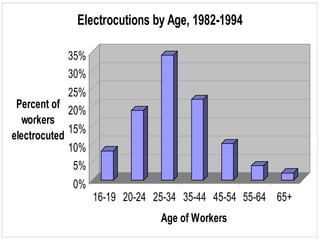
Why Now? Average of 4,000 non-disabling and 3,600 disabling electrical contact injuries annually in the United States. One person is electrocuted in the workplace every day. Electrocutions were the fourth leading cause of traumatic occupational fatalities. Labor Statistics give OSHA reason for focused citations 14 in Alabama
 
We Need a Cultural Change In a survey of 1,200 electricians found: 97% of respondents had experienced a shock at work. Most electricians will not only agree with those statistics but will argue “Electrical work is dangerous”. Apprentices are commonly encouraged to work on live parts without protection.

In an Arc Blast/Flash study: Measurements were  taken to quantify forces exerted  within 2’ of an arc blast/flash 141.5 db Temperature at exposed parts of a manikin- 437 degrees F over double temp for 2 nd  degree burn Temperature inside of shirt- 122 degrees F less than 2 nd  degree burn 2160 lbs/sq. ft of pressure was measured.
NFPA 70E Standards 4 Chapters Chapter 1 Safety-Related Work Practices Chapter 2 Safety-Related Maintenance Requirements Chapter 3 Safety Requirements for Special Equipment Chapter 4 Installation Safety Requirements
Chapter 1 Article 110  General Requirements for Electrical Safety-Related Work Practices .1 Scope of chapter 1 covers practices for employees who work on  or near  live parts .3 Responsibility of employer to provide safety-related work practices and train employees who shall implement them. .3 Responsibility of the employees is to implement the practices.
Chapter 1 Article 110  .4 Multiemployer Relationship, more than one employer may be responsible for hazardous conditions that violate safe work practices. .4 Employers shall inform each other of existing hazards, PPE requirements, safe work practice procedures, and emergency procedures. .4 This coordination shall include a meeting and documentation.
Chapter 1 Article 110  .6 Training Requirements Classroom, on-the-job, or combination All employees who face risk In specific hazards associated with electrical energy Emergency Procedures  Victim release First Aid/CPR
Chapter 1 Article 110  .6 Training Requirements (cont.) Qualified Person Shall be trained and knowledgeable of the construction and operation of equipment or a specific work method.  Shall be trained to recognize and avoid the electrical hazards that might be present. Unqualified Person Shall be trained and be familiar with any electrical safety-related practices that would apply to their safety.
Chapter 1 Article 110 .7 Electrical Safety Program Must direct activity/procedures appropriate for the voltage, energy level, and circuit conditions. Provide awareness of potential electrical hazards. Provide self-discipline for employees who might perform work on or near energized parts. Identify Principles upon which it is based. Identify controls by which it is measured and monitored. Provide a hazard/risk evaluation prior to work on or near live parts. Annex E (example 106)
Chapter 1 Article 120 .1 Establishing an Electrically Safe Work Condition  Condition considered Unsafe until all 6 steps have been successfully completed Check drawings for energy sources Open disconnecting device(s) for all sources Visual verification Apply LO/TO devices  Verify parts as deenergized Ground phase conductors before touching  (if necessary)
Chapter 1 Article 120 .2 Working On or Near Deenergized Electrical Conductors or Circuit Parts That Have Lockout/Tagout Devices Applied LO/TO 7 Principles Employee involvement, Training, Plan development, Control of Energy, Identification of LO/TO devices, Voltage removed, Coordination.
Chapter 1 Article 120 Must have established procedure including procedure audits 3 forms of control – individual, simple, complex. Coordination, Training, Equipment and Procedures listed 120.2 (D) – (F) Note – (E)(1) Lock Application If equipment isn’t compatible with LO devise what alternative is available?
Chapter 1 Article 130 Working On or Near Live Parts 5 Major Components .1 Justification for work .2 Establishing Approach Boundaries .7 PPE .3 Hazard Analysis .1(A)&110.7(G)Pre-Planning documentation
Chapter 1 Article 130 Justification for Work Testing, diagnostics that can only be performed while equip. is energized Infeasibility due to equipment design Increased or additional hazards presented Interruption of life support Deactivation of emergency alarm systems Shutdown of hazardous location ventilation
Chapter 1 Article 130 Establishing Approach Boundaries Limited Approach Boundary Unqualified persons allowed if advised on possible hazards and continuously escorted by qualified person For Voltages up to 750V Distance of 10 ft. Shock Protection if exposed parts are movable Distance of 3.5 ft. Shock Protection if exposed parts are fixed Distance of 4 ft. Flash Protection@ 600V
Chapter 1 Article 130 Establishing Approach Boundaries Restricted Approach Boundary Only qualified persons allowed No conductive objects allowed PPE required For Voltages up to 750V Distance of 1 ft. Shock Protection  Distance of 4 ft. Flash Protection@ 600V
Chapter 1 Article 130 Establishing Approach Boundaries Prohibited Approach Boundary No un-insulated part of a qualified persons body may cross this area For Voltages up to 750V Distance of 1 in. Shock Protection Distance of 4 ft. Flash Protection@ 600V
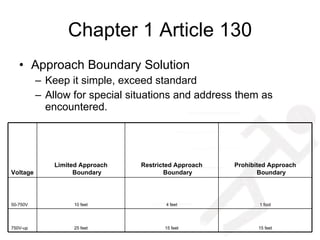
Chapter 1 Article 130 Approach Boundary Solution Keep it simple, exceed standard Allow for special situations and address them as encountered. 15 feet 15 feet 25 feet 750V-up 1 foot 4 feet 10 feet 50-750V Prohibited Approach Boundary Restricted Approach Boundary Limited Approach Boundary Voltage
Chapter 1 Article 130 Protective Clothing and Personal Protective Equipment Must be visually inspected before each use Rubber products must be electrically tested as needed (gloves 6 mo.) and certified as such
Chapter 1 Article 130 Protective Clothing and Personal Protective Equipment Hazard/Risk Category 0 – 4  Table 130.7(C)(10) and (11) Examples
Chapter 1 Article 130 Hazard Analysis Shock Hazard Analysis Determines voltage and personnel that will be exposed. Provides boundaries based on voltages Determines PPE required Flash Hazard Analysis Determines Flash Protection Boundary 600V or less = 4.0 feet Determines PPE required
 
Pre-Planning Documentation Job Briefing/Planning Checklist Electrical Work Permit Examples Annex I Annex J Does this documentation cover hazard/flash analysis  Covers documentation of justification
Chapter 1 Article 130 .6 Other Precautions for Personnel Activities (A) Alertness (B) Blind Reaching (C) Can you see? (illumination) (D) ConDuctive articles being worn (E) ConductivE material handled (F) ConFined Space
Chapter 1 Article 130 .6 Other Precautions for Personnel Activities (cont.) (G) Housekeeping Duties (H) Flammable Materials (I) Anticipating Failure (J) Routine Opening and Closing Circuits (K) Reclosing Circuits After Protective Device    Operation
Onsite Application Preparations to control access to energized parts begins when prints are made available Temporary power should be placed so that it can remain the only source of power through most of job.
Onsite Application Before Permanent Power enters building what can we look for? All empty conduits entering “To Be” energized equipment is capped (duct tape will not stop a good fish tape) Are empty conduits spares, mistakes, or planned near-future use. LO/TO equipment and procedures
Onsite Application Is PPE available for Hazard/Risk Categories Who is qualified to use PPE Have unqualified and qualified persons been trained Are sub panels completed before energized To minimize exposure, complete 100% of known circuits within a sub panel before it is energized
Onsite Application Are documented safety meetings, permits, briefing/planning checklist being completed Other examples THE MAIN IDEA……….
Onsite Application CREATE AN ELECTRICAL SAFE WORKING ENVIRONMENT (SHUT IT OFF!)
Onsite Application WHEN NOT POSSIBLE (JUSTIFIED REASON)  EVERYONE  INVOLVED SHOULD KNOW EVERYTHING  ABOUT THE WORK TO BE DONE THROUGH DOCUMENTATION.
Information Covered Introduction Statistics  Chapter 1 NFPA 70E standards Using Electrical PPE and equipment demonstration Onsite application discussion
Questions? Thank you

Nfpa 70 E

  • 1.
    NFPA 70E Standardfor Electrical Safety in the workplace
  • 2.
    Agenda Introduction Statistics Chapter 1 NFPA 70E standards Using Electrical PPE and equipment demonstration Onsite application discussion
  • 3.
    Why Now? Averageof 4,000 non-disabling and 3,600 disabling electrical contact injuries annually in the United States. One person is electrocuted in the workplace every day. Electrocutions were the fourth leading cause of traumatic occupational fatalities. Labor Statistics give OSHA reason for focused citations 14 in Alabama
  • 4.
  • 5.
    We Need aCultural Change In a survey of 1,200 electricians found: 97% of respondents had experienced a shock at work. Most electricians will not only agree with those statistics but will argue “Electrical work is dangerous”. Apprentices are commonly encouraged to work on live parts without protection.
  • 6.
    In an ArcBlast/Flash study: Measurements were taken to quantify forces exerted within 2’ of an arc blast/flash 141.5 db Temperature at exposed parts of a manikin- 437 degrees F over double temp for 2 nd degree burn Temperature inside of shirt- 122 degrees F less than 2 nd degree burn 2160 lbs/sq. ft of pressure was measured.
  • 7.
    NFPA 70E Standards4 Chapters Chapter 1 Safety-Related Work Practices Chapter 2 Safety-Related Maintenance Requirements Chapter 3 Safety Requirements for Special Equipment Chapter 4 Installation Safety Requirements
  • 8.
    Chapter 1 Article110 General Requirements for Electrical Safety-Related Work Practices .1 Scope of chapter 1 covers practices for employees who work on or near live parts .3 Responsibility of employer to provide safety-related work practices and train employees who shall implement them. .3 Responsibility of the employees is to implement the practices.
  • 9.
    Chapter 1 Article110 .4 Multiemployer Relationship, more than one employer may be responsible for hazardous conditions that violate safe work practices. .4 Employers shall inform each other of existing hazards, PPE requirements, safe work practice procedures, and emergency procedures. .4 This coordination shall include a meeting and documentation.
  • 10.
    Chapter 1 Article110 .6 Training Requirements Classroom, on-the-job, or combination All employees who face risk In specific hazards associated with electrical energy Emergency Procedures Victim release First Aid/CPR
  • 11.
    Chapter 1 Article110 .6 Training Requirements (cont.) Qualified Person Shall be trained and knowledgeable of the construction and operation of equipment or a specific work method. Shall be trained to recognize and avoid the electrical hazards that might be present. Unqualified Person Shall be trained and be familiar with any electrical safety-related practices that would apply to their safety.
  • 12.
    Chapter 1 Article110 .7 Electrical Safety Program Must direct activity/procedures appropriate for the voltage, energy level, and circuit conditions. Provide awareness of potential electrical hazards. Provide self-discipline for employees who might perform work on or near energized parts. Identify Principles upon which it is based. Identify controls by which it is measured and monitored. Provide a hazard/risk evaluation prior to work on or near live parts. Annex E (example 106)
  • 13.
    Chapter 1 Article120 .1 Establishing an Electrically Safe Work Condition Condition considered Unsafe until all 6 steps have been successfully completed Check drawings for energy sources Open disconnecting device(s) for all sources Visual verification Apply LO/TO devices Verify parts as deenergized Ground phase conductors before touching (if necessary)
  • 14.
    Chapter 1 Article120 .2 Working On or Near Deenergized Electrical Conductors or Circuit Parts That Have Lockout/Tagout Devices Applied LO/TO 7 Principles Employee involvement, Training, Plan development, Control of Energy, Identification of LO/TO devices, Voltage removed, Coordination.
  • 15.
    Chapter 1 Article120 Must have established procedure including procedure audits 3 forms of control – individual, simple, complex. Coordination, Training, Equipment and Procedures listed 120.2 (D) – (F) Note – (E)(1) Lock Application If equipment isn’t compatible with LO devise what alternative is available?
  • 16.
    Chapter 1 Article130 Working On or Near Live Parts 5 Major Components .1 Justification for work .2 Establishing Approach Boundaries .7 PPE .3 Hazard Analysis .1(A)&110.7(G)Pre-Planning documentation
  • 17.
    Chapter 1 Article130 Justification for Work Testing, diagnostics that can only be performed while equip. is energized Infeasibility due to equipment design Increased or additional hazards presented Interruption of life support Deactivation of emergency alarm systems Shutdown of hazardous location ventilation
  • 18.
    Chapter 1 Article130 Establishing Approach Boundaries Limited Approach Boundary Unqualified persons allowed if advised on possible hazards and continuously escorted by qualified person For Voltages up to 750V Distance of 10 ft. Shock Protection if exposed parts are movable Distance of 3.5 ft. Shock Protection if exposed parts are fixed Distance of 4 ft. Flash Protection@ 600V
  • 19.
    Chapter 1 Article130 Establishing Approach Boundaries Restricted Approach Boundary Only qualified persons allowed No conductive objects allowed PPE required For Voltages up to 750V Distance of 1 ft. Shock Protection Distance of 4 ft. Flash Protection@ 600V
  • 20.
    Chapter 1 Article130 Establishing Approach Boundaries Prohibited Approach Boundary No un-insulated part of a qualified persons body may cross this area For Voltages up to 750V Distance of 1 in. Shock Protection Distance of 4 ft. Flash Protection@ 600V
  • 21.
    Chapter 1 Article130 Approach Boundary Solution Keep it simple, exceed standard Allow for special situations and address them as encountered. 15 feet 15 feet 25 feet 750V-up 1 foot 4 feet 10 feet 50-750V Prohibited Approach Boundary Restricted Approach Boundary Limited Approach Boundary Voltage
  • 22.
    Chapter 1 Article130 Protective Clothing and Personal Protective Equipment Must be visually inspected before each use Rubber products must be electrically tested as needed (gloves 6 mo.) and certified as such
  • 23.
    Chapter 1 Article130 Protective Clothing and Personal Protective Equipment Hazard/Risk Category 0 – 4 Table 130.7(C)(10) and (11) Examples
  • 24.
    Chapter 1 Article130 Hazard Analysis Shock Hazard Analysis Determines voltage and personnel that will be exposed. Provides boundaries based on voltages Determines PPE required Flash Hazard Analysis Determines Flash Protection Boundary 600V or less = 4.0 feet Determines PPE required
  • 25.
  • 26.
    Pre-Planning Documentation JobBriefing/Planning Checklist Electrical Work Permit Examples Annex I Annex J Does this documentation cover hazard/flash analysis Covers documentation of justification
  • 27.
    Chapter 1 Article130 .6 Other Precautions for Personnel Activities (A) Alertness (B) Blind Reaching (C) Can you see? (illumination) (D) ConDuctive articles being worn (E) ConductivE material handled (F) ConFined Space
  • 28.
    Chapter 1 Article130 .6 Other Precautions for Personnel Activities (cont.) (G) Housekeeping Duties (H) Flammable Materials (I) Anticipating Failure (J) Routine Opening and Closing Circuits (K) Reclosing Circuits After Protective Device Operation
  • 29.
    Onsite Application Preparationsto control access to energized parts begins when prints are made available Temporary power should be placed so that it can remain the only source of power through most of job.
  • 30.
    Onsite Application BeforePermanent Power enters building what can we look for? All empty conduits entering “To Be” energized equipment is capped (duct tape will not stop a good fish tape) Are empty conduits spares, mistakes, or planned near-future use. LO/TO equipment and procedures
  • 31.
    Onsite Application IsPPE available for Hazard/Risk Categories Who is qualified to use PPE Have unqualified and qualified persons been trained Are sub panels completed before energized To minimize exposure, complete 100% of known circuits within a sub panel before it is energized
  • 32.
    Onsite Application Aredocumented safety meetings, permits, briefing/planning checklist being completed Other examples THE MAIN IDEA……….
  • 33.
    Onsite Application CREATEAN ELECTRICAL SAFE WORKING ENVIRONMENT (SHUT IT OFF!)
  • 34.
    Onsite Application WHENNOT POSSIBLE (JUSTIFIED REASON) EVERYONE INVOLVED SHOULD KNOW EVERYTHING ABOUT THE WORK TO BE DONE THROUGH DOCUMENTATION.
  • 35.
    Information Covered IntroductionStatistics Chapter 1 NFPA 70E standards Using Electrical PPE and equipment demonstration Onsite application discussion
  • 36.