Arc Flash Hazard Calculations – What does it all mean? Robert E. Fuhr, P.E. PowerStudies.com
Why are Arc Flash Hazard Studies Needed? To Increase Electrical Safety at your facility! Required by National Electric Code (NEC) and OSHA To Protect You!
 
 
OSHA Requirements Standard 29 CFR 1910 Subpart S, 1910 to 1910.336 Must  identify  all  hazards  above 50 Volts Must put  safeguards  in place for these hazards Must  train  employees on safe work practices OSHA has officially  adopted  NFPA 70E
Employers must provide workers with appropriate PPE as per the OSHA 29 1910.132 (h)(1) PPE payment requirement, i.e.,  (PPE) used to comply with this part, shall be provided by the employer at no cost to employees.  Paragraph (h) became effective February 13, 2008, and employers must implement the PPE payment requirements no later than May 15, 2008
Key References in NEC ® -2008 110.16 Flash Protection.  Switchboards, panel boards, industrial control panels, and motor control centers in other than dwelling occupancies, that are likely to require  examination, adjustment, servicing, or maintenance  while  energized , shall be field  marked  to warn qualified persons of potential electric arc flash hazards.
NEC 110.16  (continued) The  marking  shall be located so as to be  clearly visible  to qualified persons before  examination, adjustment, servicing, or maintenance  of the equipment.
Key References in NEC ® -2005 FPN No. 1  : NFPA 70E-2004, Standard For Electrical Safety in the Workplace,  provides   assistance  in determining severity of potential exposure, planning safe work practices and selecting personal protective equipment.
NFPA 70E -Flash Hazard Analysis 130.3 – A  flash hazard analysis shall be done  in order to protect personnel from the possibility of being injured by an arc flash.  The analysis shall determine: Flash Protection Boundary  Personal protective equipment  Calculate using  Formulas in 130.3.A and Table 130.7(C)(9)(a) *  in NFPA 70E *   - Use with extreme caution!!!   Equations in IEEE 1584
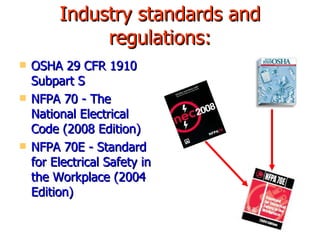
Industry standards and regulations: OSHA 29 CFR 1910 Subpart S NFPA 70 - The National Electrical Code (2008 Edition) NFPA 70E - Standard for Electrical Safety in the Workplace (2004 Edition)
Arc Flash Hazard Analysis Key Steps Use NFPA 70E *  Tables, IEEE 1584, or Lee Equations to Determine  Incident energy levels  Arc Flash hazard distance * Use with extreme caution!
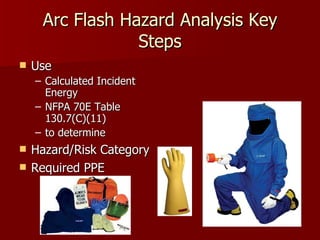
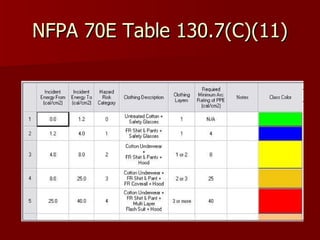
Arc Flash Hazard Analysis Key Steps Use  Calculated Incident Energy NFPA 70E Table 130.7(C)(11)  to determine  Hazard/Risk Category Required PPE
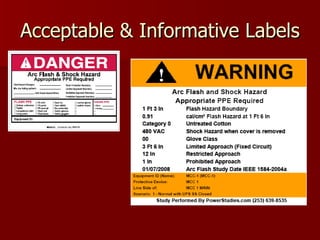
Acceptable & Informative Labels
NFPA 70E Table 130.7(C)(11)
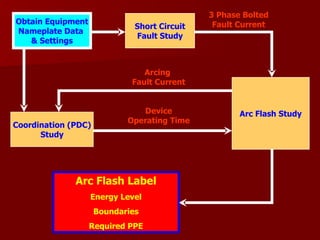
Short Circuit Fault Study Coordination (PDC) Study Arc Flash Study Device Operating Time Arcing  Fault Current 3 Phase Bolted Fault Current Arc Flash Label Energy Level Boundaries Required PPE Obtain Equipment Nameplate Data  & Settings
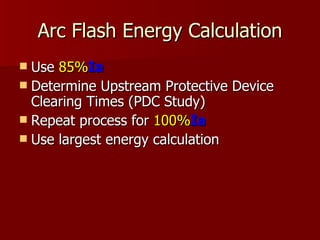
Arc Flash Energy Calculation Use  85% Ia   Determine Upstream Protective Device Clearing Times (PDC Study) Repeat process for  100% Ia Use largest energy calculation
Arc Flash Hazard Analysis Key Steps Determine: Bolted Fault Currents  (Short Circuit Study) Arcing Fault  (AF) Current Upstream Protective  Device Clearing Times  (PDC Study) using AF
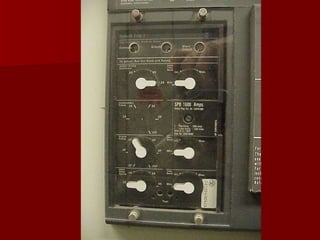
Arc Flash Hazard Analysis Key Steps Calculate Arc Flash Energy Use NFPA 70E Tables to determine: Glove Rating Class  Limited Approach Boundary Prohibited Approach Boundary Restricted Approach Boundary  Required PPE
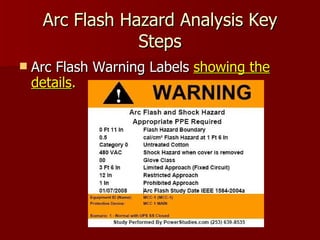
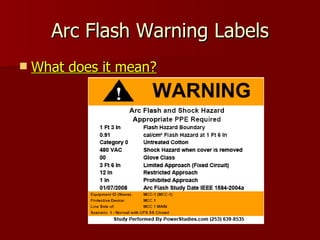
Arc Flash Hazard Analysis Key Steps Arc Flash Warning Labels  showing the details .
How a Short Circuit Study is Performed Obtain distribution system nameplate data for: Transformers Motors Circuit breakers, fuses, relays Switchgear Motor Control Centers Conductor sizes and lengths
How a Short Circuit Study is Performed Enter data  into the computer program. Simulate  short circuit at each location and  calculate  the fault current. Compare  calculated fault current to equipment short circuit rating.
What is Protective Device Coordination (PDC) Study? Determines: fuse  sizes   Settings  for relays and circuit breakers Device  operating time The study has  2  conflicting goals
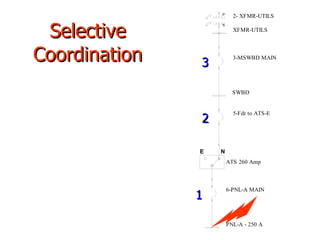
Goal #1 - Maximum Selective Coordination Between Equipment Correct  fuse sizes and settings will allow the device  closest to a fault to trip .  If the  first device fails  to operate, then the  next upstream device  will  trip . Longer  device trip  delays  =  increased  device  coordination =  greater  incident  energy
Selective Coordination 1 2 3
Goal #2 - Maximum Equipment Protection and Reduction in Arc Flash Energy Correct  fuse sizes and device settings will  quickly   interrupt  the fault current for a short circuit downstream. Shorter  device delays =  decreased  equipment damage =  less  Incident Energy
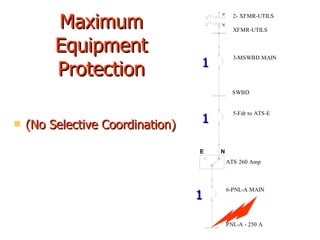
Maximum Equipment Protection (No Selective Coordination) 1 1 1
Must  balance  these  two  conflicting goals based upon the type of facility.
PDC Vocabulary Time Current Curve (TCC) Log-log graph of  time  versus  current Every breaker, fuse, and relay has a time current characteristic curve.
PDC Vocabulary  Selective Device Coordination The devices  plotted  on the  time current curves  are  coordinated  for  all  levels of fault current and time.
 
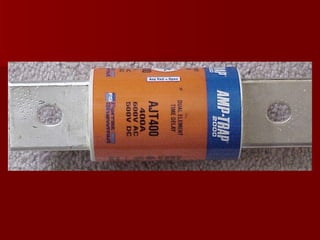
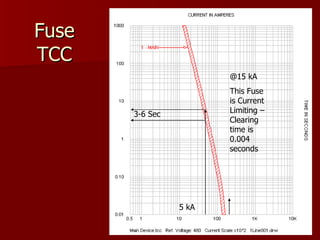
Fuse TCC 3-6 Sec  5   kA @15   kA This Fuse is Current Limiting – Clearing time is 0.004 seconds
 
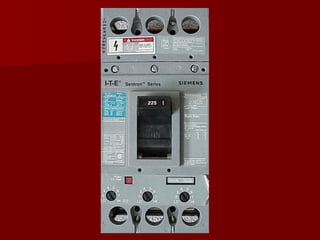
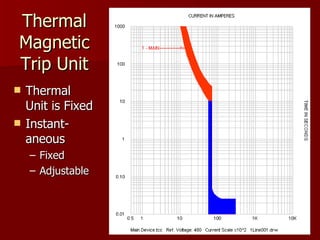
Thermal Magnetic Trip Unit Thermal Unit is Fixed Instant-aneous Fixed Adjustable
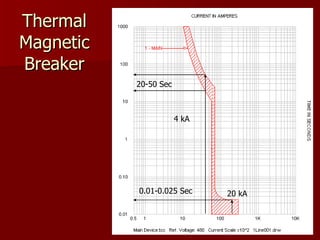
Thermal Magnetic Breaker 20   kA 0.01-0.025 Sec  4   kA 20-50 Sec
 
 
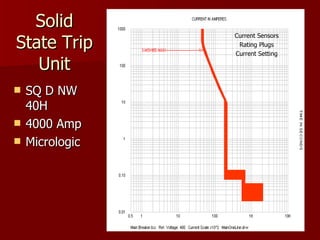
Solid State Trip Unit SQ D NW 40H 4000 Amp Micrologic Current Sensors Rating Plugs Current Setting
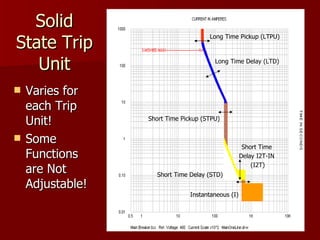
Solid State Trip Unit Varies for each Trip Unit! Some Functions are Not Adjustable! Long Time Pickup (LTPU) Long Time Delay (LTD) Short Time Pickup (STPU) Short Time Delay (STD) Instantaneous (I) Short Time  Delay I2T-IN  (I2T)
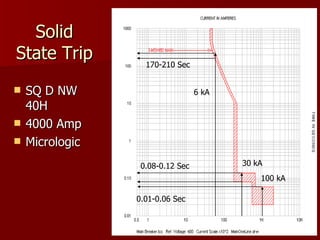
Solid State Trip SQ D NW 40H 4000 Amp Micrologic 100   kA 0.01-0.06 Sec  6   kA 0.08-0.12 Sec  30   kA 170-210 Sec
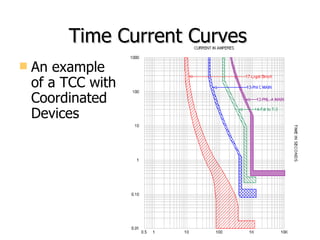
Time Current Curves   An example of a TCC with Coordinated Devices Current in Amperes X 100
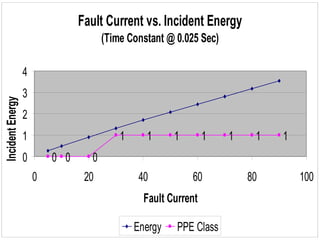
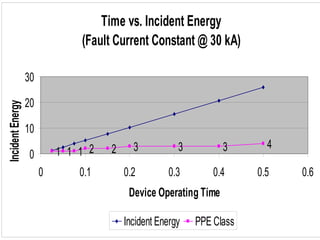
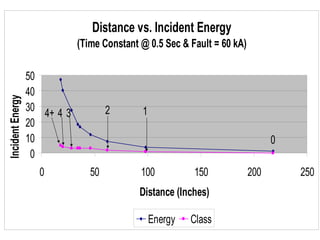
Arc Flash Energy Calculations Incident Energy Levels are dependent on:  Level  of  arcing  fault  current   Upstream device  clearing time . Multiple Sources
Typical Assumptions for an Analysis Trip time  is determined by the  upstream protective  device  settings . Worker is  stationary . The  maximum time  that a worker will be exposed to the arc flash is  2.0 seconds . (Depends upon location!!!)
Current Vs Energy Levels
Time Vs Energy Levels
Distance Vs Energy Levels
Arc Flash Warning Labels What does it mean?
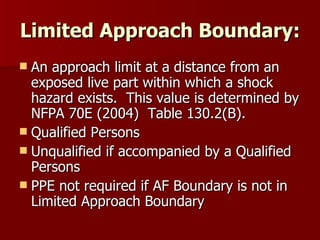
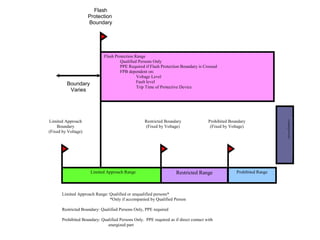
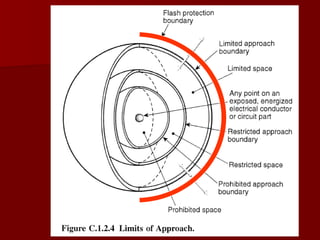
Limited Approach Boundary:   An approach limit at a distance from an exposed live part within which a shock hazard exists.  This value is determined by NFPA 70E (2004)  Table 130.2(B). Qualified Persons Unqualified if accompanied by a Qualified Persons PPE not required if AF Boundary is not in Limited Approach Boundary
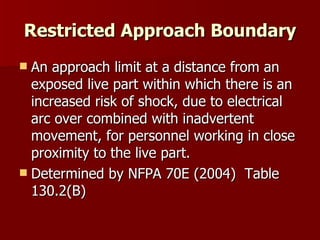
Restricted Approach Boundary An approach limit at a distance from an exposed live part within which there is an increased risk of shock, due to electrical arc over combined with inadvertent movement, for personnel working in close proximity to the live part.  Determined by NFPA 70E (2004)  Table 130.2(B)
Restricted Approach Boundary Qualified Persons Only Must wear PPE
Prohibited Approach Boundary An approach limit at a distance from an exposed live part within which work is considered the same as making contact with the live part.  Determined by NFPA 70E (2004)  Table 130.2(B). Qualified Persons Only PPE Required as if in direct contact
 
 
Arc Flash Label Installation Always clean the surface with detergent to remove all grease and dirt.  Wipe surface dry before applying the label. Some locations will have a Line Side Label.  They should be installed at locations where maintenance staff could be exposed to energized parts on the line side of a fuse or circuit breaker.  Examples of this are Main Breakers in Switchboards and Switchgear.
Arc Flash Label Installation Transformer Labels are for small distribution transformers  (480/208 V) where both the 480 and 208 Volts terminals are exposed. Locations where the label will be exposed to direct sun light should be brought to the attention of PowerStudies.com.  We will provide labels with a special UV protective covering to protect the label from fading.
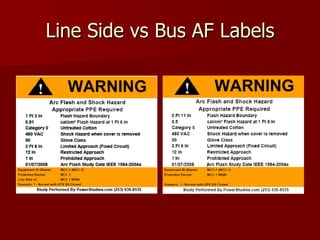
Line Side vs Bus AF Labels
Need more Information www.powerstudies.com Articles Links Specifications for Power System Studies Short Circuit Protective Device Coordination Arc Flash Hazard Phone: 253-639-8535 Email: fuhr@powerstudies.com
Your Report
Thank you for your time! Questions?????

Arc Flash Calculations What Does It All Mean

  • 1.
    Arc Flash HazardCalculations – What does it all mean? Robert E. Fuhr, P.E. PowerStudies.com
  • 2.
    Why are ArcFlash Hazard Studies Needed? To Increase Electrical Safety at your facility! Required by National Electric Code (NEC) and OSHA To Protect You!
  • 3.
  • 4.
  • 5.
    OSHA Requirements Standard29 CFR 1910 Subpart S, 1910 to 1910.336 Must identify all hazards above 50 Volts Must put safeguards in place for these hazards Must train employees on safe work practices OSHA has officially adopted NFPA 70E
  • 6.
    Employers must provideworkers with appropriate PPE as per the OSHA 29 1910.132 (h)(1) PPE payment requirement, i.e., (PPE) used to comply with this part, shall be provided by the employer at no cost to employees. Paragraph (h) became effective February 13, 2008, and employers must implement the PPE payment requirements no later than May 15, 2008
  • 7.
    Key References inNEC ® -2008 110.16 Flash Protection. Switchboards, panel boards, industrial control panels, and motor control centers in other than dwelling occupancies, that are likely to require examination, adjustment, servicing, or maintenance while energized , shall be field marked to warn qualified persons of potential electric arc flash hazards.
  • 8.
    NEC 110.16 (continued) The marking shall be located so as to be clearly visible to qualified persons before examination, adjustment, servicing, or maintenance of the equipment.
  • 9.
    Key References inNEC ® -2005 FPN No. 1 : NFPA 70E-2004, Standard For Electrical Safety in the Workplace, provides assistance in determining severity of potential exposure, planning safe work practices and selecting personal protective equipment.
  • 10.
    NFPA 70E -FlashHazard Analysis 130.3 – A flash hazard analysis shall be done in order to protect personnel from the possibility of being injured by an arc flash. The analysis shall determine: Flash Protection Boundary Personal protective equipment Calculate using Formulas in 130.3.A and Table 130.7(C)(9)(a) * in NFPA 70E * - Use with extreme caution!!! Equations in IEEE 1584
  • 11.
    Industry standards andregulations: OSHA 29 CFR 1910 Subpart S NFPA 70 - The National Electrical Code (2008 Edition) NFPA 70E - Standard for Electrical Safety in the Workplace (2004 Edition)
  • 12.
    Arc Flash HazardAnalysis Key Steps Use NFPA 70E * Tables, IEEE 1584, or Lee Equations to Determine Incident energy levels Arc Flash hazard distance * Use with extreme caution!
  • 13.
    Arc Flash HazardAnalysis Key Steps Use Calculated Incident Energy NFPA 70E Table 130.7(C)(11) to determine Hazard/Risk Category Required PPE
  • 14.
  • 15.
    NFPA 70E Table130.7(C)(11)
  • 16.
    Short Circuit FaultStudy Coordination (PDC) Study Arc Flash Study Device Operating Time Arcing Fault Current 3 Phase Bolted Fault Current Arc Flash Label Energy Level Boundaries Required PPE Obtain Equipment Nameplate Data & Settings
  • 17.
    Arc Flash EnergyCalculation Use 85% Ia Determine Upstream Protective Device Clearing Times (PDC Study) Repeat process for 100% Ia Use largest energy calculation
  • 18.
    Arc Flash HazardAnalysis Key Steps Determine: Bolted Fault Currents (Short Circuit Study) Arcing Fault (AF) Current Upstream Protective Device Clearing Times (PDC Study) using AF
  • 19.
    Arc Flash HazardAnalysis Key Steps Calculate Arc Flash Energy Use NFPA 70E Tables to determine: Glove Rating Class Limited Approach Boundary Prohibited Approach Boundary Restricted Approach Boundary Required PPE
  • 20.
    Arc Flash HazardAnalysis Key Steps Arc Flash Warning Labels showing the details .
  • 21.
    How a ShortCircuit Study is Performed Obtain distribution system nameplate data for: Transformers Motors Circuit breakers, fuses, relays Switchgear Motor Control Centers Conductor sizes and lengths
  • 22.
    How a ShortCircuit Study is Performed Enter data into the computer program. Simulate short circuit at each location and calculate the fault current. Compare calculated fault current to equipment short circuit rating.
  • 23.
    What is ProtectiveDevice Coordination (PDC) Study? Determines: fuse sizes Settings for relays and circuit breakers Device operating time The study has 2 conflicting goals
  • 24.
    Goal #1 -Maximum Selective Coordination Between Equipment Correct fuse sizes and settings will allow the device closest to a fault to trip . If the first device fails to operate, then the next upstream device will trip . Longer device trip delays = increased device coordination = greater incident energy
  • 25.
  • 26.
    Goal #2 -Maximum Equipment Protection and Reduction in Arc Flash Energy Correct fuse sizes and device settings will quickly interrupt the fault current for a short circuit downstream. Shorter device delays = decreased equipment damage = less Incident Energy
  • 27.
    Maximum Equipment Protection(No Selective Coordination) 1 1 1
  • 28.
    Must balance these two conflicting goals based upon the type of facility.
  • 29.
    PDC Vocabulary TimeCurrent Curve (TCC) Log-log graph of time versus current Every breaker, fuse, and relay has a time current characteristic curve.
  • 30.
    PDC Vocabulary Selective Device Coordination The devices plotted on the time current curves are coordinated for all levels of fault current and time.
  • 31.
  • 32.
    Fuse TCC 3-6Sec 5 kA @15 kA This Fuse is Current Limiting – Clearing time is 0.004 seconds
  • 33.
  • 34.
    Thermal Magnetic TripUnit Thermal Unit is Fixed Instant-aneous Fixed Adjustable
  • 35.
    Thermal Magnetic Breaker20 kA 0.01-0.025 Sec 4 kA 20-50 Sec
  • 36.
  • 37.
  • 38.
    Solid State TripUnit SQ D NW 40H 4000 Amp Micrologic Current Sensors Rating Plugs Current Setting
  • 39.
    Solid State TripUnit Varies for each Trip Unit! Some Functions are Not Adjustable! Long Time Pickup (LTPU) Long Time Delay (LTD) Short Time Pickup (STPU) Short Time Delay (STD) Instantaneous (I) Short Time Delay I2T-IN (I2T)
  • 40.
    Solid State TripSQ D NW 40H 4000 Amp Micrologic 100 kA 0.01-0.06 Sec 6 kA 0.08-0.12 Sec 30 kA 170-210 Sec
  • 41.
    Time Current Curves An example of a TCC with Coordinated Devices Current in Amperes X 100
  • 42.
    Arc Flash EnergyCalculations Incident Energy Levels are dependent on: Level of arcing fault current Upstream device clearing time . Multiple Sources
  • 43.
    Typical Assumptions foran Analysis Trip time is determined by the upstream protective device settings . Worker is stationary . The maximum time that a worker will be exposed to the arc flash is 2.0 seconds . (Depends upon location!!!)
  • 44.
  • 45.
  • 46.
  • 47.
    Arc Flash WarningLabels What does it mean?
  • 48.
    Limited Approach Boundary: An approach limit at a distance from an exposed live part within which a shock hazard exists. This value is determined by NFPA 70E (2004) Table 130.2(B). Qualified Persons Unqualified if accompanied by a Qualified Persons PPE not required if AF Boundary is not in Limited Approach Boundary
  • 49.
    Restricted Approach BoundaryAn approach limit at a distance from an exposed live part within which there is an increased risk of shock, due to electrical arc over combined with inadvertent movement, for personnel working in close proximity to the live part. Determined by NFPA 70E (2004) Table 130.2(B)
  • 50.
    Restricted Approach BoundaryQualified Persons Only Must wear PPE
  • 51.
    Prohibited Approach BoundaryAn approach limit at a distance from an exposed live part within which work is considered the same as making contact with the live part. Determined by NFPA 70E (2004) Table 130.2(B). Qualified Persons Only PPE Required as if in direct contact
  • 52.
  • 53.
  • 54.
    Arc Flash LabelInstallation Always clean the surface with detergent to remove all grease and dirt. Wipe surface dry before applying the label. Some locations will have a Line Side Label. They should be installed at locations where maintenance staff could be exposed to energized parts on the line side of a fuse or circuit breaker. Examples of this are Main Breakers in Switchboards and Switchgear.
  • 55.
    Arc Flash LabelInstallation Transformer Labels are for small distribution transformers (480/208 V) where both the 480 and 208 Volts terminals are exposed. Locations where the label will be exposed to direct sun light should be brought to the attention of PowerStudies.com. We will provide labels with a special UV protective covering to protect the label from fading.
  • 56.
    Line Side vsBus AF Labels
  • 57.
    Need more Informationwww.powerstudies.com Articles Links Specifications for Power System Studies Short Circuit Protective Device Coordination Arc Flash Hazard Phone: 253-639-8535 Email: fuhr@powerstudies.com
  • 58.
  • 59.
    Thank you foryour time! Questions?????