Midwest Manufacturing
Electrical Safety Policy/ Procedure
1. Purpose
The purpose of this program is to establish minimum standards to prevent hazardous
electrical exposure to personnel and ensure compliance with regulatory requirements applicable
to electrical systems. Working on equipment in a de-energized state is required unless de-
energizing equipment introduces an increased hazard or is infeasible. This program is designed
to ensure Team Members are protected against electrical shock, burns and other potential
electrical safety hazards as well as comply with regulatory requirements stated under the OSHA
Electrical Safety Standard, Title 29 Code of Federal Regulations 1910 Subpart S- Electrical and
the current NFPA 70E Electrical Standards.
2. Scope
This program addresses electrical safety requirements that are necessary for the practical
safeguarding of Midwest Manufacturing Team Members during activities listed, but are not
limited to, installation, operation, maintenance, and demolition of electrical conductors and
electrical equipment. This program applies to all Midwest Manufacturing work operations where
Team Members are exposed to electrical conductors that have not been de-energized. It will be
the responsibility of the Management departments to ensure the continuous improvement of this
program as standards change and/or machinery is added or removed. This program also applies
to any outside contractor working in a Midwest Manufacturing facility.
Page- 2
3. Table of Contents (WHEN READY)
Page- 3
4. Definitions (NFPA 70E, write down at completion of policy draft)
 Blind Reaching
Page- 4
5. Responsibilities
 It is everyone’s responsibility to report any problems concerning electrical components
on equipment, tools, and in facilities. Problems must be fixed correctly and immediately.
 The following departments will be presented with a list of responsibilities to ensure the
electrical safety policy is utilized to its fullest capability in the safe keeping of Team
Members and machinery in Midwest Manufacturing facilities:
o The Safety Department shall be responsible for the following: (Add more if
necessary)
 Ensure that all policies are up to date with current State/Federal
Standards
 Cooperate with all applicable departments to review and edit this policy
o Plant Management shall be responsible for the following: (Add more if
necessary)
 Ensure that all equipment is maintained at intervals that are sufficient to
ensure the safe functioning of the machinery
 Cooperate and coordinate with outside contractors in conducting arc flash
risk assessments
 Record keeping of arch flash studies documentation
 Providing adequate electrical safety training for all Team Members
 Maintain up to date arc flash labels on all electrical equipment
o The Midwest Manufacturing Engineering Department shall be responsible
for the following: (Add more if necessary)
 Cooperate with all applicable departments to update and edit this policy
 Establish and utilize the most reasonable and effective methods and
equipment when installing electrical components/ equipment
 Keeping CAD drawings up to date
o Plant Maintenance TMs and Operators shall be responsible for the
following: (Add more if necessary)
 Complete and pass all appropriate training and tests related to electrical
safety
 Use all tools, equipment, PPE and procedures designed to prevent or
minimize injuries as required
 Inspect all tools, equipment, and PPE required to complete the task prior
to operating
Page- 5
 Communicate to management all problems or sub-standard equipment as
soon as possible
6. General Electrical Safety
 Electric equipment shall be free from recognized hazards that are likely to cause death or
serious harm to employees.
 Any work on electrical panels having an arc rating that is ≥ 8 cal/cm², but is < 25 cal/cm²
shall be contracted to a qualified electrician.
 Conductive articles of jewelry and clothing (such as watchbands, bracelets, smart
watches, rings, key chains, necklaces, metalized aprons, cloth conductive thread, metal
headgear, or metal frame glasses) shall not be worn within the restricted approach
boundary or where they present an electrical contact hazard with exposed energized
electrical conductors or circuit parts.
 Sufficient access, working space, and all illumination shall be provided and maintained
around all electric equipment to permit ready and safe operation and maintenance of such
equipment.
 If and when a defect/evidence of damage that can result in an electrical hazard is
identified, the defective/damaged piece of equipment shall be removed from service until
repaired by qualified persons or replaced.
 Only Qualified Team Members shall open/ close electrical panels and/or box doors or
touch any circuit breakers.
 Maintain a 36 inch clearance around all electrical panels and boxes.
 Safety of equipment shall be determined using the following considerations:
o Suitability for installation and use in conformity with the provisions of the
subpart:
o Suitability of equipment for an identified purpose may be evidenced by
listing or labeling for that identified purpose
o Mechanical strength and durability, including, for parts to enclose and protect
other equipment, the adequacy of the protection thus provided
o Wire-bending and connection space
o Electrical insulation
o Heating effects under all conditions of use
o Arcing effects
o Classification by type, size, voltage, current capacity, and specific use
o Other factors that contribute to the practical safeguarding of person using or likely
to come in contact with the equipment
Page- 6
7. Program Principles
 Evaluation of Operations
 An electrical safety policy review shall be performed at intervals not to exceed 3
years to ensure compliance with all relevant OSHA and NFPA 70E standards by
the Safety Coordinator.
 Single Line Diagrams
 A single-line diagram, where provided for the electrical system, shall be
maintained in a legible condition and shall be kept current.
 Single-Line Diagrams shall:
 Show how the main components of the electrical system are connected.
 Including redundant equipment and available spares.
 Show correct power distribution path from the incoming power source to
each downstream load.
 Including the ratings and sizes of each piece of electrical
equipment, their circuit conductors, and their protective devices.
 Arc Flash Risk Assessment
 A risk assessment procedure will be conducted by a contracted qualified
electrician to address employee exposure to electrical hazards.
 The procedure will:
o Identify hazards
o Identify Midwest Manufacturing Operators and affected Team Members
o Analyze manufacturing process
o Assess risks
o Implement risk control/reduction method
 Arc Flash Label
 NFPA 70E- 2015 requires that all the following equipment be labeled:
 Switchboards
 Switchgears
 Panel Boards
 Industrial Control Panels
 Meter Socket Enclosures
 Motor Control Panels
 The arc flash labels shall include:
 The nominal system voltage
 Arc flash boundary
Page- 7
 At least one of the following:
o Available incident energy and the corresponding working distance
o The arc flash PPE category in Table 130.7 (C)(15)(A)(b) or Table
130.7 (C)(15)(B) for the equipment, but not both, minimum arc rating
of clothing
o Site-specific level of PPE
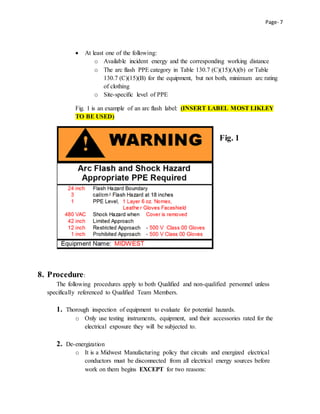
Fig. 1 is an example of an arc flash label: (INSERT LABEL MOST LIKLEY
TO BE USED)
8. Procedure:
The following procedures apply to both Qualified and non-qualified personnel unless
specifically referenced to Qualified Team Members.
1. Thorough inspection of equipment to evaluate for potential hazards.
o Only use testing instruments, equipment, and their accessories rated for the
electrical exposure they will be subjected to.
2. De-energization
o It is a Midwest Manufacturing policy that circuits and energized electrical
conductors must be disconnected from all electrical energy sources before
work on them begins EXCEPT for two reasons:
Fig. 1
Page- 8
 De-energizing introduces additional or increased hazards, such as,
cutting ventilation to a hazardous location.
 Doing work is infeasible due to equipment design or operational
limitations such as: voltage testing for diagnosis and start up testing.
o De-energization of machinery shall follow standard shutdown procedures
specific to that machine.
o Lock Out Tag Out:
 Team Members will follow Midwest Manufacturing’s LOTO program
when de-energizing and locking out any piece of machinery
 Use proper lockout devices to prevent accidental re-energizing of the
equipment.
 Use proper tags to properly indicate who is responsible for the lockout
and when the tag out was applied.
 Lock Out Tag Out can only be performed by Qualified Team Members
after they have been trained under the rules stated in NFPA 70E-2015
3. Energized Parts
o Every effort shall be made to ensure live parts are de-energized before
beginning work.
o If de-energization cannot be performed, other safety-related work practices
shall be used to protect Team Members who may be exposed to the electrical
hazards involved.
 Examples:
 Signs
 Non-conductive barricades
 Wearing PPE appropriate for electrical category
4. Energized Work Permits
o When energized work is permitted, an energized work permit shall be required
under the following conditions:
 When work is performed within the restricted approach boundary.
 When the employee interacts with the equipment when conductors or
circuit parts are not exposed but an increased likelihood of injury from
an exposure to an arc flash hazard exists.
o The energized electrical work permit shall include, but not limited to, the
following items:
Page- 9
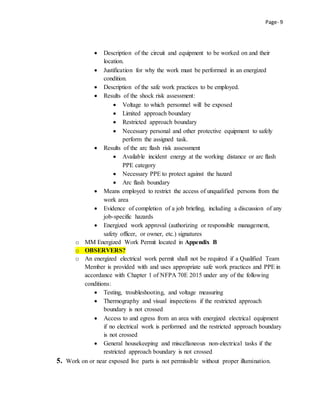
 Description of the circuit and equipment to be worked on and their
location.
 Justification for why the work must be performed in an energized
condition.
 Description of the safe work practices to be employed.
 Results of the shock risk assessment:
 Voltage to which personnel will be exposed
 Limited approach boundary
 Restricted approach boundary
 Necessary personal and other protective equipment to safely
perform the assigned task.
 Results of the arc flash risk assessment
 Available incident energy at the working distance or arc flash
PPE category
 Necessary PPE to protect against the hazard
 Arc flash boundary
 Means employed to restrict the access of unqualified persons from the
work area
 Evidence of completion of a job briefing, including a discussion of any
job-specific hazards
 Energized work approval (authorizing or responsible management,
safety officer, or owner, etc.) signatures
o MM Energized Work Permit located in Appendix B
o OBSERVERS?
o An energized electrical work permit shall not be required if a Qualified Team
Member is provided with and uses appropriate safe work practices and PPE in
accordance with Chapter 1 of NFPA 70E 2015 under any of the following
conditions:
 Testing, troubleshooting, and voltage measuring
 Thermography and visual inspections if the restricted approach
boundary is not crossed
 Access to and egress from an area with energized electrical equipment
if no electrical work is performed and the restricted approach boundary
is not crossed
 General housekeeping and miscellaneous non-electrical tasks if the
restricted approach boundary is not crossed
5. Work on or near exposed live parts is not permissible without proper illumination.
Page- 10
6. Non-qualified Team Members are restricted from access to exposed energized parts
of voltages greater than 50 volts.
7. Blind reaching is not allowed in any electrical panels/equipment.
8. All troubleshooting and/or testing above 50 volts require voltage insulating gloves
and other appropriate PPE.
o The Arc Flash Label indicates what proper category of PPE should be worn
when performing troubleshooting and/or testing. See Appendix A.
9. Precautions for Equipment Commonly Found in MM Facilities
9.1 Adapters
 Midwest Manufacturing prohibits the use of adapters (sometimes referred to as
a “Cheater Plug/ AC Ground Lifter”) to plug three-prong electrical plugs into
two-prong receptacles. The defeat of a grounding circuit can create a hazard.
9.2 Extension Cords
9.2.1 Inspection
 Prior to use, check for cracks, exposed wiring, and missing or
damaged prongs.
 Check plug and body of extension cord while it is in use. A hot
extension cord is an indication that it is overloaded and should be
replaced with a cord having larger conductors.
 Discard damaged extension cords immediately.
9.2.2 Use
 Make sure plugs are fully inserted into outlets in use.
 Make sure extension cords (any part of) are clean from combustible
material/debris such as paper, sawdust, oils, etc.
 When disconnecting cords, pull the plug rather than the cord itself.
 Never repair damaged extension cords.
 Only handle extension cords with dry hands.
 Never raise or lower equipment using an extension cord.
Page- 11
9.3 Portable Heaters
 Due to the nature of some tasks and position during winter weather conditions,
portable heaters are a common appliance in MM facilities. The use of manager-
approved portable heaters is permissible under the following conditions:
9.3.1 Prior to use, fully inspect the heater of any exterior physical damage.
9.3.2 Never leave the heater operating while unattended.
9.3.3 Keep combustible materials at least 3 feet from the front, sides, and rear
of the heater at all times.
9.3.4 Place heater on stable and even surface located where it cannot be
accidentally knocked over/tipped.
10. Training
 Non-Qualified
o INSERT TRAINING HERE
 Qualified
o INSERT TRAINING HERE
10.1 Retraining
 The retraining of Qualified Team Members will only occur when:
o INSTERT RETRAING PROCEDURES HERE
11. Personal Protective Equipment (PPE) (NEED TO FIND WHO
PROVIDES AND HOW TO ACQUIRE)
 Team Members working in areas where electrical hazards are present shall be
provided with, and shall use, protective equipment that is designed and
constructed for the specific body part to be protected and for the work to be
performed.
 Every plant/work area has been provided with at least one electrical tool bag
containing: (NEED TO CHECK IF LIST OF TOOLS ARE AVAILABLE)
o insulated tools
o lockout supplies
o voltage tester
o rubber insulated gloves with leather protectors
 Refer to MM Policy #349- Electrical Safety Gloves Testing
 Flame resistant clothing is available in every facility and must be worn when
working on electrical projects.
Page- 12
 The supplier of the clothing will launder and maintain all the flame resistant
clothing.
 It is the Team Member’s responsibility to inspect any PPE prior to using. They
shall look for holes, tears, punctures etc. that may compromise their safety.
 PPE shall conform to the standards listed in Table 130.7 (C)(14)
 Arc Flash PPE categories can be seen in Appendix A.
11.1 Other Protective Equipment (NEED TO CHECK IF
EQUIPMENT IS AVAIABLE, CHECK WITH ME)
A. Requirements for Insulated tools:
 Insulated tools shall be rated for the voltages on which they are used.
 Insulated tools shall be designed and constructed for the environment to which
they are exposed to which they are exposed and the manner in which they are
used.
 Insulated tools and equipment shall be inspected prior to each use.
o The inspection shall look for damage prior to the insulation or damage
that can limit the tool from performing its intended function or could
increase the potential for an incident (e.g., damaged tip on a screwdriver)
B. Fuse or Fuseholder Handling Equipment.
 Fuse or fuseholder handling equipment, insulated for the circuit voltage, shall be
used to remove or install a fuse if the fuse terminals are energized.
C. Ropes and Handlines.
 Ropes and handlines used within the limited approach boundary of exposed
energized electrical conductors or circuit parts operating at 50 volts or more, or
used where an electrical hazard exists, shall be nonconductive.
D. Fiberglass-Reinforced Plastic Rods.
 Fiberglass-reinforced plastic rod and tube used for live-line tools shall meet the
requirements of applicable portions of electrical codes and standards dealing with
electrical insulation requirements.
Page- 13
E. Portable ladders.
 Portable ladders shall have nonconductive side rails if they are used where an
employee or ladder could contact exposed energized electrical conductors or
circuit parts operating at 50 volts or more or where an electrical hazard exists.
Nonconductive ladders shall meet the requirements of ANSI standards for ladders
listed in ANSI/ASC A14.1, A14.3, A14.4, A14.5.
F. Protective Shields
 Protective shields, protective barriers, or insulating materials shall be used to
protect each employee from shock, burns, or other electrically related injuries
while an employee is working within the limited approach boundary of energized
conductors or circuit parts that might be accidently contacted or where dangerous
electric heating or arcing might occur.
 When normally enclosed energized conductors or circuit parts are exposed for
maintenance or repair, they shall be guarded to protect unqualified persons from
contact with the energized conductors or circuit parts.
G. Rubber insulating Equipment
 Rubber insulating equipment used for protection from accidental contact with
energized conductors or circuit parts shall meet the requirements of the ASTM
standards F2320.
H. Voltage-Rated Plastic Guard Equipment
 Plastic guard equipment for protection of employees from accidental contact with
energized conductors or circuit parts, or for protection of employees or energized
equipment or material from contact with ground, shall meet requirements of
ASTM standards listed in Table 130.7(F).
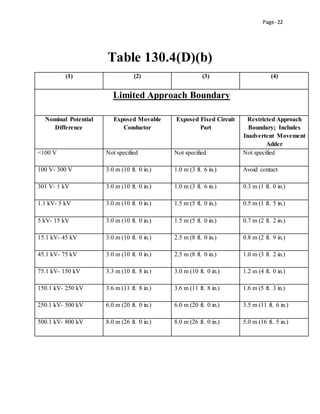
I. Physical or Mechanical Barriers.
 Physical or mechanical (field-fabricated) barriers shall be installed no closer than
the restricted approach boundary distance given in Table 130.4(D)(a) and Table
130.4(D)(b).
 While the barriers are being installed, the restricted approach boundary distance
specified in Table 130.4(D)(a) and Table 130.4(D)(b) shall be maintained, or the
energized conductors or circuit parts shall be placed in an electrically safe work
condition. Table 130.4(D)(a) is ALTERNATING-CURRENT. Table
130.4(D)(b) is DIRECT-CURRENT.
Page- 14
11.2 Summary Describing PPE for Electrical Hazards
Incident energy exposures < 1.2 cal/cm²
 Clothing: non-melting or untreated natural fiber long-sleeve shirt and long pants
or coverall.
 Gloves: heavy-duty leather
 Hard Hat: class G or E
 Face shield: covers the face, neck, chin (as needed)
 Safety glasses or googles
 Hearing Protection
 Footwear: Heavy-duty leather (as needed)
Incident energy exposures ≥1.2 cal/cm²
 Clothing: arc-rated clothing system with an arc rating appropriate to the
anticipated incident energy exposure
o Clothing underlayers (when used): arc-rated or non-melting untreated
natural fiber
 Gloves :
o Exposures ≥1.2 cal/cm² and ≤ 8 cal/cm²: Heavy-duty leather gloves
o Exposures > 8 cal/cm²:
 Rubber insulating gloves with their leather protectors; or arc-rated
gloves
 Hard Hat: class G or E
 Face Shield:
o Exposures ≥ 1.2 cal/cm² and < 12 cal/cm²:
 Arc-rated face shield that covers the face, neck, and chin and arc-
rated balaclava or an arc flash suit hood
 Safety glasses or googles
 Hearing protection
 Footwear:
o Exposures ≤ 4 cal/cm²
 Heavy-duty leather footwear (as needed)
o Exposures > 4 cal/cm²
 Heavy-duty leather footwear
Page- 15
Appendix A
Page- 16
INSERT ENERGIZED WORK PERMIT
HERE
Appendix B
Page- 17
Table 130.7 (C)(15) (A)(b)
Page- 18
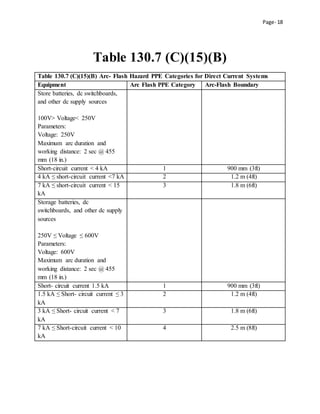
Table 130.7 (C)(15)(B)
Table 130.7 (C)(15)(B) Arc- Flash Hazard PPE Categories for Direct Current Systems
Equipment Arc Flash PPE Category Arc-Flash Boundary
Store batteries, dc switchboards,
and other dc supply sources
100V> Voltage< 250V
Parameters:
Voltage: 250V
Maximum arc duration and
working distance: 2 sec @ 455
mm (18 in.)
Short-circuit current < 4 kA 1 900 mm (3ft)
4 kA ≤ short-circuit current <7 kA 2 1.2 m (4ft)
7 kA ≤ short-circuit current < 15
kA
3 1.8 m (6ft)
Storage batteries, dc
switchboards, and other dc supply
sources
250V ≤ Voltage ≤ 600V
Parameters:
Voltage: 600V
Maximum arc duration and
working distance: 2 sec @ 455
mm (18 in.)
Short- circuit current 1.5 kA 1 900 mm (3ft)
1.5 kA ≤ Short- circuit current ≤ 3
kA
2 1.2 m (4ft)
3 kA ≤ Short- circuit current < 7
kA
3 1.8 m (6ft)
7 kA ≤ Short-circuit current < 10
kA
4 2.5 m (8ft)
Page- 19
Table 130.7 (C)(14)
Subject Document Title Document Number
Apparel-Arc Rated
Standard Performance Specificationfir
Flame Resistantand Arc Rated Textile
Materials foruse by electricalworkers
exposed to momentary electric arc and
related thermal hazards
ASTM F1506
Standard Guide forIndustrial
Laundering ofFlame, Thermal and
Arc Resistant Clothing
ASTM F1449
Standard Guide forHome Laundering
Care and Maintenance ofFlame,
Thermal Arc Resistant Clothing
ASTM F2757
Aprons-Insulating Standard SpecificationforElectrically
Insulating Aprons ASTM F2677
Eye and Face Protection-General Practice for Occupationaland
EducationalEye and Face Protection ANSI Z87.1
Face-Arc Rated Standard TestMethod forDetermining
the Arc Rating and Standard
Specification forEye or Face
Protective Products
ASTM F2178
Fall Protection Standard SpecificationforPersonal
Climbing Equipment
ASTM F887
Footwear-Dielectric Specifications Standard SpecificationforDielectric
Footwear
ASTM F1117
Footwear-Dielectric Test Method Standard TestMethod forDetermining
Dielectric Strength ofDielectric
Footwear
ASTM F1116
Footwear-StandardPerformance
Specification
Standard Specificationfor
Performance Requirements for
Protective (Safety)Toe Cap Footwear
ASTM F2413
Footwear-StandardTestMethod Standard TestMethods forFoot
Protections
ASTM F2412
Gloves-LeatherProtectors Standard SpecificationforLeather
Protectors for RubberInsulating
Gloves and Mittens
ASTM F696
Gloves-RubberInsulating Standard SpecificationforRubber
Insulating Gloves
ASTM D120
Gloves and Sleeves – In Service Care Standard SpecificationforIn-Service
Care of Insulating Gloves andSleeves
ASTM F496
Head Protection-Hard Hats Requirements forProtective Headwear
for IndustrialWorkers
ANSI Z89.1
Rainwear-Arc Rated Standard SpecificationforArc and
Flame ResistantRainwear
ASTM F1891
RubberProtective Products-Visual
Inspection
Standard Guide forVisual Inspection
of Electrical Protective Rubber
Products
ASTM F1236
Sleeves-Insulating Standard SpecificationforRubber
Insulating Sleeves
ASTM D1051
Page- 20
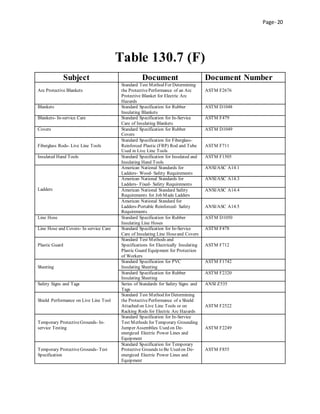
Table 130.7 (F)
Subject Document Document Number
Arc Protective Blankets
Standard Test Method For Determining
the ProtectivePerformance of an Arc
Protective Blanket for Electric Arc
Hazards
ASTM F2676
Blankets Standard Specification for Rubber
Insulating Blankets
ASTM D1048
Blankets- In-service Care Standard Specification for In-Service
Care of Insulating Blankets
ASTM F479
Covers Standard Specification for Rubber
Covers
ASTM D1049
Fiberglass Rods- Live Line Tools
Standard Specification for Fiberglass-
Reinforced Plastic (FRP) Rod and Tube
Used in Live Line Tools
ASTM F711
Insulated Hand Tools Standard Specification for Insulated and
Insulating Hand Tools
ASTM F1505
Ladders
American National Standards for
Ladders- Wood- Safety Requirements
ANSI/ASC A14.1
American National Standards for
Ladders- Fixed- Safety Requirements
ANSI/ASC A14.3
American National Standard Safety
Requirements for Job Made Ladders
ANSI/ASC A14.4
American National Standard for
Ladders-Portable Reinforced- Safety
Requirements
ANSI/ASC A14.5
Line Hose Standard Specification for Rubber
Insulating Line Hoses
ASTM D1050
Line Hose and Covers- In service Care Standard Specification for In-Service
Care of Insulating Line Hoseand Covers
ASTM F478
Plastic Guard
Standard Test Methods and
Specifications for Electrically Insulating
Plastic Guard Equipment for Protection
of Workers
ASTM F712
Sheeting
Standard Specification for PVC
Insulating Sheeting
ASTM F1742
Standard Specification for Rubber
Insulating Sheeting
ASTM F2320
Safety Signs and Tags Series of Standards for Safety Signs and
Tags
ANSI Z535
Shield Performance on Live Line Tool
Standard Test Method for Determining
the ProtectivePerformance of a Shield
Attached on Live Line Tools or on
Racking Rods for Electric Arc Hazards
ASTM F2522
Temporary ProtectiveGrounds- In-
service Testing
Standard Specification for In-Service
Test Methods for Temporary Grounding
Jumper Assemblies Used on De-
energized Electric Power Lines and
Equipment
ASTM F2249
Temporary ProtectiveGrounds- Test
Specification
Standard Specification for Temporary
Protective Grounds to Be Used on De-
energized Electric Power Lines and
Equipment
ASTM F855
Page- 21
Table 130.4(D)(a)
Page- 22
Table 130.4(D)(b)
(1) (2) (3) (4)
Limited Approach Boundary
Nominal Potential
Difference
Exposed Movable
Conductor
Exposed Fixed Circuit
Part
Restricted Approach
Boundary; Includes
Inadvertent Movement
Adder
<100 V Not specified Not specified Not specified
100 V- 300 V 3.0 m (10 ft. 0 in.) 1.0 m (3 ft. 6 in.) Avoid contact
301 V- 1 kV 3.0 m (10 ft. 0 in.) 1.0 m (3 ft. 6 in.) 0.3 m (1 ft. 0 in.)
1.1 kV- 5 kV 3.0 m (10 ft. 0 in.) 1.5 m (5 ft. 0 in.) 0.5 m (1 ft. 5 in.)
5 kV- 15 kV 3.0 m (10 ft. 0 in.) 1.5 m (5 ft. 0 in.) 0.7 m (2 ft. 2 in.)
15.1 kV- 45 kV 3.0 m (10 ft. 0 in.) 2.5 m (8 ft. 0 in.) 0.8 m (2 ft. 9 in.)
45.1 kV- 75 kV 3.0 m (10 ft. 0 in.) 2.5 m (8 ft. 0 in.) 1.0 m (3 ft. 2 in.)
75.1 kV- 150 kV 3.3 m (10 ft. 8 in.) 3.0 m (10 ft. 0 in.) 1.2 m (4 ft. 0 in.)
150.1 kV- 250 kV 3.6 m (11 ft. 8 in.) 3.6 m (11 ft. 8 in.) 1.6 m (5 ft. 3 in.)
250.1 kV- 500 kV 6.0 m (20 ft. 0 in.) 6.0 m (20 ft. 0 in.) 3.5 m (11 ft. 6 in.)
500.1 kV- 800 kV 8.0 m (26 ft. 0 in.) 8.0 m (26 ft. 0 in.) 5.0 m (16 ft. 5 in.)
Page- 23
References:
 OSHA 29 CFR 1910.300- 1910.308
 OSHA 29 CFR 1910.331- 1910.335
 NFPA 70E
 MM Policy #349- Electrical Safety Gloves Testing

MM Electrical Safety Policy-Procedure draft 2

  • 1.
    Midwest Manufacturing Electrical SafetyPolicy/ Procedure 1. Purpose The purpose of this program is to establish minimum standards to prevent hazardous electrical exposure to personnel and ensure compliance with regulatory requirements applicable to electrical systems. Working on equipment in a de-energized state is required unless de- energizing equipment introduces an increased hazard or is infeasible. This program is designed to ensure Team Members are protected against electrical shock, burns and other potential electrical safety hazards as well as comply with regulatory requirements stated under the OSHA Electrical Safety Standard, Title 29 Code of Federal Regulations 1910 Subpart S- Electrical and the current NFPA 70E Electrical Standards. 2. Scope This program addresses electrical safety requirements that are necessary for the practical safeguarding of Midwest Manufacturing Team Members during activities listed, but are not limited to, installation, operation, maintenance, and demolition of electrical conductors and electrical equipment. This program applies to all Midwest Manufacturing work operations where Team Members are exposed to electrical conductors that have not been de-energized. It will be the responsibility of the Management departments to ensure the continuous improvement of this program as standards change and/or machinery is added or removed. This program also applies to any outside contractor working in a Midwest Manufacturing facility.
  • 2.
    Page- 2 3. Tableof Contents (WHEN READY)
  • 3.
    Page- 3 4. Definitions(NFPA 70E, write down at completion of policy draft)  Blind Reaching
  • 4.
    Page- 4 5. Responsibilities It is everyone’s responsibility to report any problems concerning electrical components on equipment, tools, and in facilities. Problems must be fixed correctly and immediately.  The following departments will be presented with a list of responsibilities to ensure the electrical safety policy is utilized to its fullest capability in the safe keeping of Team Members and machinery in Midwest Manufacturing facilities: o The Safety Department shall be responsible for the following: (Add more if necessary)  Ensure that all policies are up to date with current State/Federal Standards  Cooperate with all applicable departments to review and edit this policy o Plant Management shall be responsible for the following: (Add more if necessary)  Ensure that all equipment is maintained at intervals that are sufficient to ensure the safe functioning of the machinery  Cooperate and coordinate with outside contractors in conducting arc flash risk assessments  Record keeping of arch flash studies documentation  Providing adequate electrical safety training for all Team Members  Maintain up to date arc flash labels on all electrical equipment o The Midwest Manufacturing Engineering Department shall be responsible for the following: (Add more if necessary)  Cooperate with all applicable departments to update and edit this policy  Establish and utilize the most reasonable and effective methods and equipment when installing electrical components/ equipment  Keeping CAD drawings up to date o Plant Maintenance TMs and Operators shall be responsible for the following: (Add more if necessary)  Complete and pass all appropriate training and tests related to electrical safety  Use all tools, equipment, PPE and procedures designed to prevent or minimize injuries as required  Inspect all tools, equipment, and PPE required to complete the task prior to operating
  • 5.
    Page- 5  Communicateto management all problems or sub-standard equipment as soon as possible 6. General Electrical Safety  Electric equipment shall be free from recognized hazards that are likely to cause death or serious harm to employees.  Any work on electrical panels having an arc rating that is ≥ 8 cal/cm², but is < 25 cal/cm² shall be contracted to a qualified electrician.  Conductive articles of jewelry and clothing (such as watchbands, bracelets, smart watches, rings, key chains, necklaces, metalized aprons, cloth conductive thread, metal headgear, or metal frame glasses) shall not be worn within the restricted approach boundary or where they present an electrical contact hazard with exposed energized electrical conductors or circuit parts.  Sufficient access, working space, and all illumination shall be provided and maintained around all electric equipment to permit ready and safe operation and maintenance of such equipment.  If and when a defect/evidence of damage that can result in an electrical hazard is identified, the defective/damaged piece of equipment shall be removed from service until repaired by qualified persons or replaced.  Only Qualified Team Members shall open/ close electrical panels and/or box doors or touch any circuit breakers.  Maintain a 36 inch clearance around all electrical panels and boxes.  Safety of equipment shall be determined using the following considerations: o Suitability for installation and use in conformity with the provisions of the subpart: o Suitability of equipment for an identified purpose may be evidenced by listing or labeling for that identified purpose o Mechanical strength and durability, including, for parts to enclose and protect other equipment, the adequacy of the protection thus provided o Wire-bending and connection space o Electrical insulation o Heating effects under all conditions of use o Arcing effects o Classification by type, size, voltage, current capacity, and specific use o Other factors that contribute to the practical safeguarding of person using or likely to come in contact with the equipment
  • 6.
    Page- 6 7. ProgramPrinciples  Evaluation of Operations  An electrical safety policy review shall be performed at intervals not to exceed 3 years to ensure compliance with all relevant OSHA and NFPA 70E standards by the Safety Coordinator.  Single Line Diagrams  A single-line diagram, where provided for the electrical system, shall be maintained in a legible condition and shall be kept current.  Single-Line Diagrams shall:  Show how the main components of the electrical system are connected.  Including redundant equipment and available spares.  Show correct power distribution path from the incoming power source to each downstream load.  Including the ratings and sizes of each piece of electrical equipment, their circuit conductors, and their protective devices.  Arc Flash Risk Assessment  A risk assessment procedure will be conducted by a contracted qualified electrician to address employee exposure to electrical hazards.  The procedure will: o Identify hazards o Identify Midwest Manufacturing Operators and affected Team Members o Analyze manufacturing process o Assess risks o Implement risk control/reduction method  Arc Flash Label  NFPA 70E- 2015 requires that all the following equipment be labeled:  Switchboards  Switchgears  Panel Boards  Industrial Control Panels  Meter Socket Enclosures  Motor Control Panels  The arc flash labels shall include:  The nominal system voltage  Arc flash boundary
  • 7.
    Page- 7  Atleast one of the following: o Available incident energy and the corresponding working distance o The arc flash PPE category in Table 130.7 (C)(15)(A)(b) or Table 130.7 (C)(15)(B) for the equipment, but not both, minimum arc rating of clothing o Site-specific level of PPE Fig. 1 is an example of an arc flash label: (INSERT LABEL MOST LIKLEY TO BE USED) 8. Procedure: The following procedures apply to both Qualified and non-qualified personnel unless specifically referenced to Qualified Team Members. 1. Thorough inspection of equipment to evaluate for potential hazards. o Only use testing instruments, equipment, and their accessories rated for the electrical exposure they will be subjected to. 2. De-energization o It is a Midwest Manufacturing policy that circuits and energized electrical conductors must be disconnected from all electrical energy sources before work on them begins EXCEPT for two reasons: Fig. 1
  • 8.
    Page- 8  De-energizingintroduces additional or increased hazards, such as, cutting ventilation to a hazardous location.  Doing work is infeasible due to equipment design or operational limitations such as: voltage testing for diagnosis and start up testing. o De-energization of machinery shall follow standard shutdown procedures specific to that machine. o Lock Out Tag Out:  Team Members will follow Midwest Manufacturing’s LOTO program when de-energizing and locking out any piece of machinery  Use proper lockout devices to prevent accidental re-energizing of the equipment.  Use proper tags to properly indicate who is responsible for the lockout and when the tag out was applied.  Lock Out Tag Out can only be performed by Qualified Team Members after they have been trained under the rules stated in NFPA 70E-2015 3. Energized Parts o Every effort shall be made to ensure live parts are de-energized before beginning work. o If de-energization cannot be performed, other safety-related work practices shall be used to protect Team Members who may be exposed to the electrical hazards involved.  Examples:  Signs  Non-conductive barricades  Wearing PPE appropriate for electrical category 4. Energized Work Permits o When energized work is permitted, an energized work permit shall be required under the following conditions:  When work is performed within the restricted approach boundary.  When the employee interacts with the equipment when conductors or circuit parts are not exposed but an increased likelihood of injury from an exposure to an arc flash hazard exists. o The energized electrical work permit shall include, but not limited to, the following items:
  • 9.
    Page- 9  Descriptionof the circuit and equipment to be worked on and their location.  Justification for why the work must be performed in an energized condition.  Description of the safe work practices to be employed.  Results of the shock risk assessment:  Voltage to which personnel will be exposed  Limited approach boundary  Restricted approach boundary  Necessary personal and other protective equipment to safely perform the assigned task.  Results of the arc flash risk assessment  Available incident energy at the working distance or arc flash PPE category  Necessary PPE to protect against the hazard  Arc flash boundary  Means employed to restrict the access of unqualified persons from the work area  Evidence of completion of a job briefing, including a discussion of any job-specific hazards  Energized work approval (authorizing or responsible management, safety officer, or owner, etc.) signatures o MM Energized Work Permit located in Appendix B o OBSERVERS? o An energized electrical work permit shall not be required if a Qualified Team Member is provided with and uses appropriate safe work practices and PPE in accordance with Chapter 1 of NFPA 70E 2015 under any of the following conditions:  Testing, troubleshooting, and voltage measuring  Thermography and visual inspections if the restricted approach boundary is not crossed  Access to and egress from an area with energized electrical equipment if no electrical work is performed and the restricted approach boundary is not crossed  General housekeeping and miscellaneous non-electrical tasks if the restricted approach boundary is not crossed 5. Work on or near exposed live parts is not permissible without proper illumination.
  • 10.
    Page- 10 6. Non-qualifiedTeam Members are restricted from access to exposed energized parts of voltages greater than 50 volts. 7. Blind reaching is not allowed in any electrical panels/equipment. 8. All troubleshooting and/or testing above 50 volts require voltage insulating gloves and other appropriate PPE. o The Arc Flash Label indicates what proper category of PPE should be worn when performing troubleshooting and/or testing. See Appendix A. 9. Precautions for Equipment Commonly Found in MM Facilities 9.1 Adapters  Midwest Manufacturing prohibits the use of adapters (sometimes referred to as a “Cheater Plug/ AC Ground Lifter”) to plug three-prong electrical plugs into two-prong receptacles. The defeat of a grounding circuit can create a hazard. 9.2 Extension Cords 9.2.1 Inspection  Prior to use, check for cracks, exposed wiring, and missing or damaged prongs.  Check plug and body of extension cord while it is in use. A hot extension cord is an indication that it is overloaded and should be replaced with a cord having larger conductors.  Discard damaged extension cords immediately. 9.2.2 Use  Make sure plugs are fully inserted into outlets in use.  Make sure extension cords (any part of) are clean from combustible material/debris such as paper, sawdust, oils, etc.  When disconnecting cords, pull the plug rather than the cord itself.  Never repair damaged extension cords.  Only handle extension cords with dry hands.  Never raise or lower equipment using an extension cord.
  • 11.
    Page- 11 9.3 PortableHeaters  Due to the nature of some tasks and position during winter weather conditions, portable heaters are a common appliance in MM facilities. The use of manager- approved portable heaters is permissible under the following conditions: 9.3.1 Prior to use, fully inspect the heater of any exterior physical damage. 9.3.2 Never leave the heater operating while unattended. 9.3.3 Keep combustible materials at least 3 feet from the front, sides, and rear of the heater at all times. 9.3.4 Place heater on stable and even surface located where it cannot be accidentally knocked over/tipped. 10. Training  Non-Qualified o INSERT TRAINING HERE  Qualified o INSERT TRAINING HERE 10.1 Retraining  The retraining of Qualified Team Members will only occur when: o INSTERT RETRAING PROCEDURES HERE 11. Personal Protective Equipment (PPE) (NEED TO FIND WHO PROVIDES AND HOW TO ACQUIRE)  Team Members working in areas where electrical hazards are present shall be provided with, and shall use, protective equipment that is designed and constructed for the specific body part to be protected and for the work to be performed.  Every plant/work area has been provided with at least one electrical tool bag containing: (NEED TO CHECK IF LIST OF TOOLS ARE AVAILABLE) o insulated tools o lockout supplies o voltage tester o rubber insulated gloves with leather protectors  Refer to MM Policy #349- Electrical Safety Gloves Testing  Flame resistant clothing is available in every facility and must be worn when working on electrical projects.
  • 12.
    Page- 12  Thesupplier of the clothing will launder and maintain all the flame resistant clothing.  It is the Team Member’s responsibility to inspect any PPE prior to using. They shall look for holes, tears, punctures etc. that may compromise their safety.  PPE shall conform to the standards listed in Table 130.7 (C)(14)  Arc Flash PPE categories can be seen in Appendix A. 11.1 Other Protective Equipment (NEED TO CHECK IF EQUIPMENT IS AVAIABLE, CHECK WITH ME) A. Requirements for Insulated tools:  Insulated tools shall be rated for the voltages on which they are used.  Insulated tools shall be designed and constructed for the environment to which they are exposed to which they are exposed and the manner in which they are used.  Insulated tools and equipment shall be inspected prior to each use. o The inspection shall look for damage prior to the insulation or damage that can limit the tool from performing its intended function or could increase the potential for an incident (e.g., damaged tip on a screwdriver) B. Fuse or Fuseholder Handling Equipment.  Fuse or fuseholder handling equipment, insulated for the circuit voltage, shall be used to remove or install a fuse if the fuse terminals are energized. C. Ropes and Handlines.  Ropes and handlines used within the limited approach boundary of exposed energized electrical conductors or circuit parts operating at 50 volts or more, or used where an electrical hazard exists, shall be nonconductive. D. Fiberglass-Reinforced Plastic Rods.  Fiberglass-reinforced plastic rod and tube used for live-line tools shall meet the requirements of applicable portions of electrical codes and standards dealing with electrical insulation requirements.
  • 13.
    Page- 13 E. Portableladders.  Portable ladders shall have nonconductive side rails if they are used where an employee or ladder could contact exposed energized electrical conductors or circuit parts operating at 50 volts or more or where an electrical hazard exists. Nonconductive ladders shall meet the requirements of ANSI standards for ladders listed in ANSI/ASC A14.1, A14.3, A14.4, A14.5. F. Protective Shields  Protective shields, protective barriers, or insulating materials shall be used to protect each employee from shock, burns, or other electrically related injuries while an employee is working within the limited approach boundary of energized conductors or circuit parts that might be accidently contacted or where dangerous electric heating or arcing might occur.  When normally enclosed energized conductors or circuit parts are exposed for maintenance or repair, they shall be guarded to protect unqualified persons from contact with the energized conductors or circuit parts. G. Rubber insulating Equipment  Rubber insulating equipment used for protection from accidental contact with energized conductors or circuit parts shall meet the requirements of the ASTM standards F2320. H. Voltage-Rated Plastic Guard Equipment  Plastic guard equipment for protection of employees from accidental contact with energized conductors or circuit parts, or for protection of employees or energized equipment or material from contact with ground, shall meet requirements of ASTM standards listed in Table 130.7(F). I. Physical or Mechanical Barriers.  Physical or mechanical (field-fabricated) barriers shall be installed no closer than the restricted approach boundary distance given in Table 130.4(D)(a) and Table 130.4(D)(b).  While the barriers are being installed, the restricted approach boundary distance specified in Table 130.4(D)(a) and Table 130.4(D)(b) shall be maintained, or the energized conductors or circuit parts shall be placed in an electrically safe work condition. Table 130.4(D)(a) is ALTERNATING-CURRENT. Table 130.4(D)(b) is DIRECT-CURRENT.
  • 14.
    Page- 14 11.2 SummaryDescribing PPE for Electrical Hazards Incident energy exposures < 1.2 cal/cm²  Clothing: non-melting or untreated natural fiber long-sleeve shirt and long pants or coverall.  Gloves: heavy-duty leather  Hard Hat: class G or E  Face shield: covers the face, neck, chin (as needed)  Safety glasses or googles  Hearing Protection  Footwear: Heavy-duty leather (as needed) Incident energy exposures ≥1.2 cal/cm²  Clothing: arc-rated clothing system with an arc rating appropriate to the anticipated incident energy exposure o Clothing underlayers (when used): arc-rated or non-melting untreated natural fiber  Gloves : o Exposures ≥1.2 cal/cm² and ≤ 8 cal/cm²: Heavy-duty leather gloves o Exposures > 8 cal/cm²:  Rubber insulating gloves with their leather protectors; or arc-rated gloves  Hard Hat: class G or E  Face Shield: o Exposures ≥ 1.2 cal/cm² and < 12 cal/cm²:  Arc-rated face shield that covers the face, neck, and chin and arc- rated balaclava or an arc flash suit hood  Safety glasses or googles  Hearing protection  Footwear: o Exposures ≤ 4 cal/cm²  Heavy-duty leather footwear (as needed) o Exposures > 4 cal/cm²  Heavy-duty leather footwear
  • 15.
  • 16.
    Page- 16 INSERT ENERGIZEDWORK PERMIT HERE Appendix B
  • 17.
    Page- 17 Table 130.7(C)(15) (A)(b)
  • 18.
    Page- 18 Table 130.7(C)(15)(B) Table 130.7 (C)(15)(B) Arc- Flash Hazard PPE Categories for Direct Current Systems Equipment Arc Flash PPE Category Arc-Flash Boundary Store batteries, dc switchboards, and other dc supply sources 100V> Voltage< 250V Parameters: Voltage: 250V Maximum arc duration and working distance: 2 sec @ 455 mm (18 in.) Short-circuit current < 4 kA 1 900 mm (3ft) 4 kA ≤ short-circuit current <7 kA 2 1.2 m (4ft) 7 kA ≤ short-circuit current < 15 kA 3 1.8 m (6ft) Storage batteries, dc switchboards, and other dc supply sources 250V ≤ Voltage ≤ 600V Parameters: Voltage: 600V Maximum arc duration and working distance: 2 sec @ 455 mm (18 in.) Short- circuit current 1.5 kA 1 900 mm (3ft) 1.5 kA ≤ Short- circuit current ≤ 3 kA 2 1.2 m (4ft) 3 kA ≤ Short- circuit current < 7 kA 3 1.8 m (6ft) 7 kA ≤ Short-circuit current < 10 kA 4 2.5 m (8ft)
  • 19.
    Page- 19 Table 130.7(C)(14) Subject Document Title Document Number Apparel-Arc Rated Standard Performance Specificationfir Flame Resistantand Arc Rated Textile Materials foruse by electricalworkers exposed to momentary electric arc and related thermal hazards ASTM F1506 Standard Guide forIndustrial Laundering ofFlame, Thermal and Arc Resistant Clothing ASTM F1449 Standard Guide forHome Laundering Care and Maintenance ofFlame, Thermal Arc Resistant Clothing ASTM F2757 Aprons-Insulating Standard SpecificationforElectrically Insulating Aprons ASTM F2677 Eye and Face Protection-General Practice for Occupationaland EducationalEye and Face Protection ANSI Z87.1 Face-Arc Rated Standard TestMethod forDetermining the Arc Rating and Standard Specification forEye or Face Protective Products ASTM F2178 Fall Protection Standard SpecificationforPersonal Climbing Equipment ASTM F887 Footwear-Dielectric Specifications Standard SpecificationforDielectric Footwear ASTM F1117 Footwear-Dielectric Test Method Standard TestMethod forDetermining Dielectric Strength ofDielectric Footwear ASTM F1116 Footwear-StandardPerformance Specification Standard Specificationfor Performance Requirements for Protective (Safety)Toe Cap Footwear ASTM F2413 Footwear-StandardTestMethod Standard TestMethods forFoot Protections ASTM F2412 Gloves-LeatherProtectors Standard SpecificationforLeather Protectors for RubberInsulating Gloves and Mittens ASTM F696 Gloves-RubberInsulating Standard SpecificationforRubber Insulating Gloves ASTM D120 Gloves and Sleeves – In Service Care Standard SpecificationforIn-Service Care of Insulating Gloves andSleeves ASTM F496 Head Protection-Hard Hats Requirements forProtective Headwear for IndustrialWorkers ANSI Z89.1 Rainwear-Arc Rated Standard SpecificationforArc and Flame ResistantRainwear ASTM F1891 RubberProtective Products-Visual Inspection Standard Guide forVisual Inspection of Electrical Protective Rubber Products ASTM F1236 Sleeves-Insulating Standard SpecificationforRubber Insulating Sleeves ASTM D1051
  • 20.
    Page- 20 Table 130.7(F) Subject Document Document Number Arc Protective Blankets Standard Test Method For Determining the ProtectivePerformance of an Arc Protective Blanket for Electric Arc Hazards ASTM F2676 Blankets Standard Specification for Rubber Insulating Blankets ASTM D1048 Blankets- In-service Care Standard Specification for In-Service Care of Insulating Blankets ASTM F479 Covers Standard Specification for Rubber Covers ASTM D1049 Fiberglass Rods- Live Line Tools Standard Specification for Fiberglass- Reinforced Plastic (FRP) Rod and Tube Used in Live Line Tools ASTM F711 Insulated Hand Tools Standard Specification for Insulated and Insulating Hand Tools ASTM F1505 Ladders American National Standards for Ladders- Wood- Safety Requirements ANSI/ASC A14.1 American National Standards for Ladders- Fixed- Safety Requirements ANSI/ASC A14.3 American National Standard Safety Requirements for Job Made Ladders ANSI/ASC A14.4 American National Standard for Ladders-Portable Reinforced- Safety Requirements ANSI/ASC A14.5 Line Hose Standard Specification for Rubber Insulating Line Hoses ASTM D1050 Line Hose and Covers- In service Care Standard Specification for In-Service Care of Insulating Line Hoseand Covers ASTM F478 Plastic Guard Standard Test Methods and Specifications for Electrically Insulating Plastic Guard Equipment for Protection of Workers ASTM F712 Sheeting Standard Specification for PVC Insulating Sheeting ASTM F1742 Standard Specification for Rubber Insulating Sheeting ASTM F2320 Safety Signs and Tags Series of Standards for Safety Signs and Tags ANSI Z535 Shield Performance on Live Line Tool Standard Test Method for Determining the ProtectivePerformance of a Shield Attached on Live Line Tools or on Racking Rods for Electric Arc Hazards ASTM F2522 Temporary ProtectiveGrounds- In- service Testing Standard Specification for In-Service Test Methods for Temporary Grounding Jumper Assemblies Used on De- energized Electric Power Lines and Equipment ASTM F2249 Temporary ProtectiveGrounds- Test Specification Standard Specification for Temporary Protective Grounds to Be Used on De- energized Electric Power Lines and Equipment ASTM F855
  • 21.
  • 22.
    Page- 22 Table 130.4(D)(b) (1)(2) (3) (4) Limited Approach Boundary Nominal Potential Difference Exposed Movable Conductor Exposed Fixed Circuit Part Restricted Approach Boundary; Includes Inadvertent Movement Adder <100 V Not specified Not specified Not specified 100 V- 300 V 3.0 m (10 ft. 0 in.) 1.0 m (3 ft. 6 in.) Avoid contact 301 V- 1 kV 3.0 m (10 ft. 0 in.) 1.0 m (3 ft. 6 in.) 0.3 m (1 ft. 0 in.) 1.1 kV- 5 kV 3.0 m (10 ft. 0 in.) 1.5 m (5 ft. 0 in.) 0.5 m (1 ft. 5 in.) 5 kV- 15 kV 3.0 m (10 ft. 0 in.) 1.5 m (5 ft. 0 in.) 0.7 m (2 ft. 2 in.) 15.1 kV- 45 kV 3.0 m (10 ft. 0 in.) 2.5 m (8 ft. 0 in.) 0.8 m (2 ft. 9 in.) 45.1 kV- 75 kV 3.0 m (10 ft. 0 in.) 2.5 m (8 ft. 0 in.) 1.0 m (3 ft. 2 in.) 75.1 kV- 150 kV 3.3 m (10 ft. 8 in.) 3.0 m (10 ft. 0 in.) 1.2 m (4 ft. 0 in.) 150.1 kV- 250 kV 3.6 m (11 ft. 8 in.) 3.6 m (11 ft. 8 in.) 1.6 m (5 ft. 3 in.) 250.1 kV- 500 kV 6.0 m (20 ft. 0 in.) 6.0 m (20 ft. 0 in.) 3.5 m (11 ft. 6 in.) 500.1 kV- 800 kV 8.0 m (26 ft. 0 in.) 8.0 m (26 ft. 0 in.) 5.0 m (16 ft. 5 in.)
  • 23.
    Page- 23 References:  OSHA29 CFR 1910.300- 1910.308  OSHA 29 CFR 1910.331- 1910.335  NFPA 70E  MM Policy #349- Electrical Safety Gloves Testing