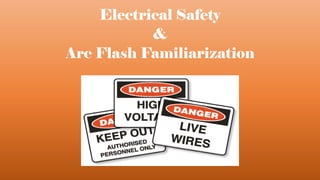
Electrical Safety
Who is Shoreline Power Services?
• Safety Training & Safety Program Services
• Managing Health & Safety
• NFPA 70E Arc Flash Training
• Safety & Health Programs
• Fire Protection and Prevention
• Health Hazards
• Confined Space
• Lockout/Tagout
• OSHA 10-30 Hour Training
• Welding & Cutting
• Personal Protection Equipment
• And much more……….
Electrical Safety
&
Arc Flash Familiarization
You will become Familiar with...
Hazards of Electricity
You will become Familiar with...
Testing Circuits
You will become Familiar with...
Isolating Circuits
You will become Familiar with...
Work Area Safety
You will become Familiar with...
Electrical PPE
You will become Familiar with...
Working on Energized
Equipment
Hazards of Electricity
Topic #1
There are four main types of
electrical injuries
Electrocution
(Death due to electrical shock)
An Average of one worker is
electrocuted on the job each
day.
Electrical
shock
More than 30,000 non-fatal
shock accidents occur each
year.
Electrical Shock
• Received when current passes through the body
• Severity of the shock depends on:
• Path of current through the body
• Amount of current flowing through the body
• Length of time the body is in the circuit
• LOW VOLTAGE DOES NOT MEAN LOW HAZARD
Burns
As much as 80% of all electrical injuries are burns
resulting from an arc-flash and ignition of
flammable clothing.
Electrical Burns
 Most common shock-related, nonfatal injury
 Occurs when you touch electrical wiring or equipment that
is improperly used or maintained
 Typically occurs on the hands
 Very serious injury that needs immediate attention
Falls
Electrical Safety
• Special Training is required for work on electrical equipment
• Only Authorized Employees may conduct electrical work
Electrical Safety
Special Training is required for work on electrical equipment
OnlyAuthorized Employees may
conduct electrical work
Authorized person: A person approved
or assigned by the employer to perform a
specific type of duty or duties or to be at
a specific location or locations at the
jobsite.
Overload Hazards
• If too many devices are plugged into a circuit, the current will heat
the wires to a very high temperature, which may cause a fire
• If the wire insulation melts, arcing may occur and cause a fire in the
area where the overload exists, even inside a wall
Ground-Fault Circuit
Interrupter
• This device protects you from dangerous shock
• The GFCI detects a difference in current between the black and white
circuit wires
(This could happen when electrical equipment is not working
correctly, causing current “leakage” – known as a ground fault.)
• If a ground fault is detected, the GFCI can shut off electricity flow in as
little as 1/40 of a second, protecting you from a dangerous shock
Grounding Path
 The path to ground from circuits, equipment, and enclosures must be
permanent and continuous
 Violation shown here is an extension cord with a missing grounding
prong
Visually Inspect…
• Portable cord and plug connected equipment and flexible cord sets
(extension cords) shall be visually inspected before use on any shift
for external defects:
• Loose parts
• Deformed or missing pins
• Damage to outer jacket or insulation
• Evidence of possible internal damage
Portable Electric Tools &
Cords
• Portable equipment must be handled in a manner which will not
cause damage.
• Flexible electric cords connected to equipment may not be used for
raising or lowering the equipment.
• Flexible cords may not be fastened with staples or otherwise hung in
such a fashion as could damage the outer jacket or insulation.
Remove from Service…
• If there is a defect or evidence of damage to any electrical tools or
equipment…
Immediately notify your supervisor
Remove the item from service
Tell your co-workers
Use of Flexible Cords
• More vulnerable than fixed wiring
• Do not use if one of the recognized wiring methods can be used instead
• Flexible cords can be damaged by:
• Aging
• Door or window edges
• Staples or fastenings
• Abrasion from adjacent materials
• Activities in the area
• Improper use of flexible cords can cause shocks, burns or fire
Permissible Uses of Flexible
Cords
Examples
Prohibited Uses of Flexible
Cords
Examples
Clues that Electrical
Hazards Exist
•Tripped circuit breakers or blown fuses
•Warm tools, wires, cords, connections, or
junction boxes
•GFCI that shuts off a circuit
•Worn or frayed insulation around wire or
connection
Overhead Powerline
Hazards
• Most people don’t realize that overhead powerlines are usually not
insulated
• Powerline workers need special training and personal protective
equipment (PPE) to work safely
• Do not use metal ladders – instead, use fiberglass ladders
• Beware of powerlines when you work with ladders and scaffolding
Safe Work Practices
Before starting work…
- De-energize, Lock, Tag & Test all
circuits of 50 volts or more
- De-energize all Power Sources
- Disconnect from all electric energy
sources
Control Devices
Control circuit devices such as…
• push buttons
• selector switches
• interlocks
…may not be used as the sole means for de-energizing
circuits or equipment.
Lock & Tag…
Lock & Tag all Sources
 Place Lock & Tag on each disconnecting means
used to de-energize circuits
 Attach Lock so as to prevent operating the
disconnecting means
 Place Tag with Each Lock
If a Lock cannot be
applied…
• A tag used without a lock must be supplemented by at least one
additional safety measure that provides a level of safety equal to that
of a lock.
• Examples:
• Removal of an isolating circuit element such as a fuse
• Blocking of a controlling switch
• Opening of an extra disconnecting device.
Energized….
Working with Energized Parts:
 Persons working on energized equipment must
be familiar with the proper use of special
precautionary techniques, personal protective
equipment, insulating and shielding materials,
and insulated tools.
Working on energized
circuits
• When working on energized circuits
• Isolate the area from all traffic
• Post signs & barricades
• Use an attendant if necessary
• Use insulated tool, mats and sheeting
• Use electrical rubber sheeting to cover nearby exposed circuits
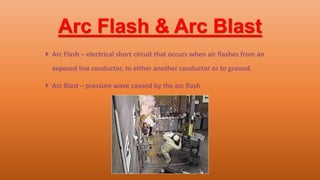
Arc Flash & Arc Blast
 Arc Flash – electrical short circuit that occurs when air flashes from an
exposed live conductor, to either another conductor or to ground.
 Arc Blast – pressure wave caused by the arc flash
Arc Flash/Blast
 Concentrated energy explodes outward
 High intensity flash
 Temperatures can reach 35,000 (skin ignites 480)
 Pressure wave can reach 200lbs/sq. inch
 Vaporizes conductors and copper with exploding particles.
Arc Flash Effects
• Severe burns
• Broken bones
• Vision damage
• Hearing loss
• Brain/internal injuries
• Punctures and lacerations
• Death
Causes of Arc Flash
• Improper training
• Improper work procedures
• Dropped tools
• Accidental contact with electrical systems
• Installation failure
• Improper Design/Repair
• Voltage testingwith inappropriate equipment
Causes of Arc Flash (cont.)
 Buildup of dust, corrosion on insulating surfaces
 Lack of maintenance
 Sparks produced during racking of breakers, replacement of fuses
and closing into faulty lines.
 Over confidence
 All power circuits and electrical equipment shall
be deenergized before work is done on such
circuits and equipment, except when necessary
for trouble shooting or testing.
1000-Volt Insulated
Tools
Conductive Apparel
•Remove all conductive articles of jewelry and
clothing, such a watch bands, bracelets, rings,
key chains, necklaces, metalized aprons, cloth
with conductive thread, or metal headgear.
Test Instruments..
• Test instruments, equipment & test leads, cables, power
cords, probes, and connectors must be visually inspected
for external defects and damage before the equipment is
used.
• Remove any defective items from service
Instrument Ratings…
•Test instruments and equipment & accessories must
be:
• Rated for the circuits and equipment to which they
will be connected
• Designed for the environment in which they will be
used
Is it “Dead”?…
• Verify System is De-energized
• Operate the equipment
controls to check that
equipment cannot be
restarted.
• Use test equipment to test the circuits & electrical parts for
voltage & current
Check your tester…
• Check test equipment (Volt-Ohlm Meter) on a known live source of
same rating to ensure it works before and after checking the circuit
on which you will be working
LDL
(LIVE-DEAD-LIVE)
Personal Protective
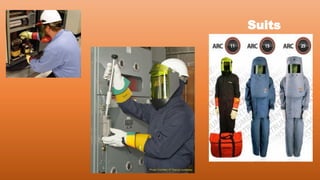
Equipment…
Use electrical rated protective equipment
when working in areas where there is a
potential electrical
Suits
Voltage Rated Gloves
High Voltage Glove Testing
Required Testing
Every
6-Months
Air Test Before Every Use
Glove Classifications
Electrically Rated Footwear
Boots
Shoes
&
Work Area Safety…
 You must be able to see what you are doing
when working on energized equipment
Alerting others…
•Use safety signs, safety symbols, or
accident prevention tags to warn others
about electrical hazards which may
endanger them.
• Hazards of Electricity
• Testing Circuits
• Isolating Circuits
• Work Area Safety
• Electrical PPE (Personal Protective Equipment
• Working on Energized Equipment
Its Your Job….
 Know the hazards of electricity
 Know the equipment
 Use Safe Work Practices
 Inspect your PPE before each use
 Don’t work on energized circuits without
permission
It’s your life

2 Gall - Electrical Safety.pdf

  • 1.
  • 2.
    Who is ShorelinePower Services? • Safety Training & Safety Program Services • Managing Health & Safety • NFPA 70E Arc Flash Training • Safety & Health Programs • Fire Protection and Prevention • Health Hazards • Confined Space • Lockout/Tagout • OSHA 10-30 Hour Training • Welding & Cutting • Personal Protection Equipment • And much more……….
  • 3.
  • 4.
    You will becomeFamiliar with... Hazards of Electricity
  • 5.
    You will becomeFamiliar with... Testing Circuits
  • 6.
    You will becomeFamiliar with... Isolating Circuits
  • 7.
    You will becomeFamiliar with... Work Area Safety
  • 8.
    You will becomeFamiliar with... Electrical PPE
  • 9.
    You will becomeFamiliar with... Working on Energized Equipment
  • 10.
  • 11.
    There are fourmain types of electrical injuries
  • 12.
    Electrocution (Death due toelectrical shock)
  • 13.
    An Average ofone worker is electrocuted on the job each day.
  • 14.
  • 15.
    More than 30,000non-fatal shock accidents occur each year.
  • 16.
    Electrical Shock • Receivedwhen current passes through the body • Severity of the shock depends on: • Path of current through the body • Amount of current flowing through the body • Length of time the body is in the circuit • LOW VOLTAGE DOES NOT MEAN LOW HAZARD
  • 17.
  • 18.
    As much as80% of all electrical injuries are burns resulting from an arc-flash and ignition of flammable clothing.
  • 19.
    Electrical Burns  Mostcommon shock-related, nonfatal injury  Occurs when you touch electrical wiring or equipment that is improperly used or maintained  Typically occurs on the hands  Very serious injury that needs immediate attention
  • 20.
  • 21.
    Electrical Safety • SpecialTraining is required for work on electrical equipment • Only Authorized Employees may conduct electrical work
  • 22.
    Electrical Safety Special Trainingis required for work on electrical equipment OnlyAuthorized Employees may conduct electrical work
  • 23.
    Authorized person: Aperson approved or assigned by the employer to perform a specific type of duty or duties or to be at a specific location or locations at the jobsite.
  • 24.
    Overload Hazards • Iftoo many devices are plugged into a circuit, the current will heat the wires to a very high temperature, which may cause a fire • If the wire insulation melts, arcing may occur and cause a fire in the area where the overload exists, even inside a wall
  • 25.
    Ground-Fault Circuit Interrupter • Thisdevice protects you from dangerous shock • The GFCI detects a difference in current between the black and white circuit wires (This could happen when electrical equipment is not working correctly, causing current “leakage” – known as a ground fault.) • If a ground fault is detected, the GFCI can shut off electricity flow in as little as 1/40 of a second, protecting you from a dangerous shock
  • 27.
    Grounding Path  Thepath to ground from circuits, equipment, and enclosures must be permanent and continuous  Violation shown here is an extension cord with a missing grounding prong
  • 28.
    Visually Inspect… • Portablecord and plug connected equipment and flexible cord sets (extension cords) shall be visually inspected before use on any shift for external defects: • Loose parts • Deformed or missing pins • Damage to outer jacket or insulation • Evidence of possible internal damage
  • 29.
    Portable Electric Tools& Cords • Portable equipment must be handled in a manner which will not cause damage. • Flexible electric cords connected to equipment may not be used for raising or lowering the equipment. • Flexible cords may not be fastened with staples or otherwise hung in such a fashion as could damage the outer jacket or insulation.
  • 30.
    Remove from Service… •If there is a defect or evidence of damage to any electrical tools or equipment… Immediately notify your supervisor Remove the item from service Tell your co-workers
  • 31.
    Use of FlexibleCords • More vulnerable than fixed wiring • Do not use if one of the recognized wiring methods can be used instead • Flexible cords can be damaged by: • Aging • Door or window edges • Staples or fastenings • Abrasion from adjacent materials • Activities in the area • Improper use of flexible cords can cause shocks, burns or fire
  • 32.
    Permissible Uses ofFlexible Cords Examples
  • 33.
    Prohibited Uses ofFlexible Cords Examples
  • 34.
    Clues that Electrical HazardsExist •Tripped circuit breakers or blown fuses •Warm tools, wires, cords, connections, or junction boxes •GFCI that shuts off a circuit •Worn or frayed insulation around wire or connection
  • 35.
    Overhead Powerline Hazards • Mostpeople don’t realize that overhead powerlines are usually not insulated • Powerline workers need special training and personal protective equipment (PPE) to work safely • Do not use metal ladders – instead, use fiberglass ladders • Beware of powerlines when you work with ladders and scaffolding
  • 37.
    Safe Work Practices Beforestarting work… - De-energize, Lock, Tag & Test all circuits of 50 volts or more - De-energize all Power Sources - Disconnect from all electric energy sources
  • 38.
    Control Devices Control circuitdevices such as… • push buttons • selector switches • interlocks …may not be used as the sole means for de-energizing circuits or equipment.
  • 40.
    Lock & Tag… Lock& Tag all Sources  Place Lock & Tag on each disconnecting means used to de-energize circuits  Attach Lock so as to prevent operating the disconnecting means  Place Tag with Each Lock
  • 41.
    If a Lockcannot be applied… • A tag used without a lock must be supplemented by at least one additional safety measure that provides a level of safety equal to that of a lock. • Examples: • Removal of an isolating circuit element such as a fuse • Blocking of a controlling switch • Opening of an extra disconnecting device.
  • 43.
    Energized…. Working with EnergizedParts:  Persons working on energized equipment must be familiar with the proper use of special precautionary techniques, personal protective equipment, insulating and shielding materials, and insulated tools.
  • 44.
    Working on energized circuits •When working on energized circuits • Isolate the area from all traffic • Post signs & barricades • Use an attendant if necessary • Use insulated tool, mats and sheeting • Use electrical rubber sheeting to cover nearby exposed circuits
  • 46.
    Arc Flash &Arc Blast  Arc Flash – electrical short circuit that occurs when air flashes from an exposed live conductor, to either another conductor or to ground.  Arc Blast – pressure wave caused by the arc flash
  • 47.
    Arc Flash/Blast  Concentratedenergy explodes outward  High intensity flash  Temperatures can reach 35,000 (skin ignites 480)  Pressure wave can reach 200lbs/sq. inch  Vaporizes conductors and copper with exploding particles.
  • 48.
    Arc Flash Effects •Severe burns • Broken bones • Vision damage • Hearing loss • Brain/internal injuries • Punctures and lacerations • Death
  • 49.
    Causes of ArcFlash • Improper training • Improper work procedures • Dropped tools • Accidental contact with electrical systems • Installation failure • Improper Design/Repair • Voltage testingwith inappropriate equipment
  • 50.
    Causes of ArcFlash (cont.)  Buildup of dust, corrosion on insulating surfaces  Lack of maintenance  Sparks produced during racking of breakers, replacement of fuses and closing into faulty lines.  Over confidence
  • 51.
     All powercircuits and electrical equipment shall be deenergized before work is done on such circuits and equipment, except when necessary for trouble shooting or testing.
  • 53.
  • 54.
    Conductive Apparel •Remove allconductive articles of jewelry and clothing, such a watch bands, bracelets, rings, key chains, necklaces, metalized aprons, cloth with conductive thread, or metal headgear.
  • 55.
    Test Instruments.. • Testinstruments, equipment & test leads, cables, power cords, probes, and connectors must be visually inspected for external defects and damage before the equipment is used. • Remove any defective items from service
  • 56.
    Instrument Ratings… •Test instrumentsand equipment & accessories must be: • Rated for the circuits and equipment to which they will be connected • Designed for the environment in which they will be used
  • 57.
    Is it “Dead”?… •Verify System is De-energized • Operate the equipment controls to check that equipment cannot be restarted. • Use test equipment to test the circuits & electrical parts for voltage & current
  • 58.
    Check your tester… •Check test equipment (Volt-Ohlm Meter) on a known live source of same rating to ensure it works before and after checking the circuit on which you will be working LDL (LIVE-DEAD-LIVE)
  • 60.
    Personal Protective Equipment… Use electricalrated protective equipment when working in areas where there is a potential electrical
  • 61.
  • 62.
    Voltage Rated Gloves HighVoltage Glove Testing Required Testing Every 6-Months Air Test Before Every Use
  • 63.
  • 64.
  • 67.
    Work Area Safety… You must be able to see what you are doing when working on energized equipment
  • 68.
    Alerting others… •Use safetysigns, safety symbols, or accident prevention tags to warn others about electrical hazards which may endanger them.
  • 70.
    • Hazards ofElectricity • Testing Circuits • Isolating Circuits • Work Area Safety • Electrical PPE (Personal Protective Equipment • Working on Energized Equipment
  • 71.
    Its Your Job…. Know the hazards of electricity  Know the equipment  Use Safe Work Practices  Inspect your PPE before each use  Don’t work on energized circuits without permission
  • 72.