Arcing Fault Events
ArcingFault Events
An arc is produced by flow of electrical
An arc is produced by flow of electrical
current through ionized air after an initial
current through ionized air after an initial
flashover or short circuit.
flashover or short circuit.
Arcs produce some of the highest
Arcs produce some of the highest
temperatures known to occur on earth –
temperatures known to occur on earth –
up to 35,000 degrees F. This is four times
up to 35,000 degrees F. This is four times
the surface temperature of the sun.
the surface temperature of the sun.
All known materials are vaporized at this
All known materials are vaporized at this
temperature.
temperature.
3.
Arc Flash Effects
ArcFlash Effects
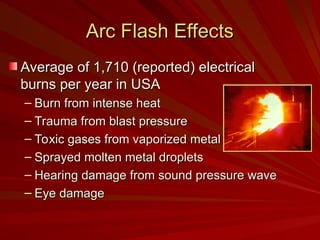
Average of 1,710 (reported) electrical
Average of 1,710 (reported) electrical
burns per year in USA
burns per year in USA
– Burn from intense heat
Burn from intense heat
– Trauma from blast pressure
Trauma from blast pressure
– Toxic gases from vaporized metal
Toxic gases from vaporized metal
– Sprayed molten metal droplets
Sprayed molten metal droplets
– Hearing damage from sound pressure wave
Hearing damage from sound pressure wave
– Eye damage
Eye damage
9.
Electrical Safety Requirements
ElectricalSafety Requirements
OSHA 1910.333 (a)(1) & NFPA 70E 130.1
OSHA 1910.333 (a)(1) & NFPA 70E 130.1
Qualified electrical workers shall not be asked
Qualified electrical workers shall not be asked
to work on equipment that is “hot” or “live”
to work on equipment that is “hot” or “live”
except for two reasons:
except for two reasons:
1.
1. De-energizing introduces additional or
De-energizing introduces additional or
increased hazards
increased hazards
Such as cutting ventilation to a hazardous location
Such as cutting ventilation to a hazardous location
2.
2. Infeasible due to equipment design or
Infeasible due to equipment design or
operational limitations
operational limitations
Such as doing voltage testing for diagnostics
Such as doing voltage testing for diagnostics
10.
Elements of ArcFlash Safety
Elements of Arc Flash Safety
Defined responsibilities
Defined responsibilities
Calculation of degree of arc flash hazard
Calculation of degree of arc flash hazard
Personal protective equipment
Personal protective equipment
Training
Training
Tools for safe work
Tools for safe work
Warning labels on equipment
Warning labels on equipment
11.
Responsibilities
Responsibilities
YSU will provide:
YSUwill provide:
– PPE
PPE
– Training
Training
– Labeling
Labeling
– Insulated tools
Insulated tools
– Lock out/tag out
Lock out/tag out
devices
devices
YSU employee will:
YSU employee will:
– Follow safe work
Follow safe work
practices
practices
– Use appropriate
Use appropriate
insulated tools
insulated tools
– Wear PPE when
Wear PPE when
required
required
12.
Arc Flash HazardAnalysis
Arc Flash Hazard Analysis
Determines flash protection boundary and
Determines flash protection boundary and
PPE requirements as a function of location
PPE requirements as a function of location
and work activity.
and work activity.
Arc flash hazard and flash protection
Arc flash hazard and flash protection
boundary varies with:
boundary varies with:
– Type of equipment and configuration
Type of equipment and configuration
– Available short circuit current
Available short circuit current
– Voltage
Voltage
– Predicted fault duration – protective devices
Predicted fault duration – protective devices
upstream on the arcing fault and their settings
upstream on the arcing fault and their settings
13.
Flash Protection Boundary
FlashProtection Boundary
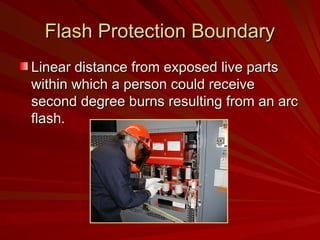
Linear distance from exposed live parts
Linear distance from exposed live parts
within which a person could receive
within which a person could receive
second degree burns resulting from an arc
second degree burns resulting from an arc
flash.
flash.
14.
Flash Protection Boundaries
FlashProtection Boundaries
Limited Approach Boundary
Limited Approach Boundary
– Entered only by qualified persons or unqualified
Entered only by qualified persons or unqualified
persons escorted by qualified person
persons escorted by qualified person
Restricted Approach Boundary
Restricted Approach Boundary
– Entered only by qualified persons required to use
Entered only by qualified persons required to use
shock protection techniques and equipment
shock protection techniques and equipment
Prohibited Approach Boundary
Prohibited Approach Boundary
– Entered only by qualified persons requiring same
Entered only by qualified persons requiring same
protection as if in direct contact with live parts
protection as if in direct contact with live parts
15.
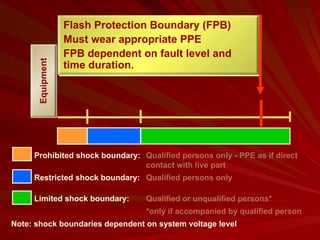
Prohibited shock boundary:Qualified persons only - PPE as if direct
contact with live part
Restricted shock boundary: Qualified persons only
Limited shock boundary: Qualified or unqualified persons*
*only if accompanied by qualified person
Note: shock boundaries dependent on system voltage level
Flash Protection Boundary (FPB)
Must wear appropriate PPE
FPB dependent on fault level and
time duration.
Equipment
16.
Approach Boundaries
Approach Boundaries
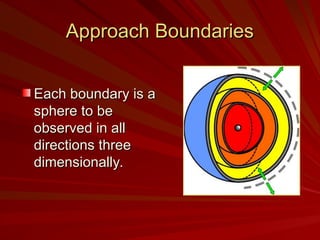
Eachboundary is a
Each boundary is a
sphere to be
sphere to be
observed in all
observed in all
directions three
directions three
dimensionally.
dimensionally.
17.
Labeling
Labeling
Switchboards, panel boards,industrial
Switchboards, panel boards, industrial
controls, etc. that require examination,
controls, etc. that require examination,
adjustment, or maintenance while
adjustment, or maintenance while
energized shall be labeled.
energized shall be labeled.
18.
Labeling
Labeling
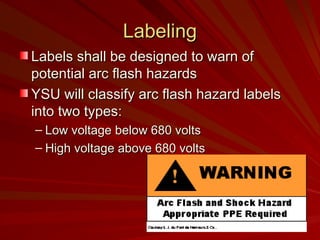
Labels shall bedesigned to warn of
Labels shall be designed to warn of
potential arc flash hazards
potential arc flash hazards
YSU will classify arc flash hazard labels
YSU will classify arc flash hazard labels
into two types:
into two types:
– Low voltage below 680 volts
Low voltage below 680 volts
– High voltage above 680 volts
High voltage above 680 volts
19.
Insulated Tools
Insulated Tools
Flameretardant
Flame retardant
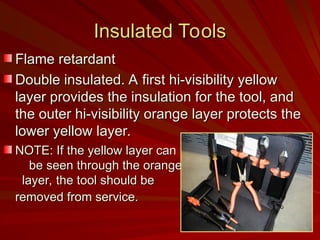
Double insulated. A first hi-visibility yellow
Double insulated. A first hi-visibility yellow
layer provides the insulation for the tool, and
layer provides the insulation for the tool, and
the outer hi-visibility orange layer protects the
the outer hi-visibility orange layer protects the
lower yellow layer.
lower yellow layer.
NOTE: If the yellow layer can
NOTE: If the yellow layer can
be seen through the orange
be seen through the orange
layer, the tool should be
layer, the tool should be
removed from service.
removed from service.
20.
NFPA 70E 120.1
NFPA70E 120.1
120.1 Process of Achieving an
120.1 Process of Achieving an
Electrically Safe Work Condition
Electrically Safe Work Condition
– An electrically safe work condition shall be
An electrically safe work condition shall be
achieved when performed in accordance
achieved when performed in accordance
with the procedures of 120.2 and verified by
with the procedures of 120.2 and verified by
the following process:
the following process:
21.
Electrically Safe WorkCondition
Electrically Safe Work Condition
1.
1. Determine all electrical sources using up-to-
Determine all electrical sources using up-to-
date information, drawings, diagrams, etc.
date information, drawings, diagrams, etc.
2.
2. After properly interrupting the load current,
After properly interrupting the load current,
open the disconnecting device(s) for each
open the disconnecting device(s) for each
source.
source.
– At this point, the equipment or circuit is simply
At this point, the equipment or circuit is simply
de-energized, not in an electrically safe work
de-energized, not in an electrically safe work
condition.
condition.
22.
Electrically Safe WorkCondition
Electrically Safe Work Condition
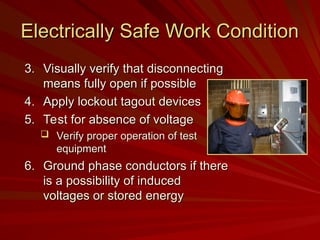
3.
3. Visually verify that disconnecting
Visually verify that disconnecting
means fully open if possible
means fully open if possible
4.
4. Apply lockout tagout devices
Apply lockout tagout devices
5.
5. Test for absence of voltage
Test for absence of voltage
Verify proper operation of test
Verify proper operation of test
equipment
equipment
6.
6. Ground phase conductors if there
Ground phase conductors if there
is a possibility of induced
is a possibility of induced
voltages or stored energy
voltages or stored energy
23.
Electrically Safe WorkCondition
Electrically Safe Work Condition
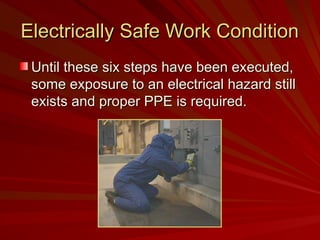
Until these six steps have been executed,
Until these six steps have been executed,
some exposure to an electrical hazard still
some exposure to an electrical hazard still
exists and proper PPE is required.
exists and proper PPE is required.
24.
Safe Work Practices
SafeWork Practices
For open box work where the circuit can
For open box work where the circuit can
not be de-energized, safe work practices
not be de-energized, safe work practices
will include:
will include:
– Use of insulated tools
Use of insulated tools
– Use of personal protective equipment
Use of personal protective equipment
– Not working alone
Not working alone
25.
Safe Work Practices
SafeWork Practices
If the box is open and the circuit can not
If the box is open and the circuit can not
be de-energized personal protective
be de-energized personal protective
equipment is required; for 120 volts:
equipment is required; for 120 volts:
– Safety glasses
Safety glasses
– Cotton shirt and pants
Cotton shirt and pants
*Note: NFPA recommends cotton under
*Note: NFPA recommends cotton under
garments for use when an arc flash hazard is
garments for use when an arc flash hazard is
present.
present.
26.
Safe Work Practices
SafeWork Practices
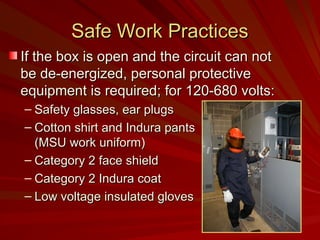
If the box is open and the circuit can not
If the box is open and the circuit can not
be de-energized, personal protective
be de-energized, personal protective
equipment is required; for 120-680 volts:
equipment is required; for 120-680 volts:
– Safety glasses, ear plugs
Safety glasses, ear plugs
– Cotton shirt and Indura pants
Cotton shirt and Indura pants
(MSU work uniform)
(MSU work uniform)
– Category 2 face shield
Category 2 face shield
– Category 2 Indura coat
Category 2 Indura coat
– Low voltage insulated gloves
Low voltage insulated gloves
27.
Safe Work Practices
SafeWork Practices
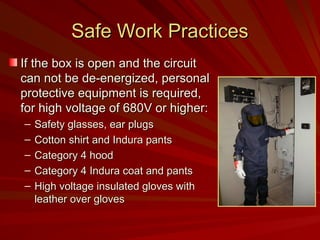
If the box is open and the circuit
If the box is open and the circuit
can not be de-energized, personal
can not be de-energized, personal
protective equipment is required,
protective equipment is required,
for high voltage of 680V or higher:
for high voltage of 680V or higher:
– Safety glasses, ear plugs
Safety glasses, ear plugs
– Cotton shirt and Indura pants
Cotton shirt and Indura pants
– Category 4 hood
Category 4 hood
– Category 4 Indura coat and pants
Category 4 Indura coat and pants
– High voltage insulated gloves with
High voltage insulated gloves with
leather over gloves
leather over gloves
28.
PPE – NFPA70E Table 130.7
PPE – NFPA 70E Table 130.7
Typical Protective Clothing Systems
Hazard/Risk
Category
Clothing Description
(Typical number of clothing layers is given in parentheses)
RequiredMinimum
Arc Rating of PPE
[(J/cm
2
(cal/cm
2
)]
0 Non-melting, flammable materials (i.e., untreated cotton,
wool, rayon, or silk, or blends of these materials) with a
fabric weight at least 4.5 oz/yd
2
(1)
N/A
1 FR Shirt and FR pants or FR coverall (1) 16.74 (4)
2 Cotton underwear - conventional short sleeve and
brief/shorts, plus FR shirt and FR pants (1 or 2)
33.47 (8)
3 Cotton underwear plus FR shirt and FR pants plus FR
coverall, or cotton underwear plus two FR coveralls (2 or 3)
104.6 (25)
4 Cotton underwear plus FR shirt and FR pants plus multi-
layer flash suit (3, or more)
167.36 (40)
29.
Summary
Summary
Equipment should beplaced in an electrically
Equipment should be placed in an electrically
safe work condition prior to servicing the
safe work condition prior to servicing the
equipment.
equipment.
Safe work practices should be followed to
Safe work practices should be followed to
reduce the hazards associated with an arc
reduce the hazards associated with an arc
flash.
flash.
If necessary to work on live parts:
If necessary to work on live parts:
– 120 volts - safety glasses & cotton uniform
120 volts - safety glasses & cotton uniform
– 120-680 volts – Category 2 arc flash suit
120-680 volts – Category 2 arc flash suit
– 680 volts and above – Category 4 arc flash suit
680 volts and above – Category 4 arc flash suit







![PPE – NFPA 70E Table 130.7
PPE – NFPA 70E Table 130.7
Typical Protective Clothing Systems
Hazard/Risk
Category
Clothing Description
(Typical number of clothing layers is given in parentheses)
RequiredMinimum
Arc Rating of PPE
[(J/cm
2
(cal/cm
2
)]
0 Non-melting, flammable materials (i.e., untreated cotton,
wool, rayon, or silk, or blends of these materials) with a
fabric weight at least 4.5 oz/yd
2
(1)
N/A
1 FR Shirt and FR pants or FR coverall (1) 16.74 (4)
2 Cotton underwear - conventional short sleeve and
brief/shorts, plus FR shirt and FR pants (1 or 2)
33.47 (8)
3 Cotton underwear plus FR shirt and FR pants plus FR
coverall, or cotton underwear plus two FR coveralls (2 or 3)
104.6 (25)
4 Cotton underwear plus FR shirt and FR pants plus multi-
layer flash suit (3, or more)
167.36 (40)](https://image.slidesharecdn.com/trainingpresentation-arcflashsafety-250310062816-452199d5/85/Training-Presentation-Arc-Flash-Safety-ppt-28-320.jpg)