AQUACULTURE
6/15/2021 Dr. C. Beulah Jayarani 2
6/15/2021 Dr. C. Beulah Jayarani 3
6/15/2021 Dr. C. Beulah Jayarani 4
6/15/2021 Dr. C. Beulah Jayarani 5
6/15/2021 Dr. C. Beulah Jayarani 6
6/15/2021 Dr. C. Beulah Jayarani 7
6/15/2021 Dr. C. Beulah Jayarani 8
6/15/2021 Dr. C. Beulah Jayarani 9
6/15/2021 Dr. C. Beulah Jayarani 10
6/15/2021 Dr. C. Beulah Jayarani 11
6/15/2021 Dr. C. Beulah Jayarani 12
6/15/2021 Dr. C. Beulah Jayarani 13
6/15/2021 Dr. C. Beulah Jayarani 14
6/15/2021 Dr. C. Beulah Jayarani 15
6/15/2021 Dr. C. Beulah Jayarani 16
6/15/2021 Dr. C. Beulah Jayarani 17
6/15/2021 Dr. C. Beulah Jayarani 18
6/15/2021 Dr. C. Beulah Jayarani 19
6/15/2021 Dr. C. Beulah Jayarani 20
6/15/2021 Dr. C. Beulah Jayarani 21
6/15/2021 Dr. C. Beulah Jayarani 22
Aquaculture is a branch of science
that deals with the farming of aquatic
organisms for business that involves
the production and marketing of:
 aquatic organisms
 both plants and animals, under
controlled conditions.
Aquaculture includes culture of:
Prawn, lobsters, fish, pearl oysters,
mussels and crabs.
6/15/2021 Dr. C. Beulah Jayarani 24
6/15/2021 Dr. C. Beulah Jayarani 25
The process of rearing and
breeding of fishes in rivers,
streams, ponds, irrigation canals
and paddy fields is known as
pisciculture.
o Pisciculture plays an important role in
Indian economy.
 It provides employment and income to
millions of fishermen and farmers,
particularly in the coastal areas.
Factors to be considered for pisciculture:
1.Topography or location of pond
2. Water resources and quality of water
3. Quality of soil (Nutrients)
4. Temperature of water
6/15/2021 Dr. C. Beulah Jayarani 27
FRESH WATER
BRACKISH WATER
MARINE WATER
6/15/2021 Dr. C. Beulah Jayarani 28
Extensive
Pisciculture
Intensive
Pisciculture
Monoculture Polyculture
Integrated
Pisciculture
6/15/2021 Dr. C. Beulah Jayarani 29
 Extensive
Pisciculture -
growing fish on
natural feed.
ExTEnsivE PisCiCULTURE
6/15/2021 Dr. C. Beulah Jayarani 30
 Intensive Pisciculture
- Growing fish on
artificial feed to
maximize production.
inTEnsivE PisCiCULTURE
6/15/2021 Dr. C. Beulah Jayarani 31
 Monoculture -
Growing a single
type of fish in a
water body
MonoCULTURE
6/15/2021 Dr. C. Beulah Jayarani 32
 Polyculture - Growing
one type of fish or
more types of fishes
with different feeding
habits together in a
waterbody.
PoLyCULTURE
6/15/2021 Dr. C. Beulah Jayarani 33
Integrated Pisciculture
- Growing fish
along with agricultural
crops or other
animals.
inTEgRATEd PisCiCULTURE
6/15/2021 Dr. C. Beulah Jayarani 34
Breeding
Hatching
Nursing
Rearing
Stocking
6/15/2021 Dr. C. Beulah Jayarani 35
Breeding ponds –
Sexually mature males and
females are collected and left in
these ponds for breeding.
These ponds are prepared near the
rivers or other natural water
resources.
BREEding Ponds
6/15/2021 Dr. C. Beulah Jayarani 36
6/15/2021 Dr. C. Beulah Jayarani 37
Natural breeding (Bund breeding)
 These are special types of ponds
where natural riverine conditions or
any natural water resources are
managed for breeding of culturable
fishes.
 It constructed in large low-lying
areas that can accommodate large
quantity of rain water.
6/15/2021 Dr. C. Beulah Jayarani 38
6/15/2021 Dr. C. Beulah Jayarani 39
 Fish seed is collected
from breeding ponds.
 The spawn collecting net
is commonly called
Benchijal (Shooting net)
and transferred to the
hatching pits
6/15/2021 Dr. C. Beulah Jayarani 40
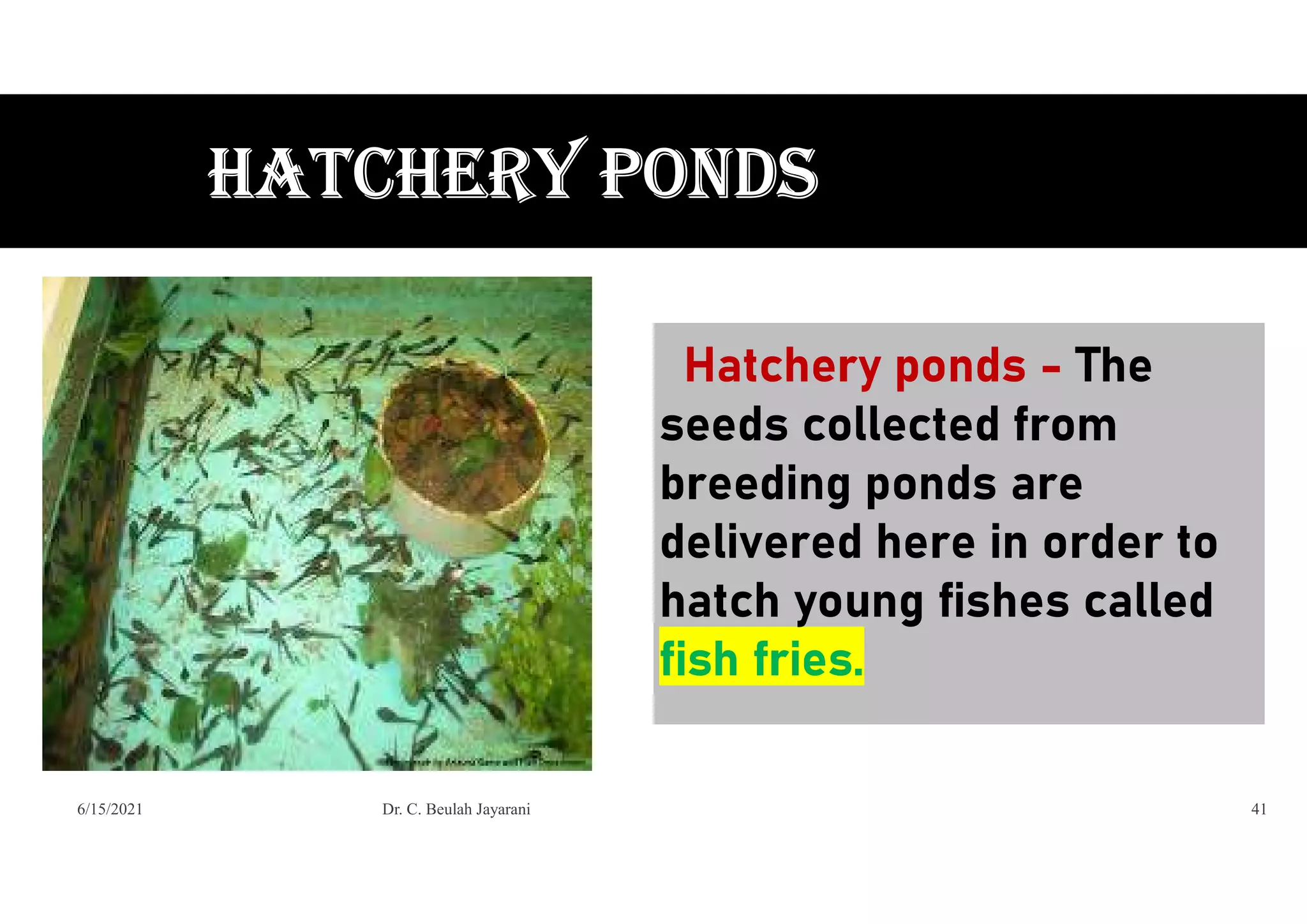
Hatchery ponds - The
seeds collected from
breeding ponds are
delivered here in order to
hatch young fishes called
fish fries.
HATCHERy Ponds
6/15/2021 Dr. C. Beulah Jayarani 41
 Hatching pits should be smaller in size
with good quality water & nearer to the
breeding grounds, fertilized eggs are
kept in. There are two types of hatching
pits,
 i) Hatcheries - small sized pond -
unfertilized eggs are transferred.
 ii) Hatching hapas - rectangular
trough shaped tanks made up of
mosquito net cloth supported by
bamboo poles and fixed in the river
6/15/2021 Dr. C. Beulah Jayarani 42
Nursery pond - 3 to
5 day old fish fries
are retained here for
about 20 days and
fed well.
nURsERy Pond
6/15/2021 Dr. C. Beulah Jayarani 43
Rearing ponds - These are
deeper ponds where fish
fries from the nursery ponds
are transferred and
maintained for about three
months. The fish fries grow
to a size of about 125 mm in
length and are now called
fish fingerlings.
REARing Ponds
6/15/2021 Dr. C. Beulah Jayarani 44
Stocking ponds - These are
larger ponds and the
fingerlings are fed with
artificial feed.
Organic and inorganic
fertilizers are used to increase
their size.
Antibiotics are used to prevent
infectious diseases.
sToCking Ponds
6/15/2021 Dr. C. Beulah Jayarani 45
 Well grown fishes are taken out for
marketing. Small sized fishes are again
released into the stocking ponds for further
growth.
 Different methods of fishing are carried out
to harvest fishes. These include Stranding,
Angling, Traps, Dipnets, Cast nets, Gill nets,
Drag nets and purse nets.
 The harvested fishes are preserved by
refrigeration, Deep freezing, freeze drying,
sun drying, salting, smoking and canning.
6/15/2021 Dr. C. Beulah Jayarani 46
 High growth rate in short period for culture
 They should accept supplementary diet.
 They should be hardy enough to resist some common
diseases and infection of parasites.
 Fishes proposed for polyculture should be able to live
together without interfering or attacking other fishes.
 They should have high conversion efficiency so that they can
effectively utilize the food.
6/15/2021 Dr. C. Beulah Jayarani 47
 Cultivable fish are of 3 types.
 Indigenous or native fresh water
fishes (Major carps, Catla,
Labeo, Clarias)
 Salt water fishes acclimatized
for fresh water (Chanos, Mullet).
 Exotic fishes or imported from
other counties (Common carps)
6/15/2021 Dr. C. Beulah Jayarani 48
BRACkisH WATER FisHEs
6/15/2021 Dr. C. Beulah Jayarani 49
6/15/2021 Dr. C. Beulah Jayarani 50
6/15/2021 Dr. C. Beulah Jayarani 51
6/15/2021 Dr. C. Beulah Jayarani 52
6/15/2021 Dr. C. Beulah Jayarani 53
6/15/2021 Dr. C. Beulah Jayarani 54
6/15/2021 Dr. C. Beulah Jayarani 55
6/15/2021 Dr. C. Beulah Jayarani 56
6/15/2021 Dr. C. Beulah Jayarani 57
6/15/2021 Dr. C. Beulah Jayarani 58
 Feed on zooplanktons and
phytoplankton's, decaying
weeds, debris and other
aquatic plants.
 They can survive in turbid
water with slightly higher
temperature
 Can tolerate O2 variations in
water.
 Can be transported from one
place to other easily.
6/15/2021 Dr. C. Beulah Jayarani 59
6/15/2021 Dr. C. Beulah Jayarani 60
 The fishes imported into a
country for fish culture are
called exotic fishes and such
fish culture is known as exotic
fish culture. Examples of such
exotic fishes introduced in
India are Cyprinus carpio and
Oreochromis mossambicus.
6/15/2021 Dr. C. Beulah Jayarani 61
6/15/2021 Dr. C. Beulah Jayarani 62
6/15/2021 Dr. C. Beulah Jayarani 63
 Diseases can be of viral or
bacterial origin. Regular
monitoring of parameters
like water quality, aeration,
regular feeding, observation
for mortality should be
checked. Parasitic
infestations and microbial
infections should be
observed periodically.
6/15/2021 Dr. C. Beulah Jayarani 64
 Fishes form a rich source of protein
high amino acids concentrations
particularly histidine omega 3 fatty
acids, minerals such as calcium,
magnesium, phosphorus, potassium,
iron, manganese, iodine and copper.
 Fish liver oil is derived from the liver
which is rich in vitamin A and D,
whereas fish body oil has high
content of iodine, not suitable for
human consumption, but is used in
the manufacture of laundry soaps,
paints and cosmetics.
6/15/2021 Dr. C. Beulah Jayarani 65
 It’s prepared from fish
waste after extracting oil
from the fish. The dried
wastes are used to prepare
food for pig, poultry and
cattle. The wastes obtained
during the preparation of
fish meal are widely used
as manure.
6/15/2021 Dr. C. Beulah Jayarani 66
 High-grade collagen produced
from dried air bladder or swim
bladder of certain fishes viz.
catfish and carps. The
processed bladder which is
dissolved in hot water forms a
gelatin having adhesive
property. It is primarily used
for clarification of wine, beer
and vinegar.
6/15/2021 Dr. C. Beulah Jayarani 67
“SCIENCE READER”
 Tamil Nadu text book
 NCERT Books
 Google Images
6/15/2021 Dr. C. Beulah Jayarani 68

Aquaculture

  • 1.
  • 2.
    6/15/2021 Dr. C.Beulah Jayarani 2
  • 3.
    6/15/2021 Dr. C.Beulah Jayarani 3
  • 4.
    6/15/2021 Dr. C.Beulah Jayarani 4
  • 5.
    6/15/2021 Dr. C.Beulah Jayarani 5
  • 6.
    6/15/2021 Dr. C.Beulah Jayarani 6
  • 7.
    6/15/2021 Dr. C.Beulah Jayarani 7
  • 8.
    6/15/2021 Dr. C.Beulah Jayarani 8
  • 9.
    6/15/2021 Dr. C.Beulah Jayarani 9
  • 10.
    6/15/2021 Dr. C.Beulah Jayarani 10
  • 11.
    6/15/2021 Dr. C.Beulah Jayarani 11
  • 12.
    6/15/2021 Dr. C.Beulah Jayarani 12
  • 13.
    6/15/2021 Dr. C.Beulah Jayarani 13
  • 14.
    6/15/2021 Dr. C.Beulah Jayarani 14
  • 15.
    6/15/2021 Dr. C.Beulah Jayarani 15
  • 16.
    6/15/2021 Dr. C.Beulah Jayarani 16
  • 17.
    6/15/2021 Dr. C.Beulah Jayarani 17
  • 18.
    6/15/2021 Dr. C.Beulah Jayarani 18
  • 19.
    6/15/2021 Dr. C.Beulah Jayarani 19
  • 20.
    6/15/2021 Dr. C.Beulah Jayarani 20
  • 21.
    6/15/2021 Dr. C.Beulah Jayarani 21
  • 22.
    6/15/2021 Dr. C.Beulah Jayarani 22
  • 24.
    Aquaculture is abranch of science that deals with the farming of aquatic organisms for business that involves the production and marketing of:  aquatic organisms  both plants and animals, under controlled conditions. Aquaculture includes culture of: Prawn, lobsters, fish, pearl oysters, mussels and crabs. 6/15/2021 Dr. C. Beulah Jayarani 24
  • 25.
    6/15/2021 Dr. C.Beulah Jayarani 25
  • 26.
    The process ofrearing and breeding of fishes in rivers, streams, ponds, irrigation canals and paddy fields is known as pisciculture.
  • 27.
    o Pisciculture playsan important role in Indian economy.  It provides employment and income to millions of fishermen and farmers, particularly in the coastal areas. Factors to be considered for pisciculture: 1.Topography or location of pond 2. Water resources and quality of water 3. Quality of soil (Nutrients) 4. Temperature of water 6/15/2021 Dr. C. Beulah Jayarani 27
  • 28.
    FRESH WATER BRACKISH WATER MARINEWATER 6/15/2021 Dr. C. Beulah Jayarani 28
  • 29.
  • 30.
     Extensive Pisciculture - growingfish on natural feed. ExTEnsivE PisCiCULTURE 6/15/2021 Dr. C. Beulah Jayarani 30
  • 31.
     Intensive Pisciculture -Growing fish on artificial feed to maximize production. inTEnsivE PisCiCULTURE 6/15/2021 Dr. C. Beulah Jayarani 31
  • 32.
     Monoculture - Growinga single type of fish in a water body MonoCULTURE 6/15/2021 Dr. C. Beulah Jayarani 32
  • 33.
     Polyculture -Growing one type of fish or more types of fishes with different feeding habits together in a waterbody. PoLyCULTURE 6/15/2021 Dr. C. Beulah Jayarani 33
  • 34.
    Integrated Pisciculture - Growingfish along with agricultural crops or other animals. inTEgRATEd PisCiCULTURE 6/15/2021 Dr. C. Beulah Jayarani 34
  • 35.
  • 36.
    Breeding ponds – Sexuallymature males and females are collected and left in these ponds for breeding. These ponds are prepared near the rivers or other natural water resources. BREEding Ponds 6/15/2021 Dr. C. Beulah Jayarani 36
  • 37.
    6/15/2021 Dr. C.Beulah Jayarani 37
  • 38.
    Natural breeding (Bundbreeding)  These are special types of ponds where natural riverine conditions or any natural water resources are managed for breeding of culturable fishes.  It constructed in large low-lying areas that can accommodate large quantity of rain water. 6/15/2021 Dr. C. Beulah Jayarani 38
  • 39.
    6/15/2021 Dr. C.Beulah Jayarani 39
  • 40.
     Fish seedis collected from breeding ponds.  The spawn collecting net is commonly called Benchijal (Shooting net) and transferred to the hatching pits 6/15/2021 Dr. C. Beulah Jayarani 40
  • 41.
    Hatchery ponds -The seeds collected from breeding ponds are delivered here in order to hatch young fishes called fish fries. HATCHERy Ponds 6/15/2021 Dr. C. Beulah Jayarani 41
  • 42.
     Hatching pitsshould be smaller in size with good quality water & nearer to the breeding grounds, fertilized eggs are kept in. There are two types of hatching pits,  i) Hatcheries - small sized pond - unfertilized eggs are transferred.  ii) Hatching hapas - rectangular trough shaped tanks made up of mosquito net cloth supported by bamboo poles and fixed in the river 6/15/2021 Dr. C. Beulah Jayarani 42
  • 43.
    Nursery pond -3 to 5 day old fish fries are retained here for about 20 days and fed well. nURsERy Pond 6/15/2021 Dr. C. Beulah Jayarani 43
  • 44.
    Rearing ponds -These are deeper ponds where fish fries from the nursery ponds are transferred and maintained for about three months. The fish fries grow to a size of about 125 mm in length and are now called fish fingerlings. REARing Ponds 6/15/2021 Dr. C. Beulah Jayarani 44
  • 45.
    Stocking ponds -These are larger ponds and the fingerlings are fed with artificial feed. Organic and inorganic fertilizers are used to increase their size. Antibiotics are used to prevent infectious diseases. sToCking Ponds 6/15/2021 Dr. C. Beulah Jayarani 45
  • 46.
     Well grownfishes are taken out for marketing. Small sized fishes are again released into the stocking ponds for further growth.  Different methods of fishing are carried out to harvest fishes. These include Stranding, Angling, Traps, Dipnets, Cast nets, Gill nets, Drag nets and purse nets.  The harvested fishes are preserved by refrigeration, Deep freezing, freeze drying, sun drying, salting, smoking and canning. 6/15/2021 Dr. C. Beulah Jayarani 46
  • 47.
     High growthrate in short period for culture  They should accept supplementary diet.  They should be hardy enough to resist some common diseases and infection of parasites.  Fishes proposed for polyculture should be able to live together without interfering or attacking other fishes.  They should have high conversion efficiency so that they can effectively utilize the food. 6/15/2021 Dr. C. Beulah Jayarani 47
  • 48.
     Cultivable fishare of 3 types.  Indigenous or native fresh water fishes (Major carps, Catla, Labeo, Clarias)  Salt water fishes acclimatized for fresh water (Chanos, Mullet).  Exotic fishes or imported from other counties (Common carps) 6/15/2021 Dr. C. Beulah Jayarani 48
  • 49.
    BRACkisH WATER FisHEs 6/15/2021Dr. C. Beulah Jayarani 49
  • 50.
    6/15/2021 Dr. C.Beulah Jayarani 50
  • 51.
    6/15/2021 Dr. C.Beulah Jayarani 51
  • 52.
    6/15/2021 Dr. C.Beulah Jayarani 52
  • 53.
    6/15/2021 Dr. C.Beulah Jayarani 53
  • 54.
    6/15/2021 Dr. C.Beulah Jayarani 54
  • 55.
    6/15/2021 Dr. C.Beulah Jayarani 55
  • 56.
    6/15/2021 Dr. C.Beulah Jayarani 56
  • 57.
    6/15/2021 Dr. C.Beulah Jayarani 57
  • 58.
    6/15/2021 Dr. C.Beulah Jayarani 58
  • 59.
     Feed onzooplanktons and phytoplankton's, decaying weeds, debris and other aquatic plants.  They can survive in turbid water with slightly higher temperature  Can tolerate O2 variations in water.  Can be transported from one place to other easily. 6/15/2021 Dr. C. Beulah Jayarani 59
  • 60.
    6/15/2021 Dr. C.Beulah Jayarani 60
  • 61.
     The fishesimported into a country for fish culture are called exotic fishes and such fish culture is known as exotic fish culture. Examples of such exotic fishes introduced in India are Cyprinus carpio and Oreochromis mossambicus. 6/15/2021 Dr. C. Beulah Jayarani 61
  • 62.
    6/15/2021 Dr. C.Beulah Jayarani 62
  • 63.
    6/15/2021 Dr. C.Beulah Jayarani 63
  • 64.
     Diseases canbe of viral or bacterial origin. Regular monitoring of parameters like water quality, aeration, regular feeding, observation for mortality should be checked. Parasitic infestations and microbial infections should be observed periodically. 6/15/2021 Dr. C. Beulah Jayarani 64
  • 65.
     Fishes forma rich source of protein high amino acids concentrations particularly histidine omega 3 fatty acids, minerals such as calcium, magnesium, phosphorus, potassium, iron, manganese, iodine and copper.  Fish liver oil is derived from the liver which is rich in vitamin A and D, whereas fish body oil has high content of iodine, not suitable for human consumption, but is used in the manufacture of laundry soaps, paints and cosmetics. 6/15/2021 Dr. C. Beulah Jayarani 65
  • 66.
     It’s preparedfrom fish waste after extracting oil from the fish. The dried wastes are used to prepare food for pig, poultry and cattle. The wastes obtained during the preparation of fish meal are widely used as manure. 6/15/2021 Dr. C. Beulah Jayarani 66
  • 67.
     High-grade collagenproduced from dried air bladder or swim bladder of certain fishes viz. catfish and carps. The processed bladder which is dissolved in hot water forms a gelatin having adhesive property. It is primarily used for clarification of wine, beer and vinegar. 6/15/2021 Dr. C. Beulah Jayarani 67
  • 68.
    “SCIENCE READER”  TamilNadu text book  NCERT Books  Google Images 6/15/2021 Dr. C. Beulah Jayarani 68