11/7/2020
1
Dr. M. Samee Mubarik
Introduction of Course
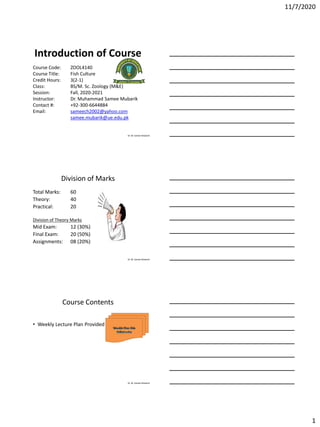
Course Code: ZOOL4140
Course Title: Fish Culture
Credit Hours: 3(2-1)
Class: BS/M. Sc. Zoology (M&E)
Session: Fall, 2020-2021
Instructor: Dr. Muhammad Samee Mubarik
Contact #: +92-300-6644884
Email: sameech2002@yahoo.com
samee.mubarik@ue.edu.pk
Dr. M. Samee Mubarik
Division of Marks
Total Marks: 60
Theory: 40
Practical: 20
Division of Theory Marks
Mid Exam: 12 (30%)
Final Exam: 20 (50%)
Assignments: 08 (20%)
Dr. M. Samee Mubarik
Course Contents
• Weekly Lecture Plan Provided
11/7/2020
2
Dr. M. Samee Mubarik
Definition of Fish
• Bilaterally Symmetrical
• Cold blooded (poikilothermic)
• Gill breathing
• Water living
• Vertebrate
Dr. M. Samee Mubarik
Other meanings of Fish
• FISh (programming language), an array
programming language
• Fish (cryptography) (sometimes FISH), the
British codeword for World War II German
stream cipher teleprinter secure
communications devices
• FISH (Fluorescent in situ hybridization, a
technique used in genetics to detect DNA
sequences)
Dr. M. Samee Mubarik
• To hunt and to eat the fish of the sea is made lawful for you, a provision for you and
for seafarers; but to hunt on land is forbidden you so long as ye are on the
pilgrimage. Be mindful of your duty to Allah, unto Whom ye will be gathered (Al-
Maeda [5:96] ).
• Ask them (O Muhammad) of the township that was by the sea, how they did break
the Sabbath, how their big fish came unto them visibly upon their Sabbath day and
on a day when they did not keep Sabbath came they not unto them. Thus did We try
them for that they were evil-livers. (Al-Araf [7:163] )
• And when they reached the point where the two met, they forgot their fish, and it
took its way into the waters, being free. (Al-Kahf [18:61] )
• He said: Didst thou see, when we took refuge on the rock, and I forgot the fish - and
none but Satan caused me to forget to mention it - it took its way into the waters by
a marvel. (Al-Kahf [18:63])
• And the fish swallowed him while he was blameworthy. (As-Saaffat [37:142] )
• But wait thou for thy Lord's decree, and be not like him of the fish, who cried out in
despair. (Al-Qalam [68:48])
11/7/2020
3
Dr. M. Samee Mubarik
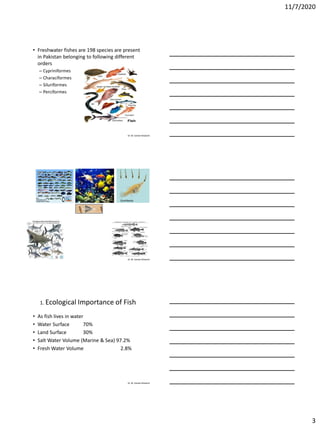
• Freshwater fishes are 198 species are present
in Pakistan belonging to following different
orders
– Cypriniformes
– Characiformes
– Siluriformes
– Perciformes
Dr. M. Samee Mubarik
Puffer Fish
Gumbozia
Dr. M. Samee Mubarik
1. Ecological Importance of Fish
• As fish lives in water
• Water Surface 70%
• Land Surface 30%
• Salt Water Volume (Marine & Sea) 97.2%
• Fresh Water Volume 2.8%
11/7/2020
4
Dr. M. Samee Mubarik
FISHERIES RESOURCES OF
PUNJAB
(AREA IN HECTARES)
RIVERS AND MAIN TRIBUTARIES Max. 2,940,000
Min. 713,000
CANALS 22,400
DAMS 24,960
RESERVOIRS 40,840
(ATTACHED WITH BARRAGES)
LAKES & WATER LOGGED AREAS 47,400
Source: Fisheries Sector Study 1987
SMALL DAMS 7,000
PRIVATE FISH FARMS 24,190
(Till June 2015)
Reference: Dr. Muhammad Ayub, DG, Department of Fisheries, Punjab
(During
Monsoon)
Dr. M. Samee Mubarik
Fish Body Shape
There is a tremendous diversity of fish in the world. Each species is
adapted to life in a specific habitat.
Dr. M. Samee Mubarik
• Catla catla
• Labeo rohita
• Cirrhinus mrigala
Major Carps
11/7/2020
5
Dr. M. Samee Mubarik
Common Fish Species in Pakistan
Sr. No Species (Local Name)
1. Tor putitora Mahaseer
2. Catla catla Thaila
3. Labeo rohita Rohu
4. Cirrhinus mrigala Mori
5. Cyprinus carpio Gulfam
6.
Tilapia mosambica/
Oreochromus niloticus
Chirra
7. Wallagu attu Malli
8. Labeo gonius Sariha
9. Notopterus spp. Pari
10. Ompok bimaculatus Palu
Dr. M. Samee Mubarik
Sr. No Species (Local Name)
11. Bagarius bagarius Mujahid
12. Crosochilus diplochilus Bhangan
13. Heteropneustes fossilis Lohaat
14. Labeo calbasu Kalbans
15. Hypophthalmichthys molitrix Silver carp
16. Channa marulius Soal
17. Ctenophryngodon idella Grass carp
18. Channa punctatus Dola
19. Mastacembulus armatus Baam
20. Eutropchthys vacha Jhali
21. Rita rita Desi Khagga
22. Carassius auratus Paplate
23. Sperata sarwari Singahri
24. Clupisoma garua Bachwa
25. Cirrhinus reba Sonni
Dr. M. Samee Mubarik
Photo Credit: DG, Department of Punjab Fisheries
11/7/2020
6
Dr. M. Samee Mubarik
Types of Fish Culture
2.1. Depending upon stocking density
2.2. Depending upon gender
2.3. Depending upon Species
2.4. Depending upon Facilities
2.5. Integrated Fish Culture
Dr. M. Samee Mubarik
2.1. Depending upon stocking density
2.1.1. Conventional Fish Culture
2.1.2. Extensive Fish Culture
2.1.3. Semi-intensive Fish Culture
2.1.4. Intensive Fish Culture
2.1.5. Super-Intensive Fish Culture
Dr. M. Samee Mubarik
Extensive Fish
Culture
Semi-Intensive
Fish Culture
Intensive Fish
Culture
• Poor Management
Skills
• Stocking Density
(n<1000)
• Input low
• Underdeveloped
Countries where
labour is cheap
• Income Low
• Good Management
Skills
• Stocking Density
(n=1000)
• Input Medium
• Developing Countries
where labour is cheap
• Income High
• Higher Management
Skills
• Stocking Density
(n>1000)
• Input High
• Developed Countries
where labour is not
cheap
• Income very High
11/7/2020
7
Dr. M. Samee Mubarik
2.2. Depending upon gender
2.2.1. Mixed Sex Culture
Type of fish culture in which both gender (male &
female) of any fish specie are cultivated
2.2.2. Mono Sex Culture
Type of fish culture in which only one gender (Either
male/female/hybrid) of any fish specie are be cultivated
Dr. M. Samee Mubarik
2.3. Depending upon Species
2.3.1. Mono Culture
Type of fish culture in which only one specie of any fish is
cultivated (ex. Labeo rohita or Catla catla etc)
2.3.2. Poly Culture
Type of fish culture in which two or more than two fish
species are cultivated either indigenous or exotic species
(ex. 1. Labeo rohita, Catla catla, Cirrhinus mrigala or
2. Cyprinus carpio, Oreochromis niloticus, Hypophthalmichthys
molitrix, Ctenopharyngodon idella)
2.3.3. Composite Culture
Type of fish culture in which two or more than two fish
species are cultivated i.e. indigenous & exotic species
(ex. Labeo rohita, Catla catla, & Oreochromis niloticus)
Dr. M. Samee Mubarik
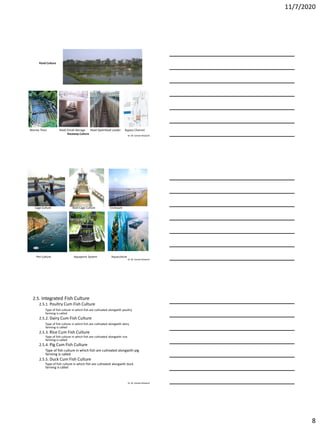
2.4. Depending upon Facilities
2.4.1. Pond Culture
Type of fish culture in which earthen ponds are used for
cultivation is called
2.4.2. Raceway Culture
Type of fish culture in which raceways are used for cultivation is
called
2.4.3. Cage Culture
Type of fish culture in which cages are used for cultivation is called
2.4.4. Enclosure
Type of fish culture in which enclosure are used cultivation is
called
2.4.5. Pen Culture
Type of fish culture in which pen/strings are used cultivation is
called
2.4.6. Aquaponic
Type of fish culture in which artificial structure are used
cultivation of fish is called
2.4.7. Aquaculture
Type of fish culture in which fish along other organism are
cultivated is called
11/7/2020
8
Dr. M. Samee Mubarik
Murree Trout Head Jinnah Barrage Head QadirAbad Leader Bypass Channel
Raceway Culture
Pond Culture
Dr. M. Samee Mubarik
Cage Culture Boat Cage Culture Enclosure
Pen Culture Aquaponic System Aquaculture
Dr. M. Samee Mubarik
2.5. Integrated Fish Culture
2.5.1. Poultry Cum Fish Culture
Type of fish culture in which fish are cultivated alongwith poultry
farming is called
2.5.2. Dairy Cum Fish Culture
Type of fish culture in which fish are cultivated alongwith dairy
farming is called
2.5.3. Rice Cum Fish Culture
Type of fish culture in which fish are cultivated alongwith rice
farming is called
2.5.4. Pig Cum Fish Culture
Type of fish culture in which fish are cultivated alongwith pig
farming is called
2.5.5. Duck Cum Fish Culture
Type of fish culture in which fish are cultivated alongwith duck
farming is called
11/7/2020
9
Dr. M. Samee Mubarik
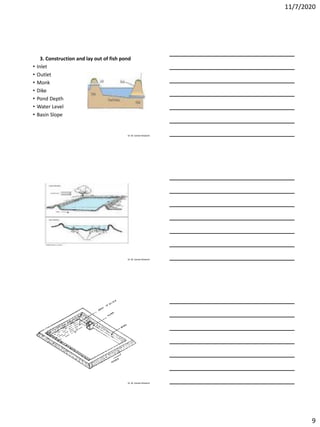
3. Construction and lay out of fish pond
• Inlet
• Outlet
• Monk
• Dike
• Pond Depth
• Water Level
• Basin Slope
Dr. M. Samee Mubarik
11/7/2020
10
Dr. M. Samee Mubarik
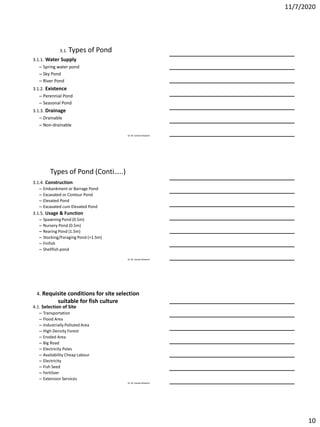
3.1. Types of Pond
3.1.1. Water Supply
– Spring water pond
– Sky Pond
– River Pond
3.1.2. Existence
– Perennial Pond
– Seasonal Pond
3.1.3. Drainage
– Drainable
– Non-drainable
Dr. M. Samee Mubarik
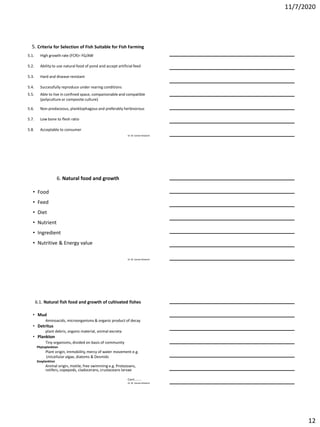
3.1.4. Construction
– Embankment or Barrage Pond
– Excavated or Contour Pond
– Elevated Pond
– Excavated cum Elevated Pond
3.1.5. Usage & Function
– Spawning Pond (0.5m)
– Nursery Pond (0.5m)
– Rearing Pond (1.5m)
– Stocking/Foraging Pond (+1.5m)
– Finfish
– Shellfish pond
Types of Pond (Conti…..)
Dr. M. Samee Mubarik
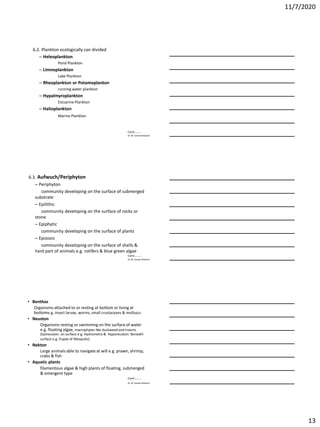
4. Requisite conditions for site selection
suitable for fish culture
4.1. Selection of Site
– Transportation
– Flood Area
– Industrially Polluted Area
– High Density Forest
– Eroded Area
– Big Road
– Electricity Poles
– Availability Cheap Labour
– Electricity
– Fish Seed
– Fertilizer
– Extension Services
11/7/2020
11
Dr. M. Samee Mubarik
4.2. Topography
– Surface Feature of Area
– Flat Area with gentle Slop (0.5-1.0%)
– Slop more than 5% should be avoided
4.3. Soil Quality
– Clay
– Silt
– Sand
– Good soils are heavy clay, silt clay, clay loamy &
water logged
Dr. M. Samee Mubarik
4.4. Water Quality
– Colour
– Odor
– Temperature (Temp.) 12-18/25-35 ◦C
– Dissolved Oxygen (DO) 5 mg.L-1/0.0005 %
– Light Penetration (LP) 10-12cm
– pH 7.5-8.5
– Total Alkalinity (TA) 200 mg.L-1
– Total Hardness (TH) 200 mg.L-1
– Total Solids (TS) 200 mg.L-1
– Ammonia (TA) µg.L-1
– Heavy Metal µg.L-1
Dr. M. Samee Mubarik
List of Model Fish Farms
1. Mian Fish Farm, Mian Mohsin Chak #. 144 R.B.
2. Ch. Faqir Muhammad Fish Farm, 190 R.B.
3. Kajwani Fish Farm, Kajwani Sugar Mills Tandianwala,
Faisalabad
4. Anwar Fish Farm, Chak # 40 G.B.
5. Tufail Fish Farm, Chak # 113 G.B.
6. Crescent Fish Farm, Crescent Jute Mills, Faisalabad
7. Crescent Fish Farm, Crescent Sugar Mills, Nishat Abad
8. Adnan Fish Farm, Mian M. Adnan, Chak #. 144 R.B., Fsd
9. Mian Fish Farm, Mian M. Hussain, Chak #. 214 R.B., Fsd
10. Waraich Fish Farm, M. Ashad Waraich, Chak #. 462 G. B.,
Fsd
Total # of Fish Farms Total Area (Acres)
114 460
11/7/2020
12
Dr. M. Samee Mubarik
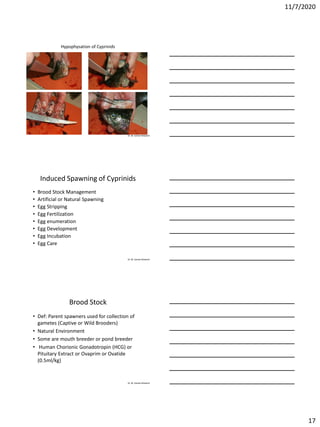
5. Criteria for Selection of Fish Suitable for Fish Farming
5.1. High growth rate (FCR)= FG/AW
5.2. Ability to use natural food of pond and accept artificial feed
5.3. Hard and disease resistant
5.4. Successfully reproduce under rearing conditions
5.5. Able to live in confined space, companionable and compatible
(polyculture or composite culture)
5.6. Non-predaceous, planktophagous and preferably herbivorous
5.7. Low bone to flesh ratio
5.8. Acceptable to consumer
Dr. M. Samee Mubarik
6. Natural food and growth
• Food
• Feed
• Diet
• Nutrient
• Ingredient
• Nutritive & Energy value
Dr. M. Samee Mubarik
6.1. Natural fish food and growth of cultivated fishes
• Mud
Aminoacids, microorganisms & organic product of decay
• Detritus
plant debris, organic material, animal excreta
• Plankton
Tiny organisms, divided on basis of community
Phytoplankton
Plant origin, Immobility, mercy of water movement e.g.
Unicellular algae, diatoms & Desmids
Zooplankton
Animal origin, motile, free swimming e.g. Protozoans,
rotifers, copepods, cladocerans, crustaceans larvae
Conti……….
11/7/2020
13
Dr. M. Samee Mubarik
6.2. Plankton ecologically can divided
– Heleoplankton
Pond Plankton
– Limnoplankton
Lake Plankton
– Rheoplankton or Potamoplanton
running water plankton
– Hypalmyroplankton
Estuarine Plankton
– Halioplankton
Marine Plankton
Conti……….
Dr. M. Samee Mubarik
6.3. Aufwuch/Periphyton
– Periphyton
community developing on the surface of submerged
substrate
– Epilithic
community developing on the surface of rocks or
stone
– Epiphytic
community developing on the surface of plants
– Epizooic
community developing on the surface of shells &
hard part of animals e.g. rotifers & blue green algae
Conti……….
Dr. M. Samee Mubarik
• Benthos
Organisms attached to or resting at bottom or living at
bottome.g. insect larvae, worms, small crustaceans & molluscs
• Neuston
Organisms resting or swimming on the surface of water
e.g. floating algae, macrophytes like duckweed and Insects
(Epineuston: on surface e.g. Hydrometra & Hyponeuston: Beneath
surface e.g. Pupae of Mosquito)
• Nekton
Large animals able to navigate at will e.g. prawn, shrimp,
crabs & fish
• Aquatic plants
filamentous algae & high plants of floating, submerged
& emergent type
Conti……….
11/7/2020
14
Dr. M. Samee Mubarik
Fish Feeding Types
• Mud Feeders
Ingest finely divided silt at bottom, e.g. Prochilodus sp.
• Detritivores
Ingest detritus, valuable source of nutrients from
decomposed organic particles including micro-organisms e.g.
Cyprinids & Tilapia sp.
• Scavengers
Feed on dead or decay organism e.g. Myxine sp.
• Herbivores
– Grazers: scrape or rasp algae from algae bottom e.g.
Plecostomus
– Browsers: feed on regularly on leaves, stems of higher
plants & filamentous algae e.g. Ctenopharyngodon
– Phytoplanktivores: primarily feed upon phytoplankton e.g.
diatoms
Conti……….
Dr. M. Samee Mubarik
• Carnivores (live animal Prey)
– Zooplanktivores
Feed on zooplankton either pick individuallyor by gill racks filtratione.g. Engraolis
– Benthivores
Feed on insect larvae, annelid worms, small crustaceans & molluscs
– Aerial Feeders
Feed on flying insect or resting above the water surface e.g. Salmonids &
Toxotes sp.
– Piscivores
Feed exclusively on fish e.g. Nandus sp.
– Cannibilitics
Feed on young ones of their own specie . too e.g. Channa sp.
– Specialized Carnivores (feed but do not kill the host)
I) Parsitic feed on blood of host catfish e.g. Lamrey sp.
II) Scale Eaters feed on plucked scales of fishes (Lepidophagy) e.g. Exodon sp.
IIIFin Biters feed on pieces they bite from the fins of other fishes e.g.
Belanophago sp.
• Omnivores
feed on variety of food including plants & animals
Dr. M. Samee Mubarik
Food and feeding of fish, types of
ingredients used in fish feed
• Food Ingredients
– Fish Meal
– Blood Meal
– Rice Polish
– Maize Glutein (30-60 % CP)
– Soyabean Meal
– Sunflower Meal
– Molluscs
– Insects
etc
11/7/2020
15
Dr. M. Samee Mubarik
7. Fish feed composition, preparation and
preservation
• Crude Protein (CP %) Essential AA
• Crude Fat (CF %) Essential FA
• Carbohydrates (Carb %)
• Vitamin
• Mineral
• Energy Value (K.cal)
Dr. M. Samee Mubarik
Fish Feed Formulation
• Square Method
• Algorithmic Method
30 % Crude Protein (CP) Fish Supplementary Diet by taking animal and Plant sources (50 /50).
Source of
Ingredients
CP % in
Ingredients
Diet 1 Diet 2
% of
Ingredients
taken
CP % taken
from
Ingredients
CP%
in Diet
% of
Ingredients
taken
CP % taken
from
Ingredients
CP% in
Diet
Fish Meal 48 32 32×48/100= 15.36 32 32×48/100= 15.36
Maize Glutein
CP30/35%
30 20 20×30/100= 6.0 16 16×30/100= 4.8
Sunflower Meal 25 20 20×25/100= 5.0 18 18×25/100= 4.5
Soya bean Meal 25 10 10×25/100= 2.5 18 18×25/100= 4.5
Rice Polish 12 12 12×12/100= 1.44 10 10×12/100= 1.2
Vitamin &
Mineral/
Antioxidant/
Flavors/Vaccines
0 2 2×0/100= 0 2 2×0/100= 0
Oil Binders 0 4 4×0/100= 0 4 4×0/100= 0
Total 100 30.30 100 30.36
Dr. M. Samee Mubarik
7.Breeding of Cyprinids
• Gender of Fish
• Maturity of Fish
• Egg Laying Capacity
• Breeding Season
11/7/2020
16
Dr. M. Samee Mubarik
Reproductive behavior of fish, GSI (G/B)
• Breeding Requirement
– Light (Photo-period)
– Rainfall
– Temperature
– Flow Rate
– pH of water
– EC of water
Dr. M. Samee Mubarik
Artificial breeding of Fish
• Reproductive Physiology of fish
• Hypophysation
• Induced Spawning
Dr. M. Samee Mubarik
Endocrine Cascade
• Brain releases
messengers
• Pit releases
gonadotropins
• Gonads release
steroids
• Gonad forms gametes
11/7/2020
17
Dr. M. Samee Mubarik
Hypophysation of Cyprinids
Dr. M. Samee Mubarik
Induced Spawning of Cyprinids
• Brood Stock Management
• Artificial or Natural Spawning
• Egg Stripping
• Egg Fertilization
• Egg enumeration
• Egg Development
• Egg Incubation
• Egg Care
Dr. M. Samee Mubarik
Brood Stock
• Def: Parent spawners used for collection of
gametes (Captive or Wild Brooders)
• Natural Environment
• Some are mouth breeder or pond breeder
• Human Chorionic Gonadotropin (HCG) or
Pituitary Extract or Ovaprim or Ovatide
(0.5ml/kg)
11/7/2020
18
Dr. M. Samee Mubarik
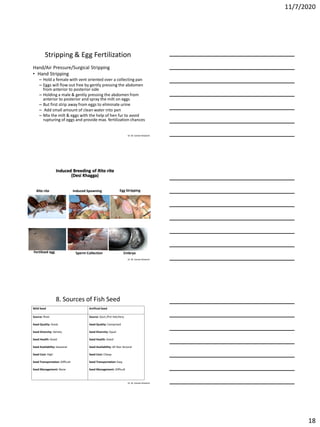
Stripping & Egg Fertilization
Hand/Air Pressure/Surgical Stripping
• Hand Stripping
– Hold a female with vent oriented over a collecting pan
– Eggs will flow out free by gently pressing the abdomen
from anterior to posterior side
– Holding a male & gently pressing the abdomen from
anterior to posterior and spray the milt on eggs
– But first strip away from eggs to eliminate urine
– Add small amount of clean water into pen
– Mix the milt & eggs with the help of hen fur to avoid
rupturing of eggs and provide max. fertilization chances
Dr. M. Samee Mubarik
Induced Breeding of Rita rita
(Desi Khagga)
Rita rita Induced Spawning Egg Stripping
Sperm Collection
Fertilized egg Embryo
Dr. M. Samee Mubarik
8. Sources of Fish Seed
Wild Seed Artificial Seed
Source: River
Seed Quality: Great
Seed Diversity: Variety
Seed Health: Good
Seed Availability: Seasonal
Seed Cost: High
Seed Transportation: Difficult
Seed Management: None
Source: Govt./Pvt Hatchery
Seed Quality: Comprised
Seed Diversity: Equal
Seed Health: Good
Seed Availability: All Year Around
Seed Cost: Cheap
Seed Transportation: Easy
Seed Management: Difficult
11/7/2020
19
Dr. M. Samee Mubarik
Development
Dr. M. Samee Mubarik
Paper Discussion
Dr. M. Samee Mubarik
9. Biological means of increasing fish
production
• Organic Fertilizers
• Integrated Fish Culture
• Polyculture/Composite Culture
• Aquaponics
• Aquaculture
11/7/2020
20
Dr. M. Samee Mubarik
Organic fertilizers, their application
and impact on fish and water quality
• Poultry Manure (Poultry dropping)
• Cowdung
• Domestic Waste
Dr. M. Samee Mubarik
Inorganic fertilizers and their application
and impact on fish and water quality
• Ammonium Nitrate (NH4NO3)
• Single Super Phosphate (SSP)
• Triple Super Phosphate (TSP)
• Ammonium Phosphate
Dr. M. Samee Mubarik
Pros & Corns of Organic & Inorganic Fertilizer
Organic Fertilizer /Manure Inorganic
• Cheaper Source
• Easily Available
• Less Toxic
• May have pathogenic agent
• Decomposition
• Costly
• Seasonal Availability
• Very Toxic in large quantity
• No Pathogenicity
• Readily available Nutrients
11/7/2020
21
Dr. M. Samee Mubarik
10. Maintenance and improvement of pond
• Aquatic Vegetation Control
• Fish Predators
• Pond Structure & Shape
• Liming
• Carrying Capacity
• Stocking Density
Dr. M. Samee Mubarik
12. Fish Diseases
common in captivity but minor in natural environment
• Infectious Diseases
– Viral
– Bacterial
– Fungal
– Protozoan
– Crustacean
• Non-infectious
– Abiotic
– Biotic
Dr. M. Samee Mubarik
11/7/2020
22
Dr. M. Samee Mubarik
Symptoms of Fish Diseases
• Discoloration of body
• Rapid secretion of grey coloured slime on the
body
• Appearance of white, brown or black spots on
the body
• Growth of fungus
• Irritation, due to which rubs its body with stones
• Folding of fins & lingering at bottom
• Increase in breathing frequency
• Whirling or tumbling movements
• Diseases of internal organs cause swelling of
abdomen
• Fish population stop eating
Dr. M. Samee Mubarik
Prophylactic measures
• Pond water supply
• Excessive growth of plants & siltation to be removed
• Pond & tank must be dried out at least once in two
years
• Disease free fingerling should be selected
• Overcrowding should be avoided
• Disease outbreak, dead or seriously infected fish
must be destroyed
• Excessive & rough handling should be avoided cause
stress to fish
• Disinfection of pond is advisable by quick lime
(500kg/ha)
Dr. M. Samee Mubarik
Viral Diseases
• Viruses smallest microorganism ranging from
25-300 nm in size only be seen by EM.
• Multiply locally in the host & form inclusion
• with a secondary bacterial or fungal infection
• Few cases, vaccines & antibiotic drugs mixed
with food have shown to effective in
protecting fish
• Such measures on commercial scale are not
only laborious but uneconomical
11/7/2020
23
Dr. M. Samee Mubarik
Lymphocystis
Proliferous growth of
connecting tissues in skin,
cell may grow 50,000 times
in size, no mortality,
disfigurement of shape
• Symptoms:
Tumours or Warts on
the body
• Treatment:
No Cure, effected
fish should be
destroyed
Warts
Dr. M. Samee Mubarik
Viral Haemorrhagic Septicaemia (VHS)
In rainbow trout farming,
confined to Europe,
mortality rate high
• Symptoms:
Usually kidney & liver
infected; belly swells & foul
smelling yellowish fluid
found in visceral cavity
• Treatment: No Cure,
infected fish should be
destroyed
Viral Haemorrhagic
Septicaemia
Dr. M. Samee Mubarik
Infectious Pancreatic Necrosis (IPN)
Contagious to salmonids &
confined to USA, JAPAN,
EU
• Symptoms: Revolves,
disorderly swim, finally
rest at bottom, cavity
filled with white fluid,
dragging threadlike
mucus feces
• Treatment: No cure,
bury or burn infected
fish
Infectious Pancreatic
Necrosis
11/7/2020
24
Dr. M. Samee Mubarik
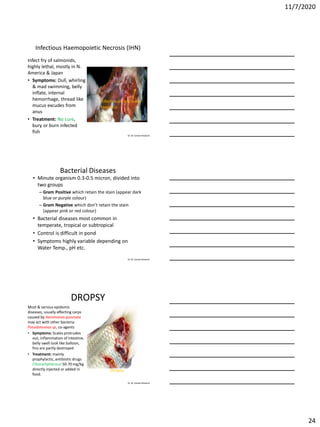
Infectious Haemopoietic Necrosis (IHN)
Infect fry of salmonids,
highly lethal, mostly in N.
America & Japan
• Symptoms: Dull, whirling
& mad swimming, belly
inflate, internal
hemorrhage, thread like
mucus excudes from
anus
• Treatment: No cure,
bury or burn infected
fish
Infectious Pancreatic
Necrosis
Dr. M. Samee Mubarik
Bacterial Diseases
• Minute organism 0.3-0.5 micron, divided into
two groups
– Gram Positive which retain the stain (appear dark
blue or purple colour)
– Gram Negative which don’t retain the stain
(appear pink or red colour)
• Bacterial diseases most common in
temperate, tropical or subtropical
• Control is difficult in pond
• Symptoms highly variable depending on
Water Temp., pH etc.
Dr. M. Samee Mubarik
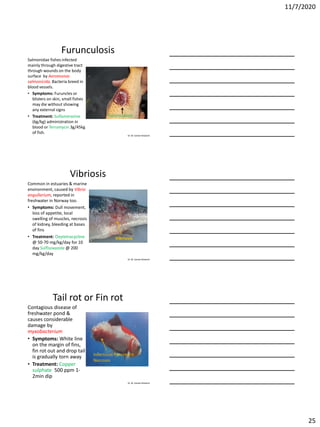
DROPSY
Most & serious epidemic
diseases, usually affecting carps
caused by Aeromonas punctata
may act with other bacteria
Pseudomonas sp, co-agents
• Symptoms: Scales protrudes
out, inflammation of intestine,
belly swell look like balloon,
fins are partly destroyed
• Treatment: mainly
prophylactic, antibiotic drugs
Chloramphenicol 50-70 mg/kg
directly injected or added in
food.
Dropsy
11/7/2020
25
Dr. M. Samee Mubarik
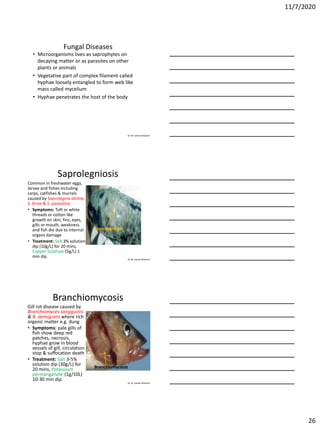
Furunculosis
Salmonidae fishes infected
mainly through digestive tract
through wounds on the body
surface by Aeromonas
salmonicida. Bacteria breed in
blood vessels.
• Symptoms: Furuncles or
blisters on skin, small fishes
may die without showing
any external signs
• Treatment: Sulfamerazine
(6g/kg) administration in
blood or Terramycin 3g/45kg
of fish.
Furunculosis
Dr. M. Samee Mubarik
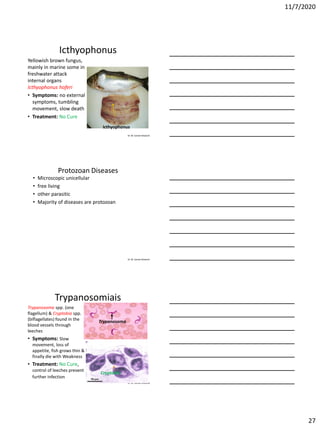
Vibriosis
Common in estuaries & marine
environment, caused by Vibrio
angullarium, reported in
freshwater in Norway too.
• Symptoms: Dull movement,
loss of appetite, local
swelling of muscles, necrosis
of kidney, bleeding at bases
of fins
• Treatment: Oxytetracycline
@ 50-70 mg/kg/day for 10
day Sulfisoxazole @ 200
mg/kg/day
Vibriosis
Dr. M. Samee Mubarik
Tail rot or Fin rot
Contagious disease of
freshwater pond &
causes considerable
damage by
myxobacterium
• Symptoms: White line
on the margin of fins,
fin rot out and drop tail
is gradually torn away
• Treatment: Copper
sulphate 500 ppm 1-
2min dip
Infectious Pancreatic
Necrosis
11/7/2020
26
Dr. M. Samee Mubarik
Fungal Diseases
• Microorganisms lives as saprophytes on
decaying matter or as parasites on other
plants or animals
• Vegetative part of complex filament called
hyphae loosely entangled to form web like
mass called mycelium
• Hyphae penetrates the host of the body
Dr. M. Samee Mubarik
Saprolegniosis
Common in freshwater eggs,
larvae and fishes including
carps, catfishes & murrels
caused by Saprolegnia diclina,
S. ferax & S. parasitica
• Symptoms: Tuft or white
threads or cotton like
growth on skin, fins, eyes,
gills or mouth, weakness
and fish die due to internal
organs damage
• Treatment: Salt 3% solution
dip (10g/L) for 20 mins,
Copper Sulphate (5g/L) 1
min dip
Saprolegniosis
Dr. M. Samee Mubarik
Branchiomycosis
Gill rot disease caused by
Branchiomyces sangguinis
& B. demigrans where rich
organic matter e.g. dung
• Symptoms: pale gills of
fish show deep red
patches, necrosis,
hyphae grow in blood
vessels of gill, circulation
stop & suffocation death
• Treatment: Salt 3-5%
solution dip (30g/L) for
20 mins, Potassium
permanganate (1g/10L)
10-30 min dip
Branchiomycosis
11/7/2020
27
Dr. M. Samee Mubarik
Icthyophonus
Yellowish brown fungus,
mainly in marine some in
freshwater attack
internal organs
Icthyophonus hoferi
• Symptoms: no external
symptoms, tumbling
movement, slow death
• Treatment: No Cure
Icthyophonus
Dr. M. Samee Mubarik
Protozoan Diseases
• Microscopic unicellular
• free living
• other parasitic
• Majority of diseases are protozoan
Dr. M. Samee Mubarik
Trypanosomiais
Trypanosoma spp. (one
flagellum) & Cryptobia spp.
(biflagellates) found in the
blood vessels through
leeches
• Symptoms: Slow
movement, loss of
appetite, fish grows thin &
finally die with Weakness
• Treatment: No Cure,
control of leeches prevent
further infection
Trypanosoma
Cryptobia
11/7/2020
28
Dr. M. Samee Mubarik
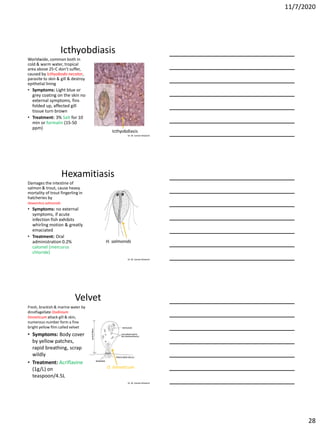
Icthyobdiasis
Worldwide, common both in
cold & warm water, tropical
area above 25◦C don’t suffer,
caused by Icthyobodo necator,
parasite to skin & gill & destroy
epithelial lining
• Symptoms: Light blue or
grey coating on the skin no
external symptoms, fins
folded up, affected gill
tissue turn brown
• Treatment: 3% Salt for 10
min or formalin (15-50
ppm)
Icthyobdiasis
Dr. M. Samee Mubarik
Hexamitiasis
Damages the intestine of
salmon & trout, cause heavy
mortality of trout fingerling in
hatcheries by
Hexamitus salmonids
• Symptoms: no external
symptoms, if acute
infection fish exhibits
whirling motion & greatly
emaciated
• Treatment: Oral
administration 0.2%
calomel (mercurus
chloride)
H. salmonids
Dr. M. Samee Mubarik
Velvet
Fresh, brackish & marine water by
dinoflagellate Oodinium
limneticum attack gill & skin,
numerous number form a fine
bright yellow film called velvet
• Symptoms: Body cover
by yellow patches,
rapid breathing, scrap
wildly
• Treatment: Acriflavine
(1g/L) on
teaspoon/4.5L
O. limneticum
11/7/2020
29
Dr. M. Samee Mubarik
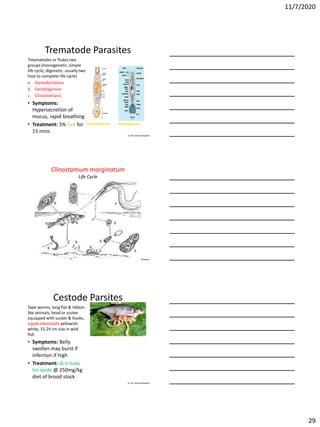
Trematode Parasites
Treamatodes or flukes two
groups (monogenetic: simple
life cycle; digenetic: usually two
host to complete life cycle)
a. Gyraodactylosis
b. Dactylogyrosis
c. Clinostomiasis
• Symptoms:
Hypersecretion of
mucus, rapid breathing
• Treatment: 5% Salt for
15 mins
Gyraodactylosis Dactylogyrosis
Dr. M. Samee Mubarik
Clinostomum marginatum
Life Cycle
Dr. M. Samee Mubarik
Cestode Parsites
Tape worms, long flat & ribbon
like animals, head or scolex
equipped with sucker & hooks,
Ligula intestinalis yellowish
white, 15-24 cm size in wild
fish
• Symptoms: Belly
swollen may burst if
infection if high
• Treatment: di-n-buty
tin oxide @ 250mg/kg
diet of brood stock
L. intestinalis
11/7/2020
30
Dr. M. Samee Mubarik
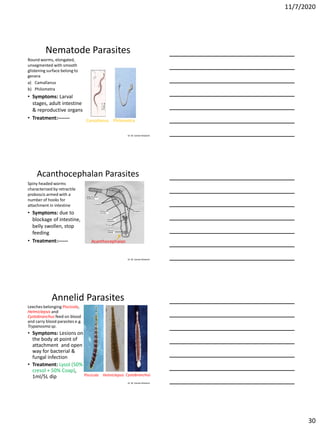
Nematode Parasites
Round worms, elongated,
unsegmented with smooth
glistening surface belong to
genera
a) Camallanus
b) Philometra
• Symptoms: Larval
stages, adult intestine
& reproductive organs
• Treatment:------- Camallanus Philometra
Dr. M. Samee Mubarik
Acanthocephalan Parasites
Spiny headed worms
characterized by retractile
proboscis armed with a
number of hooks for
attachment in intestine
• Symptoms: due to
blockage of intestine,
belly swollen, stop
feeding
• Treatment:------ Acanthocephalan
Dr. M. Samee Mubarik
Annelid Parasites
Leeches belonging Piscicola,
Helmiclepsis and
Cystobranchus feed on blood
and carry blood parasites e.g.
Trypanosma sp.
• Symptoms: Lesions on
the body at point of
attachment and open
way for bacterial &
fungal infection
• Treatment: Lysol (50%
cresol + 50% Coap),
1ml/5L dip Piscicola Helmiclepsis Cystobranchus
11/7/2020
31
Dr. M. Samee Mubarik
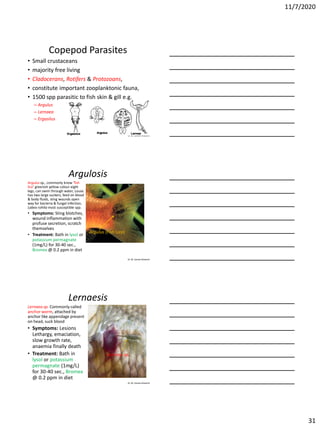
Copepod Parasites
• Small crustaceans
• majority free living
• Cladocerans, Rotifers & Protozoans,
• constitute important zooplanktonic fauna,
• 1500 spp parasitic to fish skin & gill e.g.
– Argulus
– Lernaea
– Ergasilus
Dr. M. Samee Mubarik
Argulosis
Argulus sp., commonly know ‘fish
lice’ greenish yellow colour eight
legs, can swim through water, Louse
has two large suckers, feed on blood
& body fluids, sting wounds open
way for bacteria & fungal infection,
Labeo rohita most susceptible spp.
• Symptoms: Sting blotches,
wound inflammation with
profuse secretion, scratch
themselves
• Treatment: Bath in lysol or
potassium permagnate
(1mg/L) for 30-40 sec.,
Bromex @ 0.2 ppm in diet
Argulus (Fish Lice)
Dr. M. Samee Mubarik
Lernaesis
Lernaea sp. Commonly called
anchor worm, attached by
anchor like appendage present
on head, suck blood
• Symptoms: Lesions
Lethargy, emaciation,
slow growth rate,
anaemia finally death
• Treatment: Bath in
lysol or potassium
permagnate (1mg/L)
for 30-40 sec., Bromex
@ 0.2 ppm in diet
Lernaea sp.
11/7/2020
32
Dr. M. Samee Mubarik
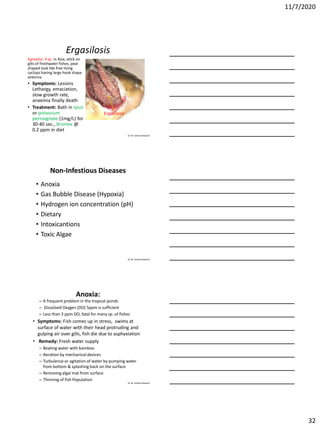
Ergasilosis
Egrasilus 4 sp. in Asia, attck on
gills of freshwater fishes, pear
shaped look like free living
cyclops having large hook shape
antenna
• Symptoms: Lesions
Lethargy, emaciation,
slow growth rate,
anaemia finally death
• Treatment: Bath in lysol
or potassium
permagnate (1mg/L) for
30-40 sec., Bromex @
0.2 ppm in diet
Ergasilosis
Dr. M. Samee Mubarik
Non-Infestious Diseases
• Anoxia
• Gas Bubble Disease (Hypoxia)
• Hydrogen ion concentration (pH)
• Dietary
• Intoxicantions
• Toxic Algae
Dr. M. Samee Mubarik
Anoxia:
– A frequent problem in the tropical ponds
– Dissolved Oxygen (DO) 5ppm is sufficient
– Less than 3 ppm DO, fatal for many sp. of fishes
• Symptoms: Fish comes up in stress, swims at
surface of water with their head protruding and
gulping air over gills, fish die due to asphyxiation
• Remedy: Fresh water supply
– Beating water with bamboo
– Aeration by mechanical devices
– Turbulence or agitation of water by pumping water
from bottom & splashing back on the surface
– Removing algal mat from surface
– Thinning of fish Population
11/7/2020
33
Dr. M. Samee Mubarik
Gas Bubble Disease (Hypoxia)
– Excess saturation of gases (O2, N2 & CO2)
– Above than 110% is problematic may cause embolism
– Gas bubbles in blood capillaries cause hindrance to
circulation of blood
• Symptoms: Loose connective tissue surrounding
eye ball, it results into the protrusion of eye ball
called pop-eye
– Small bubbles beneath skin, on fin, around the eye, in
stomach & intestine
– Bleeding may occur due to occlusion of blood
capillaries
– Bubble reach brain or heart sudden death may occur
• Remedy:
– Well agitation to lower the saturation of gases below
110%
– Infected fish should be transferred to other pond
Dr. M. Samee Mubarik
Hydrogen Ion Concentration (pH)
– Acidic water are not suitable for fish rearing
– A greater pH 7.5-8.5 is best
• Symptoms:
• If pH goes down, fish shows signs of acidaemia
• Fish may perform rapid movement & tendency to
jump out of water
• Remedy:
– pH level must be normalized with judicious
application of powdered calcium carbide
Dr. M. Samee Mubarik
Dietary Diseases
– Dietary diseases caused due to nutritional
deficiencies
• Symptoms:
– Anemia due to varied vitamin
– Thyroid tumor or goiter deficiency of Iodine
– Muscle and liver lesion deficiency of Vitamin E
– Dietary gill diseases deficiency of pantothenic acid
– Blue slim disease of trout deficiency of biotin
– Lipoid degeneration from over feeding of poorly
balance diet
– Remedy:
– Poorly balance diet with additive vitamins &
minerals
11/7/2020
34
Dr. M. Samee Mubarik
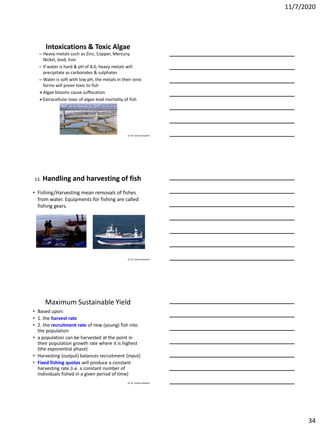
Intoxications & Toxic Algae
– Heavy metals such as Zinc, Copper, Mercury,
Nickel, lead, Iron
– If water is hard & pH of 8.0, heavy metals will
precipitate as carbonates & sulphates
– Water is soft with low pH, the metals in their ionic
forms will prove toxic to fish
Algae blooms cause suffocation
Extracellular toxic of algae lead mortality of fish
Dr. M. Samee Mubarik
13. Handling and harvesting of fish
• Fishing/Harvesting mean removals of fishes
from water. Equipments for fishing are called
fishing gears.
Dr. M. Samee Mubarik
Maximum Sustainable Yield
• Based upon:
• 1. the harvest rate
• 2. the recruitment rate of new (young) fish into
the population
• a population can be harvested at the point in
their population growth rate where it is highest
(the exponential phase)
• Harvesting (output) balances recruitment (input)
• Fixed fishing quotas will produce a constant
harvesting rate (i.e. a constant number of
individuals fished in a given period of time)
11/7/2020
35
Dr. M. Samee Mubarik
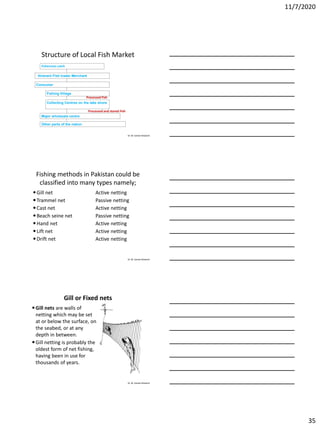
Structure of Local Fish Market
Fisherman catch
Itinerant Fish trader Merchant
Consumer
Fishing Village
Collecting Centres on the lake shore
Major wholesale centre
Other parts of the nation
Processed Fish
Processed and stored Fish
Dr. M. Samee Mubarik
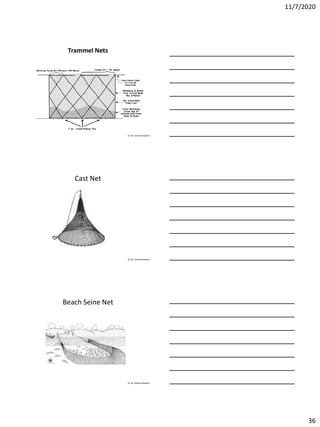
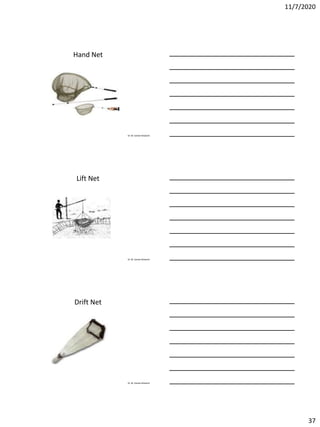
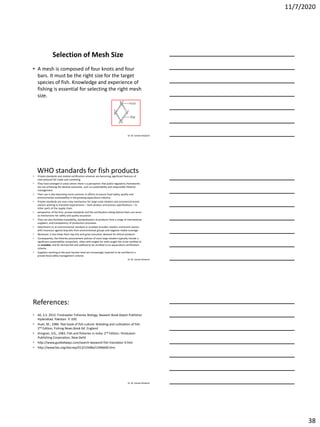
Fishing methods in Pakistan could be
classified into many types namely;
Gill net Active netting
Trammel net Passive netting
Cast net Active netting
Beach seine net Passive netting
Hand net Active netting
Lift net Active netting
Drift net Active netting
Dr. M. Samee Mubarik
Gill or Fixed nets
Gill nets are walls of
netting which may be set
at or below the surface, on
the seabed, or at any
depth in between.
Gill netting is probably the
oldest form of net fishing,
having been in use for
thousands of years.
11/7/2020
36
Dr. M. Samee Mubarik
Trammel Nets
Dr. M. Samee Mubarik
Cast Net
Dr. M. Samee Mubarik
Beach Seine Net
11/7/2020
37
Dr. M. Samee Mubarik
Hand Net
Dr. M. Samee Mubarik
Lift Net
Dr. M. Samee Mubarik
Drift Net
11/7/2020
38
Dr. M. Samee Mubarik
Selection of Mesh Size
• A mesh is composed of four knots and four
bars. It must be the right size for the target
species of fish. Knowledge and experience of
fishing is essential for selecting the right mesh
size.
Dr. M. Samee Mubarik
WHO standards for fish products
• Private standards and related certification schemes are becoming significant features of
international fish trade and marketing.
• They have emerged in areas where there is a perception that public regulatory frameworks
are not achieving the desired outcomes, such as sustainability and responsible fisheries
management.
• Their use is also becoming more common in efforts to ensure food safety, quality and
environmental sustainability in the growing aquaculture industry.
• Private standards are now a key mechanism for large-scale retailers and commercial brand
owners wishing to translate requirements – both product and process specifications – to
other parts of the supply chain.
• perspective of the firm, private standards and the certification sitting behind them can serve
as mechanisms for safety and quality assurance.
• They can also facilitate traceability, standardization of products from a range of international
suppliers, and transparency of production processes.
• Attachment to an environmental standard or ecolabel provides retailers and brand owners
with insurance against boycotts from environmental groups and negative media coverage.
• Moreover, it also helps them tap into and grow consumer demand for ethical products.
• Consequently, the fisheries procurement policies of most large retailers typically include a
significant sustainability component, often with targets for wild-caught fish to be certified to
an ecolabel, and for farmed fish and seafood to be certified to an aquaculture certification
scheme.
• Suppliers working at the post-harvest level are increasingly required to be certified to a
private food safety management scheme.
Dr. M. Samee Mubarik
References:
• Ali, S.S. 2012. Freshwater Fisheries Biology. Naseem Book Depot Publisher.
Hyderabad. Pakistan. P. 330.
• Huet, M., 1986. Text book of fish culture: Breeding and cultivation of fish.
2nd Edition. Fishing News Book ltd. England
• Jhingran, V.G., 1983. Fish and fisheries in India. 2nd Edition. Hinduston
Publishing Corporation, New Dehli
• http://www.guidedways.com/search-keyword-fish-translator-4.htm
• http://www.fao.org/docrep/013/i1948e/i1948e00.htm
11/7/2020
39
Dr. M. Samee Mubarik
Final Paper Discussion

Fish culture zool4140 (dr. samee) handout

  • 1.
    11/7/2020 1 Dr. M. SameeMubarik Introduction of Course Course Code: ZOOL4140 Course Title: Fish Culture Credit Hours: 3(2-1) Class: BS/M. Sc. Zoology (M&E) Session: Fall, 2020-2021 Instructor: Dr. Muhammad Samee Mubarik Contact #: +92-300-6644884 Email: sameech2002@yahoo.com samee.mubarik@ue.edu.pk Dr. M. Samee Mubarik Division of Marks Total Marks: 60 Theory: 40 Practical: 20 Division of Theory Marks Mid Exam: 12 (30%) Final Exam: 20 (50%) Assignments: 08 (20%) Dr. M. Samee Mubarik Course Contents • Weekly Lecture Plan Provided
  • 2.
    11/7/2020 2 Dr. M. SameeMubarik Definition of Fish • Bilaterally Symmetrical • Cold blooded (poikilothermic) • Gill breathing • Water living • Vertebrate Dr. M. Samee Mubarik Other meanings of Fish • FISh (programming language), an array programming language • Fish (cryptography) (sometimes FISH), the British codeword for World War II German stream cipher teleprinter secure communications devices • FISH (Fluorescent in situ hybridization, a technique used in genetics to detect DNA sequences) Dr. M. Samee Mubarik • To hunt and to eat the fish of the sea is made lawful for you, a provision for you and for seafarers; but to hunt on land is forbidden you so long as ye are on the pilgrimage. Be mindful of your duty to Allah, unto Whom ye will be gathered (Al- Maeda [5:96] ). • Ask them (O Muhammad) of the township that was by the sea, how they did break the Sabbath, how their big fish came unto them visibly upon their Sabbath day and on a day when they did not keep Sabbath came they not unto them. Thus did We try them for that they were evil-livers. (Al-Araf [7:163] ) • And when they reached the point where the two met, they forgot their fish, and it took its way into the waters, being free. (Al-Kahf [18:61] ) • He said: Didst thou see, when we took refuge on the rock, and I forgot the fish - and none but Satan caused me to forget to mention it - it took its way into the waters by a marvel. (Al-Kahf [18:63]) • And the fish swallowed him while he was blameworthy. (As-Saaffat [37:142] ) • But wait thou for thy Lord's decree, and be not like him of the fish, who cried out in despair. (Al-Qalam [68:48])
  • 3.
    11/7/2020 3 Dr. M. SameeMubarik • Freshwater fishes are 198 species are present in Pakistan belonging to following different orders – Cypriniformes – Characiformes – Siluriformes – Perciformes Dr. M. Samee Mubarik Puffer Fish Gumbozia Dr. M. Samee Mubarik 1. Ecological Importance of Fish • As fish lives in water • Water Surface 70% • Land Surface 30% • Salt Water Volume (Marine & Sea) 97.2% • Fresh Water Volume 2.8%
  • 4.
    11/7/2020 4 Dr. M. SameeMubarik FISHERIES RESOURCES OF PUNJAB (AREA IN HECTARES) RIVERS AND MAIN TRIBUTARIES Max. 2,940,000 Min. 713,000 CANALS 22,400 DAMS 24,960 RESERVOIRS 40,840 (ATTACHED WITH BARRAGES) LAKES & WATER LOGGED AREAS 47,400 Source: Fisheries Sector Study 1987 SMALL DAMS 7,000 PRIVATE FISH FARMS 24,190 (Till June 2015) Reference: Dr. Muhammad Ayub, DG, Department of Fisheries, Punjab (During Monsoon) Dr. M. Samee Mubarik Fish Body Shape There is a tremendous diversity of fish in the world. Each species is adapted to life in a specific habitat. Dr. M. Samee Mubarik • Catla catla • Labeo rohita • Cirrhinus mrigala Major Carps
  • 5.
    11/7/2020 5 Dr. M. SameeMubarik Common Fish Species in Pakistan Sr. No Species (Local Name) 1. Tor putitora Mahaseer 2. Catla catla Thaila 3. Labeo rohita Rohu 4. Cirrhinus mrigala Mori 5. Cyprinus carpio Gulfam 6. Tilapia mosambica/ Oreochromus niloticus Chirra 7. Wallagu attu Malli 8. Labeo gonius Sariha 9. Notopterus spp. Pari 10. Ompok bimaculatus Palu Dr. M. Samee Mubarik Sr. No Species (Local Name) 11. Bagarius bagarius Mujahid 12. Crosochilus diplochilus Bhangan 13. Heteropneustes fossilis Lohaat 14. Labeo calbasu Kalbans 15. Hypophthalmichthys molitrix Silver carp 16. Channa marulius Soal 17. Ctenophryngodon idella Grass carp 18. Channa punctatus Dola 19. Mastacembulus armatus Baam 20. Eutropchthys vacha Jhali 21. Rita rita Desi Khagga 22. Carassius auratus Paplate 23. Sperata sarwari Singahri 24. Clupisoma garua Bachwa 25. Cirrhinus reba Sonni Dr. M. Samee Mubarik Photo Credit: DG, Department of Punjab Fisheries
  • 6.
    11/7/2020 6 Dr. M. SameeMubarik Types of Fish Culture 2.1. Depending upon stocking density 2.2. Depending upon gender 2.3. Depending upon Species 2.4. Depending upon Facilities 2.5. Integrated Fish Culture Dr. M. Samee Mubarik 2.1. Depending upon stocking density 2.1.1. Conventional Fish Culture 2.1.2. Extensive Fish Culture 2.1.3. Semi-intensive Fish Culture 2.1.4. Intensive Fish Culture 2.1.5. Super-Intensive Fish Culture Dr. M. Samee Mubarik Extensive Fish Culture Semi-Intensive Fish Culture Intensive Fish Culture • Poor Management Skills • Stocking Density (n<1000) • Input low • Underdeveloped Countries where labour is cheap • Income Low • Good Management Skills • Stocking Density (n=1000) • Input Medium • Developing Countries where labour is cheap • Income High • Higher Management Skills • Stocking Density (n>1000) • Input High • Developed Countries where labour is not cheap • Income very High
  • 7.
    11/7/2020 7 Dr. M. SameeMubarik 2.2. Depending upon gender 2.2.1. Mixed Sex Culture Type of fish culture in which both gender (male & female) of any fish specie are cultivated 2.2.2. Mono Sex Culture Type of fish culture in which only one gender (Either male/female/hybrid) of any fish specie are be cultivated Dr. M. Samee Mubarik 2.3. Depending upon Species 2.3.1. Mono Culture Type of fish culture in which only one specie of any fish is cultivated (ex. Labeo rohita or Catla catla etc) 2.3.2. Poly Culture Type of fish culture in which two or more than two fish species are cultivated either indigenous or exotic species (ex. 1. Labeo rohita, Catla catla, Cirrhinus mrigala or 2. Cyprinus carpio, Oreochromis niloticus, Hypophthalmichthys molitrix, Ctenopharyngodon idella) 2.3.3. Composite Culture Type of fish culture in which two or more than two fish species are cultivated i.e. indigenous & exotic species (ex. Labeo rohita, Catla catla, & Oreochromis niloticus) Dr. M. Samee Mubarik 2.4. Depending upon Facilities 2.4.1. Pond Culture Type of fish culture in which earthen ponds are used for cultivation is called 2.4.2. Raceway Culture Type of fish culture in which raceways are used for cultivation is called 2.4.3. Cage Culture Type of fish culture in which cages are used for cultivation is called 2.4.4. Enclosure Type of fish culture in which enclosure are used cultivation is called 2.4.5. Pen Culture Type of fish culture in which pen/strings are used cultivation is called 2.4.6. Aquaponic Type of fish culture in which artificial structure are used cultivation of fish is called 2.4.7. Aquaculture Type of fish culture in which fish along other organism are cultivated is called
  • 8.
    11/7/2020 8 Dr. M. SameeMubarik Murree Trout Head Jinnah Barrage Head QadirAbad Leader Bypass Channel Raceway Culture Pond Culture Dr. M. Samee Mubarik Cage Culture Boat Cage Culture Enclosure Pen Culture Aquaponic System Aquaculture Dr. M. Samee Mubarik 2.5. Integrated Fish Culture 2.5.1. Poultry Cum Fish Culture Type of fish culture in which fish are cultivated alongwith poultry farming is called 2.5.2. Dairy Cum Fish Culture Type of fish culture in which fish are cultivated alongwith dairy farming is called 2.5.3. Rice Cum Fish Culture Type of fish culture in which fish are cultivated alongwith rice farming is called 2.5.4. Pig Cum Fish Culture Type of fish culture in which fish are cultivated alongwith pig farming is called 2.5.5. Duck Cum Fish Culture Type of fish culture in which fish are cultivated alongwith duck farming is called
  • 9.
    11/7/2020 9 Dr. M. SameeMubarik 3. Construction and lay out of fish pond • Inlet • Outlet • Monk • Dike • Pond Depth • Water Level • Basin Slope Dr. M. Samee Mubarik Dr. M. Samee Mubarik
  • 10.
    11/7/2020 10 Dr. M. SameeMubarik 3.1. Types of Pond 3.1.1. Water Supply – Spring water pond – Sky Pond – River Pond 3.1.2. Existence – Perennial Pond – Seasonal Pond 3.1.3. Drainage – Drainable – Non-drainable Dr. M. Samee Mubarik 3.1.4. Construction – Embankment or Barrage Pond – Excavated or Contour Pond – Elevated Pond – Excavated cum Elevated Pond 3.1.5. Usage & Function – Spawning Pond (0.5m) – Nursery Pond (0.5m) – Rearing Pond (1.5m) – Stocking/Foraging Pond (+1.5m) – Finfish – Shellfish pond Types of Pond (Conti…..) Dr. M. Samee Mubarik 4. Requisite conditions for site selection suitable for fish culture 4.1. Selection of Site – Transportation – Flood Area – Industrially Polluted Area – High Density Forest – Eroded Area – Big Road – Electricity Poles – Availability Cheap Labour – Electricity – Fish Seed – Fertilizer – Extension Services
  • 11.
    11/7/2020 11 Dr. M. SameeMubarik 4.2. Topography – Surface Feature of Area – Flat Area with gentle Slop (0.5-1.0%) – Slop more than 5% should be avoided 4.3. Soil Quality – Clay – Silt – Sand – Good soils are heavy clay, silt clay, clay loamy & water logged Dr. M. Samee Mubarik 4.4. Water Quality – Colour – Odor – Temperature (Temp.) 12-18/25-35 ◦C – Dissolved Oxygen (DO) 5 mg.L-1/0.0005 % – Light Penetration (LP) 10-12cm – pH 7.5-8.5 – Total Alkalinity (TA) 200 mg.L-1 – Total Hardness (TH) 200 mg.L-1 – Total Solids (TS) 200 mg.L-1 – Ammonia (TA) µg.L-1 – Heavy Metal µg.L-1 Dr. M. Samee Mubarik List of Model Fish Farms 1. Mian Fish Farm, Mian Mohsin Chak #. 144 R.B. 2. Ch. Faqir Muhammad Fish Farm, 190 R.B. 3. Kajwani Fish Farm, Kajwani Sugar Mills Tandianwala, Faisalabad 4. Anwar Fish Farm, Chak # 40 G.B. 5. Tufail Fish Farm, Chak # 113 G.B. 6. Crescent Fish Farm, Crescent Jute Mills, Faisalabad 7. Crescent Fish Farm, Crescent Sugar Mills, Nishat Abad 8. Adnan Fish Farm, Mian M. Adnan, Chak #. 144 R.B., Fsd 9. Mian Fish Farm, Mian M. Hussain, Chak #. 214 R.B., Fsd 10. Waraich Fish Farm, M. Ashad Waraich, Chak #. 462 G. B., Fsd Total # of Fish Farms Total Area (Acres) 114 460
  • 12.
    11/7/2020 12 Dr. M. SameeMubarik 5. Criteria for Selection of Fish Suitable for Fish Farming 5.1. High growth rate (FCR)= FG/AW 5.2. Ability to use natural food of pond and accept artificial feed 5.3. Hard and disease resistant 5.4. Successfully reproduce under rearing conditions 5.5. Able to live in confined space, companionable and compatible (polyculture or composite culture) 5.6. Non-predaceous, planktophagous and preferably herbivorous 5.7. Low bone to flesh ratio 5.8. Acceptable to consumer Dr. M. Samee Mubarik 6. Natural food and growth • Food • Feed • Diet • Nutrient • Ingredient • Nutritive & Energy value Dr. M. Samee Mubarik 6.1. Natural fish food and growth of cultivated fishes • Mud Aminoacids, microorganisms & organic product of decay • Detritus plant debris, organic material, animal excreta • Plankton Tiny organisms, divided on basis of community Phytoplankton Plant origin, Immobility, mercy of water movement e.g. Unicellular algae, diatoms & Desmids Zooplankton Animal origin, motile, free swimming e.g. Protozoans, rotifers, copepods, cladocerans, crustaceans larvae Conti……….
  • 13.
    11/7/2020 13 Dr. M. SameeMubarik 6.2. Plankton ecologically can divided – Heleoplankton Pond Plankton – Limnoplankton Lake Plankton – Rheoplankton or Potamoplanton running water plankton – Hypalmyroplankton Estuarine Plankton – Halioplankton Marine Plankton Conti………. Dr. M. Samee Mubarik 6.3. Aufwuch/Periphyton – Periphyton community developing on the surface of submerged substrate – Epilithic community developing on the surface of rocks or stone – Epiphytic community developing on the surface of plants – Epizooic community developing on the surface of shells & hard part of animals e.g. rotifers & blue green algae Conti………. Dr. M. Samee Mubarik • Benthos Organisms attached to or resting at bottom or living at bottome.g. insect larvae, worms, small crustaceans & molluscs • Neuston Organisms resting or swimming on the surface of water e.g. floating algae, macrophytes like duckweed and Insects (Epineuston: on surface e.g. Hydrometra & Hyponeuston: Beneath surface e.g. Pupae of Mosquito) • Nekton Large animals able to navigate at will e.g. prawn, shrimp, crabs & fish • Aquatic plants filamentous algae & high plants of floating, submerged & emergent type Conti……….
  • 14.
    11/7/2020 14 Dr. M. SameeMubarik Fish Feeding Types • Mud Feeders Ingest finely divided silt at bottom, e.g. Prochilodus sp. • Detritivores Ingest detritus, valuable source of nutrients from decomposed organic particles including micro-organisms e.g. Cyprinids & Tilapia sp. • Scavengers Feed on dead or decay organism e.g. Myxine sp. • Herbivores – Grazers: scrape or rasp algae from algae bottom e.g. Plecostomus – Browsers: feed on regularly on leaves, stems of higher plants & filamentous algae e.g. Ctenopharyngodon – Phytoplanktivores: primarily feed upon phytoplankton e.g. diatoms Conti………. Dr. M. Samee Mubarik • Carnivores (live animal Prey) – Zooplanktivores Feed on zooplankton either pick individuallyor by gill racks filtratione.g. Engraolis – Benthivores Feed on insect larvae, annelid worms, small crustaceans & molluscs – Aerial Feeders Feed on flying insect or resting above the water surface e.g. Salmonids & Toxotes sp. – Piscivores Feed exclusively on fish e.g. Nandus sp. – Cannibilitics Feed on young ones of their own specie . too e.g. Channa sp. – Specialized Carnivores (feed but do not kill the host) I) Parsitic feed on blood of host catfish e.g. Lamrey sp. II) Scale Eaters feed on plucked scales of fishes (Lepidophagy) e.g. Exodon sp. IIIFin Biters feed on pieces they bite from the fins of other fishes e.g. Belanophago sp. • Omnivores feed on variety of food including plants & animals Dr. M. Samee Mubarik Food and feeding of fish, types of ingredients used in fish feed • Food Ingredients – Fish Meal – Blood Meal – Rice Polish – Maize Glutein (30-60 % CP) – Soyabean Meal – Sunflower Meal – Molluscs – Insects etc
  • 15.
    11/7/2020 15 Dr. M. SameeMubarik 7. Fish feed composition, preparation and preservation • Crude Protein (CP %) Essential AA • Crude Fat (CF %) Essential FA • Carbohydrates (Carb %) • Vitamin • Mineral • Energy Value (K.cal) Dr. M. Samee Mubarik Fish Feed Formulation • Square Method • Algorithmic Method 30 % Crude Protein (CP) Fish Supplementary Diet by taking animal and Plant sources (50 /50). Source of Ingredients CP % in Ingredients Diet 1 Diet 2 % of Ingredients taken CP % taken from Ingredients CP% in Diet % of Ingredients taken CP % taken from Ingredients CP% in Diet Fish Meal 48 32 32×48/100= 15.36 32 32×48/100= 15.36 Maize Glutein CP30/35% 30 20 20×30/100= 6.0 16 16×30/100= 4.8 Sunflower Meal 25 20 20×25/100= 5.0 18 18×25/100= 4.5 Soya bean Meal 25 10 10×25/100= 2.5 18 18×25/100= 4.5 Rice Polish 12 12 12×12/100= 1.44 10 10×12/100= 1.2 Vitamin & Mineral/ Antioxidant/ Flavors/Vaccines 0 2 2×0/100= 0 2 2×0/100= 0 Oil Binders 0 4 4×0/100= 0 4 4×0/100= 0 Total 100 30.30 100 30.36 Dr. M. Samee Mubarik 7.Breeding of Cyprinids • Gender of Fish • Maturity of Fish • Egg Laying Capacity • Breeding Season
  • 16.
    11/7/2020 16 Dr. M. SameeMubarik Reproductive behavior of fish, GSI (G/B) • Breeding Requirement – Light (Photo-period) – Rainfall – Temperature – Flow Rate – pH of water – EC of water Dr. M. Samee Mubarik Artificial breeding of Fish • Reproductive Physiology of fish • Hypophysation • Induced Spawning Dr. M. Samee Mubarik Endocrine Cascade • Brain releases messengers • Pit releases gonadotropins • Gonads release steroids • Gonad forms gametes
  • 17.
    11/7/2020 17 Dr. M. SameeMubarik Hypophysation of Cyprinids Dr. M. Samee Mubarik Induced Spawning of Cyprinids • Brood Stock Management • Artificial or Natural Spawning • Egg Stripping • Egg Fertilization • Egg enumeration • Egg Development • Egg Incubation • Egg Care Dr. M. Samee Mubarik Brood Stock • Def: Parent spawners used for collection of gametes (Captive or Wild Brooders) • Natural Environment • Some are mouth breeder or pond breeder • Human Chorionic Gonadotropin (HCG) or Pituitary Extract or Ovaprim or Ovatide (0.5ml/kg)
  • 18.
    11/7/2020 18 Dr. M. SameeMubarik Stripping & Egg Fertilization Hand/Air Pressure/Surgical Stripping • Hand Stripping – Hold a female with vent oriented over a collecting pan – Eggs will flow out free by gently pressing the abdomen from anterior to posterior side – Holding a male & gently pressing the abdomen from anterior to posterior and spray the milt on eggs – But first strip away from eggs to eliminate urine – Add small amount of clean water into pen – Mix the milt & eggs with the help of hen fur to avoid rupturing of eggs and provide max. fertilization chances Dr. M. Samee Mubarik Induced Breeding of Rita rita (Desi Khagga) Rita rita Induced Spawning Egg Stripping Sperm Collection Fertilized egg Embryo Dr. M. Samee Mubarik 8. Sources of Fish Seed Wild Seed Artificial Seed Source: River Seed Quality: Great Seed Diversity: Variety Seed Health: Good Seed Availability: Seasonal Seed Cost: High Seed Transportation: Difficult Seed Management: None Source: Govt./Pvt Hatchery Seed Quality: Comprised Seed Diversity: Equal Seed Health: Good Seed Availability: All Year Around Seed Cost: Cheap Seed Transportation: Easy Seed Management: Difficult
  • 19.
    11/7/2020 19 Dr. M. SameeMubarik Development Dr. M. Samee Mubarik Paper Discussion Dr. M. Samee Mubarik 9. Biological means of increasing fish production • Organic Fertilizers • Integrated Fish Culture • Polyculture/Composite Culture • Aquaponics • Aquaculture
  • 20.
    11/7/2020 20 Dr. M. SameeMubarik Organic fertilizers, their application and impact on fish and water quality • Poultry Manure (Poultry dropping) • Cowdung • Domestic Waste Dr. M. Samee Mubarik Inorganic fertilizers and their application and impact on fish and water quality • Ammonium Nitrate (NH4NO3) • Single Super Phosphate (SSP) • Triple Super Phosphate (TSP) • Ammonium Phosphate Dr. M. Samee Mubarik Pros & Corns of Organic & Inorganic Fertilizer Organic Fertilizer /Manure Inorganic • Cheaper Source • Easily Available • Less Toxic • May have pathogenic agent • Decomposition • Costly • Seasonal Availability • Very Toxic in large quantity • No Pathogenicity • Readily available Nutrients
  • 21.
    11/7/2020 21 Dr. M. SameeMubarik 10. Maintenance and improvement of pond • Aquatic Vegetation Control • Fish Predators • Pond Structure & Shape • Liming • Carrying Capacity • Stocking Density Dr. M. Samee Mubarik 12. Fish Diseases common in captivity but minor in natural environment • Infectious Diseases – Viral – Bacterial – Fungal – Protozoan – Crustacean • Non-infectious – Abiotic – Biotic Dr. M. Samee Mubarik
  • 22.
    11/7/2020 22 Dr. M. SameeMubarik Symptoms of Fish Diseases • Discoloration of body • Rapid secretion of grey coloured slime on the body • Appearance of white, brown or black spots on the body • Growth of fungus • Irritation, due to which rubs its body with stones • Folding of fins & lingering at bottom • Increase in breathing frequency • Whirling or tumbling movements • Diseases of internal organs cause swelling of abdomen • Fish population stop eating Dr. M. Samee Mubarik Prophylactic measures • Pond water supply • Excessive growth of plants & siltation to be removed • Pond & tank must be dried out at least once in two years • Disease free fingerling should be selected • Overcrowding should be avoided • Disease outbreak, dead or seriously infected fish must be destroyed • Excessive & rough handling should be avoided cause stress to fish • Disinfection of pond is advisable by quick lime (500kg/ha) Dr. M. Samee Mubarik Viral Diseases • Viruses smallest microorganism ranging from 25-300 nm in size only be seen by EM. • Multiply locally in the host & form inclusion • with a secondary bacterial or fungal infection • Few cases, vaccines & antibiotic drugs mixed with food have shown to effective in protecting fish • Such measures on commercial scale are not only laborious but uneconomical
  • 23.
    11/7/2020 23 Dr. M. SameeMubarik Lymphocystis Proliferous growth of connecting tissues in skin, cell may grow 50,000 times in size, no mortality, disfigurement of shape • Symptoms: Tumours or Warts on the body • Treatment: No Cure, effected fish should be destroyed Warts Dr. M. Samee Mubarik Viral Haemorrhagic Septicaemia (VHS) In rainbow trout farming, confined to Europe, mortality rate high • Symptoms: Usually kidney & liver infected; belly swells & foul smelling yellowish fluid found in visceral cavity • Treatment: No Cure, infected fish should be destroyed Viral Haemorrhagic Septicaemia Dr. M. Samee Mubarik Infectious Pancreatic Necrosis (IPN) Contagious to salmonids & confined to USA, JAPAN, EU • Symptoms: Revolves, disorderly swim, finally rest at bottom, cavity filled with white fluid, dragging threadlike mucus feces • Treatment: No cure, bury or burn infected fish Infectious Pancreatic Necrosis
  • 24.
    11/7/2020 24 Dr. M. SameeMubarik Infectious Haemopoietic Necrosis (IHN) Infect fry of salmonids, highly lethal, mostly in N. America & Japan • Symptoms: Dull, whirling & mad swimming, belly inflate, internal hemorrhage, thread like mucus excudes from anus • Treatment: No cure, bury or burn infected fish Infectious Pancreatic Necrosis Dr. M. Samee Mubarik Bacterial Diseases • Minute organism 0.3-0.5 micron, divided into two groups – Gram Positive which retain the stain (appear dark blue or purple colour) – Gram Negative which don’t retain the stain (appear pink or red colour) • Bacterial diseases most common in temperate, tropical or subtropical • Control is difficult in pond • Symptoms highly variable depending on Water Temp., pH etc. Dr. M. Samee Mubarik DROPSY Most & serious epidemic diseases, usually affecting carps caused by Aeromonas punctata may act with other bacteria Pseudomonas sp, co-agents • Symptoms: Scales protrudes out, inflammation of intestine, belly swell look like balloon, fins are partly destroyed • Treatment: mainly prophylactic, antibiotic drugs Chloramphenicol 50-70 mg/kg directly injected or added in food. Dropsy
  • 25.
    11/7/2020 25 Dr. M. SameeMubarik Furunculosis Salmonidae fishes infected mainly through digestive tract through wounds on the body surface by Aeromonas salmonicida. Bacteria breed in blood vessels. • Symptoms: Furuncles or blisters on skin, small fishes may die without showing any external signs • Treatment: Sulfamerazine (6g/kg) administration in blood or Terramycin 3g/45kg of fish. Furunculosis Dr. M. Samee Mubarik Vibriosis Common in estuaries & marine environment, caused by Vibrio angullarium, reported in freshwater in Norway too. • Symptoms: Dull movement, loss of appetite, local swelling of muscles, necrosis of kidney, bleeding at bases of fins • Treatment: Oxytetracycline @ 50-70 mg/kg/day for 10 day Sulfisoxazole @ 200 mg/kg/day Vibriosis Dr. M. Samee Mubarik Tail rot or Fin rot Contagious disease of freshwater pond & causes considerable damage by myxobacterium • Symptoms: White line on the margin of fins, fin rot out and drop tail is gradually torn away • Treatment: Copper sulphate 500 ppm 1- 2min dip Infectious Pancreatic Necrosis
  • 26.
    11/7/2020 26 Dr. M. SameeMubarik Fungal Diseases • Microorganisms lives as saprophytes on decaying matter or as parasites on other plants or animals • Vegetative part of complex filament called hyphae loosely entangled to form web like mass called mycelium • Hyphae penetrates the host of the body Dr. M. Samee Mubarik Saprolegniosis Common in freshwater eggs, larvae and fishes including carps, catfishes & murrels caused by Saprolegnia diclina, S. ferax & S. parasitica • Symptoms: Tuft or white threads or cotton like growth on skin, fins, eyes, gills or mouth, weakness and fish die due to internal organs damage • Treatment: Salt 3% solution dip (10g/L) for 20 mins, Copper Sulphate (5g/L) 1 min dip Saprolegniosis Dr. M. Samee Mubarik Branchiomycosis Gill rot disease caused by Branchiomyces sangguinis & B. demigrans where rich organic matter e.g. dung • Symptoms: pale gills of fish show deep red patches, necrosis, hyphae grow in blood vessels of gill, circulation stop & suffocation death • Treatment: Salt 3-5% solution dip (30g/L) for 20 mins, Potassium permanganate (1g/10L) 10-30 min dip Branchiomycosis
  • 27.
    11/7/2020 27 Dr. M. SameeMubarik Icthyophonus Yellowish brown fungus, mainly in marine some in freshwater attack internal organs Icthyophonus hoferi • Symptoms: no external symptoms, tumbling movement, slow death • Treatment: No Cure Icthyophonus Dr. M. Samee Mubarik Protozoan Diseases • Microscopic unicellular • free living • other parasitic • Majority of diseases are protozoan Dr. M. Samee Mubarik Trypanosomiais Trypanosoma spp. (one flagellum) & Cryptobia spp. (biflagellates) found in the blood vessels through leeches • Symptoms: Slow movement, loss of appetite, fish grows thin & finally die with Weakness • Treatment: No Cure, control of leeches prevent further infection Trypanosoma Cryptobia
  • 28.
    11/7/2020 28 Dr. M. SameeMubarik Icthyobdiasis Worldwide, common both in cold & warm water, tropical area above 25◦C don’t suffer, caused by Icthyobodo necator, parasite to skin & gill & destroy epithelial lining • Symptoms: Light blue or grey coating on the skin no external symptoms, fins folded up, affected gill tissue turn brown • Treatment: 3% Salt for 10 min or formalin (15-50 ppm) Icthyobdiasis Dr. M. Samee Mubarik Hexamitiasis Damages the intestine of salmon & trout, cause heavy mortality of trout fingerling in hatcheries by Hexamitus salmonids • Symptoms: no external symptoms, if acute infection fish exhibits whirling motion & greatly emaciated • Treatment: Oral administration 0.2% calomel (mercurus chloride) H. salmonids Dr. M. Samee Mubarik Velvet Fresh, brackish & marine water by dinoflagellate Oodinium limneticum attack gill & skin, numerous number form a fine bright yellow film called velvet • Symptoms: Body cover by yellow patches, rapid breathing, scrap wildly • Treatment: Acriflavine (1g/L) on teaspoon/4.5L O. limneticum
  • 29.
    11/7/2020 29 Dr. M. SameeMubarik Trematode Parasites Treamatodes or flukes two groups (monogenetic: simple life cycle; digenetic: usually two host to complete life cycle) a. Gyraodactylosis b. Dactylogyrosis c. Clinostomiasis • Symptoms: Hypersecretion of mucus, rapid breathing • Treatment: 5% Salt for 15 mins Gyraodactylosis Dactylogyrosis Dr. M. Samee Mubarik Clinostomum marginatum Life Cycle Dr. M. Samee Mubarik Cestode Parsites Tape worms, long flat & ribbon like animals, head or scolex equipped with sucker & hooks, Ligula intestinalis yellowish white, 15-24 cm size in wild fish • Symptoms: Belly swollen may burst if infection if high • Treatment: di-n-buty tin oxide @ 250mg/kg diet of brood stock L. intestinalis
  • 30.
    11/7/2020 30 Dr. M. SameeMubarik Nematode Parasites Round worms, elongated, unsegmented with smooth glistening surface belong to genera a) Camallanus b) Philometra • Symptoms: Larval stages, adult intestine & reproductive organs • Treatment:------- Camallanus Philometra Dr. M. Samee Mubarik Acanthocephalan Parasites Spiny headed worms characterized by retractile proboscis armed with a number of hooks for attachment in intestine • Symptoms: due to blockage of intestine, belly swollen, stop feeding • Treatment:------ Acanthocephalan Dr. M. Samee Mubarik Annelid Parasites Leeches belonging Piscicola, Helmiclepsis and Cystobranchus feed on blood and carry blood parasites e.g. Trypanosma sp. • Symptoms: Lesions on the body at point of attachment and open way for bacterial & fungal infection • Treatment: Lysol (50% cresol + 50% Coap), 1ml/5L dip Piscicola Helmiclepsis Cystobranchus
  • 31.
    11/7/2020 31 Dr. M. SameeMubarik Copepod Parasites • Small crustaceans • majority free living • Cladocerans, Rotifers & Protozoans, • constitute important zooplanktonic fauna, • 1500 spp parasitic to fish skin & gill e.g. – Argulus – Lernaea – Ergasilus Dr. M. Samee Mubarik Argulosis Argulus sp., commonly know ‘fish lice’ greenish yellow colour eight legs, can swim through water, Louse has two large suckers, feed on blood & body fluids, sting wounds open way for bacteria & fungal infection, Labeo rohita most susceptible spp. • Symptoms: Sting blotches, wound inflammation with profuse secretion, scratch themselves • Treatment: Bath in lysol or potassium permagnate (1mg/L) for 30-40 sec., Bromex @ 0.2 ppm in diet Argulus (Fish Lice) Dr. M. Samee Mubarik Lernaesis Lernaea sp. Commonly called anchor worm, attached by anchor like appendage present on head, suck blood • Symptoms: Lesions Lethargy, emaciation, slow growth rate, anaemia finally death • Treatment: Bath in lysol or potassium permagnate (1mg/L) for 30-40 sec., Bromex @ 0.2 ppm in diet Lernaea sp.
  • 32.
    11/7/2020 32 Dr. M. SameeMubarik Ergasilosis Egrasilus 4 sp. in Asia, attck on gills of freshwater fishes, pear shaped look like free living cyclops having large hook shape antenna • Symptoms: Lesions Lethargy, emaciation, slow growth rate, anaemia finally death • Treatment: Bath in lysol or potassium permagnate (1mg/L) for 30-40 sec., Bromex @ 0.2 ppm in diet Ergasilosis Dr. M. Samee Mubarik Non-Infestious Diseases • Anoxia • Gas Bubble Disease (Hypoxia) • Hydrogen ion concentration (pH) • Dietary • Intoxicantions • Toxic Algae Dr. M. Samee Mubarik Anoxia: – A frequent problem in the tropical ponds – Dissolved Oxygen (DO) 5ppm is sufficient – Less than 3 ppm DO, fatal for many sp. of fishes • Symptoms: Fish comes up in stress, swims at surface of water with their head protruding and gulping air over gills, fish die due to asphyxiation • Remedy: Fresh water supply – Beating water with bamboo – Aeration by mechanical devices – Turbulence or agitation of water by pumping water from bottom & splashing back on the surface – Removing algal mat from surface – Thinning of fish Population
  • 33.
    11/7/2020 33 Dr. M. SameeMubarik Gas Bubble Disease (Hypoxia) – Excess saturation of gases (O2, N2 & CO2) – Above than 110% is problematic may cause embolism – Gas bubbles in blood capillaries cause hindrance to circulation of blood • Symptoms: Loose connective tissue surrounding eye ball, it results into the protrusion of eye ball called pop-eye – Small bubbles beneath skin, on fin, around the eye, in stomach & intestine – Bleeding may occur due to occlusion of blood capillaries – Bubble reach brain or heart sudden death may occur • Remedy: – Well agitation to lower the saturation of gases below 110% – Infected fish should be transferred to other pond Dr. M. Samee Mubarik Hydrogen Ion Concentration (pH) – Acidic water are not suitable for fish rearing – A greater pH 7.5-8.5 is best • Symptoms: • If pH goes down, fish shows signs of acidaemia • Fish may perform rapid movement & tendency to jump out of water • Remedy: – pH level must be normalized with judicious application of powdered calcium carbide Dr. M. Samee Mubarik Dietary Diseases – Dietary diseases caused due to nutritional deficiencies • Symptoms: – Anemia due to varied vitamin – Thyroid tumor or goiter deficiency of Iodine – Muscle and liver lesion deficiency of Vitamin E – Dietary gill diseases deficiency of pantothenic acid – Blue slim disease of trout deficiency of biotin – Lipoid degeneration from over feeding of poorly balance diet – Remedy: – Poorly balance diet with additive vitamins & minerals
  • 34.
    11/7/2020 34 Dr. M. SameeMubarik Intoxications & Toxic Algae – Heavy metals such as Zinc, Copper, Mercury, Nickel, lead, Iron – If water is hard & pH of 8.0, heavy metals will precipitate as carbonates & sulphates – Water is soft with low pH, the metals in their ionic forms will prove toxic to fish Algae blooms cause suffocation Extracellular toxic of algae lead mortality of fish Dr. M. Samee Mubarik 13. Handling and harvesting of fish • Fishing/Harvesting mean removals of fishes from water. Equipments for fishing are called fishing gears. Dr. M. Samee Mubarik Maximum Sustainable Yield • Based upon: • 1. the harvest rate • 2. the recruitment rate of new (young) fish into the population • a population can be harvested at the point in their population growth rate where it is highest (the exponential phase) • Harvesting (output) balances recruitment (input) • Fixed fishing quotas will produce a constant harvesting rate (i.e. a constant number of individuals fished in a given period of time)
  • 35.
    11/7/2020 35 Dr. M. SameeMubarik Structure of Local Fish Market Fisherman catch Itinerant Fish trader Merchant Consumer Fishing Village Collecting Centres on the lake shore Major wholesale centre Other parts of the nation Processed Fish Processed and stored Fish Dr. M. Samee Mubarik Fishing methods in Pakistan could be classified into many types namely; Gill net Active netting Trammel net Passive netting Cast net Active netting Beach seine net Passive netting Hand net Active netting Lift net Active netting Drift net Active netting Dr. M. Samee Mubarik Gill or Fixed nets Gill nets are walls of netting which may be set at or below the surface, on the seabed, or at any depth in between. Gill netting is probably the oldest form of net fishing, having been in use for thousands of years.
  • 36.
    11/7/2020 36 Dr. M. SameeMubarik Trammel Nets Dr. M. Samee Mubarik Cast Net Dr. M. Samee Mubarik Beach Seine Net
  • 37.
    11/7/2020 37 Dr. M. SameeMubarik Hand Net Dr. M. Samee Mubarik Lift Net Dr. M. Samee Mubarik Drift Net
  • 38.
    11/7/2020 38 Dr. M. SameeMubarik Selection of Mesh Size • A mesh is composed of four knots and four bars. It must be the right size for the target species of fish. Knowledge and experience of fishing is essential for selecting the right mesh size. Dr. M. Samee Mubarik WHO standards for fish products • Private standards and related certification schemes are becoming significant features of international fish trade and marketing. • They have emerged in areas where there is a perception that public regulatory frameworks are not achieving the desired outcomes, such as sustainability and responsible fisheries management. • Their use is also becoming more common in efforts to ensure food safety, quality and environmental sustainability in the growing aquaculture industry. • Private standards are now a key mechanism for large-scale retailers and commercial brand owners wishing to translate requirements – both product and process specifications – to other parts of the supply chain. • perspective of the firm, private standards and the certification sitting behind them can serve as mechanisms for safety and quality assurance. • They can also facilitate traceability, standardization of products from a range of international suppliers, and transparency of production processes. • Attachment to an environmental standard or ecolabel provides retailers and brand owners with insurance against boycotts from environmental groups and negative media coverage. • Moreover, it also helps them tap into and grow consumer demand for ethical products. • Consequently, the fisheries procurement policies of most large retailers typically include a significant sustainability component, often with targets for wild-caught fish to be certified to an ecolabel, and for farmed fish and seafood to be certified to an aquaculture certification scheme. • Suppliers working at the post-harvest level are increasingly required to be certified to a private food safety management scheme. Dr. M. Samee Mubarik References: • Ali, S.S. 2012. Freshwater Fisheries Biology. Naseem Book Depot Publisher. Hyderabad. Pakistan. P. 330. • Huet, M., 1986. Text book of fish culture: Breeding and cultivation of fish. 2nd Edition. Fishing News Book ltd. England • Jhingran, V.G., 1983. Fish and fisheries in India. 2nd Edition. Hinduston Publishing Corporation, New Dehli • http://www.guidedways.com/search-keyword-fish-translator-4.htm • http://www.fao.org/docrep/013/i1948e/i1948e00.htm
  • 39.
    11/7/2020 39 Dr. M. SameeMubarik Final Paper Discussion