An Aptamer Based Assay for the Early
Detection of Lung Cancer
Bob Bruce
20th DEC 2011
2
Introduction
What is an Aptamer?
Aptamers are oligonucleic acid or peptide molecules that bind to a specific target
molecule
How are they selected?
They have been engineered through a process known as SELEX (systematic
evolution of ligands by exponential enrichment)
What is SELEX?
• The process begins with the synthesis of a very large oligonucleotide library of
randomly generated sequences of fixed length flanked by constant ends that
serve as primers.
• The sequences in the library are exposed to the target ligand – such as a protein
or a small organic compound - and those that do not bind the target are removed.
• The bound sequences are eluted and amplified by PCR to prepare for subsequent
rounds of selection to identify the tightest-binding sequences
3
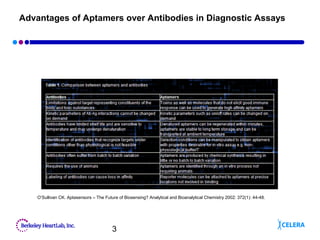
Advantages of Aptamers over Antibodies in Diagnostic Assays
O’Sullivan CK. Aptasensors – The Future of Biosensing? Analytical and Bioanalytical Chemistry 2002: 372(1): 44-48.
4
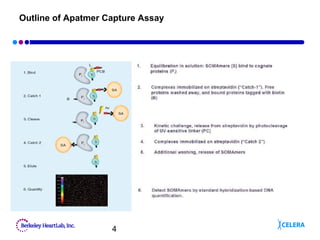
Outline of Apatmer Capture Assay
5
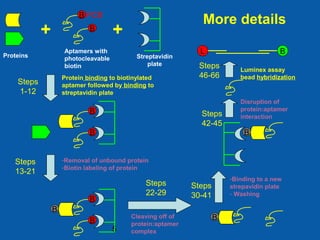
More detailsB PCB
B
+ +
B
B
-Removal of unbound protein
-Biotin labeling of protein
B
B
B
Cleaving off of
protein:aptamer
complex
B
-Binding to a new
strepavidin plate
- Washing
B
Disruption of
protein:aptamer
interaction
L B
Luminex assay
bead hybridizationProtein binding to biotinylated
aptamer followed by binding to
streptavidin plate
Proteins
Aptamers with
photocleavable
biotin
Streptavidin
plate
Steps
1-12
Steps
13-21
Steps
22-29
Steps
30-41
Steps
46-66
Steps
42-45
6
Areas where the Assay could be Improved?
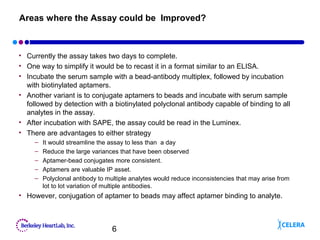
• Currently the assay takes two days to complete.
• One way to simplify it would be to recast it in a format similar to an ELISA.
• Incubate the serum sample with a bead-antibody multiplex, followed by incubation
with biotinylated aptamers.
• Another variant is to conjugate aptamers to beads and incubate with serum sample
followed by detection with a biotinylated polyclonal antibody capable of binding to all
analytes in the assay.
• After incubation with SAPE, the assay could be read in the Luminex.
• There are advantages to either strategy
– It would streamline the assay to less than a day
– Reduce the large variances that have been observed
– Aptamer-bead conjugates more consistent.
– Aptamers are valuable IP asset.
– Polyclonal antibody to multiple analytes would reduce inconsistencies that may arise from
lot to lot variation of multiple antibodies.
• However, conjugation of aptamer to beads may affect aptamer binding to analyte.
7
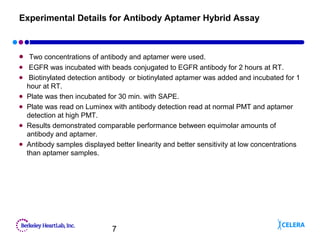
Experimental Details for Antibody Aptamer Hybrid Assay
● Two concentrations of antibody and aptamer were used.
● EGFR was incubated with beads conjugated to EGFR antibody for 2 hours at RT.
● Biotinylated detection antibody or biotinylated aptamer was added and incubated for 1
hour at RT.
● Plate was then incubated for 30 min. with SAPE.
● Plate was read on Luminex with antibody detection read at normal PMT and aptamer
detection at high PMT.
● Results demonstrated comparable performance between equimolar amounts of
antibody and aptamer.
● Antibody samples displayed better linearity and better sensitivity at low concentrations
than aptamer samples.
8
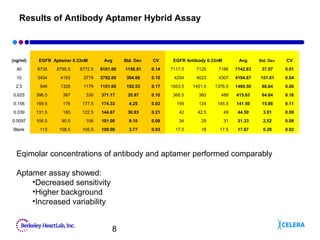
Results of Antibody Aptamer Hybrid Assay
Eqimolar concentrations of antibody and aptamer performed comparably
Aptamer assay showed:
•Decreased sensitivity
•Higher background
•Increased variability
(ng/ml) EGFR Aptamer 0.33nM Avg Std. Dev CV EGFR Antibody 0.33nM Avg Std. Dev CV
40 8735 8795.5 6772.5 8101.00 1150.91 0.14 7117.5 7125 7186 7142.83 37.57 0.01
10 3404 4193 3779 3792.00 394.66 0.10 4254 4023 4307 4194.67 151.01 0.04
2.5 946 1328 1179 1151.00 192.53 0.17 1553.5 1451.5 1376.5 1460.50 88.84 0.06
0.625 396.5 387 330 371.17 35.97 0.10 365.5 393 489 415.83 64.84 0.16
0.156 169.5 176 177.5 174.33 4.25 0.02 155 124 145.5 141.50 15.88 0.11
0.039 131.5 180 122.5 144.67 30.93 0.21 42 42.5 49 44.50 3.91 0.09
0.0097 106.5 90.5 106 101.00 9.10 0.09 34 29 31 31.33 2.52 0.08
Blank 113 108.5 105.5 109.00 3.77 0.03 17.5 18 17.5 17.67 0.29 0.02
9
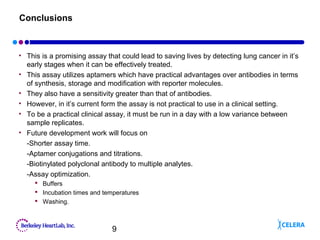
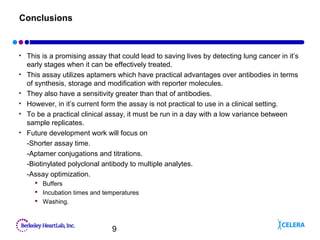
Conclusions
• This is a promising assay that could lead to saving lives by detecting lung cancer in it’s
early stages when it can be effectively treated.
• This assay utilizes aptamers which have practical advantages over antibodies in terms
of synthesis, storage and modification with reporter molecules.
• They also have a sensitivity greater than that of antibodies.
• However, in it’s current form the assay is not practical to use in a clinical setting.
• To be a practical clinical assay, it must be run in a day with a low variance between
sample replicates.
• Future development work will focus on
-Shorter assay time.
-Aptamer conjugations and titrations.
-Biotinylated polyclonal antibody to multiple analytes.
-Assay optimization.
 Buffers
 Incubation times and temperatures
 Washing.
9
Conclusions
• This is a promising assay that could lead to saving lives by detecting lung cancer in it’s
early stages when it can be effectively treated.
• This assay utilizes aptamers which have practical advantages over antibodies in terms
of synthesis, storage and modification with reporter molecules.
• They also have a sensitivity greater than that of antibodies.
• However, in it’s current form the assay is not practical to use in a clinical setting.
• To be a practical clinical assay, it must be run in a day with a low variance between
sample replicates.
• Future development work will focus on
-Shorter assay time.
-Aptamer conjugations and titrations.
-Biotinylated polyclonal antibody to multiple analytes.
-Assay optimization.
 Buffers
 Incubation times and temperatures
 Washing.

Bobs Aptamer Assay Slide Presentation_R

  • 1.
    An Aptamer BasedAssay for the Early Detection of Lung Cancer Bob Bruce 20th DEC 2011
  • 2.
    2 Introduction What is anAptamer? Aptamers are oligonucleic acid or peptide molecules that bind to a specific target molecule How are they selected? They have been engineered through a process known as SELEX (systematic evolution of ligands by exponential enrichment) What is SELEX? • The process begins with the synthesis of a very large oligonucleotide library of randomly generated sequences of fixed length flanked by constant ends that serve as primers. • The sequences in the library are exposed to the target ligand – such as a protein or a small organic compound - and those that do not bind the target are removed. • The bound sequences are eluted and amplified by PCR to prepare for subsequent rounds of selection to identify the tightest-binding sequences
  • 3.
    3 Advantages of Aptamersover Antibodies in Diagnostic Assays O’Sullivan CK. Aptasensors – The Future of Biosensing? Analytical and Bioanalytical Chemistry 2002: 372(1): 44-48.
  • 4.
    4 Outline of ApatmerCapture Assay
  • 5.
    5 More detailsB PCB B ++ B B -Removal of unbound protein -Biotin labeling of protein B B B Cleaving off of protein:aptamer complex B -Binding to a new strepavidin plate - Washing B Disruption of protein:aptamer interaction L B Luminex assay bead hybridizationProtein binding to biotinylated aptamer followed by binding to streptavidin plate Proteins Aptamers with photocleavable biotin Streptavidin plate Steps 1-12 Steps 13-21 Steps 22-29 Steps 30-41 Steps 46-66 Steps 42-45
  • 6.
    6 Areas where theAssay could be Improved? • Currently the assay takes two days to complete. • One way to simplify it would be to recast it in a format similar to an ELISA. • Incubate the serum sample with a bead-antibody multiplex, followed by incubation with biotinylated aptamers. • Another variant is to conjugate aptamers to beads and incubate with serum sample followed by detection with a biotinylated polyclonal antibody capable of binding to all analytes in the assay. • After incubation with SAPE, the assay could be read in the Luminex. • There are advantages to either strategy – It would streamline the assay to less than a day – Reduce the large variances that have been observed – Aptamer-bead conjugates more consistent. – Aptamers are valuable IP asset. – Polyclonal antibody to multiple analytes would reduce inconsistencies that may arise from lot to lot variation of multiple antibodies. • However, conjugation of aptamer to beads may affect aptamer binding to analyte.
  • 7.
    7 Experimental Details forAntibody Aptamer Hybrid Assay ● Two concentrations of antibody and aptamer were used. ● EGFR was incubated with beads conjugated to EGFR antibody for 2 hours at RT. ● Biotinylated detection antibody or biotinylated aptamer was added and incubated for 1 hour at RT. ● Plate was then incubated for 30 min. with SAPE. ● Plate was read on Luminex with antibody detection read at normal PMT and aptamer detection at high PMT. ● Results demonstrated comparable performance between equimolar amounts of antibody and aptamer. ● Antibody samples displayed better linearity and better sensitivity at low concentrations than aptamer samples.
  • 8.
    8 Results of AntibodyAptamer Hybrid Assay Eqimolar concentrations of antibody and aptamer performed comparably Aptamer assay showed: •Decreased sensitivity •Higher background •Increased variability (ng/ml) EGFR Aptamer 0.33nM Avg Std. Dev CV EGFR Antibody 0.33nM Avg Std. Dev CV 40 8735 8795.5 6772.5 8101.00 1150.91 0.14 7117.5 7125 7186 7142.83 37.57 0.01 10 3404 4193 3779 3792.00 394.66 0.10 4254 4023 4307 4194.67 151.01 0.04 2.5 946 1328 1179 1151.00 192.53 0.17 1553.5 1451.5 1376.5 1460.50 88.84 0.06 0.625 396.5 387 330 371.17 35.97 0.10 365.5 393 489 415.83 64.84 0.16 0.156 169.5 176 177.5 174.33 4.25 0.02 155 124 145.5 141.50 15.88 0.11 0.039 131.5 180 122.5 144.67 30.93 0.21 42 42.5 49 44.50 3.91 0.09 0.0097 106.5 90.5 106 101.00 9.10 0.09 34 29 31 31.33 2.52 0.08 Blank 113 108.5 105.5 109.00 3.77 0.03 17.5 18 17.5 17.67 0.29 0.02
  • 9.
    9 Conclusions • This isa promising assay that could lead to saving lives by detecting lung cancer in it’s early stages when it can be effectively treated. • This assay utilizes aptamers which have practical advantages over antibodies in terms of synthesis, storage and modification with reporter molecules. • They also have a sensitivity greater than that of antibodies. • However, in it’s current form the assay is not practical to use in a clinical setting. • To be a practical clinical assay, it must be run in a day with a low variance between sample replicates. • Future development work will focus on -Shorter assay time. -Aptamer conjugations and titrations. -Biotinylated polyclonal antibody to multiple analytes. -Assay optimization.  Buffers  Incubation times and temperatures  Washing.
  • 10.
    9 Conclusions • This isa promising assay that could lead to saving lives by detecting lung cancer in it’s early stages when it can be effectively treated. • This assay utilizes aptamers which have practical advantages over antibodies in terms of synthesis, storage and modification with reporter molecules. • They also have a sensitivity greater than that of antibodies. • However, in it’s current form the assay is not practical to use in a clinical setting. • To be a practical clinical assay, it must be run in a day with a low variance between sample replicates. • Future development work will focus on -Shorter assay time. -Aptamer conjugations and titrations. -Biotinylated polyclonal antibody to multiple analytes. -Assay optimization.  Buffers  Incubation times and temperatures  Washing.