Approach to vision loss
Dr Vaishal Shah
SR Neurology
GMC, Kota
General approach
• Decide whether it is monocular or binocular.
• Transient / persistent
Examination –
Visual acuity with pin hole
Colour vision. Pseudoisometric colour plates. - Early optic nerve
disease may manifest as a reduction in saturation or brightness of
colors
General approach
Field testing – Confrontation in both eye separately.
• An abrupt change across the horizontal axis in one eye suggests optic
nerve disease, and an abrupt change across the vertical meridian in
both eyes indicates visual loss of intracranial origin.
• Kinetic ( goldmann) perimetry
• Automated static perimetry.
General approach
Pupil – RAPD localise lesion to optic nerve. Exceptions include central
or large-branch retinal artery occlusions and large retinal
detachments.
Local eye examination – Ophthalmologist’ domain. Gross
examination can be done including proptosis, congestion.
• ‘‘If you can’t see in, the patient can’t see out.’’
Fundus – Disc – o –centric. Habit of seeing macula as well.
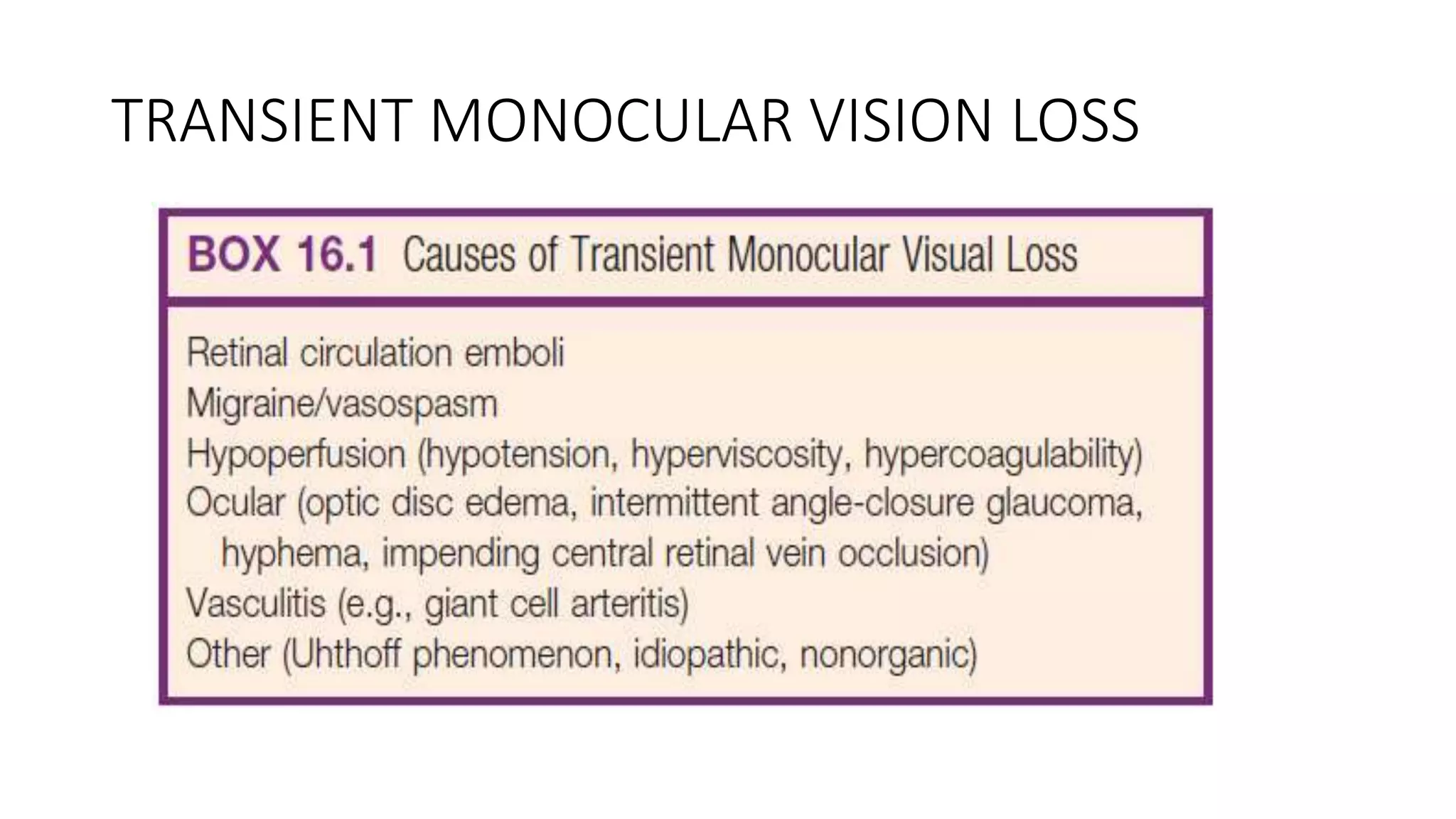
TRANSIENT MONOCULAR VISION LOSS
TRANSIENT BINOCULAR VISUAL LOSS
• Other than transient visual obscuration in patient of bilateral papilledema,
it is always due to transient dysfunction of visual cortex.
• Visual migraine aura – M/C cause in age < 40 years
• TIA – old patients. Needs thorough cardiac/ vertebrobasilar workup.
• PRES – a/w headache, altered mental status. Seen in preeclampsia,
Cyclosporine chemotherapeutic agents
• Rarely – Occipital seizure
Migraine
• Typically patients see small scotoma surrounded by jagged, luminous,
shimmering edges.
• Scotoma enlarges over several minutes, then gradually disappears
followed by hemicranial throbbing headache.
• Patient might experience visual aura without headache – acephalgic
migraine.
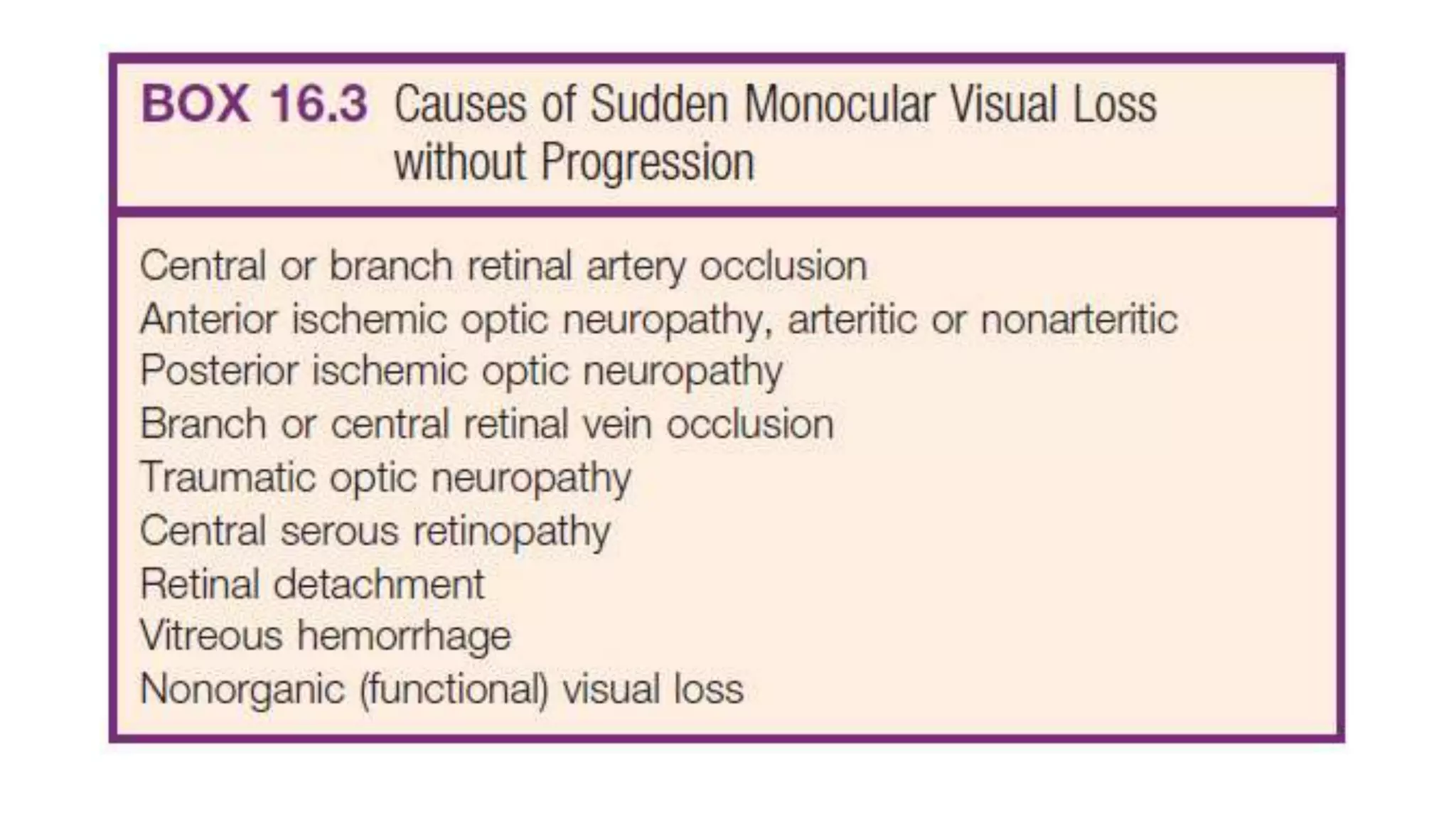
SUDDEN MONOCULAR VISUAL LOSS
WITHOUT PROGRESSION
• Localise to eye or optic nerve.
• Classic feature of unilateral optic neuropathy. Central visual loss, clear
view through ocular media, RAPD, swollen or pale optic disc.
• Important to differentiate between lesion of macula vs optic nerve
• Usually Painless, visual distortions, appropriate colour vision
involvement, vision is slow to recover after bright light, absence of
RAPD – Macular disease ( M/C – CSR )
SUDDEN BINOCULAR VISUAL LOSS WITHOUT
PROGRESSION
• If trauma history is negative, then most commonly by stroke involving
retrochiasmal visual pathways.
• Simultaneous bilateral ischemic optic neuropathy.
• Chiasmal compression due to pituitary apoplexy – headache, diplopia,
altered mental status, hemodynamic shock. Presentation might not
be severe always.
ACUTE ONSET VISUAL LOSS
Sudden onset painful monocular vision loss that subsequently worsens is
commonly due to optic nerve inflammation (optic neuritis). Fundus - normal
• Progresses over hours to days before stabilizing and then improving. MS –
visual recovery good.
• NMO – visual recovery poor.
• Other causes – ADEM, Anti MOG, CRION, post vaccine associated optic
neuritis.
LHON - Produces acute or subacute painless, often permanent, central
visual loss, usually in young adult men. Monocular initially, other eye
becomes affected within 6 months.
ACUTE ONSET VISUAL LOSS
LHON continued…
• Visual recovery is variable and infrequent, and depends on the
mitochondrial DNA mutation.
• In the acute phase, the classic triad of ophthalmic findings includes
Telangiectatic vessels around the optic disc
Nonedematous elevation of the optic disc
Absence of leakage from the disc on fluorescein angiography.
CHRONIC PROGRESSIVE VISUAL LOSS
• Visual field defects of patients with chiasmal or retrochiasmal lesions
may go unnoticed as long as central visual acuity is spared.
• Bitemporal visual field defects that respect the vertical meridian are
diagnostic of lesions, almost always compressive in etiology, at the
optic chiasm – Pituitary adenoma, meningioma, craniopharyngioma,
aneurysm. – MRI is mandatory.
CHRONIC PROGRESSIVE VISUAL LOSS
• Retinal disorders like vitamin A deficiency retinopathies, toxic
retinopathies, carcinoma associated and melanoma associated
paraneoplastic retinopathies needs to be differentiated from bilateral
optic neuropathies - Optic nerve pallor may be present in all.
Elecroretinogram is helpful.
• Primary open angle glaucoma.
• To rule these disorders – Ophalmologist opinion is required.
Bilateral optic nerve drusen
37/F, 5 week prior to presentation,
she had decreased vision in the
inferior visual field in the right eye,
which worsened over 4 to 5 days. She
had no eye pain, pain with eye
movement, or headaches. She had a
brain MRI that showed no optic nerve
enhancement. Her vision failed to
improve during the following 4 weeks.
Visual acuity was 6/24. Colour vision
was normal but mild red desaturation
was present in right eye. RAPD was
present in right eye. Visual fields
showed an inferior arcuate defect in
the right eye.
Diagnosis?
Right NAION
A 33-year-old woman was referred
for an 8-day history of progressive
decreased vision in her left eye.
One day prior to the onset of visual
loss, she had experienced pain
over her left forehead that
worsened with eye movements.
Her past medical history was
unremarkable, and she was on no
medication. visual acuity was
20/400 with no color perception
and a dense relative afferent
pupillary defect. Visual field testing
showed a large dense central
scotoma. Motility was full.
Diagnosis?...Next investigation?? Optic neuritis
MRI brain with orbital cuts
Temporal pallor after 2
months
A 55-year-old woman presented with
progressive 6 months of painless
visual loss in the left eye. She had
been evaluated by an ophthalmologist
1 month prior to this presentation, at
which time she had visual acuity of
6/12 in the left eye with decreased
colour vision, left RAPD, an enlarged
blind spot in the left eye. Funduscopic
examination showed temporal pallor
of the left optic disc. MRI of the brain
showed nonspecific white matter
changes, and a diagnosis of optic
neuritis, possibly related to multiple
sclerosis, was made by
ophthalmologist. Patient came to
neurologist for second opinion. MRI
repeated.
Diagnosis? Optic nerve sheath meningioma
• Optic disc edema with
macular star
Neuroretinitis
• A 65-year-old woman had episodic visual loss. In her twenties and
thirties, she had experienced episodic headaches with nausea,
photophobia, and phonophobia, but with no associated visual
phenomena. 2 years before the present examination she had begun
to experience episodes of bilateral visual disturbances, which she
described as the appearance of gold line just off the center of vision
in both eyes. The line enlarged over approximately 5 to 10 minutes,
enclosing a central area. After 20 minutes, the process gradually
broke up like a puzzle and normal vision was restored. She denied
associated headache or eye pain. Diagnosis??
Acephalgic migraine with visual aura
An 82-year-old man reported acute binocular visual
loss. His past medical history was notable for coronary
artery disease with previous myocardial infarction and
heavy cigarette use. On examination, visual acuity was
6/30 in both eyes and color vision was impaired in
both eyes. Pupils, motility, and fundi were normal.
Next investigation?
Thank you

Approach to vision loss

  • 1.
    Approach to visionloss Dr Vaishal Shah SR Neurology GMC, Kota
  • 2.
    General approach • Decidewhether it is monocular or binocular. • Transient / persistent Examination – Visual acuity with pin hole Colour vision. Pseudoisometric colour plates. - Early optic nerve disease may manifest as a reduction in saturation or brightness of colors
  • 3.
    General approach Field testing– Confrontation in both eye separately. • An abrupt change across the horizontal axis in one eye suggests optic nerve disease, and an abrupt change across the vertical meridian in both eyes indicates visual loss of intracranial origin. • Kinetic ( goldmann) perimetry • Automated static perimetry.
  • 5.
    General approach Pupil –RAPD localise lesion to optic nerve. Exceptions include central or large-branch retinal artery occlusions and large retinal detachments. Local eye examination – Ophthalmologist’ domain. Gross examination can be done including proptosis, congestion. • ‘‘If you can’t see in, the patient can’t see out.’’ Fundus – Disc – o –centric. Habit of seeing macula as well.
  • 6.
  • 7.
    TRANSIENT BINOCULAR VISUALLOSS • Other than transient visual obscuration in patient of bilateral papilledema, it is always due to transient dysfunction of visual cortex. • Visual migraine aura – M/C cause in age < 40 years • TIA – old patients. Needs thorough cardiac/ vertebrobasilar workup. • PRES – a/w headache, altered mental status. Seen in preeclampsia, Cyclosporine chemotherapeutic agents • Rarely – Occipital seizure
  • 8.
    Migraine • Typically patientssee small scotoma surrounded by jagged, luminous, shimmering edges. • Scotoma enlarges over several minutes, then gradually disappears followed by hemicranial throbbing headache. • Patient might experience visual aura without headache – acephalgic migraine.
  • 9.
    SUDDEN MONOCULAR VISUALLOSS WITHOUT PROGRESSION • Localise to eye or optic nerve. • Classic feature of unilateral optic neuropathy. Central visual loss, clear view through ocular media, RAPD, swollen or pale optic disc. • Important to differentiate between lesion of macula vs optic nerve • Usually Painless, visual distortions, appropriate colour vision involvement, vision is slow to recover after bright light, absence of RAPD – Macular disease ( M/C – CSR )
  • 13.
    SUDDEN BINOCULAR VISUALLOSS WITHOUT PROGRESSION • If trauma history is negative, then most commonly by stroke involving retrochiasmal visual pathways. • Simultaneous bilateral ischemic optic neuropathy. • Chiasmal compression due to pituitary apoplexy – headache, diplopia, altered mental status, hemodynamic shock. Presentation might not be severe always.
  • 15.
    ACUTE ONSET VISUALLOSS Sudden onset painful monocular vision loss that subsequently worsens is commonly due to optic nerve inflammation (optic neuritis). Fundus - normal • Progresses over hours to days before stabilizing and then improving. MS – visual recovery good. • NMO – visual recovery poor. • Other causes – ADEM, Anti MOG, CRION, post vaccine associated optic neuritis. LHON - Produces acute or subacute painless, often permanent, central visual loss, usually in young adult men. Monocular initially, other eye becomes affected within 6 months.
  • 16.
    ACUTE ONSET VISUALLOSS LHON continued… • Visual recovery is variable and infrequent, and depends on the mitochondrial DNA mutation. • In the acute phase, the classic triad of ophthalmic findings includes Telangiectatic vessels around the optic disc Nonedematous elevation of the optic disc Absence of leakage from the disc on fluorescein angiography.
  • 18.
  • 19.
    CHRONIC PROGRESSIVE VISUALLOSS • Visual field defects of patients with chiasmal or retrochiasmal lesions may go unnoticed as long as central visual acuity is spared. • Bitemporal visual field defects that respect the vertical meridian are diagnostic of lesions, almost always compressive in etiology, at the optic chiasm – Pituitary adenoma, meningioma, craniopharyngioma, aneurysm. – MRI is mandatory.
  • 20.
    CHRONIC PROGRESSIVE VISUALLOSS • Retinal disorders like vitamin A deficiency retinopathies, toxic retinopathies, carcinoma associated and melanoma associated paraneoplastic retinopathies needs to be differentiated from bilateral optic neuropathies - Optic nerve pallor may be present in all. Elecroretinogram is helpful. • Primary open angle glaucoma. • To rule these disorders – Ophalmologist opinion is required.
  • 22.
  • 23.
    37/F, 5 weekprior to presentation, she had decreased vision in the inferior visual field in the right eye, which worsened over 4 to 5 days. She had no eye pain, pain with eye movement, or headaches. She had a brain MRI that showed no optic nerve enhancement. Her vision failed to improve during the following 4 weeks. Visual acuity was 6/24. Colour vision was normal but mild red desaturation was present in right eye. RAPD was present in right eye. Visual fields showed an inferior arcuate defect in the right eye. Diagnosis? Right NAION
  • 24.
    A 33-year-old womanwas referred for an 8-day history of progressive decreased vision in her left eye. One day prior to the onset of visual loss, she had experienced pain over her left forehead that worsened with eye movements. Her past medical history was unremarkable, and she was on no medication. visual acuity was 20/400 with no color perception and a dense relative afferent pupillary defect. Visual field testing showed a large dense central scotoma. Motility was full. Diagnosis?...Next investigation?? Optic neuritis MRI brain with orbital cuts
  • 25.
  • 26.
    A 55-year-old womanpresented with progressive 6 months of painless visual loss in the left eye. She had been evaluated by an ophthalmologist 1 month prior to this presentation, at which time she had visual acuity of 6/12 in the left eye with decreased colour vision, left RAPD, an enlarged blind spot in the left eye. Funduscopic examination showed temporal pallor of the left optic disc. MRI of the brain showed nonspecific white matter changes, and a diagnosis of optic neuritis, possibly related to multiple sclerosis, was made by ophthalmologist. Patient came to neurologist for second opinion. MRI repeated. Diagnosis? Optic nerve sheath meningioma
  • 27.
    • Optic discedema with macular star Neuroretinitis
  • 28.
    • A 65-year-oldwoman had episodic visual loss. In her twenties and thirties, she had experienced episodic headaches with nausea, photophobia, and phonophobia, but with no associated visual phenomena. 2 years before the present examination she had begun to experience episodes of bilateral visual disturbances, which she described as the appearance of gold line just off the center of vision in both eyes. The line enlarged over approximately 5 to 10 minutes, enclosing a central area. After 20 minutes, the process gradually broke up like a puzzle and normal vision was restored. She denied associated headache or eye pain. Diagnosis?? Acephalgic migraine with visual aura
  • 29.
    An 82-year-old manreported acute binocular visual loss. His past medical history was notable for coronary artery disease with previous myocardial infarction and heavy cigarette use. On examination, visual acuity was 6/30 in both eyes and color vision was impaired in both eyes. Pupils, motility, and fundi were normal. Next investigation?
  • 30.

Editor's Notes

  • #23 Drusen of the optic nerve head are extracellular deposits of plasma proteins and a variety of inorganic materials that can compress optic nerve axons near the surface of the nerve head as they enlarge. Loss of visual acuity is atypical, but can result from development of a secondary choroidal neovascular membrane, with subsequent hemorrhage into the macula, or anterior ischemic optic neuropathy.