Headache in Children
Dr Nagi Barakat
Consultant paediatrician/neurology
London
UK
www.indexforpaediatrics.com
2
Headache is common in children and adolescents
Prevalence of headache in schoolchildren
≥ 1 headache over 1 year 50-70%
Migraine 10.6%
Chronic TTH 0.9%
Episodic TTH 18-25%
From several studies
3
Aberdeen schoolchildren
(Abu-Arafeh and Russell, BMJ, 1994)
Types of Headaches
• Acute
• Acute recurrent
• Chronic progressive
• Chronic non-progressive
• Cluster headache
• Epileptic headache
• Psychogenic
• Mixed
5
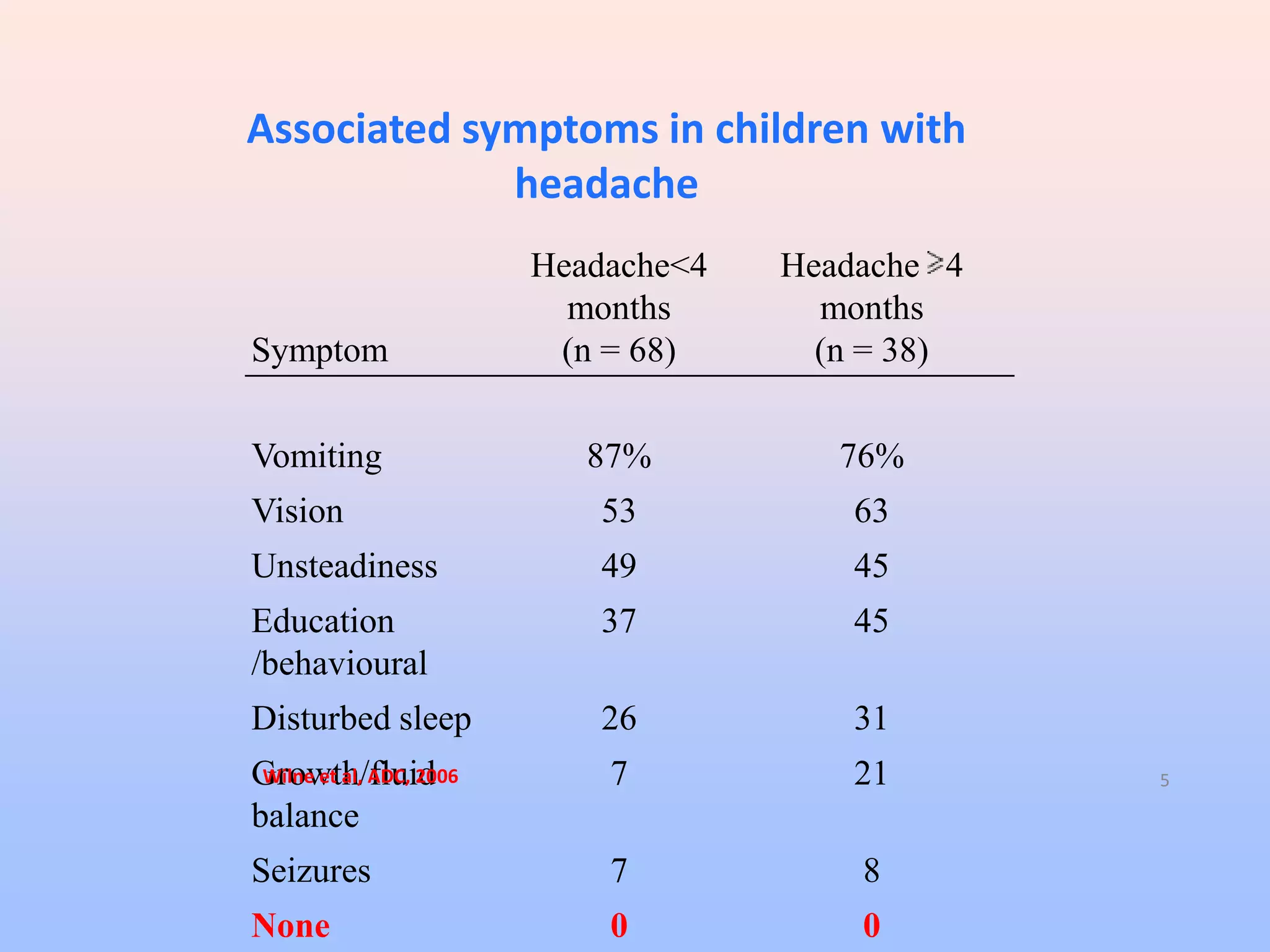
Symptom
Headache<4
months
(n = 68)
Headache 4
months
(n = 38)
Vomiting 87% 76%
Vision 53 63
Unsteadiness 49 45
Education
/behavioural
37 45
Disturbed sleep 26 31
Growth/fluid
balance
7 21
Seizures 7 8
None 0 0
Associated symptoms in children with
headache
Wilne et al, ADC, 2006
• International Classification
of Headache Disorders
• http://www.ihs-
classification.org/_downloa
ds/mixed/International-
Headache-Classification-III-
ICHD-III-2013-Beta.pdf
Headache is common in Children
7
Evaluation of the child with headache:
The Clinical History
• Interviewing the child/adolescent
and parents.
• A diary may be useful
• location
• severity
• timing
• precipitating factors.
Disease and headache Characteristics
Duration of illness
Frequency of attacks
Duration of each attack
Severity of pain (interference with
activities)
Location of maximal pain
Quality of pain
Trigger factors
Warning symptoms
8
Symptoms during attacks
Anorexia
Nausea
Vomiting
Light intolerance
Noise intolerance
Pallor
Physical activities
Relieving factors
Symptoms between attacks
• Medication and toxin exposure
• Family history
Causes of headaches
• Brain tumours
• CNS infection(TB, chronic meningitis, abscess)
• Arterial hypertension and vascular
malformation
• Benign increase intracranial pressure
• Hydrocephalus and congenital malformation
• Para nasal sinusitis
• Endocrine and metabolic causes (
hypoglycaemia)
Migraine common in children
10
Acute Headache
It could be migraine
Cerebrovascular bleed(CT or MRI with contrast)
Trauma (CT)
Meningitis (LP )
URTI- Viral
Encephalitis (EEG and CT or MRI)
Drugs (urine toxicology)
Ventricular shunt malfunction
16
Childhood Migraine
Migraine
• Hippocrates described migraine
• Galen first used the term hemicrania
• Incidence 1.2% -3.2% at age of 7 years , and
4%-25% by age of 15 years
• 2.8 school days per year lost as result of
migraine
• Children commonly have migraine without
aura
• Children not usually having unilateral
headache
• Vasodilatation,vasoconstriction,oedema, and
inflammation of cerebral vessels produce pain
Classification of migraine
ICHD-II, Cephalalgia, 2004
1.1 Migraine without aura
1.2 Probable migraine without aura
1.3 Migraine with aura
1.3.1 Typical aura with migraine headache
1.3.2 Typical aura with non- migraine
headache
1.3.3 Typical aura without headache
1.3.4 Familial hemiplegic migraine
1.3.5 Sporadic hemiplegic migraine
1.3.6 Basilar artery migraine
1.4 Probable migraine with aura
14
1.5 Childhood periodic syndromes
1.5.1 Cyclical vomiting
1.5.2 Abdominal migraine
1.5.3 Benign Paroxysmal vertigo of
childhood
1.6 Retinal Migraine
1.7 Complications of migraine
1.7.1 Chronic migraine
1.7.2 Status migrainosus
1.7.3 Persistence aura without
infarction
1.7.4 Migraine infarction
1.7.5 Migraine triggered seizures
Criteria for the diagnosis: migraine without aura
ICHD‐III beta, Cephalalgia, 2013
A. At least 5 attacks fulfilling B‐D
B. Headache lasting 4 ‐72 hours (2‐72 in children)
C. Headache has at least two of the following characteristic
1. Unilateral location
2. Pulsating quality
3. moderate or severe intensity
4. Aggravation by walking or similar routine activity.
D. During headache at least one of the following:
1. Nausea and/or vomiting.
2. Photophobia and phonophobia.
15
Migraine attacks - clinical features
• Prodrome (Change in mode or activity level)
• Aura (Occur in 10-50% of paediatric patients with
migraine)- Phtopsia, Scatoma, Numbness, tingling,
ataxia, dizziness , and Vertigo
16
Migraine- clinical features-2
• Headache( Barlow et al, 300 pts with juvenile
migraine, only 9% of attacks were children
awakened from sleep by the onset of a migraine
and only 4% of attacks did they begin on
awakening)
• Resolution( headache may last 1-4hrs, sleep and
analgesic)
• Postdrome( Lethargy, anorexia and mood disturbances)
Chronic progressive headache
Brain Tumour- (space occupying lesions)
• Late night, early morning headaches,
vomiting, neurological changes include
academic performance, weakness,
visual, personality, papilloedema,
ataxia
• Benign increased intracranial pressure (Pseudo-
tumour cerebri)
• Benign increased intracranial pressure
with papilloedema, sometime
associated with VI palsy
• Typically described in adolescent girls.
Brain Tumour
• Uncommon in school-age children
• Prevalence 3 per 100,000 per annum or any
other space occupying lesions
• Additional neurological symptoms and signs
on examination
Brain tumour- 2
• Honig and Charney( 72 children with brain tumour
• 94% with abnormal neurological examination
• 85% with abnormalities on CNS examination within 2 months of
presentation
• Childhood brain Tumour consortium
• 3291 children with brain tumour
• Headaches at time of diagnosis in 58% of
Supratontorial and 70% of Infratontorial
• 99% of children with headaches and brain tumour had
at least 1 abnormal neurological symptom and 98%
had at least 1 abnormal neurological sign
Relationship between headache and brain
tumour?
•Almost all children with brain tumour have headache at some stage
•The vast majority of children with headache have no brain tumour
•Childhood Brain Tumor Consortium
• 3291 children with brain tumors
• 62% had headache prior to diagnosis
• 98% had > 1 other associated sign or symptom
• >50% had > 3 other associated signs or symptoms
J Neurooncol. 1991
21
22
Frequency of symptoms in 200 children with brain tumours
Wilne et al, ADC, 2006
Pattern of Symptoms and signs of Primary intracranial tumours in Children and
young adults: a record linkage study (TPC Chu et al , ArchDis Child, December 2015)
• In primary care, The main features were
those of visual disturbances in children
aged 0-4 years and headache in older age
group
• Features of raised ICP were the most
common group symptoms presented in
Hospitals, They emerged 3-6 months
before diagnosis
• The proportion of emergency
presentations to hospitals rose steadily
from 35% over 12 months before diagnosis
to 55% by the time of diagnosis
• Non - localising symptoms and signs were
more than twice as common as focal
neurological signs.
• Intracranial tumours should be su be
considered in patients with relevant
symptoms that do not resolve or progress
rabidly
23
Astrocytoma
Brain tumour
Medulloblastoma
Chronic non-progressive
• Tension headache
• At the end of the day on every day most days
• Often not responding to analgesia and may
cause rebound headache
• Frequent school absence
• More in females
• Often respond to relaxation therapy and
behavioural intervention
• Systematic review is important
• Therapeutic plan (check life style, school
attendance mandatory,counselling, behaviour and
stress therapy and biofeedback is important)
Tension headaches- 2
• Occurring during times of obvious stress
• Involving the neck and occiput
• Continuous pain
• No nausea, vomiting, or abdominal pain
• Family history of migraine is less likely
• In some patients, obvious symptoms of
depression; in this subgroup, headaches
are relieved when depression is treated
Chronic Non-Progressive (Chronic daily headache)-2
• Post-traumatic Headaches
• occur 6-8 weeks following a head injury and have a
dizzy-like quality in children (HIS diagnostic criteria V)
• Features of increased ICP following post-traumatic head injury
include
• decreased level of consciousness
• pain coming in waves
• visual changes
• alterations in vital signs
30
Abdominal migraine
Affects 1% to 4% of children
Onset is between the ages of 7 to 12 years, F>M
Acute incapacitating non-colicky periumbilical abdominal pain that lasts
for 1 or more hours
Associated with Pallor, anorexia, nausea, vomiting, photophobia, or
headache
Positive family history of migraine
Must exclude or eliminate of other organic causes
Use same approach for treating headache and migraine as well as
lifestyle modifications.
Clinical examination
• Look to skin
• Wt, Ht and and head circumference
• Listen for cranial bruits
• Blood pressure
• Detailed CNS and systemic examination
(optic disc, eye movements, motor
asymmetry, coordination, and reflexes)
The signs of papilloedema that are seen using an ophthalmoscope include
• venous engorgement
(usually the first signs)
• loss of venous pulsation
• haemorrhages over and /
or adjacent to the optic
disc
• blurring of optic margins
• elevation of optic disc
• Paton's lines = radial
retinal lines
cascading from the optic
disc 33
Indications for neuroimaging
• High priority
• Chronic progressive headache
• Papilloedema
• Neurocutaneous syndromes (NF or TS or others)
• Younger age < 3 years
• Positive neurological signs or symptoms
• Supporting evidences from history
– Dipolpia
– Vomiting
– Headaches that awaken him/her from sleep
• Sudden sever headache which called thunder headache which may
indicate Subarachnoid or intracranial haemorrhage (aneurysm or
AVMs)
• Trauma
Indication for neuroimaging -2
• Low
priority
• Chronic non-
progressive headache
• Mixed headache
• Classic or common migraine
• meningeal signs
• variation in headache location
•Overall, 9.3% (112/1204) of
the patients had abnormal
findings from neuroimaging
•An abnormal neurological
examination, abnormal
findings on neuroimaging were
seen in 50.0% (9/18) of
patients (P < .001)
36
The Role of Neuroimaging in Children and Adolescents With Recurrent Headaches, Young-II et al
Management of Headaches
• Depend on the cause
• Frequency
• regularity
• Severity
• Impact on life style
• Reassurance is more
important in migraine and
tension type headache
Approach when treating headache
Acute therapy(depending on the severity of the headache
Preventive therapy (when the headaches are frequent or causing
substantial disability)
Biobehavioural therapy (to assist with coping with recurrent
headaches)
Additional factors can contribute to exacerbations of headaches
including comorbid disorders and pubertal changes
38
Treatment of Migraine
Medications have proved to be safe in the paediatric age group
• Abortive treatment
• Acute migraine include over-the-counter non-steroidal anti-inflammatory
drugs (NSAIDs), as well as the oral triptans such as sumatriptan succinate,
rizatriptan benzoate, and zolmitriptan and the nasal spray formulations of
sumatriptan and zolmitriptan
• Subcutaneous sumatriptan and parenteral dihydroergotamine have also been
used limitedly
• Preventive treatment for patients with frequent or disabling migraines includes
• Antidepressants amitriptyline hydrochloride and nortriptyline hydrochloride,
the anticonvulsants divalproex sodium and topiramate, and the antihistaminic
agent cyprohepatine hydrochloride
• Biobehavioral approaches
• Addressing the fundamental lifestyle issues and non pharmacologic
approaches to management are fundamental to long-term success
39
Drugs In use for both migraine and headache –
Abortive medication
• Acetaminophen
• Neurofen (NSAID)
• Codeine phosphate
• Ergot derivative (avoid in children if used will be admitted)
• Triptans 5ST1B/1D (e.g. sumatriptan) avoid <12yrs of age
Anti-emetics which may be used in the treatment of
Nausea and vomiting accompanying childhood
migraine
Promethazine (phenergan)
Trimethobenzamide (Tigan)
Prochlorperazine
Methoclopramide
Hydroxyzine
Triptans (5-HT1B/1D receptor)
• No approval for use in <16 years old
• Aborting the attack within 30 to 90 minutes in 70-
80% of patients.
• Early studies on safety and efficacy are encouraging
• Caution when use in hemiplegic, basilar artery
migraine and allergic reaction
• Can be given orally, Intranasal or IM
• Side effects- skin sensitivity?
What said about Triptans use in Children
• Paul Winner, Paediatrics Vol.106 No 5, 11/200
(Sumatriptan Nasal spray is effective and well tolerated for
rapid relief of migraine in Adolescent in dose of 20mg which
provide best efficacy and tolerability)
• Uberall M, Neurology,52, 1507-1510, 1999
( Small group placebo controlled study for children <10 years
of age with migraine, Sumatriptan NS of 20mg provided
significantly more headache relief 2 hours post dose compare
with placebo)
• Linder S,Headache, 36, 419-422, 1996
(Subcutaneous Sumatriptan used in 6-16 year of age with
migraine at dose of 0.6mg/kg is effective in alleviating
migraine attack)
Treatment of headache in Children and young adults
Acute Treatment Therapies for Pediatric Migraine: A Qualitative Systematic Review.
Patniyot IR1,2, Gelfand AA1,2.
• Of the available evidence, ibuprofen, prochlorperazine,
and certain triptan medications are the most effective
and safe agents for acute management of migraine and
other benign headache disorders in the paediatric
population. (Oberian et al 2015)
• Migraine headache is a neurologic disorder that occurs in
18% of women and 6% of men.
• Studies have shown that early treatment with large
doses of medication work well for the treatment of
moderate to severe migraine headache. (Harmon TP et al 2015)
Drugs for prophylaxis of migraine in children
DB, XO and placebo controlled trials
45
Drug Dose No. results
Pizotifen 1-1.5mg / day 39 No difference
Propranolol 60‐120mg/d 28 less often, nausea
Flunarizine 5mg/ day 70 reduce headache
frequency
Topiramate 50-100mg / day 103 reduce headache days
Amitriptyline +
CBT
1mg/kg / day 64 Better reduction in
Headache
Amitriptyline +
Education
1mg/kg/day 71 Less reduction in
headache
From: Cognitive Behavioral Therapy Plus Amitriptyline for Chronic Migraine in Children and Adolescents: A Randomized Clinical Trial
JAMA. 2013;310(24):2622-2630. doi:10.1001/jama.2013.282533
Other drugs in migraine prophylaxis
Based on open studies and clinical experience
Magnesium oxide
Sodium Valproate
Gabapentin
Cyproheptadine
Other beta blockers (Atenalol)
Other calcium channels blockers (verapamil)
Vitamin B2
Fever few Botulinum toxin
47
Drugs in migraine prophylaxis NICE –
update 2015
• Offer:
Propranolol
Or Topiramate
Consider Amitriptyline
Preventative treatment should be used:
•regularly for at least 4-6 weeks
•If successful, continue for 6-12 months
48
Episodic tension headache
•Non Pharmacological approach
49
Avoid aggravating factors
Rest
Hydration
Occasionally Paracetamol or Ibuprofen
Chronic tension‐type headache
Life style modification
Regular meals
Regular sleep
Regular exercise
Avoid caffeinated drinks
Avoid Painkillers if at all possible Max 2
days per week
50
Chronic migraine
Defined as Headache on at least 15 days /month of which at least 8 days
with typical migraine over at least 3 months
 Aim to revert to episodic migraine
 Explore medication overuse as a contributory factor
 Preventative treatment better than rescue treatment
 Multidisciplinary approach (life style modification)
51
Hemiplegic migraine
• A subtype of migraine with aura (motor aura)
 Associated with loss of power on one side of body with or without slurred speech
 Familial or Sporadic
 Diagnosis after excluding intracranial lesions – MRI and MRA
 Acute Treatment: Triptans are not recommended
 Preventative treatment: Topiramate 1‐2 mg/kg/day
Fulnarizine 5‐10 mg/day
Propranolol: avoid torisk of infarction
Avoid oral contraceptive pill
52
Medication Overuse Headache is a chronic
daily headache
 in a patient taking rescue medications on 10‐15 days per month
 for at least 3 months
 withdrawal of medication reduces headache frequency by at least 50%
Occurs on the background of an episodic primary headache
Treatment should include stopping all painkillers
Headache will be worse before getting better
May treat with pain modifying agents to reduce suffering
53
Other treatment
• PFO ligation(http://www.americanheadachesociety.org/assets/1/7/Schwedt.pdf)
•homeopathic remedies
• Botox (http://www.nhs.uk/news/2012/05may/Pages/nice-may-approve-botox-jab-for-chronic-
migraine.aspx)
•Acupuncture
•Nerve block
Key Points
• Headache is more common in teenagers
• History and examination is important to exclude pathology
• Neuroimaging not indicated in every cases( acute and
progressive headache)
• Treatment can be supportive as well as medication may help
• Consider other causes when stuck

Headache in children -indexforpaediatrics.com

  • 1.
    Headache in Children DrNagi Barakat Consultant paediatrician/neurology London UK www.indexforpaediatrics.com
  • 2.
    2 Headache is commonin children and adolescents
  • 3.
    Prevalence of headachein schoolchildren ≥ 1 headache over 1 year 50-70% Migraine 10.6% Chronic TTH 0.9% Episodic TTH 18-25% From several studies 3 Aberdeen schoolchildren (Abu-Arafeh and Russell, BMJ, 1994)
  • 4.
    Types of Headaches •Acute • Acute recurrent • Chronic progressive • Chronic non-progressive • Cluster headache • Epileptic headache • Psychogenic • Mixed
  • 5.
    5 Symptom Headache<4 months (n = 68) Headache4 months (n = 38) Vomiting 87% 76% Vision 53 63 Unsteadiness 49 45 Education /behavioural 37 45 Disturbed sleep 26 31 Growth/fluid balance 7 21 Seizures 7 8 None 0 0 Associated symptoms in children with headache Wilne et al, ADC, 2006
  • 6.
    • International Classification ofHeadache Disorders • http://www.ihs- classification.org/_downloa ds/mixed/International- Headache-Classification-III- ICHD-III-2013-Beta.pdf
  • 7.
    Headache is commonin Children 7
  • 8.
    Evaluation of thechild with headache: The Clinical History • Interviewing the child/adolescent and parents. • A diary may be useful • location • severity • timing • precipitating factors. Disease and headache Characteristics Duration of illness Frequency of attacks Duration of each attack Severity of pain (interference with activities) Location of maximal pain Quality of pain Trigger factors Warning symptoms 8 Symptoms during attacks Anorexia Nausea Vomiting Light intolerance Noise intolerance Pallor Physical activities Relieving factors Symptoms between attacks • Medication and toxin exposure • Family history
  • 9.
    Causes of headaches •Brain tumours • CNS infection(TB, chronic meningitis, abscess) • Arterial hypertension and vascular malformation • Benign increase intracranial pressure • Hydrocephalus and congenital malformation • Para nasal sinusitis • Endocrine and metabolic causes ( hypoglycaemia)
  • 10.
    Migraine common inchildren 10
  • 11.
    Acute Headache It couldbe migraine Cerebrovascular bleed(CT or MRI with contrast) Trauma (CT) Meningitis (LP ) URTI- Viral Encephalitis (EEG and CT or MRI) Drugs (urine toxicology) Ventricular shunt malfunction
  • 12.
  • 13.
    Migraine • Hippocrates describedmigraine • Galen first used the term hemicrania • Incidence 1.2% -3.2% at age of 7 years , and 4%-25% by age of 15 years • 2.8 school days per year lost as result of migraine • Children commonly have migraine without aura • Children not usually having unilateral headache • Vasodilatation,vasoconstriction,oedema, and inflammation of cerebral vessels produce pain
  • 14.
    Classification of migraine ICHD-II,Cephalalgia, 2004 1.1 Migraine without aura 1.2 Probable migraine without aura 1.3 Migraine with aura 1.3.1 Typical aura with migraine headache 1.3.2 Typical aura with non- migraine headache 1.3.3 Typical aura without headache 1.3.4 Familial hemiplegic migraine 1.3.5 Sporadic hemiplegic migraine 1.3.6 Basilar artery migraine 1.4 Probable migraine with aura 14 1.5 Childhood periodic syndromes 1.5.1 Cyclical vomiting 1.5.2 Abdominal migraine 1.5.3 Benign Paroxysmal vertigo of childhood 1.6 Retinal Migraine 1.7 Complications of migraine 1.7.1 Chronic migraine 1.7.2 Status migrainosus 1.7.3 Persistence aura without infarction 1.7.4 Migraine infarction 1.7.5 Migraine triggered seizures
  • 15.
    Criteria for thediagnosis: migraine without aura ICHD‐III beta, Cephalalgia, 2013 A. At least 5 attacks fulfilling B‐D B. Headache lasting 4 ‐72 hours (2‐72 in children) C. Headache has at least two of the following characteristic 1. Unilateral location 2. Pulsating quality 3. moderate or severe intensity 4. Aggravation by walking or similar routine activity. D. During headache at least one of the following: 1. Nausea and/or vomiting. 2. Photophobia and phonophobia. 15
  • 16.
    Migraine attacks -clinical features • Prodrome (Change in mode or activity level) • Aura (Occur in 10-50% of paediatric patients with migraine)- Phtopsia, Scatoma, Numbness, tingling, ataxia, dizziness , and Vertigo 16
  • 17.
    Migraine- clinical features-2 •Headache( Barlow et al, 300 pts with juvenile migraine, only 9% of attacks were children awakened from sleep by the onset of a migraine and only 4% of attacks did they begin on awakening) • Resolution( headache may last 1-4hrs, sleep and analgesic) • Postdrome( Lethargy, anorexia and mood disturbances)
  • 18.
    Chronic progressive headache BrainTumour- (space occupying lesions) • Late night, early morning headaches, vomiting, neurological changes include academic performance, weakness, visual, personality, papilloedema, ataxia • Benign increased intracranial pressure (Pseudo- tumour cerebri) • Benign increased intracranial pressure with papilloedema, sometime associated with VI palsy • Typically described in adolescent girls.
  • 19.
    Brain Tumour • Uncommonin school-age children • Prevalence 3 per 100,000 per annum or any other space occupying lesions • Additional neurological symptoms and signs on examination
  • 20.
    Brain tumour- 2 •Honig and Charney( 72 children with brain tumour • 94% with abnormal neurological examination • 85% with abnormalities on CNS examination within 2 months of presentation • Childhood brain Tumour consortium • 3291 children with brain tumour • Headaches at time of diagnosis in 58% of Supratontorial and 70% of Infratontorial • 99% of children with headaches and brain tumour had at least 1 abnormal neurological symptom and 98% had at least 1 abnormal neurological sign
  • 21.
    Relationship between headacheand brain tumour? •Almost all children with brain tumour have headache at some stage •The vast majority of children with headache have no brain tumour •Childhood Brain Tumor Consortium • 3291 children with brain tumors • 62% had headache prior to diagnosis • 98% had > 1 other associated sign or symptom • >50% had > 3 other associated signs or symptoms J Neurooncol. 1991 21
  • 22.
    22 Frequency of symptomsin 200 children with brain tumours Wilne et al, ADC, 2006
  • 23.
    Pattern of Symptomsand signs of Primary intracranial tumours in Children and young adults: a record linkage study (TPC Chu et al , ArchDis Child, December 2015) • In primary care, The main features were those of visual disturbances in children aged 0-4 years and headache in older age group • Features of raised ICP were the most common group symptoms presented in Hospitals, They emerged 3-6 months before diagnosis • The proportion of emergency presentations to hospitals rose steadily from 35% over 12 months before diagnosis to 55% by the time of diagnosis • Non - localising symptoms and signs were more than twice as common as focal neurological signs. • Intracranial tumours should be su be considered in patients with relevant symptoms that do not resolve or progress rabidly 23
  • 24.
  • 25.
  • 26.
  • 28.
    Chronic non-progressive • Tensionheadache • At the end of the day on every day most days • Often not responding to analgesia and may cause rebound headache • Frequent school absence • More in females • Often respond to relaxation therapy and behavioural intervention • Systematic review is important • Therapeutic plan (check life style, school attendance mandatory,counselling, behaviour and stress therapy and biofeedback is important)
  • 29.
    Tension headaches- 2 •Occurring during times of obvious stress • Involving the neck and occiput • Continuous pain • No nausea, vomiting, or abdominal pain • Family history of migraine is less likely • In some patients, obvious symptoms of depression; in this subgroup, headaches are relieved when depression is treated
  • 30.
    Chronic Non-Progressive (Chronicdaily headache)-2 • Post-traumatic Headaches • occur 6-8 weeks following a head injury and have a dizzy-like quality in children (HIS diagnostic criteria V) • Features of increased ICP following post-traumatic head injury include • decreased level of consciousness • pain coming in waves • visual changes • alterations in vital signs 30
  • 31.
    Abdominal migraine Affects 1%to 4% of children Onset is between the ages of 7 to 12 years, F>M Acute incapacitating non-colicky periumbilical abdominal pain that lasts for 1 or more hours Associated with Pallor, anorexia, nausea, vomiting, photophobia, or headache Positive family history of migraine Must exclude or eliminate of other organic causes Use same approach for treating headache and migraine as well as lifestyle modifications.
  • 32.
    Clinical examination • Lookto skin • Wt, Ht and and head circumference • Listen for cranial bruits • Blood pressure • Detailed CNS and systemic examination (optic disc, eye movements, motor asymmetry, coordination, and reflexes)
  • 33.
    The signs ofpapilloedema that are seen using an ophthalmoscope include • venous engorgement (usually the first signs) • loss of venous pulsation • haemorrhages over and / or adjacent to the optic disc • blurring of optic margins • elevation of optic disc • Paton's lines = radial retinal lines cascading from the optic disc 33
  • 34.
    Indications for neuroimaging •High priority • Chronic progressive headache • Papilloedema • Neurocutaneous syndromes (NF or TS or others) • Younger age < 3 years • Positive neurological signs or symptoms • Supporting evidences from history – Dipolpia – Vomiting – Headaches that awaken him/her from sleep • Sudden sever headache which called thunder headache which may indicate Subarachnoid or intracranial haemorrhage (aneurysm or AVMs) • Trauma
  • 35.
    Indication for neuroimaging-2 • Low priority • Chronic non- progressive headache • Mixed headache • Classic or common migraine • meningeal signs • variation in headache location
  • 36.
    •Overall, 9.3% (112/1204)of the patients had abnormal findings from neuroimaging •An abnormal neurological examination, abnormal findings on neuroimaging were seen in 50.0% (9/18) of patients (P < .001) 36 The Role of Neuroimaging in Children and Adolescents With Recurrent Headaches, Young-II et al
  • 37.
    Management of Headaches •Depend on the cause • Frequency • regularity • Severity • Impact on life style • Reassurance is more important in migraine and tension type headache
  • 38.
    Approach when treatingheadache Acute therapy(depending on the severity of the headache Preventive therapy (when the headaches are frequent or causing substantial disability) Biobehavioural therapy (to assist with coping with recurrent headaches) Additional factors can contribute to exacerbations of headaches including comorbid disorders and pubertal changes 38
  • 39.
    Treatment of Migraine Medicationshave proved to be safe in the paediatric age group • Abortive treatment • Acute migraine include over-the-counter non-steroidal anti-inflammatory drugs (NSAIDs), as well as the oral triptans such as sumatriptan succinate, rizatriptan benzoate, and zolmitriptan and the nasal spray formulations of sumatriptan and zolmitriptan • Subcutaneous sumatriptan and parenteral dihydroergotamine have also been used limitedly • Preventive treatment for patients with frequent or disabling migraines includes • Antidepressants amitriptyline hydrochloride and nortriptyline hydrochloride, the anticonvulsants divalproex sodium and topiramate, and the antihistaminic agent cyprohepatine hydrochloride • Biobehavioral approaches • Addressing the fundamental lifestyle issues and non pharmacologic approaches to management are fundamental to long-term success 39
  • 40.
    Drugs In usefor both migraine and headache – Abortive medication • Acetaminophen • Neurofen (NSAID) • Codeine phosphate • Ergot derivative (avoid in children if used will be admitted) • Triptans 5ST1B/1D (e.g. sumatriptan) avoid <12yrs of age
  • 41.
    Anti-emetics which maybe used in the treatment of Nausea and vomiting accompanying childhood migraine Promethazine (phenergan) Trimethobenzamide (Tigan) Prochlorperazine Methoclopramide Hydroxyzine
  • 42.
    Triptans (5-HT1B/1D receptor) •No approval for use in <16 years old • Aborting the attack within 30 to 90 minutes in 70- 80% of patients. • Early studies on safety and efficacy are encouraging • Caution when use in hemiplegic, basilar artery migraine and allergic reaction • Can be given orally, Intranasal or IM • Side effects- skin sensitivity?
  • 43.
    What said aboutTriptans use in Children • Paul Winner, Paediatrics Vol.106 No 5, 11/200 (Sumatriptan Nasal spray is effective and well tolerated for rapid relief of migraine in Adolescent in dose of 20mg which provide best efficacy and tolerability) • Uberall M, Neurology,52, 1507-1510, 1999 ( Small group placebo controlled study for children <10 years of age with migraine, Sumatriptan NS of 20mg provided significantly more headache relief 2 hours post dose compare with placebo) • Linder S,Headache, 36, 419-422, 1996 (Subcutaneous Sumatriptan used in 6-16 year of age with migraine at dose of 0.6mg/kg is effective in alleviating migraine attack)
  • 44.
    Treatment of headachein Children and young adults Acute Treatment Therapies for Pediatric Migraine: A Qualitative Systematic Review. Patniyot IR1,2, Gelfand AA1,2. • Of the available evidence, ibuprofen, prochlorperazine, and certain triptan medications are the most effective and safe agents for acute management of migraine and other benign headache disorders in the paediatric population. (Oberian et al 2015) • Migraine headache is a neurologic disorder that occurs in 18% of women and 6% of men. • Studies have shown that early treatment with large doses of medication work well for the treatment of moderate to severe migraine headache. (Harmon TP et al 2015)
  • 45.
    Drugs for prophylaxisof migraine in children DB, XO and placebo controlled trials 45 Drug Dose No. results Pizotifen 1-1.5mg / day 39 No difference Propranolol 60‐120mg/d 28 less often, nausea Flunarizine 5mg/ day 70 reduce headache frequency Topiramate 50-100mg / day 103 reduce headache days Amitriptyline + CBT 1mg/kg / day 64 Better reduction in Headache Amitriptyline + Education 1mg/kg/day 71 Less reduction in headache
  • 46.
    From: Cognitive BehavioralTherapy Plus Amitriptyline for Chronic Migraine in Children and Adolescents: A Randomized Clinical Trial JAMA. 2013;310(24):2622-2630. doi:10.1001/jama.2013.282533
  • 47.
    Other drugs inmigraine prophylaxis Based on open studies and clinical experience Magnesium oxide Sodium Valproate Gabapentin Cyproheptadine Other beta blockers (Atenalol) Other calcium channels blockers (verapamil) Vitamin B2 Fever few Botulinum toxin 47
  • 48.
    Drugs in migraineprophylaxis NICE – update 2015 • Offer: Propranolol Or Topiramate Consider Amitriptyline Preventative treatment should be used: •regularly for at least 4-6 weeks •If successful, continue for 6-12 months 48
  • 49.
    Episodic tension headache •NonPharmacological approach 49 Avoid aggravating factors Rest Hydration Occasionally Paracetamol or Ibuprofen
  • 50.
    Chronic tension‐type headache Lifestyle modification Regular meals Regular sleep Regular exercise Avoid caffeinated drinks Avoid Painkillers if at all possible Max 2 days per week 50
  • 51.
    Chronic migraine Defined asHeadache on at least 15 days /month of which at least 8 days with typical migraine over at least 3 months  Aim to revert to episodic migraine  Explore medication overuse as a contributory factor  Preventative treatment better than rescue treatment  Multidisciplinary approach (life style modification) 51
  • 52.
    Hemiplegic migraine • Asubtype of migraine with aura (motor aura)  Associated with loss of power on one side of body with or without slurred speech  Familial or Sporadic  Diagnosis after excluding intracranial lesions – MRI and MRA  Acute Treatment: Triptans are not recommended  Preventative treatment: Topiramate 1‐2 mg/kg/day Fulnarizine 5‐10 mg/day Propranolol: avoid torisk of infarction Avoid oral contraceptive pill 52
  • 53.
    Medication Overuse Headacheis a chronic daily headache  in a patient taking rescue medications on 10‐15 days per month  for at least 3 months  withdrawal of medication reduces headache frequency by at least 50% Occurs on the background of an episodic primary headache Treatment should include stopping all painkillers Headache will be worse before getting better May treat with pain modifying agents to reduce suffering 53
  • 54.
    Other treatment • PFOligation(http://www.americanheadachesociety.org/assets/1/7/Schwedt.pdf) •homeopathic remedies • Botox (http://www.nhs.uk/news/2012/05may/Pages/nice-may-approve-botox-jab-for-chronic- migraine.aspx) •Acupuncture •Nerve block
  • 55.
    Key Points • Headacheis more common in teenagers • History and examination is important to exclude pathology • Neuroimaging not indicated in every cases( acute and progressive headache) • Treatment can be supportive as well as medication may help • Consider other causes when stuck