Migraine and tension headache
Dr. Hassan Gad
Dr. Hassan Gad
Fakhry Hospital
Fakhry Hospital
MD. Neurology - Al- Azhar University
Introduction
Introduction
Headache is extremely common. It is estimated
that up to 80% of adults suffer from headache at
sometime in their lives. Headache can be a
symptom of underlying structural pathology and
potentially dangerous. However, most
headaches are benign and recurrent.
Classification of headaches
International headache society (IHS) criteria categorize headaches as:
Primary headaches (90% of all headache types).
No underlying cause and includes:
Migraine
Migraine
Tension headache
Tension headache
Cluster headache
Cluster headache
Secondary headaches (10%).
According to the etiology:
Cerebrovascular disease
Head trauma
Head trauma
Subdural hematoma
Subdural hematoma
Temporal arteritis
Temporal arteritis
Brain tumor
Brain tumor
Pseudotumor cerebri
Pseudotumor cerebri
Trigeminal neuralgia
Hypertension
Hypertension
Drug abuse
Drug abuse
Referred pain from eye, ear , teeth,
nasal sinuses, TMJ and cervical spines
Quality of pain
Quality of pain
-
- Boring or burning in cluster
Boring or burning in cluster
- Sense of pressure or tightness in tension headache
- Throbbing or pulsating in migraine
- Lancinating or electric shock like in trigeminal neuralgia
Severity of headache
-
- The vast majority of severe headaches are due to migraine
The vast majority of severe headaches are due to migraine
or cluster headaches. In contrast, patients with headaches
due to brain tumors or subdural hematomas may report mild
headache similar to tension headaches.
-
- The first and worst headache may be due aneurysm rupture
The first and worst headache may be due aneurysm rupture
and subarachnoid hemorrhage.
Neuroimaging indications
- Age more than 50 years.
- Headache increasing in frequency and severity.
- Sudden onset of new and severe headache.
- Recurrent early morning headaches.
- Frequent awakening due to headache.
- Increased with coughing and straining.
- Abnormal examinations:
Neck stiffness
Papiloedema
Decreased visual acuity
Mental changes
Focal neurologic signs
Prevalence of migraine
Migraine affects 18% of all women and 6% of all men
Age of onset from10 – 20 years (teenagers)
About 80% begins before the age of 30.
It is rare after the age of 50
Types of migraine:
Migraine without aura occurs in 80%
Migraine with aura occurs in 20%.
Pathophysiology of migraine
Although the mechanism of migraine remains incompletely understood,
there is growing evidence that migraine is a neurovascular disorder. The
aura that precedes some migraines is a slow march of visual or other
neurologic symptoms associated with changes in neuronal activity that
result in spreading neuronal depression from the occipital cortex.
Excitatory changes produce increased cerebral blood flow and followed by
inhibitory changes associated with reduced cerebral blood flow.
Activation of trigeminovascular complex: trigeminal nerve supply the
blood vessels. When the peripheral nerve endings of the trigeminal nerve
are activated during migraine, pain results from release of substance P and
other peptides. These substances induce vasodilatation and throbbing pain
Diagnosis of migraine without aura
IHS criteria for migraine without aura:
At least five attacks of headache with a duration ranges from 4-72 hours.
The headaches are associated with at least two of the following:
- Unilateral location
- Pulsating quality
- Pulsating quality
- Moderate to severe intensity
- Aggravation by routine physical activity
The pain is accompanied by at least one of the following:
- Nausea with or without vomiting
- Sensitivity to light (photophobia)
- Sensitivity to sound (phonophobia)
Diagnosis of migraine with aura
The headache is the same but the headache is preceded by transient neurologic
symptoms. The migraine aura has a total duration of usually less than one hour.
The aura may be visual, sensory or motor symptoms.
The most common aura is the visual one which is present in 99% of cases.
Visual aura include:
- Small spots, dots or stars
- Unformed flashes or streaks of light and zig – zag lines
- Scintillating scotoma or fortification spectrum
Migraine variants
Hemiplegic migraine
Is a rare familial type in children. The aura is accompanied by hemiparesis or
hemiplegia followed by contralateral headache. This disorder is caused by
autosomal dominant mutation in a brain specific P/Q- type calcium channel subunit
on chromosome 19.
Basilar migraine
It is a rare variant of migraine with aura which occurs in young women. The aura is
due to: Bilateral occipital lobe and brainstem dysfunction.
Visual changes (typical of migraine aura or cortical blindness)
Dysarthria, vertigo, tinnitus, diplopia, ataxia, bilateral parasthesia, weakness.and
impaired level of consciousness. These symptoms last 20 to 30 minutes and are
followed by occipital and throbbing headache.
Ophthalmoplegic migraine
Recurrent episodes of headache is associated with paresis of cranial nerves III, IV,
and VI alone or in combination. The most common is the 3rd nerve palsy.
Treatment of migraine
Treatment of the acute attack
- Early treatment, when the headache is mild is more effective than later
treatment when the headache becomes more intense.
- Acute therapy should be restricted to a maximum of 2 or 3 days a week.
- The following medications are effective at the early onset of headache.
1- Simple analgesics (Aspirin, Acetamenophen and ibuprofen)
2- 5HT1 receptor agonists:
Selective such as triptan group
Non selective such as ergotamine
Treatment of the acute attack
Triptan medications
Triptan medications are selective 5HT (1B and 1D) receptor agonist
are selective 5HT (1B and 1D) receptor agonist
Sumatriptan
Sumatriptan (Imigran tab 50 mg or injection sc 6mg).
(Imigran tab 50 mg or injection sc 6mg).
Rizatriptan
Rizatriptan (Mygon tab 5 and 10 mg).
(Mygon tab 5 and 10 mg).
Contraindicated in those with:
- Ischemic heart
- Ischemic heart
- Uncontrolled hypertension
Side effects: chest tightness or pressure in <5% of patients not
associated with ECG changes.
Ergotamine preparations
Ergotamine preparations include (Migril, Migranil and Cafergot)
include (Migril, Migranil and Cafergot)
Prophylactic treatment
Indications:
Indications: Patients with 2 or more attacks /month.
Patients with 2 or more attacks /month.
Severe headache interfere with daily activities.
General principles
General principles
- Start small go slow
- Each trial of medications should be at least 2 months
- Overused acute medications decrease the efficacy of
prophylactic treatment.
- Patients should be educated about the rational for treatment
and possible side effects.
- Patients should be educated to avoid migraine triggers.
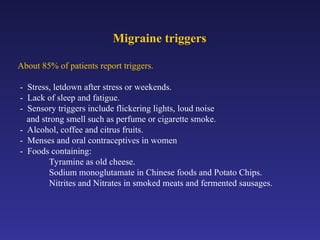
Migraine triggers
About 85% of patients report triggers.
- Stress, letdown after stress or weekends.
- Lack of sleep and fatigue.
- Sensory triggers include flickering lights, loud noise
and strong smell such as perfume or cigarette smoke.
- Alcohol, coffee and citrus fruits.
- Menses and oral contraceptives in women
- Foods containing:
Tyramine as old cheese.
Sodium monoglutamate in Chinese foods and Potato Chips.
Nitrites and Nitrates in smoked meats and fermented sausages.
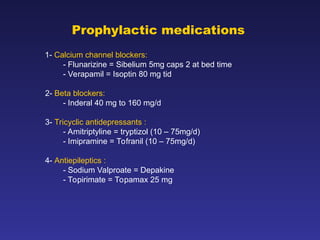
Prophylactic medications
1- Calcium channel blockers:
- Flunarizine = Sibelium 5mg caps 2 at bed time
- Verapamil = Isoptin 80 mg tid
2- Beta blockers:
- Inderal 40 mg to 160 mg/d
3- Tricyclic antidepressants :
- Amitriptyline = tryptizol (10 – 75mg/d)
- Imipramine = Tofranil (10 – 75mg/d)
4- Antiepileptics :
- Sodium Valproate = Depakine
- Topirimate = Topamax 25 mg
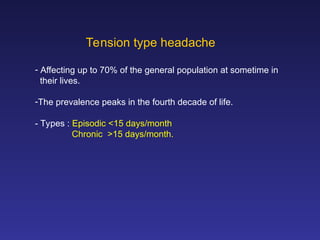
Tension type headache
- Affecting up to 70% of the general population at sometime in
their lives.
-The prevalence peaks in the fourth decade of life.
- Types : Episodic <15 days/month
Chronic >15 days/month.
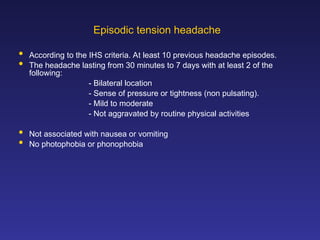
Episodic tension headache
 According to the IHS criteria. At least 10 previous headache episodes.
 The headache lasting from 30 minutes to 7 days with at least 2 of the
following:
- Bilateral location
- Sense of pressure or tightness (non pulsating).
- Mild to moderate
- Not aggravated by routine physical activities
 Not associated with nausea or vomiting
 No photophobia or phonophobia
Treatment of tension headache
- Simple analgesics
- Stronger analgesics should be avoided
- Muscle relaxants
- Tricyclic antidepressants in chronic type.
- Biofeedback and relaxation techniques

headache1bbbbbbbbbbbbbbbbbbbbbbbbbbbbbbbb.ppt

  • 1.
    Migraine and tensionheadache Migraine and tension headache Dr. Hassan Gad Dr. Hassan Gad Fakhry Hospital Fakhry Hospital MD. Neurology - Al- Azhar University MD. Neurology - Al- Azhar University
  • 2.
    Introduction Introduction Headache is extremelycommon. It is estimated Headache is extremely common. It is estimated that up to 80% of adults suffer from headache at that up to 80% of adults suffer from headache at sometime in their lives. Headache can be a sometime in their lives. Headache can be a symptom of underlying structural pathology and symptom of underlying structural pathology and potentially dangerous. However, most potentially dangerous. However, most headaches are benign and recurrent. headaches are benign and recurrent.
  • 3.
    Classification of headaches Classificationof headaches International headache society (IHS) criteria categorize headaches as: International headache society (IHS) criteria categorize headaches as: Primary headaches (90% of all headache types). Primary headaches (90% of all headache types). No underlying cause and includes: No underlying cause and includes: Migraine Migraine Tension headache Tension headache Cluster headache Cluster headache Secondary headaches (10%). Secondary headaches (10%). According to the etiology: According to the etiology: Cerebrovascular disease Cerebrovascular disease Head trauma Head trauma Subdural hematoma Subdural hematoma Temporal arteritis Temporal arteritis Brain tumor Brain tumor Pseudotumor cerebri Pseudotumor cerebri Trigeminal neuralgia Trigeminal neuralgia Hypertension Hypertension Drug abuse Drug abuse Referred pain from eye, ear , teeth, Referred pain from eye, ear , teeth, nasal sinuses, TMJ and cervical spines nasal sinuses, TMJ and cervical spines
  • 4.
    Quality of pain Qualityof pain - - Boring or burning in cluster Boring or burning in cluster - Sense of pressure or tightness in tension headache - Sense of pressure or tightness in tension headache - Throbbing or pulsating in migraine - Throbbing or pulsating in migraine - Lancinating or electric shock like in trigeminal neuralgia - Lancinating or electric shock like in trigeminal neuralgia Severity of headache Severity of headache - - The vast majority of severe headaches are due to migraine The vast majority of severe headaches are due to migraine or cluster headaches. In contrast, patients with headaches or cluster headaches. In contrast, patients with headaches due to brain tumors or subdural hematomas may report mild due to brain tumors or subdural hematomas may report mild headache similar to tension headaches. headache similar to tension headaches. - - The first and worst headache may be due aneurysm rupture The first and worst headache may be due aneurysm rupture and subarachnoid hemorrhage. and subarachnoid hemorrhage.
  • 5.
    Neuroimaging indications - Agemore than 50 years. - Headache increasing in frequency and severity. - Sudden onset of new and severe headache. - Recurrent early morning headaches. - Frequent awakening due to headache. - Increased with coughing and straining. - Abnormal examinations: Neck stiffness Papiloedema Decreased visual acuity Mental changes Focal neurologic signs
  • 6.
    Prevalence of migraine Migraineaffects 18% of all women and 6% of all men Age of onset from10 – 20 years (teenagers) About 80% begins before the age of 30. It is rare after the age of 50 Types of migraine: Migraine without aura occurs in 80% Migraine with aura occurs in 20%.
  • 7.
    Pathophysiology of migraine Pathophysiologyof migraine Although the mechanism of migraine remains incompletely understood, Although the mechanism of migraine remains incompletely understood, there is growing evidence that migraine is a neurovascular disorder. The there is growing evidence that migraine is a neurovascular disorder. The aura that precedes some migraines is a slow march of visual or other aura that precedes some migraines is a slow march of visual or other neurologic symptoms associated with changes in neuronal activity that neurologic symptoms associated with changes in neuronal activity that result in spreading neuronal depression from the occipital cortex. result in spreading neuronal depression from the occipital cortex. Excitatory changes produce increased cerebral blood flow and followed by Excitatory changes produce increased cerebral blood flow and followed by inhibitory changes associated with reduced cerebral blood flow. inhibitory changes associated with reduced cerebral blood flow. Activation of trigeminovascular complex: trigeminal nerve supply the Activation of trigeminovascular complex: trigeminal nerve supply the blood vessels. When the peripheral nerve endings of the trigeminal nerve blood vessels. When the peripheral nerve endings of the trigeminal nerve are activated during migraine, pain results from release of substance P and are activated during migraine, pain results from release of substance P and other peptides. These substances induce vasodilatation and throbbing pain other peptides. These substances induce vasodilatation and throbbing pain
  • 8.
    Diagnosis of migrainewithout aura Diagnosis of migraine without aura IHS criteria for migraine without aura: IHS criteria for migraine without aura: At least five attacks of headache with a duration ranges from 4-72 hours. At least five attacks of headache with a duration ranges from 4-72 hours. The headaches are associated with at least two of the following: The headaches are associated with at least two of the following: - Unilateral location - Unilateral location - Pulsating quality - Pulsating quality - Moderate to severe intensity - Moderate to severe intensity - Aggravation by routine physical activity - Aggravation by routine physical activity The pain is accompanied by at least one of the following: The pain is accompanied by at least one of the following: - Nausea with or without vomiting - Nausea with or without vomiting - Sensitivity to light (photophobia) - Sensitivity to light (photophobia) - Sensitivity to sound (phonophobia) - Sensitivity to sound (phonophobia)
  • 9.
    Diagnosis of migrainewith aura The headache is the same but the headache is preceded by transient neurologic symptoms. The migraine aura has a total duration of usually less than one hour. The aura may be visual, sensory or motor symptoms. The most common aura is the visual one which is present in 99% of cases. Visual aura include: - Small spots, dots or stars - Unformed flashes or streaks of light and zig – zag lines - Scintillating scotoma or fortification spectrum
  • 10.
    Migraine variants Hemiplegic migraine Isa rare familial type in children. The aura is accompanied by hemiparesis or hemiplegia followed by contralateral headache. This disorder is caused by autosomal dominant mutation in a brain specific P/Q- type calcium channel subunit on chromosome 19. Basilar migraine It is a rare variant of migraine with aura which occurs in young women. The aura is due to: Bilateral occipital lobe and brainstem dysfunction. Visual changes (typical of migraine aura or cortical blindness) Dysarthria, vertigo, tinnitus, diplopia, ataxia, bilateral parasthesia, weakness.and impaired level of consciousness. These symptoms last 20 to 30 minutes and are followed by occipital and throbbing headache. Ophthalmoplegic migraine Recurrent episodes of headache is associated with paresis of cranial nerves III, IV, and VI alone or in combination. The most common is the 3rd nerve palsy.
  • 11.
    Treatment of migraine Treatmentof migraine Treatment of the acute attack Treatment of the acute attack - Early treatment, when the headache is mild is more effective than later - Early treatment, when the headache is mild is more effective than later treatment when the headache becomes more intense. treatment when the headache becomes more intense. - Acute therapy should be restricted to a maximum of 2 or 3 days a week. - Acute therapy should be restricted to a maximum of 2 or 3 days a week. - The following medications are effective at the early onset of headache. - The following medications are effective at the early onset of headache. 1- Simple analgesics (Aspirin, Acetamenophen and ibuprofen) 1- Simple analgesics (Aspirin, Acetamenophen and ibuprofen) 2- 5HT1 receptor agonists: 2- 5HT1 receptor agonists: Selective such as triptan group Selective such as triptan group Non selective such as ergotamine Non selective such as ergotamine
  • 12.
    Treatment of theacute attack Treatment of the acute attack Triptan medications Triptan medications are selective 5HT (1B and 1D) receptor agonist are selective 5HT (1B and 1D) receptor agonist Sumatriptan Sumatriptan (Imigran tab 50 mg or injection sc 6mg). (Imigran tab 50 mg or injection sc 6mg). Rizatriptan Rizatriptan (Mygon tab 5 and 10 mg). (Mygon tab 5 and 10 mg). Contraindicated in those with: Contraindicated in those with: - Ischemic heart - Ischemic heart - Uncontrolled hypertension - Uncontrolled hypertension Side effects: chest tightness or pressure in <5% of patients not Side effects: chest tightness or pressure in <5% of patients not associated with ECG changes. associated with ECG changes. Ergotamine preparations Ergotamine preparations include (Migril, Migranil and Cafergot) include (Migril, Migranil and Cafergot)
  • 13.
    Prophylactic treatment Prophylactic treatment Indications: Indications:Patients with 2 or more attacks /month. Patients with 2 or more attacks /month. Severe headache interfere with daily activities. Severe headache interfere with daily activities. General principles General principles - Start small go slow - Start small go slow - Each trial of medications should be at least 2 months - Each trial of medications should be at least 2 months - Overused acute medications decrease the efficacy of - Overused acute medications decrease the efficacy of prophylactic treatment. prophylactic treatment. - Patients should be educated about the rational for treatment - Patients should be educated about the rational for treatment and possible side effects. and possible side effects. - Patients should be educated to avoid migraine triggers. - Patients should be educated to avoid migraine triggers.
  • 14.
    Migraine triggers About 85%of patients report triggers. - Stress, letdown after stress or weekends. - Lack of sleep and fatigue. - Sensory triggers include flickering lights, loud noise and strong smell such as perfume or cigarette smoke. - Alcohol, coffee and citrus fruits. - Menses and oral contraceptives in women - Foods containing: Tyramine as old cheese. Sodium monoglutamate in Chinese foods and Potato Chips. Nitrites and Nitrates in smoked meats and fermented sausages.
  • 15.
    Prophylactic medications 1- Calciumchannel blockers: - Flunarizine = Sibelium 5mg caps 2 at bed time - Verapamil = Isoptin 80 mg tid 2- Beta blockers: - Inderal 40 mg to 160 mg/d 3- Tricyclic antidepressants : - Amitriptyline = tryptizol (10 – 75mg/d) - Imipramine = Tofranil (10 – 75mg/d) 4- Antiepileptics : - Sodium Valproate = Depakine - Topirimate = Topamax 25 mg
  • 16.
    Tension type headache -Affecting up to 70% of the general population at sometime in their lives. -The prevalence peaks in the fourth decade of life. - Types : Episodic <15 days/month Chronic >15 days/month.
  • 17.
    Episodic tension headache According to the IHS criteria. At least 10 previous headache episodes.  The headache lasting from 30 minutes to 7 days with at least 2 of the following: - Bilateral location - Sense of pressure or tightness (non pulsating). - Mild to moderate - Not aggravated by routine physical activities  Not associated with nausea or vomiting  No photophobia or phonophobia
  • 18.
    Treatment of tensionheadache - Simple analgesics - Stronger analgesics should be avoided - Muscle relaxants - Tricyclic antidepressants in chronic type. - Biofeedback and relaxation techniques