Los Contextos del Cambio
Por: Dr. Rafael Cartagena
I. Las Organizaciones: Las metáforas de Gareth Morgan
“Images of Organizations”
3
I. Las Organizaciones: Las metáforas de Gareth Morgan
“Images of Organizations”
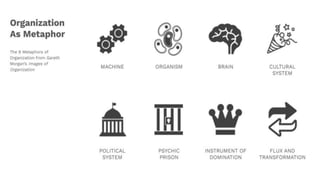
1. Machines: the basic concept of this metaphor is that the
organizations follow the same principles as a machine. The means
that each process is carefully selected and monitored in order to
make sure that it is done as efficiently as possible. This is done
through highly specifying and standardizing the parts and processes
that make up the machine.
2. Biological organisms: the organismic view emphasizes growth,
adaptation and environmental relations. 4
5
3. Human brains: the perspective depicts organizations as
cultures are based on values, norms, beliefs, assumptions,
manifestations, artefacts and rituals.
4. Cultures or subcultures: organizations as cultures are
based on values, norms, beliefs, assumptions,
manifestations, artefacts and rituals.
5. Political systems: in political organizations it is interests,
conflict and power issues that predominate.
6
6. Psychic prisons: organizations as psychic prisons are
where people are trapped by certain ways of thinking,
which restricts creativity.
7. System of change and transformation: such
organizations can adapt and change.
8. Instruments of domination: organizations as
instruments of domination have an emphasis on explotation
and the organization imposing their will on employees.
“
7
II. ¿Qué es La Burocracia?
1. Reglamentos
2. Jerarquías
3. Formalidad de la comunicación
4. División y procedimiento del trabajo
5. Normas de trabajo
6. Meritocracia
7. Administración
8. Profesionalización de sus miembros
9. Previsión del funcionamiento
6. Criticas
III. Las fuerzas que propician el cambio
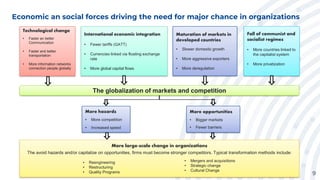
Economic an social forces driving the need for major chance in organizations
9
Technological change
• Faster an better
Communication
• Faster and better
transportation
• More information networks
connection people globally
International economic integration
• Fewer tariffs (GATT)
• Currencies linked via floating exchange
rate
• More global capital flows
Maturation of markets in
developed countries
• Slower domestic growth
• More aggressive exporters
• More deregulation
Fall of communist and
socialist regimes
• More countries linked to
the capitalist system
• More privatization
The globalization of markets and competition
More hazards
• More competition
• Increased speed
More large-scale change in organizations
The avoid hazards and/or capitalize on opportunities, firms must become stronger competitors. Typical transformation methods include:
• Reengineering
• Restructuring
• Quality Programs
• Mergers and acquisitions
• Strategic change
• Cultural Change
More opportunities
• Bigger markets
• Fewer barriers
10
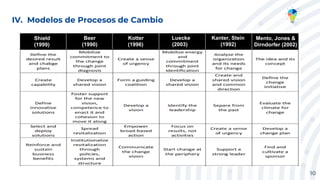
IV. Modelos de Procesos de Cambio
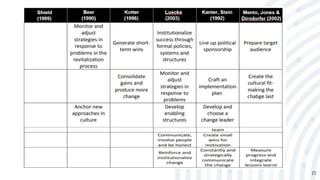
Shield
(1999)
Beer
(1990)
Kotter
(1996)
Luecke
(2003)
Kanter, Stein
(1992)
Mento, Jones &
Dirndorfer (2002)
11

Los Contextos del Cambio

  • 1.
    Los Contextos delCambio Por: Dr. Rafael Cartagena
  • 2.
    I. Las Organizaciones:Las metáforas de Gareth Morgan “Images of Organizations”
  • 3.
  • 4.
    I. Las Organizaciones:Las metáforas de Gareth Morgan “Images of Organizations” 1. Machines: the basic concept of this metaphor is that the organizations follow the same principles as a machine. The means that each process is carefully selected and monitored in order to make sure that it is done as efficiently as possible. This is done through highly specifying and standardizing the parts and processes that make up the machine. 2. Biological organisms: the organismic view emphasizes growth, adaptation and environmental relations. 4
  • 5.
    5 3. Human brains:the perspective depicts organizations as cultures are based on values, norms, beliefs, assumptions, manifestations, artefacts and rituals. 4. Cultures or subcultures: organizations as cultures are based on values, norms, beliefs, assumptions, manifestations, artefacts and rituals. 5. Political systems: in political organizations it is interests, conflict and power issues that predominate.
  • 6.
    6 6. Psychic prisons:organizations as psychic prisons are where people are trapped by certain ways of thinking, which restricts creativity. 7. System of change and transformation: such organizations can adapt and change. 8. Instruments of domination: organizations as instruments of domination have an emphasis on explotation and the organization imposing their will on employees.
  • 7.
    “ 7 II. ¿Qué esLa Burocracia? 1. Reglamentos 2. Jerarquías 3. Formalidad de la comunicación 4. División y procedimiento del trabajo 5. Normas de trabajo 6. Meritocracia 7. Administración 8. Profesionalización de sus miembros 9. Previsión del funcionamiento 6. Criticas
  • 8.
    III. Las fuerzasque propician el cambio
  • 9.
    Economic an socialforces driving the need for major chance in organizations 9 Technological change • Faster an better Communication • Faster and better transportation • More information networks connection people globally International economic integration • Fewer tariffs (GATT) • Currencies linked via floating exchange rate • More global capital flows Maturation of markets in developed countries • Slower domestic growth • More aggressive exporters • More deregulation Fall of communist and socialist regimes • More countries linked to the capitalist system • More privatization The globalization of markets and competition More hazards • More competition • Increased speed More large-scale change in organizations The avoid hazards and/or capitalize on opportunities, firms must become stronger competitors. Typical transformation methods include: • Reengineering • Restructuring • Quality Programs • Mergers and acquisitions • Strategic change • Cultural Change More opportunities • Bigger markets • Fewer barriers
  • 10.
    10 IV. Modelos deProcesos de Cambio Shield (1999) Beer (1990) Kotter (1996) Luecke (2003) Kanter, Stein (1992) Mento, Jones & Dirndorfer (2002)
  • 11.