Presented by:
Tracy Rehberg, Bull City Learning
Richard Duncan, UNICEF
Alan Brooks, GAVI
Change Management Presentation
and Panel Discussion
Session Overview
 Review Change Management Models and Best Practices
 Share Two Practical Guides for Setting the Right Course
 Review WHO/UNICEF Immunization eLearning Initiative Barriers
 Highlight the WHO/UNICEF Immunization eLearning Initiative
 Richard Duncan, UNICEF, will Share Ongoing Change Management Efforts
 Alan Brooks, GAVI will Share Recent Work Experiences
The Definition & Purpose of Change Management
Change management is a structured approach, transitioning an
organization from a current state to a desired future state.
Change management models are used to
1. Provide smoother implementation with more rapid results
2. Ensure change is understood, supported, and pervasive
3. Deliver sustained benefits of change
What is the best change management model?
Kotter’s 8 Step Change Model
Harvard University Professor John Kotter in mid-late 1990s model views change as a
campaign. The goal of the 8-step process is for teams to buy into the change after
leaders convince them of the critical need for change to occur.
1 2 3 4 5 6 7 8
Creating a climate for change
Engaging and enabling the
entire organization
Sustaining the change
Creating
Urgency
Leadership
Team
Vision Buy-in
Empower
Action
Short-
term
wins
Don’t let
up
Make it
stick
Lewin’s Change Management Model
Psychologist Kurt Lewin’s 1950s model, recognizes that most people prefer and operate within certain zones
of safety. His model is prescribes “Unfreeze – Change – Refreeze” as three-stage process for change.
1. Determine what needs to change.
2. Ensure strong support from upper management.
3. Create the need for change.
4. Manage and understand the doubts and concerns.
1. Anchor the changes into the culture.
2. Develop ways to sustain the change.
3. Provide support and training.
4. Celebrate success!
1. Unfreeze
2. Change
3. Refreeze
1. Communicate often.
2. Dispel rumors.
3. Empower action.
4. Involve people in the process.
Prosci's 3-Phase Change Management Process
Prosci is an independent research company focusing on change management techniques. Its process is the sequence
of steps or activities that a change management team follows to apply change management to an initiative.
What do these models have in common?
What else must be considered?
The Congruence Model
The Congruence Model is based on the principle that an organization's performance is derived from four elements: tasks, people,
structure, and culture. The higher the congruence, or compatibility, amongst these elements, the greater the performance.
1. Step One: Analyze each element
1. Step Two: Analyze how elements interrelate
1. Step Three: Plan to create and maintain congruence
Culture:
How does information flow around the organization?
What are the beliefs and values of individuals in the organization?
How can leadership be leveraged?
Tasks:
Does the work require specific knowledge or skill?
What are the intrinsic rewards involved in completing the work?
What sort of approach is needed to do this work best?
People:
Who interacts to get the work done?
What are these people's preferences and expectations for compensation,
reward, career progression, recognition, and organizational commitment?
Organizational Structure:
How is the company organized?
Are there distinct business units or other separations?
How standardized is the work? Rules, policies, procedures.
How is work measured and incentivized and rewarded?
Communication: A Practical Planning Tool
•
Stakeholder Key Interest Desired Support Barriers Message Needs Communication
Approach
Communications: An Effective Planning Checklist
 Who will deliver the communications in your organization?
 Who are the key influencers and how will you use them?
 How will you answer WHY this change is needed?
 What is in it for your audience?
 What are their barriers to this change? How will you overcome them?
 What are your key messages?
 How will you deliver the message? What will be most effective?
 Are your communicators prepared? Are your influencers on the same page?
 Are you resisting the urge to have the communication come only from the project lead?
 Will there be face-to-face communications? How will you create opportunities for two-way dialogue?
 How will you repeat the message at least at eight times?
 How will you celebrate short-term wins? How will you reward performance longer term?
 Are reactions being gauged? Are you open to refinement?
 Are the results be measured?
 How will change be reinforced and rewarded over the long haul?
Change Management Discussion – WHO/UNICEF
The Immunization eLearning Initiative is a digital learning programme designed to help immunization staff
in all roles improve their support to MOH and government partners.
Change management is being used to
1. Achieve high levels of training participation
2. Grow acceptance of online learning as a valuable means of training
3. Strengthen staff support of immunization programmes in critical areas
Preparation for Change
WHO and UNICEF completed a training needs survey of all Immunization staff in the Fall of 2014.
 Areas of greatest immunization training need were determined, including
1. Immunization Supply Chain Management
2. Communications
3. Programme Planning
4. Data Management and Use
 Barriers to online learning acceptance were revealed
LEARNING CULTURE
SUPPORT
FAMILIARITY
TIME
FEAR
VALUE
TECHNOLOGY
Several physical, cultural, and attitudinal barriers to immunization eLearning adoption must be effectively
mitigated by change management strategies.
Immunization
eLearning
Adoption
Immunization
eLearning
Implementation
Barriers to Change
Immunization
eLearning
Adoption
Immunization
eLearning
Implementation
Catalysts to Change
FLEXIBILITY
TIME SAVINGS
CONVENIENCE
SKILL ATTAINMENT
CERTIFICATION
CHOICE
COST SAVINGS
Conversely several benefits to eLearning exist and should be reinforced.
1. VALUE ESTABLISHMENT
2. PROGRAMME VISION
3. INFLUENCER SUPPORT
4. GOAL SHARING
5. STEP CLARITY
6. BRANDED PROMOTION
7. SUFFICIENT REPETITION
8. URGENCY OF COMPLETION
9. INCREMENTAL WINS
10. SOCIAL SHARING
11. PARTICIPATION INCENTIVE
12. REINFORCEMENT
Change Management Elements
Given the barriers and benefits, we developed a plan to leverage 12 change management elements to reach
our goals.
WHO/UNICEF Change Management Activities
Jhilmil Bahl, Capacity Building Officer, Immunizations, Vaccines, Biologicals, WHO
Richard Duncan, Senior Immunization Specialist, UNICEF
Immunization eLearning Initiative
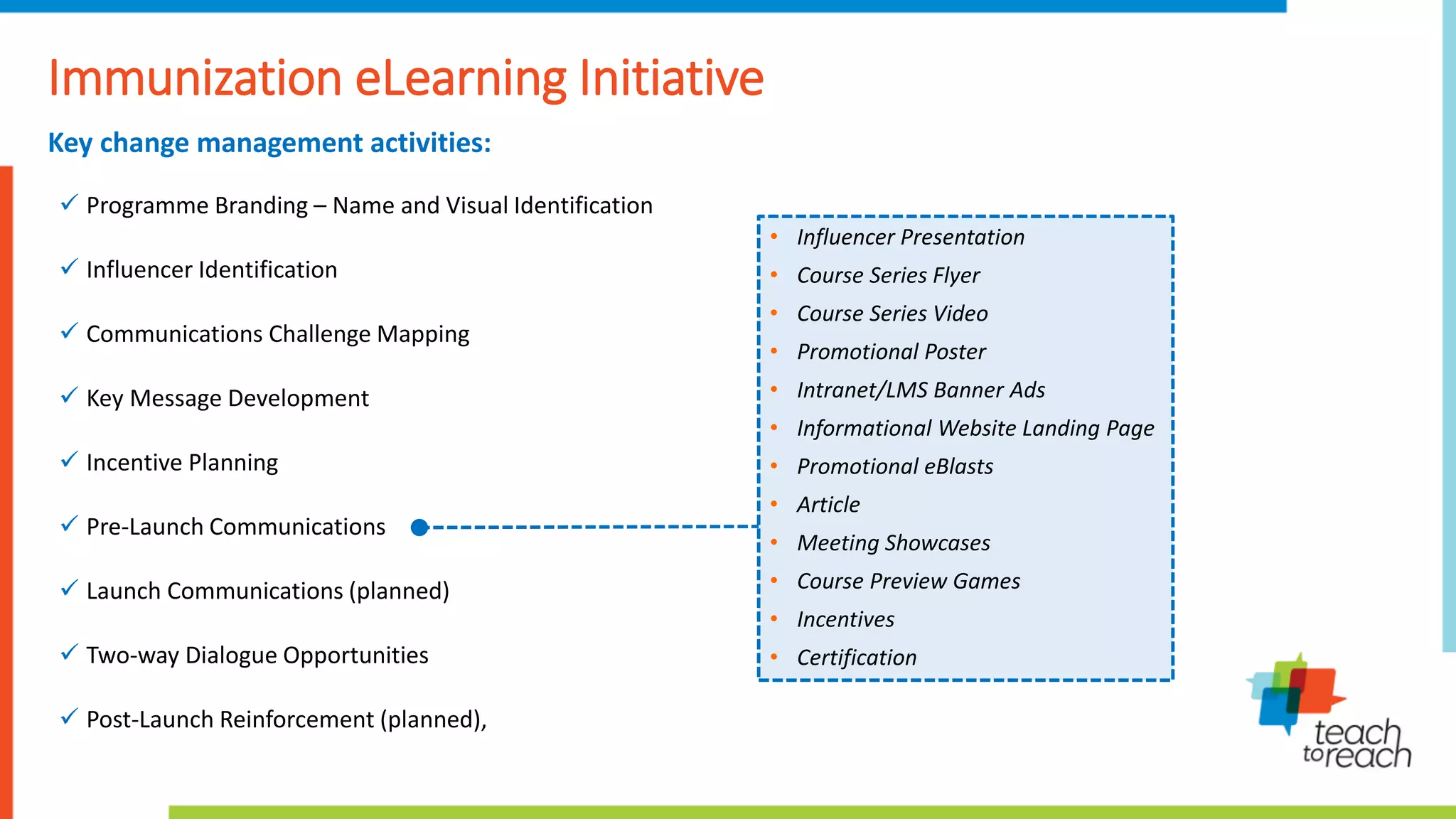
 Programme Branding – Name and Visual Identification
 Influencer Identification
 Communications Challenge Mapping
 Key Message Development
 Incentive Planning
 Pre-Launch Communications
 Launch Communications (planned)
 Two-way Dialogue Opportunities
 Post-Launch Reinforcement (planned),
Key change management activities:
• Influencer Presentation
• Course Series Flyer
• Course Series Video
• Promotional Poster
• Intranet/LMS Banner Ads
• Informational Website Landing Page
• Promotional eBlasts
• Article
• Meeting Showcases
• Course Preview Games
• Incentives
• Certification
Promotional materials
Promotional video
A Shared Brand Platform
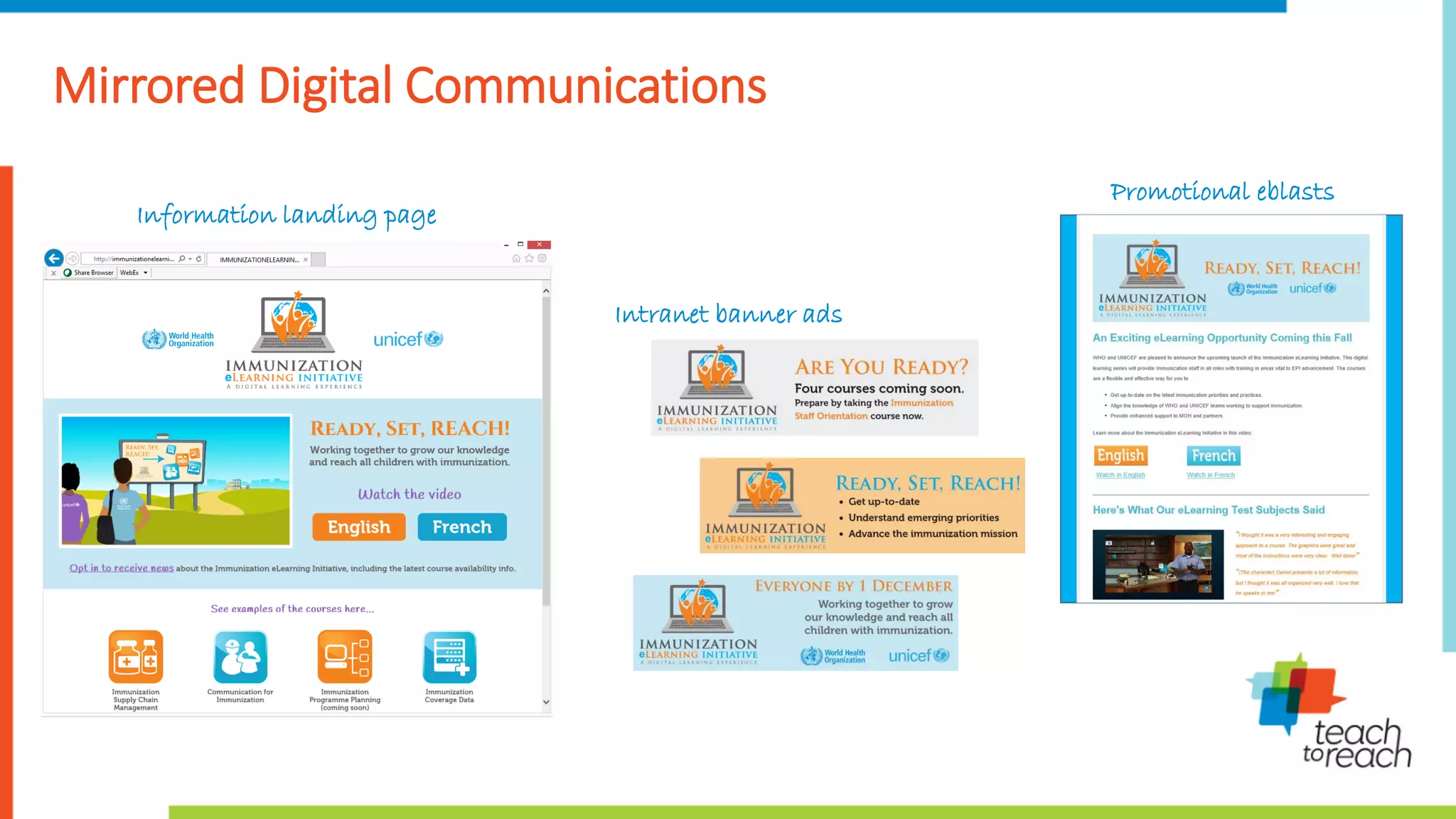
Information landing page
Intranet banner ads
Promotional eblasts
Mirrored Digital Communications
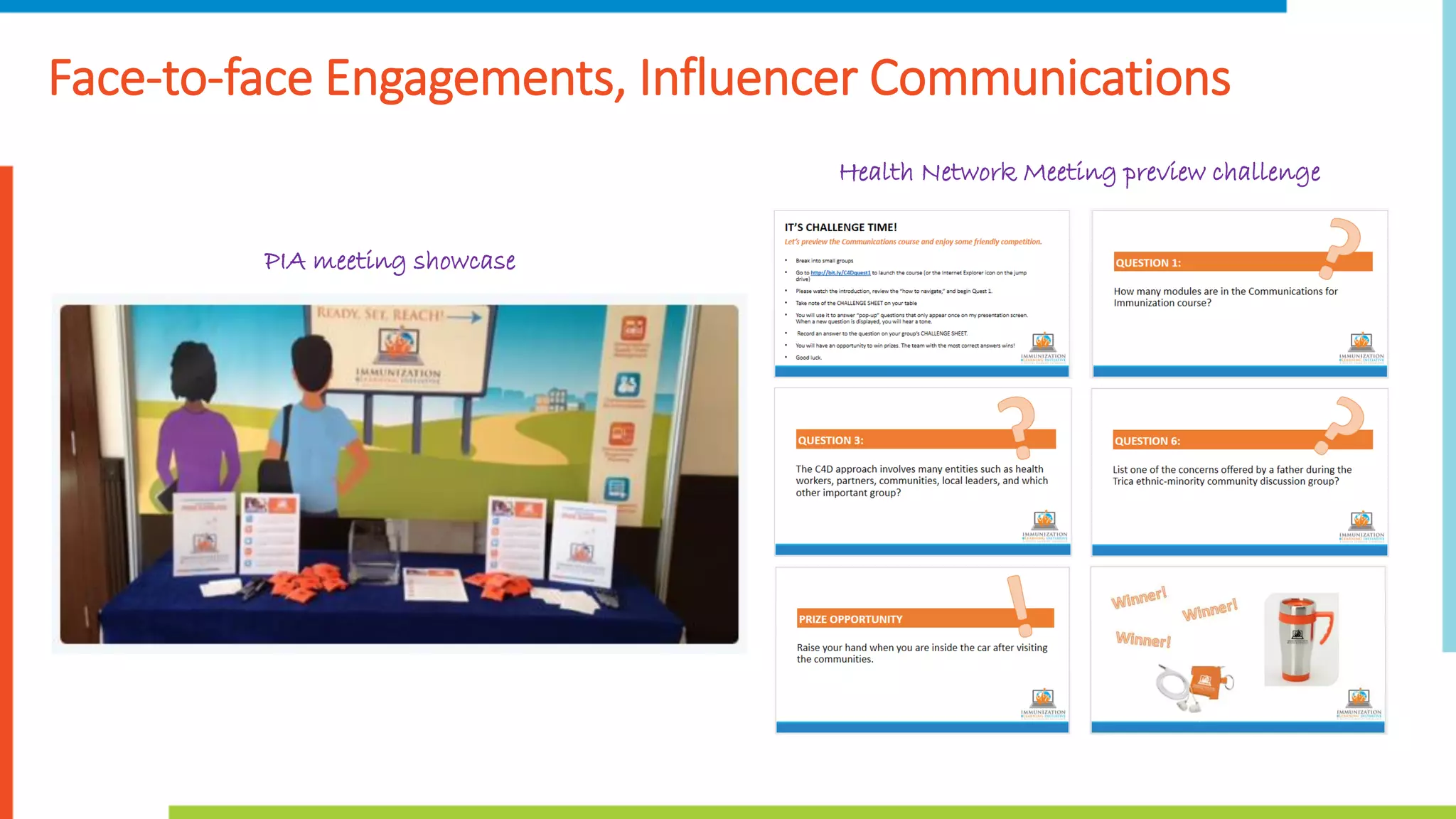
PIA meeting showcase
Health Network Meeting preview challenge
Face-to-face Engagements, Influencer Communications
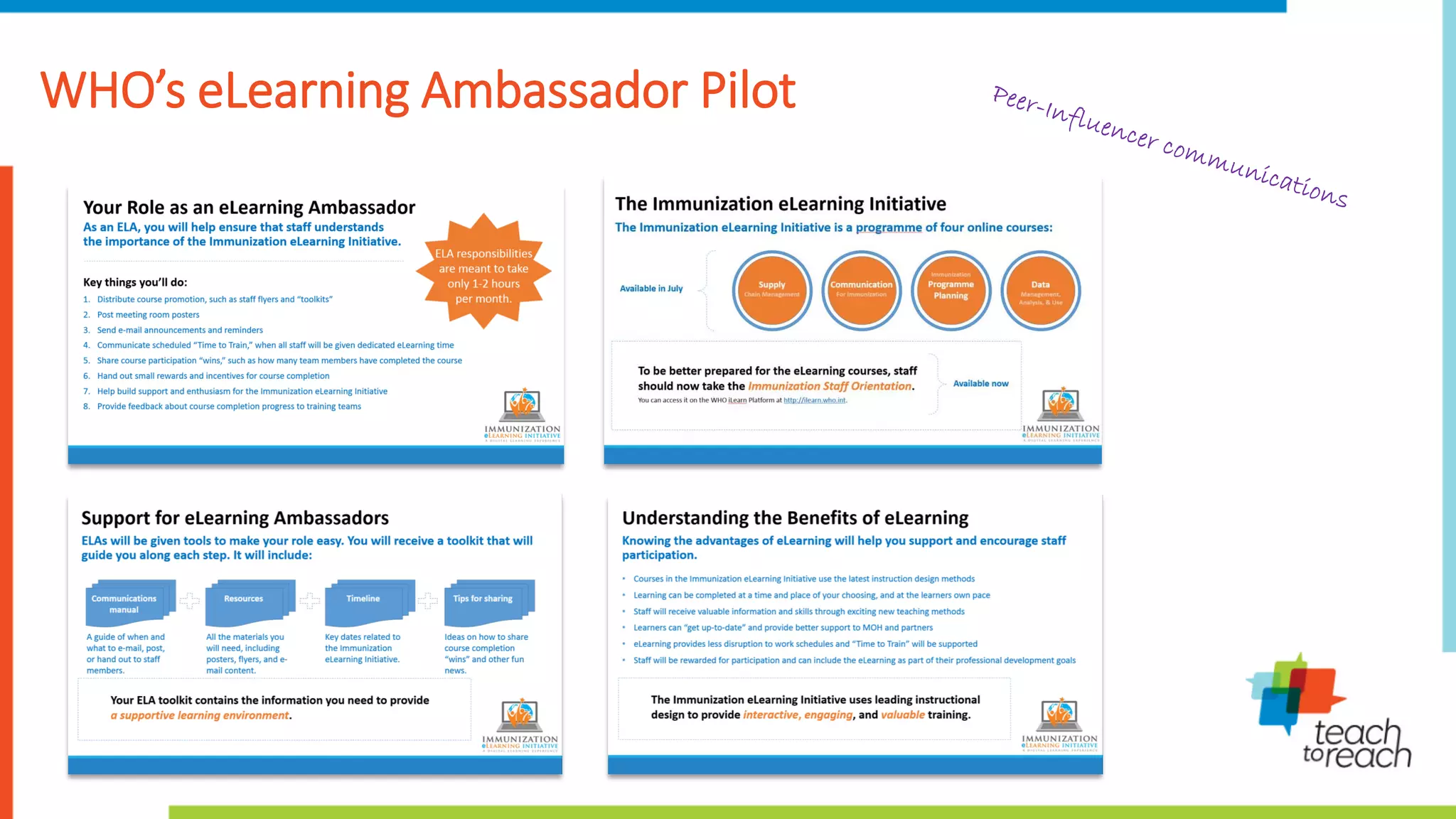
WHO’s eLearning Ambassador Pilot
GAVI Change Management Activities
Alan Brooks, Director for Health Systems and Immunisation Strengthening, Gavi Alliance
Panel Discussion Q&A
Tracy Rehberg, Change Management Strategist, Bull City Learning
Richard Duncan, Senior Immunization Specialist, UNICEF
Alan Brooks, Director for Health Systems and Immunisation Strengthening, Gavi Alliance

Change Management Panel

  • 1.
    Presented by: Tracy Rehberg,Bull City Learning Richard Duncan, UNICEF Alan Brooks, GAVI Change Management Presentation and Panel Discussion
  • 2.
    Session Overview  ReviewChange Management Models and Best Practices  Share Two Practical Guides for Setting the Right Course  Review WHO/UNICEF Immunization eLearning Initiative Barriers  Highlight the WHO/UNICEF Immunization eLearning Initiative  Richard Duncan, UNICEF, will Share Ongoing Change Management Efforts  Alan Brooks, GAVI will Share Recent Work Experiences
  • 3.
    The Definition &Purpose of Change Management Change management is a structured approach, transitioning an organization from a current state to a desired future state. Change management models are used to 1. Provide smoother implementation with more rapid results 2. Ensure change is understood, supported, and pervasive 3. Deliver sustained benefits of change
  • 4.
    What is thebest change management model?
  • 5.
    Kotter’s 8 StepChange Model Harvard University Professor John Kotter in mid-late 1990s model views change as a campaign. The goal of the 8-step process is for teams to buy into the change after leaders convince them of the critical need for change to occur. 1 2 3 4 5 6 7 8 Creating a climate for change Engaging and enabling the entire organization Sustaining the change Creating Urgency Leadership Team Vision Buy-in Empower Action Short- term wins Don’t let up Make it stick
  • 6.
    Lewin’s Change ManagementModel Psychologist Kurt Lewin’s 1950s model, recognizes that most people prefer and operate within certain zones of safety. His model is prescribes “Unfreeze – Change – Refreeze” as three-stage process for change. 1. Determine what needs to change. 2. Ensure strong support from upper management. 3. Create the need for change. 4. Manage and understand the doubts and concerns. 1. Anchor the changes into the culture. 2. Develop ways to sustain the change. 3. Provide support and training. 4. Celebrate success! 1. Unfreeze 2. Change 3. Refreeze 1. Communicate often. 2. Dispel rumors. 3. Empower action. 4. Involve people in the process.
  • 7.
    Prosci's 3-Phase ChangeManagement Process Prosci is an independent research company focusing on change management techniques. Its process is the sequence of steps or activities that a change management team follows to apply change management to an initiative.
  • 8.
    What do thesemodels have in common?
  • 9.
    What else mustbe considered?
  • 10.
    The Congruence Model TheCongruence Model is based on the principle that an organization's performance is derived from four elements: tasks, people, structure, and culture. The higher the congruence, or compatibility, amongst these elements, the greater the performance. 1. Step One: Analyze each element 1. Step Two: Analyze how elements interrelate 1. Step Three: Plan to create and maintain congruence Culture: How does information flow around the organization? What are the beliefs and values of individuals in the organization? How can leadership be leveraged? Tasks: Does the work require specific knowledge or skill? What are the intrinsic rewards involved in completing the work? What sort of approach is needed to do this work best? People: Who interacts to get the work done? What are these people's preferences and expectations for compensation, reward, career progression, recognition, and organizational commitment? Organizational Structure: How is the company organized? Are there distinct business units or other separations? How standardized is the work? Rules, policies, procedures. How is work measured and incentivized and rewarded?
  • 11.
    Communication: A PracticalPlanning Tool • Stakeholder Key Interest Desired Support Barriers Message Needs Communication Approach
  • 12.
    Communications: An EffectivePlanning Checklist  Who will deliver the communications in your organization?  Who are the key influencers and how will you use them?  How will you answer WHY this change is needed?  What is in it for your audience?  What are their barriers to this change? How will you overcome them?  What are your key messages?  How will you deliver the message? What will be most effective?  Are your communicators prepared? Are your influencers on the same page?  Are you resisting the urge to have the communication come only from the project lead?  Will there be face-to-face communications? How will you create opportunities for two-way dialogue?  How will you repeat the message at least at eight times?  How will you celebrate short-term wins? How will you reward performance longer term?  Are reactions being gauged? Are you open to refinement?  Are the results be measured?  How will change be reinforced and rewarded over the long haul?
  • 13.
    Change Management Discussion– WHO/UNICEF The Immunization eLearning Initiative is a digital learning programme designed to help immunization staff in all roles improve their support to MOH and government partners. Change management is being used to 1. Achieve high levels of training participation 2. Grow acceptance of online learning as a valuable means of training 3. Strengthen staff support of immunization programmes in critical areas
  • 14.
    Preparation for Change WHOand UNICEF completed a training needs survey of all Immunization staff in the Fall of 2014.  Areas of greatest immunization training need were determined, including 1. Immunization Supply Chain Management 2. Communications 3. Programme Planning 4. Data Management and Use  Barriers to online learning acceptance were revealed
  • 15.
    LEARNING CULTURE SUPPORT FAMILIARITY TIME FEAR VALUE TECHNOLOGY Several physical,cultural, and attitudinal barriers to immunization eLearning adoption must be effectively mitigated by change management strategies. Immunization eLearning Adoption Immunization eLearning Implementation Barriers to Change
  • 16.
    Immunization eLearning Adoption Immunization eLearning Implementation Catalysts to Change FLEXIBILITY TIMESAVINGS CONVENIENCE SKILL ATTAINMENT CERTIFICATION CHOICE COST SAVINGS Conversely several benefits to eLearning exist and should be reinforced.
  • 17.
    1. VALUE ESTABLISHMENT 2.PROGRAMME VISION 3. INFLUENCER SUPPORT 4. GOAL SHARING 5. STEP CLARITY 6. BRANDED PROMOTION 7. SUFFICIENT REPETITION 8. URGENCY OF COMPLETION 9. INCREMENTAL WINS 10. SOCIAL SHARING 11. PARTICIPATION INCENTIVE 12. REINFORCEMENT Change Management Elements Given the barriers and benefits, we developed a plan to leverage 12 change management elements to reach our goals.
  • 18.
    WHO/UNICEF Change ManagementActivities Jhilmil Bahl, Capacity Building Officer, Immunizations, Vaccines, Biologicals, WHO Richard Duncan, Senior Immunization Specialist, UNICEF
  • 19.
    Immunization eLearning Initiative Programme Branding – Name and Visual Identification  Influencer Identification  Communications Challenge Mapping  Key Message Development  Incentive Planning  Pre-Launch Communications  Launch Communications (planned)  Two-way Dialogue Opportunities  Post-Launch Reinforcement (planned), Key change management activities: • Influencer Presentation • Course Series Flyer • Course Series Video • Promotional Poster • Intranet/LMS Banner Ads • Informational Website Landing Page • Promotional eBlasts • Article • Meeting Showcases • Course Preview Games • Incentives • Certification
  • 20.
  • 21.
    Information landing page Intranetbanner ads Promotional eblasts Mirrored Digital Communications
  • 22.
    PIA meeting showcase HealthNetwork Meeting preview challenge Face-to-face Engagements, Influencer Communications
  • 23.
  • 24.
    GAVI Change ManagementActivities Alan Brooks, Director for Health Systems and Immunisation Strengthening, Gavi Alliance
  • 25.
    Panel Discussion Q&A TracyRehberg, Change Management Strategist, Bull City Learning Richard Duncan, Senior Immunization Specialist, UNICEF Alan Brooks, Director for Health Systems and Immunisation Strengthening, Gavi Alliance