1
Presentation Topic:
Presented by:
Assigned By:
APPLICATIONS OF UV WITH HPLC
DR.AYAZ ALI
MEMON
DADU MAL(DK)
Zubair Ali Shah
 Spectroscopy
UV-Visible Region
Hyphenated techniques
Chromatography
 HPLC
HPLC Instrumentation
UV Detector
Advantages and Limitations
 Application of UV with HPLC
References
Acknowledgement
3
The study of interaction of
electromagnetic radiations with
matter is called “Spectroscopy.
4
 Detection of functional groups.
 Detection of impurities.
 Qualitative analysis
 Quantitative analysis.
 Characterization of species
 Structure elucidation.
 Determination of conjugation etc.
5
This is the earliest method of molecular
spectroscopy.
A phenomenon of interaction of molecule with
ultraviolet and visible light(EMR).
Absorption of photons results in electronic
transition of a molecule and electrons are promoted
from ground state to the excited state.
6
 Russian botanist Mikhail Tswett in 1903
 Chromatography is a physical method of
separation that distributes components to separate
between two phases, one stationary (stationary
phase), the other (the mobile phase) moving in a
definite direction.
7
8
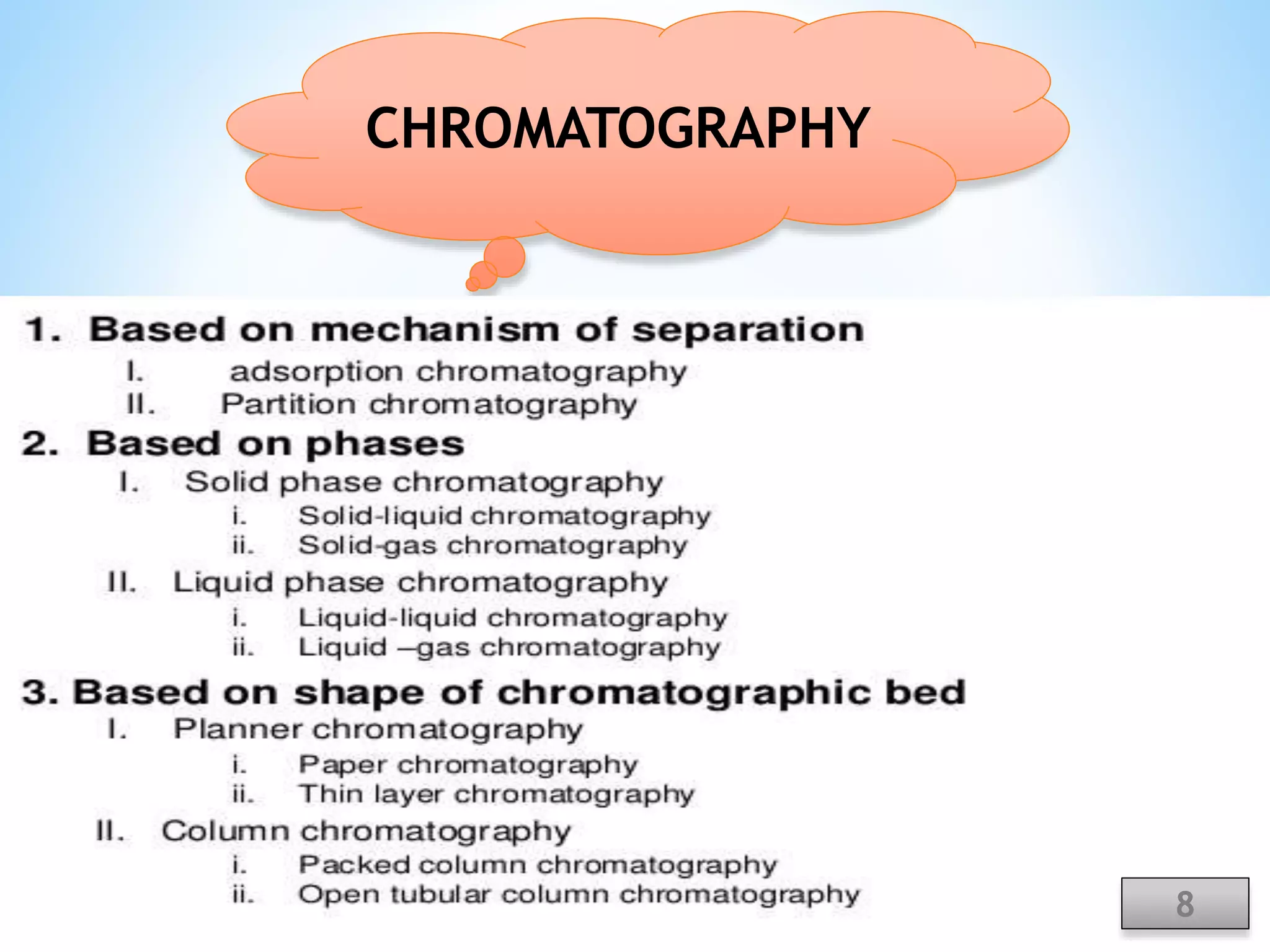
CHROMATOGRAPHY
8
 HPLC is a technique in analytical chemistry used to separate,
identify, and quantify each component in a mixture.
BASIC PRINCIPLE
 When a mixture of components is introduced into a HPLC column,
they travel according their relative affinities towards the
stationary phase.
 The components which has more affinity towards the adsorbent
travel slowest the component which has less affinity towards the
stationary phase travels faster.
 Since two components have not the same affinity towards the
stationary phase, the components are separated.
9
HPLC
 Hyphenated technique is a combination or coupling of two
different analytical techniques with the help of proper
interface.
 Hirschfield (1980) introduced the term “hyphenation” to
refer to the on-line combination of separation technique and
one or more spectroscopic detection techniques .
 The hyphenated technique is developed from the coupling of
a separation technique and an online spectroscopic detection
technology.
10
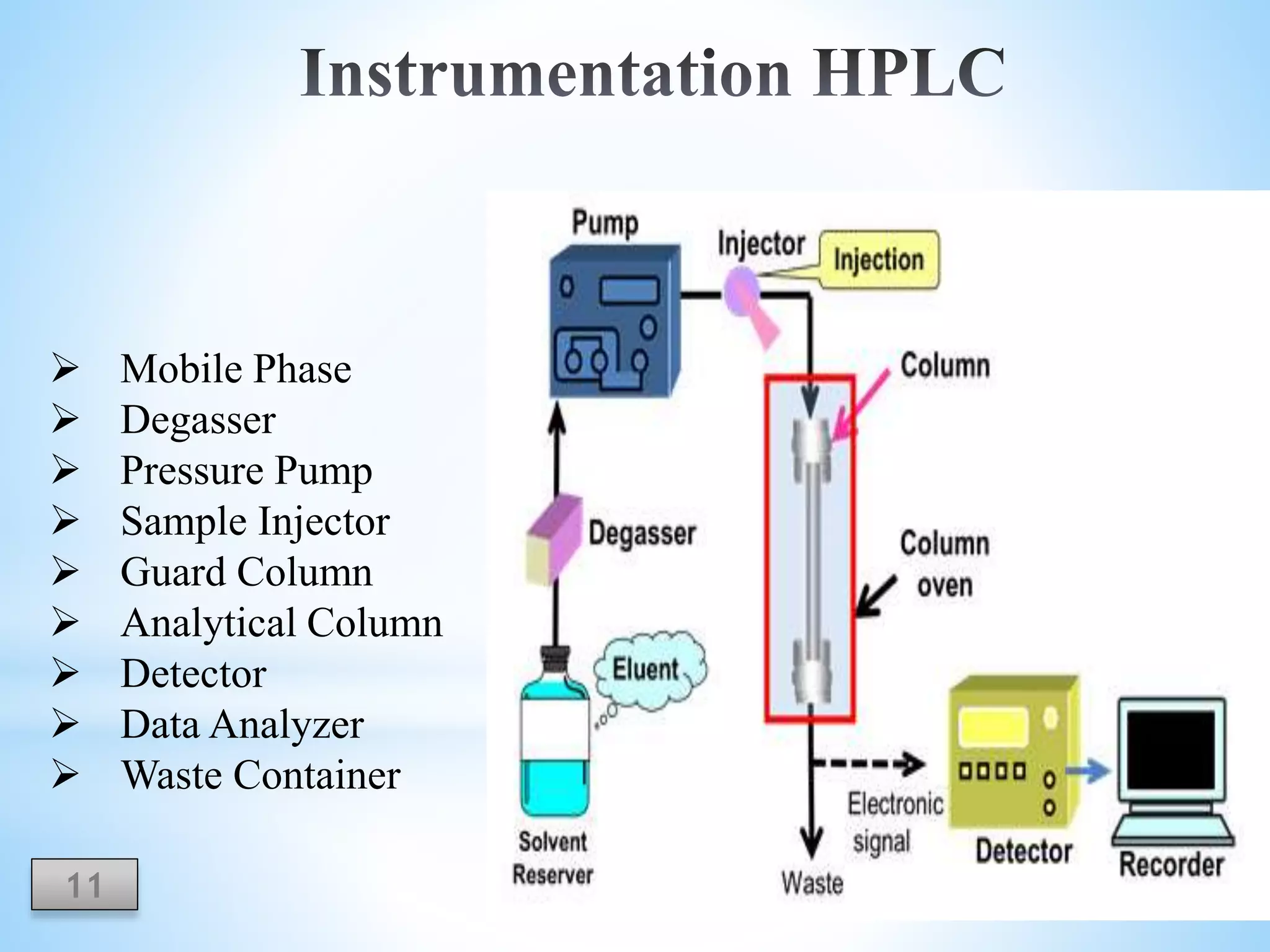
 Mobile Phase
 Degasser
 Pressure Pump
 Sample Injector
 Guard Column
 Analytical Column
 Detector
 Data Analyzer
 Waste Container
11
UV/VIS Detector
Photo diode array Detector
Fluorescence Detector
Refractive index Detector
12
 UV detection is the most usual and widespread detection.
 The instrument is simple and is available from numerous
manufacturers
 Many analytes suitable for HPLC analysis and also absorb
in the UV region.
 The wavelength range can be easily expanded to the region
of visible light (Vis) for the detection of colored Analytes.
 UV/Vis detection is more sharp than many other detection
systems.
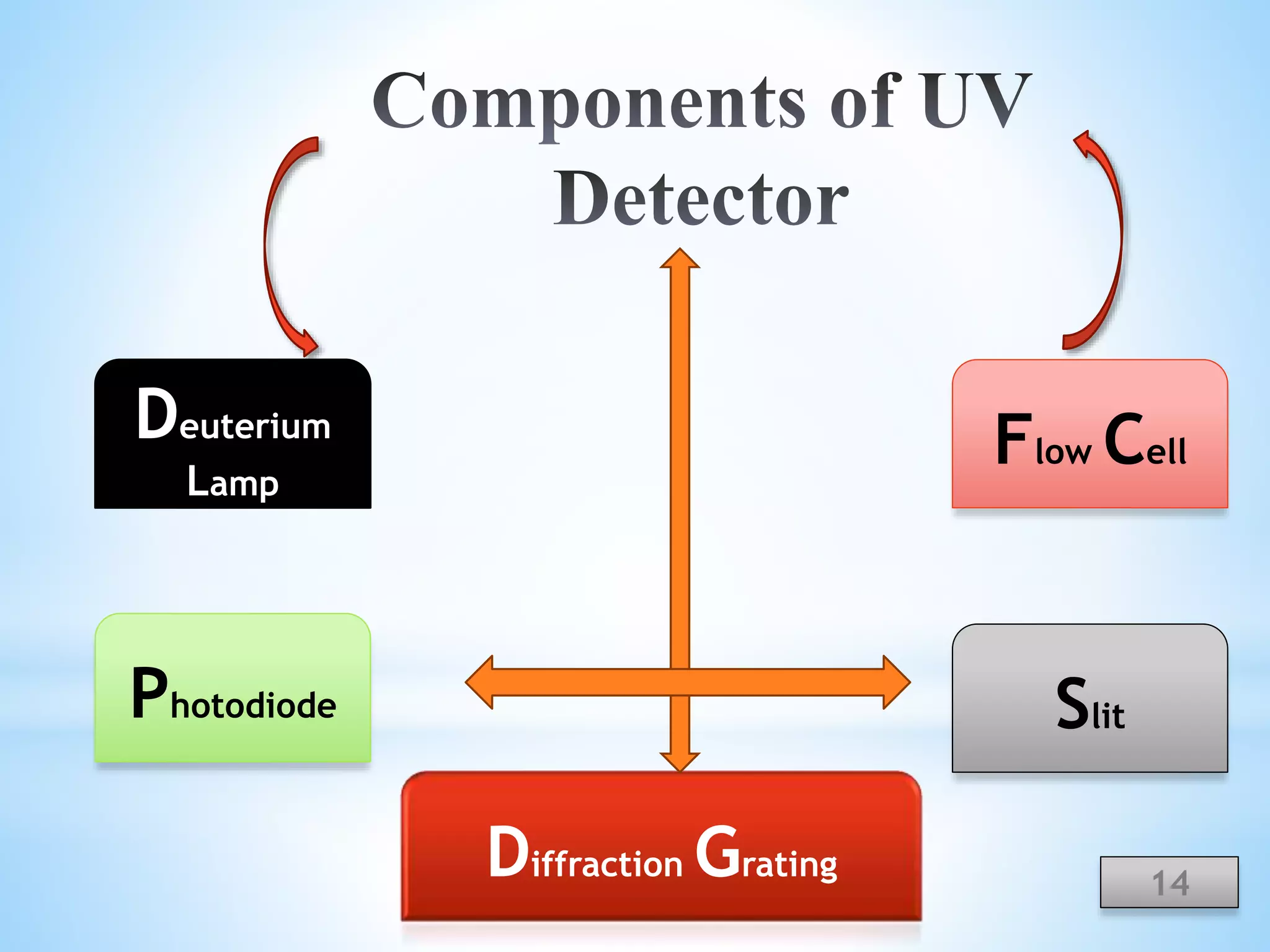
UV DETECTOR
13
SlitPhotodiode
Deuterium
Lamp
Diffraction Grating
Flow Cell
14
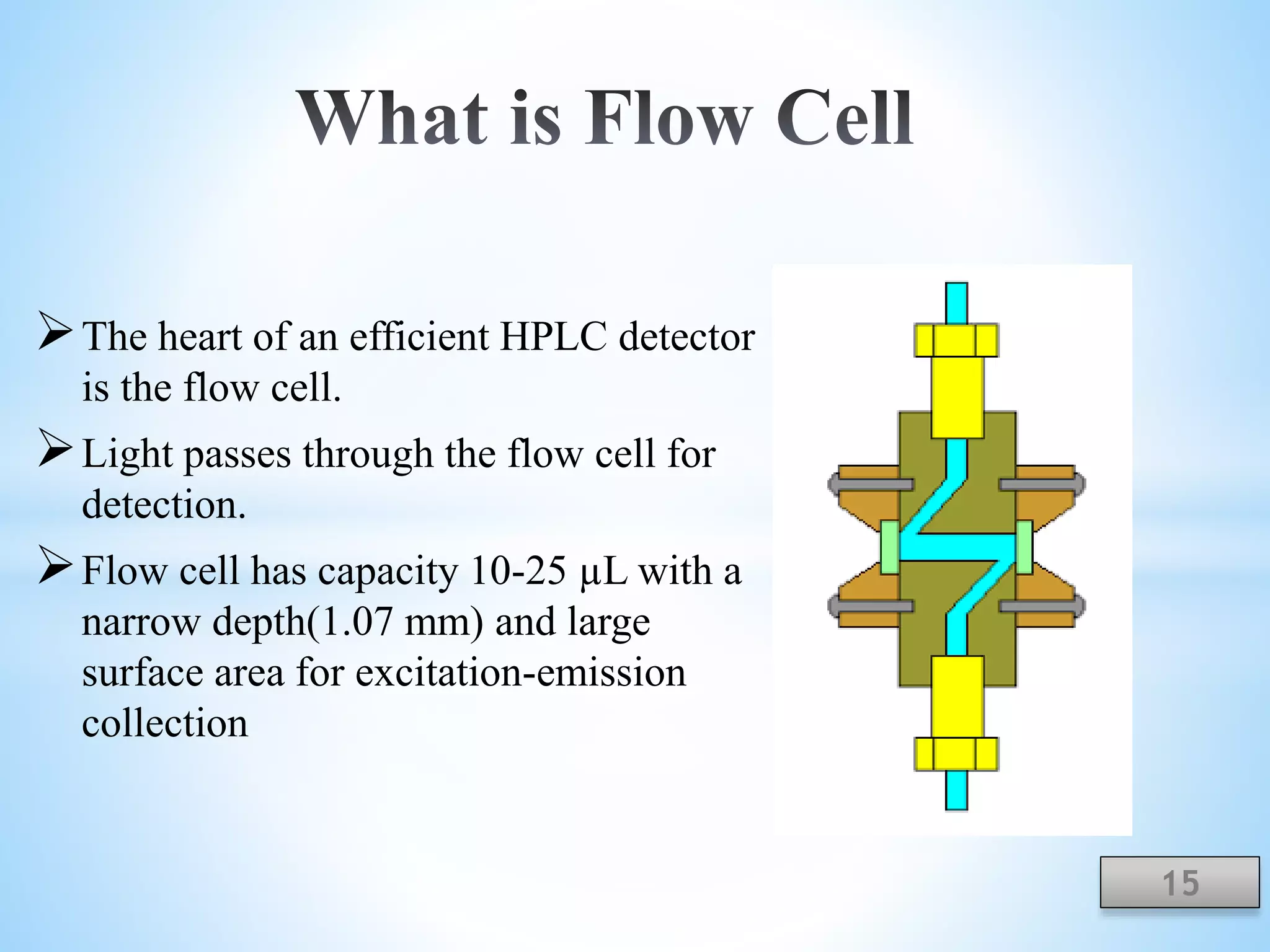
The heart of an efficient HPLC detector
is the flow cell.
Light passes through the flow cell for
detection.
Flow cell has capacity 10-25 µL with a
narrow depth(1.07 mm) and large
surface area for excitation-emission
collection
15
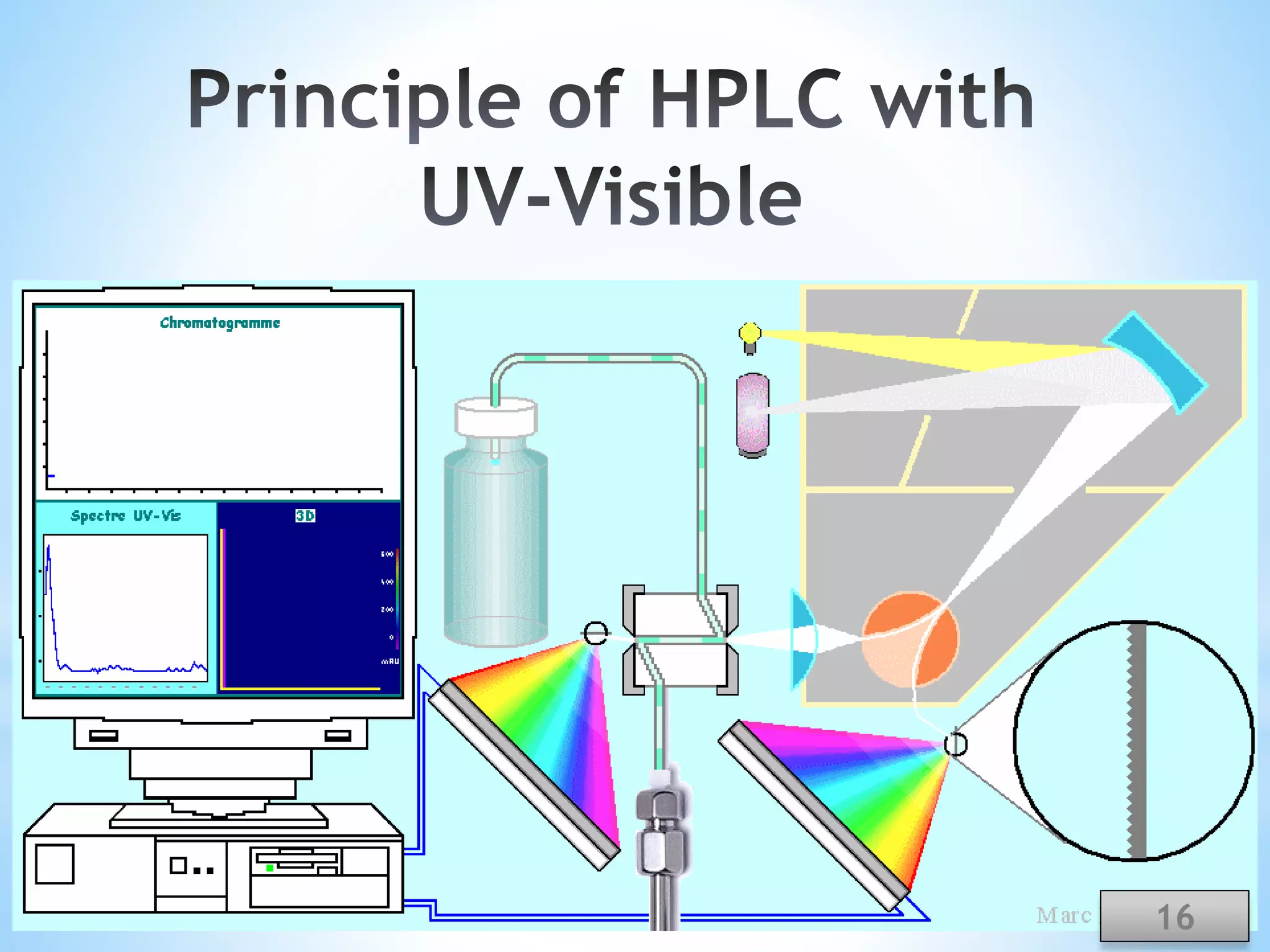
16
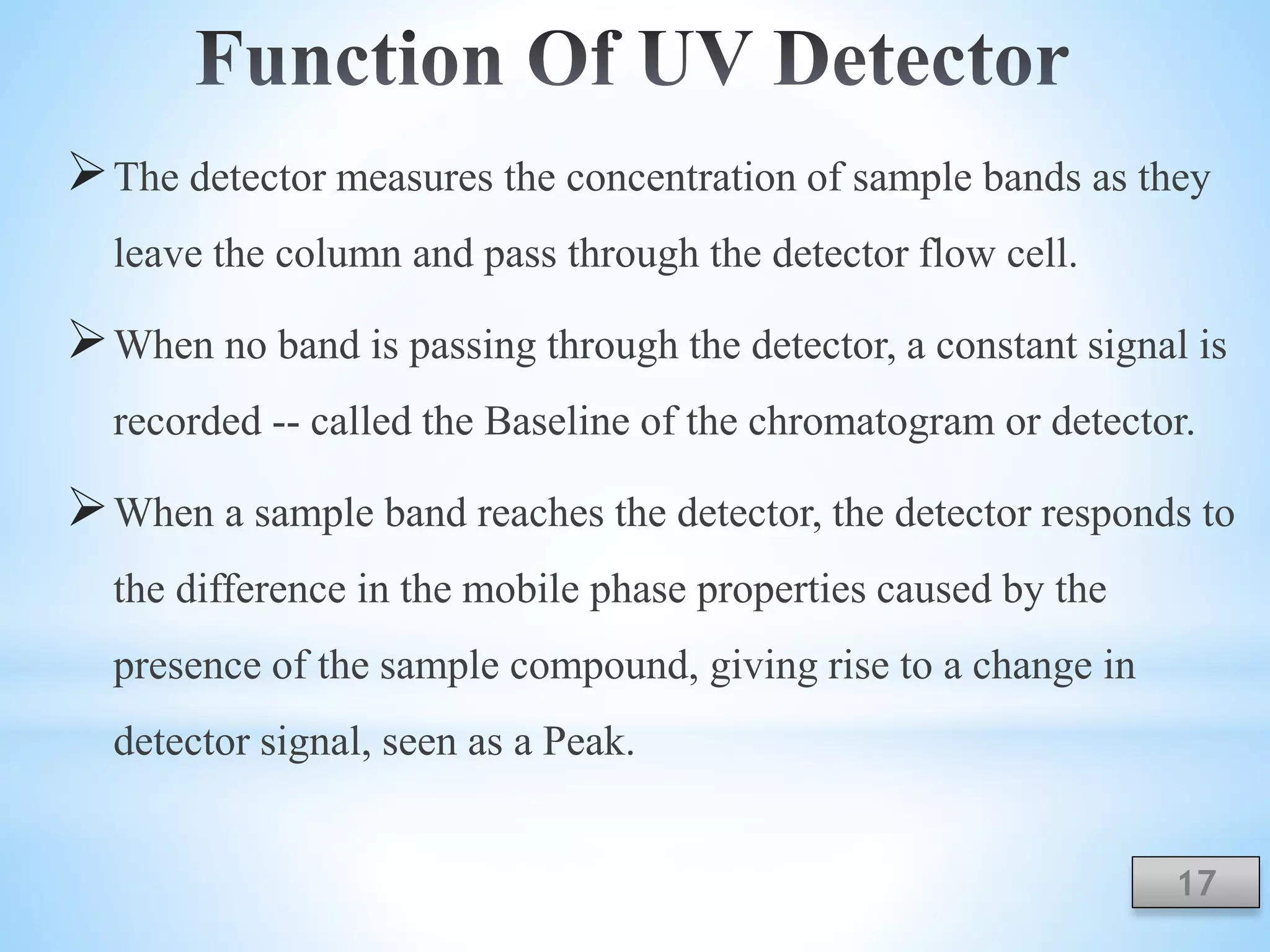
The detector measures the concentration of sample bands as they
leave the column and pass through the detector flow cell.
When no band is passing through the detector, a constant signal is
recorded -- called the Baseline of the chromatogram or detector.
When a sample band reaches the detector, the detector responds to
the difference in the mobile phase properties caused by the
presence of the sample compound, giving rise to a change in
detector signal, seen as a Peak.
17
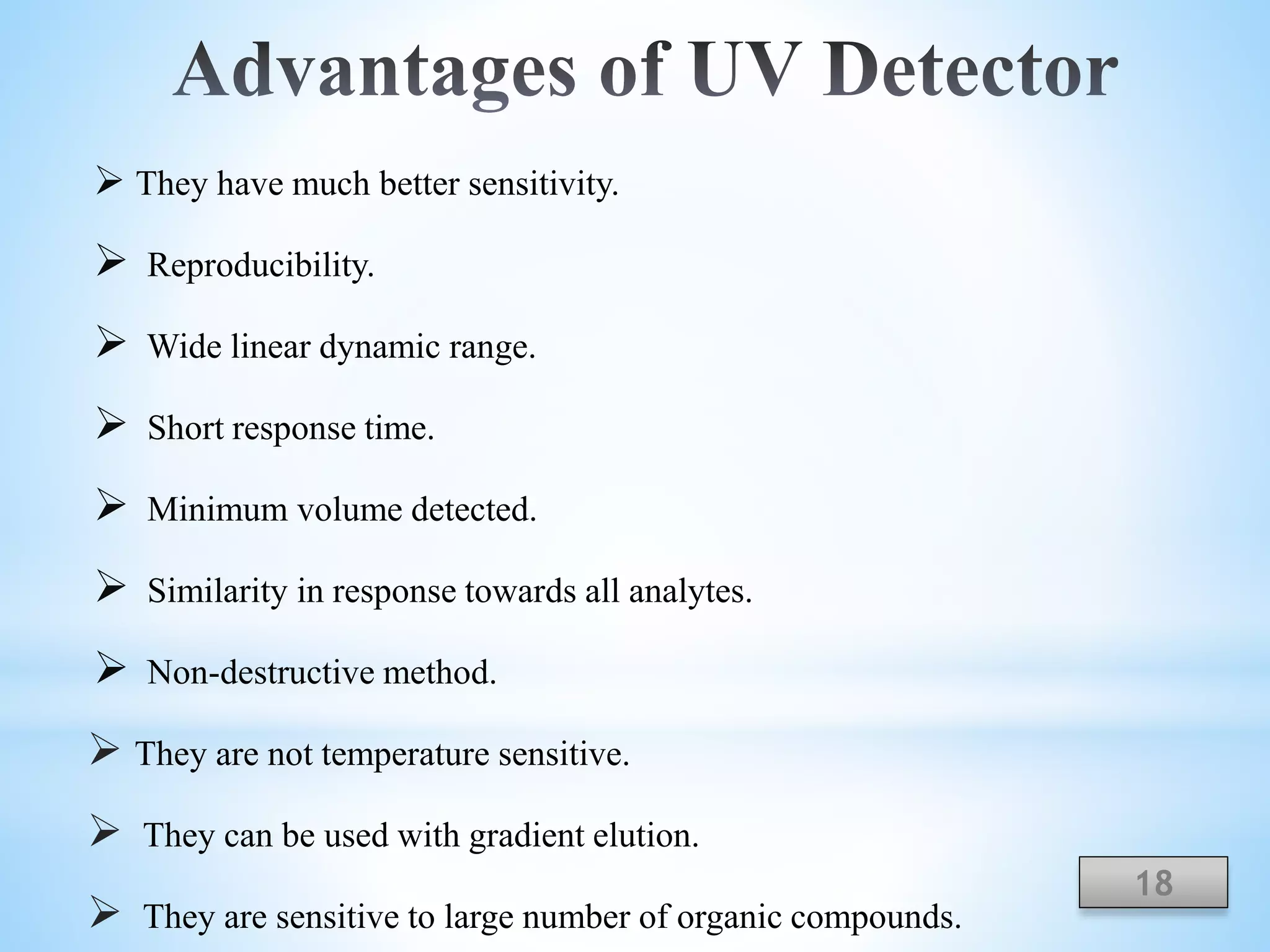
 They have much better sensitivity.
 Reproducibility.
 Wide linear dynamic range.
 Short response time.
 Minimum volume detected.
 Similarity in response towards all analytes.
 Non-destructive method.
 They are not temperature sensitive.
 They can be used with gradient elution.
 They are sensitive to large number of organic compounds.
18
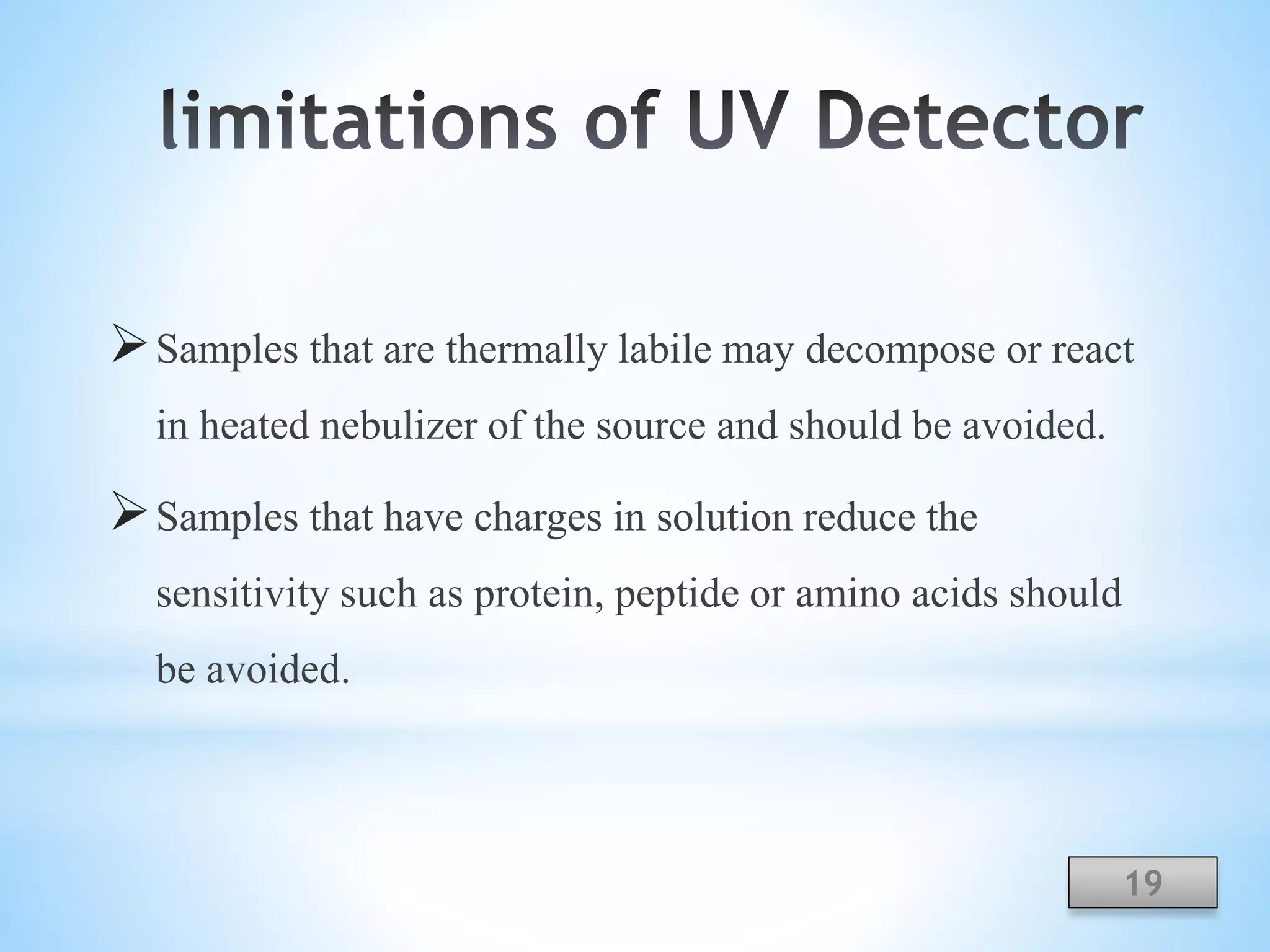
Samples that are thermally labile may decompose or react
in heated nebulizer of the source and should be avoided.
Samples that have charges in solution reduce the
sensitivity such as protein, peptide or amino acids should
be avoided.
19
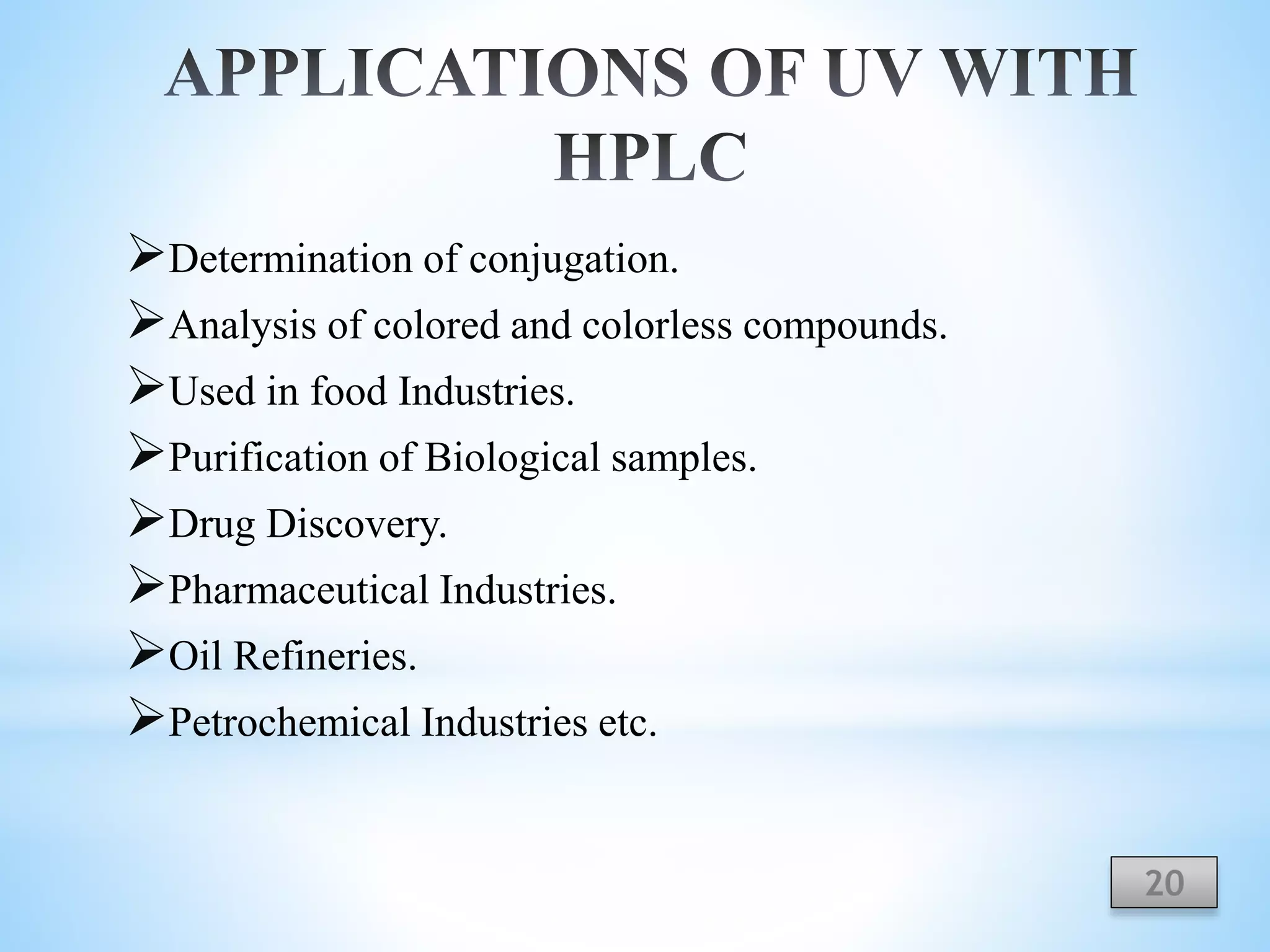
Determination of conjugation.
Analysis of colored and colorless compounds.
Used in food Industries.
Purification of Biological samples.
Drug Discovery.
Pharmaceutical Industries.
Oil Refineries.
Petrochemical Industries etc.
20
 ORGANIC SPECTROSCOPY AND
CHROMATOGRAPHY,
Third edition, By M.Younis
 ELEMENTRY ORGANIC SPECTROSCOPY, By
YR SHARMA
 Wikipedia
 Quora
 Slideshare 21
 We are thankful to Almighty ALLAH for
his divine support.
 We are thankful to Sir Dr: AYAZ ALI
MEMON for giving such a good platform
to enhance our skills and also thanks for his
kind support.
22
THANK YOU
23
COMMENTS? Queries?
SUGESTIONS?

Applications of uv with hplc

  • 1.
  • 2.
    Presentation Topic: Presented by: AssignedBy: APPLICATIONS OF UV WITH HPLC DR.AYAZ ALI MEMON DADU MAL(DK) Zubair Ali Shah
  • 3.
     Spectroscopy UV-Visible Region Hyphenatedtechniques Chromatography  HPLC HPLC Instrumentation UV Detector Advantages and Limitations  Application of UV with HPLC References Acknowledgement 3
  • 4.
    The study ofinteraction of electromagnetic radiations with matter is called “Spectroscopy. 4
  • 5.
     Detection offunctional groups.  Detection of impurities.  Qualitative analysis  Quantitative analysis.  Characterization of species  Structure elucidation.  Determination of conjugation etc. 5
  • 6.
    This is theearliest method of molecular spectroscopy. A phenomenon of interaction of molecule with ultraviolet and visible light(EMR). Absorption of photons results in electronic transition of a molecule and electrons are promoted from ground state to the excited state. 6
  • 7.
     Russian botanistMikhail Tswett in 1903  Chromatography is a physical method of separation that distributes components to separate between two phases, one stationary (stationary phase), the other (the mobile phase) moving in a definite direction. 7
  • 8.
  • 9.
     HPLC isa technique in analytical chemistry used to separate, identify, and quantify each component in a mixture. BASIC PRINCIPLE  When a mixture of components is introduced into a HPLC column, they travel according their relative affinities towards the stationary phase.  The components which has more affinity towards the adsorbent travel slowest the component which has less affinity towards the stationary phase travels faster.  Since two components have not the same affinity towards the stationary phase, the components are separated. 9 HPLC
  • 10.
     Hyphenated techniqueis a combination or coupling of two different analytical techniques with the help of proper interface.  Hirschfield (1980) introduced the term “hyphenation” to refer to the on-line combination of separation technique and one or more spectroscopic detection techniques .  The hyphenated technique is developed from the coupling of a separation technique and an online spectroscopic detection technology. 10
  • 11.
     Mobile Phase Degasser  Pressure Pump  Sample Injector  Guard Column  Analytical Column  Detector  Data Analyzer  Waste Container 11
  • 12.
    UV/VIS Detector Photo diodearray Detector Fluorescence Detector Refractive index Detector 12
  • 13.
     UV detectionis the most usual and widespread detection.  The instrument is simple and is available from numerous manufacturers  Many analytes suitable for HPLC analysis and also absorb in the UV region.  The wavelength range can be easily expanded to the region of visible light (Vis) for the detection of colored Analytes.  UV/Vis detection is more sharp than many other detection systems. UV DETECTOR 13
  • 14.
  • 15.
    The heart ofan efficient HPLC detector is the flow cell. Light passes through the flow cell for detection. Flow cell has capacity 10-25 µL with a narrow depth(1.07 mm) and large surface area for excitation-emission collection 15
  • 16.
  • 17.
    The detector measuresthe concentration of sample bands as they leave the column and pass through the detector flow cell. When no band is passing through the detector, a constant signal is recorded -- called the Baseline of the chromatogram or detector. When a sample band reaches the detector, the detector responds to the difference in the mobile phase properties caused by the presence of the sample compound, giving rise to a change in detector signal, seen as a Peak. 17
  • 18.
     They havemuch better sensitivity.  Reproducibility.  Wide linear dynamic range.  Short response time.  Minimum volume detected.  Similarity in response towards all analytes.  Non-destructive method.  They are not temperature sensitive.  They can be used with gradient elution.  They are sensitive to large number of organic compounds. 18
  • 19.
    Samples that arethermally labile may decompose or react in heated nebulizer of the source and should be avoided. Samples that have charges in solution reduce the sensitivity such as protein, peptide or amino acids should be avoided. 19
  • 20.
    Determination of conjugation. Analysisof colored and colorless compounds. Used in food Industries. Purification of Biological samples. Drug Discovery. Pharmaceutical Industries. Oil Refineries. Petrochemical Industries etc. 20
  • 21.
     ORGANIC SPECTROSCOPYAND CHROMATOGRAPHY, Third edition, By M.Younis  ELEMENTRY ORGANIC SPECTROSCOPY, By YR SHARMA  Wikipedia  Quora  Slideshare 21
  • 22.
     We arethankful to Almighty ALLAH for his divine support.  We are thankful to Sir Dr: AYAZ ALI MEMON for giving such a good platform to enhance our skills and also thanks for his kind support. 22
  • 23.