Lesson 3
Computer Applications Software
What’s In
1. What are the basic set of devices
found in most Personal Computers?
2.What is an input device? Give
examples.
3.What is an output device? Give
examples.
What’s New
What is It
Application Software is a program or
group of programs designed for end
users that allows end users to
accomplish one or more specific (non-
computer related) tasks.
Examples of Computer Application
Software:
Word processor is a software
program capable of creating,
storing, and printing documents.
Some examples are Microsoft Word,
WordPro, AppleWorks.
Spreadsheet is a data file made up of rows
and columns that are used to sort data and
allow a user to manipulate and arrange data
easily, commonly numerical data. Examples
are Microsoft Excel, Lotus 1-2-3 , Apple
Numbers, and OpenOffice Calc.
Presentation Software
A presentation program is a software program
that helps create a slideshow that addresses a
topic. It is often used in businesses and schools
for discussing a topic or for teaching. Examples
are Microsoft PowerPoint, Adobe Persuasion,
Hypercard, OpenOffice Impress and Scala
Multimedia.
•Database Management System (DBMS)
Software
A program that controls the organization,
storage, management, and retrieval of data in a
database. Users can create tables, queries,
forms and reports. DBMS software examples are
Microsoft Access, Oracle Database, MySQL and
FoxPro.
•Desktop Publishing Software
This is used to produce high-quality printed
documents such as magazine, greeting
card, posters, etc. and allows you to use
different typefaces, specify various margins
and justifications, and embed illustrations
and graphs directly into the text. Desktop
Publishing software examples are Adobe
InDesign, QuarkXPress and MS Publisher.
Web Browser
Web browser is a software application used
to locate and display Web pages. Examples
are: Internet Explorer (IE), Mozilla Firefox,
Opera and Google Chrome.
•Graphic Software
•Graphics software or image editing software is a
program or collection of programs that enable a
person to manipulate visual images on a
computer. Computer graphics can be classified
into two distinct categories: raster graphics and
vector graphics. The most common example is
Adobe Photoshop.
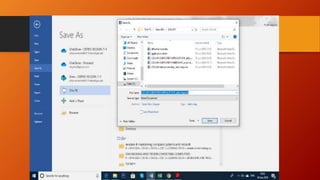
Save and Save As
•To save your file, follow the following
procedures:
1. In the File Tab, hover over and click Save As
(saving for the first time and saving to another
file name or another copy), click browse for you
to access the Save As dialog box and it will
appear.
2. In the save as dialog box, you need to
have the following information:
File name –is a name used to uniquely
identify a computer file stored in a file
system.
•File Extension or File name Extension -is
the ending of a file that helps identify
the type of file in operating systems,
such as Microsoft Windows. In Microsoft
Windows, the file name extension is a
period that is often followed by three
characters but may also be one, two, or
four characters long. Some of the more
common file extensions are listed below,
separated by the types of files the
associated file extensions. Pic
File Extension or File name Extension
File Location or Path - defines the
location of a file or folder in a
computer's file system. Paths are also
called "directory paths" because they
often include one or more directories
that describe the path to the file or
folder.
3. After filling in the filename, choosing the file
extension and the location, then click save.
Note:
Use Save to update the lastly preserved file with
the latest content.
Use Save As to store a new file or to store an
existing file to a new location with the same
name or a different name
What is a Storage Device?
A storage device is any hardware
capable of holding information either
temporarily or permanently.
There are two types of storage devices used
with computers:
1. a primary storage device, such as
RAM;
2. a secondary storage device, such as a
hard drive, secondary storage can be
removable, internal, or external.
(www.computerhope.com 2017)
Primary storage device
•A primary storage device is a medium that holds
memory for short periods of time while a computer is
running. Although it has a much lower access time and
faster performance, it is also about two orders of
magnitude more costly than secondary storage device.
RAM (random access memory) and cache are both
examples of a primary storage device. Primary
storage's key differences from the others are that it is
directly accessible by the CPU, it is volatile, and it is
non-removable.
Secondary storage device
A secondary storage device is a non-volatile device
that holds data until it is deleted or overwritten.
Secondary storage is about two orders of
magnitude cheaper than primary storage. Off-line
storage is a subset of secondary storage, as they
both serve the same purpose and do not interact
directly with the CPU.
Examples of secondary storage:
A hard disk drive (sometimes abbreviated as a
hard drive, HD, or HDD) is a non-volatile data
storage device. It is usually installed internally
in a computer, attached directly to the disk
controller of the computer's motherboard.
Solid-State Drive
•Short for solid-state drive, an SSD
is a storage medium that uses non-
volatile memory as a means of
holding and accessing data.
•USB Thumb Drive
•Alternatively referred to as a USB
flash drive, data stick, pen drive,
memory unit, keychain drive, and
thumb drive, a thumb drive is a
portable storage device
•SD Card
•Short for Secure Digital card, the SD card
is one of the more common types of
memory cards used with electronics. The
SD technology is used by over 400 brands
of electronic equipment and over 8000
different models, including digital
cameras and cell phones.
•Types of SD cards
The three versions of the SD
card, along with their physical
dimensions as shown.
•SD - 32mm x 24mm x 2.1mm
•MiniSD - 21.5mm x 20mm x
1.4mm
•MicroSD - 15mm x 11mm x
1.0mm
•CD
•Abbreviated as CD, a compact disc is a flat,
round, optical storage medium invented by
James Russell. The first CD was created at a
Philips factory in Germany on August 17,
1982.
•DVD
•Short for digital versatile disc or digital video
disc, a DVD or DVD-ROM is a disc capable of
storing a significant amount more data than a
standard compact disc. DVDs are widely used
for storing and viewing movies and other
data.
•Floppy Diskette
•Alternatively referred to as a floppy or
floppy disk, a floppy diskette is a type of
storage media, capable of storing
electronic data, like a computer file.
The floppy diskette was first created in
1967 by IBM as an alternative to buying
Which storage devices are used today?
Most of the storage devices mentioned above are
no longer used with today's computers. Most
computers today primarily use an SSD to store
information, as well as the ability to use USB flash
drives and access to cloud storage. Most desktop
computers and some laptops include a disc drive
that is capable of reading and writing CDs and
What storage device has the largest capacity?
•For most computers, the largest
storage device is the hard drive or
SSD. However, networked computers
may also have access to larger
storage with large tape drives,
cloud computing, or NAS devices.
•Let Us Play!
•Direction: Below are jumbled letters, form each
item to correspond to one application software.
Write your answers in your notebook.
•1. WDOR CESPROSOR 6. SHERPUBLI
•2. SHEETSPREAD 7. BRSEROW
•3. TATIONPRESEN 8. PHICSGRA
•4. BASEDATA 9. WARESOFT
•5. CATIONAPPLI 10. MS RDWO
application software - lesson 3.pptx

application software - lesson 3.pptx

  • 1.
  • 2.
    What’s In 1. Whatare the basic set of devices found in most Personal Computers? 2.What is an input device? Give examples. 3.What is an output device? Give examples.
  • 3.
  • 4.
    What is It ApplicationSoftware is a program or group of programs designed for end users that allows end users to accomplish one or more specific (non- computer related) tasks.
  • 5.
    Examples of ComputerApplication Software: Word processor is a software program capable of creating, storing, and printing documents. Some examples are Microsoft Word, WordPro, AppleWorks.
  • 6.
    Spreadsheet is adata file made up of rows and columns that are used to sort data and allow a user to manipulate and arrange data easily, commonly numerical data. Examples are Microsoft Excel, Lotus 1-2-3 , Apple Numbers, and OpenOffice Calc.
  • 7.
    Presentation Software A presentationprogram is a software program that helps create a slideshow that addresses a topic. It is often used in businesses and schools for discussing a topic or for teaching. Examples are Microsoft PowerPoint, Adobe Persuasion, Hypercard, OpenOffice Impress and Scala Multimedia.
  • 8.
    •Database Management System(DBMS) Software A program that controls the organization, storage, management, and retrieval of data in a database. Users can create tables, queries, forms and reports. DBMS software examples are Microsoft Access, Oracle Database, MySQL and FoxPro.
  • 9.
    •Desktop Publishing Software Thisis used to produce high-quality printed documents such as magazine, greeting card, posters, etc. and allows you to use different typefaces, specify various margins and justifications, and embed illustrations and graphs directly into the text. Desktop Publishing software examples are Adobe InDesign, QuarkXPress and MS Publisher.
  • 10.
    Web Browser Web browseris a software application used to locate and display Web pages. Examples are: Internet Explorer (IE), Mozilla Firefox, Opera and Google Chrome.
  • 11.
    •Graphic Software •Graphics softwareor image editing software is a program or collection of programs that enable a person to manipulate visual images on a computer. Computer graphics can be classified into two distinct categories: raster graphics and vector graphics. The most common example is Adobe Photoshop.
  • 12.
    Save and SaveAs •To save your file, follow the following procedures: 1. In the File Tab, hover over and click Save As (saving for the first time and saving to another file name or another copy), click browse for you to access the Save As dialog box and it will appear.
  • 14.
    2. In thesave as dialog box, you need to have the following information: File name –is a name used to uniquely identify a computer file stored in a file system.
  • 15.
    •File Extension orFile name Extension -is the ending of a file that helps identify the type of file in operating systems, such as Microsoft Windows. In Microsoft Windows, the file name extension is a period that is often followed by three characters but may also be one, two, or four characters long. Some of the more common file extensions are listed below, separated by the types of files the associated file extensions. Pic
  • 16.
    File Extension orFile name Extension
  • 17.
    File Location orPath - defines the location of a file or folder in a computer's file system. Paths are also called "directory paths" because they often include one or more directories that describe the path to the file or folder.
  • 18.
    3. After fillingin the filename, choosing the file extension and the location, then click save. Note: Use Save to update the lastly preserved file with the latest content. Use Save As to store a new file or to store an existing file to a new location with the same name or a different name
  • 19.
    What is aStorage Device? A storage device is any hardware capable of holding information either temporarily or permanently.
  • 20.
    There are twotypes of storage devices used with computers: 1. a primary storage device, such as RAM; 2. a secondary storage device, such as a hard drive, secondary storage can be removable, internal, or external. (www.computerhope.com 2017)
  • 21.
    Primary storage device •Aprimary storage device is a medium that holds memory for short periods of time while a computer is running. Although it has a much lower access time and faster performance, it is also about two orders of magnitude more costly than secondary storage device. RAM (random access memory) and cache are both examples of a primary storage device. Primary storage's key differences from the others are that it is directly accessible by the CPU, it is volatile, and it is non-removable.
  • 22.
    Secondary storage device Asecondary storage device is a non-volatile device that holds data until it is deleted or overwritten. Secondary storage is about two orders of magnitude cheaper than primary storage. Off-line storage is a subset of secondary storage, as they both serve the same purpose and do not interact directly with the CPU.
  • 23.
    Examples of secondarystorage: A hard disk drive (sometimes abbreviated as a hard drive, HD, or HDD) is a non-volatile data storage device. It is usually installed internally in a computer, attached directly to the disk controller of the computer's motherboard.
  • 24.
    Solid-State Drive •Short forsolid-state drive, an SSD is a storage medium that uses non- volatile memory as a means of holding and accessing data.
  • 25.
    •USB Thumb Drive •Alternativelyreferred to as a USB flash drive, data stick, pen drive, memory unit, keychain drive, and thumb drive, a thumb drive is a portable storage device
  • 26.
    •SD Card •Short forSecure Digital card, the SD card is one of the more common types of memory cards used with electronics. The SD technology is used by over 400 brands of electronic equipment and over 8000 different models, including digital cameras and cell phones.
  • 27.
    •Types of SDcards The three versions of the SD card, along with their physical dimensions as shown. •SD - 32mm x 24mm x 2.1mm •MiniSD - 21.5mm x 20mm x 1.4mm •MicroSD - 15mm x 11mm x 1.0mm
  • 28.
    •CD •Abbreviated as CD,a compact disc is a flat, round, optical storage medium invented by James Russell. The first CD was created at a Philips factory in Germany on August 17, 1982.
  • 29.
    •DVD •Short for digitalversatile disc or digital video disc, a DVD or DVD-ROM is a disc capable of storing a significant amount more data than a standard compact disc. DVDs are widely used for storing and viewing movies and other data.
  • 30.
    •Floppy Diskette •Alternatively referredto as a floppy or floppy disk, a floppy diskette is a type of storage media, capable of storing electronic data, like a computer file. The floppy diskette was first created in 1967 by IBM as an alternative to buying
  • 31.
    Which storage devicesare used today?
  • 32.
    Most of thestorage devices mentioned above are no longer used with today's computers. Most computers today primarily use an SSD to store information, as well as the ability to use USB flash drives and access to cloud storage. Most desktop computers and some laptops include a disc drive that is capable of reading and writing CDs and
  • 33.
    What storage devicehas the largest capacity?
  • 34.
    •For most computers,the largest storage device is the hard drive or SSD. However, networked computers may also have access to larger storage with large tape drives, cloud computing, or NAS devices.
  • 35.
    •Let Us Play! •Direction:Below are jumbled letters, form each item to correspond to one application software. Write your answers in your notebook. •1. WDOR CESPROSOR 6. SHERPUBLI •2. SHEETSPREAD 7. BRSEROW •3. TATIONPRESEN 8. PHICSGRA •4. BASEDATA 9. WARESOFT •5. CATIONAPPLI 10. MS RDWO