PROPER TOOL
SELECTION
and
HARDWARE
TOOLS
Proper tool selection
A tool is a handheld device that aids
in accomplishing a task.
Tools range from a traditional metal
cutting part of a machine to an
element of a computer program that
activates and controls a particular
function.
Safe Use of tools
Once selected, use the tool for the
purpose for which it was designed. Not
all tools come with detailed instructions,
but there are those that do spell out the
safety ―Do’s and Dont’s for the your
safety.
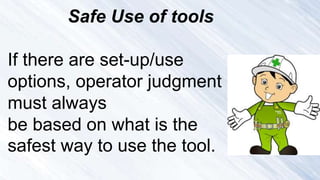
Safe Use of tools
If there are set-up/use
options, operator judgment
must always
be based on what is the
safest way to use the tool.
• All tools be kept in good condition with regular
maintenance.
• The right tool be used for the job.
• Each tool be examined before use and damaged
or defective tools NOT to be used.
• Tools be operated according to manufacturer’s
instructions.
• The right protective equipment for the tool and
activity must be used.
Environmental Safety and Health Program requires
the following:
CATEGORIES OF
HARDWARE TOOLS
1.Electro-Static Discharge (ESD) tools
2. Hand tools
3. Cleaning tools
4. Diagnostic tools
Static electricity is easily generated by
friction on carpets, tile flooring, clothing,
hair, fabric, and etc.
The friction of moving air alone will charge
suspended particles and cause the
buildup of static electrical charges on people
and objects in the environment.
Electro-Static Discharge (ESD) Tools
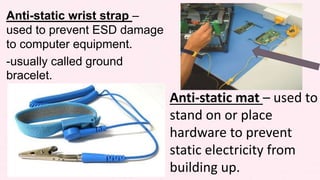
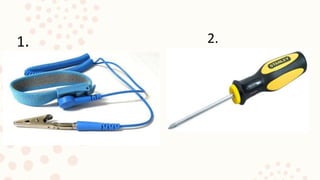
Anti-static wrist strap –
used to prevent ESD damage
to computer equipment.
-usually called ground
bracelet.
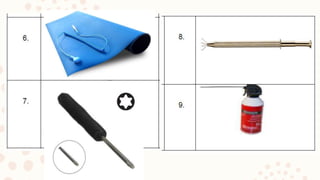
Anti-static mat – used to
stand on or place
hardware to prevent
static electricity from
building up.
Hand Tools
A hand tool is a device for performing
work on a material or a physical system
using only hands.
The hand tools can be manually used
employing force, or electrically powered,
using electrical current.
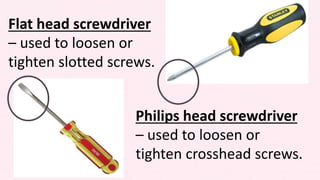
Flat head screwdriver
– used to loosen or
tighten slotted screws.
Philips head screwdriver
– used to loosen or
tighten crosshead screws.
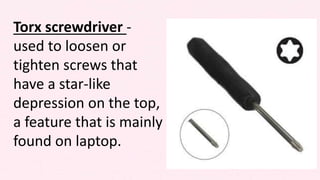
Torx screwdriver -
used to loosen or
tighten screws that
have a star-like
depression on the top,
a feature that is mainly
found on laptop.
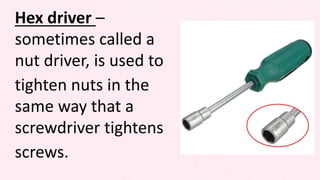
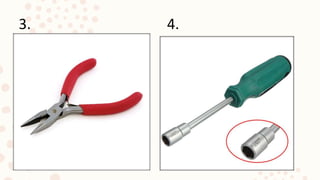
Hex driver –
sometimes called a
nut driver, is used to
tighten nuts in the
same way that a
screwdriver tightens
screws.
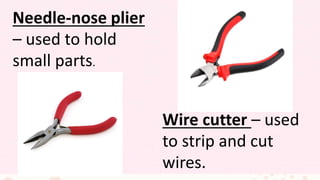
Needle-nose plier
– used to hold
small parts.
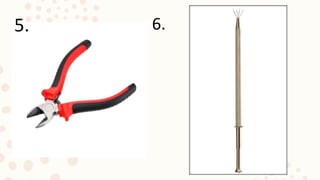
Wire cutter – used
to strip and cut
wires.
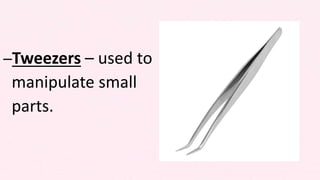
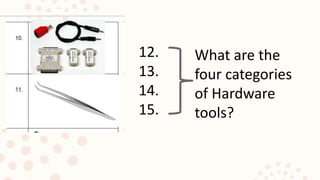
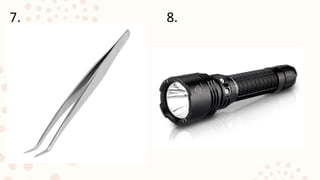
–Tweezers – used to
manipulate small
parts.
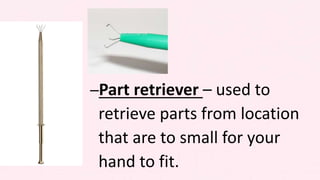
–Part retriever – used to
retrieve parts from location
that are to small for your
hand to fit.
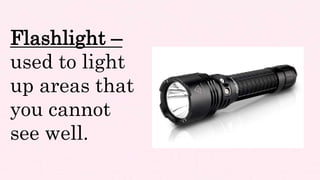
Flashlight –
used to light
up areas that
you cannot
see well.
Cleaning Tools
Having the appropriate cleaning tools is
essential when maintaining or repairing
computers.
Using these tools ensures that computer
components are not damaged during cleaning.
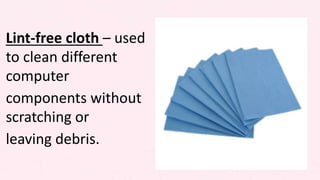
Lint-free cloth – used
to clean different
computer
components without
scratching or
leaving debris.
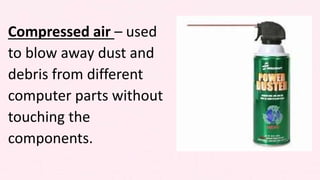
Compressed air – used
to blow away dust and
debris from different
computer parts without
touching the
components.
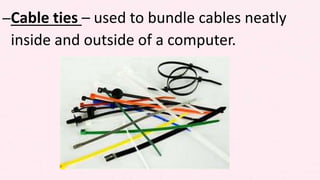
–Cable ties – used to bundle cables neatly
inside and outside of a computer.
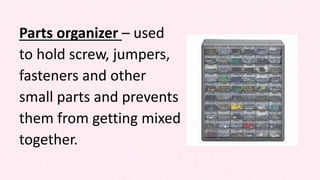
Parts organizer – used
to hold screw, jumpers,
fasteners and other
small parts and prevents
them from getting mixed
together.
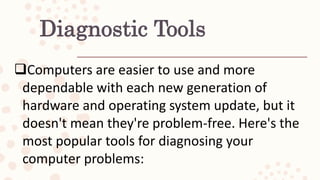
Diagnostic Tools
Computers are easier to use and more
dependable with each new generation of
hardware and operating system update, but it
doesn't mean they're problem-free. Here's the
most popular tools for diagnosing your
computer problems:
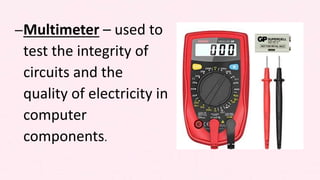
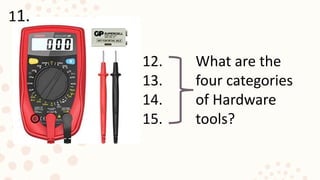
–Multimeter – used to
test the integrity of
circuits and the
quality of electricity in
computer
components.
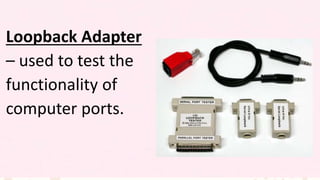
Loopback Adapter
– used to test the
functionality of
computer ports.
Is there any more
Get your Test booklet for your quiz.
1. 2.
3. 4.
5. 6.
7. 8.
9. 10.
12.
13.
14.
15.
What are the
four categories
of Hardware
tools?
11.
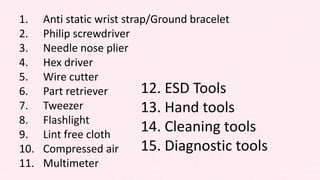
1. Anti static wrist strap/Ground bracelet
2. Philip screwdriver
3. Needle nose plier
4. Hex driver
5. Wire cutter
6. Part retriever
7. Tweezer
8. Flashlight
9. Lint free cloth
10. Compressed air
11. Multimeter
12. ESD Tools
13. Hand tools
14. Cleaning tools
15. Diagnostic tools
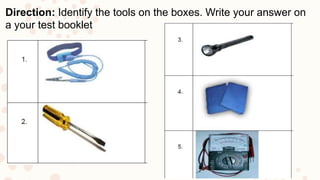
Direction: Identify the tools on the boxes. Write your answer on
a your test booklet
12.
13.
14.
15.
What are the
four categories
of Hardware
tools?
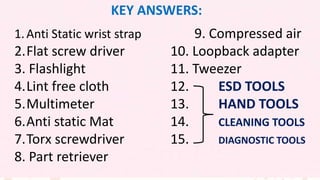
KEY ANSWERS:
1.Anti Static wrist strap 9. Compressed air

2.Flat screw driver 10. Loopback adapter
3. Flashlight 11. Tweezer
4.Lint free cloth 12. ESD TOOLS
5.Multimeter 13. HAND TOOLS
6.Anti static Mat 14. CLEANING TOOLS
7.Torx screwdriver 15. DIAGNOSTIC TOOLS
8. Part retriever
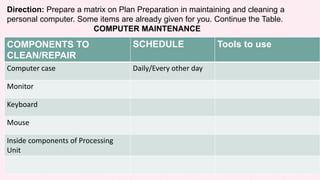
Direction: Prepare a matrix on Plan Preparation in maintaining and cleaning a
personal computer. Some items are already given for you. Continue the Table.
COMPUTER MAINTENANCE
COMPONENTS TO
CLEAN/REPAIR
SCHEDULE Tools to use
Computer case Daily/Every other day
Monitor
Keyboard
Mouse
Inside components of Processing
Unit

COMPUTER HARDWARE TOOLS IN CHS AND CSS

  • 1.
  • 2.
    Proper tool selection Atool is a handheld device that aids in accomplishing a task. Tools range from a traditional metal cutting part of a machine to an element of a computer program that activates and controls a particular function.
  • 3.
    Safe Use oftools Once selected, use the tool for the purpose for which it was designed. Not all tools come with detailed instructions, but there are those that do spell out the safety ―Do’s and Dont’s for the your safety.
  • 4.
    Safe Use oftools If there are set-up/use options, operator judgment must always be based on what is the safest way to use the tool.
  • 5.
    • All toolsbe kept in good condition with regular maintenance. • The right tool be used for the job. • Each tool be examined before use and damaged or defective tools NOT to be used. • Tools be operated according to manufacturer’s instructions. • The right protective equipment for the tool and activity must be used. Environmental Safety and Health Program requires the following:
  • 6.
    CATEGORIES OF HARDWARE TOOLS 1.Electro-StaticDischarge (ESD) tools 2. Hand tools 3. Cleaning tools 4. Diagnostic tools
  • 7.
    Static electricity iseasily generated by friction on carpets, tile flooring, clothing, hair, fabric, and etc. The friction of moving air alone will charge suspended particles and cause the buildup of static electrical charges on people and objects in the environment. Electro-Static Discharge (ESD) Tools
  • 8.
    Anti-static wrist strap– used to prevent ESD damage to computer equipment. -usually called ground bracelet. Anti-static mat – used to stand on or place hardware to prevent static electricity from building up.
  • 9.
    Hand Tools A handtool is a device for performing work on a material or a physical system using only hands. The hand tools can be manually used employing force, or electrically powered, using electrical current.
  • 10.
    Flat head screwdriver –used to loosen or tighten slotted screws. Philips head screwdriver – used to loosen or tighten crosshead screws.
  • 11.
    Torx screwdriver - usedto loosen or tighten screws that have a star-like depression on the top, a feature that is mainly found on laptop.
  • 12.
    Hex driver – sometimescalled a nut driver, is used to tighten nuts in the same way that a screwdriver tightens screws.
  • 13.
    Needle-nose plier – usedto hold small parts. Wire cutter – used to strip and cut wires.
  • 14.
    –Tweezers – usedto manipulate small parts.
  • 15.
    –Part retriever –used to retrieve parts from location that are to small for your hand to fit.
  • 16.
    Flashlight – used tolight up areas that you cannot see well.
  • 17.
    Cleaning Tools Having theappropriate cleaning tools is essential when maintaining or repairing computers. Using these tools ensures that computer components are not damaged during cleaning.
  • 18.
    Lint-free cloth –used to clean different computer components without scratching or leaving debris.
  • 19.
    Compressed air –used to blow away dust and debris from different computer parts without touching the components.
  • 20.
    –Cable ties –used to bundle cables neatly inside and outside of a computer.
  • 21.
    Parts organizer –used to hold screw, jumpers, fasteners and other small parts and prevents them from getting mixed together.
  • 22.
    Diagnostic Tools Computers areeasier to use and more dependable with each new generation of hardware and operating system update, but it doesn't mean they're problem-free. Here's the most popular tools for diagnosing your computer problems:
  • 23.
    –Multimeter – usedto test the integrity of circuits and the quality of electricity in computer components.
  • 24.
    Loopback Adapter – usedto test the functionality of computer ports.
  • 25.
    Is there anymore Get your Test booklet for your quiz.
  • 26.
  • 27.
  • 28.
  • 29.
  • 30.
  • 31.
    12. 13. 14. 15. What are the fourcategories of Hardware tools? 11.
  • 32.
    1. Anti staticwrist strap/Ground bracelet 2. Philip screwdriver 3. Needle nose plier 4. Hex driver 5. Wire cutter 6. Part retriever 7. Tweezer 8. Flashlight 9. Lint free cloth 10. Compressed air 11. Multimeter 12. ESD Tools 13. Hand tools 14. Cleaning tools 15. Diagnostic tools
  • 33.
    Direction: Identify thetools on the boxes. Write your answer on a your test booklet
  • 35.
    12. 13. 14. 15. What are the fourcategories of Hardware tools?
  • 36.
    KEY ANSWERS: 1.Anti Staticwrist strap 9. Compressed air 2.Flat screw driver 10. Loopback adapter 3. Flashlight 11. Tweezer 4.Lint free cloth 12. ESD TOOLS 5.Multimeter 13. HAND TOOLS 6.Anti static Mat 14. CLEANING TOOLS 7.Torx screwdriver 15. DIAGNOSTIC TOOLS 8. Part retriever
  • 37.
    Direction: Prepare amatrix on Plan Preparation in maintaining and cleaning a personal computer. Some items are already given for you. Continue the Table. COMPUTER MAINTENANCE COMPONENTS TO CLEAN/REPAIR SCHEDULE Tools to use Computer case Daily/Every other day Monitor Keyboard Mouse Inside components of Processing Unit