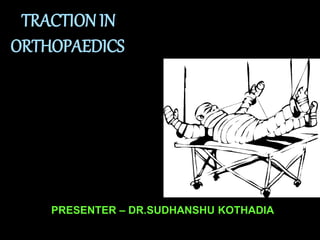
TRACTION IN
ORTHOPAEDICS
PRESENTER – DR.SUDHANSHU KOTHADIA
Principle of Traction
WHAT IS TRACTION ?
Orthopedist’s great "master tool“.
Traction - the application of a force
to stretch certain parts of the body
in a specific direction
WHY DO WE NEED TRACTION ?
Inflammation of a joint
Pain and muscle spasm
Defomity
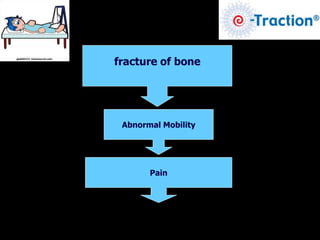
fracture of bone
Abnormal Mobility
Pain
TRACTION
The purpose of traction is to:
 To regain normal length and alignment of
involved bone.
 To reduce and immobilize a fractured bone.
 To relieve or eliminate muscle spasms.
 To relieve pressure on nerves, especially
spinal.
 To prevent or reduce skeletal deformities or
muscle contractures.
TRACTION
 Controls pain.
 Reduces fracture.
 Maintain reduction.
 Prevents & corrects deformity.
TRACTION
Based on principle
Fixed traction
Sliding traction
FIXED TRACTION
 Traction is applied to the leg against a fixed point
of counter pressure.
– Fixed traction in Thomas’s splint
– Roger Anderson well-leg traction
– Halo-Pelvic Traction
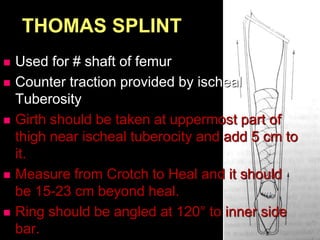
THOMAS SPLINT
 Used for # shaft of femur
 Counter traction provided by ischeal
Tuberosity
 Girth should be taken at uppermost part of
thigh near ischeal tuberocity and add 5 cm to
it.
 Measure from Crotch to Heal and it should
be 15-23 cm beyond heal.
 Ring should be angled at 120° to inner side
bar.
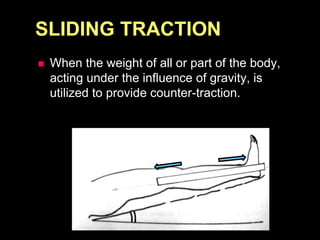
SLIDING TRACTION
 When the weight of all or part of the body,
acting under the influence of gravity, is
utilized to provide counter-traction.
SLIDING TRACTION
 Exact weight required is determined by
trial.
 For the fracture of femoral shaft an
initial weight of 10% of body weight
 Foot end is elevated so that the body
slides in opposite direction.
 1 inch (2.5 cm) for each 1 lb (0.46 kg)
of traction weight
TRACTION to limbs
TYPES OF TRACTION ON
APPLICATION
Skin traction
–Adhesive
–Non – adhesive
Skeletal Traction
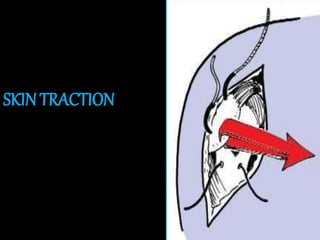
SKIN TRACTION
SKIN TRACTION
 Traction force is applied over a large
area of skin
 Applied over limb distal to fracture site
 Anteromedial and posterolateral part
should be covered with cotton and
malleoli should be covered with cotton.
 “Coning effect”
SKIN TRACTION
 Adhesive skin traction:
– Maximum weight 6.7 kg
 Non-adhesive skin traction
– Maximum weight should not exceed 4.5
kg
– Used in thin and atrophic skin,
– skin sensitive to adhesive strapping,
COMMON SKIN TRACTIONS
 Buck’s Traction
 Hamilton Russel Traction
 Tulloch Brown Traction
 Gallow’s or Brayant’s Traction
 Modified Brayan’s Traction
 Pelvic Traction
 Dunlop Traction
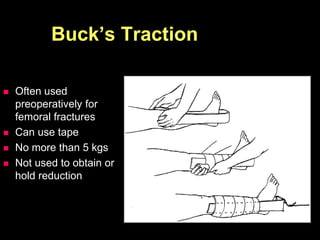
Buck’s Traction
 Often used
preoperatively for
femoral fractures
 Can use tape
 No more than 5 kgs
 Not used to obtain or
hold reduction
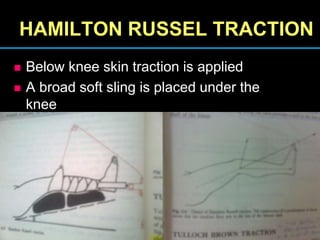
HAMILTON RUSSEL TRACTION
 Below knee skin traction is applied
 A broad soft sling is placed under the
knee
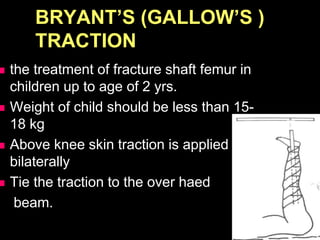
BRYANT’S (GALLOW’S )
TRACTION
 the treatment of fracture shaft femur in
children up to age of 2 yrs.
 Weight of child should be less than 15-
18 kg
 Above knee skin traction is applied
bilaterally
 Tie the traction to the over haed
beam.
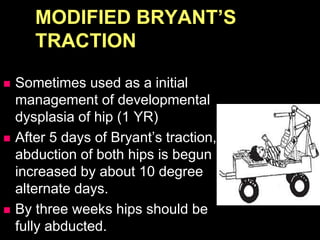
MODIFIED BRYANT’S
TRACTION
 Sometimes used as a initial
management of developmental
dysplasia of hip (1 YR)
 After 5 days of Bryant’s traction,
abduction of both hips is begun
increased by about 10 degree
alternate days.
 By three weeks hips should be
fully abducted.
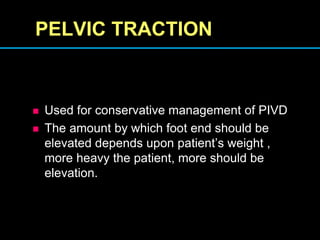
PELVIC TRACTION
 Used for conservative management of PIVD
 The amount by which foot end should be
elevated depends upon patient’s weight ,
more heavy the patient, more should be
elevation.
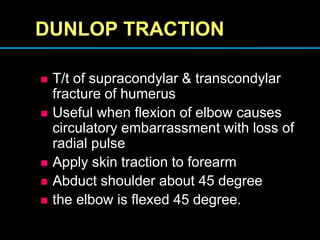
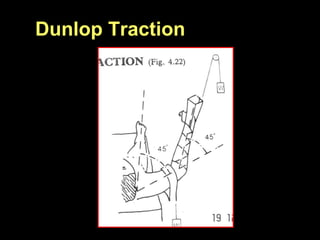
DUNLOP TRACTION
 T/t of supracondylar & transcondylar
fracture of humerus
 Useful when flexion of elbow causes
circulatory embarrassment with loss of
radial pulse
 Apply skin traction to forearm
 Abduct shoulder about 45 degree
 the elbow is flexed 45 degree.
Dunlop Traction
SKIN TRACTION
COMPLICATIONS Of Adhesive Skin Traction :
 Allergic reactions to adhesives.
 Excoriation of skin.
 Pressure sores over bony prominences
and tendoachillis.
 Common peroneal nerve palsy.
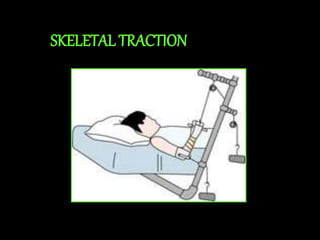
SKELETAL TRACTION
SKELETAL TRACTION
 pin or wire
 more frequently used in lower limb
fractures
 Should be reserved for those cases in
which skin traction is insufficient.
 Generally used when more weight is
needed to give traction.
 To treat fractures conservatively.
SKELETAL TRACTION
 SITES
– Upper tibial
– Lower femoral
– Lower tibial
– Calcaneus
– Olecrenon
– Metacarpel
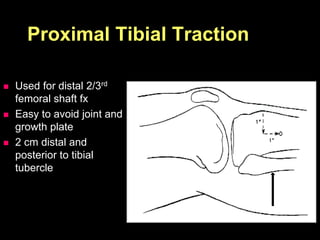
Proximal Tibial Traction
 Used for distal 2/3rd
femoral shaft fx
 Easy to avoid joint and
growth plate
 2 cm distal and
posterior to tibial
tubercle
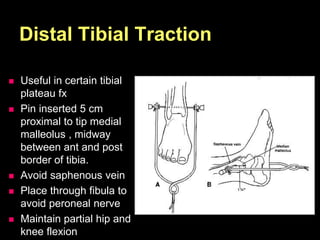
Distal Tibial Traction
 Useful in certain tibial
plateau fx
 Pin inserted 5 cm
proximal to tip medial
malleolus , midway
between ant and post
border of tibia.
 Avoid saphenous vein
 Place through fibula to
avoid peroneal nerve
 Maintain partial hip and
knee flexion
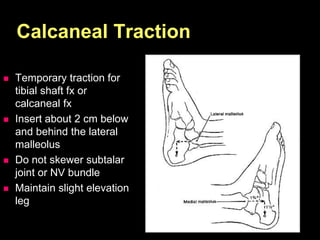
Calcaneal Traction
 Temporary traction for
tibial shaft fx or
calcaneal fx
 Insert about 2 cm below
and behind the lateral
malleolus
 Do not skewer subtalar
joint or NV bundle
 Maintain slight elevation
leg
SOME SKELETAL
TRACTIONS
 Lateral or Upper Femoral Traction
 Nintey / Nintey traction
 Olecrenone traction
 Perkin’s Traction
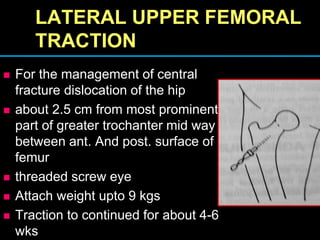
LATERAL UPPER FEMORAL
TRACTION
 For the management of central
fracture dislocation of the hip
 about 2.5 cm from most prominent
part of greater trochanter mid way
between ant. And post. surface of
femur
 threaded screw eye
 Attach weight upto 9 kgs
 Traction to continued for about 4-6
wks
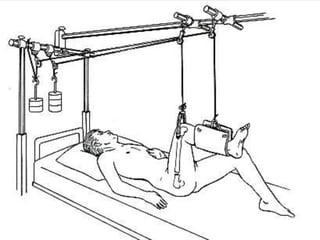
NINETY / NINETY TRACTION
 Used for sub trochanteric fractures and
those in the proximal third of the shaft
of the femur
 Management of fractures with posterior
wound is easier
 Traction is given through lower femoral
pin, which is more efficient, or by upper
tibial pin.
NINETY / NINETY TRACTION
 Complications of 90/90 traction:
– those related with skeletal traction.
– Stiffness and loss of extension of knee.
– Flexion contracture of hip.
– Injury to epiphyseal plate in children.
– Neurovascular damage
SKELETAL TRACTION
COMPLICATIONS
 Infection
 Cut out
 Distraction at fracture site
 Physeal damage
 Nerve Injury
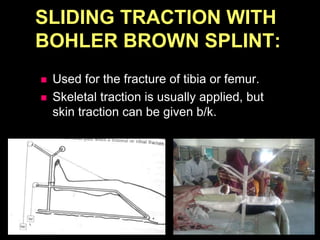
SLIDING TRACTION WITH
BOHLER BROWN SPLINT:
 Used for the fracture of tibia or femur.
 Skeletal traction is usually applied, but
skin traction can be given b/k.
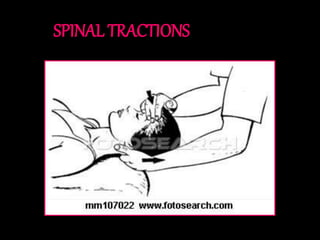
SPINAL TRACTIONS
CERVICAL TRACTIONS
 SKIN TRACTION Head Halter traction
 SKELETAL TRACTION
Crutchfield tongs
Cone or Barton tongs
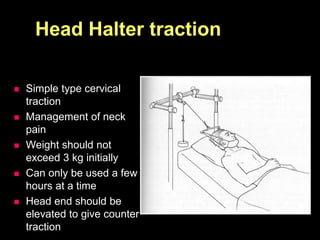
Head Halter traction
 Simple type cervical
traction
 Management of neck
pain
 Weight should not
exceed 3 kg initially
 Can only be used a few
hours at a time
 Head end should be
elevated to give counter
traction
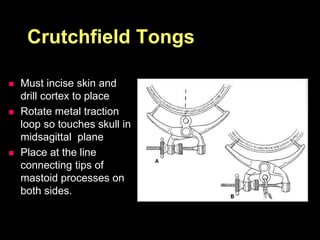
Crutchfield Tongs
 Must incise skin and
drill cortex to place
 Rotate metal traction
loop so touches skull in
midsagittal plane
 Place at the line
connecting tips of
mastoid processes on
both sides.
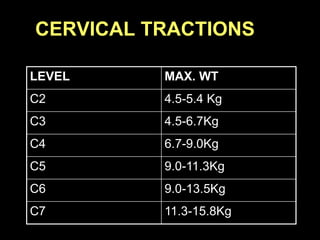
CERVICAL TRACTIONS
LEVEL MAX. WT
C2 4.5-5.4 Kg
C3 4.5-6.7Kg
C4 6.7-9.0Kg
C5 9.0-11.3Kg
C6 9.0-13.5Kg
C7 11.3-15.8Kg
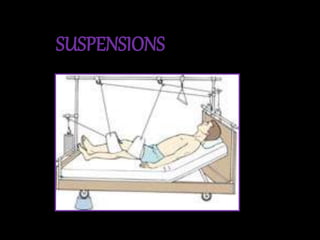
SUSPENSIONS
SUSPENSION
 Done for better nursing care
 To increase the mobility of patient
 To prevent dangers of immobilization
 Suspension system consists of traction cords
pulleys and weight
 Commonly Balken Beam frame is used for
suspension purpose.
BALKEN BEAM FRAME
 Commonly Used to suspends splints.
 one or two Balken Frames are used
 Today balken frames are made up of Metal
tubes
 Two uprights are on each side of bed and are joined by two
long horizontal bars.
 Other short horizontal bar may be there joined to two
uprights on same side or to long horizontal bar.
TRACION CORDS
 Used to suspend weights to give traction
 Cords perform two functions – traction and
suspension
 For this color code system is available –
- red or green for traction cords
- white for suspension cords.
PULLEYS
 Function of pulley is to control the direction of
weight attached to end of the cord over
pulley.
 Large pulley wheels of 6cm in diameter and
6mm in diameter of axles are preferable
 Majority of pulleys are prepared from Tufnol
WEIGHTS
 The amount of weight required to suspend
an appliance depends upon -
- weight of appliance
- weight of part of body suspended in
appliance
- the amount of friction present in system.
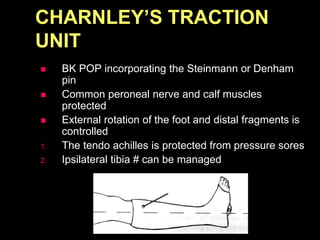
CHARNLEY’S TRACTION
UNIT
 BK POP incorporating the Steinmann or Denham
pin
 Common peroneal nerve and calf muscles
protected
 External rotation of the foot and distal fragments is
controlled
1. The tendo achilles is protected from pressure sores
2. Ipsilateral tibia # can be managed
Traction JEFF_in_orthopaedics-1(1).ppt

Traction JEFF_in_orthopaedics-1(1).ppt

  • 1.
  • 2.
  • 3.
    WHAT IS TRACTION? Orthopedist’s great "master tool“. Traction - the application of a force to stretch certain parts of the body in a specific direction
  • 4.
    WHY DO WENEED TRACTION ? Inflammation of a joint Pain and muscle spasm Defomity
  • 5.
  • 6.
    TRACTION The purpose oftraction is to:  To regain normal length and alignment of involved bone.  To reduce and immobilize a fractured bone.  To relieve or eliminate muscle spasms.  To relieve pressure on nerves, especially spinal.  To prevent or reduce skeletal deformities or muscle contractures.
  • 7.
    TRACTION  Controls pain. Reduces fracture.  Maintain reduction.  Prevents & corrects deformity.
  • 8.
    TRACTION Based on principle Fixedtraction Sliding traction
  • 9.
    FIXED TRACTION  Tractionis applied to the leg against a fixed point of counter pressure. – Fixed traction in Thomas’s splint – Roger Anderson well-leg traction – Halo-Pelvic Traction
  • 10.
    THOMAS SPLINT  Usedfor # shaft of femur  Counter traction provided by ischeal Tuberosity  Girth should be taken at uppermost part of thigh near ischeal tuberocity and add 5 cm to it.  Measure from Crotch to Heal and it should be 15-23 cm beyond heal.  Ring should be angled at 120° to inner side bar.
  • 11.
    SLIDING TRACTION  Whenthe weight of all or part of the body, acting under the influence of gravity, is utilized to provide counter-traction.
  • 12.
    SLIDING TRACTION  Exactweight required is determined by trial.  For the fracture of femoral shaft an initial weight of 10% of body weight  Foot end is elevated so that the body slides in opposite direction.  1 inch (2.5 cm) for each 1 lb (0.46 kg) of traction weight
  • 13.
  • 14.
    TYPES OF TRACTIONON APPLICATION Skin traction –Adhesive –Non – adhesive Skeletal Traction
  • 15.
  • 16.
    SKIN TRACTION  Tractionforce is applied over a large area of skin  Applied over limb distal to fracture site  Anteromedial and posterolateral part should be covered with cotton and malleoli should be covered with cotton.  “Coning effect”
  • 17.
    SKIN TRACTION  Adhesiveskin traction: – Maximum weight 6.7 kg  Non-adhesive skin traction – Maximum weight should not exceed 4.5 kg – Used in thin and atrophic skin, – skin sensitive to adhesive strapping,
  • 18.
    COMMON SKIN TRACTIONS Buck’s Traction  Hamilton Russel Traction  Tulloch Brown Traction  Gallow’s or Brayant’s Traction  Modified Brayan’s Traction  Pelvic Traction  Dunlop Traction
  • 19.
    Buck’s Traction  Oftenused preoperatively for femoral fractures  Can use tape  No more than 5 kgs  Not used to obtain or hold reduction
  • 20.
    HAMILTON RUSSEL TRACTION Below knee skin traction is applied  A broad soft sling is placed under the knee
  • 21.
    BRYANT’S (GALLOW’S ) TRACTION the treatment of fracture shaft femur in children up to age of 2 yrs.  Weight of child should be less than 15- 18 kg  Above knee skin traction is applied bilaterally  Tie the traction to the over haed beam.
  • 22.
    MODIFIED BRYANT’S TRACTION  Sometimesused as a initial management of developmental dysplasia of hip (1 YR)  After 5 days of Bryant’s traction, abduction of both hips is begun increased by about 10 degree alternate days.  By three weeks hips should be fully abducted.
  • 23.
    PELVIC TRACTION  Usedfor conservative management of PIVD  The amount by which foot end should be elevated depends upon patient’s weight , more heavy the patient, more should be elevation.
  • 24.
    DUNLOP TRACTION  T/tof supracondylar & transcondylar fracture of humerus  Useful when flexion of elbow causes circulatory embarrassment with loss of radial pulse  Apply skin traction to forearm  Abduct shoulder about 45 degree  the elbow is flexed 45 degree.
  • 25.
  • 26.
    SKIN TRACTION COMPLICATIONS OfAdhesive Skin Traction :  Allergic reactions to adhesives.  Excoriation of skin.  Pressure sores over bony prominences and tendoachillis.  Common peroneal nerve palsy.
  • 27.
  • 28.
    SKELETAL TRACTION  pinor wire  more frequently used in lower limb fractures  Should be reserved for those cases in which skin traction is insufficient.  Generally used when more weight is needed to give traction.  To treat fractures conservatively.
  • 29.
    SKELETAL TRACTION  SITES –Upper tibial – Lower femoral – Lower tibial – Calcaneus – Olecrenon – Metacarpel
  • 30.
    Proximal Tibial Traction Used for distal 2/3rd femoral shaft fx  Easy to avoid joint and growth plate  2 cm distal and posterior to tibial tubercle
  • 31.
    Distal Tibial Traction Useful in certain tibial plateau fx  Pin inserted 5 cm proximal to tip medial malleolus , midway between ant and post border of tibia.  Avoid saphenous vein  Place through fibula to avoid peroneal nerve  Maintain partial hip and knee flexion
  • 32.
    Calcaneal Traction  Temporarytraction for tibial shaft fx or calcaneal fx  Insert about 2 cm below and behind the lateral malleolus  Do not skewer subtalar joint or NV bundle  Maintain slight elevation leg
  • 33.
    SOME SKELETAL TRACTIONS  Lateralor Upper Femoral Traction  Nintey / Nintey traction  Olecrenone traction  Perkin’s Traction
  • 34.
    LATERAL UPPER FEMORAL TRACTION For the management of central fracture dislocation of the hip  about 2.5 cm from most prominent part of greater trochanter mid way between ant. And post. surface of femur  threaded screw eye  Attach weight upto 9 kgs  Traction to continued for about 4-6 wks
  • 35.
    NINETY / NINETYTRACTION  Used for sub trochanteric fractures and those in the proximal third of the shaft of the femur  Management of fractures with posterior wound is easier  Traction is given through lower femoral pin, which is more efficient, or by upper tibial pin.
  • 37.
    NINETY / NINETYTRACTION  Complications of 90/90 traction: – those related with skeletal traction. – Stiffness and loss of extension of knee. – Flexion contracture of hip. – Injury to epiphyseal plate in children. – Neurovascular damage
  • 38.
    SKELETAL TRACTION COMPLICATIONS  Infection Cut out  Distraction at fracture site  Physeal damage  Nerve Injury
  • 39.
    SLIDING TRACTION WITH BOHLERBROWN SPLINT:  Used for the fracture of tibia or femur.  Skeletal traction is usually applied, but skin traction can be given b/k.
  • 40.
  • 41.
    CERVICAL TRACTIONS  SKINTRACTION Head Halter traction  SKELETAL TRACTION Crutchfield tongs Cone or Barton tongs
  • 42.
    Head Halter traction Simple type cervical traction  Management of neck pain  Weight should not exceed 3 kg initially  Can only be used a few hours at a time  Head end should be elevated to give counter traction
  • 43.
    Crutchfield Tongs  Mustincise skin and drill cortex to place  Rotate metal traction loop so touches skull in midsagittal plane  Place at the line connecting tips of mastoid processes on both sides.
  • 44.
    CERVICAL TRACTIONS LEVEL MAX.WT C2 4.5-5.4 Kg C3 4.5-6.7Kg C4 6.7-9.0Kg C5 9.0-11.3Kg C6 9.0-13.5Kg C7 11.3-15.8Kg
  • 45.
  • 46.
    SUSPENSION  Done forbetter nursing care  To increase the mobility of patient  To prevent dangers of immobilization  Suspension system consists of traction cords pulleys and weight  Commonly Balken Beam frame is used for suspension purpose.
  • 47.
    BALKEN BEAM FRAME Commonly Used to suspends splints.  one or two Balken Frames are used  Today balken frames are made up of Metal tubes  Two uprights are on each side of bed and are joined by two long horizontal bars.  Other short horizontal bar may be there joined to two uprights on same side or to long horizontal bar.
  • 48.
    TRACION CORDS  Usedto suspend weights to give traction  Cords perform two functions – traction and suspension  For this color code system is available – - red or green for traction cords - white for suspension cords.
  • 49.
    PULLEYS  Function ofpulley is to control the direction of weight attached to end of the cord over pulley.  Large pulley wheels of 6cm in diameter and 6mm in diameter of axles are preferable  Majority of pulleys are prepared from Tufnol
  • 50.
    WEIGHTS  The amountof weight required to suspend an appliance depends upon - - weight of appliance - weight of part of body suspended in appliance - the amount of friction present in system.
  • 51.
    CHARNLEY’S TRACTION UNIT  BKPOP incorporating the Steinmann or Denham pin  Common peroneal nerve and calf muscles protected  External rotation of the foot and distal fragments is controlled 1. The tendo achilles is protected from pressure sores 2. Ipsilateral tibia # can be managed