
Application of Titanium
nanoparticles
By
Sulaiman Ishaq Muktar
20162418
Outline
• Introduction
• Synthesize of Titanium dioxide nanoparticles using Moringa oleifera
leaves and evaluation of wound healing activity.
• Effect of Titanium Nanoparticles (TiO2) on Growth, Yield and
Chemical Constituents of Coriander Plants.
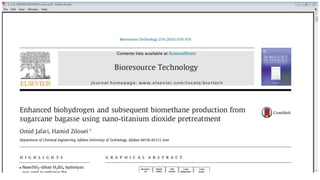
• Enhanced biohydrogen and subsequent biomethane production from
sugarcane bagasse using nano-titanium dioxide pretreatment.
• References
Introduction
• Nanotechnology is emerging rapidly with the development of
nanoscale materials which have potential biomedical applications,
especially in fighting and preventing diseases.
• The new age drugs include the nanoparticles of polymers, metals,
ceramics which can fight against human pathogens like bacteria and
even cancer
• The importance of nanoparticles having potent bactericidal activity is
inevitable because of their effect against resistant strains of
pathogens.
• Nanoparticles increase the chemical activity due to their large surface
volume ratio
• In recent times in fact, the metallic nanoparticles have proven that
they are the most suited candidate among all the other nano particles
• Metal oxide nanoparticles (NPs) are known to possess strong
antimicrobial activity.
• Titanium nanoparticles are one of the most important metal oxide
nanoparticles compared to others and are used in glass ceramics,
catalyst, solar cell sensors, electric conductors and sun screen as well
as biological related aspects
Synthesize of Titanium dioxide nanoparticles using Moringa
oleifera leaves and evaluation of wound healing activity
• Wounds are among major world-wide clinical problems because of
morbidity associated with prolonged periods required for repair and
regeneration of the injured tissue, bleeding,risk for infections and scar
formation.
• Due to the increment in the proportion of aged people’s population in the
coming decades, the wound healing process cost in clinical aspect may
likely to increase.
• Bacteria can easily contaminate the surface of wounds and access the
underlying tissue, thereby delaying the healing process
• Considering that resistance against newly approved antibiotics developed
within two years, there is an urgent need for newer generation of
antibiotics to fight infections.
Materials and methods
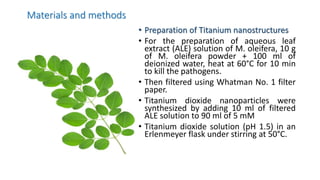
• Preparation of Titanium nanostructures
• For the preparation of aqueous leaf
extract (ALE) solution of M. oleifera, 10 g
of M. oleifera powder + 100 ml of
deionized water, heat at 60°C for 10 min
to kill the pathogens.
• Then filtered using Whatman No. 1 filter
paper.
• Titanium dioxide nanoparticles were
synthesized by adding 10 ml of filtered
ALE solution to 90 ml of 5 mM
• Titanium dioxide solution (pH 1.5) in an
Erlenmeyer flask under stirring at 50°C.
• After 5 h, the developed dark brown colour confirmed the formation
of Titanium dioxide nanoparticles (TiNPs).
• Centrifugation at 10,000 rpm for 15 min and thus separated Titanium
dioxide nanoparticles (TiNPs) and were dried.
Characterization techniques
• UV–Vis spectral analysis
• SEM analysis of Titanium nanoparticles
• Excision and treatment on animals
• The wound healing activity was examined upon the Male albino rats
of Wistar strain with weight of 160–1100 g
• The rats were housed in spacious polypropylene cages bedded with
rice husk and the room was well ventilated maintained under
standard experimental conditions (temperature 27°C and 12 h
light/dark cycle) throughout the experimental periods.
• The animals were distributed into various groups as where
Group I is treated with gel alone to serve as self immunity,
Group II animals are treated with gel based ointment (TiNPs + gel).
 The standard drug sulfadiazine purchased from medical store was
treated on Group III (sulfadiazine + gel) animals.
• Each group has six animals
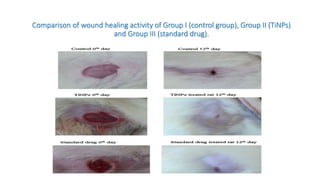
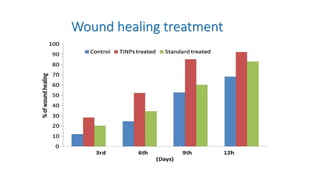
Comparison of wound healing activity of Group I (control group), Group II (TiNPs)
and Group III (standard drug).
Wound healing treatment
Conclusion
• Titanium dioxide and the use of M. oleifera leaf extract for the
biosynthesize of Titanium dioxide nanoparticles. This simple, cost
effective, time saving and environmental friendly synthetic method
gives a potential avenue for various applications
• The eco-friendly green chemistry approach using leaf extract for the
synthesize of nanoparticles will increase the economic viability and
sustainable management.
• Preparation of nano-titanium gel using bio synthesized Titanium
nanoparticles is a highly effective technique towards the wound
healing and opens a new paradigm of medical research
Materials and Methods
• Field Experiment
• Experiments were carried out at a Farm in Sakara, Giza , Egypt .
During two successive seasons, 2011/2012 and 2012/2013.
• The experimental plot area was 2 m x 4m
• The planting distance was 30 cm apart and it was 50 cm between
lines
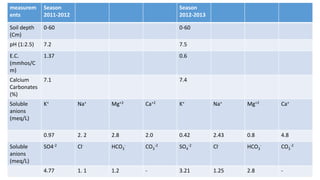
The soil chemical analysis for the two seasons
measurem
ents
Season
2011-2012
Season
2012-2013
Soil depth
(Cm)
0-60 0-60
pH (1:2.5) 7.2 7.5
E.C.
(mmhos/C
m)
1.37 0.6
Calcium
Carbonates
(%)
7.1 7.4
Soluble
anions
(meq/L)
K+ Na+ Mg+2 Ca+2 K+ Na+ Mg+2 Ca+
0.97 2. 2 2.8 2.0 0.42 2.43 0.8 4.8
Soluble
anions
(meq/L)
SO4-2 Cl- HCO3
- CO3
-2 SO4
-2 Cl- HCO3
- CO3
-2
4.77 1. 1 1.2 - 3.21 1.25 2.8 -
• Preparation of TiO2 Nanoparticles
• Titanium nanoparticles (TiO2) were prepared by laser ablation of a
titanium plate (99.9% purity) in 10 ml deionized water . Q-switched
Nd: YAG (Quantel) pulse laser generating 8 ns pulses at the
wavelength of 1064 nm with a repetition rate of 10 Hz and the
focused energy density was 400 mJ cm_2, using a 100 mm focal
length lens on the metal plate immersed in water.
• Characterization of TiO2 Nanoparticles
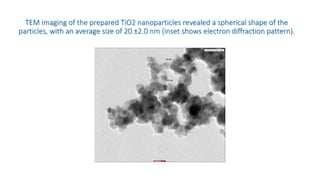
TEM imaging of the prepared TiO2 nanoparticles revealed a spherical shape of the
particles, with an average size of 20 ±2.0 nm (inset shows electron diffraction pattern).
Results
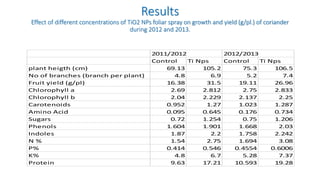
Effect of different concentrations of TiO2 NPs foliar spray on growth and yield (g/pl.) of coriander
during 2012 and 2013.
2011/2012 2012/2013
Control Ti Nps Control Ti Nps
plant heigth (cm) 69.13 105.2 75.3 106.5
No of branches (branch per plant) 4.8 6.9 5.2 7.4
Fruit yield (g/pl) 16.38 31.5 19.11 26.96
Chlorophyll a 2.69 2.812 2.75 2.833
Chlorophyll b 2.04 2.229 2.137 2.25
Carotenoids 0.952 1.27 1.023 1.287
Amino Acid 0.095 0.645 0.176 0.734
Sugars 0.72 1.254 0.75 1.206
Phenols 1.604 1.901 1.668 2.03
Indoles 1.87 2.2 1.758 2.242
N % 1.54 2.75 1.694 3.08
P% 0.414 0.546 0.4554 0.6006
K% 4.8 6.7 5.28 7.37
Protein 9.63 17.21 10.593 19.28
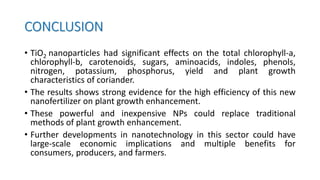
CONCLUSION
• TiO2 nanoparticles had significant effects on the total chlorophyll-a,
chlorophyll-b, carotenoids, sugars, aminoacids, indoles, phenols,
nitrogen, potassium, phosphorus, yield and plant growth
characteristics of coriander.
• The results shows strong evidence for the high efficiency of this new
nanofertilizer on plant growth enhancement.
• These powerful and inexpensive NPs could replace traditional
methods of plant growth enhancement.
• Further developments in nanotechnology in this sector could have
large-scale economic implications and multiple benefits for
consumers, producers, and farmers.
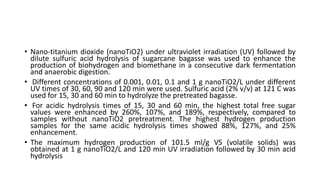
• Nano-titanium dioxide (nanoTiO2) under ultraviolet irradiation (UV) followed by
dilute sulfuric acid hydrolysis of sugarcane bagasse was used to enhance the
production of biohydrogen and biomethane in a consecutive dark fermentation
and anaerobic digestion.
• Different concentrations of 0.001, 0.01, 0.1 and 1 g nanoTiO2/L under different
UV times of 30, 60, 90 and 120 min were used. Sulfuric acid (2% v/v) at 121 C was
used for 15, 30 and 60 min to hydrolyze the pretreated bagasse.
• For acidic hydrolysis times of 15, 30 and 60 min, the highest total free sugar
values were enhanced by 260%, 107%, and 189%, respectively, compared to
samples without nanoTiO2 pretreatment. The highest hydrogen production
samples for the same acidic hydrolysis times showed 88%, 127%, and 25%
enhancement.
• The maximum hydrogen production of 101.5 ml/g VS (volatile solids) was
obtained at 1 g nanoTiO2/L and 120 min UV irradiation followed by 30 min acid
hydrolysis
Materials and methods
• Sugarcane bagasse
• Anaerobic sludge
• Pretreatment of sugarcane bagasse using nanoTiO2/UV irradiation
• HPLC
• Gas chromatograph
• Scanning electron microscopy (SEM)
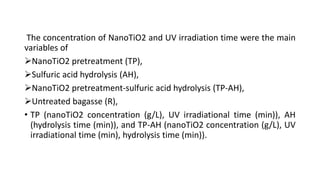
The concentration of NanoTiO2 and UV irradiation time were the main
variables of
NanoTiO2 pretreatment (TP),
Sulfuric acid hydrolysis (AH),
NanoTiO2 pretreatment-sulfuric acid hydrolysis (TP-AH),
Untreated bagasse (R),
• TP (nanoTiO2 concentration (g/L), UV irradiational time (min)), AH
(hydrolysis time (min)), and TP-AH (nanoTiO2 concentration (g/L), UV
irradiational time (min), hydrolysis time (min)).
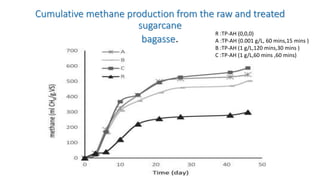
Cumulative methane production from the raw and treated
sugarcane
bagasse.
R :TP-AH (0,0,0)
A :TP-AH (0.001 g/L, 60 mins,15 mins )
B :TP-AH (1 g/L,120 mins,30 mins )
C :TP-AH (1 g/L,60 mins ,60 mins)
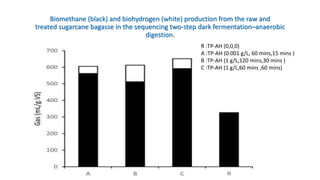
Biomethane (black) and biohydrogen (white) production from the raw and
treated sugarcane bagasse in the sequencing two-step dark fermentation–anaerobic
digestion.
R :TP-AH (0,0,0)
A :TP-AH (0.001 g/L, 60 mins,15 mins )
B :TP-AH (1 g/L,120 mins,30 mins )
C :TP-AH (1 g/L,60 mins ,60 mins)
Conclusion
• Pretreatment of bagasse using nano-titanium dioxide before acid hydrolysis
significantly improved the hydrogen production efficiency of dark
fermentation.
• The effects of nano-titanium dioxide pretreatment were destruction of
surface morphology and reduction of crystallinity. In fact, the operational
conditions of acid hydrolysis was changed using nano-titanium dioxide
pretreatment (reduction of temperature, time duration, and acid
concentration) in a way that not only energy saves but also destruction of
released sugars and production of inhibitor is declined.
• Dark fermentation not only released some energy in the form of
biohydrogen, but also facilitated the anaerobic digestion of bagasse by
enhancing its biomethane efficiency.
Thank You
References
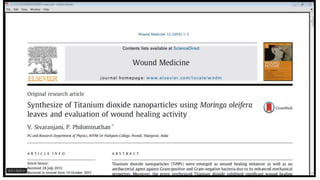
• V. Sivaranjani, P. Philominathan .Synthesize of Titanium dioxide nanoparticles using
Moringa oleifera leaves and evaluation of wound healing activity, Wound Medicine 12
(2016) 1–5.
• C.K. Sen, G.M. Gordillo, S. Roy, Human skin wounds: a major and snowballing threat to
public health and the economy, J. Wound Repair Regen. 17 (2009) 763–771
• R. Shankar, R. Dhivya, K. Subramanian, V.J. Ravikumar, Wound healing activity of
Origanum vulgare engineered titanium dioxide nanoparticles in Wistar albino rats, J.
Mater. Sci.: Mater. Med. 25 (2014) 1701–1708
• Mohamed S. khater, Effect of Titanium Nanoparticles (TiO2) on Growth, Yield and
Chemical Constituents of Coriander Plants. Arab Journal of Nuclear Science and
Applications, 48(4), (187-194) 2015.
• Omid Jafari, Hamid Zilouei, Enhanced biohydrogen and subsequent biomethane
production from sugarcane bagasse using nano-titanium dioxide pretreatment.
Bioresource Technology 214 (2016) 670–678

Application of titanium nanoparticles

  • 1.
  • 2.
    Outline • Introduction • Synthesizeof Titanium dioxide nanoparticles using Moringa oleifera leaves and evaluation of wound healing activity. • Effect of Titanium Nanoparticles (TiO2) on Growth, Yield and Chemical Constituents of Coriander Plants. • Enhanced biohydrogen and subsequent biomethane production from sugarcane bagasse using nano-titanium dioxide pretreatment. • References
  • 3.
    Introduction • Nanotechnology isemerging rapidly with the development of nanoscale materials which have potential biomedical applications, especially in fighting and preventing diseases. • The new age drugs include the nanoparticles of polymers, metals, ceramics which can fight against human pathogens like bacteria and even cancer • The importance of nanoparticles having potent bactericidal activity is inevitable because of their effect against resistant strains of pathogens.
  • 4.
    • Nanoparticles increasethe chemical activity due to their large surface volume ratio • In recent times in fact, the metallic nanoparticles have proven that they are the most suited candidate among all the other nano particles • Metal oxide nanoparticles (NPs) are known to possess strong antimicrobial activity. • Titanium nanoparticles are one of the most important metal oxide nanoparticles compared to others and are used in glass ceramics, catalyst, solar cell sensors, electric conductors and sun screen as well as biological related aspects
  • 6.
    Synthesize of Titaniumdioxide nanoparticles using Moringa oleifera leaves and evaluation of wound healing activity • Wounds are among major world-wide clinical problems because of morbidity associated with prolonged periods required for repair and regeneration of the injured tissue, bleeding,risk for infections and scar formation. • Due to the increment in the proportion of aged people’s population in the coming decades, the wound healing process cost in clinical aspect may likely to increase. • Bacteria can easily contaminate the surface of wounds and access the underlying tissue, thereby delaying the healing process • Considering that resistance against newly approved antibiotics developed within two years, there is an urgent need for newer generation of antibiotics to fight infections.
  • 7.
    Materials and methods •Preparation of Titanium nanostructures • For the preparation of aqueous leaf extract (ALE) solution of M. oleifera, 10 g of M. oleifera powder + 100 ml of deionized water, heat at 60°C for 10 min to kill the pathogens. • Then filtered using Whatman No. 1 filter paper. • Titanium dioxide nanoparticles were synthesized by adding 10 ml of filtered ALE solution to 90 ml of 5 mM • Titanium dioxide solution (pH 1.5) in an Erlenmeyer flask under stirring at 50°C.
  • 8.
    • After 5h, the developed dark brown colour confirmed the formation of Titanium dioxide nanoparticles (TiNPs). • Centrifugation at 10,000 rpm for 15 min and thus separated Titanium dioxide nanoparticles (TiNPs) and were dried.
  • 9.
    Characterization techniques • UV–Visspectral analysis • SEM analysis of Titanium nanoparticles • Excision and treatment on animals • The wound healing activity was examined upon the Male albino rats of Wistar strain with weight of 160–1100 g • The rats were housed in spacious polypropylene cages bedded with rice husk and the room was well ventilated maintained under standard experimental conditions (temperature 27°C and 12 h light/dark cycle) throughout the experimental periods.
  • 10.
    • The animalswere distributed into various groups as where Group I is treated with gel alone to serve as self immunity, Group II animals are treated with gel based ointment (TiNPs + gel).  The standard drug sulfadiazine purchased from medical store was treated on Group III (sulfadiazine + gel) animals. • Each group has six animals
  • 11.
    Comparison of woundhealing activity of Group I (control group), Group II (TiNPs) and Group III (standard drug).
  • 12.
  • 13.
    Conclusion • Titanium dioxideand the use of M. oleifera leaf extract for the biosynthesize of Titanium dioxide nanoparticles. This simple, cost effective, time saving and environmental friendly synthetic method gives a potential avenue for various applications • The eco-friendly green chemistry approach using leaf extract for the synthesize of nanoparticles will increase the economic viability and sustainable management. • Preparation of nano-titanium gel using bio synthesized Titanium nanoparticles is a highly effective technique towards the wound healing and opens a new paradigm of medical research
  • 15.
    Materials and Methods •Field Experiment • Experiments were carried out at a Farm in Sakara, Giza , Egypt . During two successive seasons, 2011/2012 and 2012/2013. • The experimental plot area was 2 m x 4m • The planting distance was 30 cm apart and it was 50 cm between lines
  • 16.
    The soil chemicalanalysis for the two seasons
  • 17.
    measurem ents Season 2011-2012 Season 2012-2013 Soil depth (Cm) 0-60 0-60 pH(1:2.5) 7.2 7.5 E.C. (mmhos/C m) 1.37 0.6 Calcium Carbonates (%) 7.1 7.4 Soluble anions (meq/L) K+ Na+ Mg+2 Ca+2 K+ Na+ Mg+2 Ca+ 0.97 2. 2 2.8 2.0 0.42 2.43 0.8 4.8 Soluble anions (meq/L) SO4-2 Cl- HCO3 - CO3 -2 SO4 -2 Cl- HCO3 - CO3 -2 4.77 1. 1 1.2 - 3.21 1.25 2.8 -
  • 18.
    • Preparation ofTiO2 Nanoparticles • Titanium nanoparticles (TiO2) were prepared by laser ablation of a titanium plate (99.9% purity) in 10 ml deionized water . Q-switched Nd: YAG (Quantel) pulse laser generating 8 ns pulses at the wavelength of 1064 nm with a repetition rate of 10 Hz and the focused energy density was 400 mJ cm_2, using a 100 mm focal length lens on the metal plate immersed in water. • Characterization of TiO2 Nanoparticles
  • 19.
    TEM imaging ofthe prepared TiO2 nanoparticles revealed a spherical shape of the particles, with an average size of 20 ±2.0 nm (inset shows electron diffraction pattern).
  • 20.
    Results Effect of differentconcentrations of TiO2 NPs foliar spray on growth and yield (g/pl.) of coriander during 2012 and 2013. 2011/2012 2012/2013 Control Ti Nps Control Ti Nps plant heigth (cm) 69.13 105.2 75.3 106.5 No of branches (branch per plant) 4.8 6.9 5.2 7.4 Fruit yield (g/pl) 16.38 31.5 19.11 26.96 Chlorophyll a 2.69 2.812 2.75 2.833 Chlorophyll b 2.04 2.229 2.137 2.25 Carotenoids 0.952 1.27 1.023 1.287 Amino Acid 0.095 0.645 0.176 0.734 Sugars 0.72 1.254 0.75 1.206 Phenols 1.604 1.901 1.668 2.03 Indoles 1.87 2.2 1.758 2.242 N % 1.54 2.75 1.694 3.08 P% 0.414 0.546 0.4554 0.6006 K% 4.8 6.7 5.28 7.37 Protein 9.63 17.21 10.593 19.28
  • 21.
    CONCLUSION • TiO2 nanoparticleshad significant effects on the total chlorophyll-a, chlorophyll-b, carotenoids, sugars, aminoacids, indoles, phenols, nitrogen, potassium, phosphorus, yield and plant growth characteristics of coriander. • The results shows strong evidence for the high efficiency of this new nanofertilizer on plant growth enhancement. • These powerful and inexpensive NPs could replace traditional methods of plant growth enhancement. • Further developments in nanotechnology in this sector could have large-scale economic implications and multiple benefits for consumers, producers, and farmers.
  • 23.
    • Nano-titanium dioxide(nanoTiO2) under ultraviolet irradiation (UV) followed by dilute sulfuric acid hydrolysis of sugarcane bagasse was used to enhance the production of biohydrogen and biomethane in a consecutive dark fermentation and anaerobic digestion. • Different concentrations of 0.001, 0.01, 0.1 and 1 g nanoTiO2/L under different UV times of 30, 60, 90 and 120 min were used. Sulfuric acid (2% v/v) at 121 C was used for 15, 30 and 60 min to hydrolyze the pretreated bagasse. • For acidic hydrolysis times of 15, 30 and 60 min, the highest total free sugar values were enhanced by 260%, 107%, and 189%, respectively, compared to samples without nanoTiO2 pretreatment. The highest hydrogen production samples for the same acidic hydrolysis times showed 88%, 127%, and 25% enhancement. • The maximum hydrogen production of 101.5 ml/g VS (volatile solids) was obtained at 1 g nanoTiO2/L and 120 min UV irradiation followed by 30 min acid hydrolysis
  • 24.
    Materials and methods •Sugarcane bagasse • Anaerobic sludge • Pretreatment of sugarcane bagasse using nanoTiO2/UV irradiation • HPLC • Gas chromatograph • Scanning electron microscopy (SEM)
  • 25.
    The concentration ofNanoTiO2 and UV irradiation time were the main variables of NanoTiO2 pretreatment (TP), Sulfuric acid hydrolysis (AH), NanoTiO2 pretreatment-sulfuric acid hydrolysis (TP-AH), Untreated bagasse (R), • TP (nanoTiO2 concentration (g/L), UV irradiational time (min)), AH (hydrolysis time (min)), and TP-AH (nanoTiO2 concentration (g/L), UV irradiational time (min), hydrolysis time (min)).
  • 26.
    Cumulative methane productionfrom the raw and treated sugarcane bagasse. R :TP-AH (0,0,0) A :TP-AH (0.001 g/L, 60 mins,15 mins ) B :TP-AH (1 g/L,120 mins,30 mins ) C :TP-AH (1 g/L,60 mins ,60 mins)
  • 27.
    Biomethane (black) andbiohydrogen (white) production from the raw and treated sugarcane bagasse in the sequencing two-step dark fermentation–anaerobic digestion. R :TP-AH (0,0,0) A :TP-AH (0.001 g/L, 60 mins,15 mins ) B :TP-AH (1 g/L,120 mins,30 mins ) C :TP-AH (1 g/L,60 mins ,60 mins)
  • 28.
    Conclusion • Pretreatment ofbagasse using nano-titanium dioxide before acid hydrolysis significantly improved the hydrogen production efficiency of dark fermentation. • The effects of nano-titanium dioxide pretreatment were destruction of surface morphology and reduction of crystallinity. In fact, the operational conditions of acid hydrolysis was changed using nano-titanium dioxide pretreatment (reduction of temperature, time duration, and acid concentration) in a way that not only energy saves but also destruction of released sugars and production of inhibitor is declined. • Dark fermentation not only released some energy in the form of biohydrogen, but also facilitated the anaerobic digestion of bagasse by enhancing its biomethane efficiency.
  • 29.
  • 30.
    References • V. Sivaranjani,P. Philominathan .Synthesize of Titanium dioxide nanoparticles using Moringa oleifera leaves and evaluation of wound healing activity, Wound Medicine 12 (2016) 1–5. • C.K. Sen, G.M. Gordillo, S. Roy, Human skin wounds: a major and snowballing threat to public health and the economy, J. Wound Repair Regen. 17 (2009) 763–771 • R. Shankar, R. Dhivya, K. Subramanian, V.J. Ravikumar, Wound healing activity of Origanum vulgare engineered titanium dioxide nanoparticles in Wistar albino rats, J. Mater. Sci.: Mater. Med. 25 (2014) 1701–1708 • Mohamed S. khater, Effect of Titanium Nanoparticles (TiO2) on Growth, Yield and Chemical Constituents of Coriander Plants. Arab Journal of Nuclear Science and Applications, 48(4), (187-194) 2015. • Omid Jafari, Hamid Zilouei, Enhanced biohydrogen and subsequent biomethane production from sugarcane bagasse using nano-titanium dioxide pretreatment. Bioresource Technology 214 (2016) 670–678