STIRLING ENGINE
HISTORY
 Robert Stirling invented stirling engine in the year 1816.
Thought to replace the steam turbines of his days due to
frequent explosion caused by unsustainable high pressure
killing and injuring workers.
Stirling engine could not explode and produce more power
than the steam engine used.
WHAT IS STIRLING ENGINE ?
Device that converts heat energy to
mechanical power by alternately
compressing and expanding a fixed quantity
of working fluid at different temperatures.
MAIN COMPONENTS
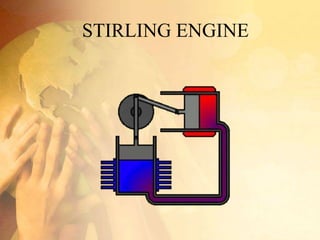
Power piston – small tightly sealed piston that
moves up when the gas inside the engine expands
Displacer – larger piston and it is very loose in its
cylinder so air can move easily between the heated
cooled sections of the engine as the displacer
moves up and down
These piston move by the action of compression
and expansion.
Difference in pressure causes the piston to move
and produce power.
STIRLING ENGINE
WORKING PRINCIPLE
I. One side of the engine is continuously heated
while the other side is continuously cooled.
II. First, the air moves to the hot side, where it is
heated and it expands pushing up on a piston.
III. Then the air moves through the regenerator to
the cold side, where it cools off and contracts
pulling down on the piston.
IV. Temperature change inside the engine produces
the pressure change needed to push on the
piston and make the engine run.
EFFICIENCY
Theoretically
 Stirling engine efficiency = Carnot efficiency
 Unfortunately working fluid or gas is not ideal this
causes the efficiency to be lower than Carnot
efficiency.
ADVANTAGES
Various heat sources (solar, geothermal,
nuclear energy, waste heat, biological)
Environmental friendly
Heat is external and the burning of a fuel-air
mixture can be more accurately controlled.
Operates at relatively low pressure and thus
are much safer than typical steam turbines
Less manpower needed to operate any type
of commercial Stirling engine.
APPLICATIONS
Water pump stations
Combined heat and power plant
Solar power generation
Stirling cyrocoolers
Heat pump
Marine engines
Nuclear power
Aircraft engines
Micro CHP
STIRLING CYROCOOLERS
 It is mainly used in heavy ships for high heat
production
NUCLEAR POWER
 Replacing the steam turbines of the nuclear
power plant with Stirling engine might simplify
the plant, yield greater efficiency, and reduce
the radioactivity by products.
CONCLUSION
Unlimited source of heat source
Political awareness of green heat and power
production.
Large market experiencing rapid growth.
Many different possible applications.
Time to change.
solar-power-stirling-engine-767-X9n3i00.ppt

solar-power-stirling-engine-767-X9n3i00.ppt

  • 1.
  • 2.
    HISTORY  Robert Stirlinginvented stirling engine in the year 1816. Thought to replace the steam turbines of his days due to frequent explosion caused by unsustainable high pressure killing and injuring workers. Stirling engine could not explode and produce more power than the steam engine used.
  • 3.
    WHAT IS STIRLINGENGINE ? Device that converts heat energy to mechanical power by alternately compressing and expanding a fixed quantity of working fluid at different temperatures.
  • 4.
    MAIN COMPONENTS Power piston– small tightly sealed piston that moves up when the gas inside the engine expands Displacer – larger piston and it is very loose in its cylinder so air can move easily between the heated cooled sections of the engine as the displacer moves up and down These piston move by the action of compression and expansion. Difference in pressure causes the piston to move and produce power.
  • 5.
  • 6.
    WORKING PRINCIPLE I. Oneside of the engine is continuously heated while the other side is continuously cooled. II. First, the air moves to the hot side, where it is heated and it expands pushing up on a piston. III. Then the air moves through the regenerator to the cold side, where it cools off and contracts pulling down on the piston. IV. Temperature change inside the engine produces the pressure change needed to push on the piston and make the engine run.
  • 7.
    EFFICIENCY Theoretically  Stirling engineefficiency = Carnot efficiency  Unfortunately working fluid or gas is not ideal this causes the efficiency to be lower than Carnot efficiency.
  • 8.
    ADVANTAGES Various heat sources(solar, geothermal, nuclear energy, waste heat, biological) Environmental friendly Heat is external and the burning of a fuel-air mixture can be more accurately controlled. Operates at relatively low pressure and thus are much safer than typical steam turbines Less manpower needed to operate any type of commercial Stirling engine.
  • 9.
    APPLICATIONS Water pump stations Combinedheat and power plant Solar power generation Stirling cyrocoolers Heat pump Marine engines Nuclear power Aircraft engines Micro CHP
  • 10.
    STIRLING CYROCOOLERS  Itis mainly used in heavy ships for high heat production NUCLEAR POWER  Replacing the steam turbines of the nuclear power plant with Stirling engine might simplify the plant, yield greater efficiency, and reduce the radioactivity by products.
  • 11.
    CONCLUSION Unlimited source ofheat source Political awareness of green heat and power production. Large market experiencing rapid growth. Many different possible applications. Time to change.