A
Special Report
On
Gas Chromatography- Mass spectrometry : Principle,
Instrumentation and Application
CONTENTS
 General Introduction
 Principle
 Instrumentation
 GC-MS Setup
 Types of Mass Spectrometer detector
 Application
General Introduction
 Gas Chromatography – Mass Spectrometry (GC-MS) is
an analytical method that combines the features of
gas- liquid chromatography and mass spectrometry to
identify different substances with in a test sample.
 Gas chromatography is a technique used to separate
drugs that might be present in a sample. The detector
for the GC is the Mass spectrometry detector.
 Mass spectrometer(MS) is an instrument that serves
for establishment of the molecular weight and
structure of both inorganic and organic compounds,
and the identification and determination of analytes
in complex mixtures.
Principle
 GC-MS instrument separates chemical mixtures (the
GC component) and identifies the components at a
molecular level (the MS component).
 GC works on the principle that a mixture will separate
into individual substances when heated. The heated
gases are carried through a column with an inert gas.
 As the separated substances emerge from the column
opening , they flow into MS.
 Mass spectrometry identifies compounds by the mass
of the analyte molecule.
Instrumentation
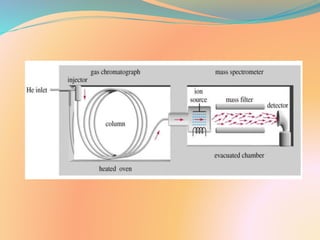
 The GC-MS is composed of two major building blocks:
 Gas chromatograph
 Mass spectrometer
 The molecules are retained by the capillary column and
elute from the column at different times.
 The Mass spectrometer capture, ionize, accelerate, deflect
and detect the ionized molecules separately by breaking
each molecule into ionize fragments and detecting these
fragments using their mass to charge ratio.
GC-MS Setup
Types of Mass spectrometer Detectors
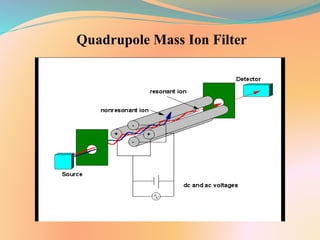
1. Quadrupole Mass Spectrometer- most common
2. Ion Trap Mass Spectrometer
3. Magnetic Mass Spectrometer
Quadrupole Mass Ion Filter
Ion trap Filter
Advantages of GC-MS
 Accurate identification of a particular molecule is
possible.
 Differentiate between multiple molecules in the
same amount of time.
 Identification carried out at a molecular level.
 Easy to Operate.
Application
 Environmental monitoring and cleanup
 Assay of pharmaceuticals and purity and
characterization of raw materials
 Studies of Drug metabolite
 Characterization of Odour and flavor component
of food
 Law enforcement
 Sports Anti- doping analysis
 Medical Diagnosis
 Security of Airports
 Criminal Forensics
Thank
You

Hyphenated GC-MS

  • 1.
    A Special Report On Gas Chromatography-Mass spectrometry : Principle, Instrumentation and Application
  • 2.
    CONTENTS  General Introduction Principle  Instrumentation  GC-MS Setup  Types of Mass Spectrometer detector  Application
  • 3.
    General Introduction  GasChromatography – Mass Spectrometry (GC-MS) is an analytical method that combines the features of gas- liquid chromatography and mass spectrometry to identify different substances with in a test sample.  Gas chromatography is a technique used to separate drugs that might be present in a sample. The detector for the GC is the Mass spectrometry detector.  Mass spectrometer(MS) is an instrument that serves for establishment of the molecular weight and structure of both inorganic and organic compounds, and the identification and determination of analytes in complex mixtures.
  • 4.
    Principle  GC-MS instrumentseparates chemical mixtures (the GC component) and identifies the components at a molecular level (the MS component).  GC works on the principle that a mixture will separate into individual substances when heated. The heated gases are carried through a column with an inert gas.  As the separated substances emerge from the column opening , they flow into MS.  Mass spectrometry identifies compounds by the mass of the analyte molecule.
  • 7.
    Instrumentation  The GC-MSis composed of two major building blocks:  Gas chromatograph  Mass spectrometer  The molecules are retained by the capillary column and elute from the column at different times.  The Mass spectrometer capture, ionize, accelerate, deflect and detect the ionized molecules separately by breaking each molecule into ionize fragments and detecting these fragments using their mass to charge ratio.
  • 9.
  • 10.
    Types of Massspectrometer Detectors 1. Quadrupole Mass Spectrometer- most common 2. Ion Trap Mass Spectrometer 3. Magnetic Mass Spectrometer
  • 11.
  • 12.
  • 13.
    Advantages of GC-MS Accurate identification of a particular molecule is possible.  Differentiate between multiple molecules in the same amount of time.  Identification carried out at a molecular level.  Easy to Operate.
  • 14.
    Application  Environmental monitoringand cleanup  Assay of pharmaceuticals and purity and characterization of raw materials  Studies of Drug metabolite  Characterization of Odour and flavor component of food  Law enforcement  Sports Anti- doping analysis  Medical Diagnosis  Security of Airports  Criminal Forensics
  • 15.