Application of CNC Machine
Contents
2
• Introduction to CNC
• History of CNC
• Operations in CNC
• Advantages and Disadvantages of CNC
• Axis selection
• Element of CNC Machine
• Application of CNC Machine
Introduction to CNC
3
• Numerical control (NC) is the automation of machine tools that are
operated by precisely programmed commands encoded on a storage
medium, as opposed to controlled manually.
• Most NC today is computer numerical control (CNC), in which
computers play an integral part of the control.
• In modern CNC systems, end-to-end component design is highly
automated using computer-aided design (CAD) and computer-aided
manufacturing (CAM) programs.
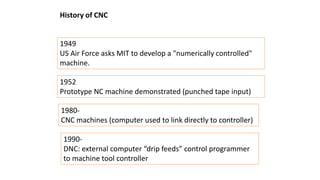
History of CNC
1949
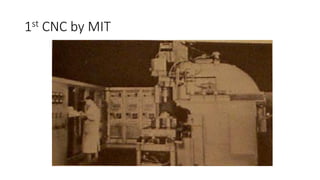
US Air Force asks MIT to develop a "numerically controlled"
machine.
1952
Prototype NC machine demonstrated (punched tape input)
1980-
CNC machines (computer used to link directly to controller)
1990-
DNC: external computer “drip feeds” control programmer
to machine tool controller
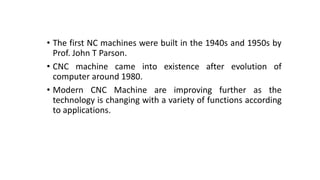
• The first NC machines were built in the 1940s and 1950s by
Prof. John T Parson.
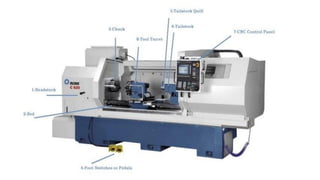
• CNC machine came into existence after evolution of
computer around 1980.
• Modern CNC Machine are improving further as the
technology is changing with a variety of functions according
to applications.
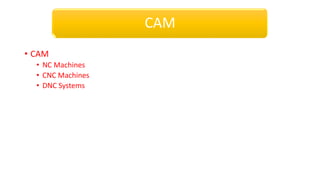
• CAM
• NC Machines
• CNC Machines
• DNC Systems
CAM
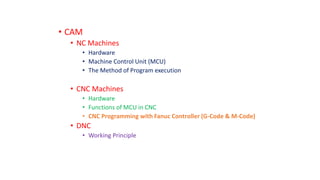
• CAM
• NC Machines
• Hardware
• Machine Control Unit (MCU)
• The Method of Program execution
• CNC Machines
• Hardware
• Functions of MCU in CNC
• CNC Programming with Fanuc Controller (G-Code & M-Code)
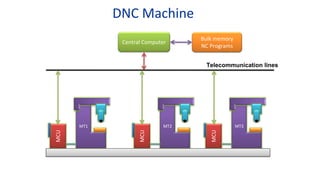
• DNC
• Working Principle
1st CNC by MIT
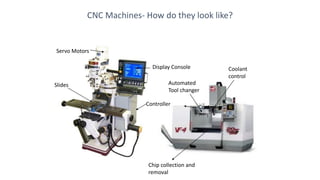
CNC Machines- How do they look like?
Slides
Controller
Servo Motors
Display Console
Controller
Automated
Tool changer
Coolant
control
Chip collection and
removal
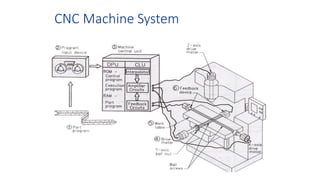
CNC Machine System
MT1
MCU
MT2
MCU
MT3
MCU
Central Computer
Bulk memory
NC Programs
Telecommunication lines
DNC Machine
Automated Manufacturing system includes
(Operates on Physical Product)
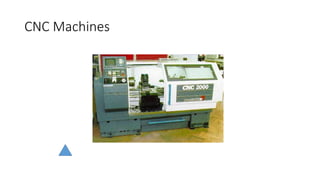
• Automated machine tools that process parts (Ex. NC & CNC Machines)
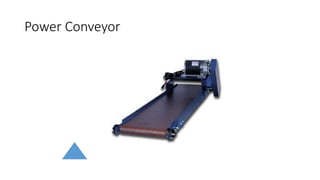
• Automated Material handling (Ex. Power conveyor )
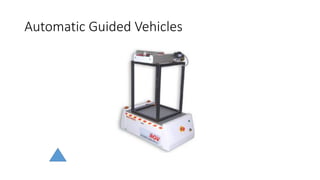
• Automated Guided vehicles
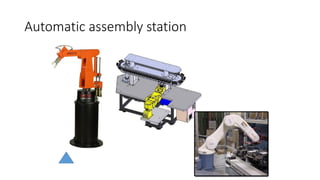
• Automated assembly system (Robots are used to perform assembly)
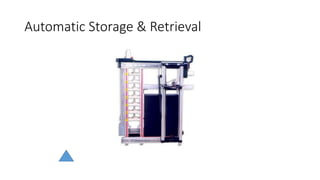
• Automatic storage & retrieval
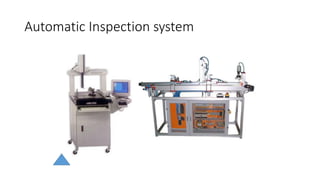
• Automatic inspection systems for quality control
14
CNC Operations are:-
• CNC Water Jet Cutter
• Drilling
• Sheet metal works (Turret punch)
• Wire bending machines
• Surface grinders
• Cylindrical grinders
• submerged welding
• Glass cutting
Advantages of CNC
15
• CNC machines can be used continuously
• Batch production with high accuracy
• Can be updated by improving the software
• Training in the use of CNCs is available through the use of ‘virtual software’.
• No need to make a prototype or a model
• One person can supervise many CNC machines simultaneously
• saves time
• Reduces non productive time
• Reduces manufacturing lead time
• Greater manufacturing flexibility
Disadvantages
16
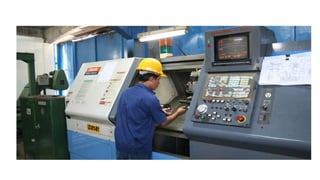
• More expensive than manually operated machines
• The CNC machine operator only needs basic training and skills,
enough to supervise several machines. In years gone by, engineers
needed years of training to operate centre lathes, milling machines
and other manually operated machines. This means many of the old
skills are been lost.
• Investment in CNC machines can lead to unemployment
Elements of CNC Machine
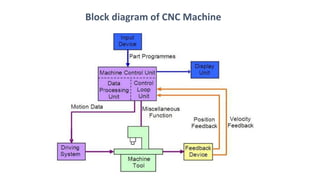
• A CNC machine consist of following 6 major elements:
i. Input Device
ii. Machine Control Unit
iii. Machine Tool
iv. Driving System
v. Feedback Devices
vi. Display Unit
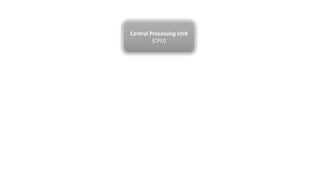
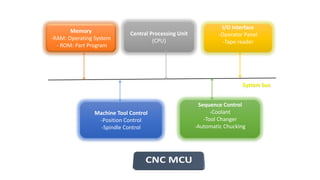
Central Processing Unit
(CPU)
Memory
-RAM: Operating System
- ROM: Part Program
I/O Interface
-Operator Panel
-Tape reader
Machine Tool Control
-Position Control
-Spindle Control
Sequence Control
-Coolant
-Tool Changer
-Automatic Chucking
Memory
-RAM: Operating System
- ROM: Part Program
I/O Interface
-Operator Panel
-Tape reader
Central Processing Unit
(CPU)
Machine Tool Control
-Position Control
-Spindle Control
Sequence Control
-Coolant
-Tool Changer
-Automatic Chucking
System bus
Block diagram of CNC Machine
SAMPLE
CNC MACHINES
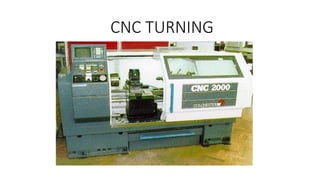
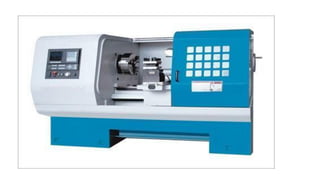
CNC TURNING
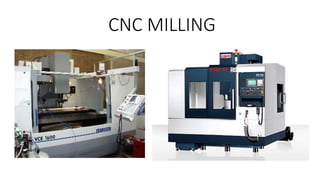
CNC MILLING
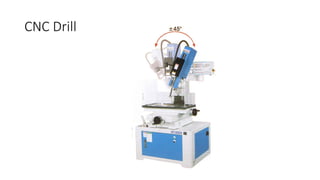
CNC Drill
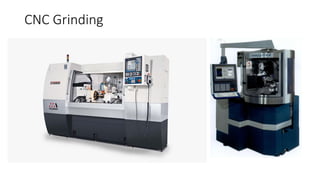
CNC Grinding
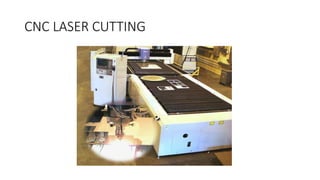
CNC LASER CUTTING
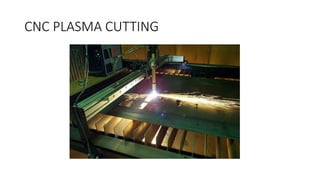
CNC PLASMA CUTTING
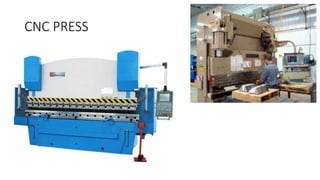
CNC PRESS
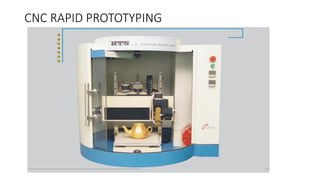
CNC RAPID PROTOTYPING
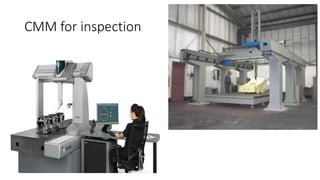
CMM for inspection
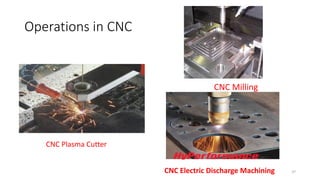
Operations in CNC
37
CNC Milling
CNC Plasma Cutter
CNC Electric Discharge Machining
INDUSTRIES MOST AFFECTED by CNC
• Aerospace
• Machinery
• Electrical
• Fabrication
• Automotive
• Instrumentation
• Mold making
SAMPLE PRODUCTS
OF
CNC MANUFACTURING
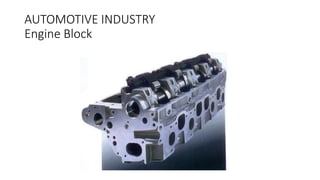
AUTOMOTIVE INDUSTRY
Engine Block
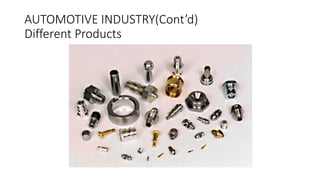
AUTOMOTIVE INDUSTRY(Cont’d)
Different Products
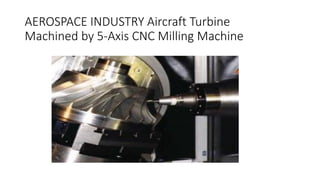
AEROSPACE INDUSTRY Aircraft Turbine
Machined by 5-Axis CNC Milling Machine
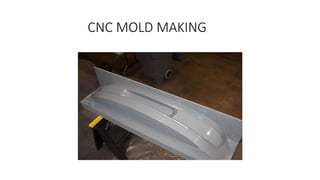
CNC MOLD MAKING
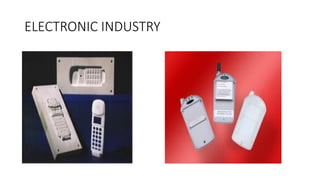
ELECTRONIC INDUSTRY
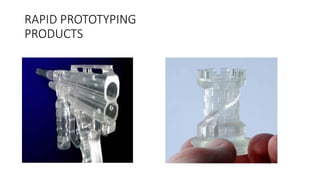
RAPID PROTOTYPING
PRODUCTS
Automation in Production Systems
• Automation can be defined as a technology concerned with
the application of mechanical, electronic, and computer-
based systems to operate and control production.
• Mechatronics engineering, is a multidisciplinary branch of
engineering that focuses on the engineering of both electrical
and mechanical systems, and also includes a combination of
robotics, electronics, computer, telecommunications,
systems, control, and product engineering.
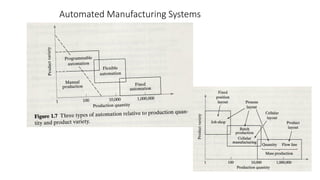
Automated Manufacturing Systems
• Classified into 3 basic types.
1. Fixed Automation : sequence of processing (or assembly)
operations is fixed.
Typical features of fixed automation are
• High initial investment (custom-engineered equipment)
• High production rate
• Relative inflexible in accommodating product variety
Automated Manufacturing Systems
• Very large quantities and high production rate
• High initial cost of the equipment can be spread over
a very large number of units
• Ex Machining transfer lines and Automated assembly
machines.
Automated Manufacturing Systems
2. Programmable Automation
• The operation sequence is controlled by a program.
• New programs can be prepared and entered into the
equipment to produce new products.
• Typical features of programmable automation are
• High investment in General purpose machines
• Low production rate than fixed automation
Automated Manufacturing Systems
• Typical features of programmable automation are
• Flexibility to deal with variation and change in
product configuration
• Changeover procedure takes time
• Include numerically controlled (NC,CNC) machine tools,
in industrial robots, and programmable logic
controllers.
Automated Manufacturing Systems
• Flexible Automation:
• No time lost for changeovers from one part style to the
next
• Soft variety
• Typical features of flexible automation are
• High investment for Custom engineered systems
• Continuous production of variable mixtures of products
Automated Manufacturing Systems
• Typical features of flexible automation are
• Medium production rate
• Flexible to deal with product design variations
Automated Manufacturing Systems
CNC Machines
Power Conveyor
Automatic Guided Vehicles
Automatic assembly station
Automatic Storage & Retrieval
Automatic Inspection system

Application of cnc machine

  • 1.
  • 2.
    Contents 2 • Introduction toCNC • History of CNC • Operations in CNC • Advantages and Disadvantages of CNC • Axis selection • Element of CNC Machine • Application of CNC Machine
  • 3.
    Introduction to CNC 3 •Numerical control (NC) is the automation of machine tools that are operated by precisely programmed commands encoded on a storage medium, as opposed to controlled manually. • Most NC today is computer numerical control (CNC), in which computers play an integral part of the control. • In modern CNC systems, end-to-end component design is highly automated using computer-aided design (CAD) and computer-aided manufacturing (CAM) programs.
  • 4.
    History of CNC 1949 USAir Force asks MIT to develop a "numerically controlled" machine. 1952 Prototype NC machine demonstrated (punched tape input) 1980- CNC machines (computer used to link directly to controller) 1990- DNC: external computer “drip feeds” control programmer to machine tool controller
  • 5.
    • The firstNC machines were built in the 1940s and 1950s by Prof. John T Parson. • CNC machine came into existence after evolution of computer around 1980. • Modern CNC Machine are improving further as the technology is changing with a variety of functions according to applications.
  • 6.
    • CAM • NCMachines • CNC Machines • DNC Systems CAM
  • 7.
    • CAM • NCMachines • Hardware • Machine Control Unit (MCU) • The Method of Program execution • CNC Machines • Hardware • Functions of MCU in CNC • CNC Programming with Fanuc Controller (G-Code & M-Code) • DNC • Working Principle
  • 8.
  • 10.
    CNC Machines- Howdo they look like? Slides Controller Servo Motors Display Console Controller Automated Tool changer Coolant control Chip collection and removal
  • 11.
  • 12.
    MT1 MCU MT2 MCU MT3 MCU Central Computer Bulk memory NCPrograms Telecommunication lines DNC Machine
  • 13.
    Automated Manufacturing systemincludes (Operates on Physical Product) • Automated machine tools that process parts (Ex. NC & CNC Machines) • Automated Material handling (Ex. Power conveyor ) • Automated Guided vehicles • Automated assembly system (Robots are used to perform assembly) • Automatic storage & retrieval • Automatic inspection systems for quality control
  • 14.
    14 CNC Operations are:- •CNC Water Jet Cutter • Drilling • Sheet metal works (Turret punch) • Wire bending machines • Surface grinders • Cylindrical grinders • submerged welding • Glass cutting
  • 15.
    Advantages of CNC 15 •CNC machines can be used continuously • Batch production with high accuracy • Can be updated by improving the software • Training in the use of CNCs is available through the use of ‘virtual software’. • No need to make a prototype or a model • One person can supervise many CNC machines simultaneously • saves time • Reduces non productive time • Reduces manufacturing lead time • Greater manufacturing flexibility
  • 16.
    Disadvantages 16 • More expensivethan manually operated machines • The CNC machine operator only needs basic training and skills, enough to supervise several machines. In years gone by, engineers needed years of training to operate centre lathes, milling machines and other manually operated machines. This means many of the old skills are been lost. • Investment in CNC machines can lead to unemployment
  • 18.
    Elements of CNCMachine • A CNC machine consist of following 6 major elements: i. Input Device ii. Machine Control Unit iii. Machine Tool iv. Driving System v. Feedback Devices vi. Display Unit
  • 19.
  • 20.
  • 21.
  • 22.
    Machine Tool Control -PositionControl -Spindle Control
  • 23.
  • 24.
    Memory -RAM: Operating System -ROM: Part Program I/O Interface -Operator Panel -Tape reader Central Processing Unit (CPU) Machine Tool Control -Position Control -Spindle Control Sequence Control -Coolant -Tool Changer -Automatic Chucking System bus
  • 25.
    Block diagram ofCNC Machine
  • 26.
  • 27.
  • 29.
  • 30.
  • 31.
  • 32.
  • 33.
  • 34.
  • 35.
  • 36.
  • 37.
    Operations in CNC 37 CNCMilling CNC Plasma Cutter CNC Electric Discharge Machining
  • 38.
    INDUSTRIES MOST AFFECTEDby CNC • Aerospace • Machinery • Electrical • Fabrication • Automotive • Instrumentation • Mold making
  • 39.
  • 40.
  • 41.
  • 42.
    AEROSPACE INDUSTRY AircraftTurbine Machined by 5-Axis CNC Milling Machine
  • 43.
  • 44.
  • 45.
  • 46.
    Automation in ProductionSystems • Automation can be defined as a technology concerned with the application of mechanical, electronic, and computer- based systems to operate and control production. • Mechatronics engineering, is a multidisciplinary branch of engineering that focuses on the engineering of both electrical and mechanical systems, and also includes a combination of robotics, electronics, computer, telecommunications, systems, control, and product engineering.
  • 47.
    Automated Manufacturing Systems •Classified into 3 basic types. 1. Fixed Automation : sequence of processing (or assembly) operations is fixed. Typical features of fixed automation are • High initial investment (custom-engineered equipment) • High production rate • Relative inflexible in accommodating product variety
  • 48.
    Automated Manufacturing Systems •Very large quantities and high production rate • High initial cost of the equipment can be spread over a very large number of units • Ex Machining transfer lines and Automated assembly machines.
  • 49.
    Automated Manufacturing Systems 2.Programmable Automation • The operation sequence is controlled by a program. • New programs can be prepared and entered into the equipment to produce new products. • Typical features of programmable automation are • High investment in General purpose machines • Low production rate than fixed automation
  • 50.
    Automated Manufacturing Systems •Typical features of programmable automation are • Flexibility to deal with variation and change in product configuration • Changeover procedure takes time • Include numerically controlled (NC,CNC) machine tools, in industrial robots, and programmable logic controllers.
  • 51.
    Automated Manufacturing Systems •Flexible Automation: • No time lost for changeovers from one part style to the next • Soft variety • Typical features of flexible automation are • High investment for Custom engineered systems • Continuous production of variable mixtures of products
  • 52.
    Automated Manufacturing Systems •Typical features of flexible automation are • Medium production rate • Flexible to deal with product design variations
  • 53.
  • 55.
  • 56.
  • 57.
  • 58.
  • 59.
  • 60.