Which process


ANSI
                                                            pump is right
                                                              for your
                                                            application?
  vs
I
   API?  By Ross C. Mackay,
         Contributing Editor


    n the world of pumps, there are two types of
    horizontal end suction centrifugal pumps that
    are more commonly used than all the others put
                                                            In view of these figures, it is apparent that the
                                                        API pumps should be considered for higher pres-
                                                        sure and temperature services than the lighter duty
together. They are the ANSI pump that is designed       ANSI pump.
and built to the standards of the American National
Standards Institute, and the API pump that meets        The Liquids
the requirements of the American Petroleum                   In considering the various types of liquids han-
Institute Standard 610 for General Refinery Service.    dled by these pumps, the fluids in the petrochemi-
     Over the years, ANSI designs have become the       cal industry are frequently classified as
preferred style of end suction pumps, not only for      Hydrocarbons, Aggressive Chemicals and Mild
chemical process applications, but also for water       Chemicals.
and other less aggressive services. The ANSI                 Hydrocarbons are petroleum-based products
Standard provides for dimensional interchangeabil-      that are frequently classified as light, intermediate
ity of pumps from one manufacturer to another.          or heavy. At atmospheric pressure and temperature,
     The API pump is almost the exclusive choice        light hydrocarbons tend to vaporize, intermediate
for applications in the oil refin-                                        hydrocarbons are liquid, and
ery industry, where it handles                                            heavy hydrocarbons are highly
higher temperatures and pressure    Taking these fac-                     viscous or even solid.
applications of a more aggressive                                              Aggressive Chemicals include
nature. While this specification    tors into account,                    strong acids, alkalines or oxidiz-
also deals with some vertical                                             ing agents that are destructive to
shaft models, this article will     you can finish up                     both equipment and the environ-
focus on the more widely used                                             ment. They are also dangerous to
horizontal designs. These single
                                     with a profitable                    plant personnel if allowed to leak.
stage pumps are designed with a                                                Mild Chemicals are generally
radially split casing to accommo-
                                       and reliable                       easy to handle, and are not detri-
                                                                          mental to either equipment or
date a back pullout arrangement
for ease of maintenance. The
                                    operating system.                     the environment.
major difference between the                                                   Many of these liquids can
two styles is reflected in the casing pressure design   produce toxic fluid exposure and vapors if they are
ratings, which are as follows:                          allowed to leak out of a pump. Vapor release is a
                                                        common danger with hydrocarbons that vaporize at
     ANSI Pump Rating = 300 PSIG at 300° F              atmospheric conditions or other chemicals that may
     API Pump Rating = 750 PSIG at 500° F               be exposed to very high operating temperatures.


36    MARCH 2004                             www.pump-zone.com                               PUMPS & SYSTEMS
If a vapor release is exposed to a spark, the vapor       discussed on this problem in recent years. This load
cloud may even explode or catch fires.                    is at its maximum when the pump is run at the
     Consequently, in handling these liquids, we          shutoff condition, and gradually decreases as the
must be extremely aware of much more than envi-           flow rate approaches the Best Efficiency Point
ronmental damage and pumping efficiency. We               (BEP). If the pump operates beyond the BEP, the
must also be very conscious about personal safety.        load increases again, but in the opposite direction
Therefore, the choice between the ANSI pump and           on the same plane. Examination of the resultant
the API pump must take into account the specific          shaft deflection problems has indicated that the
fluid properties, as well as the operating conditions.    radial plane on which the out-of-balance load acts
     The main difference between these choices is         is approximately 60° counterclockwise from the
predominantly a result of the differences in casing       cut-water of the volute.
design.

Volute Cases
    Both pump styles have a radial split casing, and
most ANSI pumps and some API pumps employ a
single volute design of the interior passages. This is
particularly evident in the smaller sizes that involve
low-flow rates and lower specific speeds of the
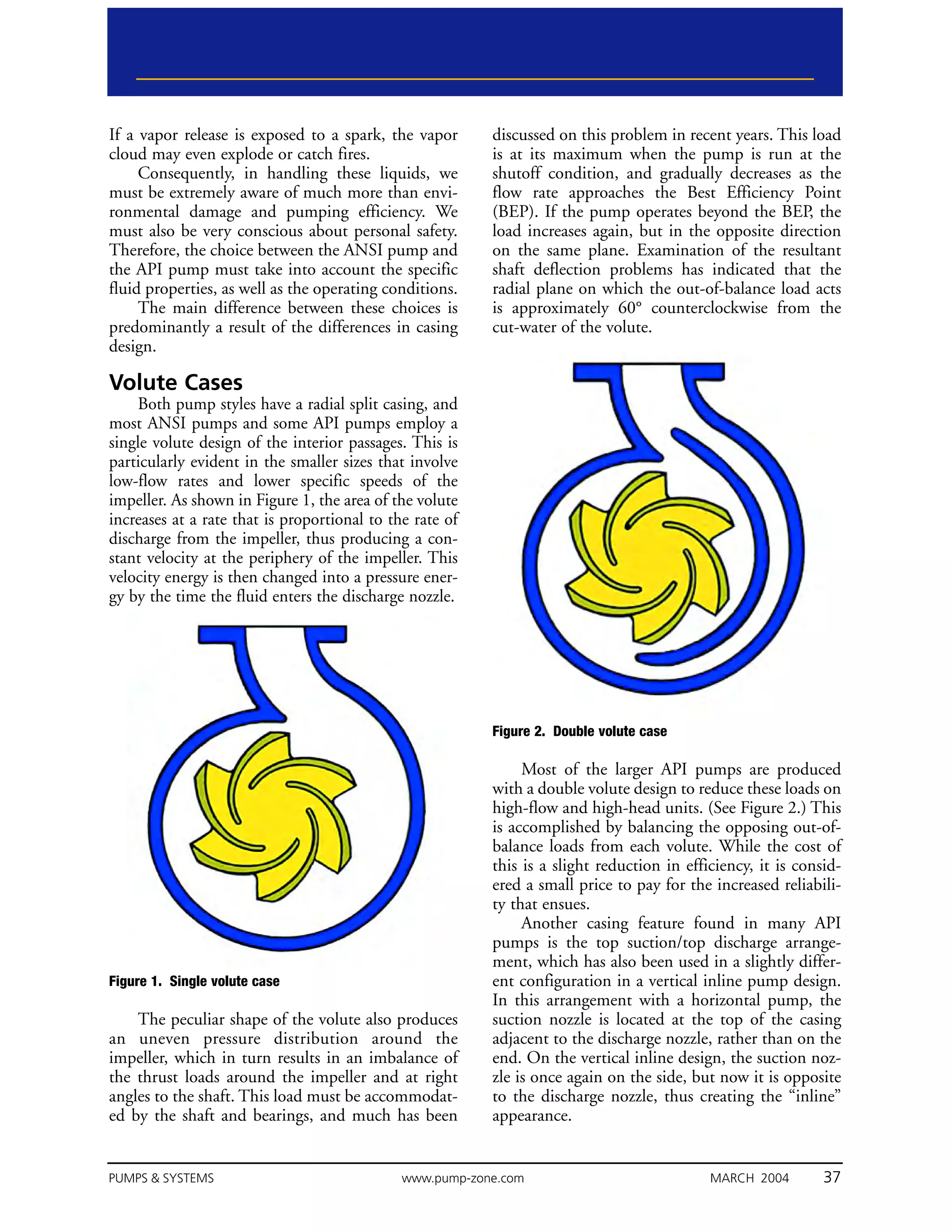
impeller. As shown in Figure 1, the area of the volute
increases at a rate that is proportional to the rate of
discharge from the impeller, thus producing a con-
stant velocity at the periphery of the impeller. This
velocity energy is then changed into a pressure ener-
gy by the time the fluid enters the discharge nozzle.


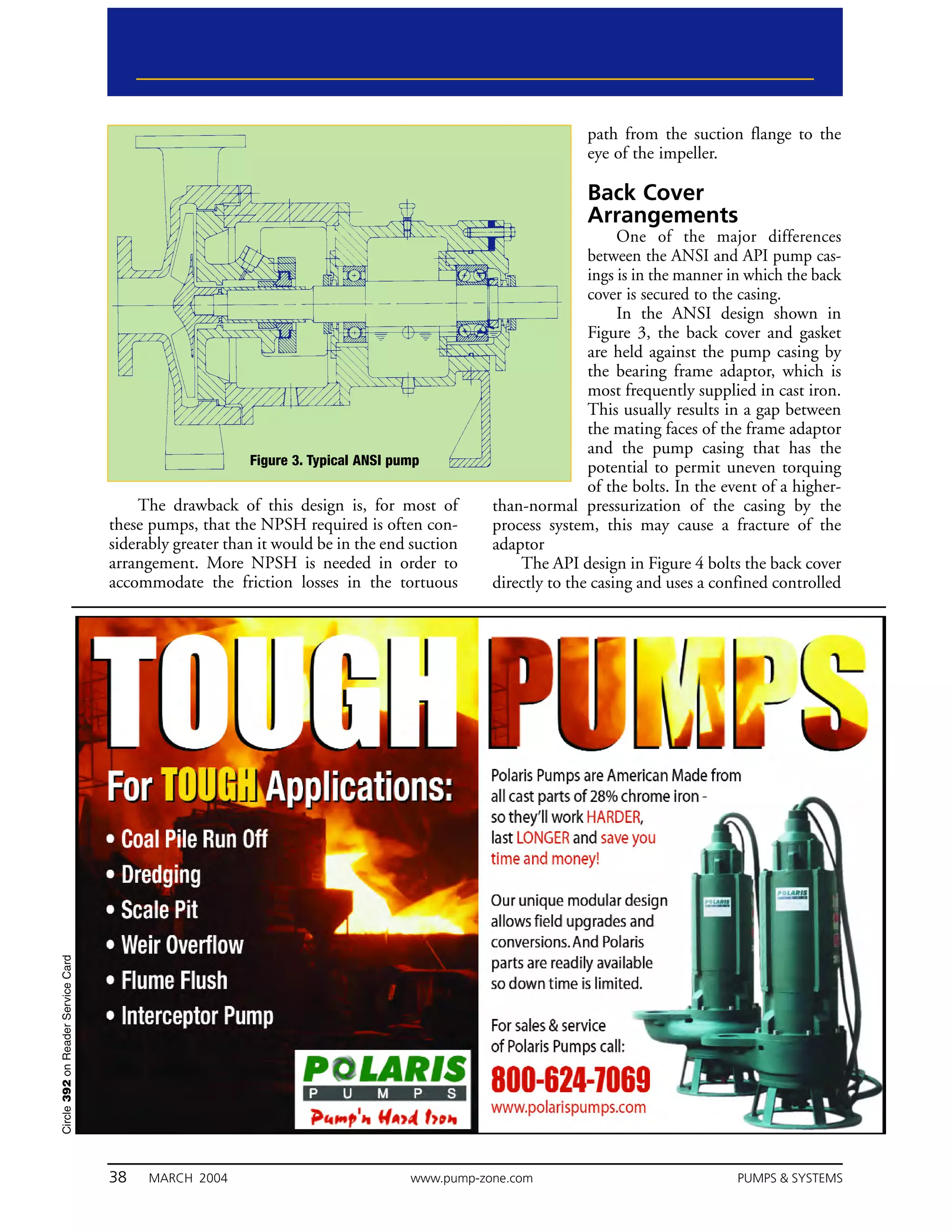
                                                          Figure 2. Double volute case

                                                               Most of the larger API pumps are produced
                                                          with a double volute design to reduce these loads on
                                                          high-flow and high-head units. (See Figure 2.) This
                                                          is accomplished by balancing the opposing out-of-
                                                          balance loads from each volute. While the cost of
                                                          this is a slight reduction in efficiency, it is consid-
                                                          ered a small price to pay for the increased reliabili-
                                                          ty that ensues.
                                                               Another casing feature found in many API
                                                          pumps is the top suction/top discharge arrange-
                                                          ment, which has also been used in a slightly differ-
Figure 1. Single volute case                              ent configuration in a vertical inline pump design.
                                                          In this arrangement with a horizontal pump, the
    The peculiar shape of the volute also produces        suction nozzle is located at the top of the casing
an uneven pressure distribution around the                adjacent to the discharge nozzle, rather than on the
impeller, which in turn results in an imbalance of        end. On the vertical inline design, the suction noz-
the thrust loads around the impeller and at right         zle is once again on the side, but now it is opposite
angles to the shaft. This load must be accommodat-        to the discharge nozzle, thus creating the “inline”
ed by the shaft and bearings, and much has been           appearance.


PUMPS & SYSTEMS                               www.pump-zone.com                             MARCH 2004        37
path from the suction flange to the
                                                                                                           eye of the impeller.

                                                                                                           Back Cover
                                                                                                           Arrangements
                                                                                                                 One of the major differences
                                                                                                            between the ANSI and API pump cas-
                                                                                                            ings is in the manner in which the back
                                                                                                            cover is secured to the casing.
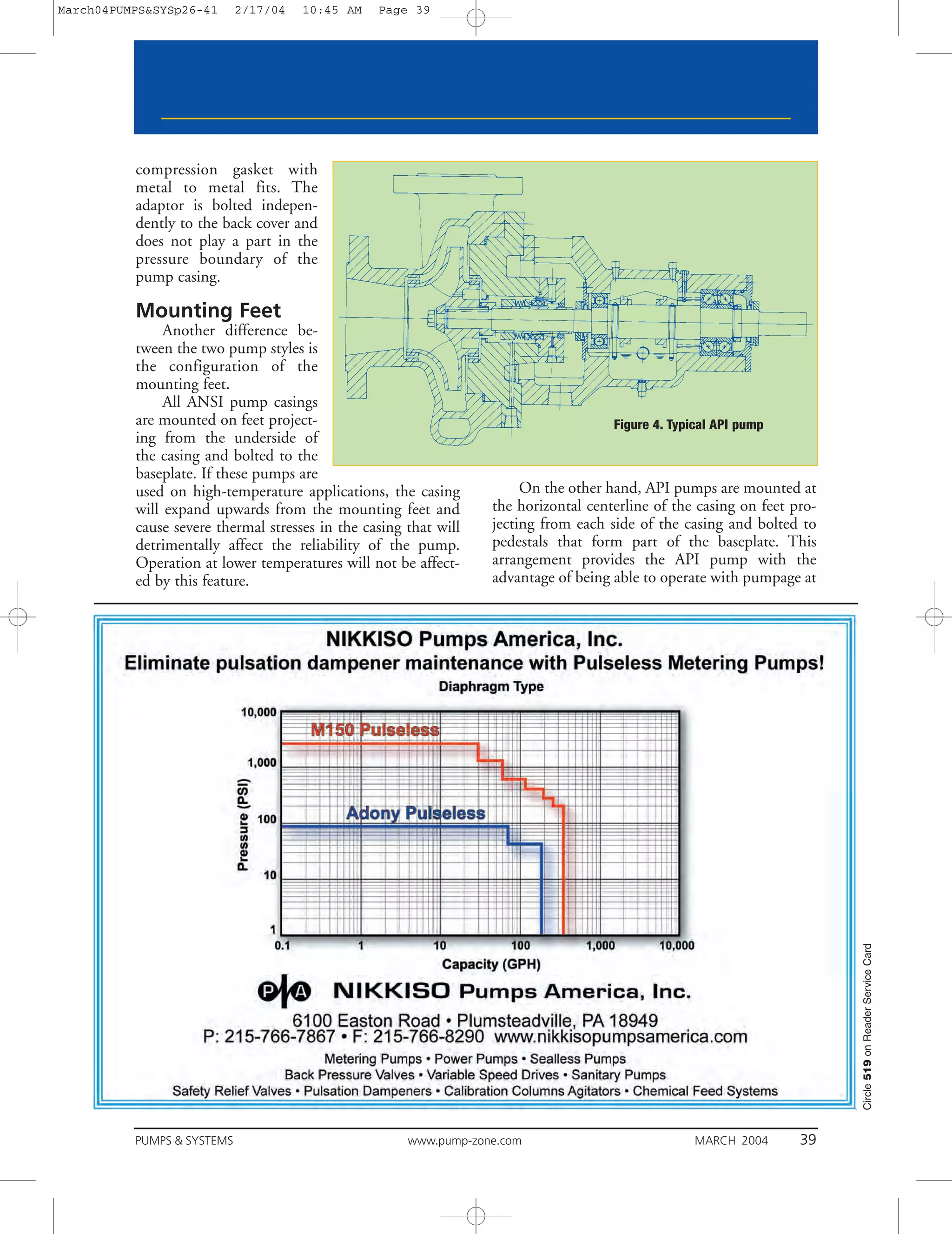
                                                                                                                 In the ANSI design shown in
                                                                                                            Figure 3, the back cover and gasket
                                                                                                            are held against the pump casing by
                                                                                                            the bearing frame adaptor, which is
                                                                                                            most frequently supplied in cast iron.
                                                                                                            This usually results in a gap between
                                                                                                            the mating faces of the frame adaptor
                                                                                                            and the pump casing that has the
                                                         Figure 3. Typical ANSI pump                        potential to permit uneven torquing
                                                                                                            of the bolts. In the event of a higher-
                                        The drawback of this design is, for most of          than-normal pressurization of the casing by the
                                    these pumps, that the NPSH required is often con-        process system, this may cause a fracture of the
                                    siderably greater than it would be in the end suction    adaptor
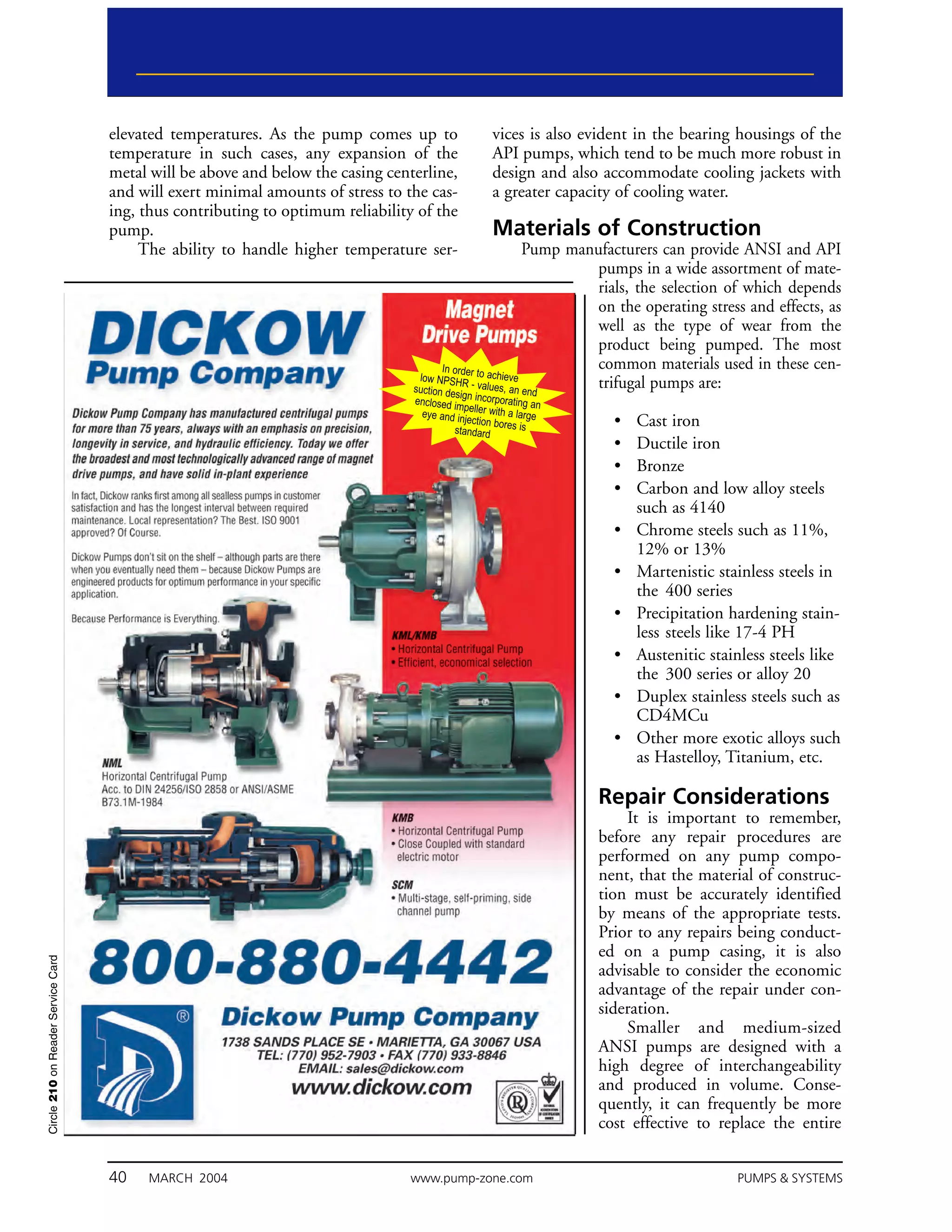
                                    arrangement. More NPSH is needed in order to                 The API design in Figure 4 bolts the back cover
                                    accommodate the friction losses in the tortuous          directly to the casing and uses a confined controlled
Circle 392 on Reader Service Card


                                    38    MARCH 2004                              www.pump-zone.com                               PUMPS & SYSTEMS
March04PUMPS&SYSp26-41      2/17/04   10:45 AM   Page 39


          compression gasket with
          metal to metal fits. The
          adaptor is bolted indepen-
          dently to the back cover and
          does not play a part in the
          pressure boundary of the
          pump casing.

          Mounting Feet
               Another difference be-
          tween the two pump styles is
          the configuration of the
          mounting feet.
               All ANSI pump casings
          are mounted on feet project-                                               Figure 4. Typical API pump
          ing from the underside of
          the casing and bolted to the
          baseplate. If these pumps are
          used on high-temperature applications, the casing            On the other hand, API pumps are mounted at
          will expand upwards from the mounting feet and          the horizontal centerline of the casing on feet pro-
          cause severe thermal stresses in the casing that will   jecting from each side of the casing and bolted to
          detrimentally affect the reliability of the pump.       pedestals that form part of the baseplate. This
          Operation at lower temperatures will not be affect-     arrangement provides the API pump with the
          ed by this feature.                                     advantage of being able to operate with pumpage at


                                                                                                                         Circle 519 on Reader Service Card


          PUMPS & SYSTEMS                             www.pump-zone.com                            MARCH 2004      39
elevated temperatures. As the pump comes up to                vices is also evident in the bearing housings of the
                                    temperature in such cases, any expansion of the               API pumps, which tend to be much more robust in
                                    metal will be above and below the casing centerline,          design and also accommodate cooling jackets with
                                    and will exert minimal amounts of stress to the cas-          a greater capacity of cooling water.
                                    ing, thus contributing to optimum reliability of the
                                    pump.                                                         Materials of Construction
                                         The ability to handle higher temperature ser-                      Pump manufacturers can provide ANSI and API
                                                                                                                     pumps in a wide assortment of mate-
                                                                                                                     rials, the selection of which depends
                                                                                                                     on the operating stress and effects, as
                                                                                                                     well as the type of wear from the
                                                                                                                     product being pumped. The most
                                                                                        In order to                  common materials used in these cen-
                                                                                  low NPSHR         achieve
                                                                                 suction de    - values, an
                                                                                                            end
                                                                                                                     trifugal pumps are:
                                                                                           sign
                                                                                 enclosed im incorporating an
                                                                                             pe
                                                                                  eye and in ller with a large
                                                                                              jection bo
                                                                                          standard res is
                                                                                                                    •   Cast iron
                                                                                                                    •   Ductile iron
                                                                                                                    •   Bronze
                                                                                                                    •   Carbon and low alloy steels
                                                                                                                        such as 4140
                                                                                                                    •   Chrome steels such as 11%,
                                                                                                                        12% or 13%
                                                                                                                    •   Martenistic stainless steels in
                                                                                                                        the 400 series
                                                                                                                    •   Precipitation hardening stain-
                                                                                                                        less steels like 17-4 PH
                                                                                                                    •   Austenitic stainless steels like
                                                                                                                        the 300 series or alloy 20
                                                                                                                    •   Duplex stainless steels such as
                                                                                                                        CD4MCu
                                                                                                                    •   Other more exotic alloys such
                                                                                                                        as Hastelloy, Titanium, etc.

                                                                                                                 Repair Considerations
                                                                                                                     It is important to remember,
                                                                                                                 before any repair procedures are
                                                                                                                 performed on any pump compo-
                                                                                                                 nent, that the material of construc-
                                                                                                                 tion must be accurately identified
                                                                                                                 by means of the appropriate tests.
                                                                                                                 Prior to any repairs being conduct-
                                                                                                                 ed on a pump casing, it is also
Circle 210 on Reader Service Card


                                                                                                                 advisable to consider the economic
                                                                                                                 advantage of the repair under con-
                                                                                                                 sideration.
                                                                                                                     Smaller and medium-sized
                                                                                                                 ANSI pumps are designed with a
                                                                                                                 high degree of interchangeability
                                                                                                                 and produced in volume. Conse-
                                                                                                                 quently, it can frequently be more
                                                                                                                 cost effective to replace the entire


                                    40   MARCH 2004                             www.pump-zone.com                                        PUMPS & SYSTEMS
pump rather than a combination of the impeller,              Contributing Editor Ross Mackay has over 40
casing and back cover. In addition, both the indi-      years in the pump industry—many of them working
vidual parts and complete pumps are available fairly    with both ANSI and API pump applications. Today,
quickly. This can make it more cost effective to        he specializes in helping companies increase their
replace rather than repair the parts, unless the wet    pump reliability and reduce operating and mainte-
ends are made of the more exotic alloys. It is clear,   nance costs through consulting and education. He can
in the case of non-metallic pumps (which may also       be reached at 1-800-465-6260 or through his web site
conform to ANSI standards), that the components         at www.rossmackay.com
must be replaced, as they general-
ly cannot be repaired.
     API pumps, however, are gen-
erally more economical to repair
than to replace. These units are
usually installed in more rugged
duties and hazardous applications
in refineries or other petrochemi-
cal industries, and are conse-
quently more durable and more
expensive. Delivery periods are
also frequently longer, and the
parts more costly than their ANSI
equivalents—particularly the cases
and impellers.
     This makes it very tempting
to source these parts from an
after-market supplier rather than
the Original Equipment Manu-
facturer (OEM). It should be
noted, though, that the major
parts of a centrifugal pump (i.e.
the casing, the impeller and the
back cover) are all cast from pat-
terns involving intricate hydraulic
designs, which are of a proprietary
nature. These parts are also the
ones that provide the hydraulic
performance of the pump. While
the parts might be available from
after-market suppliers at slightly
lower prices than they are from
the OEM, that cost saving will
fade into insignificance if the
pump does not meet its hydraulic
performance. Your OEM can
                                                                                                               Circle 537 on Reader Service Card


accept the responsibility for the
subsequent hydraulic perfor-
mance of these replacement parts.
     By taking these factors into
account, you can finish up with
reliable pumps that have been
properly selected to provide a prof-
itable and reliable operating system.
                            P&S


PUMPS & SYSTEMS                             www.pump-zone.com                           MARCH 2004       41
Api vs ansi pump

  • 1.
    Which process ANSI pump is right for your application? vs I API? By Ross C. Mackay, Contributing Editor n the world of pumps, there are two types of horizontal end suction centrifugal pumps that are more commonly used than all the others put In view of these figures, it is apparent that the API pumps should be considered for higher pres- sure and temperature services than the lighter duty together. They are the ANSI pump that is designed ANSI pump. and built to the standards of the American National Standards Institute, and the API pump that meets The Liquids the requirements of the American Petroleum In considering the various types of liquids han- Institute Standard 610 for General Refinery Service. dled by these pumps, the fluids in the petrochemi- Over the years, ANSI designs have become the cal industry are frequently classified as preferred style of end suction pumps, not only for Hydrocarbons, Aggressive Chemicals and Mild chemical process applications, but also for water Chemicals. and other less aggressive services. The ANSI Hydrocarbons are petroleum-based products Standard provides for dimensional interchangeabil- that are frequently classified as light, intermediate ity of pumps from one manufacturer to another. or heavy. At atmospheric pressure and temperature, The API pump is almost the exclusive choice light hydrocarbons tend to vaporize, intermediate for applications in the oil refin- hydrocarbons are liquid, and ery industry, where it handles heavy hydrocarbons are highly higher temperatures and pressure Taking these fac- viscous or even solid. applications of a more aggressive Aggressive Chemicals include nature. While this specification tors into account, strong acids, alkalines or oxidiz- also deals with some vertical ing agents that are destructive to shaft models, this article will you can finish up both equipment and the environ- focus on the more widely used ment. They are also dangerous to horizontal designs. These single with a profitable plant personnel if allowed to leak. stage pumps are designed with a Mild Chemicals are generally radially split casing to accommo- and reliable easy to handle, and are not detri- mental to either equipment or date a back pullout arrangement for ease of maintenance. The operating system. the environment. major difference between the Many of these liquids can two styles is reflected in the casing pressure design produce toxic fluid exposure and vapors if they are ratings, which are as follows: allowed to leak out of a pump. Vapor release is a common danger with hydrocarbons that vaporize at ANSI Pump Rating = 300 PSIG at 300° F atmospheric conditions or other chemicals that may API Pump Rating = 750 PSIG at 500° F be exposed to very high operating temperatures. 36 MARCH 2004 www.pump-zone.com PUMPS & SYSTEMS
  • 2.
    If a vaporrelease is exposed to a spark, the vapor discussed on this problem in recent years. This load cloud may even explode or catch fires. is at its maximum when the pump is run at the Consequently, in handling these liquids, we shutoff condition, and gradually decreases as the must be extremely aware of much more than envi- flow rate approaches the Best Efficiency Point ronmental damage and pumping efficiency. We (BEP). If the pump operates beyond the BEP, the must also be very conscious about personal safety. load increases again, but in the opposite direction Therefore, the choice between the ANSI pump and on the same plane. Examination of the resultant the API pump must take into account the specific shaft deflection problems has indicated that the fluid properties, as well as the operating conditions. radial plane on which the out-of-balance load acts The main difference between these choices is is approximately 60° counterclockwise from the predominantly a result of the differences in casing cut-water of the volute. design. Volute Cases Both pump styles have a radial split casing, and most ANSI pumps and some API pumps employ a single volute design of the interior passages. This is particularly evident in the smaller sizes that involve low-flow rates and lower specific speeds of the impeller. As shown in Figure 1, the area of the volute increases at a rate that is proportional to the rate of discharge from the impeller, thus producing a con- stant velocity at the periphery of the impeller. This velocity energy is then changed into a pressure ener- gy by the time the fluid enters the discharge nozzle. Figure 2. Double volute case Most of the larger API pumps are produced with a double volute design to reduce these loads on high-flow and high-head units. (See Figure 2.) This is accomplished by balancing the opposing out-of- balance loads from each volute. While the cost of this is a slight reduction in efficiency, it is consid- ered a small price to pay for the increased reliabili- ty that ensues. Another casing feature found in many API pumps is the top suction/top discharge arrange- ment, which has also been used in a slightly differ- Figure 1. Single volute case ent configuration in a vertical inline pump design. In this arrangement with a horizontal pump, the The peculiar shape of the volute also produces suction nozzle is located at the top of the casing an uneven pressure distribution around the adjacent to the discharge nozzle, rather than on the impeller, which in turn results in an imbalance of end. On the vertical inline design, the suction noz- the thrust loads around the impeller and at right zle is once again on the side, but now it is opposite angles to the shaft. This load must be accommodat- to the discharge nozzle, thus creating the “inline” ed by the shaft and bearings, and much has been appearance. PUMPS & SYSTEMS www.pump-zone.com MARCH 2004 37
  • 3.
    path from thesuction flange to the eye of the impeller. Back Cover Arrangements One of the major differences between the ANSI and API pump cas- ings is in the manner in which the back cover is secured to the casing. In the ANSI design shown in Figure 3, the back cover and gasket are held against the pump casing by the bearing frame adaptor, which is most frequently supplied in cast iron. This usually results in a gap between the mating faces of the frame adaptor and the pump casing that has the Figure 3. Typical ANSI pump potential to permit uneven torquing of the bolts. In the event of a higher- The drawback of this design is, for most of than-normal pressurization of the casing by the these pumps, that the NPSH required is often con- process system, this may cause a fracture of the siderably greater than it would be in the end suction adaptor arrangement. More NPSH is needed in order to The API design in Figure 4 bolts the back cover accommodate the friction losses in the tortuous directly to the casing and uses a confined controlled Circle 392 on Reader Service Card 38 MARCH 2004 www.pump-zone.com PUMPS & SYSTEMS
  • 4.
    March04PUMPS&SYSp26-41 2/17/04 10:45 AM Page 39 compression gasket with metal to metal fits. The adaptor is bolted indepen- dently to the back cover and does not play a part in the pressure boundary of the pump casing. Mounting Feet Another difference be- tween the two pump styles is the configuration of the mounting feet. All ANSI pump casings are mounted on feet project- Figure 4. Typical API pump ing from the underside of the casing and bolted to the baseplate. If these pumps are used on high-temperature applications, the casing On the other hand, API pumps are mounted at will expand upwards from the mounting feet and the horizontal centerline of the casing on feet pro- cause severe thermal stresses in the casing that will jecting from each side of the casing and bolted to detrimentally affect the reliability of the pump. pedestals that form part of the baseplate. This Operation at lower temperatures will not be affect- arrangement provides the API pump with the ed by this feature. advantage of being able to operate with pumpage at Circle 519 on Reader Service Card PUMPS & SYSTEMS www.pump-zone.com MARCH 2004 39
  • 5.
    elevated temperatures. Asthe pump comes up to vices is also evident in the bearing housings of the temperature in such cases, any expansion of the API pumps, which tend to be much more robust in metal will be above and below the casing centerline, design and also accommodate cooling jackets with and will exert minimal amounts of stress to the cas- a greater capacity of cooling water. ing, thus contributing to optimum reliability of the pump. Materials of Construction The ability to handle higher temperature ser- Pump manufacturers can provide ANSI and API pumps in a wide assortment of mate- rials, the selection of which depends on the operating stress and effects, as well as the type of wear from the product being pumped. The most In order to common materials used in these cen- low NPSHR achieve suction de - values, an end trifugal pumps are: sign enclosed im incorporating an pe eye and in ller with a large jection bo standard res is • Cast iron • Ductile iron • Bronze • Carbon and low alloy steels such as 4140 • Chrome steels such as 11%, 12% or 13% • Martenistic stainless steels in the 400 series • Precipitation hardening stain- less steels like 17-4 PH • Austenitic stainless steels like the 300 series or alloy 20 • Duplex stainless steels such as CD4MCu • Other more exotic alloys such as Hastelloy, Titanium, etc. Repair Considerations It is important to remember, before any repair procedures are performed on any pump compo- nent, that the material of construc- tion must be accurately identified by means of the appropriate tests. Prior to any repairs being conduct- ed on a pump casing, it is also Circle 210 on Reader Service Card advisable to consider the economic advantage of the repair under con- sideration. Smaller and medium-sized ANSI pumps are designed with a high degree of interchangeability and produced in volume. Conse- quently, it can frequently be more cost effective to replace the entire 40 MARCH 2004 www.pump-zone.com PUMPS & SYSTEMS
  • 6.
    pump rather thana combination of the impeller, Contributing Editor Ross Mackay has over 40 casing and back cover. In addition, both the indi- years in the pump industry—many of them working vidual parts and complete pumps are available fairly with both ANSI and API pump applications. Today, quickly. This can make it more cost effective to he specializes in helping companies increase their replace rather than repair the parts, unless the wet pump reliability and reduce operating and mainte- ends are made of the more exotic alloys. It is clear, nance costs through consulting and education. He can in the case of non-metallic pumps (which may also be reached at 1-800-465-6260 or through his web site conform to ANSI standards), that the components at www.rossmackay.com must be replaced, as they general- ly cannot be repaired. API pumps, however, are gen- erally more economical to repair than to replace. These units are usually installed in more rugged duties and hazardous applications in refineries or other petrochemi- cal industries, and are conse- quently more durable and more expensive. Delivery periods are also frequently longer, and the parts more costly than their ANSI equivalents—particularly the cases and impellers. This makes it very tempting to source these parts from an after-market supplier rather than the Original Equipment Manu- facturer (OEM). It should be noted, though, that the major parts of a centrifugal pump (i.e. the casing, the impeller and the back cover) are all cast from pat- terns involving intricate hydraulic designs, which are of a proprietary nature. These parts are also the ones that provide the hydraulic performance of the pump. While the parts might be available from after-market suppliers at slightly lower prices than they are from the OEM, that cost saving will fade into insignificance if the pump does not meet its hydraulic performance. Your OEM can Circle 537 on Reader Service Card accept the responsibility for the subsequent hydraulic perfor- mance of these replacement parts. By taking these factors into account, you can finish up with reliable pumps that have been properly selected to provide a prof- itable and reliable operating system. P&S PUMPS & SYSTEMS www.pump-zone.com MARCH 2004 41