


By
DR. ANIRUDDHA G. BANHATTI
Associate Professor
T.S.S.M.’s
Bhivrabai Sawant College of Engineering and Research
VIDEO CONFERENCE
on
Architectural Planning and Design of
Buildings
for
S.E. Civil
5th March 2014
1
Civil Engineering
ď‚— It is the oldest branch of Engineering
ď‚— It came into existence since humans
started living in caves.
ď‚— The first invention in civil engineering was
something with which one can see
through a wall.
 It is called “ a window ”
2
Planning of Buildings
ď‚— There are 14 principles of planning as
listed below:
ď‚— Aspect
ď‚— Prospect
ď‚— Orientation
ď‚— Privacy
ď‚— Circulation
ď‚— Grouping
ď‚— Roominess
3
Principles of Planning
ď‚— Furniture Requirements
ď‚— Sanitation
ď‚— Elegance
ď‚— Economy
ď‚— Access
ď‚— Architectural composition
ď‚— Climate and its Effect
4
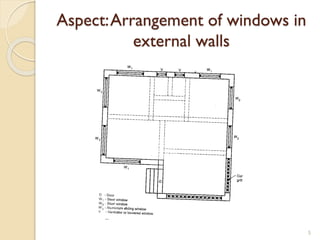
Aspect:Arrangement of windows in
external walls
5
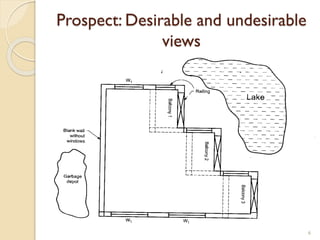
Prospect: Desirable and undesirable
views
6
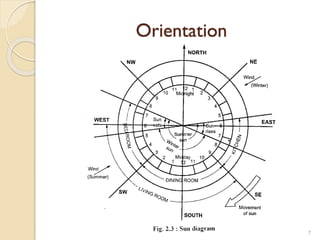
Orientation
7
Privacy
ď‚— External :
ď‚— Isolation from surrounding buildings
ď‚— Avoiding noise, dust and pollution from
surroundings
ď‚— Raised sill height of w.c. and bath
ď‚— Compound wall
ď‚— Growing trees around the house
8
Privacy
ď‚— Internal :
ď‚— Prevention of direct view of one room
from another
ď‚— Staggering of doors
ď‚— Use of screens
ď‚— Proper furniture arrangement
9
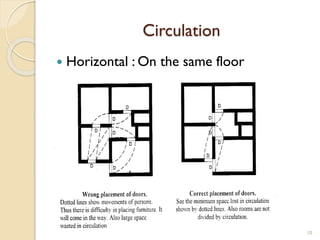
Circulation
ď‚— Horizontal : On the same floor
10
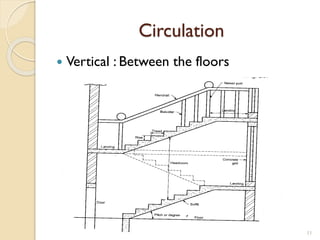
Circulation
ď‚— Vertical : Between the floors
11
Grouping
ď‚— Rooms of similar function together
ď‚— More important in Public Buildings
ď‚— Staircase or lift approachable from each
room
ď‚— Kitchen w.c. and bath grouped for easy
plumbing and watersupply
12
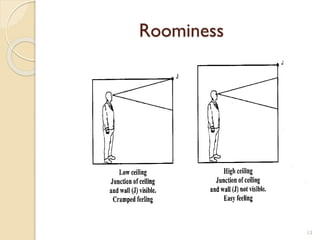
Roominess
13
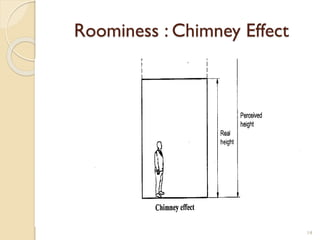
Roominess : Chimney Effect
14
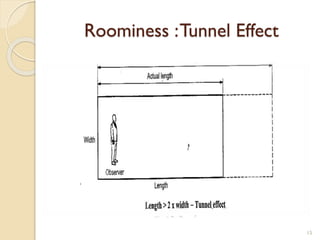
Roominess :Tunnel Effect
15
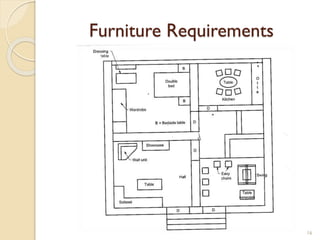
Furniture Requirements
16
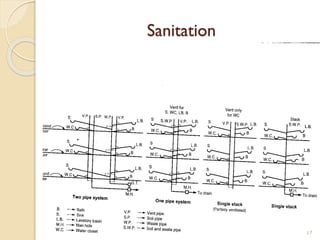
Sanitation
17
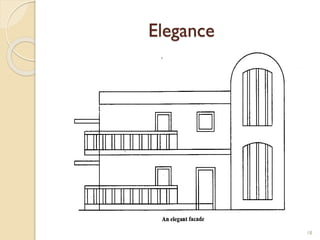
Elegance
18
Economy
ď‚— Planning should avoid all type of wastage
ď‚— Wastage of space
ď‚— Judicious use of space
ď‚— Architectural aesthetics for space
19
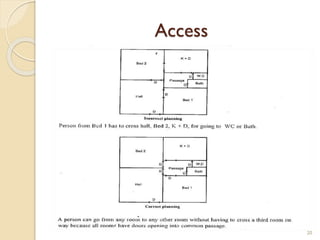
Access
20
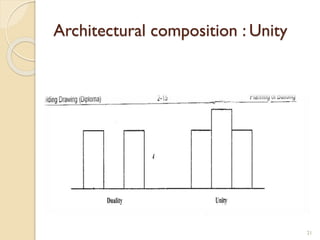
Architectural composition : Unity
21
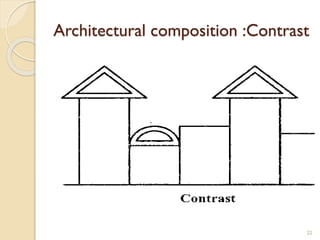
Architectural composition :Contrast
22
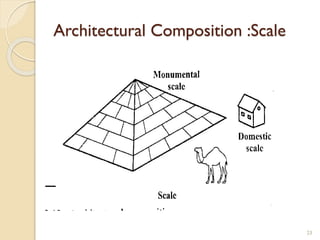
Architectural Composition :Scale
23
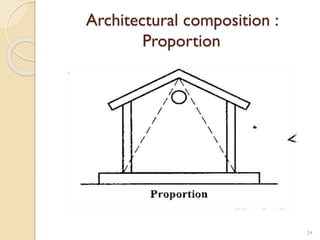
Architectural composition :
Proportion
24
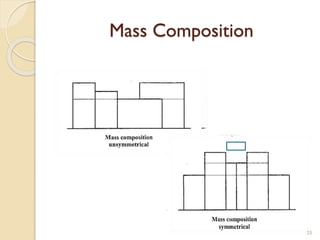
Mass Composition
25
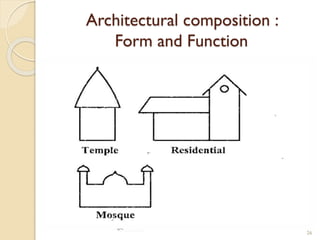
Architectural composition :
Form and Function
26
Climate and Its Effect
ď‚— Window openings
ď‚— Type of roof
ď‚— Sunbreakers and chajjas
ď‚— External finish, paint and color
27
Noise and Acoustics
ď‚— Qualities of sound
ď‚— Noise
ď‚— Comfort level of noise
ď‚— Intensity and Loudness
ď‚— Frequency or Pitch
ď‚— Timbre or Quality
28
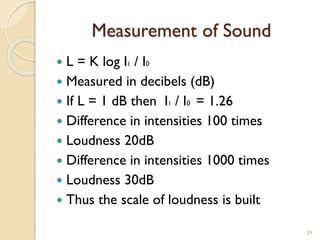
Measurement of Sound
ď‚— L = K log I1 / I0
ď‚— Measured in decibels (dB)
ď‚— If L = 1 dB then I1 / I0 = 1.26
ď‚— Difference in intensities 100 times
ď‚— Loudness 20dB
ď‚— Difference in intensities 1000 times
ď‚— Loudness 30dB
ď‚— Thus the scale of loudness is built
29
Sound Insulation
ď‚— For avoiding indoor and outdoor noise
ď‚— Wall insulation
ď‚— Floor insulation
ď‚— Cavity walls
ď‚— Floating floors
ď‚— Use of sound absorbing materials
ď‚— Linoleum, Cork, Carpets etc.
30
Sound Absorbent Materials
ď‚— Porous absorbents
ď‚— Resonant panels
ď‚— Cavity resonators
ď‚— Composite type absorbents
31
Acoustical Defects
ď‚— Echoes
ď‚— Reverberation
ď‚— Sound foci
ď‚— Dead spots
ď‚— Insufficient loudness
ď‚— Intrusion of noise from outside
32
Reverberation time
 Calculated by Sabine’s formula
ď‚— Excellent : 0.5 to 1.5 sec
ď‚— Good : 1.5 to 2 sec
ď‚— Fairly good : 2 to 3 sec
ď‚— Bad : 3 to 5 sec
ď‚— Very bad Above 5 sec
33
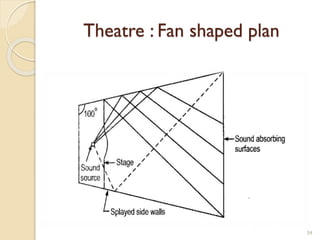
Theatre : Fan shaped plan
34
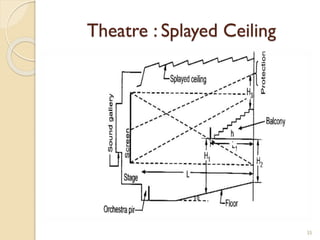
Theatre : Splayed Ceiling
35
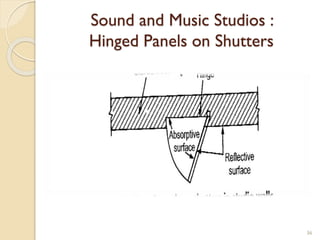
Sound and Music Studios :
Hinged Panels on Shutters
36
Building Services
ď‚— Electrical services
ď‚— Telecommunication services
ď‚— Entertainment services
ď‚— Ventilation and Lighting
ď‚— Air-conditioning and heating
ď‚— Lifts and escalators
ď‚— Emergency escape stairs
ď‚— Fire fighting arrangements
37
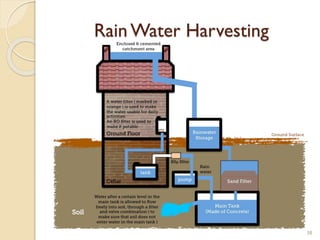
Rain Water Harvesting
38
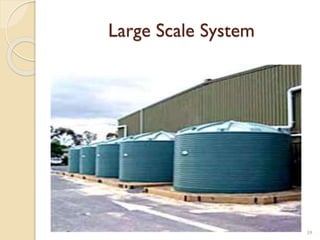
Large Scale System
39
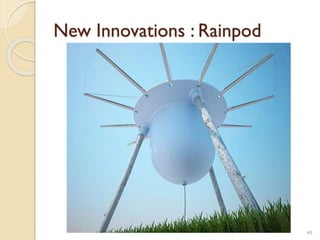
New Innovations : Rainpod
40
Building Bye-laws
ď‚— Definitions
ď‚— Floor Area Ratio
ď‚— = Total area on all floors / Plot area
ď‚— Areas Excluded : projections < 0.75m
ď‚— Canopies 5x2.5m in cantilever fashion
ď‚— Balconies with certain specifications
ď‚— Parking lock up garages or stilt floor
parking
41
Excluded areas from FAR
 Electric cabin / sub station, watchman’s
cabin of max 1.6 sq.m. pump house,
garage shaft, fire hydrants, electrical
fittings, water tanks
ď‚— Staircase room, lift room above top floor,
architectural features, chimneys
ď‚— Well, plant nursery, water pool, uncovered
swimming pool. Platform round atree,
fountain, bench, ramps, compound wall,
overhead tank
42
Individual’s voice is characterized by
ď‚— Timber
ď‚— Pitch
ď‚— Intensity
ď‚— loudness
43
Individual’s voice is characterized by
ď‚— Timber
ď‚— Pitch
ď‚— Intensity
ď‚— loudness
44
Find good sound absorber
ď‚— Metal
ď‚— Open door
ď‚— Water body
ď‚— Carpet
45
Find good sound absorber
ď‚— Metal
ď‚— Open door
ď‚— Water body
ď‚— Carpet
46
100000 times difference in
intensities will create loudness of
ď‚— 30 dB
ď‚— 100 dB
ď‚— Log 10 dB
ď‚— 50dB
47
100000 times difference in
intensities will create loudness of
ď‚— 30 dB
ď‚— 100 dB
ď‚— Log 10 dB
ď‚— 50 dB
48
Climate of Mumbai is
ď‚— Hot and arid
ď‚— Humid and hot
ď‚— Salty and windy
ď‚— Coastal and cold
49
Climate of Mumbai is
ď‚— Hot and arid
ď‚— Humid and hot
ď‚— Salty and windy
ď‚— Coastal and cold
50
Climate of Pune is
ď‚— Hot and humid
ď‚— Temperate and arid
ď‚— Cold and pleasant
ď‚— Arid and dry
51
Climate of Pune is
ď‚— Hot and humid
ď‚— Temperate and arid
ď‚— Cold and pleasant
ď‚— Arid and dry
52
A theater should have
ď‚— Dome shaped ceiling
ď‚— Hanging ceiling
ď‚— Rough wooden ceiling
ď‚— Splayed ceiling
53
A theater should have
ď‚— Dome shaped ceiling
ď‚— Hanging ceiling
ď‚— Rough wooden ceiling
ď‚— Splayed ceiling
54
Sound foci is a
ď‚— Desirable feature for music room
ď‚— Desirable feature for bed room
ď‚— Desirable feature for auditorium
ď‚— None of the above
55
Sound foci is a
ď‚— Desirable feature for music room
ď‚— Desirable feature for bed room
ď‚— Desirable feature for auditorium
ď‚— None of the above
56
Lifts in malls should carry
ď‚— 12 to 20 persons
ď‚— 20 to 30 persons
ď‚— 5 to 8 persons
ď‚— 8 to 10 persons
57
Lifts in malls should carry
ď‚— 12 to 20 persons
ď‚— 20 to 30 persons
ď‚— 5 to 8 persons
ď‚— 8 to 10 persons
58
Car speed of mall lifts should not
exceed
ď‚— 5m/s
ď‚— 1m/s
ď‚— 7m/s
ď‚— 2.5m/s
59
Car speed of mall lifts should not
exceed
ď‚— 5m/s
ď‚— 1m/s
ď‚— 7m/s
ď‚— 2.5m/s
60
One point perspective is used for
ď‚— Brochures
ď‚— Railway lines
ď‚— Interior decoration
ď‚— Panoramic view
61
One point perspective is used for
ď‚— Brochures
ď‚— Railway lines
ď‚— Interior decoration
ď‚— Panoramic view
62
Three point perspective is common
for
ď‚— Axonometric view
ď‚— Symmetrical view
ď‚— Detailed terrace view
ď‚— Exploded view
63
Three point perspective is common
for
ď‚— Axonometric view
ď‚— Symmetrical view
ď‚— Detailed terrace view
ď‚— Exploded view
64
Dead spots are points where
ď‚— Sound is heard louder
ď‚— Sound is inaudible
ď‚— Pitch changes
ď‚— Wave front of sound faces a barrier
65
Dead spots are points where
ď‚— Sound is heard louder
ď‚— Sound is inaudible
ď‚— Pitch changes
ď‚— Wave front of sound faces a barrier
66
Sound insulation is important for
ď‚— Hospital
ď‚— School
ď‚— Residential house
ď‚— Music studio
67
Sound insulation is important for
ď‚— Hospital
ď‚— School
ď‚— Residential house
ď‚— Music studio
68
Ramp is essential at entrance of
ď‚— Five star hotel
ď‚— Kindergarten
ď‚— School
ď‚— Hospital
69
Ramp is essential at entrance of
ď‚— Five star hotel
ď‚— Kindergarten
ď‚— School
ď‚— Hospital
70
Automatic car leveling is must for
ď‚— Car service centre
ď‚— Hospital
ď‚— Poolside
ď‚— Weigh bridge for vehicles
71
Automatic car leveling is must for
ď‚— Car service centre
ď‚— Hospital
ď‚— Poolside
ď‚— Weigh bridge for vehicles
72
Additional persons allowed in a
stretcher lift are
ď‚— 1
ď‚— 3
ď‚— 2
ď‚— 5
73
Additional persons allowed in a
stretcher lift are
ď‚— 1
ď‚— 3
ď‚— 2
ď‚— 5
74
Staircase width for public building is
ď‚— 1.6 to 1.9m
ď‚— 1 to 1.5m
ď‚— 1.2 to 1.5m
ď‚— None of the above
75
Staircase width for public building is
ď‚— 1.8 to 2m
ď‚— 1 to 1.5m
ď‚— 1.2 to 1.5m
ď‚— None of the above
76
Winders should be
ď‚— Avoided on staircase
ď‚— Provided on pipes
ď‚— Provided at corners
ď‚— Provided for curved roof gutters
77
Winders should be
ď‚— Avoided on staircase
ď‚— Provided on pipes
ď‚— Provided at corners
ď‚— Provided for curved roof gutters
78
Two point perspective is similar to
ď‚— A photograph
ď‚— Isometric view
ď‚— Axonometric view
ď‚— None of the above
79
Two point perspective is similar to
ď‚— A photograph
ď‚— Isometric view
ď‚— Axonometric view
ď‚— None of the above
80
Tunel effect is due to
ď‚— Lack of ventilation
ď‚— Too much length of a room
ď‚— Defect in vision
ď‚— None of the above
81
Tunel effect is due to
ď‚— Lack of ventilation
ď‚— Too much length of a room
ď‚— Defect in vision
ď‚— None of the above
82
Chimney effect relates to
ď‚— A factory building
ď‚— Roominess
ď‚— Insufficient ventilation
ď‚— None of the above
83
Chimney effect relates to
ď‚— A factory building
ď‚— Roominess
ď‚— Insufficient ventilation
ď‚— None of the above
84
North on a drawing is shown for
ď‚— Feng shui considerations
ď‚— Good vastu
ď‚— Plane table alignment
ď‚— Correct orientation during line out
85
North on a drawing is shown for
ď‚— Feng shui considerations
ď‚— Good vastu
ď‚— Plane table alignment
ď‚— Correct orientation during line out
86
Theatre olan should be
ď‚— Circular
ď‚— Fern shaped
ď‚— Rectangular
ď‚— None of these
87
Theatre olan should be
ď‚— Circular
ď‚— Fern shaped
ď‚— Rectangular
ď‚— None of these
88
Surfaces near sound source in a
theatre should be
ď‚— Rough and absorbent
ď‚— Clad with cork
ď‚— Having grooves
ď‚— Smooth, hard and polished
89
Surfaces near sound source in a
theatre should be
ď‚— Rough and absorbent
ď‚— Clad with cork
ď‚— Having grooves
ď‚— Smooth, hard and polished
90
To increase sound absorption
ď‚— Windows should be open
ď‚— Heavy curtains should be provided
ď‚— Walls should be smooth
ď‚— None of the above
91
To increase sound absorption
ď‚— Windows should be open
ď‚— Heavy curtains should be provided
ď‚— Walls should be smooth
ď‚— None of the above
92
Perforated boards covering walls
ď‚— Increase sound absorption
ď‚— Provide scattered light
ď‚— Increase echoes
ď‚— Make interference in sound
93
Perforated boards covering walls
ď‚— Increase sound absorption
ď‚— Provide scattered light
ď‚— Increase echoes
ď‚— Make interference in sound
94
Riser in stairs shall be
ď‚— 150 to 300 mm
ď‚— 200 to 300 mm
ď‚— 300 to 450 mm
ď‚— None of the above
95
Riser in stairs shall be
ď‚— 150 to 300 mm
ď‚— 200 to 300 mm
ď‚— 300 to 450 mm
ď‚— None of the above
96
In public building riser is
ď‚— > in residential building
ď‚— Twice high than in residential building
ď‚— Equal to tread
ď‚— < in residential building
97
In public building riser is
ď‚— > in residential building
ď‚— Twice high than in residential building
ď‚— Equal to tread
ď‚— < in residential building
98
Tread dimension in staircase is at
least
ď‚— 300 mm
ď‚— 400 mm
ď‚— 450 mm
ď‚— 500 mm
99
Tread dimension in staircase is at
least
ď‚— 300 mm
ď‚— 400 mm
ď‚— 450 mm
ď‚— 500 mm
100
Tread wider than minimum
dimension is
ď‚— Not allowed
ď‚— Allowed with some fine paid
ď‚— Allowed
ď‚— Must be covered with carpet
101
Tread wider than minimum
dimension is
ď‚— Not allowed
ď‚— Allowed with some fine paid
ď‚— Allowed
ď‚— Must be covered with carpet
102
Angle of inclination for escalators is
ď‚— 30 degrees
ď‚— 40 degrees
ď‚— 10 degrees
ď‚— Depends on height between floors
103
Angle of inclination for escalators is
ď‚— 30 degrees
ď‚— 40 degrees
ď‚— 10 degrees
ď‚— Depends on height between floors
104
Escalators can bbe stopped in case
of emergency
ď‚— By the control room operator
ď‚— From main switch board
ď‚— With a lever at the top
ď‚— By pressing a button near the bottom
105
Escalators can bbe stopped in case
of emergency
ď‚— By the control room operator
ď‚— From main switch board
ď‚— With a lever at the top
ď‚— By pressing a button near the bottom
106
In escalators rise is not more than
ď‚— 30 cm
ď‚— 20 cm
ď‚— 40 cm
ď‚— 25 cm
107
In escalators rise is not more than
ď‚— 30 cm
ď‚— 20 cm
ď‚— 40 cm
ď‚— 25 cm
108
Coming Challenges
ď‚— Design of Green buildings
ď‚— Ecosystem preservation
ď‚— Renewable energy
ď‚— Self sufficient homes from garbage
disposal to water supply and all such
facilities
109
In case of problems
ď‚— Contact me at anibanister@gmail.com
ď‚— This presentation shall be viewable at
www.slideshare.net
Type Aniruddha Banhatti and search
Upload your own presentations by
registering at slide share
110
THANKYOU
ď‚— ANY QUESTIONS?
111

Apdb video conferencing

  • 1.
    By DR. ANIRUDDHA G.BANHATTI Associate Professor T.S.S.M.’s Bhivrabai Sawant College of Engineering and Research VIDEO CONFERENCE on Architectural Planning and Design of Buildings for S.E. Civil 5th March 2014 1
  • 2.
    Civil Engineering  Itis the oldest branch of Engineering  It came into existence since humans started living in caves.  The first invention in civil engineering was something with which one can see through a wall.  It is called “ a window ” 2
  • 3.
    Planning of Buildings ď‚—There are 14 principles of planning as listed below: ď‚— Aspect ď‚— Prospect ď‚— Orientation ď‚— Privacy ď‚— Circulation ď‚— Grouping ď‚— Roominess 3
  • 4.
    Principles of Planning ď‚—Furniture Requirements ď‚— Sanitation ď‚— Elegance ď‚— Economy ď‚— Access ď‚— Architectural composition ď‚— Climate and its Effect 4
  • 5.
    Aspect:Arrangement of windowsin external walls 5
  • 6.
    Prospect: Desirable andundesirable views 6
  • 7.
  • 8.
    Privacy ď‚— External : ď‚—Isolation from surrounding buildings ď‚— Avoiding noise, dust and pollution from surroundings ď‚— Raised sill height of w.c. and bath ď‚— Compound wall ď‚— Growing trees around the house 8
  • 9.
    Privacy ď‚— Internal : ď‚—Prevention of direct view of one room from another ď‚— Staggering of doors ď‚— Use of screens ď‚— Proper furniture arrangement 9
  • 10.
  • 11.
    Circulation ď‚— Vertical :Between the floors 11
  • 12.
    Grouping ď‚— Rooms ofsimilar function together ď‚— More important in Public Buildings ď‚— Staircase or lift approachable from each room ď‚— Kitchen w.c. and bath grouped for easy plumbing and watersupply 12
  • 13.
  • 14.
  • 15.
  • 16.
  • 17.
  • 18.
  • 19.
    Economy ď‚— Planning shouldavoid all type of wastage ď‚— Wastage of space ď‚— Judicious use of space ď‚— Architectural aesthetics for space 19
  • 20.
  • 21.
  • 22.
  • 23.
  • 24.
  • 25.
  • 26.
  • 27.
    Climate and ItsEffect ď‚— Window openings ď‚— Type of roof ď‚— Sunbreakers and chajjas ď‚— External finish, paint and color 27
  • 28.
    Noise and Acoustics ď‚—Qualities of sound ď‚— Noise ď‚— Comfort level of noise ď‚— Intensity and Loudness ď‚— Frequency or Pitch ď‚— Timbre or Quality 28
  • 29.
    Measurement of Sound ď‚—L = K log I1 / I0 ď‚— Measured in decibels (dB) ď‚— If L = 1 dB then I1 / I0 = 1.26 ď‚— Difference in intensities 100 times ď‚— Loudness 20dB ď‚— Difference in intensities 1000 times ď‚— Loudness 30dB ď‚— Thus the scale of loudness is built 29
  • 30.
    Sound Insulation ď‚— Foravoiding indoor and outdoor noise ď‚— Wall insulation ď‚— Floor insulation ď‚— Cavity walls ď‚— Floating floors ď‚— Use of sound absorbing materials ď‚— Linoleum, Cork, Carpets etc. 30
  • 31.
    Sound Absorbent Materials ď‚—Porous absorbents ď‚— Resonant panels ď‚— Cavity resonators ď‚— Composite type absorbents 31
  • 32.
    Acoustical Defects ď‚— Echoes ď‚—Reverberation ď‚— Sound foci ď‚— Dead spots ď‚— Insufficient loudness ď‚— Intrusion of noise from outside 32
  • 33.
    Reverberation time  Calculatedby Sabine’s formula  Excellent : 0.5 to 1.5 sec  Good : 1.5 to 2 sec  Fairly good : 2 to 3 sec  Bad : 3 to 5 sec  Very bad Above 5 sec 33
  • 34.
    Theatre : Fanshaped plan 34
  • 35.
  • 36.
    Sound and MusicStudios : Hinged Panels on Shutters 36
  • 37.
    Building Services ď‚— Electricalservices ď‚— Telecommunication services ď‚— Entertainment services ď‚— Ventilation and Lighting ď‚— Air-conditioning and heating ď‚— Lifts and escalators ď‚— Emergency escape stairs ď‚— Fire fighting arrangements 37
  • 38.
  • 39.
  • 40.
  • 41.
    Building Bye-laws ď‚— Definitions ď‚—Floor Area Ratio ď‚— = Total area on all floors / Plot area ď‚— Areas Excluded : projections < 0.75m ď‚— Canopies 5x2.5m in cantilever fashion ď‚— Balconies with certain specifications ď‚— Parking lock up garages or stilt floor parking 41
  • 42.
    Excluded areas fromFAR  Electric cabin / sub station, watchman’s cabin of max 1.6 sq.m. pump house, garage shaft, fire hydrants, electrical fittings, water tanks  Staircase room, lift room above top floor, architectural features, chimneys  Well, plant nursery, water pool, uncovered swimming pool. Platform round atree, fountain, bench, ramps, compound wall, overhead tank 42
  • 43.
    Individual’s voice ischaracterized by  Timber  Pitch  Intensity  loudness 43
  • 44.
    Individual’s voice ischaracterized by  Timber  Pitch  Intensity  loudness 44
  • 45.
    Find good soundabsorber ď‚— Metal ď‚— Open door ď‚— Water body ď‚— Carpet 45
  • 46.
    Find good soundabsorber ď‚— Metal ď‚— Open door ď‚— Water body ď‚— Carpet 46
  • 47.
    100000 times differencein intensities will create loudness of ď‚— 30 dB ď‚— 100 dB ď‚— Log 10 dB ď‚— 50dB 47
  • 48.
    100000 times differencein intensities will create loudness of ď‚— 30 dB ď‚— 100 dB ď‚— Log 10 dB ď‚— 50 dB 48
  • 49.
    Climate of Mumbaiis ď‚— Hot and arid ď‚— Humid and hot ď‚— Salty and windy ď‚— Coastal and cold 49
  • 50.
    Climate of Mumbaiis ď‚— Hot and arid ď‚— Humid and hot ď‚— Salty and windy ď‚— Coastal and cold 50
  • 51.
    Climate of Puneis ď‚— Hot and humid ď‚— Temperate and arid ď‚— Cold and pleasant ď‚— Arid and dry 51
  • 52.
    Climate of Puneis ď‚— Hot and humid ď‚— Temperate and arid ď‚— Cold and pleasant ď‚— Arid and dry 52
  • 53.
    A theater shouldhave ď‚— Dome shaped ceiling ď‚— Hanging ceiling ď‚— Rough wooden ceiling ď‚— Splayed ceiling 53
  • 54.
    A theater shouldhave ď‚— Dome shaped ceiling ď‚— Hanging ceiling ď‚— Rough wooden ceiling ď‚— Splayed ceiling 54
  • 55.
    Sound foci isa ď‚— Desirable feature for music room ď‚— Desirable feature for bed room ď‚— Desirable feature for auditorium ď‚— None of the above 55
  • 56.
    Sound foci isa ď‚— Desirable feature for music room ď‚— Desirable feature for bed room ď‚— Desirable feature for auditorium ď‚— None of the above 56
  • 57.
    Lifts in mallsshould carry ď‚— 12 to 20 persons ď‚— 20 to 30 persons ď‚— 5 to 8 persons ď‚— 8 to 10 persons 57
  • 58.
    Lifts in mallsshould carry ď‚— 12 to 20 persons ď‚— 20 to 30 persons ď‚— 5 to 8 persons ď‚— 8 to 10 persons 58
  • 59.
    Car speed ofmall lifts should not exceed ď‚— 5m/s ď‚— 1m/s ď‚— 7m/s ď‚— 2.5m/s 59
  • 60.
    Car speed ofmall lifts should not exceed ď‚— 5m/s ď‚— 1m/s ď‚— 7m/s ď‚— 2.5m/s 60
  • 61.
    One point perspectiveis used for ď‚— Brochures ď‚— Railway lines ď‚— Interior decoration ď‚— Panoramic view 61
  • 62.
    One point perspectiveis used for ď‚— Brochures ď‚— Railway lines ď‚— Interior decoration ď‚— Panoramic view 62
  • 63.
    Three point perspectiveis common for ď‚— Axonometric view ď‚— Symmetrical view ď‚— Detailed terrace view ď‚— Exploded view 63
  • 64.
    Three point perspectiveis common for ď‚— Axonometric view ď‚— Symmetrical view ď‚— Detailed terrace view ď‚— Exploded view 64
  • 65.
    Dead spots arepoints where ď‚— Sound is heard louder ď‚— Sound is inaudible ď‚— Pitch changes ď‚— Wave front of sound faces a barrier 65
  • 66.
    Dead spots arepoints where ď‚— Sound is heard louder ď‚— Sound is inaudible ď‚— Pitch changes ď‚— Wave front of sound faces a barrier 66
  • 67.
    Sound insulation isimportant for ď‚— Hospital ď‚— School ď‚— Residential house ď‚— Music studio 67
  • 68.
    Sound insulation isimportant for ď‚— Hospital ď‚— School ď‚— Residential house ď‚— Music studio 68
  • 69.
    Ramp is essentialat entrance of ď‚— Five star hotel ď‚— Kindergarten ď‚— School ď‚— Hospital 69
  • 70.
    Ramp is essentialat entrance of ď‚— Five star hotel ď‚— Kindergarten ď‚— School ď‚— Hospital 70
  • 71.
    Automatic car levelingis must for ď‚— Car service centre ď‚— Hospital ď‚— Poolside ď‚— Weigh bridge for vehicles 71
  • 72.
    Automatic car levelingis must for ď‚— Car service centre ď‚— Hospital ď‚— Poolside ď‚— Weigh bridge for vehicles 72
  • 73.
    Additional persons allowedin a stretcher lift are ď‚— 1 ď‚— 3 ď‚— 2 ď‚— 5 73
  • 74.
    Additional persons allowedin a stretcher lift are ď‚— 1 ď‚— 3 ď‚— 2 ď‚— 5 74
  • 75.
    Staircase width forpublic building is ď‚— 1.6 to 1.9m ď‚— 1 to 1.5m ď‚— 1.2 to 1.5m ď‚— None of the above 75
  • 76.
    Staircase width forpublic building is ď‚— 1.8 to 2m ď‚— 1 to 1.5m ď‚— 1.2 to 1.5m ď‚— None of the above 76
  • 77.
    Winders should be ď‚—Avoided on staircase ď‚— Provided on pipes ď‚— Provided at corners ď‚— Provided for curved roof gutters 77
  • 78.
    Winders should be ď‚—Avoided on staircase ď‚— Provided on pipes ď‚— Provided at corners ď‚— Provided for curved roof gutters 78
  • 79.
    Two point perspectiveis similar to ď‚— A photograph ď‚— Isometric view ď‚— Axonometric view ď‚— None of the above 79
  • 80.
    Two point perspectiveis similar to ď‚— A photograph ď‚— Isometric view ď‚— Axonometric view ď‚— None of the above 80
  • 81.
    Tunel effect isdue to ď‚— Lack of ventilation ď‚— Too much length of a room ď‚— Defect in vision ď‚— None of the above 81
  • 82.
    Tunel effect isdue to ď‚— Lack of ventilation ď‚— Too much length of a room ď‚— Defect in vision ď‚— None of the above 82
  • 83.
    Chimney effect relatesto ď‚— A factory building ď‚— Roominess ď‚— Insufficient ventilation ď‚— None of the above 83
  • 84.
    Chimney effect relatesto ď‚— A factory building ď‚— Roominess ď‚— Insufficient ventilation ď‚— None of the above 84
  • 85.
    North on adrawing is shown for ď‚— Feng shui considerations ď‚— Good vastu ď‚— Plane table alignment ď‚— Correct orientation during line out 85
  • 86.
    North on adrawing is shown for ď‚— Feng shui considerations ď‚— Good vastu ď‚— Plane table alignment ď‚— Correct orientation during line out 86
  • 87.
    Theatre olan shouldbe ď‚— Circular ď‚— Fern shaped ď‚— Rectangular ď‚— None of these 87
  • 88.
    Theatre olan shouldbe ď‚— Circular ď‚— Fern shaped ď‚— Rectangular ď‚— None of these 88
  • 89.
    Surfaces near soundsource in a theatre should be ď‚— Rough and absorbent ď‚— Clad with cork ď‚— Having grooves ď‚— Smooth, hard and polished 89
  • 90.
    Surfaces near soundsource in a theatre should be ď‚— Rough and absorbent ď‚— Clad with cork ď‚— Having grooves ď‚— Smooth, hard and polished 90
  • 91.
    To increase soundabsorption ď‚— Windows should be open ď‚— Heavy curtains should be provided ď‚— Walls should be smooth ď‚— None of the above 91
  • 92.
    To increase soundabsorption ď‚— Windows should be open ď‚— Heavy curtains should be provided ď‚— Walls should be smooth ď‚— None of the above 92
  • 93.
    Perforated boards coveringwalls ď‚— Increase sound absorption ď‚— Provide scattered light ď‚— Increase echoes ď‚— Make interference in sound 93
  • 94.
    Perforated boards coveringwalls ď‚— Increase sound absorption ď‚— Provide scattered light ď‚— Increase echoes ď‚— Make interference in sound 94
  • 95.
    Riser in stairsshall be ď‚— 150 to 300 mm ď‚— 200 to 300 mm ď‚— 300 to 450 mm ď‚— None of the above 95
  • 96.
    Riser in stairsshall be ď‚— 150 to 300 mm ď‚— 200 to 300 mm ď‚— 300 to 450 mm ď‚— None of the above 96
  • 97.
    In public buildingriser is ď‚— > in residential building ď‚— Twice high than in residential building ď‚— Equal to tread ď‚— < in residential building 97
  • 98.
    In public buildingriser is ď‚— > in residential building ď‚— Twice high than in residential building ď‚— Equal to tread ď‚— < in residential building 98
  • 99.
    Tread dimension instaircase is at least ď‚— 300 mm ď‚— 400 mm ď‚— 450 mm ď‚— 500 mm 99
  • 100.
    Tread dimension instaircase is at least ď‚— 300 mm ď‚— 400 mm ď‚— 450 mm ď‚— 500 mm 100
  • 101.
    Tread wider thanminimum dimension is ď‚— Not allowed ď‚— Allowed with some fine paid ď‚— Allowed ď‚— Must be covered with carpet 101
  • 102.
    Tread wider thanminimum dimension is ď‚— Not allowed ď‚— Allowed with some fine paid ď‚— Allowed ď‚— Must be covered with carpet 102
  • 103.
    Angle of inclinationfor escalators is ď‚— 30 degrees ď‚— 40 degrees ď‚— 10 degrees ď‚— Depends on height between floors 103
  • 104.
    Angle of inclinationfor escalators is ď‚— 30 degrees ď‚— 40 degrees ď‚— 10 degrees ď‚— Depends on height between floors 104
  • 105.
    Escalators can bbestopped in case of emergency ď‚— By the control room operator ď‚— From main switch board ď‚— With a lever at the top ď‚— By pressing a button near the bottom 105
  • 106.
    Escalators can bbestopped in case of emergency ď‚— By the control room operator ď‚— From main switch board ď‚— With a lever at the top ď‚— By pressing a button near the bottom 106
  • 107.
    In escalators riseis not more than ď‚— 30 cm ď‚— 20 cm ď‚— 40 cm ď‚— 25 cm 107
  • 108.
    In escalators riseis not more than ď‚— 30 cm ď‚— 20 cm ď‚— 40 cm ď‚— 25 cm 108
  • 109.
    Coming Challenges ď‚— Designof Green buildings ď‚— Ecosystem preservation ď‚— Renewable energy ď‚— Self sufficient homes from garbage disposal to water supply and all such facilities 109
  • 110.
    In case ofproblems ď‚— Contact me at anibanister@gmail.com ď‚— This presentation shall be viewable at www.slideshare.net Type Aniruddha Banhatti and search Upload your own presentations by registering at slide share 110
  • 111.