Under-the-hood:
Creating Your Own Spark Data Sources
Speaker: Jayesh Thakrar @ Conversant
Slide 1
Why Build Your Own Data Source?
Slide 2
Don't need
• text, csv, ORC, Parquet, JSON files
• JDBC sources
• When available from project / vendor, e.g.
• Cassandra, Kafka, MongoDB, etc
• Teradata, Greenplum (2018), etc
Need to
• Use special features, e.g.
• Kafka transactions
• Exploit RDBMS specific partition features
• Because you can, and want to 
Conversant Use Cases (mid-2017)
• Greenplum as data source (read/write)
• Incompatibility between Spark, Kafka and
Kafka connector versions
Agenda
1. Introduction to Spark data sources
2. Walk-through sample code
3. Practical considerations
Slide 3
Introduction To
Spark Data Source
Slide 4
Using Data Sources
Slide 5
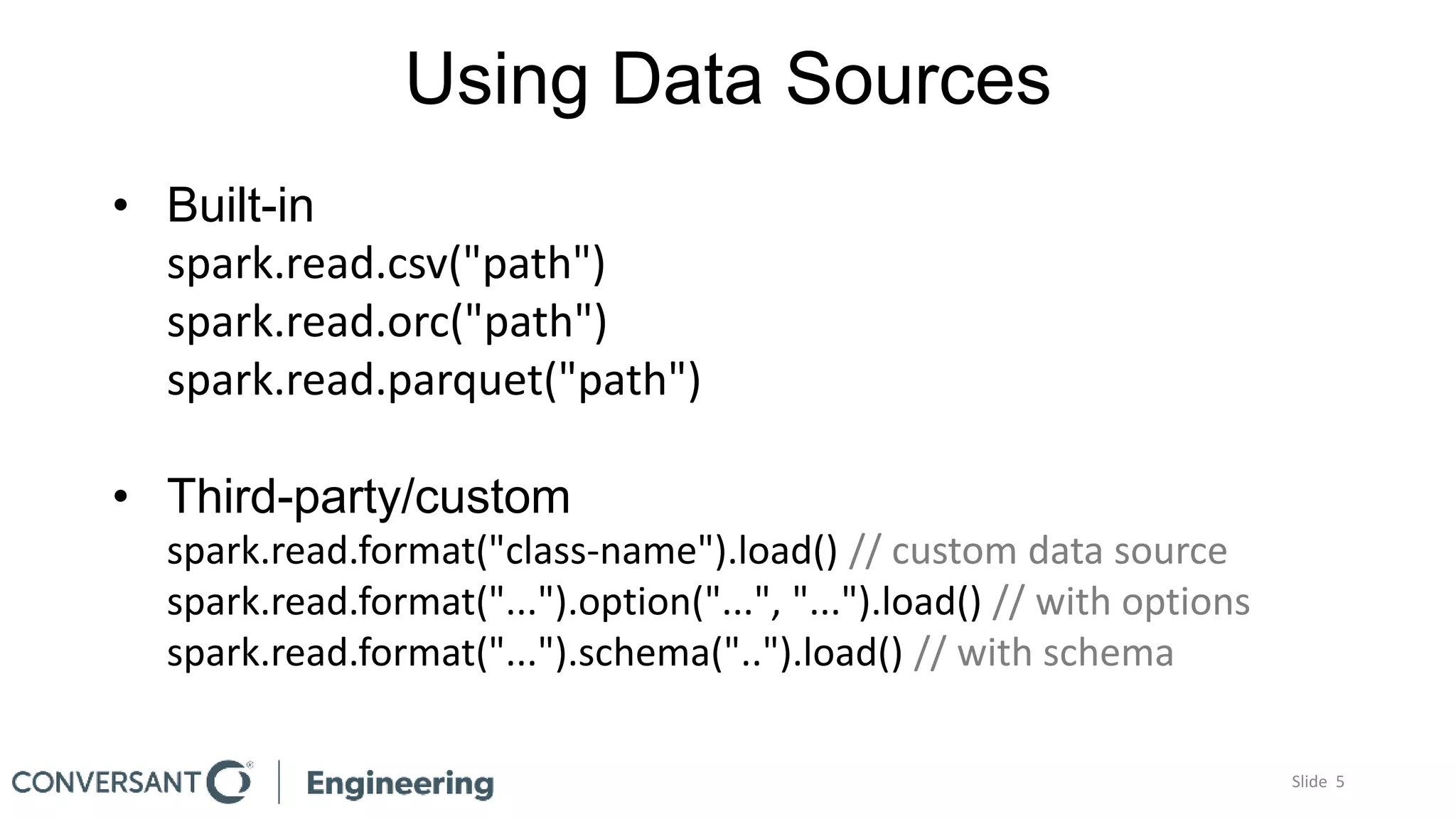
• Built-in
spark.read.csv("path")
spark.read.orc("path")
spark.read.parquet("path")
• Third-party/custom
spark.read.format("class-name").load() // custom data source
spark.read.format("...").option("...", "...").load() // with options
spark.read.format("...").schema("..").load() // with schema
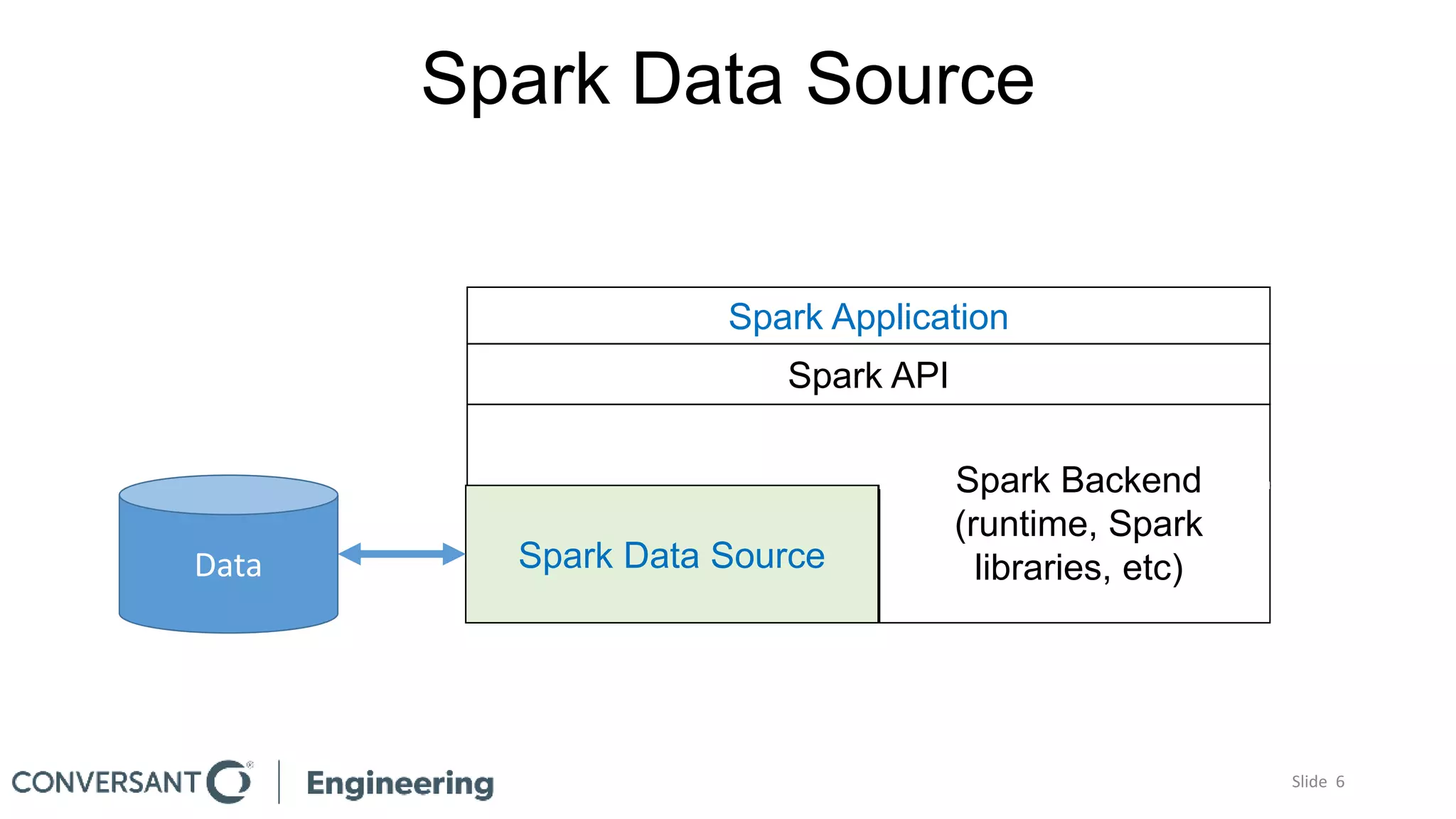
Spark Data Source
Spark Application
Spark API
Spark Data SourceData
Spark Backend
(runtime, Spark
libraries, etc)
Slide 6
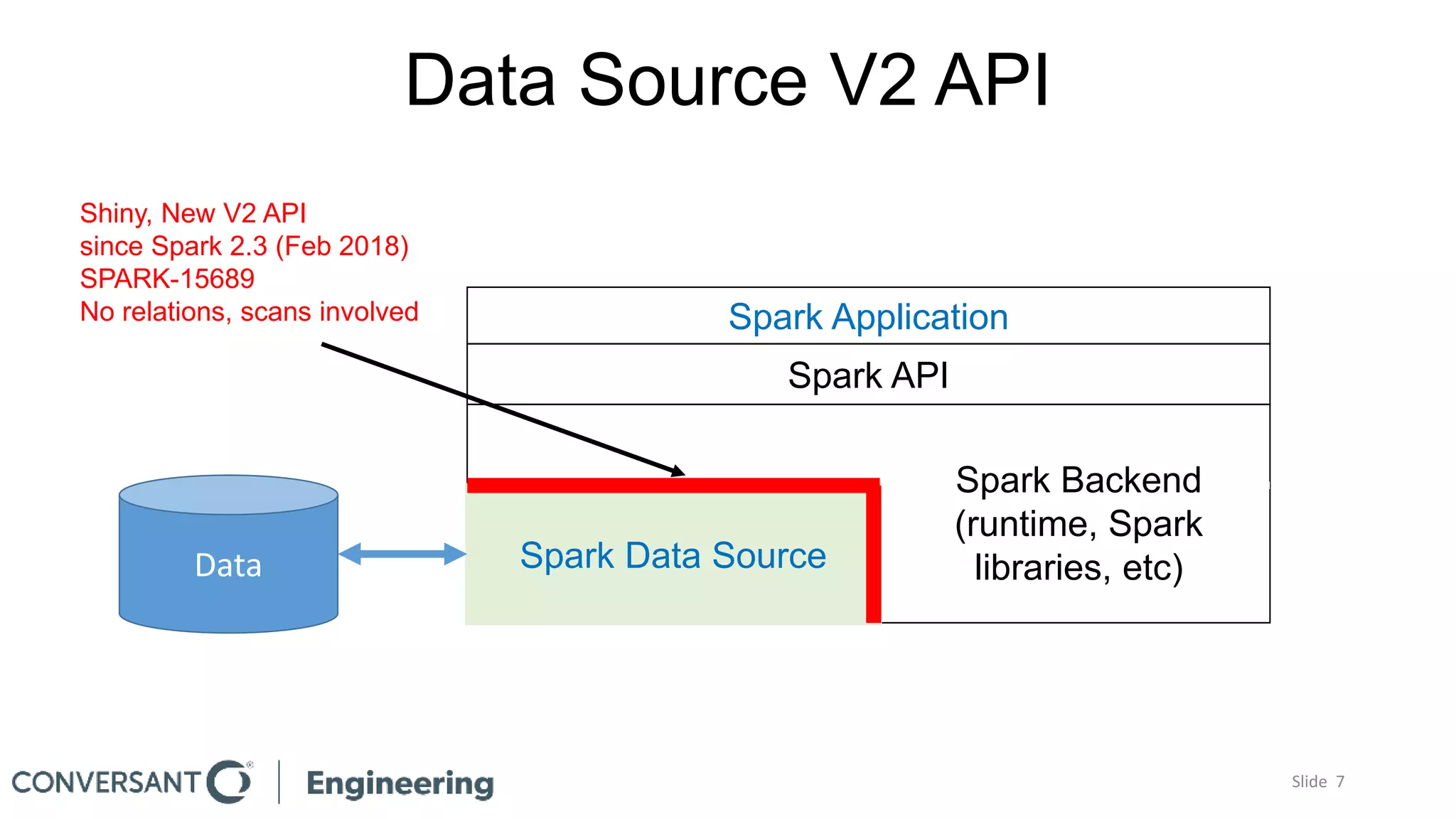
Data Source V2 API
Spark Application
Spark API
Spark Data SourceData
Spark Backend
(runtime, Spark
libraries, etc)
Shiny, New V2 API
since Spark 2.3 (Feb 2018)
SPARK-15689
No relations, scans involved
Slide 7
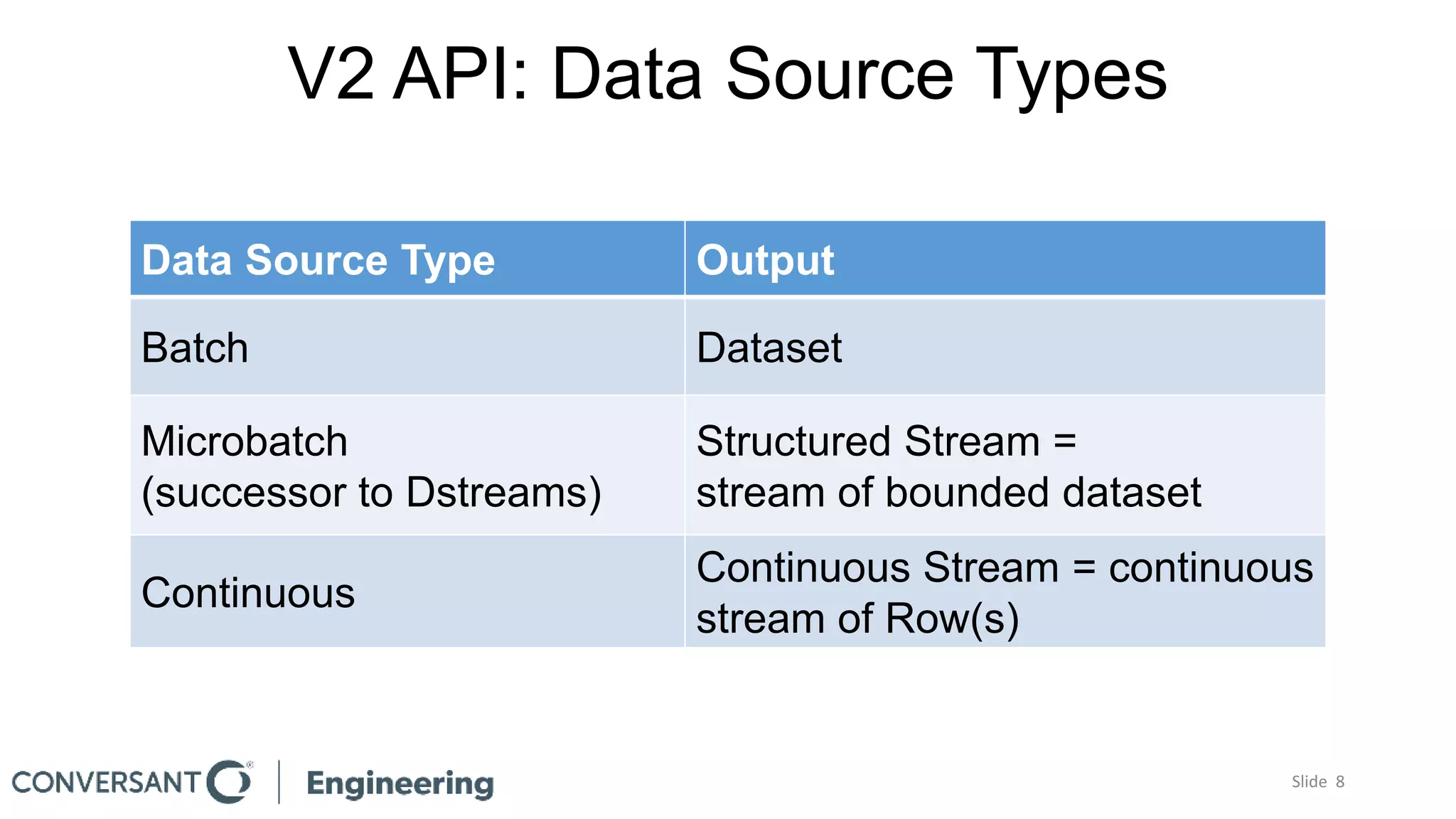
V2 API: Data Source Types
Data Source Type Output
Batch Dataset
Microbatch
(successor to Dstreams)
Structured Stream =
stream of bounded dataset
Continuous
Continuous Stream = continuous
stream of Row(s)
Slide 8
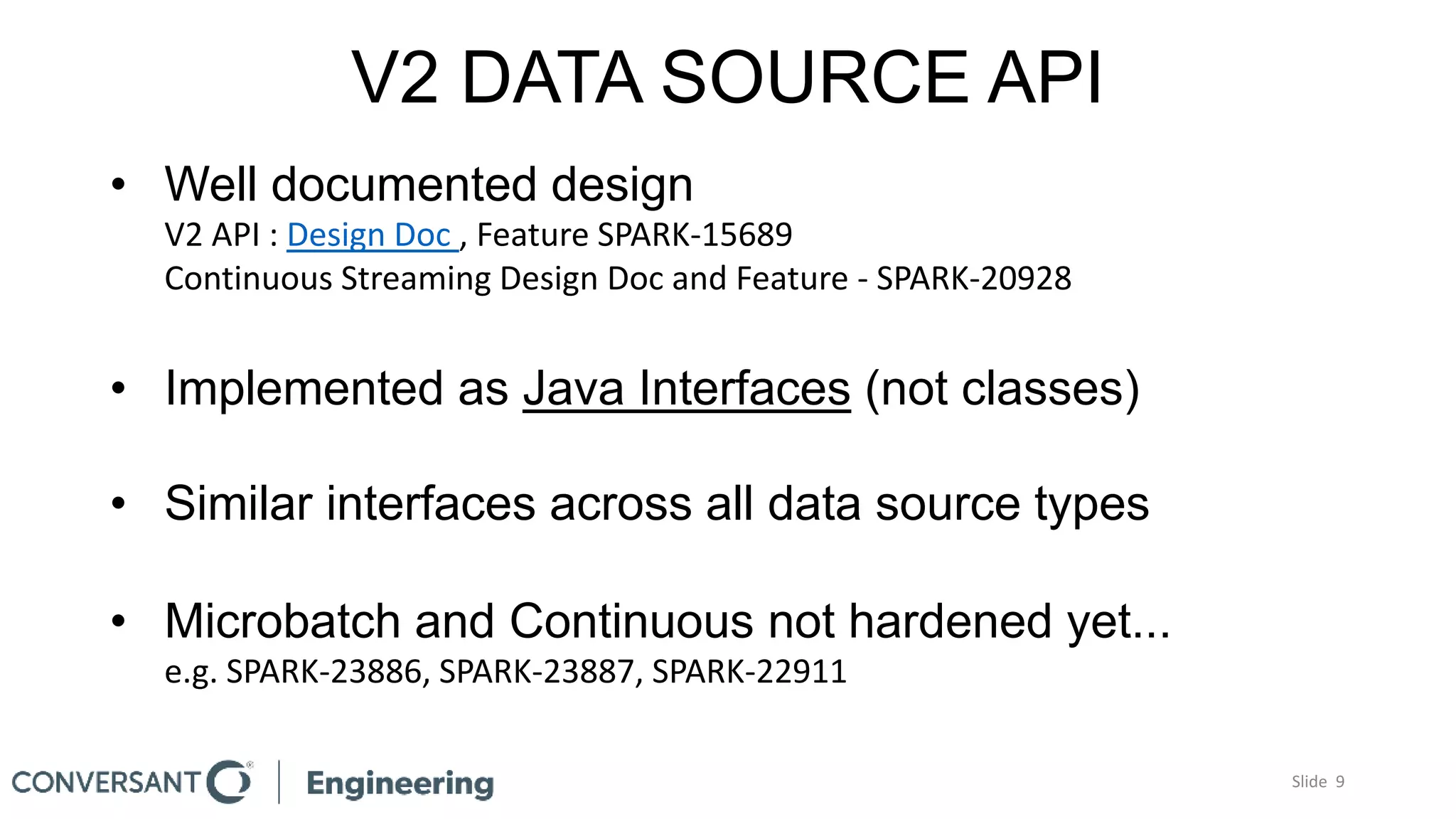
V2 DATA SOURCE API
• Well documented design
V2 API : Design Doc , Feature SPARK-15689
Continuous Streaming Design Doc and Feature - SPARK-20928
• Implemented as Java Interfaces (not classes)
• Similar interfaces across all data source types
• Microbatch and Continuous not hardened yet...
e.g. SPARK-23886, SPARK-23887, SPARK-22911
Slide 9
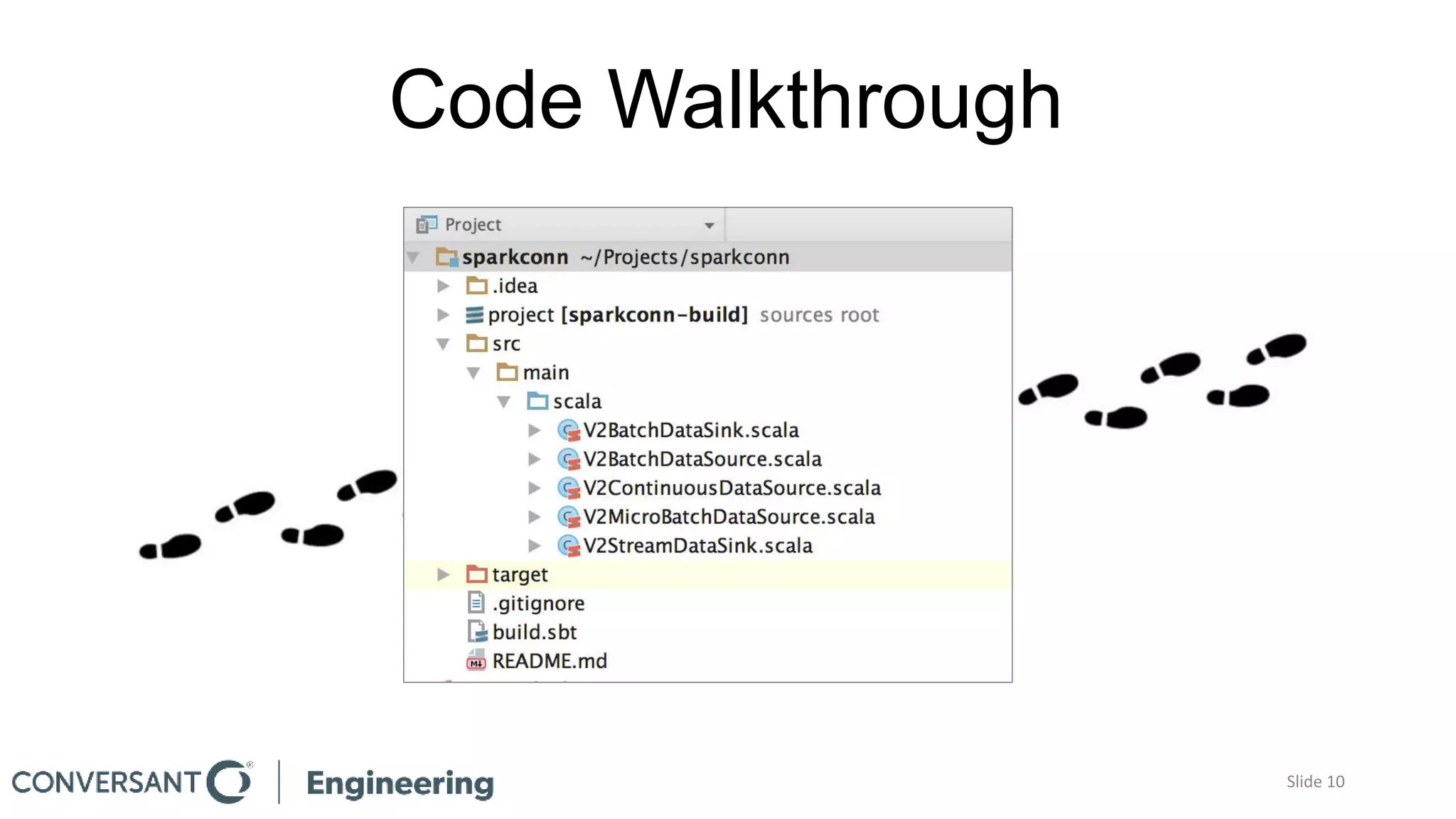
Code Walkthrough
Slide 10
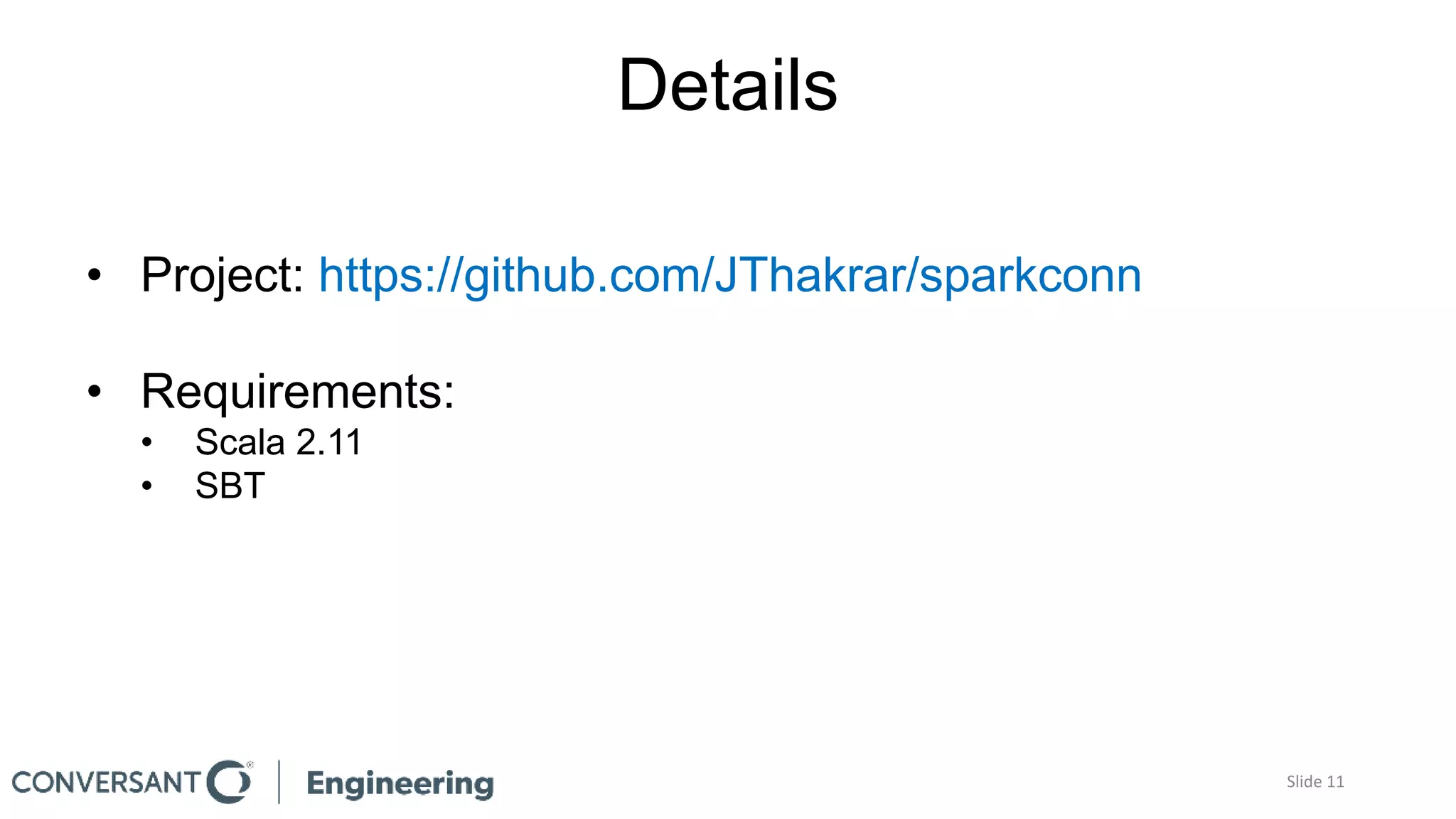
Details
• Project: https://github.com/JThakrar/sparkconn
• Requirements:
• Scala 2.11
• SBT
Slide 11
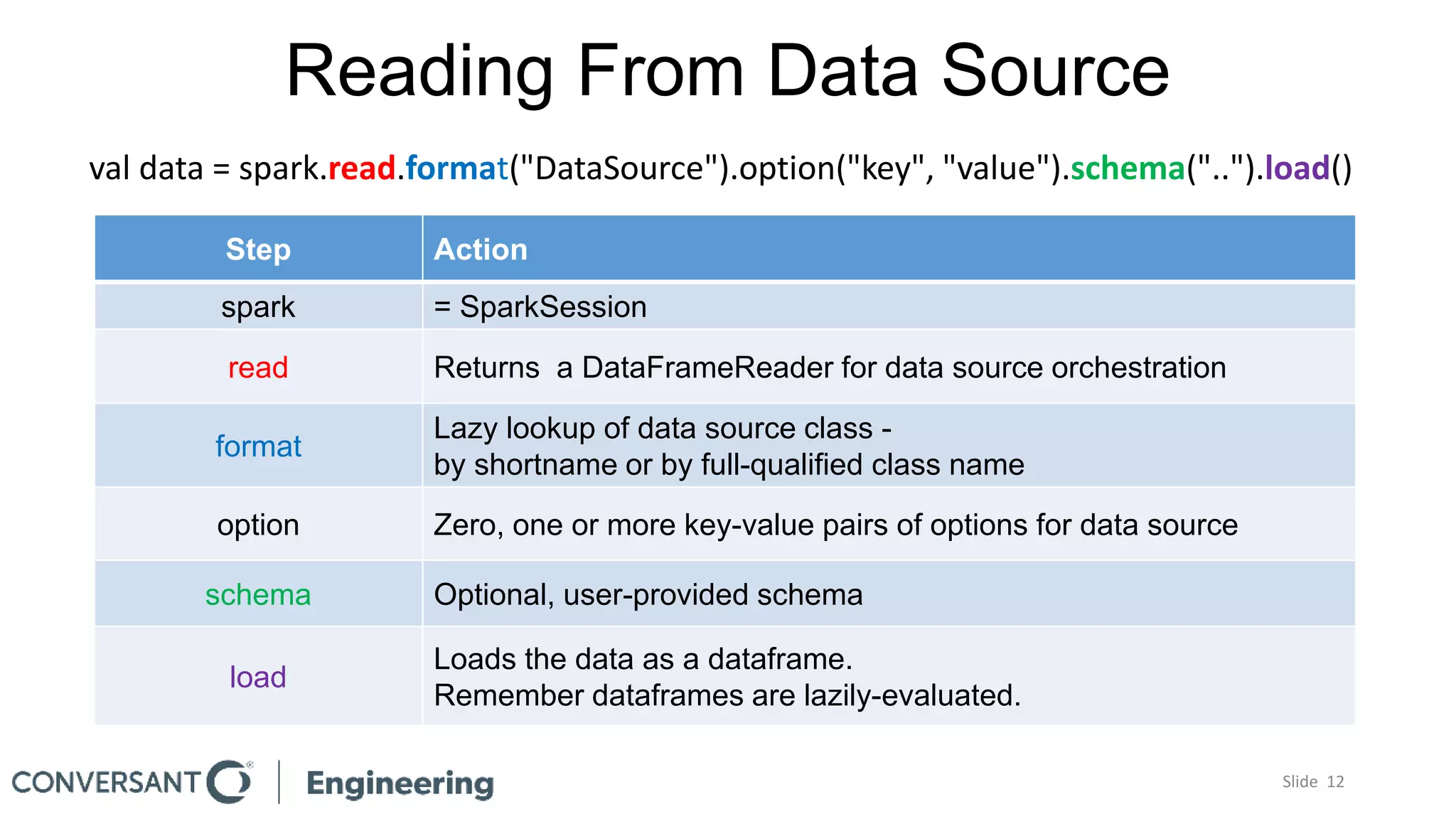
Reading From Data Source
val data = spark.read.format("DataSource").option("key", "value").schema("..").load()
Step Action
spark = SparkSession
read Returns a DataFrameReader for data source orchestration
format
Lazy lookup of data source class -
by shortname or by full-qualified class name
option Zero, one or more key-value pairs of options for data source
schema Optional, user-provided schema
load
Loads the data as a dataframe.
Remember dataframes are lazily-evaluated.
Slide 12
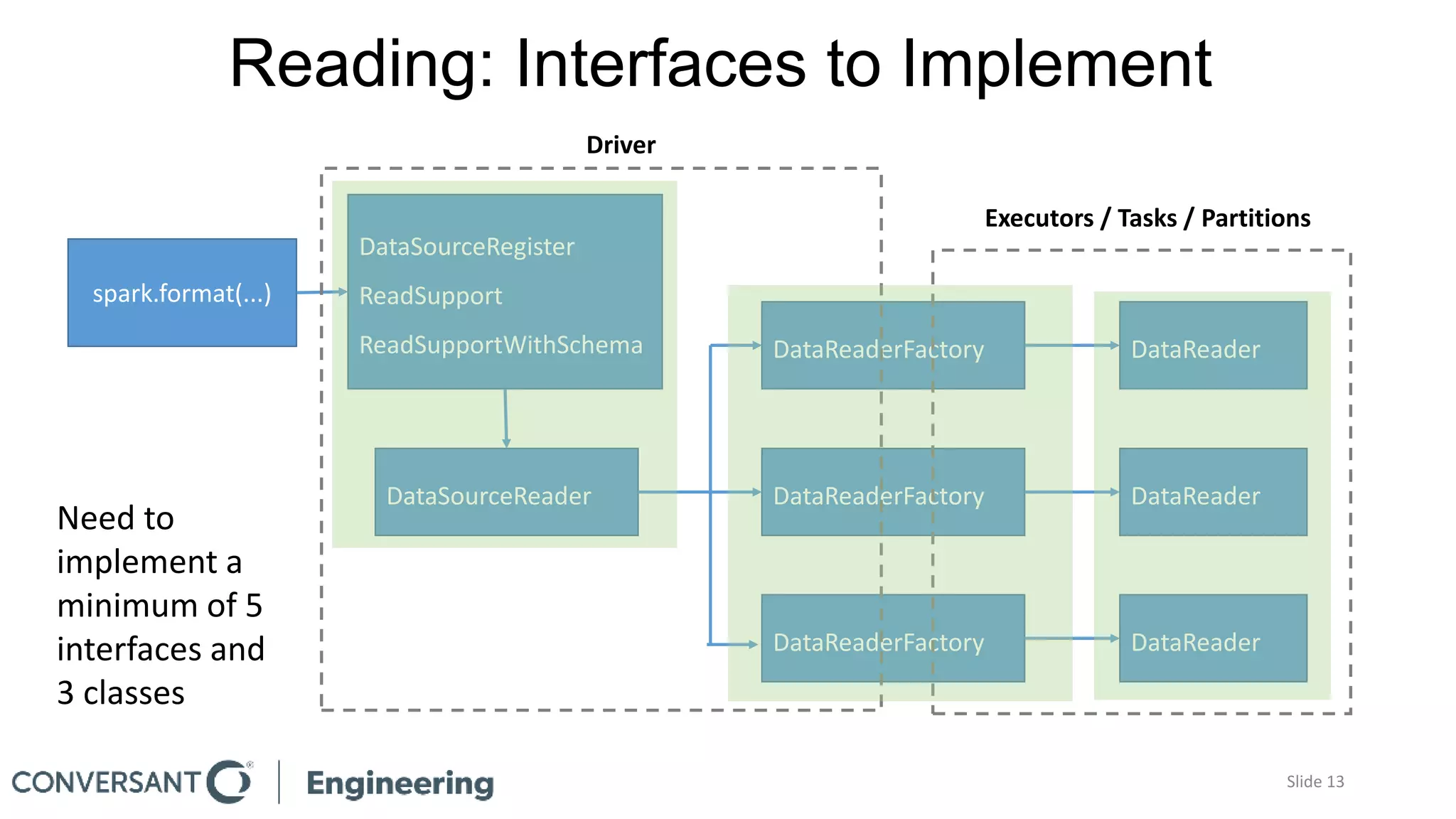
Reading: Interfaces to Implement
Slide 13
spark.format(...)
DataSourceRegister
ReadSupport
ReadSupportWithSchema
DataSourceReader
DataReaderFactory
DataReaderFactory
DataReaderFactory
DataReader
DataReader
DataReader
Driver
Executors / Tasks / Partitions
Need to
implement a
minimum of 5
interfaces and
3 classes
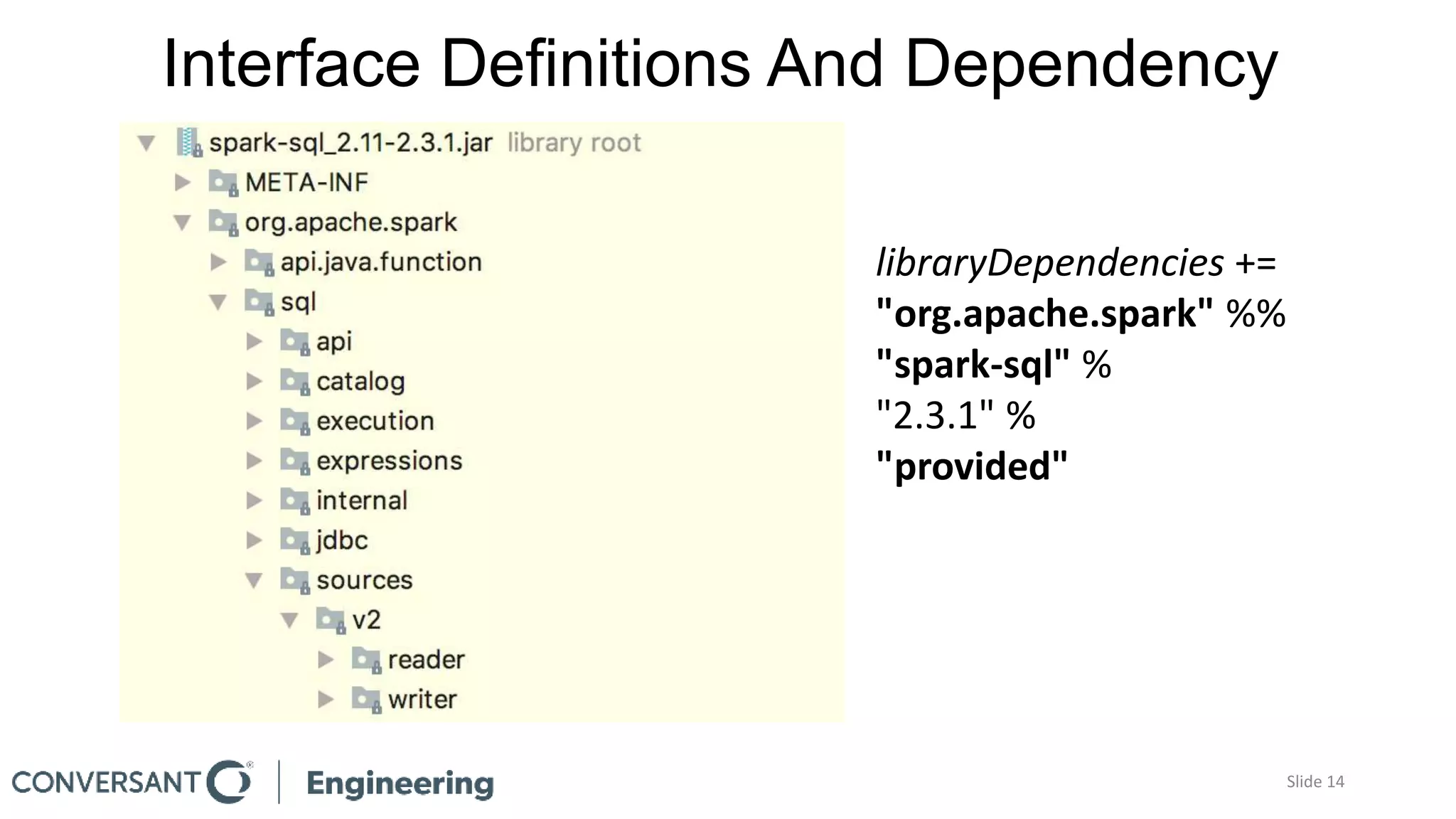
Interface Definitions And Dependency
Slide 14
libraryDependencies +=
"org.apache.spark" %%
"spark-sql" %
"2.3.1" %
"provided"
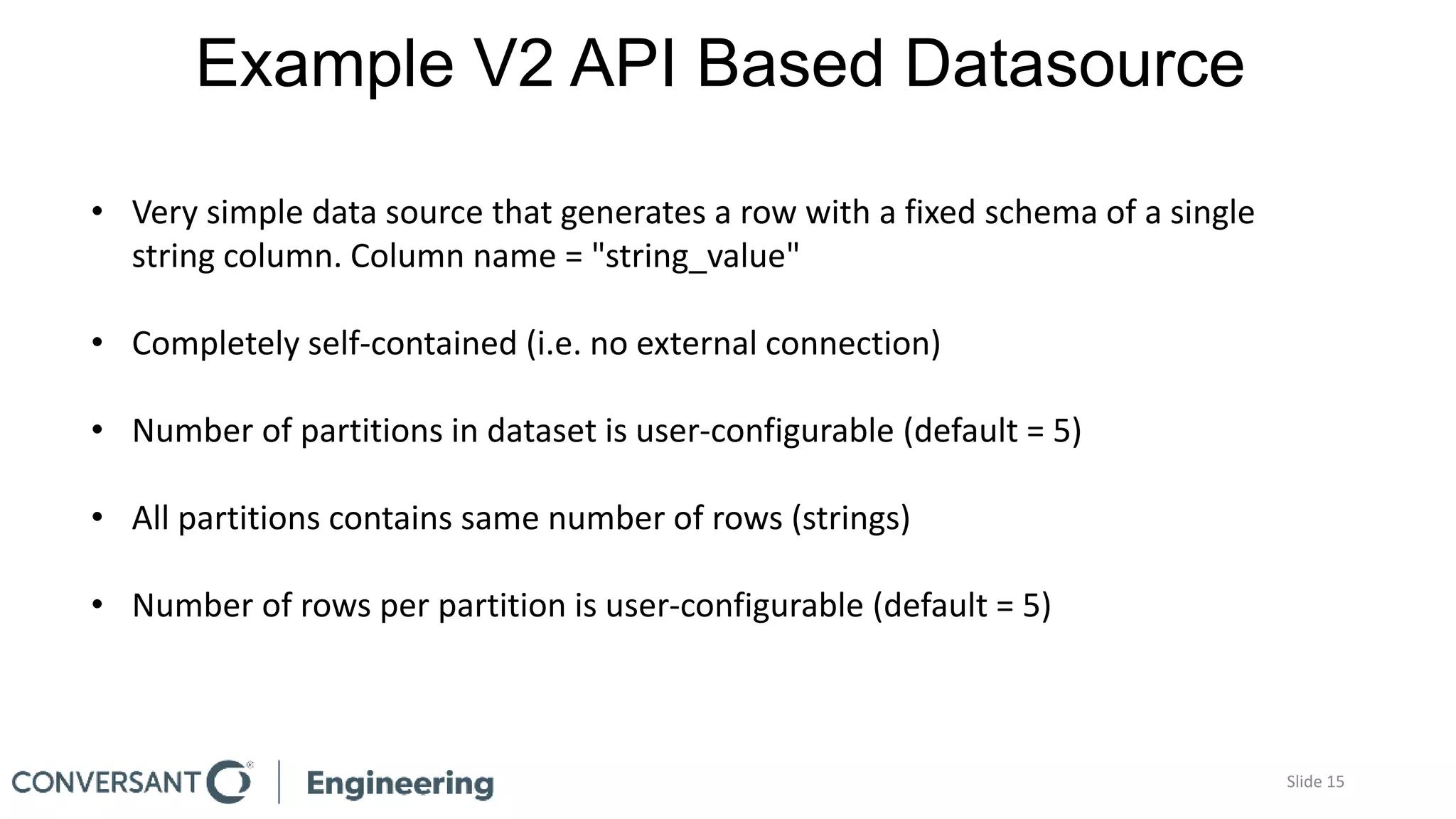
Example V2 API Based Datasource
Slide 15
• Very simple data source that generates a row with a fixed schema of a single
string column. Column name = "string_value"
• Completely self-contained (i.e. no external connection)
• Number of partitions in dataset is user-configurable (default = 5)
• All partitions contains same number of rows (strings)
• Number of rows per partition is user-configurable (default = 5)
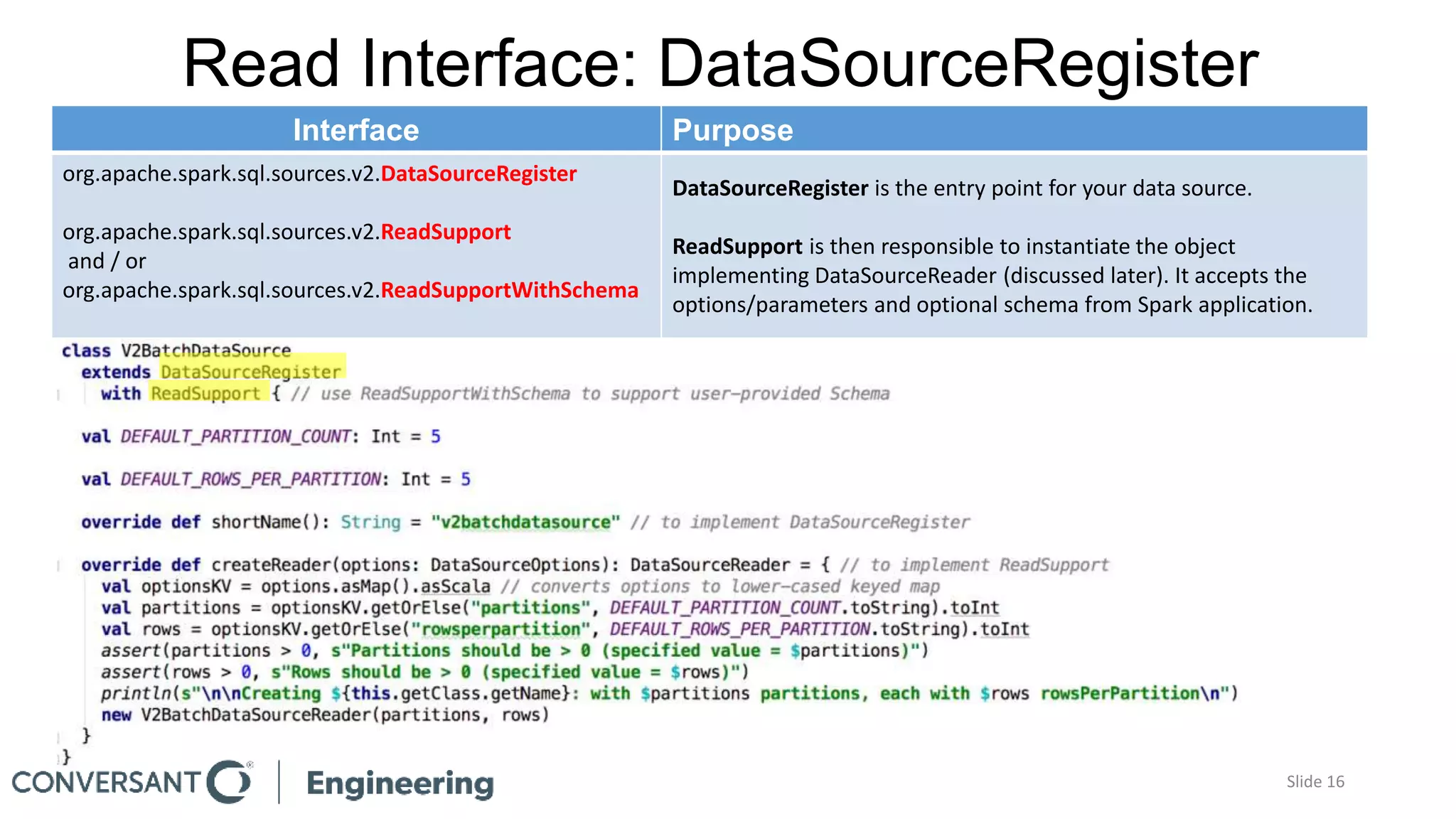
Read Interface: DataSourceRegister
Slide 16
Interface Purpose
org.apache.spark.sql.sources.v2.DataSourceRegister
org.apache.spark.sql.sources.v2.ReadSupport
and / or
org.apache.spark.sql.sources.v2.ReadSupportWithSchema
DataSourceRegister is the entry point for your data source.
ReadSupport is then responsible to instantiate the object
implementing DataSourceReader (discussed later). It accepts the
options/parameters and optional schema from Spark application.
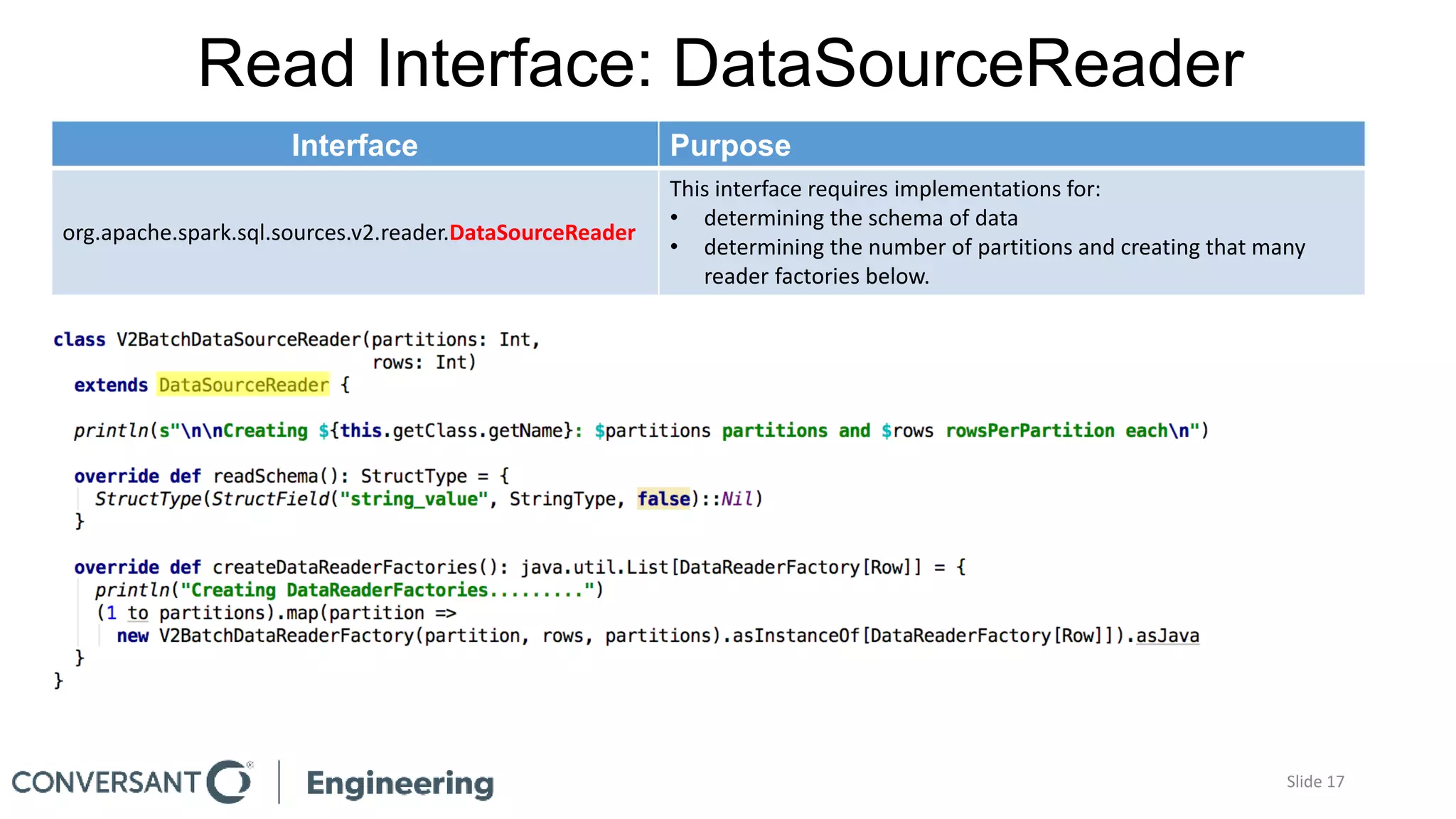
Read Interface: DataSourceReader
Slide 17
Interface Purpose
org.apache.spark.sql.sources.v2.reader.DataSourceReader
This interface requires implementations for:
• determining the schema of data
• determining the number of partitions and creating that many
reader factories below.
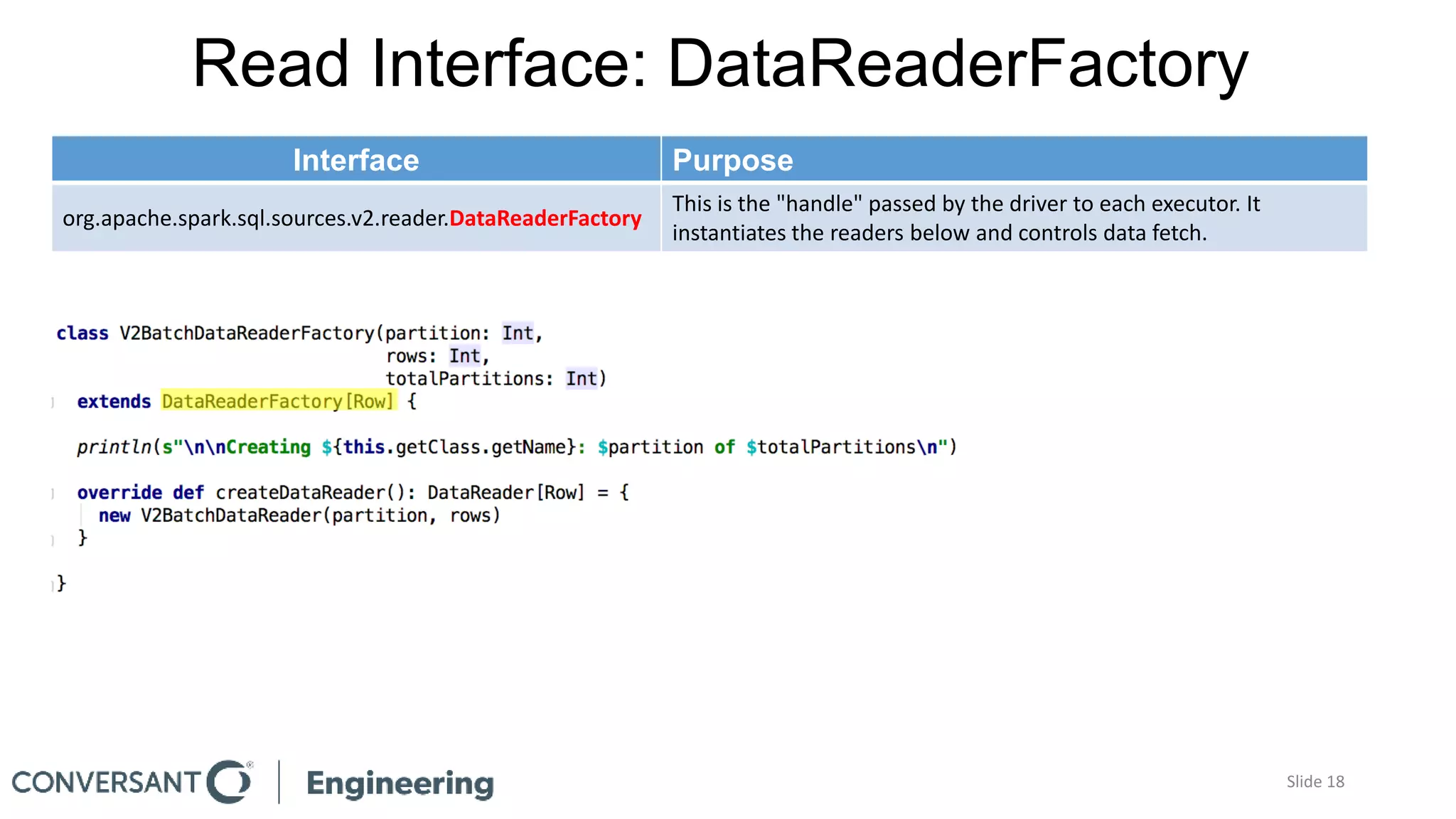
Read Interface: DataReaderFactory
Slide 18
Interface Purpose
org.apache.spark.sql.sources.v2.reader.DataReaderFactory
This is the "handle" passed by the driver to each executor. It
instantiates the readers below and controls data fetch.
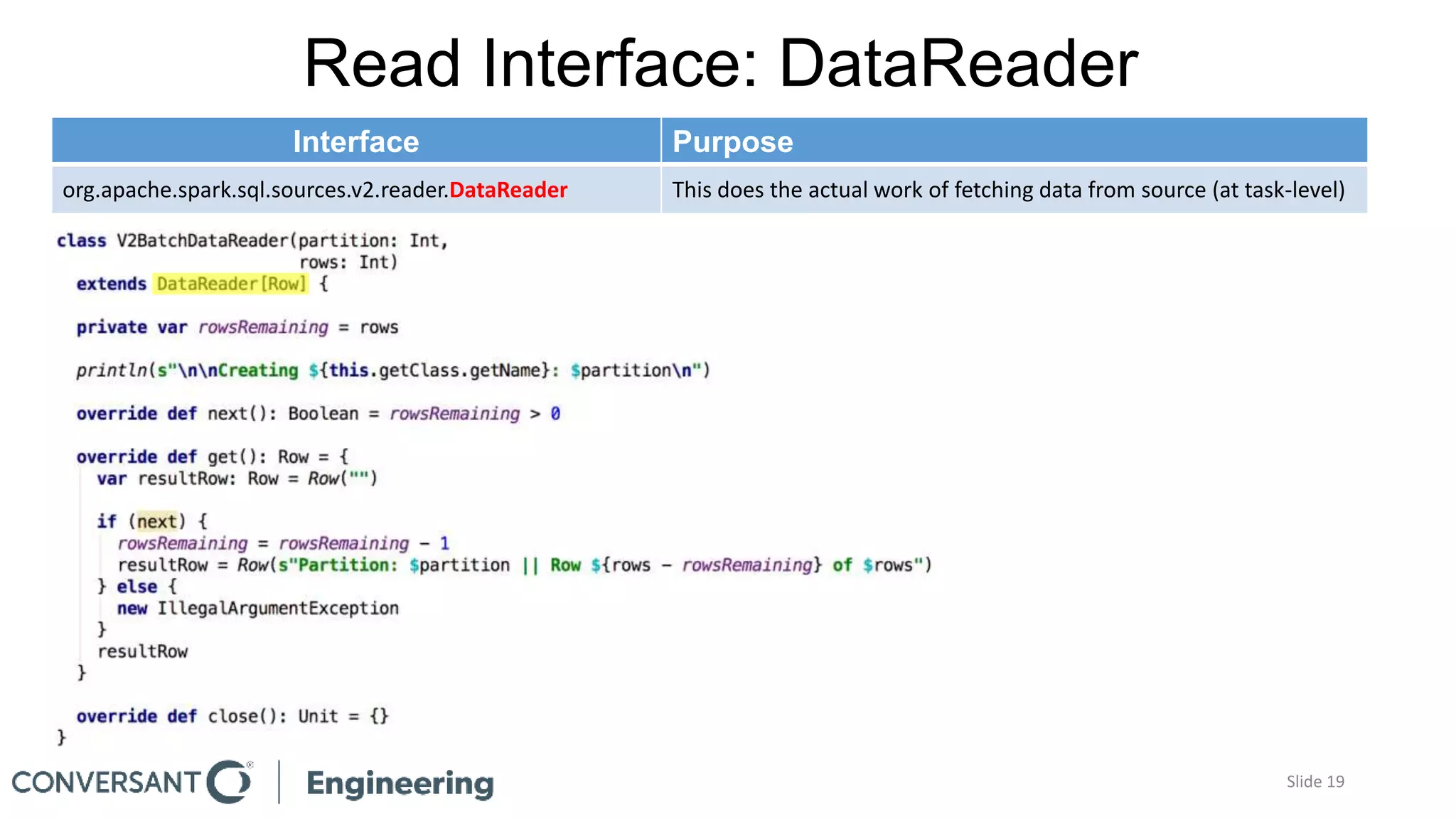
Read Interface: DataReader
Slide 19
Interface Purpose
org.apache.spark.sql.sources.v2.reader.DataReader This does the actual work of fetching data from source (at task-level)
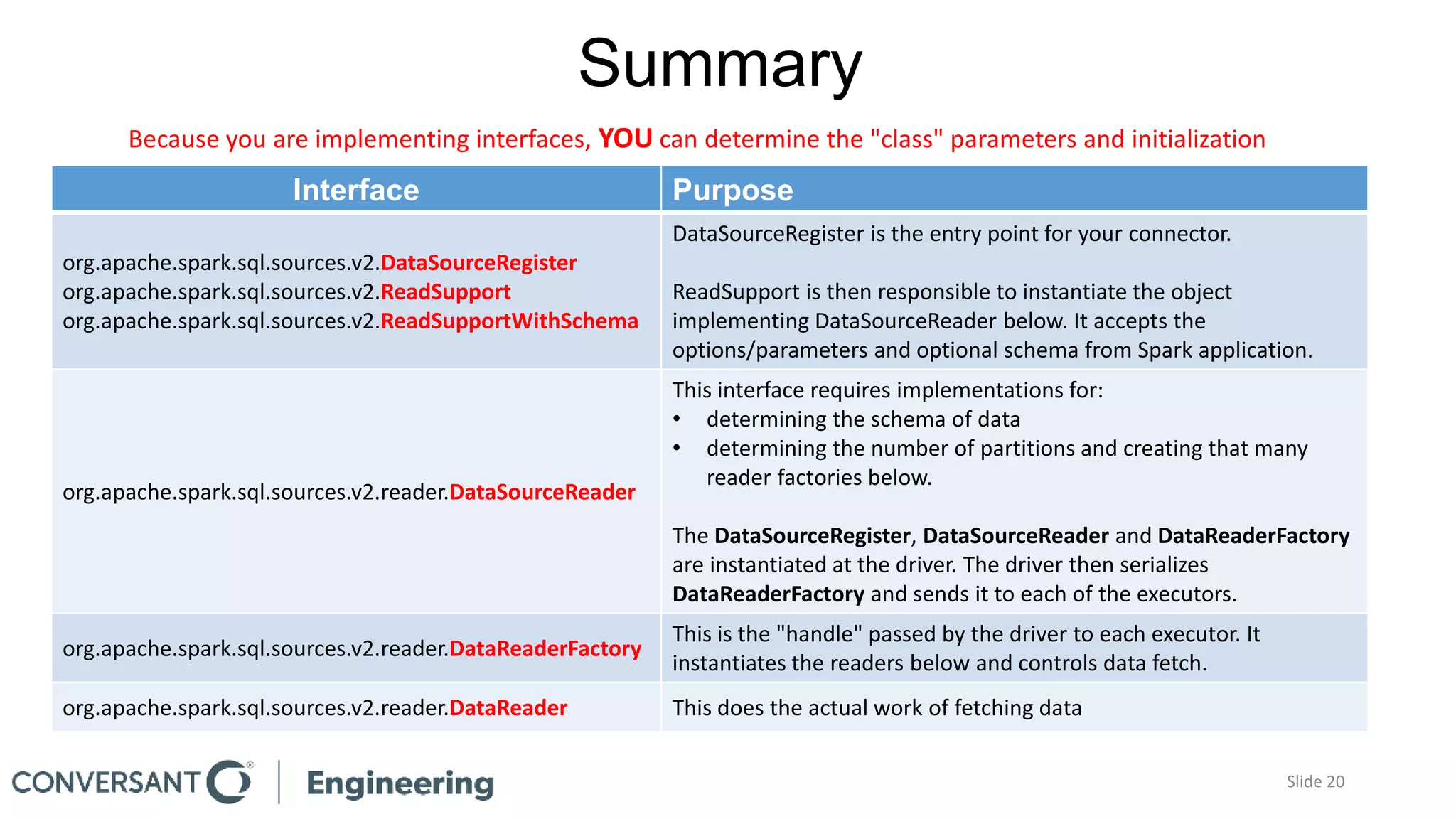
Summary
Slide 20
Interface Purpose
org.apache.spark.sql.sources.v2.DataSourceRegister
org.apache.spark.sql.sources.v2.ReadSupport
org.apache.spark.sql.sources.v2.ReadSupportWithSchema
DataSourceRegister is the entry point for your connector.
ReadSupport is then responsible to instantiate the object
implementing DataSourceReader below. It accepts the
options/parameters and optional schema from Spark application.
org.apache.spark.sql.sources.v2.reader.DataSourceReader
This interface requires implementations for:
• determining the schema of data
• determining the number of partitions and creating that many
reader factories below.
The DataSourceRegister, DataSourceReader and DataReaderFactory
are instantiated at the driver. The driver then serializes
DataReaderFactory and sends it to each of the executors.
org.apache.spark.sql.sources.v2.reader.DataReaderFactory
This is the "handle" passed by the driver to each executor. It
instantiates the readers below and controls data fetch.
org.apache.spark.sql.sources.v2.reader.DataReader This does the actual work of fetching data
Because you are implementing interfaces, YOU can determine the "class" parameters and initialization
Write Interfaces to Implement
Slide 21
Interface Purpose
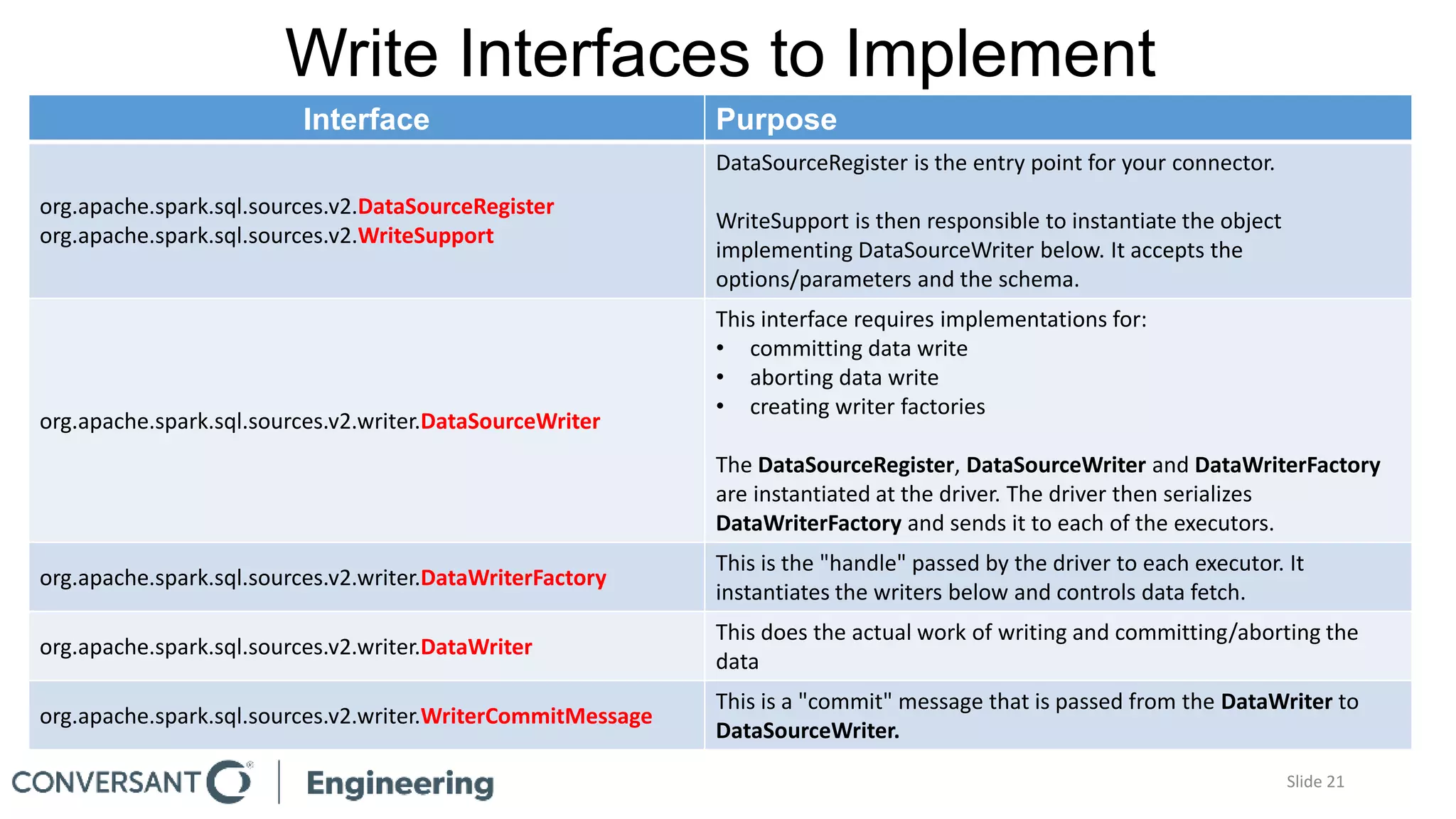
org.apache.spark.sql.sources.v2.DataSourceRegister
org.apache.spark.sql.sources.v2.WriteSupport
DataSourceRegister is the entry point for your connector.
WriteSupport is then responsible to instantiate the object
implementing DataSourceWriter below. It accepts the
options/parameters and the schema.
org.apache.spark.sql.sources.v2.writer.DataSourceWriter
This interface requires implementations for:
• committing data write
• aborting data write
• creating writer factories
The DataSourceRegister, DataSourceWriter and DataWriterFactory
are instantiated at the driver. The driver then serializes
DataWriterFactory and sends it to each of the executors.
org.apache.spark.sql.sources.v2.writer.DataWriterFactory
This is the "handle" passed by the driver to each executor. It
instantiates the writers below and controls data fetch.
org.apache.spark.sql.sources.v2.writer.DataWriter
This does the actual work of writing and committing/aborting the
data
org.apache.spark.sql.sources.v2.writer.WriterCommitMessage
This is a "commit" message that is passed from the DataWriter to
DataSourceWriter.
Practical Considerations
Slide 22
Know Your Data Source
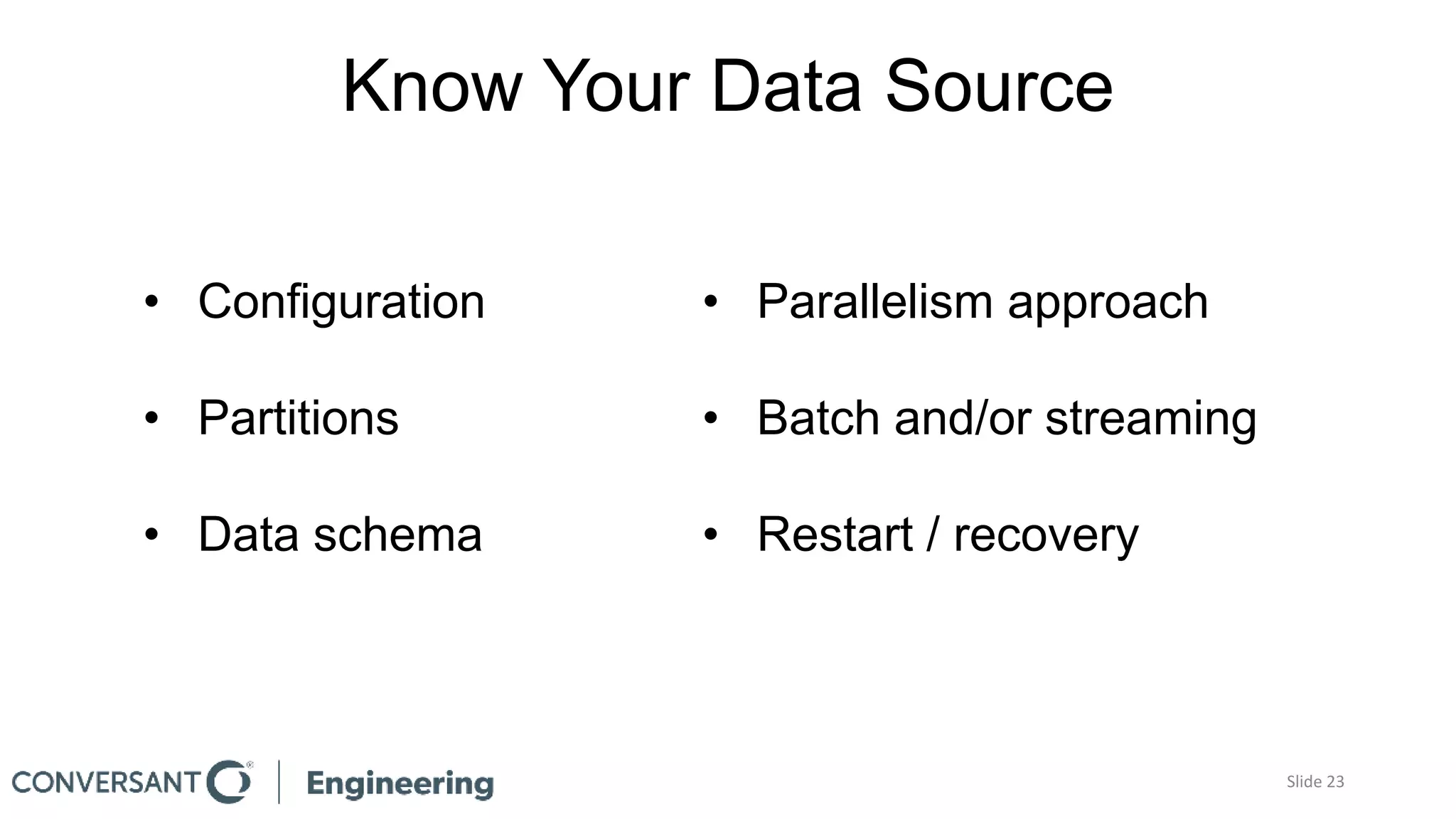
• Configuration
• Partitions
• Data schema
• Parallelism approach
• Batch and/or streaming
• Restart / recovery
Slide 23
V2 API IS STILL EVOLVING
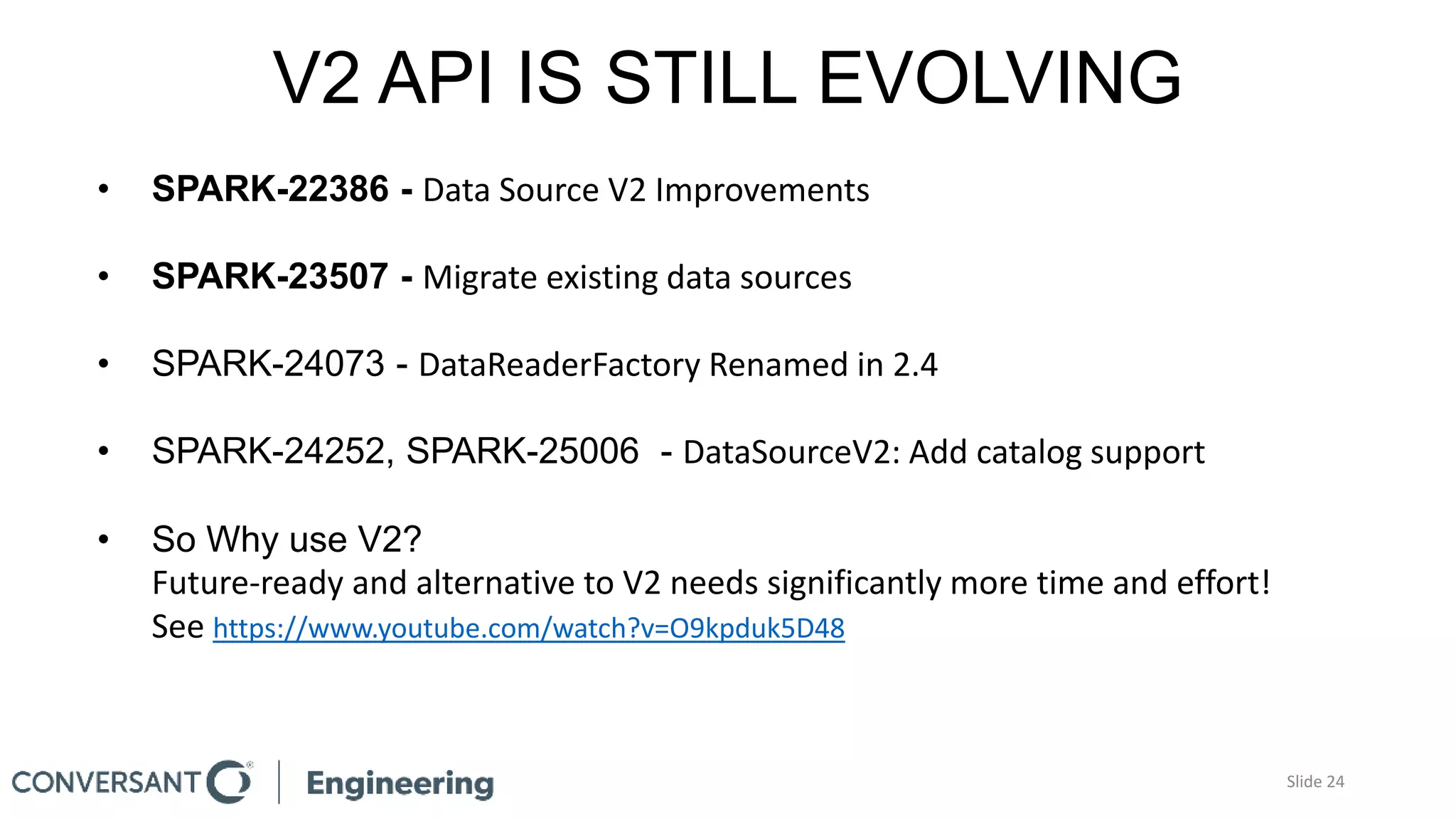
• SPARK-22386 - Data Source V2 Improvements
• SPARK-23507 - Migrate existing data sources
• SPARK-24073 - DataReaderFactory Renamed in 2.4
• SPARK-24252, SPARK-25006 - DataSourceV2: Add catalog support
• So Why use V2?
Future-ready and alternative to V2 needs significantly more time and effort!
See https://www.youtube.com/watch?v=O9kpduk5D48
Slide 24
About...
Conversant
• Digital marketing unit of Epsilon under Alliance Data Systems (ADS)
• (Significant) player in internet advertising.
We see about 80% of internet ad bids in the US
• Secret sauce = anonymous cross-device profiles driving personalized messaging
Me (Jayesh Thakrar)
• Sr. Software Engineer (jthakrar@conversantmedia.com)
• https://www.linkedin.com/in/jayeshthakrar/
Slide 25
Questions?
Slide 26

ApacheCon North America 2018: Creating Spark Data Sources

  • 1.
    Under-the-hood: Creating Your OwnSpark Data Sources Speaker: Jayesh Thakrar @ Conversant Slide 1
  • 2.
    Why Build YourOwn Data Source? Slide 2 Don't need • text, csv, ORC, Parquet, JSON files • JDBC sources • When available from project / vendor, e.g. • Cassandra, Kafka, MongoDB, etc • Teradata, Greenplum (2018), etc Need to • Use special features, e.g. • Kafka transactions • Exploit RDBMS specific partition features • Because you can, and want to  Conversant Use Cases (mid-2017) • Greenplum as data source (read/write) • Incompatibility between Spark, Kafka and Kafka connector versions
  • 3.
    Agenda 1. Introduction toSpark data sources 2. Walk-through sample code 3. Practical considerations Slide 3
  • 4.
  • 5.
    Using Data Sources Slide5 • Built-in spark.read.csv("path") spark.read.orc("path") spark.read.parquet("path") • Third-party/custom spark.read.format("class-name").load() // custom data source spark.read.format("...").option("...", "...").load() // with options spark.read.format("...").schema("..").load() // with schema
  • 6.
    Spark Data Source SparkApplication Spark API Spark Data SourceData Spark Backend (runtime, Spark libraries, etc) Slide 6
  • 7.
    Data Source V2API Spark Application Spark API Spark Data SourceData Spark Backend (runtime, Spark libraries, etc) Shiny, New V2 API since Spark 2.3 (Feb 2018) SPARK-15689 No relations, scans involved Slide 7
  • 8.
    V2 API: DataSource Types Data Source Type Output Batch Dataset Microbatch (successor to Dstreams) Structured Stream = stream of bounded dataset Continuous Continuous Stream = continuous stream of Row(s) Slide 8
  • 9.
    V2 DATA SOURCEAPI • Well documented design V2 API : Design Doc , Feature SPARK-15689 Continuous Streaming Design Doc and Feature - SPARK-20928 • Implemented as Java Interfaces (not classes) • Similar interfaces across all data source types • Microbatch and Continuous not hardened yet... e.g. SPARK-23886, SPARK-23887, SPARK-22911 Slide 9
  • 10.
  • 11.
    Details • Project: https://github.com/JThakrar/sparkconn •Requirements: • Scala 2.11 • SBT Slide 11
  • 12.
    Reading From DataSource val data = spark.read.format("DataSource").option("key", "value").schema("..").load() Step Action spark = SparkSession read Returns a DataFrameReader for data source orchestration format Lazy lookup of data source class - by shortname or by full-qualified class name option Zero, one or more key-value pairs of options for data source schema Optional, user-provided schema load Loads the data as a dataframe. Remember dataframes are lazily-evaluated. Slide 12
  • 13.
    Reading: Interfaces toImplement Slide 13 spark.format(...) DataSourceRegister ReadSupport ReadSupportWithSchema DataSourceReader DataReaderFactory DataReaderFactory DataReaderFactory DataReader DataReader DataReader Driver Executors / Tasks / Partitions Need to implement a minimum of 5 interfaces and 3 classes
  • 14.
    Interface Definitions AndDependency Slide 14 libraryDependencies += "org.apache.spark" %% "spark-sql" % "2.3.1" % "provided"
  • 15.
    Example V2 APIBased Datasource Slide 15 • Very simple data source that generates a row with a fixed schema of a single string column. Column name = "string_value" • Completely self-contained (i.e. no external connection) • Number of partitions in dataset is user-configurable (default = 5) • All partitions contains same number of rows (strings) • Number of rows per partition is user-configurable (default = 5)
  • 16.
    Read Interface: DataSourceRegister Slide16 Interface Purpose org.apache.spark.sql.sources.v2.DataSourceRegister org.apache.spark.sql.sources.v2.ReadSupport and / or org.apache.spark.sql.sources.v2.ReadSupportWithSchema DataSourceRegister is the entry point for your data source. ReadSupport is then responsible to instantiate the object implementing DataSourceReader (discussed later). It accepts the options/parameters and optional schema from Spark application.
  • 17.
    Read Interface: DataSourceReader Slide17 Interface Purpose org.apache.spark.sql.sources.v2.reader.DataSourceReader This interface requires implementations for: • determining the schema of data • determining the number of partitions and creating that many reader factories below.
  • 18.
    Read Interface: DataReaderFactory Slide18 Interface Purpose org.apache.spark.sql.sources.v2.reader.DataReaderFactory This is the "handle" passed by the driver to each executor. It instantiates the readers below and controls data fetch.
  • 19.
    Read Interface: DataReader Slide19 Interface Purpose org.apache.spark.sql.sources.v2.reader.DataReader This does the actual work of fetching data from source (at task-level)
  • 20.
    Summary Slide 20 Interface Purpose org.apache.spark.sql.sources.v2.DataSourceRegister org.apache.spark.sql.sources.v2.ReadSupport org.apache.spark.sql.sources.v2.ReadSupportWithSchema DataSourceRegisteris the entry point for your connector. ReadSupport is then responsible to instantiate the object implementing DataSourceReader below. It accepts the options/parameters and optional schema from Spark application. org.apache.spark.sql.sources.v2.reader.DataSourceReader This interface requires implementations for: • determining the schema of data • determining the number of partitions and creating that many reader factories below. The DataSourceRegister, DataSourceReader and DataReaderFactory are instantiated at the driver. The driver then serializes DataReaderFactory and sends it to each of the executors. org.apache.spark.sql.sources.v2.reader.DataReaderFactory This is the "handle" passed by the driver to each executor. It instantiates the readers below and controls data fetch. org.apache.spark.sql.sources.v2.reader.DataReader This does the actual work of fetching data Because you are implementing interfaces, YOU can determine the "class" parameters and initialization
  • 21.
    Write Interfaces toImplement Slide 21 Interface Purpose org.apache.spark.sql.sources.v2.DataSourceRegister org.apache.spark.sql.sources.v2.WriteSupport DataSourceRegister is the entry point for your connector. WriteSupport is then responsible to instantiate the object implementing DataSourceWriter below. It accepts the options/parameters and the schema. org.apache.spark.sql.sources.v2.writer.DataSourceWriter This interface requires implementations for: • committing data write • aborting data write • creating writer factories The DataSourceRegister, DataSourceWriter and DataWriterFactory are instantiated at the driver. The driver then serializes DataWriterFactory and sends it to each of the executors. org.apache.spark.sql.sources.v2.writer.DataWriterFactory This is the "handle" passed by the driver to each executor. It instantiates the writers below and controls data fetch. org.apache.spark.sql.sources.v2.writer.DataWriter This does the actual work of writing and committing/aborting the data org.apache.spark.sql.sources.v2.writer.WriterCommitMessage This is a "commit" message that is passed from the DataWriter to DataSourceWriter.
  • 22.
  • 23.
    Know Your DataSource • Configuration • Partitions • Data schema • Parallelism approach • Batch and/or streaming • Restart / recovery Slide 23
  • 24.
    V2 API ISSTILL EVOLVING • SPARK-22386 - Data Source V2 Improvements • SPARK-23507 - Migrate existing data sources • SPARK-24073 - DataReaderFactory Renamed in 2.4 • SPARK-24252, SPARK-25006 - DataSourceV2: Add catalog support • So Why use V2? Future-ready and alternative to V2 needs significantly more time and effort! See https://www.youtube.com/watch?v=O9kpduk5D48 Slide 24
  • 25.
    About... Conversant • Digital marketingunit of Epsilon under Alliance Data Systems (ADS) • (Significant) player in internet advertising. We see about 80% of internet ad bids in the US • Secret sauce = anonymous cross-device profiles driving personalized messaging Me (Jayesh Thakrar) • Sr. Software Engineer (jthakrar@conversantmedia.com) • https://www.linkedin.com/in/jayeshthakrar/ Slide 25
  • 26.