Research Article Review
Guidelines for APA Paper
Dr. Carla Piper
Peer-Reviewed Research
In academic publishing, the goal of peer review is
to assess the quality of articles submitted for
publication in a scholarly journal.
– Author submits to scholarly journal editor
– Reviewed by experts who specialize in the field
– Impartial reviewers check manuscript for accuracy
and assess the validity of the research methodology
and procedures.
Resource -
http://guides.lib.jjay.cuny.edu/content.php?pid=209679&
Where do I find a
Peer-Reviewed
Research Article?
• Click on the “Library” on the
red button left menu.
• Go to the “Library Home
Page”
• http://www1.chapman.edu/library/
Start Your Search
• Go to “Databases”
• Click on “Subject”
• Select “Education”
Brandman/Chapman Library
• Click on “Connect”
• Select one of the
“Education Specific
Databases”
• Recommend Education Full
Text, ERIC EBESCO, or
Academic Search Premier
• Log in with your Brandman
User Name (1st
part – no @)
and Password
Education Full Text Example
• Use Boolean Search Terms –
Recommend “and”
• Use 2-3 terms including one technology,
computer, or digital media term and at
least one subject matter term or
instructional/assessment strategy
Select Full Text Current Peer-
Reviewed Journal Articles
Search Results
APA Style Basics
• http://www.apastyle.org/
• Video Tutorials
• “The rules of APA Style®, detailed in the
Publication Manual of the American
Psychological Association, offer sound
guidance for writing with simplicity,
power, and concision. APA Style has
been adapted by many disciplines and is
used by writers around the world.”
APA References at OWL
No DOI:
Author, A. A., & Author, B. B. (Date of publication). Title of
article. Title of Online Periodical, volume number(issue number
if available). Retrieved from http
://www.someaddress.com/full/url/
With DOI:
Author, A. A., & Author, B. B. (Date of publication). Title of
article. Title of Journal, volume number.
doi:0000000/000000000000
No DOI but article appears as a printed version as
well (URL not required). Use "Electronic version" in brackets
after the article's title.
Whitmeyer, J. M. (2000). Power through appointment
[Electronic version]. Social Science Research, 29, 535-555.
Reference List
• Reference Page - Include a separate page for your APA
Reference
https://owl.english.purdue.edu/owl/resource/560/10/
• Examine Formats for “Reference List: Electronic Sources.”
• Acceptable Electronic Formats
APA Citations at OWL
http://owl.english.purdue.edu/owl/resource/560/02/
Short Quotations
– If you are directly quoting from a work, you will need to
include the author, year of publication, and the page number
for the reference (preceded by "p."). Introduce the quotation
with a signal phrase that includes the author's last name
followed by the date of publication in parentheses.
– According to Jones (1998), "Students often had difficulty
using APA style, especially when it was their first time" (p.
199).
– Jones (1998) found "students often had difficulty using APA
style" (p. 199); what implications does this have for teachers?
– If the author is not named in a signal phrase, place the
author's last name, the year of publication, and the page
number in parentheses after the quotation. She stated,
"Students often had difficulty using APA style," (Jones, 1998,
p. 199), but she did not offer an explanation as to why.
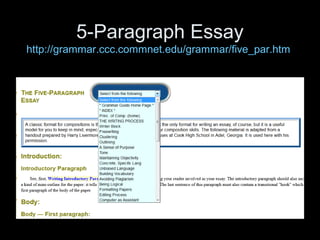
5-Paragraph Essay
http://grammar.ccc.commnet.edu/grammar/five_par.htm
Article Review Assignment
• Title Page –
https://owl.english.purdue.edu/owl/resource/560/01/
• You do not need an abstract for this
short article review paper assignment.
• Paragraph 1 – Introduction
– Include an author (date) citation
– Explain how this article relates to technology in
education and why it is significant.
– Thesis statement Example – “The purpose of this study
was to…..”
– Use 3rd
person
Paragraphs 2-4 (or 5): Body
• Describe the research conducted and the
technology or digital media being used.
• Select 3 key topics or ideas from this paper
• Provide a thorough analysis, synthesis, or summary
of each topic.
• You may wish to write a paragraph briefly
summarizing each topic.
– Remember that all quotations require a p. or para.
number.
– Limit your quotations to 2 short quotations for this brief
length of paper.
Final Paragraph
• Conclusion: Synthesize and summarize
• You may present your personal critique or
opinion using 1st
person.
• Respect the credentials of the researcher and
author! Remember that peer-reviewed research
is conducted in a controlled setting with an
established research methodology.
• Discuss how you feel this digital media or
technology can positively or negatively result in
student learning, teacher productivity and
collaboration, digital equity, communication, etc.
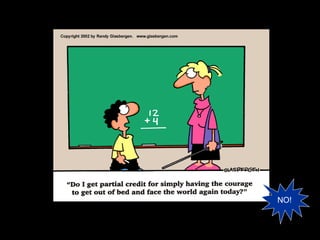
NO!
Common Writing Errors
My Own Personal Writing Lab
OWL of Purdue
Carla Piper, Ed. D.
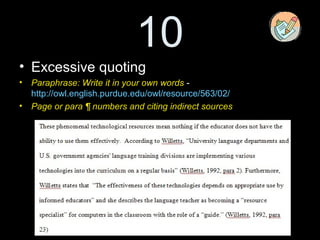
10
• Excessive quoting
• Paraphrase: Write it in your own words -
http://owl.english.purdue.edu/owl/resource/563/02/
• Page or para ¶ numbers and citing indirect sources
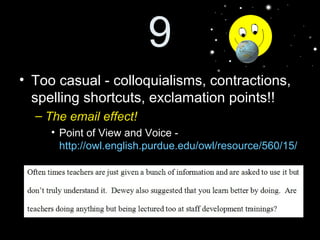
9
• Too casual - colloquialisms, contractions,
spelling shortcuts, exclamation points!!
– The email effect!
• Point of View and Voice -
http://owl.english.purdue.edu/owl/resource/560/15/
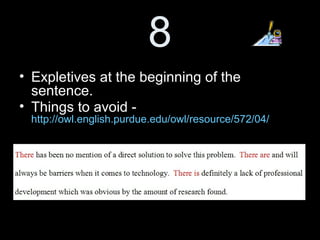
8
• Expletives at the beginning of the
sentence.
• Things to avoid -
http://owl.english.purdue.edu/owl/resource/572/04/
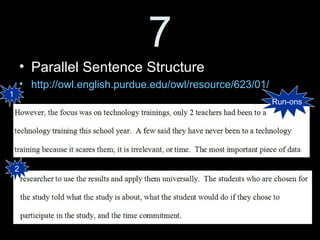
7
• Parallel Sentence Structure
• http://owl.english.purdue.edu/owl/resource/623/01/
Run-ons
1
2
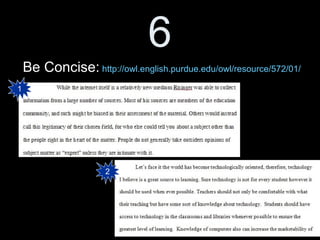
6
Be Concise: http://owl.english.purdue.edu/owl/resource/572/01/
1
2
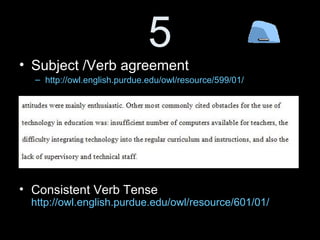
5
• Subject /Verb agreement
– http://owl.english.purdue.edu/owl/resource/599/01/
• Consistent Verb Tense
http://owl.english.purdue.edu/owl/resource/601/01/
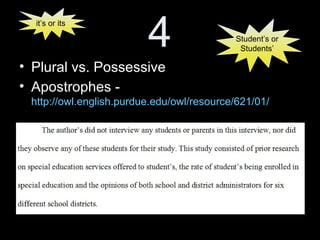
4
• Plural vs. Possessive
• Apostrophes -
http://owl.english.purdue.edu/owl/resource/621/01/
it’s or its
Student’s or
Students’
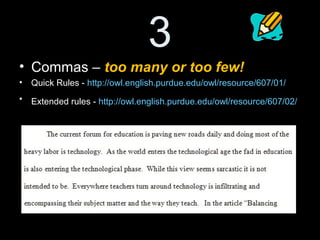
3
• Commas – too many or too few!
• Quick Rules - http://owl.english.purdue.edu/owl/resource/607/01/
• Extended rules - http://owl.english.purdue.edu/owl/resource/607/02/
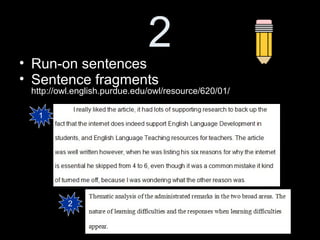
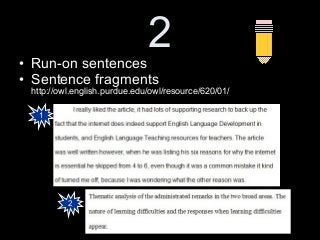
2• Run-on sentences
• Sentence fragments
http://owl.english.purdue.edu/owl/resource/620/01/
1
2
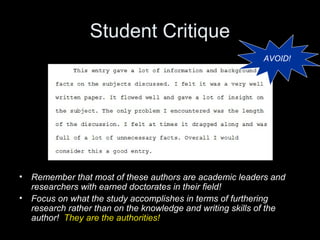
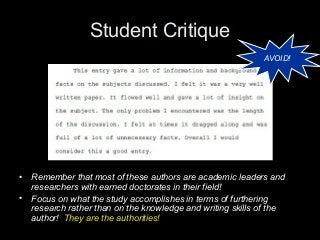
Student Critique
AVOID!
• Remember that most of these authors are academic leaders and
researchers with earned doctorates in their field!
• Focus on what the study accomplishes in terms of furthering
research rather than on the knowledge and writing skills of the
author! They are the authorities!
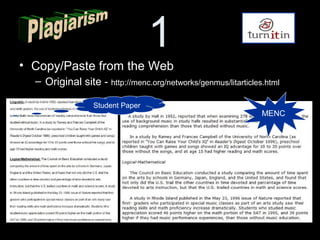
1
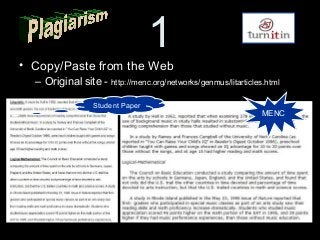
• Copy/Paste from the Web
– Original site - http://menc.org/networks/genmus/litarticles.html
MENC
Student Paper
OWL Email Support
http://owl.english.purdue.edu/writinglab/emailhelp
The Writing Process
• OWL at Purdue -
http://owl.english.purdue.edu/owl/
• OWL APA -
http://owl.english.purdue.edu/owl/resource
/560/01/
• Powerpoint - The Writing Process
-http://owl.english.purdue.edu/media/ppt/2
0071017024844_701.ppt

APA Research Article Review

  • 1.
    Research Article Review Guidelinesfor APA Paper Dr. Carla Piper
  • 2.
    Peer-Reviewed Research In academicpublishing, the goal of peer review is to assess the quality of articles submitted for publication in a scholarly journal. – Author submits to scholarly journal editor – Reviewed by experts who specialize in the field – Impartial reviewers check manuscript for accuracy and assess the validity of the research methodology and procedures. Resource - http://guides.lib.jjay.cuny.edu/content.php?pid=209679&
  • 3.
    Where do Ifind a Peer-Reviewed Research Article? • Click on the “Library” on the red button left menu. • Go to the “Library Home Page” • http://www1.chapman.edu/library/
  • 4.
    Start Your Search •Go to “Databases” • Click on “Subject” • Select “Education”
  • 5.
    Brandman/Chapman Library • Clickon “Connect” • Select one of the “Education Specific Databases” • Recommend Education Full Text, ERIC EBESCO, or Academic Search Premier • Log in with your Brandman User Name (1st part – no @) and Password
  • 6.
    Education Full TextExample • Use Boolean Search Terms – Recommend “and” • Use 2-3 terms including one technology, computer, or digital media term and at least one subject matter term or instructional/assessment strategy
  • 7.
    Select Full TextCurrent Peer- Reviewed Journal Articles
  • 8.
  • 9.
    APA Style Basics •http://www.apastyle.org/ • Video Tutorials • “The rules of APA Style®, detailed in the Publication Manual of the American Psychological Association, offer sound guidance for writing with simplicity, power, and concision. APA Style has been adapted by many disciplines and is used by writers around the world.”
  • 10.
    APA References atOWL No DOI: Author, A. A., & Author, B. B. (Date of publication). Title of article. Title of Online Periodical, volume number(issue number if available). Retrieved from http ://www.someaddress.com/full/url/ With DOI: Author, A. A., & Author, B. B. (Date of publication). Title of article. Title of Journal, volume number. doi:0000000/000000000000 No DOI but article appears as a printed version as well (URL not required). Use "Electronic version" in brackets after the article's title. Whitmeyer, J. M. (2000). Power through appointment [Electronic version]. Social Science Research, 29, 535-555.
  • 11.
    Reference List • ReferencePage - Include a separate page for your APA Reference https://owl.english.purdue.edu/owl/resource/560/10/ • Examine Formats for “Reference List: Electronic Sources.” • Acceptable Electronic Formats
  • 12.
    APA Citations atOWL http://owl.english.purdue.edu/owl/resource/560/02/ Short Quotations – If you are directly quoting from a work, you will need to include the author, year of publication, and the page number for the reference (preceded by "p."). Introduce the quotation with a signal phrase that includes the author's last name followed by the date of publication in parentheses. – According to Jones (1998), "Students often had difficulty using APA style, especially when it was their first time" (p. 199). – Jones (1998) found "students often had difficulty using APA style" (p. 199); what implications does this have for teachers? – If the author is not named in a signal phrase, place the author's last name, the year of publication, and the page number in parentheses after the quotation. She stated, "Students often had difficulty using APA style," (Jones, 1998, p. 199), but she did not offer an explanation as to why.
  • 13.
  • 14.
    Article Review Assignment •Title Page – https://owl.english.purdue.edu/owl/resource/560/01/ • You do not need an abstract for this short article review paper assignment. • Paragraph 1 – Introduction – Include an author (date) citation – Explain how this article relates to technology in education and why it is significant. – Thesis statement Example – “The purpose of this study was to…..” – Use 3rd person
  • 15.
    Paragraphs 2-4 (or5): Body • Describe the research conducted and the technology or digital media being used. • Select 3 key topics or ideas from this paper • Provide a thorough analysis, synthesis, or summary of each topic. • You may wish to write a paragraph briefly summarizing each topic. – Remember that all quotations require a p. or para. number. – Limit your quotations to 2 short quotations for this brief length of paper.
  • 16.
    Final Paragraph • Conclusion:Synthesize and summarize • You may present your personal critique or opinion using 1st person. • Respect the credentials of the researcher and author! Remember that peer-reviewed research is conducted in a controlled setting with an established research methodology. • Discuss how you feel this digital media or technology can positively or negatively result in student learning, teacher productivity and collaboration, digital equity, communication, etc.
  • 17.
  • 18.
    Common Writing Errors MyOwn Personal Writing Lab OWL of Purdue Carla Piper, Ed. D.
  • 19.
    10 • Excessive quoting •Paraphrase: Write it in your own words - http://owl.english.purdue.edu/owl/resource/563/02/ • Page or para ¶ numbers and citing indirect sources
  • 20.
    9 • Too casual- colloquialisms, contractions, spelling shortcuts, exclamation points!! – The email effect! • Point of View and Voice - http://owl.english.purdue.edu/owl/resource/560/15/
  • 21.
    8 • Expletives atthe beginning of the sentence. • Things to avoid - http://owl.english.purdue.edu/owl/resource/572/04/
  • 22.
    7 • Parallel SentenceStructure • http://owl.english.purdue.edu/owl/resource/623/01/ Run-ons 1 2
  • 23.
  • 24.
    5 • Subject /Verbagreement – http://owl.english.purdue.edu/owl/resource/599/01/ • Consistent Verb Tense http://owl.english.purdue.edu/owl/resource/601/01/
  • 25.
    4 • Plural vs.Possessive • Apostrophes - http://owl.english.purdue.edu/owl/resource/621/01/ it’s or its Student’s or Students’
  • 26.
    3 • Commas –too many or too few! • Quick Rules - http://owl.english.purdue.edu/owl/resource/607/01/ • Extended rules - http://owl.english.purdue.edu/owl/resource/607/02/
  • 27.
    2• Run-on sentences •Sentence fragments http://owl.english.purdue.edu/owl/resource/620/01/ 1 2
  • 28.
    Student Critique AVOID! • Rememberthat most of these authors are academic leaders and researchers with earned doctorates in their field! • Focus on what the study accomplishes in terms of furthering research rather than on the knowledge and writing skills of the author! They are the authorities!
  • 29.
    1 • Copy/Paste fromthe Web – Original site - http://menc.org/networks/genmus/litarticles.html MENC Student Paper
  • 30.
  • 31.
    The Writing Process •OWL at Purdue - http://owl.english.purdue.edu/owl/ • OWL APA - http://owl.english.purdue.edu/owl/resource /560/01/ • Powerpoint - The Writing Process -http://owl.english.purdue.edu/media/ppt/2 0071017024844_701.ppt