Hitler and Nazi Germany
Appeal of
Hitler and
the Nazis
In today’s class, I am learning to:
• Describe the organisation of the Nazi
Party
• Explain why support for the Nazi Party
increased in Germany
Appeal of Hitler & the Nazis
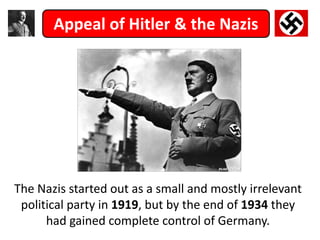
The Nazis started out as a small and mostly irrelevant
political party in 1919, but by the end of 1934 they
had gained complete control of Germany.
Appeal of Hitler & the Nazis
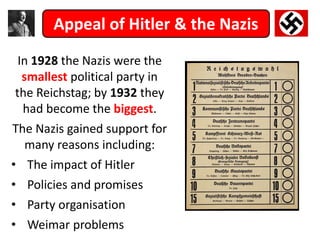
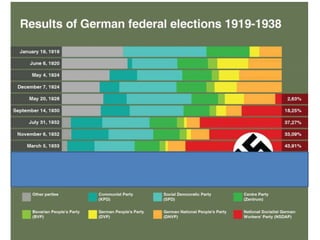
In 1928 the Nazis were the
smallest political party in
the Reichstag; by 1932 they
had become the biggest.
The Nazis gained support for
many reasons including:
• The impact of Hitler
• Policies and promises
• Party organisation
• Weimar problems
Appeal of Hitler & the Nazis
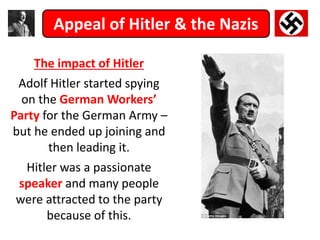
The impact of Hitler
Adolf Hitler started spying
on the German Workers’
Party for the German Army –
but he ended up joining and
then leading it.
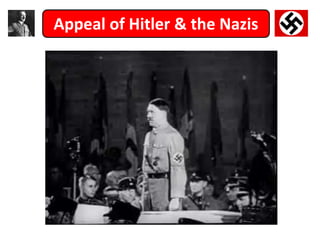
Hitler was a passionate
speaker and many people
were attracted to the party
because of this.
Appeal of Hitler & the Nazis
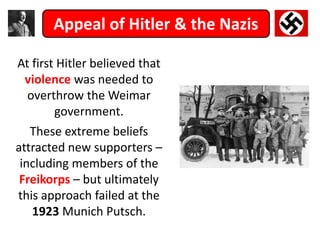
At first Hitler believed that
violence was needed to
overthrow the Weimar
government.
These extreme beliefs
attracted new supporters –
including members of the
Freikorps – but ultimately
this approach failed at the
1923 Munich Putsch.
Appeal of Hitler & the Nazis
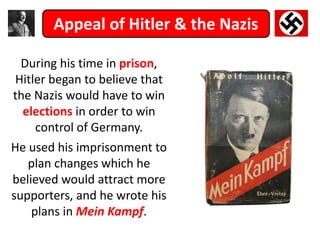
During his time in prison,
Hitler began to believe that
the Nazis would have to win
elections in order to win
control of Germany.
He used his imprisonment to
plan changes which he
believed would attract more
supporters, and he wrote his
plans in Mein Kampf.
Appeal of Hitler & the Nazis
Hitler’s role was also
important because he
attracted support – and
funding – from rich
Germans to wanted to stop
a Communist takeover.
Hitler used this money to
fund propaganda and
organise Nazi election
campaigns too.
Appeal of Hitler & the Nazis
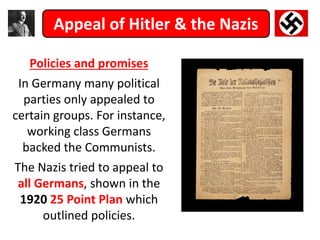
Policies and promises
In Germany many political
parties only appealed to
certain groups. For instance,
working class Germans
backed the Communists.
The Nazis tried to appeal to
all Germans, shown in the
1920 25 Point Plan which
outlined policies.
Appeal of Hitler & the Nazis
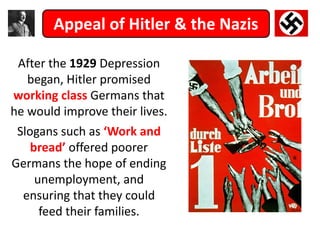
After the 1929 Depression
began, Hitler promised
working class Germans that
he would improve their lives.
Slogans such as ‘Work and
bread’ offered poorer
Germans the hope of ending
unemployment, and
ensuring that they could
feed their families.
Appeal of Hitler & the Nazis
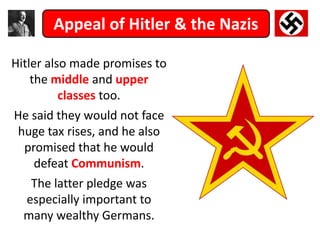
Hitler also made promises to
the middle and upper
classes too.
He said they would not face
huge tax rises, and he also
promised that he would
defeat Communism.
The latter pledge was
especially important to
many wealthy Germans.
Appeal of Hitler & the Nazis
The Nazis also appealed to
Germans’ sense of national
pride.
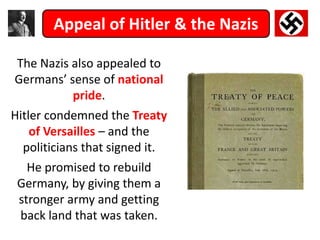
Hitler condemned the Treaty
of Versailles – and the
politicians that signed it.
He promised to rebuild
Germany, by giving them a
stronger army and getting
back land that was taken.
Appeal of Hitler & the Nazis
The Nazis also appealed to
very negative elements of
German society.
Jewish people had faced
discrimination all across
Europe – and Hitler
continued this in Germany.
Hitler said he would get rid
of ‘outsiders’ that he
believed damaged Germany.
Appeal of Hitler & the Nazis
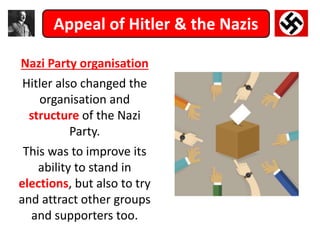
Nazi Party organisation
Hitler also changed the
organisation and
structure of the Nazi
Party.
This was to improve its
ability to stand in
elections, but also to try
and attract other groups
and supporters too.
Appeal of Hitler & the Nazis
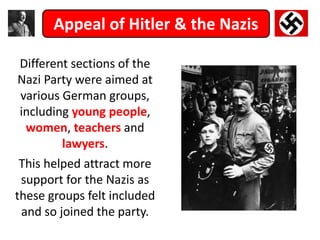
Different sections of the
Nazi Party were aimed at
various German groups,
including young people,
women, teachers and
lawyers.
This helped attract more
support for the Nazis as
these groups felt included
and so joined the party.
Appeal of Hitler & the Nazis
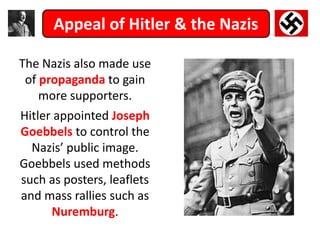
The Nazis also made use
of propaganda to gain
more supporters.
Hitler appointed Joseph
Goebbels to control the
Nazis’ public image.
Goebbels used methods
such as posters, leaflets
and mass rallies such as
Nuremburg.
Appeal of Hitler & the Nazis
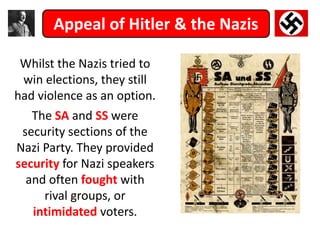
Whilst the Nazis tried to
win elections, they still
had violence as an option.
The SA and SS were
security sections of the
Nazi Party. They provided
security for Nazi speakers
and often fought with
rival groups, or
intimidated voters.
Appeal of Hitler & the Nazis
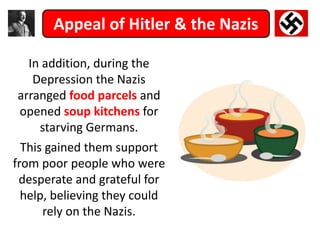
In addition, during the
Depression the Nazis
arranged food parcels and
opened soup kitchens for
starving Germans.
This gained them support
from poor people who were
desperate and grateful for
help, believing they could
rely on the Nazis.
Appeal of Hitler & the Nazis
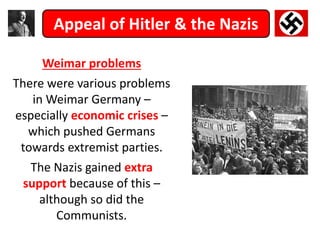
Weimar problems
There were various problems
in Weimar Germany –
especially economic crises –
which pushed Germans
towards extremist parties.
The Nazis gained extra
support because of this –
although so did the
Communists.
Appeal of Hitler & the Nazis
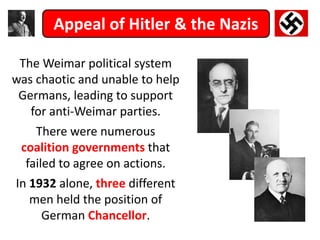
The Weimar political system
was chaotic and unable to help
Germans, leading to support
for anti-Weimar parties.
There were numerous
coalition governments that
failed to agree on actions.
In 1932 alone, three different
men held the position of
German Chancellor.
Appeal of Hitler & the Nazis
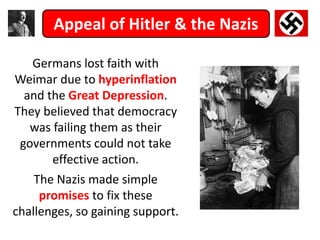
Germans lost faith with
Weimar due to hyperinflation
and the Great Depression.
They believed that democracy
was failing them as their
governments could not take
effective action.
The Nazis made simple
promises to fix these
challenges, so gaining support.
Appeal of Hitler & the Nazis
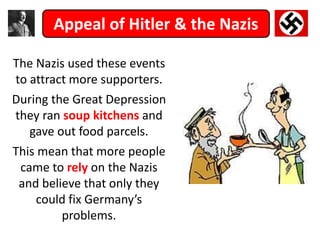
The Nazis used these events
to attract more supporters.
During the Great Depression
they ran soup kitchens and
gave out food parcels.
This mean that more people
came to rely on the Nazis
and believe that only they
could fix Germany’s
problems.
Appeal of Hitler & the Nazis
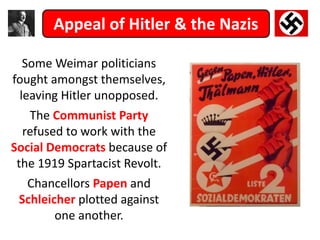
Some Weimar politicians
fought amongst themselves,
leaving Hitler unopposed.
The Communist Party
refused to work with the
Social Democrats because of
the 1919 Spartacist Revolt.
Chancellors Papen and
Schleicher plotted against
one another.
Appeal of Hitler & the Nazis
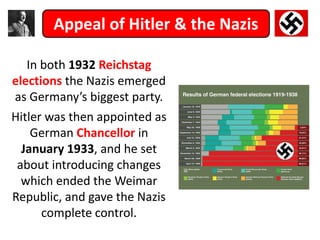
In both 1932 Reichstag
elections the Nazis emerged
as Germany’s biggest party.
Hitler was then appointed as
German Chancellor in
January 1933, and he set
about introducing changes
which ended the Weimar
Republic, and gave the Nazis
complete control.
Hitler and Nazi Germany - appeal of the hitler and the nazis