








TRANSITIONAL JUSTICE
____________________
A NEW DISCIPLINE OF
HUMAN RIGHTS
______________________________
Kora Andrieu
2010
Hasmik Manukyan
C.I.F.E M.A.E.I.S Anglophone Branch
- 2013-
WHAT IS TRANSITIONAL
JUSTICE ?
O Transitional justice is a response to systematic
or widespread violations of human rights.
O It seeks recognition for victims and promotion
of possibilities for peace, reconciliation and
democracy.
O Transitional justice is not a special form of
justice but justice adapted to societies
transforming themselves after a period of
pervasive human rights abuse.
O In some cases these transformations happen
suddenly, in others they may take place over
many decades.
TJ Historical Background
O Transitional Justice (TJ) is as an approach
emerged late 1980s and early 1990s.
O In response to political changes in Latin America
and Eastern Europe – to demands in this regions
for justice.
O At the time human rights activists wanted to
address systematic abuses by former regimes
without endangering political transformations.
O Since these changes were called “transitions to
democracy”, people named this new
multidisciplinary field “transitional justice”.
Quotes about TJ
O “Transitional justice should be designed to
strengthen democracy and peace – the key goals of
societies picking up the pieces after periods of mass
abuse”.
O “Within this diversity of experience, though, the trend
has been toward seeking some kind of closure. More
than 20 nations in the last two dozen years have
tried the institutionalized search for ''truth and
reconciliation,'' giving rise to the new academic
discipline of ''transitional justice,'' with its lexicon of
''retributive justice,'' ''restorative justice,'' ''historical
clarification,'' ''lustration'' and so on.”
O Kimberley Theidon call it “TJ industry, composed of
teams of experts, consultants, software packages or
data management, and a set of assumptions on how
to do memory and why memory matters.”
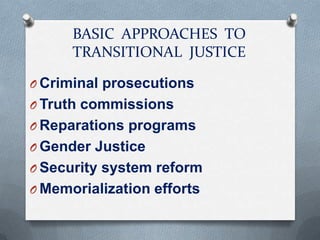
BASIC APPROACHES TO
TRANSITIONAL JUSTICE
O Criminal prosecutions
O Truth commissions
O Reparations programs
O Gender Justice
O Security system reform
O Memorialization efforts
Criminal Prosecutions
O These are judicial investigations of
those responsible for human rights
violations.
O Prosecutors frequently emphasize
investigations of the “big fish”:
suspects considered most
responsible for massive or
systematic crimes.
Truth Commissions
O These commissions of inquiry have
the primary purposes of investigating
and reporting on key periods of
recent abuse.
O They are often official state bodies
that make recommendations to
remedy such abuse and to prevent its
recurrence.
Reparations Programs
O These are state-sponsored initiatives
that help repair the material and moral
damages of past abuse.
O They typically distribute a mix of
material and symbolic benefits to
victims.
O Benefits that may include financial
compensation and official apologies.
O Instrument of reparation claims is not
criminal but civil law.
Gender Justice
O These efforts challenge impunity
for sexual and gender-based
violence.
O Ensure women’s equal access to
redress of human rights violations.
Security System Reform
O These efforts seek to transform the
military, police, judiciary and
related state institutions from
instruments of repression and
corruption into instruments of
public service and integrity.
Memorialization Efforts
O These include museums and
memorials that preserve public
memory of victims and raise moral
consciousness about past abuse, in
order to prevent its recurrence.
Which are the goals of TJ?
O Transformation or the regeneration of a
whole society.
It involves political, economic, cultural, sociological
and psychological actions:
- Prosecutions
- Truth / Reconciliation commissions
- Lustration
- Public access to police & government records
- Public apology
- Public memorials
- Reburial of victims
- Compensations, reparations
- Literary and historical writings
"Three R's" of
Transitional Justice
O Reconstruction
O Repair
O Reconciliation
Kora Andrieu distinguishes three
main categories of action for TJ
O (i) legal justice - refers to security and
judicial system reform.
O (ii) restorative justice - refers to
restoring the truth about the past, to
forgiveness, reconciliation and collective
memory in rebuilding societies.
O (iii) social justice - refers to promotion
of social trust, reparations, social
integration and structural social reforms.
Legal justice
O The historical background of Trials:
- Nuremberg Trails (1945-1949) - “the re-founding of a
political and moral community through the narration
of past horrors. (Simpson, 2008).
- Tokyo military tribunal – “little more than a sword in a
judge’s wig” (Radhabinod Pal, 2011).
O Ad hoc tribunals and International Criminal
Court:
- UN decision to create International Criminal tribunals
for ex-Yugoslavia (ICTY, 1993), and
Rwanda(ICTR, 1995).
- International Criminal Court (ICC, 2002) – main role
is to gather evidence and lead investigations in war
zones
Legal justice (II)
O Hybrid courts :
- Hybrid or “internationalized” courts – a mix of
domestic and international instruments of justice.
(established in Bosnia. Kosovo, Sierra Leone, East
Timor, Cambodia, Iraq, Lebanon).
- Truth Commissions – often official state bodies that
make recommendations to remedy recent abuse and
prevent its recurrence.
O Local justice:
- “based on local structures with local actors, TJ can be
more conducive to empowering people and building
capacities for both peace & justice” (Shaw, 2007).
Restorative justice
O “A normative theory of social repair, focuses less on
perpetrators to the benefit of victims, shifts justice
back to the affected
communities.(Braithwaite, 1999).
O “The aim of RJ is therefore to democratize the social
control of punishment, by making its methods more
consensual & participatory”. (Dzur, 2003).
O Its application to mass atrocities in post-conflict
situations, mainly through Truth & Reconciliation
Commissions (TRC). (Hayner, 1994).
O TRCs can make recommendations for broad reform
of state institutions based on their findings, and
suggest reparations for the victims.
Two kinds of TRC
can be distinguished
O (i) participatory model (South African) –
fostering reconciliation by public dialogue
and collective acknowledgement.
O (ii) other TRCs are constructed more as
educational fact-finding bodies – with the
explicit aim of encouraging historical
interpretation and disseminating a new
collective memory. (TRCs in El
Salvador, East Germany and Guatemala).
Social justice
O Reparation programs
O Material reparations – meant to put an end to an
unjust situation through the allocation of a monetary
equivalent that is supposed to compensate for it.
O As opposed to restorative justice reparation policies
are said to be morally neutral.
O Other types of compensation could include
restitution of lost property, the building of
memorials, the naming of streets after victims, the
revision of history books.
O Official apologies too are sometimes included in the
reparative paradigm.
O Limits – no money can be put on people’s suffering.
Timing of reparation. Collective responsibility for
crimes
Transitional justice initiatives
are mostly implemented by:
O NGOs
O Local and regional organizations
O UN programs
O International institutions
O International Criminal Court
O World Bank and so on
TRANSITIONAL JUSTICE
reconstructing self & society
http://tj.facinghistory.org/
Case studies
O Germany
O Northern Ireland
O Rwanda
O South Africa
Oxford Transitional Justice Research
http://www.csls.ox.ac.uk/otjr.php
O Oxford Transitional Justice Research
(OTJR) is an inter-disciplinary network
of more than 150 Oxford staff and
students working broadly on issues of
transition in societies recovering from
mass conflict and/or repressive rule.
O Founded in 2007, it is now one of the
largest and most diverse academic
communities conducting research in
this field.
International Center for
Transitional Justice (ICTJ)
ICTJ assists countries pursuing
accountability for past mass atrocity or
human rights abuse.
www.ictj.org
http://www.youtube.com/watch?v=AHeecxi
fBvs
Why Transitional Justice
O http://www.youtube.com/watch?v=EIYpJxwc6Jo
Peace and Justice
O http://www.youtube.com/watch?v=PWFpngEfu8
4
The Case for Justice
O http://www.youtube.com/watch?feature=player_
embedded&v=2fm1GmDwOqo
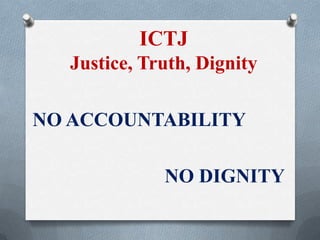
ICTJ
Justice, Truth, Dignity
NO ACCOUNTABILITY
NO DIGNITY
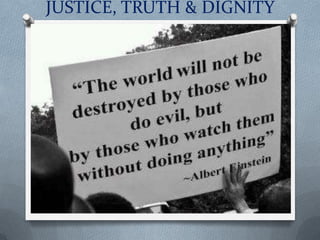
TJ & Graffiti in Libya
http://justiceinconflict.org/2011/12/12/transitional-justice-and-graffiti-in-libya/
PEACE & LOVE
Home & Security
WE DESTROY PEACE
BORDERS
JUSTICE, TRUTH & DIGNITY
GIVE PEACE A CHANCE

Transitional justice human rights discipline

  • 1.
    TRANSITIONAL JUSTICE ____________________ A NEWDISCIPLINE OF HUMAN RIGHTS ______________________________ Kora Andrieu 2010 Hasmik Manukyan C.I.F.E M.A.E.I.S Anglophone Branch - 2013-
  • 2.
    WHAT IS TRANSITIONAL JUSTICE? O Transitional justice is a response to systematic or widespread violations of human rights. O It seeks recognition for victims and promotion of possibilities for peace, reconciliation and democracy. O Transitional justice is not a special form of justice but justice adapted to societies transforming themselves after a period of pervasive human rights abuse. O In some cases these transformations happen suddenly, in others they may take place over many decades.
  • 3.
    TJ Historical Background OTransitional Justice (TJ) is as an approach emerged late 1980s and early 1990s. O In response to political changes in Latin America and Eastern Europe – to demands in this regions for justice. O At the time human rights activists wanted to address systematic abuses by former regimes without endangering political transformations. O Since these changes were called “transitions to democracy”, people named this new multidisciplinary field “transitional justice”.
  • 4.
    Quotes about TJ O“Transitional justice should be designed to strengthen democracy and peace – the key goals of societies picking up the pieces after periods of mass abuse”. O “Within this diversity of experience, though, the trend has been toward seeking some kind of closure. More than 20 nations in the last two dozen years have tried the institutionalized search for ''truth and reconciliation,'' giving rise to the new academic discipline of ''transitional justice,'' with its lexicon of ''retributive justice,'' ''restorative justice,'' ''historical clarification,'' ''lustration'' and so on.” O Kimberley Theidon call it “TJ industry, composed of teams of experts, consultants, software packages or data management, and a set of assumptions on how to do memory and why memory matters.”
  • 5.
    BASIC APPROACHES TO TRANSITIONALJUSTICE O Criminal prosecutions O Truth commissions O Reparations programs O Gender Justice O Security system reform O Memorialization efforts
  • 6.
    Criminal Prosecutions O Theseare judicial investigations of those responsible for human rights violations. O Prosecutors frequently emphasize investigations of the “big fish”: suspects considered most responsible for massive or systematic crimes.
  • 7.
    Truth Commissions O Thesecommissions of inquiry have the primary purposes of investigating and reporting on key periods of recent abuse. O They are often official state bodies that make recommendations to remedy such abuse and to prevent its recurrence.
  • 8.
    Reparations Programs O Theseare state-sponsored initiatives that help repair the material and moral damages of past abuse. O They typically distribute a mix of material and symbolic benefits to victims. O Benefits that may include financial compensation and official apologies. O Instrument of reparation claims is not criminal but civil law.
  • 9.
    Gender Justice O Theseefforts challenge impunity for sexual and gender-based violence. O Ensure women’s equal access to redress of human rights violations.
  • 10.
    Security System Reform OThese efforts seek to transform the military, police, judiciary and related state institutions from instruments of repression and corruption into instruments of public service and integrity.
  • 11.
    Memorialization Efforts O Theseinclude museums and memorials that preserve public memory of victims and raise moral consciousness about past abuse, in order to prevent its recurrence.
  • 12.
    Which are thegoals of TJ? O Transformation or the regeneration of a whole society. It involves political, economic, cultural, sociological and psychological actions: - Prosecutions - Truth / Reconciliation commissions - Lustration - Public access to police & government records - Public apology - Public memorials - Reburial of victims - Compensations, reparations - Literary and historical writings
  • 13.
    "Three R's" of TransitionalJustice O Reconstruction O Repair O Reconciliation
  • 14.
    Kora Andrieu distinguishesthree main categories of action for TJ O (i) legal justice - refers to security and judicial system reform. O (ii) restorative justice - refers to restoring the truth about the past, to forgiveness, reconciliation and collective memory in rebuilding societies. O (iii) social justice - refers to promotion of social trust, reparations, social integration and structural social reforms.
  • 15.
    Legal justice O Thehistorical background of Trials: - Nuremberg Trails (1945-1949) - “the re-founding of a political and moral community through the narration of past horrors. (Simpson, 2008). - Tokyo military tribunal – “little more than a sword in a judge’s wig” (Radhabinod Pal, 2011). O Ad hoc tribunals and International Criminal Court: - UN decision to create International Criminal tribunals for ex-Yugoslavia (ICTY, 1993), and Rwanda(ICTR, 1995). - International Criminal Court (ICC, 2002) – main role is to gather evidence and lead investigations in war zones
  • 16.
    Legal justice (II) OHybrid courts : - Hybrid or “internationalized” courts – a mix of domestic and international instruments of justice. (established in Bosnia. Kosovo, Sierra Leone, East Timor, Cambodia, Iraq, Lebanon). - Truth Commissions – often official state bodies that make recommendations to remedy recent abuse and prevent its recurrence. O Local justice: - “based on local structures with local actors, TJ can be more conducive to empowering people and building capacities for both peace & justice” (Shaw, 2007).
  • 17.
    Restorative justice O “Anormative theory of social repair, focuses less on perpetrators to the benefit of victims, shifts justice back to the affected communities.(Braithwaite, 1999). O “The aim of RJ is therefore to democratize the social control of punishment, by making its methods more consensual & participatory”. (Dzur, 2003). O Its application to mass atrocities in post-conflict situations, mainly through Truth & Reconciliation Commissions (TRC). (Hayner, 1994). O TRCs can make recommendations for broad reform of state institutions based on their findings, and suggest reparations for the victims.
  • 18.
    Two kinds ofTRC can be distinguished O (i) participatory model (South African) – fostering reconciliation by public dialogue and collective acknowledgement. O (ii) other TRCs are constructed more as educational fact-finding bodies – with the explicit aim of encouraging historical interpretation and disseminating a new collective memory. (TRCs in El Salvador, East Germany and Guatemala).
  • 19.
    Social justice O Reparationprograms O Material reparations – meant to put an end to an unjust situation through the allocation of a monetary equivalent that is supposed to compensate for it. O As opposed to restorative justice reparation policies are said to be morally neutral. O Other types of compensation could include restitution of lost property, the building of memorials, the naming of streets after victims, the revision of history books. O Official apologies too are sometimes included in the reparative paradigm. O Limits – no money can be put on people’s suffering. Timing of reparation. Collective responsibility for crimes
  • 20.
    Transitional justice initiatives aremostly implemented by: O NGOs O Local and regional organizations O UN programs O International institutions O International Criminal Court O World Bank and so on
  • 21.
    TRANSITIONAL JUSTICE reconstructing self& society http://tj.facinghistory.org/ Case studies O Germany O Northern Ireland O Rwanda O South Africa
  • 22.
    Oxford Transitional JusticeResearch http://www.csls.ox.ac.uk/otjr.php O Oxford Transitional Justice Research (OTJR) is an inter-disciplinary network of more than 150 Oxford staff and students working broadly on issues of transition in societies recovering from mass conflict and/or repressive rule. O Founded in 2007, it is now one of the largest and most diverse academic communities conducting research in this field.
  • 23.
    International Center for TransitionalJustice (ICTJ) ICTJ assists countries pursuing accountability for past mass atrocity or human rights abuse. www.ictj.org http://www.youtube.com/watch?v=AHeecxi fBvs
  • 25.
    Why Transitional Justice Ohttp://www.youtube.com/watch?v=EIYpJxwc6Jo Peace and Justice O http://www.youtube.com/watch?v=PWFpngEfu8 4 The Case for Justice O http://www.youtube.com/watch?feature=player_ embedded&v=2fm1GmDwOqo
  • 26.
    ICTJ Justice, Truth, Dignity NOACCOUNTABILITY NO DIGNITY
  • 27.
    TJ & Graffitiin Libya http://justiceinconflict.org/2011/12/12/transitional-justice-and-graffiti-in-libya/
  • 30.
  • 31.
  • 32.
  • 33.
  • 34.
  • 35.