EAP OR TEAP?
RICHARD WATSON TODD
M.BOLOURI9@GMAIL.COM
PRESENTED BY M.BOLOURI
Journal of English for Academic Purposes
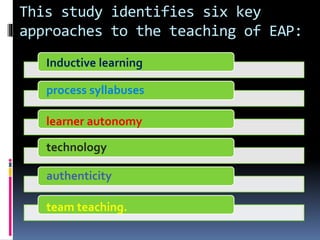
This study identifies six key
approaches to the teaching of EAP:
Inductive learning
process syllabuses
learner autonomy
technology
authenticity
team teaching.
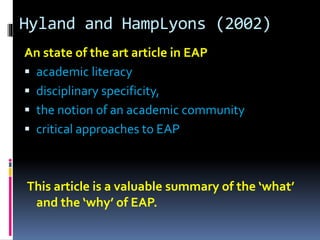
Hyland and HampLyons (2002)
An state of the art article in EAP
 academic literacy
 disciplinary specificity,
 the notion of an academic community
 critical approaches to EAP
This article is a valuable summary of the ‘what’
and the ‘why’ of EAP.
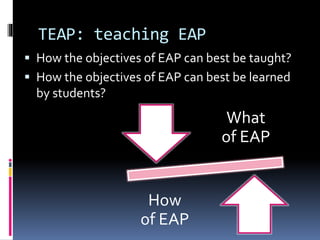
TEAP: teaching EAP
 How the objectives of EAP can best be taught?
 How the objectives of EAP can best be learned
by students?
What
of EAP
How
of EAP
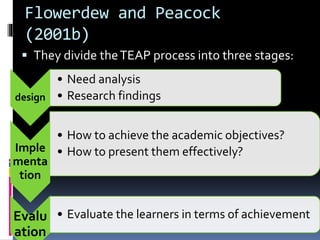
Flowerdew and Peacock
(2001b)
 They divide theTEAP process into three stages:
design
• Need analysis
• Research findings
Imple
menta
tion
• How to achieve the academic objectives?
• How to present them effectively?
Evalu
ation
• Evaluate the learners in terms of achievement
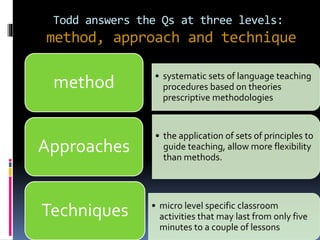
Todd answers the Qs at three levels:
method, approach and technique
• systematic sets of language teaching
procedures based on theories
prescriptive methodologies
method
• the application of sets of principles to
guide teaching, allow more flexibility
than methods.
Approaches
• micro level specific classroom
activities that may last from only five
minutes to a couple of lessons
Techniques
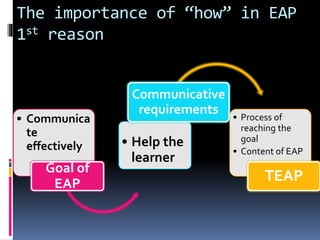
The importance of “how” in EAP
1st reason
• Communica
te
effectively
Goal of
EAP
• Help the
learner
Communicative
requirements • Process of
reaching the
goal
• Content of EAP
TEAP
The importance of “how” in EAP
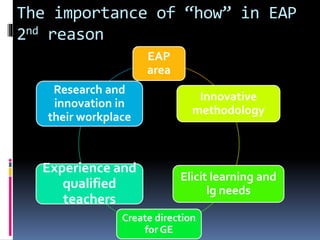
2nd reason
EAP
area
Innovative
methodology
Elicit learning and
lg needs
Create direction
for GE
Experience and
qualified
teachers
Research and
innovation in
their workplace
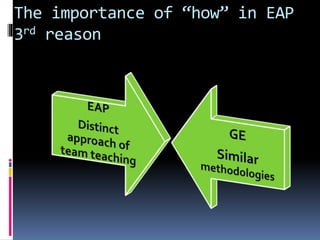
The importance of “how” in EAP
3rd reason
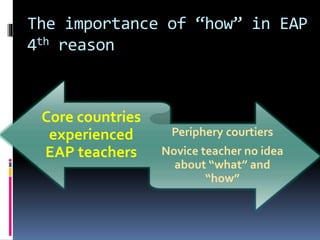
The importance of “how” in EAP
4th reason
Core countries
experienced
EAP teachers
Periphery courtiers
Novice teacher no idea
about “what” and
“how”
Method & approach in EAP
 Method: restrictive and prescriptive
how to teach EAP at the macro-level of method, has
not been very fruitful yet.
 Approach
1. lists of principles that guide EAP teaching
Hutchinson and Waters (1987) list eight principles:
language learning is an active process
language learning is an emotional experience
language learning is not systematic
2. global teaching and learning practices from
which principles can be drawn.
characteristic of tertiary EAP
EAP-specific goals, distinct content of EAP ,
specific genres, specific approaches
The nature of the students , more mature, more
self-directed and more aware, emphasizing
learner autonomy
EAP situations frequently have more resources,
available informants expert (the practicalities of
many EAP situations)
1. Inductive teaching
 the teaching of reading focusing on text
analysis
 students are encouraged to act as researchers
investigating academic communities
2. process syllabuses
 task-based and project-based learning.
3. emphasis on self-access
learning in EAP
 the use of negotiated syllabuses
 an emphasis on self and peer assessment and
feedback
 aim to promote learner autonomy
4. authenticity
The use of case studies in the teaching of EAP
for
 business
 law
 medicine
 engineering
5. technology
EAP course objectives may include technology
oriented goals
 computer concordancing
 the use of CD-ROMs
 Computer mediated communication
6. Team teaching
 This approach is specific to EAP.
 cooperating with content teachers
These six approaches are not
mutually exclusive.
Techniques in EAP
 They are more specific than approach
 They lack generalizability
 They are often equated with activities
 A few techniques such as brainstorming, can be
applied to a wide range of objectives and
situations.
 The only text of techniques by a major publisher is
Holme (1996).
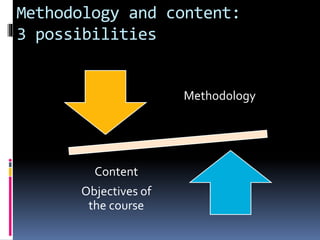
Methodology and content:
3 possibilities
Methodology
Content
Objectives of
the course
Thank you for your attention
any comments? Ideas? Questions?

discourse analysis EAP

  • 1.
    EAP OR TEAP? RICHARDWATSON TODD M.BOLOURI9@GMAIL.COM PRESENTED BY M.BOLOURI Journal of English for Academic Purposes
  • 2.
    This study identifiessix key approaches to the teaching of EAP: Inductive learning process syllabuses learner autonomy technology authenticity team teaching.
  • 3.
    Hyland and HampLyons(2002) An state of the art article in EAP  academic literacy  disciplinary specificity,  the notion of an academic community  critical approaches to EAP This article is a valuable summary of the ‘what’ and the ‘why’ of EAP.
  • 4.
    TEAP: teaching EAP How the objectives of EAP can best be taught?  How the objectives of EAP can best be learned by students? What of EAP How of EAP
  • 5.
    Flowerdew and Peacock (2001b) They divide theTEAP process into three stages: design • Need analysis • Research findings Imple menta tion • How to achieve the academic objectives? • How to present them effectively? Evalu ation • Evaluate the learners in terms of achievement
  • 6.
    Todd answers theQs at three levels: method, approach and technique • systematic sets of language teaching procedures based on theories prescriptive methodologies method • the application of sets of principles to guide teaching, allow more flexibility than methods. Approaches • micro level specific classroom activities that may last from only five minutes to a couple of lessons Techniques
  • 7.
    The importance of“how” in EAP 1st reason • Communica te effectively Goal of EAP • Help the learner Communicative requirements • Process of reaching the goal • Content of EAP TEAP
  • 8.
    The importance of“how” in EAP 2nd reason EAP area Innovative methodology Elicit learning and lg needs Create direction for GE Experience and qualified teachers Research and innovation in their workplace
  • 9.
    The importance of“how” in EAP 3rd reason
  • 10.
    The importance of“how” in EAP 4th reason Core countries experienced EAP teachers Periphery courtiers Novice teacher no idea about “what” and “how”
  • 11.
    Method & approachin EAP  Method: restrictive and prescriptive how to teach EAP at the macro-level of method, has not been very fruitful yet.  Approach 1. lists of principles that guide EAP teaching Hutchinson and Waters (1987) list eight principles: language learning is an active process language learning is an emotional experience language learning is not systematic 2. global teaching and learning practices from which principles can be drawn.
  • 12.
    characteristic of tertiaryEAP EAP-specific goals, distinct content of EAP , specific genres, specific approaches The nature of the students , more mature, more self-directed and more aware, emphasizing learner autonomy EAP situations frequently have more resources, available informants expert (the practicalities of many EAP situations)
  • 13.
    1. Inductive teaching the teaching of reading focusing on text analysis  students are encouraged to act as researchers investigating academic communities
  • 14.
    2. process syllabuses task-based and project-based learning.
  • 15.
    3. emphasis onself-access learning in EAP  the use of negotiated syllabuses  an emphasis on self and peer assessment and feedback  aim to promote learner autonomy
  • 16.
    4. authenticity The useof case studies in the teaching of EAP for  business  law  medicine  engineering
  • 17.
    5. technology EAP courseobjectives may include technology oriented goals  computer concordancing  the use of CD-ROMs  Computer mediated communication
  • 18.
    6. Team teaching This approach is specific to EAP.  cooperating with content teachers These six approaches are not mutually exclusive.
  • 19.
    Techniques in EAP They are more specific than approach  They lack generalizability  They are often equated with activities  A few techniques such as brainstorming, can be applied to a wide range of objectives and situations.  The only text of techniques by a major publisher is Holme (1996).
  • 20.
    Methodology and content: 3possibilities Methodology Content Objectives of the course
  • 21.
    Thank you foryour attention any comments? Ideas? Questions?

Editor's Notes

  • #3 Significance of this study Most previous work in EAP has focused more on the content of teaching than on the methodology.
  • #4 In the introductory article to the first issue of a new journal, a key area of EAP that Hyland and Hamp-Lyons overlooked. In concentrating on what needs to be taught/learnt in EAP situations and why EAP teaching exists, the article pays little attention to how EAP can be taught
  • #5 the ‘what’ of EAP, is subservient to the goal of conveying this nature to students, the ‘how’ of EAP.
  • #6 In implementing courses, on the other hand, the ‘how’ comes to the forefront. At this stage, typical questions asked include ‘How can we help the students to achieve this objective?’ and ‘How can this information be most effectively presented to the students? the design being informed by needs analyses and research findings into the nature of academic communication
  • #7 Richards and Rodgers (2001) regard the whole of ESP, including EAP, as one of five possible approaches within content-based instruction I hope to show that the application of the levels of method, approach and technique to EAP can generate useful insights into how we teach EAP. as a type of teaching within which the three levels may be manifested.
  • #8 Todd listed 4 reason to study the how of EAP which will be explained now
  • #9 the restrictive nature of most methods, which prescribe how teachers should teach, whereas most EAP teachers are professionals who feel confident about their own ability to make decisions concerning teaching Such factors have pushed EAP to the forefront of the English teaching field.
  • #10 although EAP is usually considered distinct from general purpose English teaching in its content, it is not clear whether EAP methodology is also distinct. further research into EAP methodology is needed
  • #11 Effective teacher training for such novice teachers needs to include informed methodological support. Articles describing the nature of EAP communication probably greatly outnumber articles focusing on how to teach EAP.
  • #12 the list of principles is based on theory, whereas the six approaches above are derived from reports of teaching and learning practice and are thus of more immediate use for teachers.
  • #13 In other English language teaching situations, this is not usually the case. For instance, English for business teachers might also wish to work with expert informants, but are usually unable to do so. From a more practical perspective, EAP situations frequently have more resources than other English language teaching situations.
  • #14 We have seen that most work on how to teach EAP has been focused at the level of approach
  • #15 They are listed in terms of their prevalency
  • #17 EAP authentic materials are de rigueur. although the use of authentic materials can be found in much recent material for English for general purposes
  • #19 While the first five sets of practices I have outlined above can also be found in English for general purposes, albeit with less of an emphasis
  • #20 Techniques in teaching EAP have received very little attention. While there is a vast range of books specifically presenting innovative techniques for English for general purposesTextbooks for EAP also seem to show a lack of interest in techniques. This lack of interest may be because of their frequent inherent non-generalisability, the lack of academic cachet in writing about techniques, and an overall concern for more conceptual rather than procedural issues in teaching
  • #21 At one extreme, methodology can be given precedence over content. This is frequently the case in process syllabuses gives precedence to the content objectives and treats the methodology almost as an afterthought. more prevalent in EAP than in other forms of English language teaching Although in practice the weightings will depend on the requirements of each situation, the teaching of EAP has perhaps suffered from too great an emphasis on content.