Asking Sacred Questions:
Understanding
Religion’s Impact on Teacher
Belief and Action
KIMBERLY WHITE
Professor: Dr Tajeddin
by Maryam Bolouri
m.bolouri9@gmail.com
May 2016
The religious orientations of teachers
The development and enactment of professional
teaching identities
In what conscious and unconscious
ways the religious identifications
impact:
Why they enter the profession
How they relate to students,
How to make the instructional decisions
to support learning.
Some typical examples:
 how would Jewish teachers respond their
students’ questions who ask them about their
Christmas?
 How A conservative Christian teacher who
believes that
homosexuality is a sin and against the Bible
instructions should react to these contents in a
class?
 How a pacifist teacher should respond the
students’ questions about the country’s current
military measures against another country?

Religion
 Religion is a sensitive subject
 Many schools are instructed to neither promote nor
prohibit the establishment of religion. This is important
due to the age and nature of impressionable children and
young adults.
 The commonality is that the questions surface everyday in
schools; and every day, teachers use their religious
understandings to provide their own answers.
 The answers that educators provide are of the utmost
importance. Teachers facilitate
 learning
 students’ self-understanding and self-esteem
 Interactions between students, and students’
world perspectives
So it is a very delicate issue
 how teachers’ religious identifications impact
their thinking and practice.
 This awareness is needed for teachers to
1.promote positive interactions and
learning in students,
2.rather than promoting stereotypes
and misconceptions among
students
Purpose of this study:
1. why all teachers must deconstruct their notions
of religion as part of multicultural understanding.
2. The use of individual case studies to illustrate
the important questions
that surface in schools in relation to teachers’
religious beliefs and practices.
3. To provide a professional development
framework to help teachers
deconstruct their own religious orientations,
while also developing knowledge of how religion
impacts student cultures and classroom
performance.
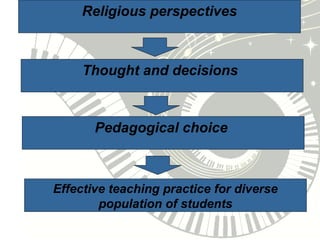
Religious perspectives
Pedagogical choice
Effective teaching practice for diverse
population of students
Thought and decisions
 the importance of
religious context in
understanding historic
and current events
 an understanding of
how religious context
shapes world events
 efforts are often driven
by a specific political
agenda
 the diversity of student
populations
Religious: inclusion or exclusion
Major US law article of 1998
 This signified a shift from protecting against
religious freedom to protecting for religious
freedom. as it asserted that pressures on
religious freedom were increasing, especially in
relation to the issue of religion in the public
school
 The true gatekeepers of what is done are
teachers. They control to what degree these
laws and policies are enacted in the classroom.
Individual teachers make the choices that
impact students’ sense of belonging and ability
to learn in a classroom.
A gap in literature? A probable topic for research?
 Educational research on multiculturalism and
teacher identity indicates that personal
experience and professional practice are
interwoven and cannot be separated
 Teachers bring their religious perspectives into
the classroom and the subject areas they teach
may reflect their viewpoints on religious issues.
 Numerous multicultural researchers have
indicated how race, socio-economic class, and
gender identification impact teaching and
learning in the classroom. Additional analysis that
incorporates religious understanding into this
multicultural paradigm is needed.
The study’s findings functions:
5 key themes surfaced from the data
(sacred questions)
 The educators must ask themselves to identify
their religious beliefs and how these
identifications may play out in the classroom.
 They represent the totality of the research
findings and the most common and salient ways
that the participants’ personal religious beliefs
impacted their decisions and actions in regards to
their teaching.
 Asking these sacred questions can promote self-
awareness in teachers, which is the first stage of
a development model that can be used to foster
further religious reflection.
Method
 a collective case study
 The qualitative study was comprised of six cases.
Three teachers were Christian and three were
Jewish
 The teachers identified themselves as religious,
meaning
1. they believed in a transcendent power
2.they held beliefs common to their religious
tradition
3.they followed these beliefs through ritual
practices
4.they each belonged to a religious institution
Method instrument
interview questions
 three sub-questions relating to philosophical
beliefs, social relations, and pedagogical
decisions:
1.why teachers entered the profession?
2. how they envisioned their role?
3.In what ways they structured relationships,
choices they made in relation to
curriculum, and educational strategies that
they enacted.
Participants selection
 Within each religion, the selected participants
represented a range from liberal to conservative
in belief in practice.
 10 All six of the cases were elementary-level
teachers
 elementary-level teachers were chosen because
of their extended contact with students
throughout the day and because of their
responsibility to cover all areas of curriculum.
Design of the study 1st
phase
 The author used life history methods of research
 four to five two-hour interviews with each participant
 They shared about their religious experience, religious
beliefs, and the purpose they draw from their religion.
They and identified their motivations to teach. They
described their teaching style and the pedagogical
choices that they enact on a routine basis.
 This life history approach made meaning out of
participants’ individual construction of identity within the
context of social and cultural relationships in schools and
places of worship.
 moving from a life story to a life history
 a holistic approach in which personal, religious
experiences and professional teaching lives were seen
in relationship to each other.
2nd
phase:
classroom observations and artifact analysis
 four half-day observations for each teacher
 To contextualize each case and see how
described pedagogies were enacted in the
classroom
 classroom interactions were recorded during
observations
 Artifacts such as lesson plans and parent
newsletters were collected to indicate curricular
and instructional decisions that were made when
the author was not observing the classroom
Data analysis
 The data was coded for the religious themes and teaching
indicators
 The three areas of teaching practice (educational
philosophy, social relations, and pedagogical choices)
were divided into orienting categories and indicators for
each category were identified.
 Topics such as forgiveness in the classroom,
discrimination and equity became relevant to religious
perspectives for multiple cases
 The validity of this data was tested by member checks.
Each teacher was provided with the interview transcripts
and a copy of the data summary
The results of the study: 1st
question
the reason to enter the profession
 Christianity suggests that ‘‘children will inherit the kingdom of God’’ and
Judaism instructs adherents to ‘‘teach the children.’’
 teaching allows them to serve a greater purpose.
2nd
question how they view students and how they
structure social relationships between students and
between themselves and the students.
 Christianity promotes forgiveness and the Golden Rule of
‘‘do unto others as you would have done unto you.’’
 Judaism, establishes ‘‘what is hateful to you, do not to your
fellow man’’ and ‘‘repair the world.’’
 These teachers stress community in the classroom because
relationships are what bring meaning to life.
3rd
question: the teachers’ personal and professional
beliefs that impact preferred instructional strategies.
The teachers’ personal and
professional beliefs impact preferred
instructional strategies.
Reading, studying, and translating
religious texts supports using this
same style of instruction and
promoting critical thinking in the
classroom.
Multiculturalism , sacred questions and religious
perspectives
 It encourages teachers to critically examine their
own cultural understandings in order to interact
more equitably with students of diverse
backgrounds.
 reflective self-analysis is important in
understanding ways that teachers’ cultural
constructions impact how they work with
students As teachers are often unaware of their
own biases and stereotypes
 Gap in literature: it has not fully examined how
teachers should engage in an examination of the
religious aspect of culture.
5 sacred questions
 five themes with related questions that each
educator should ask oneself in relation to
religious understanding
 represent the connections found between each
case’s religious orientation and his or her
classroom practice.
 the questions are of universal significance for
all educators, regardless of location and grade
level
1st
question: carrier choice
 ‘‘How might your religious beliefs and
experiences influence why you choose to teach
and what you believe to be the purpose of
education?’’
 For instance the participants stated their reasons as follows:
1. to be a witness of God’s love
2. to be a model of God’s light and love to his students and
colleagues
3. teaching is an opportunity to promote a more just society
4. teaching as an extension of social activism’
you have to be aware of the implications these dispositions
may hold for your professional practice
2nd
question: relationship ‘‘Based on your religious understanding, what gives your
life meaning and what is your responsibility toward others
with whom you come into contact? How does this impact
how you structure relationships between yourself and
students and between students themselves?’’
 without knowing each other through community, academic learning
would not be maximized
 Intw extraction:
1. what I would hope for my students is to get a kind of
connection with each other
2. Community is trusting others, knowing others, and
therefore knowing about oneself as a person and as a
learner
3. Competition would hinder rather than support, the
classroom
community they want to develop.
4. Mistakes are connected to repentance.
Cont.
 repentance, forgiveness, and the chance to start over
were the best gifts one could receive and give to
another. Rather than condemning students as bad, it
encouraged them to mediate and resolve their
problems.
 They connected mistakes and repentance to the
Christian belief in forgiveness and redemption through
Jesus Christ as dying to save people from their sins.
They believed that learning from mistakes was only one
part of the process; resolution was the final step that
had to be addressed.
 Teachers must encourage their students to take risks in
their learning, but to learn from their mistakes and
atone by rectifying the situation.
What would be the implications for
teachers?
 The sense of inclusion or exclusion impact
their own efficacy and achievement.
 The degree to which each teacher encounters
supportive relationships in the classroom and
in the school will affect his or her sense of
self-efficacy.
 In case of exclusion they sometimes feel they
lacked a critical mass of support, especially
when school practices are against their
religious principles.
3rd
question: life purpose and classroom
management
 ‘‘What purpose do you draw from your religion and
how do you view your future in life and after death?
How might these recognitions impact how you
structure discipline and motivation in your
classroom?’’
 Christian teachers, who believed in a dichotomy
between the eternal consequences of heaven and hell
were more likely to adopt authoritarian, teacher-
directed methods of behavior modification.
 the concept of externally imposed consequences
aligned with the religious perspective that un-repented
sin resulted in an eventual consequence of hell, while
proper behavior and good deeds supported grace and
the eternal reward of heaven.
Cont.
 The Jewish teachers in this study emphasized life on this
earth because they did not believe in heaven and hell, and
they were more likely to use a discipline structure that
emphasized internal motivation and treating people with
respect through a democratic style of teaching.
 ‘‘Quakerism is a very tolerant and accepting religion or
church that brings in all kinds of people and you don’t
have to present any credentials to be a member.’’ the
Quaker teachers did not believe in heaven and hell. They
did not ascribe to absolutes and their classrooms did not
function on absolutes. There was no formal discipline
structure in the classroom. They tried to promote internal
motivation and responsibility toward others while
avoiding the use of external incentives and
consequences. The most specific behavior policy she
adhered to was labeling behavior as ‘‘above the line or
below the line.’
Implication of this influence for teachers
 The primary implication of this sacred question is whether
teachers use particular management strategies and
discipline structures because they most effectively support
student learning and positive behavior, or whether they
implement particular behavior strategies because they
align most closely with their views of human nature and
behavior as defined by their religious outlook.
 Furthermore, conflict may occur when one teacher’s
behavior expectations differ from the students’
expectations.
 Teachers need to understand how their own assumptions
of acceptable classroom behavior impact their
interactions with students in the classroom.
4th
question: social roles
 ‘‘How might perspectives in your religious
community impact your view of the roles and
abilities of various cultural groups?’
 Religions have a degree of exclusivity. Is a
convert respected or looked down upon? Who is
accepted into a religion and what must one
believe to be a member?
 religion outlines different roles for males and
females. Traditional and orthodox religions may
exclude women from performing certain religious
roles. These perspectives have the power to
shape how teachers respond to students and
circumstances within the classroom.
Cont.
 The Jewish teachers of this study were more likely to
initiate conversations on discrimination and equity in the
classroom. To some extent, they all felt that they have been
discriminated against in their own lives because of their
Jewish identification, and they empathized with what it is
like to be a part of a minority population. They may be
more likely to be able to identify when students are not
being treated equitably.
 religious perspectives impacted teachers’ ability to identify
discrimination and promote equitable learning
opportunities
 Christian teachers in this study had a more difficult time
identifying inequity in the classroom because of their
identification with a majority group.
 Even One of the participant Rather than accommodating different
belief and practice, he asked them to accommodate to traditions that
have been a long-standing part of Christian-based classrooms
Implications of implicit assumptions for
teachers
 Teachers and students both come into the classroom with
implicit assumptions of how social roles should be
negotiated. These assumptions may be influenced by
religious beliefs and experiences.
 These conceptions then impact what learning
opportunities are made available to the students.
 For example, if students or teachers are accustomed to
male leaders in religious contexts and believe in separate
roles for men and women, they may limit the leadership or
learning opportunities available to female students.
5th
question: degree of belief.
 ‘‘To what degree does your religious orientation impact
your daily life and understanding of events and how does
this impact how you support or inhibit students’ religious
understanding and practice?’’
 Teachers who were more devout in their belief, regardless
of their particular religious identification, integrated
religion into content and allowed space for students to
share about their religious experience.
 Those cases that practiced their religion on a daily basis
were more likely to talk openly about religious
experiences and to give space for children to share
religious experiences as part of cultural sharing. A
common practice was the use of a community circle
sharing time to develop classroom community.
Cont.
 Alternately, those participants who experienced
discrimination based on their own religious experience
were more likely to avoid religious discussions and they
did not wear symbols that outwardly indicated their
religious identification.
 As the religious pluralism in classrooms increases,
students will need support in learning to interact
respectfully. Teachers who omit religious content and
understanding from their classrooms may inhibit
students’ opportunity to learn about traditions that
differ from their own. And although they may avoid
religious discussions in the classroom for fear of
infringing on students’ rights, they may inadvertently
promote a secular world-view over religious
perspectives.
Teachers need to identify how they are welcoming
or silencing religious perspectives in the
classroom.
 Pre-service teachers need to understand how their religious beliefs
and experience may influence how they learn to teach.
 Practicing teachers need to explore how their religious orientations
impact their thinking and enactment in their classroom.
 Understanding is the key to analyzing whether teachers are making
choices based on their own identifications or whether they are making
choices that are in the best interests of the students.
Major contribution of this article:
Professional Development Model for Religion and
Teaching
 The purpose: to support effective learning opportunities
that take into account teachers’ and students’ religious
convictions and how these impact academic and social
contexts of learning in schools.
 The model supports four key aspects of professional
development:
1. identifying how teachers’ personal religious beliefs and
practices influence their teaching; learning
2. how religion impacts the ethnic and cultural behaviors of
their students;
3. understanding how religion impacts student-to-student
and student-to-teacher interactions;
4. using this combined knowledge to make teaching
culturally responsive.
Multicultural Education Consensus Panel.
 The framework for this professional development model is
based on work completed by the Multicultural Education
Consensus Panel.
 The panel developed twelve essential principles that
describe ways in which educational policy and practice
related to diversity can be improved.
 The 12 principles are organized into five categories:
(1) teacher learning
 (2) student learning
 (3) intergroup relations
(4) school governance, organization, and equity
(5) assessment
five characteristics of effective professional
development programs for teachers:
 (1) uncover and identify their personal attitudes toward
racial, ethnic, language, and cultural groups;
 (2) acquire knowledge about the histories and cultures of
the diverse racial, ethnic, cultural, and language groups
within the nation and within their schools;
 (3) become acquainted with the diverse perspectives that
exist within different ethnic and cultural communities;
 (4) understand the ways in which institutionalized
knowledge within schools, universities, and the popular
culture can perpetuate stereotypes about racial and ethnic
groups;
 (5) acquire the knowledge and skills needed to develop and
implement an equity pedagogy, defined by James Banks as
instruction that provides all students with an equal
opportunity to attain academic and social success in school.
Cont.
 teachers need to acquire knowledge about the
histories and beliefs of different religious
groups.
 students may hold stereotypes based on
popular culture. Teachers may need to devote
time to developing a learning community and
dismantling stereotypes that affect student
interaction.
Let’s try
being
culturally
responsive
and a bit
more
reflective 

White bolouri

  • 1.
    Asking Sacred Questions: Understanding Religion’sImpact on Teacher Belief and Action KIMBERLY WHITE Professor: Dr Tajeddin by Maryam Bolouri m.bolouri9@gmail.com May 2016
  • 2.
    The religious orientationsof teachers The development and enactment of professional teaching identities
  • 3.
    In what consciousand unconscious ways the religious identifications impact: Why they enter the profession How they relate to students, How to make the instructional decisions to support learning.
  • 4.
    Some typical examples: how would Jewish teachers respond their students’ questions who ask them about their Christmas?  How A conservative Christian teacher who believes that homosexuality is a sin and against the Bible instructions should react to these contents in a class?  How a pacifist teacher should respond the students’ questions about the country’s current military measures against another country? 
  • 5.
    Religion  Religion isa sensitive subject  Many schools are instructed to neither promote nor prohibit the establishment of religion. This is important due to the age and nature of impressionable children and young adults.  The commonality is that the questions surface everyday in schools; and every day, teachers use their religious understandings to provide their own answers.  The answers that educators provide are of the utmost importance. Teachers facilitate  learning  students’ self-understanding and self-esteem  Interactions between students, and students’ world perspectives
  • 6.
    So it isa very delicate issue  how teachers’ religious identifications impact their thinking and practice.  This awareness is needed for teachers to 1.promote positive interactions and learning in students, 2.rather than promoting stereotypes and misconceptions among students
  • 7.
    Purpose of thisstudy: 1. why all teachers must deconstruct their notions of religion as part of multicultural understanding. 2. The use of individual case studies to illustrate the important questions that surface in schools in relation to teachers’ religious beliefs and practices. 3. To provide a professional development framework to help teachers deconstruct their own religious orientations, while also developing knowledge of how religion impacts student cultures and classroom performance.
  • 8.
    Religious perspectives Pedagogical choice Effectiveteaching practice for diverse population of students Thought and decisions
  • 9.
     the importanceof religious context in understanding historic and current events  an understanding of how religious context shapes world events  efforts are often driven by a specific political agenda  the diversity of student populations Religious: inclusion or exclusion
  • 10.
    Major US lawarticle of 1998  This signified a shift from protecting against religious freedom to protecting for religious freedom. as it asserted that pressures on religious freedom were increasing, especially in relation to the issue of religion in the public school  The true gatekeepers of what is done are teachers. They control to what degree these laws and policies are enacted in the classroom. Individual teachers make the choices that impact students’ sense of belonging and ability to learn in a classroom.
  • 11.
    A gap inliterature? A probable topic for research?  Educational research on multiculturalism and teacher identity indicates that personal experience and professional practice are interwoven and cannot be separated  Teachers bring their religious perspectives into the classroom and the subject areas they teach may reflect their viewpoints on religious issues.  Numerous multicultural researchers have indicated how race, socio-economic class, and gender identification impact teaching and learning in the classroom. Additional analysis that incorporates religious understanding into this multicultural paradigm is needed.
  • 12.
    The study’s findingsfunctions: 5 key themes surfaced from the data (sacred questions)  The educators must ask themselves to identify their religious beliefs and how these identifications may play out in the classroom.  They represent the totality of the research findings and the most common and salient ways that the participants’ personal religious beliefs impacted their decisions and actions in regards to their teaching.  Asking these sacred questions can promote self- awareness in teachers, which is the first stage of a development model that can be used to foster further religious reflection.
  • 13.
    Method  a collectivecase study  The qualitative study was comprised of six cases. Three teachers were Christian and three were Jewish  The teachers identified themselves as religious, meaning 1. they believed in a transcendent power 2.they held beliefs common to their religious tradition 3.they followed these beliefs through ritual practices 4.they each belonged to a religious institution
  • 14.
    Method instrument interview questions three sub-questions relating to philosophical beliefs, social relations, and pedagogical decisions: 1.why teachers entered the profession? 2. how they envisioned their role? 3.In what ways they structured relationships, choices they made in relation to curriculum, and educational strategies that they enacted.
  • 15.
    Participants selection  Withineach religion, the selected participants represented a range from liberal to conservative in belief in practice.  10 All six of the cases were elementary-level teachers  elementary-level teachers were chosen because of their extended contact with students throughout the day and because of their responsibility to cover all areas of curriculum.
  • 16.
    Design of thestudy 1st phase  The author used life history methods of research  four to five two-hour interviews with each participant  They shared about their religious experience, religious beliefs, and the purpose they draw from their religion. They and identified their motivations to teach. They described their teaching style and the pedagogical choices that they enact on a routine basis.  This life history approach made meaning out of participants’ individual construction of identity within the context of social and cultural relationships in schools and places of worship.  moving from a life story to a life history  a holistic approach in which personal, religious experiences and professional teaching lives were seen in relationship to each other.
  • 17.
    2nd phase: classroom observations andartifact analysis  four half-day observations for each teacher  To contextualize each case and see how described pedagogies were enacted in the classroom  classroom interactions were recorded during observations  Artifacts such as lesson plans and parent newsletters were collected to indicate curricular and instructional decisions that were made when the author was not observing the classroom
  • 18.
    Data analysis  Thedata was coded for the religious themes and teaching indicators  The three areas of teaching practice (educational philosophy, social relations, and pedagogical choices) were divided into orienting categories and indicators for each category were identified.  Topics such as forgiveness in the classroom, discrimination and equity became relevant to religious perspectives for multiple cases  The validity of this data was tested by member checks. Each teacher was provided with the interview transcripts and a copy of the data summary
  • 19.
    The results ofthe study: 1st question the reason to enter the profession  Christianity suggests that ‘‘children will inherit the kingdom of God’’ and Judaism instructs adherents to ‘‘teach the children.’’  teaching allows them to serve a greater purpose.
  • 20.
    2nd question how theyview students and how they structure social relationships between students and between themselves and the students.  Christianity promotes forgiveness and the Golden Rule of ‘‘do unto others as you would have done unto you.’’  Judaism, establishes ‘‘what is hateful to you, do not to your fellow man’’ and ‘‘repair the world.’’  These teachers stress community in the classroom because relationships are what bring meaning to life.
  • 21.
    3rd question: the teachers’personal and professional beliefs that impact preferred instructional strategies. The teachers’ personal and professional beliefs impact preferred instructional strategies. Reading, studying, and translating religious texts supports using this same style of instruction and promoting critical thinking in the classroom.
  • 22.
    Multiculturalism , sacredquestions and religious perspectives  It encourages teachers to critically examine their own cultural understandings in order to interact more equitably with students of diverse backgrounds.  reflective self-analysis is important in understanding ways that teachers’ cultural constructions impact how they work with students As teachers are often unaware of their own biases and stereotypes  Gap in literature: it has not fully examined how teachers should engage in an examination of the religious aspect of culture.
  • 23.
    5 sacred questions five themes with related questions that each educator should ask oneself in relation to religious understanding  represent the connections found between each case’s religious orientation and his or her classroom practice.  the questions are of universal significance for all educators, regardless of location and grade level
  • 24.
    1st question: carrier choice ‘‘How might your religious beliefs and experiences influence why you choose to teach and what you believe to be the purpose of education?’’  For instance the participants stated their reasons as follows: 1. to be a witness of God’s love 2. to be a model of God’s light and love to his students and colleagues 3. teaching is an opportunity to promote a more just society 4. teaching as an extension of social activism’ you have to be aware of the implications these dispositions may hold for your professional practice
  • 25.
    2nd question: relationship ‘‘Basedon your religious understanding, what gives your life meaning and what is your responsibility toward others with whom you come into contact? How does this impact how you structure relationships between yourself and students and between students themselves?’’  without knowing each other through community, academic learning would not be maximized  Intw extraction: 1. what I would hope for my students is to get a kind of connection with each other 2. Community is trusting others, knowing others, and therefore knowing about oneself as a person and as a learner 3. Competition would hinder rather than support, the classroom community they want to develop. 4. Mistakes are connected to repentance.
  • 26.
    Cont.  repentance, forgiveness,and the chance to start over were the best gifts one could receive and give to another. Rather than condemning students as bad, it encouraged them to mediate and resolve their problems.  They connected mistakes and repentance to the Christian belief in forgiveness and redemption through Jesus Christ as dying to save people from their sins. They believed that learning from mistakes was only one part of the process; resolution was the final step that had to be addressed.  Teachers must encourage their students to take risks in their learning, but to learn from their mistakes and atone by rectifying the situation.
  • 27.
    What would bethe implications for teachers?  The sense of inclusion or exclusion impact their own efficacy and achievement.  The degree to which each teacher encounters supportive relationships in the classroom and in the school will affect his or her sense of self-efficacy.  In case of exclusion they sometimes feel they lacked a critical mass of support, especially when school practices are against their religious principles.
  • 28.
    3rd question: life purposeand classroom management  ‘‘What purpose do you draw from your religion and how do you view your future in life and after death? How might these recognitions impact how you structure discipline and motivation in your classroom?’’  Christian teachers, who believed in a dichotomy between the eternal consequences of heaven and hell were more likely to adopt authoritarian, teacher- directed methods of behavior modification.  the concept of externally imposed consequences aligned with the religious perspective that un-repented sin resulted in an eventual consequence of hell, while proper behavior and good deeds supported grace and the eternal reward of heaven.
  • 29.
    Cont.  The Jewishteachers in this study emphasized life on this earth because they did not believe in heaven and hell, and they were more likely to use a discipline structure that emphasized internal motivation and treating people with respect through a democratic style of teaching.  ‘‘Quakerism is a very tolerant and accepting religion or church that brings in all kinds of people and you don’t have to present any credentials to be a member.’’ the Quaker teachers did not believe in heaven and hell. They did not ascribe to absolutes and their classrooms did not function on absolutes. There was no formal discipline structure in the classroom. They tried to promote internal motivation and responsibility toward others while avoiding the use of external incentives and consequences. The most specific behavior policy she adhered to was labeling behavior as ‘‘above the line or below the line.’
  • 30.
    Implication of thisinfluence for teachers  The primary implication of this sacred question is whether teachers use particular management strategies and discipline structures because they most effectively support student learning and positive behavior, or whether they implement particular behavior strategies because they align most closely with their views of human nature and behavior as defined by their religious outlook.  Furthermore, conflict may occur when one teacher’s behavior expectations differ from the students’ expectations.  Teachers need to understand how their own assumptions of acceptable classroom behavior impact their interactions with students in the classroom.
  • 31.
    4th question: social roles ‘‘How might perspectives in your religious community impact your view of the roles and abilities of various cultural groups?’  Religions have a degree of exclusivity. Is a convert respected or looked down upon? Who is accepted into a religion and what must one believe to be a member?  religion outlines different roles for males and females. Traditional and orthodox religions may exclude women from performing certain religious roles. These perspectives have the power to shape how teachers respond to students and circumstances within the classroom.
  • 32.
    Cont.  The Jewishteachers of this study were more likely to initiate conversations on discrimination and equity in the classroom. To some extent, they all felt that they have been discriminated against in their own lives because of their Jewish identification, and they empathized with what it is like to be a part of a minority population. They may be more likely to be able to identify when students are not being treated equitably.  religious perspectives impacted teachers’ ability to identify discrimination and promote equitable learning opportunities  Christian teachers in this study had a more difficult time identifying inequity in the classroom because of their identification with a majority group.  Even One of the participant Rather than accommodating different belief and practice, he asked them to accommodate to traditions that have been a long-standing part of Christian-based classrooms
  • 33.
    Implications of implicitassumptions for teachers  Teachers and students both come into the classroom with implicit assumptions of how social roles should be negotiated. These assumptions may be influenced by religious beliefs and experiences.  These conceptions then impact what learning opportunities are made available to the students.  For example, if students or teachers are accustomed to male leaders in religious contexts and believe in separate roles for men and women, they may limit the leadership or learning opportunities available to female students.
  • 34.
    5th question: degree ofbelief.  ‘‘To what degree does your religious orientation impact your daily life and understanding of events and how does this impact how you support or inhibit students’ religious understanding and practice?’’  Teachers who were more devout in their belief, regardless of their particular religious identification, integrated religion into content and allowed space for students to share about their religious experience.  Those cases that practiced their religion on a daily basis were more likely to talk openly about religious experiences and to give space for children to share religious experiences as part of cultural sharing. A common practice was the use of a community circle sharing time to develop classroom community.
  • 35.
    Cont.  Alternately, thoseparticipants who experienced discrimination based on their own religious experience were more likely to avoid religious discussions and they did not wear symbols that outwardly indicated their religious identification.  As the religious pluralism in classrooms increases, students will need support in learning to interact respectfully. Teachers who omit religious content and understanding from their classrooms may inhibit students’ opportunity to learn about traditions that differ from their own. And although they may avoid religious discussions in the classroom for fear of infringing on students’ rights, they may inadvertently promote a secular world-view over religious perspectives.
  • 36.
    Teachers need toidentify how they are welcoming or silencing religious perspectives in the classroom.  Pre-service teachers need to understand how their religious beliefs and experience may influence how they learn to teach.  Practicing teachers need to explore how their religious orientations impact their thinking and enactment in their classroom.  Understanding is the key to analyzing whether teachers are making choices based on their own identifications or whether they are making choices that are in the best interests of the students.
  • 37.
    Major contribution ofthis article: Professional Development Model for Religion and Teaching  The purpose: to support effective learning opportunities that take into account teachers’ and students’ religious convictions and how these impact academic and social contexts of learning in schools.  The model supports four key aspects of professional development: 1. identifying how teachers’ personal religious beliefs and practices influence their teaching; learning 2. how religion impacts the ethnic and cultural behaviors of their students; 3. understanding how religion impacts student-to-student and student-to-teacher interactions; 4. using this combined knowledge to make teaching culturally responsive.
  • 38.
    Multicultural Education ConsensusPanel.  The framework for this professional development model is based on work completed by the Multicultural Education Consensus Panel.  The panel developed twelve essential principles that describe ways in which educational policy and practice related to diversity can be improved.  The 12 principles are organized into five categories: (1) teacher learning  (2) student learning  (3) intergroup relations (4) school governance, organization, and equity (5) assessment
  • 39.
    five characteristics ofeffective professional development programs for teachers:  (1) uncover and identify their personal attitudes toward racial, ethnic, language, and cultural groups;  (2) acquire knowledge about the histories and cultures of the diverse racial, ethnic, cultural, and language groups within the nation and within their schools;  (3) become acquainted with the diverse perspectives that exist within different ethnic and cultural communities;  (4) understand the ways in which institutionalized knowledge within schools, universities, and the popular culture can perpetuate stereotypes about racial and ethnic groups;  (5) acquire the knowledge and skills needed to develop and implement an equity pedagogy, defined by James Banks as instruction that provides all students with an equal opportunity to attain academic and social success in school.
  • 40.
    Cont.  teachers needto acquire knowledge about the histories and beliefs of different religious groups.  students may hold stereotypes based on popular culture. Teachers may need to devote time to developing a learning community and dismantling stereotypes that affect student interaction.
  • 41.

Editor's Notes

  • #3 conscious and unconscious ways to uncover the impact with the help of 5 questions
  • #6 The Supreme Court hastraditionally protected school-aged children from religious indoctrinationbecause of their young age and impressionable nature
  • #9 be mindful of how they respond religiously to students.
  • #10 There has been much debate as to whether religion has a place in publicschools.
  • #25 Educators may be drawn to the profession because of the greater sense ofpurpose they achieve through their work.
  • #26 ‘‘Relationships are what matter most.’’ Every participant indicated that therelationships they develop in life, especially those sustained in their religiouscommunities, are what give their life purpose. Whether it is through socialcircles, synagogue or church attendance, or the religious community in thehome, the relationships developed in these places are what sustain the faithof the participants.
  • #39 help teachers understand the complex characteristics of ethnic groupswithin society and the ways in which race, ethnicity, language, and socialclass interact to influence student behavior.