JOHN FLOWERDEW
CHAPTER ONE
PRESENTED BY M.BOLOURI
M.BOLOURI9@GMAIL.COM
Topics
1. Meanings of ‘discourse’ and
‘Discourse Analysis/Studies
2. Notion of communicative
competence and its relation to
discourse
3. What is an appropriate goal for
Language Education?
How to define discourse:
little ‘d’ discourse
1. language in its contexts of use
2. language above the level of the sentence
3. knowing a language is concerned with more than just
grammar and vocabulary: it includes
 how to participate in a conversation
 how to structure a written text
big ‘D’ discourses
a type of specialized knowledge and language used by a
particular social group or a set of ideas
Discourse studies/ DA
 The study of language in its contexts of use and
above the level of the sentence
 It is arguably most closely associated with
linguistics, but is essentially an interdisciplinary
activity
 Discourse Studies refers to the field, or discipline,
in general (theory , application and a host of
methods)
 Discourse Analysis refers to the actual analysis (a
method)
Discourse analysis/ DA
structural analysis
A. A group of texts would be broken down into their
component parts
 Parts are determined based on their:
1. Functions
2. Meanings
3. Topics
4. Turns in spoken or written discourse
B. how elements of language are held together in
coherent units
Discourse analysis/ DA
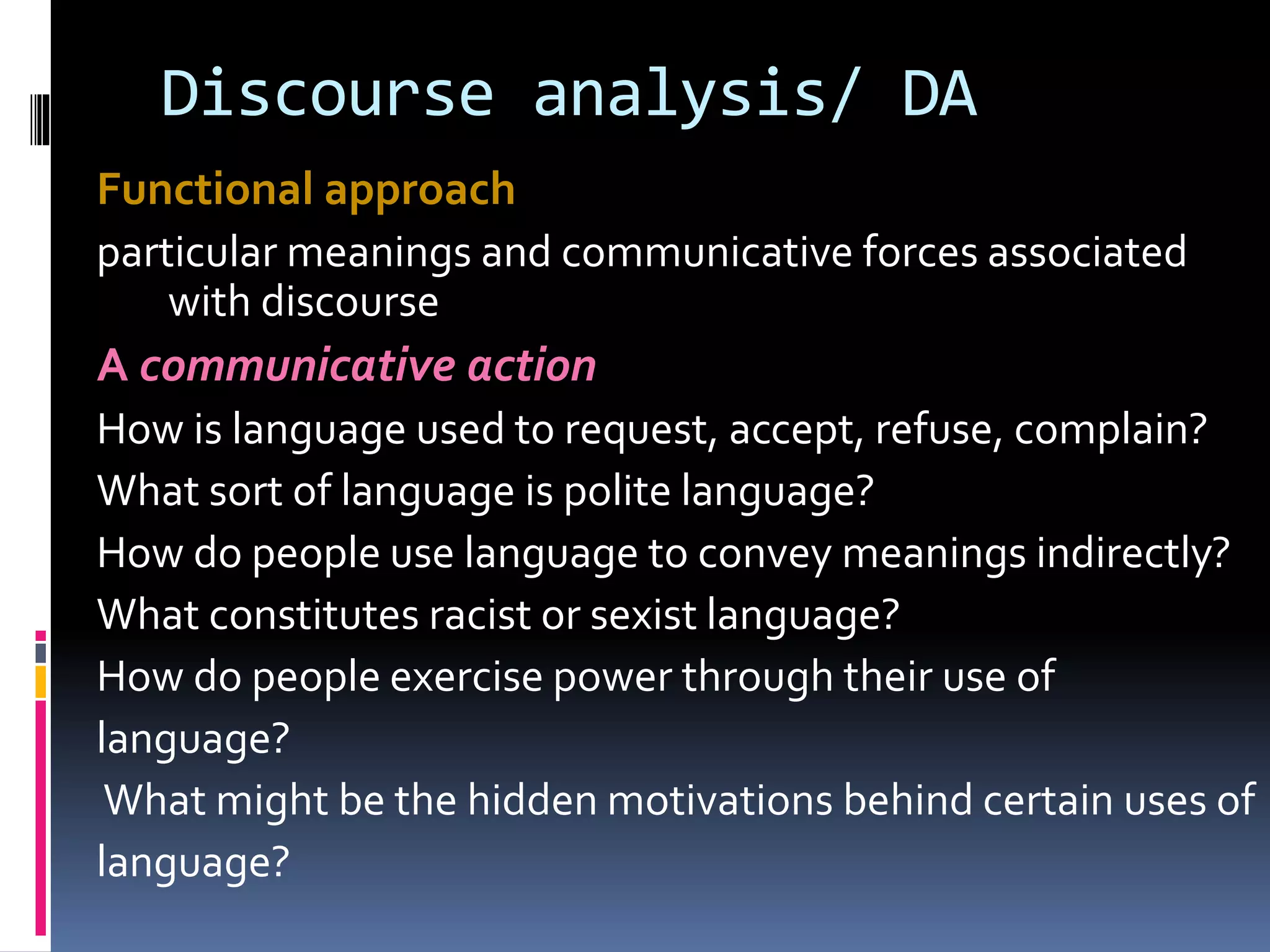
Functional approach
particular meanings and communicative forces associated
with discourse
A communicative action
How is language used to request, accept, refuse, complain?
What sort of language is polite language?
How do people use language to convey meanings indirectly?
What constitutes racist or sexist language?
How do people exercise power through their use of
language?
What might be the hidden motivations behind certain uses of
language?
Discourse analysis/ DA
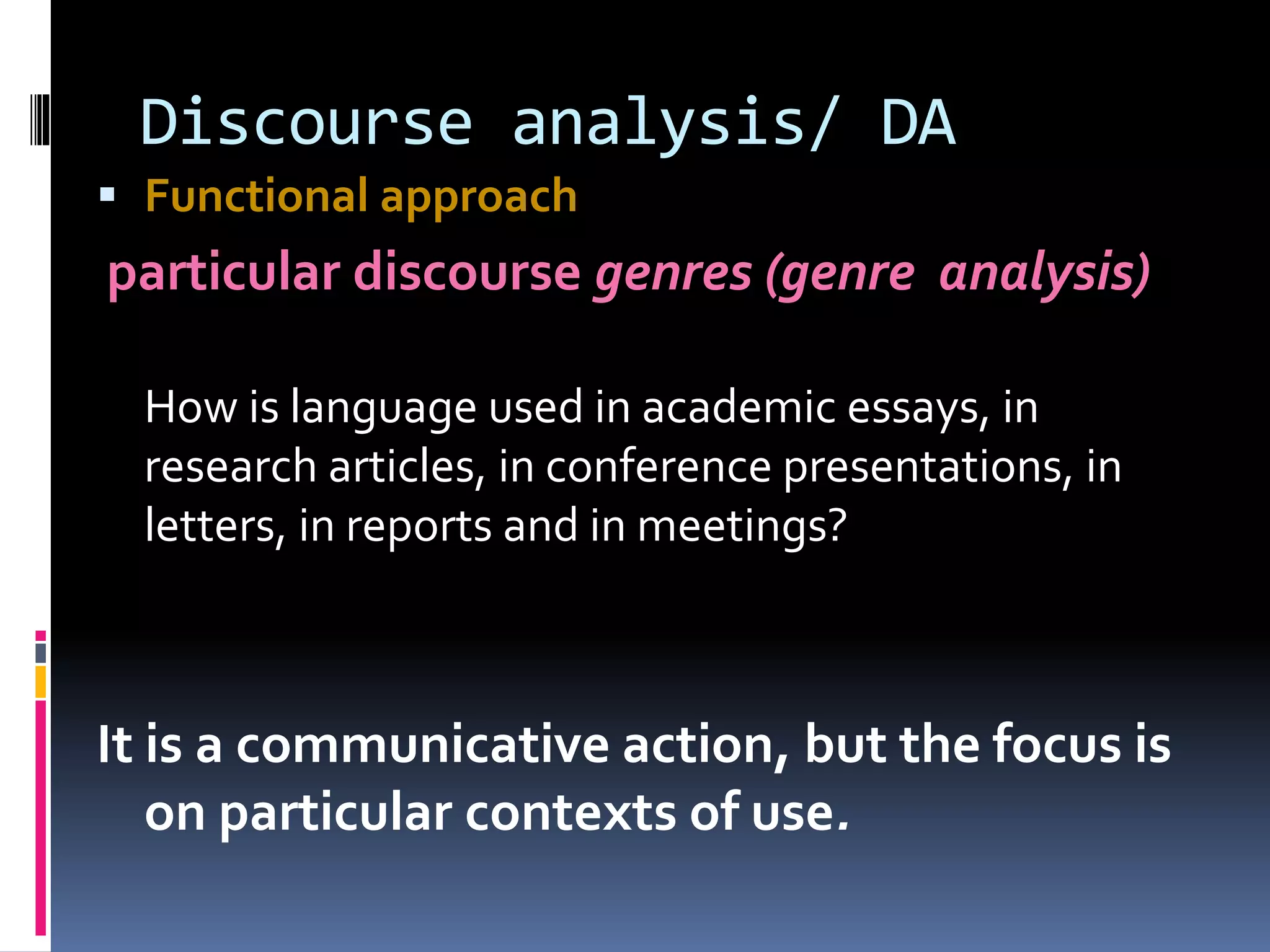
 Functional approach
particular discourse genres (genre analysis)
How is language used in academic essays, in
research articles, in conference presentations, in
letters, in reports and in meetings?
It is a communicative action, but the focus is
on particular contexts of use.
Discourse analysis/ DA
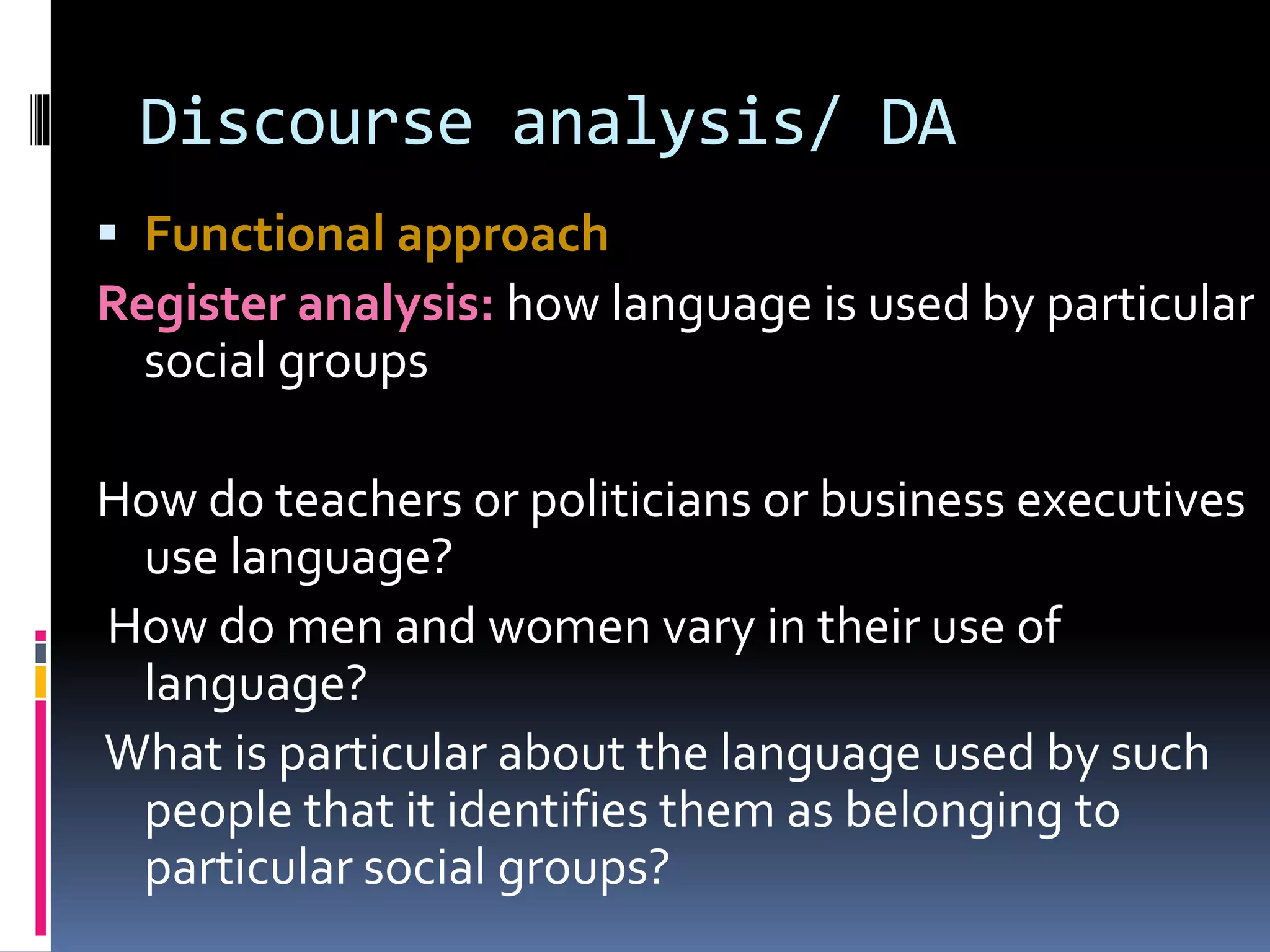
 Functional approach
Register analysis: how language is used by particular
social groups
How do teachers or politicians or business executives
use language?
How do men and women vary in their use of
language?
What is particular about the language used by such
people that it identifies them as belonging to
particular social groups?
Corpus Linguistics
(quantitative analysis)
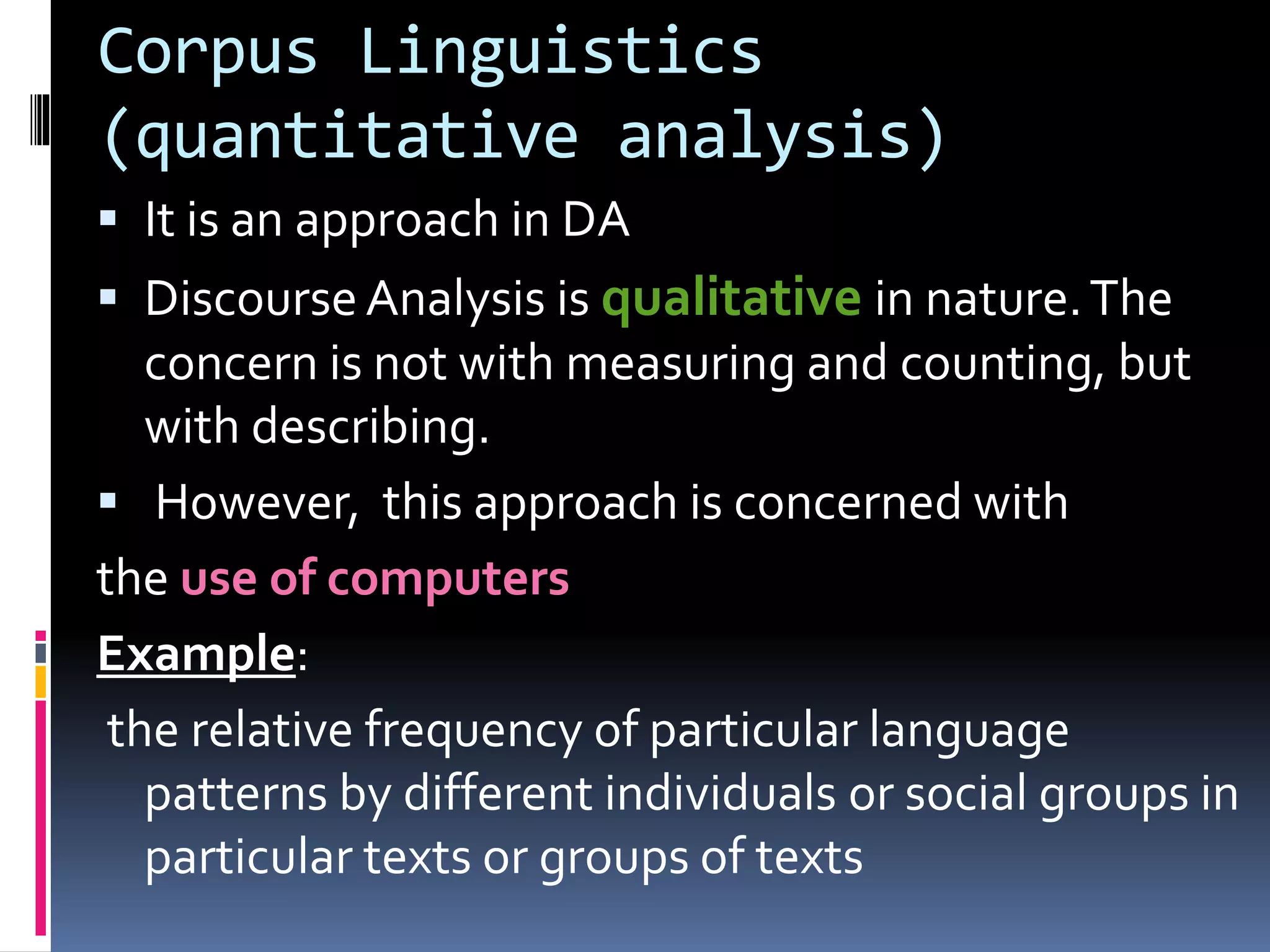
 It is an approach in DA
 DiscourseAnalysis is qualitative in nature.The
concern is not with measuring and counting, but
with describing.
 However, this approach is concerned with
the use of computers
Example:
the relative frequency of particular language
patterns by different individuals or social groups in
particular texts or groups of texts
What is “text” in DA?
 any stretch of spoken or written language.
 In written text: news reports, textbooks, company
reports, personal letters, business letters, e-mails and
faxes.
 In spoken discourse: casual conversations, business
and other professional meetings, service encounters ,
buying and selling goods and services, and classroom
lessons…
 multimodal discourse: written and/or spoken text is
combined with visual or aural dimensions, such as
television programmes, movies, websites, museum
exhibits and advertisements of various kinds
Main Approaches of DS
 register analysis (the typical features of particular fields of
activity or professions)
 cohesion, coherence and thematic development (how text
is held together, in terms of both structure and function)
 Pragmatics (language in terms of the actions it performs)
 Conversation Analysis (a micro-analytic approach to
spoken interaction)
 Genre Analysis (language in terms of the different recurrent
stages it goes through in specific contexts
 Corpus-based Discourse Analysis (the use of computers in
the analysis of very large bodies of text to identify particular
phraseologies (wordings) and rhetorical patterning
 Critical Discourse Analysis/ CDA (texts from a social
perspective, analyzing power relations and cases of
manipulation and discrimination in discourse
 eclectic or hybrid approach
Apply in what fields or
texts?
 Historical / contemporary text
 Written/ spoken discourse
 Informal/formal fields
Infml: how people interact in conversation and in
service encounters, how they tell stories, how
they gossip and how they chat
Fm: political arena, in analyzing the media, in the
law, in healthcare, and in business and other
forms of bureaucracy
intertextuality of discourse
 a single text (considering other texts in the analysis of
a given text)
1. how one text relates back to another text or texts
2. direct quotation of one text in another (through the
use of inverted commas)
intertextual links are implicit. It is extremely common in
1. newspaper headlines
2. various types of advertisement
3. Poetry
‘In the beginning, there was a nursery, with windows
opening on to a garden, and beyond that the sea.
the Gospel of St John in the Bible: ‘In the beginning
there was the word’
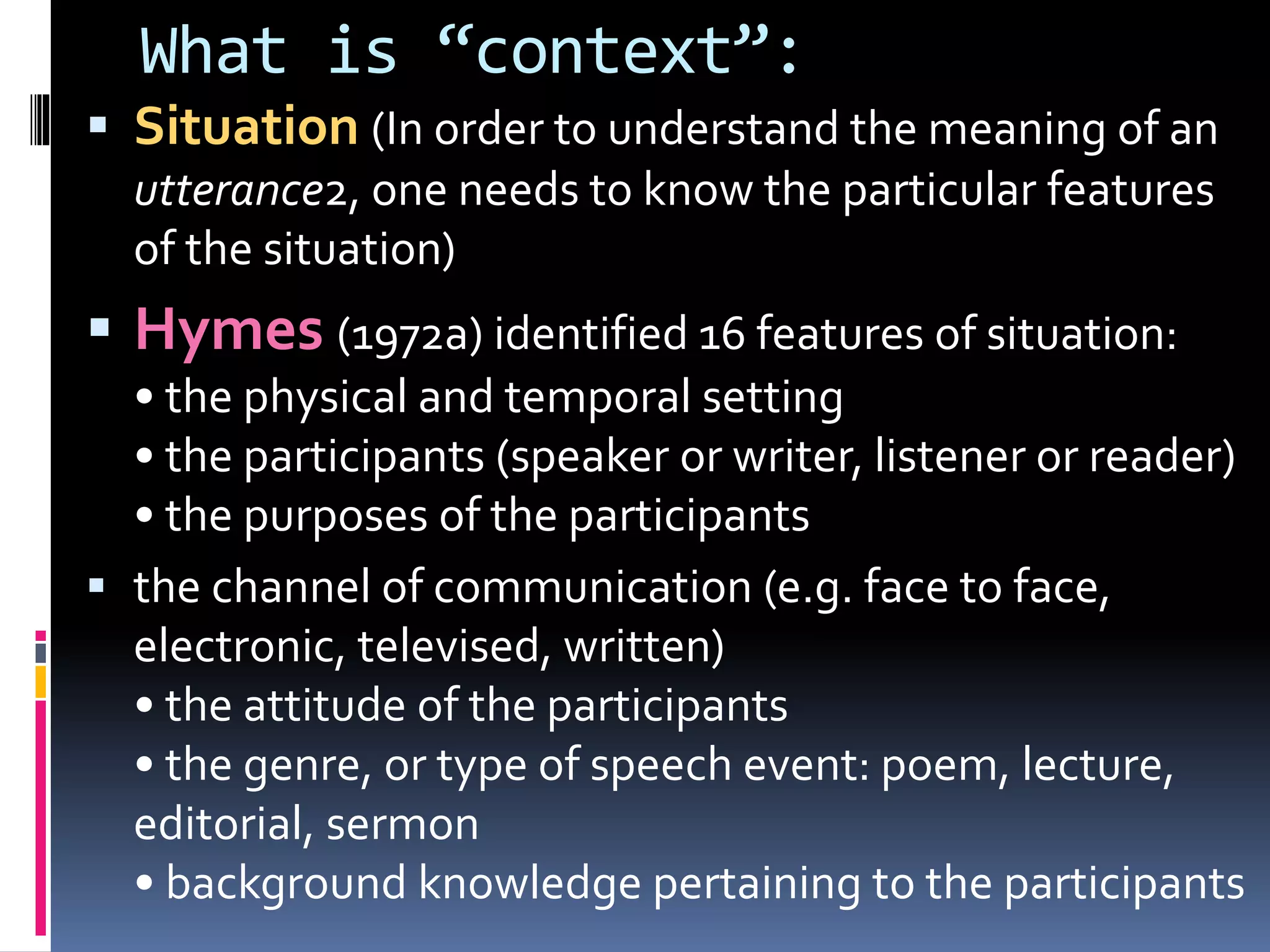
What is “context”:
 Situation (In order to understand the meaning of an
utterance2, one needs to know the particular features
of the situation)
 Hymes (1972a) identified 16 features of situation:
• the physical and temporal setting
• the participants (speaker or writer, listener or reader)
• the purposes of the participants
 the channel of communication (e.g. face to face,
electronic, televised, written)
• the attitude of the participants
• the genre, or type of speech event: poem, lecture,
editorial, sermon
• background knowledge pertaining to the participants
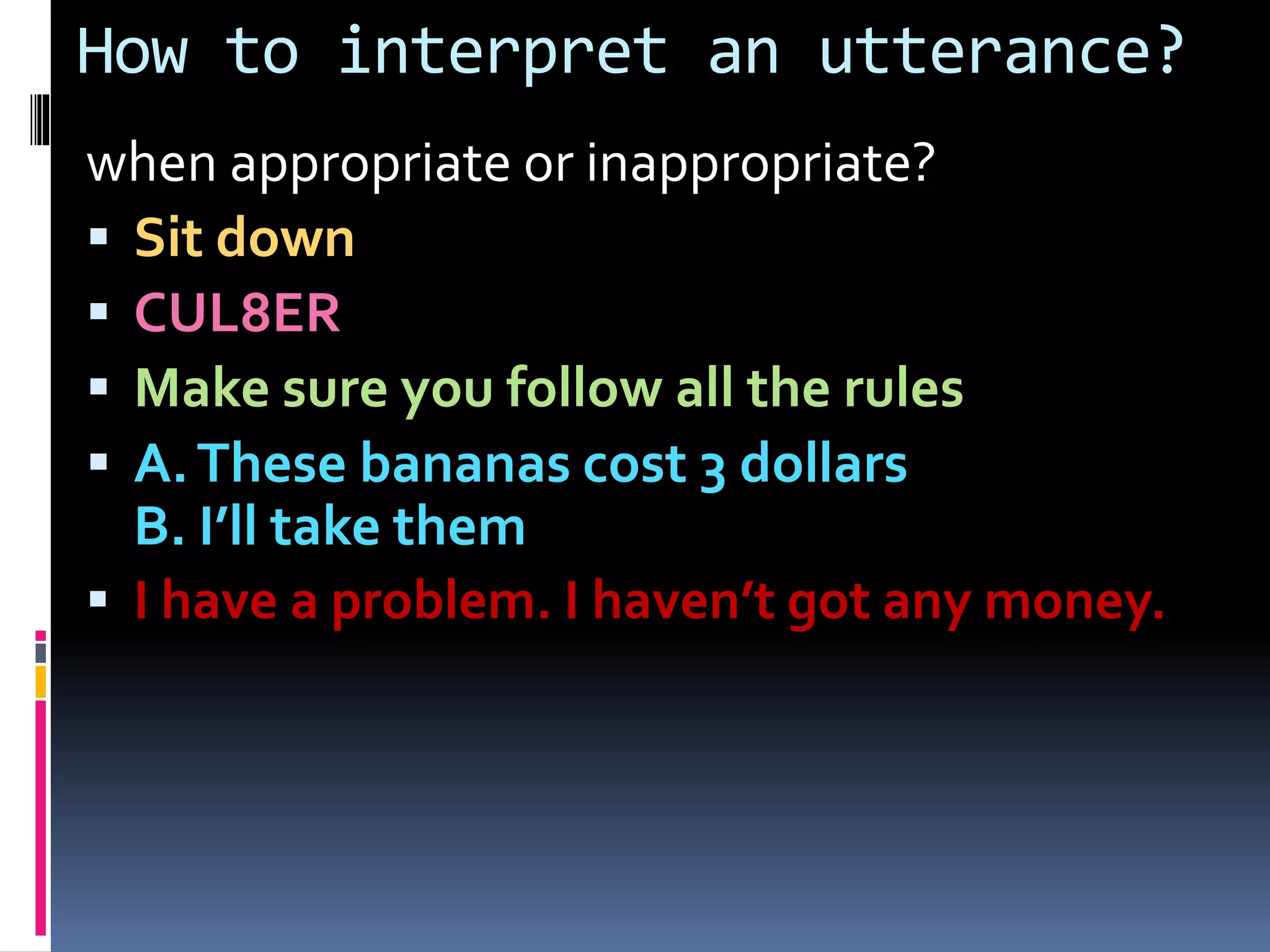
How to interpret an utterance?
when appropriate or inappropriate?
 Sit down
 CUL8ER
 Make sure you follow all the rules
 A.These bananas cost 3 dollars
B. I’ll take them
 I have a problem. I haven’t got any money.
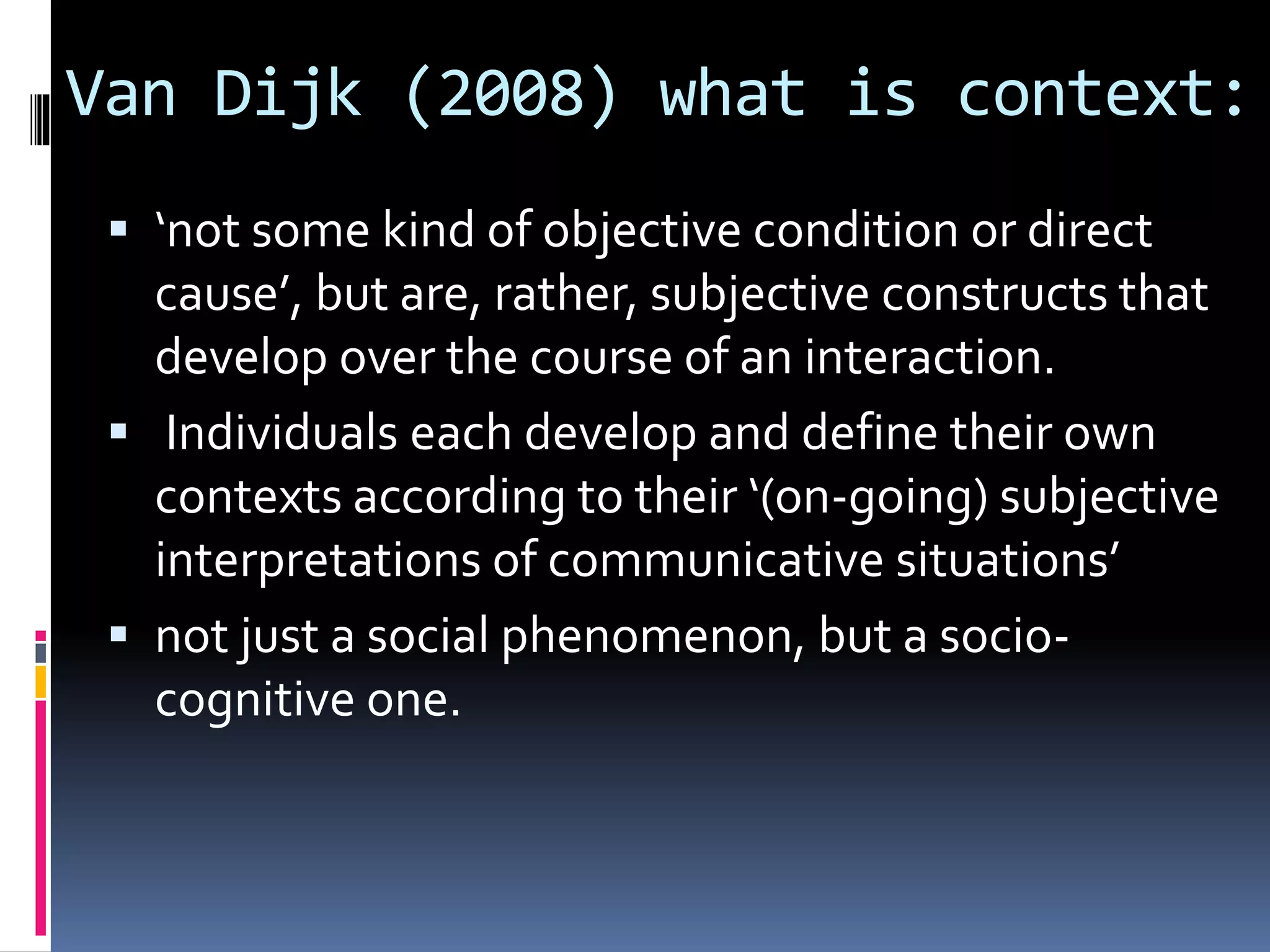
Van Dijk (2008) what is context:
 ‘not some kind of objective condition or direct
cause’, but are, rather, subjective constructs that
develop over the course of an interaction.
 Individuals each develop and define their own
contexts according to their ‘(on-going) subjective
interpretations of communicative situations’
 not just a social phenomenon, but a socio-
cognitive one.
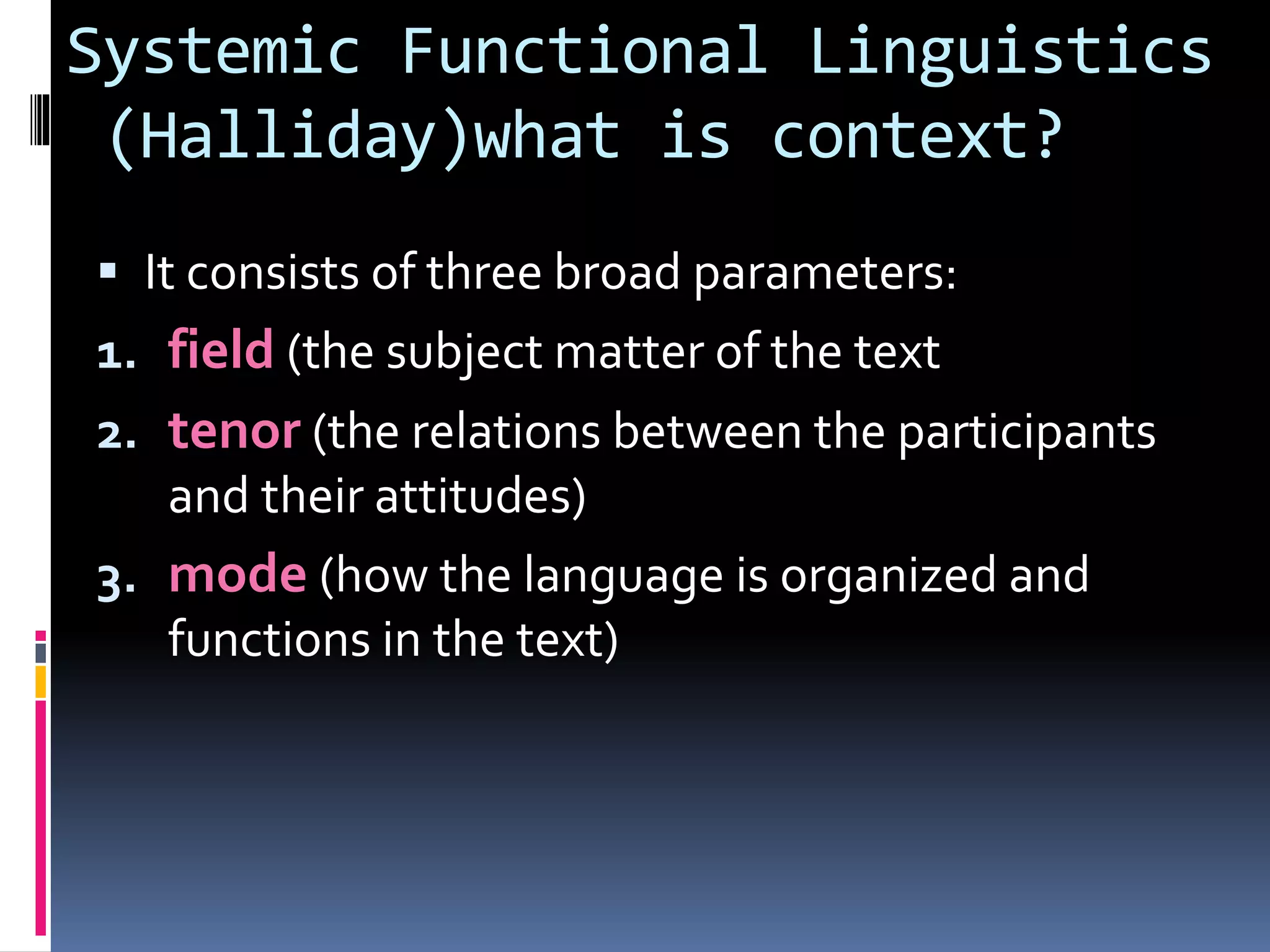
Systemic Functional Linguistics
(Halliday)what is context?
 It consists of three broad parameters:
1. field (the subject matter of the text
2. tenor (the relations between the participants
and their attitudes)
3. mode (how the language is organized and
functions in the text)
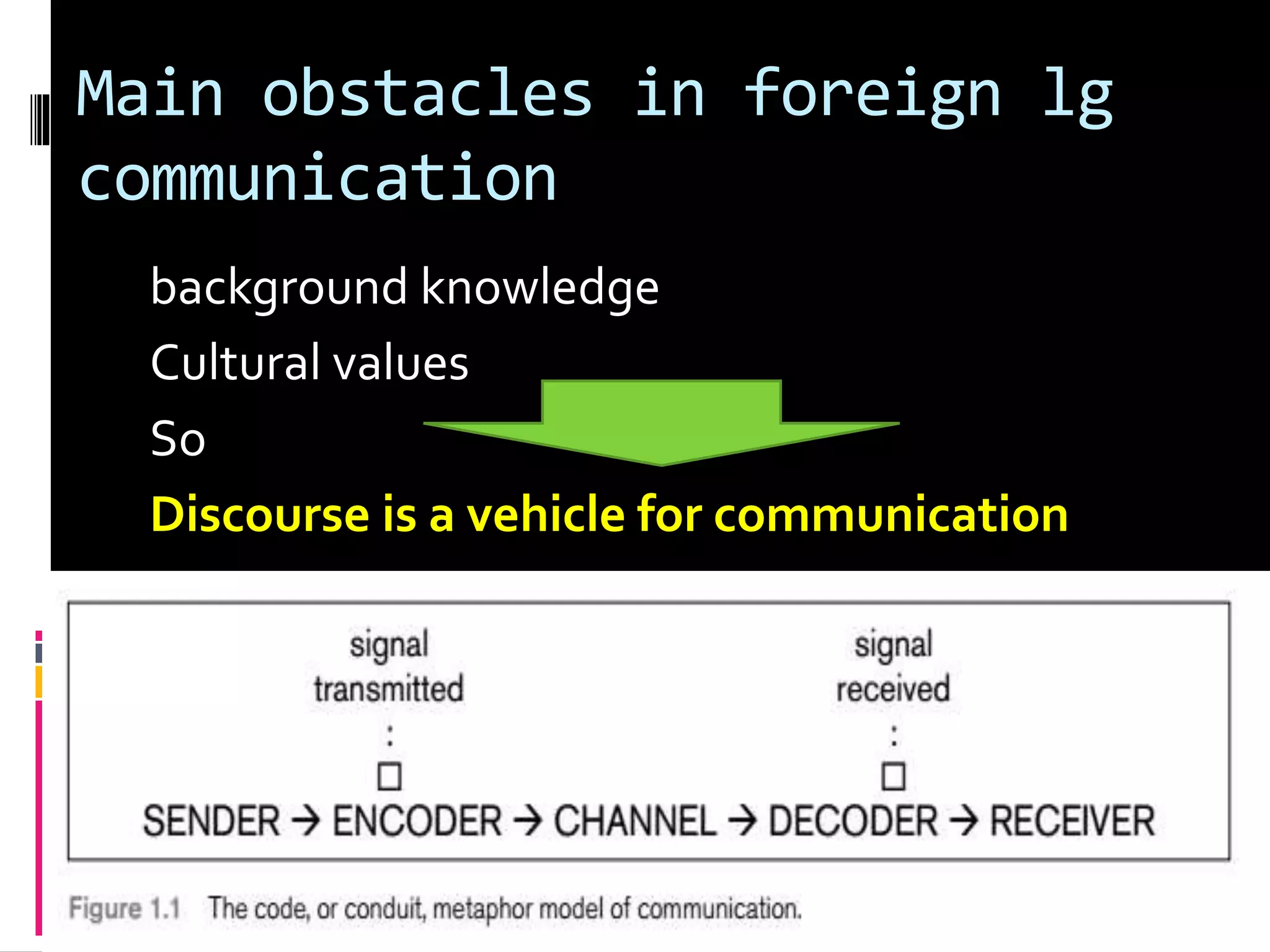
Main obstacles in foreign lg
communication
background knowledge
Cultural values
So
Discourse is a vehicle for communication
Recent model: inferential model
 Speakers take into account
 the context
 the background and world knowledge of
their addressees
 They calibrate what they say to match up
with this assumed hearer knowledge.
 They do not need to say everything, but can
rely on their addressees to fill in any details
that are not explicitly communicated.
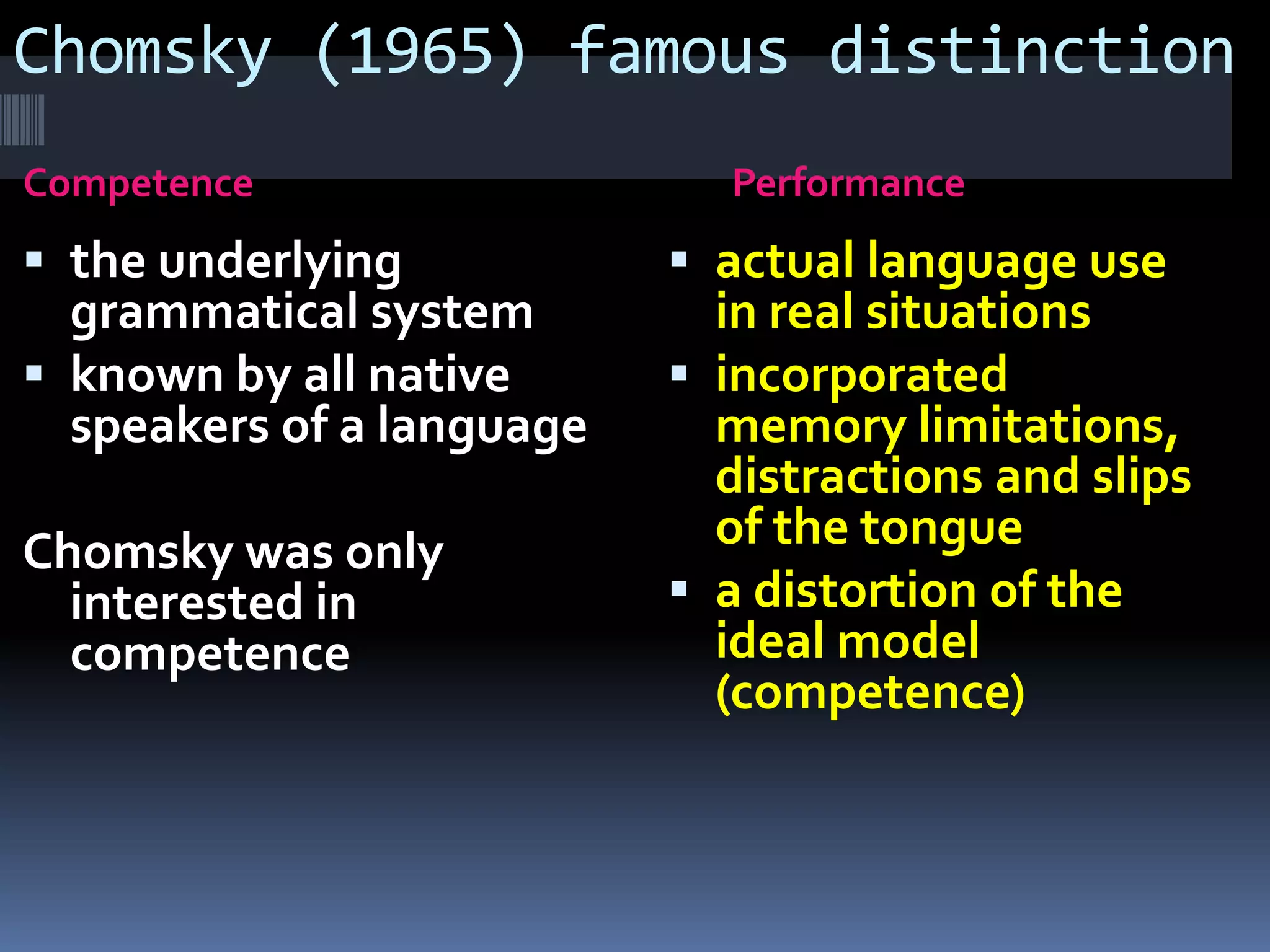
Chomsky (1965) famous distinction
Competence Performance
 the underlying
grammatical system
 known by all native
speakers of a language
Chomsky was only
interested in
competence
 actual language use
in real situations
 incorporated
memory limitations,
distractions and slips
of the tongue
 a distortion of the
ideal model
(competence)
Hymes (1972) communicative competence
 the competence that is required in real communication
 ‘there are rules of use without which the rules of
grammar would be useless’ (1972b: 278)
 Hymes developed his model of contextual variables
 His theory was recontextualized as the communicative
approach to language teaching (CLT)
 a set of standards for an ideal teaching and learning
curriculum
 Canale and Swain (1980)3, who broke communicative
competence down into three subcomponents: (next
slide)
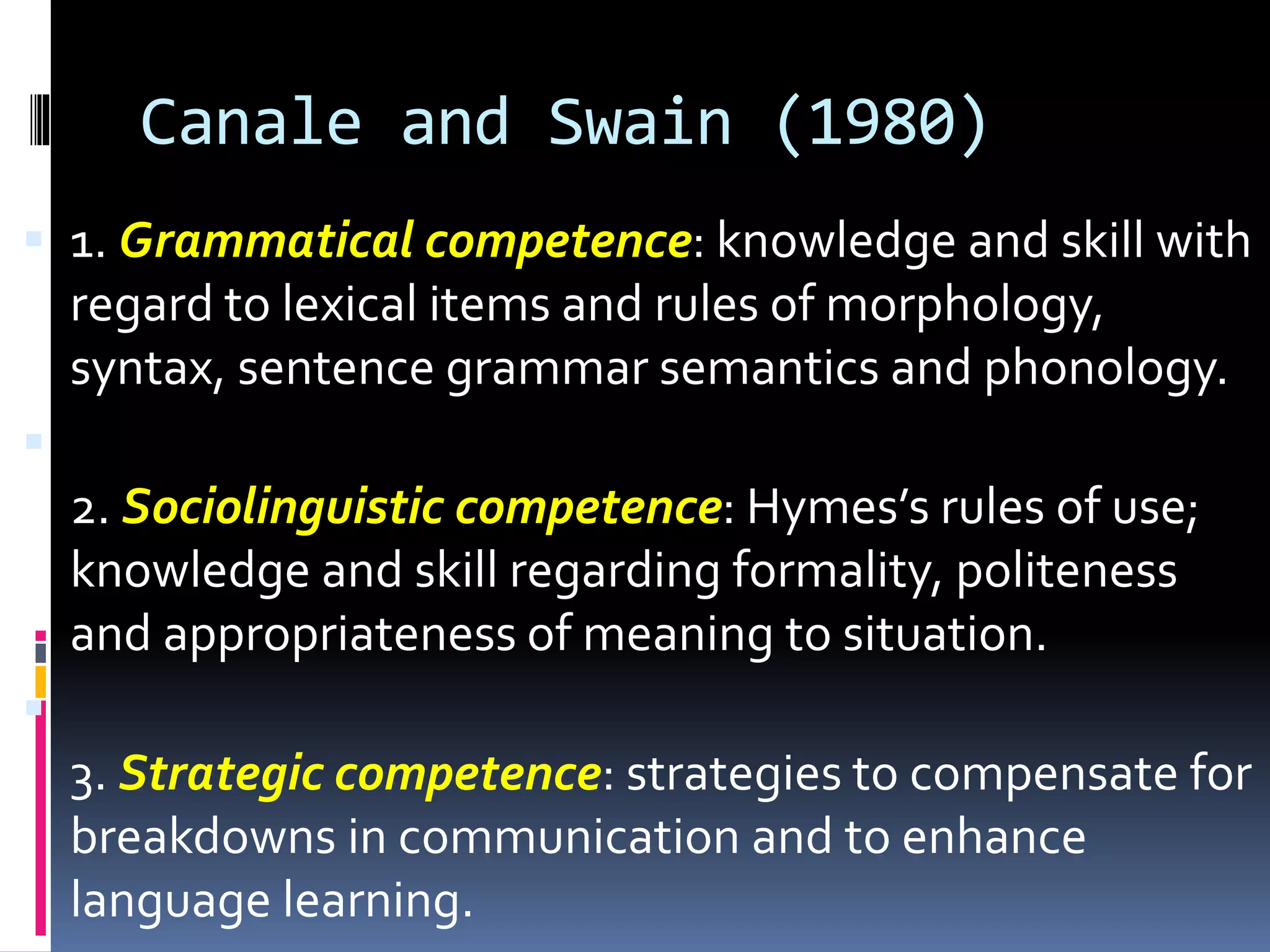
Canale and Swain (1980)
 1. Grammatical competence: knowledge and skill with
regard to lexical items and rules of morphology,
syntax, sentence grammar semantics and phonology.

2. Sociolinguistic competence: Hymes’s rules of use;
knowledge and skill regarding formality, politeness
and appropriateness of meaning to situation.

3. Strategic competence: strategies to compensate for
breakdowns in communication and to enhance
language learning.
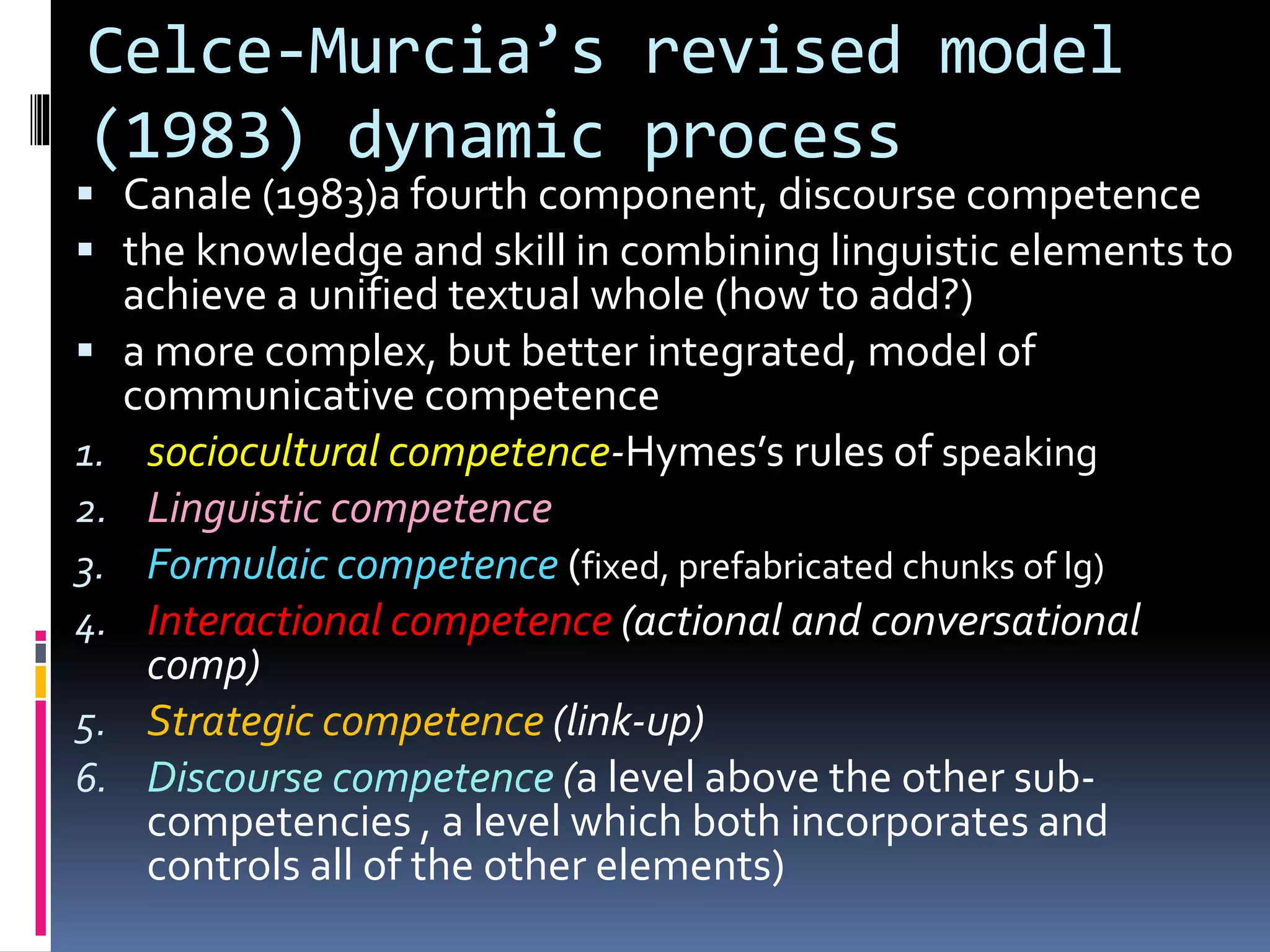
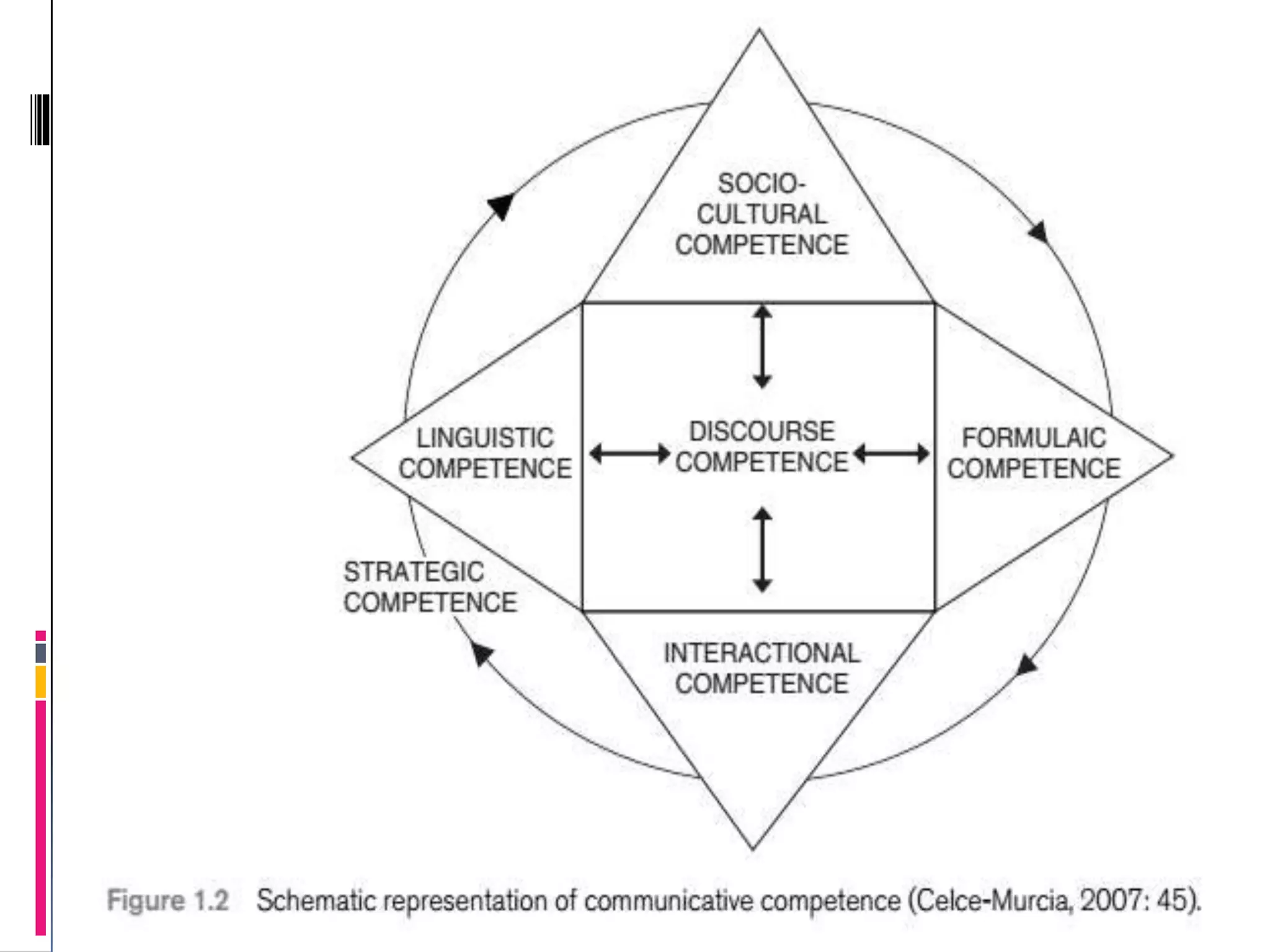
Celce-Murcia’s revised model
(1983) dynamic process
 Canale (1983)a fourth component, discourse competence
 the knowledge and skill in combining linguistic elements to
achieve a unified textual whole (how to add?)
 a more complex, but better integrated, model of
communicative competence
1. sociocultural competence-Hymes’s rules of speaking
2. Linguistic competence
3. Formulaic competence (fixed, prefabricated chunks of lg)
4. Interactional competence (actional and conversational
comp)
5. Strategic competence (link-up)
6. Discourse competence (a level above the other sub-
competencies , a level which both incorporates and
controls all of the other elements)
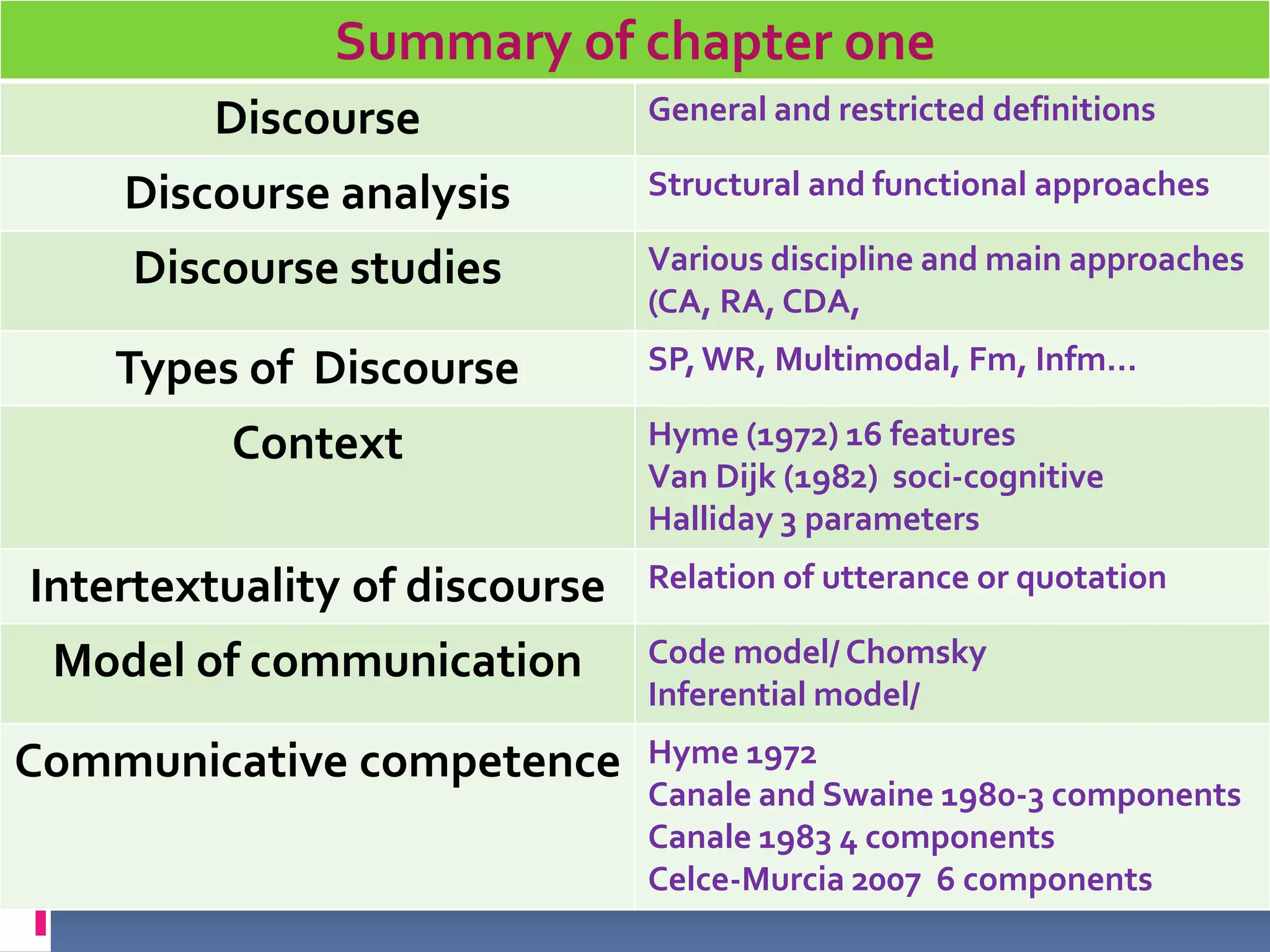
Summary of chapter one
Discourse General and restricted definitions
Discourse analysis Structural and functional approaches
Discourse studies Various discipline and main approaches
(CA, RA, CDA,
Types of Discourse SP, WR, Multimodal, Fm, Infm…
Context Hyme (1972) 16 features
Van Dijk (1982) soci-cognitive
Halliday 3 parameters
Intertextuality of discourse Relation of utterance or quotation
Model of communication Code model/ Chomsky
Inferential model/
Communicative competence Hyme 1972
Canale and Swaine 1980-3 components
Canale 1983 4 components
Celce-Murcia 2007 6 components
 flowerdew basics

flowerdew basics

  • 1.
    JOHN FLOWERDEW CHAPTER ONE PRESENTEDBY M.BOLOURI M.BOLOURI9@GMAIL.COM
  • 2.
    Topics 1. Meanings of‘discourse’ and ‘Discourse Analysis/Studies 2. Notion of communicative competence and its relation to discourse 3. What is an appropriate goal for Language Education?
  • 3.
    How to definediscourse: little ‘d’ discourse 1. language in its contexts of use 2. language above the level of the sentence 3. knowing a language is concerned with more than just grammar and vocabulary: it includes  how to participate in a conversation  how to structure a written text big ‘D’ discourses a type of specialized knowledge and language used by a particular social group or a set of ideas
  • 4.
    Discourse studies/ DA The study of language in its contexts of use and above the level of the sentence  It is arguably most closely associated with linguistics, but is essentially an interdisciplinary activity  Discourse Studies refers to the field, or discipline, in general (theory , application and a host of methods)  Discourse Analysis refers to the actual analysis (a method)
  • 5.
    Discourse analysis/ DA structuralanalysis A. A group of texts would be broken down into their component parts  Parts are determined based on their: 1. Functions 2. Meanings 3. Topics 4. Turns in spoken or written discourse B. how elements of language are held together in coherent units
  • 6.
    Discourse analysis/ DA Functionalapproach particular meanings and communicative forces associated with discourse A communicative action How is language used to request, accept, refuse, complain? What sort of language is polite language? How do people use language to convey meanings indirectly? What constitutes racist or sexist language? How do people exercise power through their use of language? What might be the hidden motivations behind certain uses of language?
  • 7.
    Discourse analysis/ DA Functional approach particular discourse genres (genre analysis) How is language used in academic essays, in research articles, in conference presentations, in letters, in reports and in meetings? It is a communicative action, but the focus is on particular contexts of use.
  • 8.
    Discourse analysis/ DA Functional approach Register analysis: how language is used by particular social groups How do teachers or politicians or business executives use language? How do men and women vary in their use of language? What is particular about the language used by such people that it identifies them as belonging to particular social groups?
  • 9.
    Corpus Linguistics (quantitative analysis) It is an approach in DA  DiscourseAnalysis is qualitative in nature.The concern is not with measuring and counting, but with describing.  However, this approach is concerned with the use of computers Example: the relative frequency of particular language patterns by different individuals or social groups in particular texts or groups of texts
  • 10.
    What is “text”in DA?  any stretch of spoken or written language.  In written text: news reports, textbooks, company reports, personal letters, business letters, e-mails and faxes.  In spoken discourse: casual conversations, business and other professional meetings, service encounters , buying and selling goods and services, and classroom lessons…  multimodal discourse: written and/or spoken text is combined with visual or aural dimensions, such as television programmes, movies, websites, museum exhibits and advertisements of various kinds
  • 11.
    Main Approaches ofDS  register analysis (the typical features of particular fields of activity or professions)  cohesion, coherence and thematic development (how text is held together, in terms of both structure and function)  Pragmatics (language in terms of the actions it performs)  Conversation Analysis (a micro-analytic approach to spoken interaction)  Genre Analysis (language in terms of the different recurrent stages it goes through in specific contexts  Corpus-based Discourse Analysis (the use of computers in the analysis of very large bodies of text to identify particular phraseologies (wordings) and rhetorical patterning  Critical Discourse Analysis/ CDA (texts from a social perspective, analyzing power relations and cases of manipulation and discrimination in discourse  eclectic or hybrid approach
  • 12.
    Apply in whatfields or texts?  Historical / contemporary text  Written/ spoken discourse  Informal/formal fields Infml: how people interact in conversation and in service encounters, how they tell stories, how they gossip and how they chat Fm: political arena, in analyzing the media, in the law, in healthcare, and in business and other forms of bureaucracy
  • 13.
    intertextuality of discourse a single text (considering other texts in the analysis of a given text) 1. how one text relates back to another text or texts 2. direct quotation of one text in another (through the use of inverted commas) intertextual links are implicit. It is extremely common in 1. newspaper headlines 2. various types of advertisement 3. Poetry ‘In the beginning, there was a nursery, with windows opening on to a garden, and beyond that the sea. the Gospel of St John in the Bible: ‘In the beginning there was the word’
  • 14.
    What is “context”: Situation (In order to understand the meaning of an utterance2, one needs to know the particular features of the situation)  Hymes (1972a) identified 16 features of situation: • the physical and temporal setting • the participants (speaker or writer, listener or reader) • the purposes of the participants  the channel of communication (e.g. face to face, electronic, televised, written) • the attitude of the participants • the genre, or type of speech event: poem, lecture, editorial, sermon • background knowledge pertaining to the participants
  • 15.
    How to interpretan utterance? when appropriate or inappropriate?  Sit down  CUL8ER  Make sure you follow all the rules  A.These bananas cost 3 dollars B. I’ll take them  I have a problem. I haven’t got any money.
  • 16.
    Van Dijk (2008)what is context:  ‘not some kind of objective condition or direct cause’, but are, rather, subjective constructs that develop over the course of an interaction.  Individuals each develop and define their own contexts according to their ‘(on-going) subjective interpretations of communicative situations’  not just a social phenomenon, but a socio- cognitive one.
  • 17.
    Systemic Functional Linguistics (Halliday)whatis context?  It consists of three broad parameters: 1. field (the subject matter of the text 2. tenor (the relations between the participants and their attitudes) 3. mode (how the language is organized and functions in the text)
  • 18.
    Main obstacles inforeign lg communication background knowledge Cultural values So Discourse is a vehicle for communication
  • 19.
    Recent model: inferentialmodel  Speakers take into account  the context  the background and world knowledge of their addressees  They calibrate what they say to match up with this assumed hearer knowledge.  They do not need to say everything, but can rely on their addressees to fill in any details that are not explicitly communicated.
  • 20.
    Chomsky (1965) famousdistinction Competence Performance  the underlying grammatical system  known by all native speakers of a language Chomsky was only interested in competence  actual language use in real situations  incorporated memory limitations, distractions and slips of the tongue  a distortion of the ideal model (competence)
  • 21.
    Hymes (1972) communicativecompetence  the competence that is required in real communication  ‘there are rules of use without which the rules of grammar would be useless’ (1972b: 278)  Hymes developed his model of contextual variables  His theory was recontextualized as the communicative approach to language teaching (CLT)  a set of standards for an ideal teaching and learning curriculum  Canale and Swain (1980)3, who broke communicative competence down into three subcomponents: (next slide)
  • 22.
    Canale and Swain(1980)  1. Grammatical competence: knowledge and skill with regard to lexical items and rules of morphology, syntax, sentence grammar semantics and phonology.  2. Sociolinguistic competence: Hymes’s rules of use; knowledge and skill regarding formality, politeness and appropriateness of meaning to situation.  3. Strategic competence: strategies to compensate for breakdowns in communication and to enhance language learning.
  • 23.
    Celce-Murcia’s revised model (1983)dynamic process  Canale (1983)a fourth component, discourse competence  the knowledge and skill in combining linguistic elements to achieve a unified textual whole (how to add?)  a more complex, but better integrated, model of communicative competence 1. sociocultural competence-Hymes’s rules of speaking 2. Linguistic competence 3. Formulaic competence (fixed, prefabricated chunks of lg) 4. Interactional competence (actional and conversational comp) 5. Strategic competence (link-up) 6. Discourse competence (a level above the other sub- competencies , a level which both incorporates and controls all of the other elements)
  • 25.
    Summary of chapterone Discourse General and restricted definitions Discourse analysis Structural and functional approaches Discourse studies Various discipline and main approaches (CA, RA, CDA, Types of Discourse SP, WR, Multimodal, Fm, Infm… Context Hyme (1972) 16 features Van Dijk (1982) soci-cognitive Halliday 3 parameters Intertextuality of discourse Relation of utterance or quotation Model of communication Code model/ Chomsky Inferential model/ Communicative competence Hyme 1972 Canale and Swaine 1980-3 components Canale 1983 4 components Celce-Murcia 2007 6 components

Editor's Notes

  • #4 Broadest meaning Main concern Based on this rationale Restricted sense First singular and second plural
  • #5 The difference btw DA and Ds (recent term) It is employed in such diverse fields as anthropology, business studies, communication studies, cultural studies, educational studies, environmental studies, law, literary studies, media studies, philosophy, politics, psychology, sociology, and many others, in addition to linguistics the misconception that the field is only concerned with analysis (that it is just a method)
  • #14 The simplest form of Discourse Analysis is of a single text. Increasingly, though, discourse analysts have come to accept the importance of considering other texts in the analysis of a given text text cannot be understood except in relation to other texts
  • #16 1. by a parent to a child or addressed to a superior (participants) channel of communication (mobile phone or business letter) 3. background knowledge, what has come before and what comes later. (co-text or linguistic context) 4. 4. text surrounding an utterance,
  • #19 A traditional, although now largely discredited (by linguists, at any rate), model of communication is the so-called code model, or conduit metaphor model Provided that there is no deficiency in the channel and that both sender and receiver are using the same code, successful communication is guaranteed. the sender encodes a message which passes along the communication channel in the form of a signal, which is then decoded by the receiver. According to this model, communication can take place without any reference to the speaker, hearer or wider context. interpretation of a message is affected by the context in which it is sent.
  • #23 A problem with adding this extra component, however, is that it seems to be at a different level; it would seem that grammatical competence, sociolinguistic competence and strategic competence are all component parts of overall discourse competence.