SREE NARAYANA COLLEGE OF
EDUCATION MUVATTUPUZHA
 Introduction
 Definition
 Digital archives
 Searching
 Software
 Advantages
 Disadvantages
A Digital Library is a special library with a
focused collection of digital objects that can
include text, visual material, audio material,
video material, stored as electronic media
formats, along with means for organizing,
storing, and retrieving the files and media
contained in the library collection. The
electronic content may be stored locally, or
accessed remotely via computer net works. An
electronic library is a type of information
retrieval system.
A Digital library Reference Model which
defines a digital library as: A potentially
virtual organization, that comprehensively
collects, manages and preserves for the
long depth of time rich digital content and
offers to its target user communities
comprehensive codified policies
Physical differ from physical libraries in several ways.
Traditionally, archives are defined as:
• containing primary sources of information rather
than the secondary sources found in library
•Having their contents organized in groups rather
than individual items.
•Having unique contents.
There are two general strategies for
searching a federation of digital libraries:
o distributed searching
o searching previously
harvested metadata
There are a number of software packages for use in
general digital libraries, for notable ones see Digital
library software. Institutional repository software,
which focuses primarily on ingest, preservation and
access of locally produced documents, particularly
locally produced academic outputs, can be found
in Institutional repository software. This software may
be proprietary, as is the case with the Library of
Congress which uses Digiboard and CTS to manage
digital content.
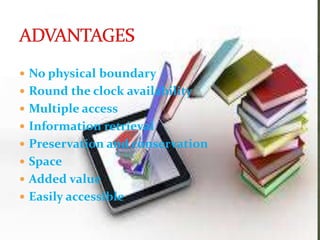
 No physical boundary
 Round the clock availability
 Multiple access
 Information retrieval
 Preservation and conservation
 Space
 Added value
 Easily accessible
Digital libraries, or at least their digital collections,
unfortunately also have brought their own
problems and challenges in areas such as:
 Equity of access
 Interoperability
 User authentication
 Information organization
 Interface design
 Digital preservation
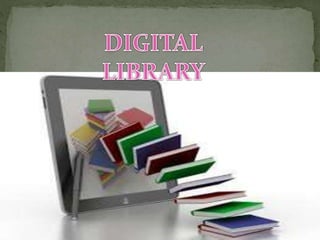
Digital library

Digital library

  • 2.
    SREE NARAYANA COLLEGEOF EDUCATION MUVATTUPUZHA
  • 4.
     Introduction  Definition Digital archives  Searching  Software  Advantages  Disadvantages
  • 5.
    A Digital Libraryis a special library with a focused collection of digital objects that can include text, visual material, audio material, video material, stored as electronic media formats, along with means for organizing, storing, and retrieving the files and media contained in the library collection. The electronic content may be stored locally, or accessed remotely via computer net works. An electronic library is a type of information retrieval system.
  • 6.
    A Digital libraryReference Model which defines a digital library as: A potentially virtual organization, that comprehensively collects, manages and preserves for the long depth of time rich digital content and offers to its target user communities comprehensive codified policies
  • 7.
    Physical differ fromphysical libraries in several ways. Traditionally, archives are defined as: • containing primary sources of information rather than the secondary sources found in library •Having their contents organized in groups rather than individual items. •Having unique contents.
  • 8.
    There are twogeneral strategies for searching a federation of digital libraries: o distributed searching o searching previously harvested metadata
  • 9.
    There are anumber of software packages for use in general digital libraries, for notable ones see Digital library software. Institutional repository software, which focuses primarily on ingest, preservation and access of locally produced documents, particularly locally produced academic outputs, can be found in Institutional repository software. This software may be proprietary, as is the case with the Library of Congress which uses Digiboard and CTS to manage digital content.
  • 10.
     No physicalboundary  Round the clock availability  Multiple access  Information retrieval  Preservation and conservation  Space  Added value  Easily accessible
  • 11.
    Digital libraries, orat least their digital collections, unfortunately also have brought their own problems and challenges in areas such as:  Equity of access  Interoperability  User authentication  Information organization  Interface design  Digital preservation