INTRODUCTION
DEFINITION
TYPES
SOFTWARES
ADVANTAGES
LIMITATIONS
INTRODUCTION
• A Digital Library is a special library
with a focused collection of digital
objects that can include text, visual
material, audio material, video
material, stored as electronic media
formats, along with means for
organizing, storing, and retrieving the
files and media contained in the
library collection.
• The electronic content may be stored
locally, or accessed remotely via
computer net works. An electronic
library is a type of information
retrieval system
• A digital library is a library in which
collections are stored in digital formats
(as opposed to print, or other media)
and accessible by computers. The
digital content may be stored locally, or
accessed remotely via computer
networks. A digital library is a type of
information retrieval system.
• It provides the architecture to model,
map, integrate, condense and
transform scattered information housed
in digital documents. Companies can
perform more substantive, accurate
and consistent analyses using the
digital library as a foundation for
decision support system.
DEFINITION
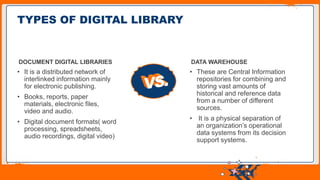
TYPES OF DIGITAL LIBRARY
DOCUMENT DIGITAL LIBRARIES
• It is a distributed network of
interlinked information mainly
for electronic publishing.
• Books, reports, paper
materials, electronic files,
video and audio.
• Digital document formats( word
processing, spreadsheets,
audio recordings, digital video)
DATA WAREHOUSE
• These are Central Information
repositories for combining and
storing vast amounts of
historical and reference data
from a number of different
sources.
• It is a physical separation of
an organization’s operational
data systems from its decision
support systems.
SOFTWARE
6
• There are a number of software packages for use in general digital
libraries, for notable ones see Digital library software.
• Institutional repository software, which focuses primarily on ingest,
preservation and access of locally produced documents, particularly
locally produced academic outputs, can be found in Institutional
repository software.
• This software may be proprietary, as is the case with the Library of
any authorized company which uses DigiBoard and CTS to manage
digital content.
• No physical boundary
• Round the clock availability
• Multiple accesses
• Structured approach
• Information retrieval
• Preservation and conservation
• Space
• Networking
8Jens Martensson
• Although digital libraries do
away with these fees, digital
libraries can be no less
expensive in their own way to
operate.
• Large costs incurred for the
conversion of print materials
into digital format, for the
technical skills of staff to
maintain them, and for the
costs of maintaining online
access (i.e. servers, bandwidth
costs, etc.).
DIGITAL LIBRARY

DIGITAL LIBRARY

  • 2.
  • 3.
    INTRODUCTION • A DigitalLibrary is a special library with a focused collection of digital objects that can include text, visual material, audio material, video material, stored as electronic media formats, along with means for organizing, storing, and retrieving the files and media contained in the library collection. • The electronic content may be stored locally, or accessed remotely via computer net works. An electronic library is a type of information retrieval system
  • 4.
    • A digitallibrary is a library in which collections are stored in digital formats (as opposed to print, or other media) and accessible by computers. The digital content may be stored locally, or accessed remotely via computer networks. A digital library is a type of information retrieval system. • It provides the architecture to model, map, integrate, condense and transform scattered information housed in digital documents. Companies can perform more substantive, accurate and consistent analyses using the digital library as a foundation for decision support system. DEFINITION
  • 5.
    TYPES OF DIGITALLIBRARY DOCUMENT DIGITAL LIBRARIES • It is a distributed network of interlinked information mainly for electronic publishing. • Books, reports, paper materials, electronic files, video and audio. • Digital document formats( word processing, spreadsheets, audio recordings, digital video) DATA WAREHOUSE • These are Central Information repositories for combining and storing vast amounts of historical and reference data from a number of different sources. • It is a physical separation of an organization’s operational data systems from its decision support systems.
  • 6.
    SOFTWARE 6 • There area number of software packages for use in general digital libraries, for notable ones see Digital library software. • Institutional repository software, which focuses primarily on ingest, preservation and access of locally produced documents, particularly locally produced academic outputs, can be found in Institutional repository software. • This software may be proprietary, as is the case with the Library of any authorized company which uses DigiBoard and CTS to manage digital content.
  • 7.
    • No physicalboundary • Round the clock availability • Multiple accesses • Structured approach • Information retrieval • Preservation and conservation • Space • Networking
  • 8.
    8Jens Martensson • Althoughdigital libraries do away with these fees, digital libraries can be no less expensive in their own way to operate. • Large costs incurred for the conversion of print materials into digital format, for the technical skills of staff to maintain them, and for the costs of maintaining online access (i.e. servers, bandwidth costs, etc.).