GRISEOFULVIN IN
DERMATOLOGY
Moderator: Prof. Th. Nandakishore
Presenter: Dr. Anup Goswami
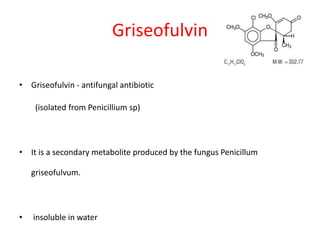
Griseofulvin
• Griseofulvin - antifungal antibiotic
(isolated from Penicillium sp)
• It is a secondary metabolite produced by the fungus Penicillum
griseofulvum.
• insoluble in water
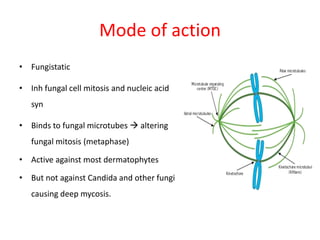
Mode of action
• Fungistatic
• Inh fungal cell mitosis and nucleic acid
syn
• Binds to fungal microtubes  altering
fungal mitosis (metaphase)
• Active against most dermatophytes
• But not against Candida and other fungi
causing deep mycosis.
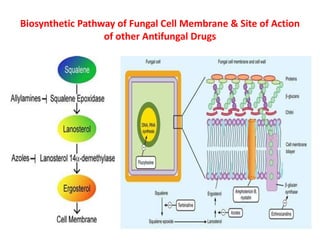
Biosynthetic Pathway of Fungal Cell Membrane & Site of Action
of other Antifungal Drugs
Pharmacokinetics
Absorption : incompletely absorbed from the GI tract, increased by
decreasing particle size and admin with fatty meals;
-peak plasma conc > 4 hours (t-max)
Distribution
Keratin precursor cells, stratum corneum
Protein-binding: 84%.
Metabolism :Hepatic
Excretion
Renal (50 %), via faeces ( 36%), via sweat; 9-24 hours (elimination half-life)
t1/2 h : 9 – 24
Indications
Treatment of following dermatophyte infections
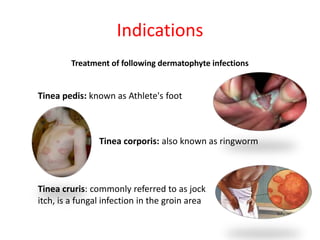
Tinea cruris: commonly referred to as jock
itch, is a fungal infection in the groin area
Tinea corporis: also known as ringworm
Tinea pedis: known as Athlete's foot
Indications
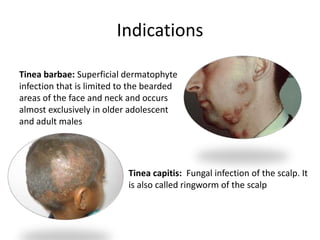
Tinea barbae: Superficial dermatophyte
infection that is limited to the bearded
areas of the face and neck and occurs
almost exclusively in older adolescent
and adult males
Tinea capitis: Fungal infection of the scalp. It
is also called ringworm of the scalp
Indications
Tinea unguium when caused by one or more of the following
species of fungi:
•Epidermophyton
floccosum
•Microsporum audouinii
•Microsporum gypseum
•Trichophyton crateriform
•Trichophyton gallinae
•Trichophyton interdigitalis
•schoenleini
•Trichophytum
sulphureum
•Trichophytum tonsurans
•Trichophytum verrucosum
•Trichophyton megnini
•Trichophyton
mentagrophytes
•Trichophyton rubrum
•Trichophyton
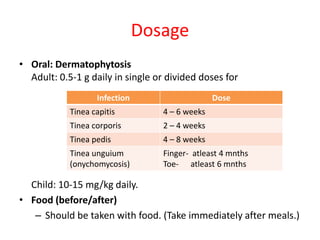
Dosage
• Oral: Dermatophytosis
Adult: 0.5-1 g daily in single or divided doses for
Child: 10-15 mg/kg daily.
• Food (before/after)
– Should be taken with food. (Take immediately after meals.)
Infection Dose
Tinea capitis 4 – 6 weeks
Tinea corporis 2 – 4 weeks
Tinea pedis 4 – 8 weeks
Tinea unguium
(onychomycosis)
Finger- atleast 4 mnths
Toe- atleast 6 mnths
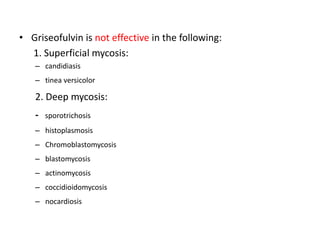
• Griseofulvin is not effective in the following:
1. Superficial mycosis:
– candidiasis
– tinea versicolor
2. Deep mycosis:
- sporotrichosis
– histoplasmosis
– Chromoblastomycosis
– blastomycosis
– actinomycosis
– coccidioidomycosis
– nocardiosis
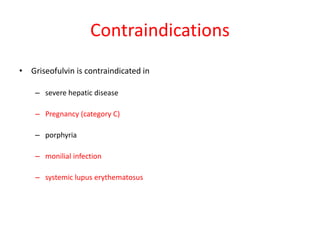
Contraindications
• Griseofulvin is contraindicated in
– severe hepatic disease
– Pregnancy (category C)
– porphyria
– monilial infection
– systemic lupus erythematosus
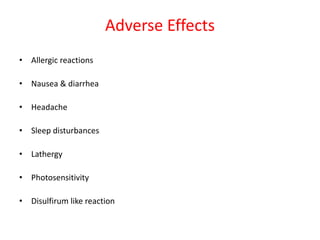
Adverse Effects
• Allergic reactions
• Nausea & diarrhea
• Headache
• Sleep disturbances
• Lathergy
• Photosensitivity
• Disulfirum like reaction
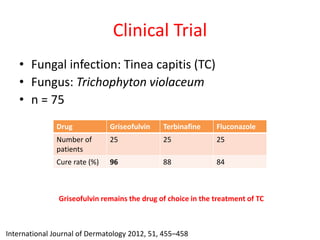
Clinical Trial
• Fungal infection: Tinea capitis (TC)
• Fungus: Trichophyton violaceum
• n = 75
International Journal of Dermatology 2012, 51, 455–458
Drug Griseofulvin Terbinafine Fluconazole
Number of
patients
25 25 25
Cure rate (%) 96 88 84
Griseofulvin remains the drug of choice in the treatment of TC
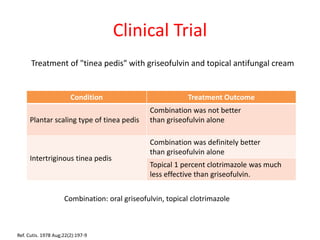
Clinical Trial
Treatment of "tinea pedis" with griseofulvin and topical antifungal cream
Condition Treatment Outcome
Plantar scaling type of tinea pedis
Combination was not better
than griseofulvin alone
Intertriginous tinea pedis
Combination was definitely better
than griseofulvin alone
Topical 1 percent clotrimazole was much
less effective than griseofulvin.
Ref. Cutis. 1978 Aug;22(2):197-9
Combination: oral griseofulvin, topical clotrimazole
THANK YOU

Griseofulvin

  • 1.
    GRISEOFULVIN IN DERMATOLOGY Moderator: Prof.Th. Nandakishore Presenter: Dr. Anup Goswami
  • 2.
    Griseofulvin • Griseofulvin -antifungal antibiotic (isolated from Penicillium sp) • It is a secondary metabolite produced by the fungus Penicillum griseofulvum. • insoluble in water
  • 3.
    Mode of action •Fungistatic • Inh fungal cell mitosis and nucleic acid syn • Binds to fungal microtubes  altering fungal mitosis (metaphase) • Active against most dermatophytes • But not against Candida and other fungi causing deep mycosis.
  • 4.
    Biosynthetic Pathway ofFungal Cell Membrane & Site of Action of other Antifungal Drugs
  • 5.
    Pharmacokinetics Absorption : incompletelyabsorbed from the GI tract, increased by decreasing particle size and admin with fatty meals; -peak plasma conc > 4 hours (t-max) Distribution Keratin precursor cells, stratum corneum Protein-binding: 84%. Metabolism :Hepatic Excretion Renal (50 %), via faeces ( 36%), via sweat; 9-24 hours (elimination half-life) t1/2 h : 9 – 24
  • 6.
    Indications Treatment of followingdermatophyte infections Tinea cruris: commonly referred to as jock itch, is a fungal infection in the groin area Tinea corporis: also known as ringworm Tinea pedis: known as Athlete's foot
  • 7.
    Indications Tinea barbae: Superficialdermatophyte infection that is limited to the bearded areas of the face and neck and occurs almost exclusively in older adolescent and adult males Tinea capitis: Fungal infection of the scalp. It is also called ringworm of the scalp
  • 8.
    Indications Tinea unguium whencaused by one or more of the following species of fungi: •Epidermophyton floccosum •Microsporum audouinii •Microsporum gypseum •Trichophyton crateriform •Trichophyton gallinae •Trichophyton interdigitalis •schoenleini •Trichophytum sulphureum •Trichophytum tonsurans •Trichophytum verrucosum •Trichophyton megnini •Trichophyton mentagrophytes •Trichophyton rubrum •Trichophyton
  • 9.
    Dosage • Oral: Dermatophytosis Adult:0.5-1 g daily in single or divided doses for Child: 10-15 mg/kg daily. • Food (before/after) – Should be taken with food. (Take immediately after meals.) Infection Dose Tinea capitis 4 – 6 weeks Tinea corporis 2 – 4 weeks Tinea pedis 4 – 8 weeks Tinea unguium (onychomycosis) Finger- atleast 4 mnths Toe- atleast 6 mnths
  • 10.
    • Griseofulvin isnot effective in the following: 1. Superficial mycosis: – candidiasis – tinea versicolor 2. Deep mycosis: - sporotrichosis – histoplasmosis – Chromoblastomycosis – blastomycosis – actinomycosis – coccidioidomycosis – nocardiosis
  • 11.
    Contraindications • Griseofulvin iscontraindicated in – severe hepatic disease – Pregnancy (category C) – porphyria – monilial infection – systemic lupus erythematosus
  • 12.
    Adverse Effects • Allergicreactions • Nausea & diarrhea • Headache • Sleep disturbances • Lathergy • Photosensitivity • Disulfirum like reaction
  • 13.
    Clinical Trial • Fungalinfection: Tinea capitis (TC) • Fungus: Trichophyton violaceum • n = 75 International Journal of Dermatology 2012, 51, 455–458 Drug Griseofulvin Terbinafine Fluconazole Number of patients 25 25 25 Cure rate (%) 96 88 84 Griseofulvin remains the drug of choice in the treatment of TC
  • 14.
    Clinical Trial Treatment of"tinea pedis" with griseofulvin and topical antifungal cream Condition Treatment Outcome Plantar scaling type of tinea pedis Combination was not better than griseofulvin alone Intertriginous tinea pedis Combination was definitely better than griseofulvin alone Topical 1 percent clotrimazole was much less effective than griseofulvin. Ref. Cutis. 1978 Aug;22(2):197-9 Combination: oral griseofulvin, topical clotrimazole
  • 15.