ANTI-PROTOZOAL DRUGS
Presented by: Srishti Bhargav
M.Pharm
(Department of Pharmacology)
OVERVIEW
Introduction
Prevention of protozoal infection
Drug resistance in protozoal disease
Challenges for novel drugs
Drugs in Pre clinical or Clinical trials
references
INTRODUCTION
 The immune system plays a crucial role in protecting against the pathological consequences of
many protozoal infections.
 Thus, opportunistic infections with protozoa are prominent in infants, individuals with cancer,
transplant recipients, those receiving immunosuppressive drugs or extensive antibiotic therapy,
and persons with advanced HIV infection.
 chemotherapy has been the only practical way to both treat infected individuals and reduce
transmission.
 Satisfactory agents for treating important protozoal infections such as African trypanosomiasis
(sleeping sickness) and chronic Chagas disease still are lacking. Many effective antiprotozoal drugs
are toxic at therapeutic doses.
ANTIBIOTICALSO EFFECTIVE IN PROTOZOAL INFECTIONS
 Eg – Metronidazole, Tinidazole is a standard antiamoebic drug for treating
adults and children with invasive amoebiasis, but it cannot fully eliminate cysts
from the intestine.
 MOA - Inhibit the growth of protozoa at different stage of the parasitic cycle
and inhibit their ability to reproduce. Hence, used to kill as well as prevent
malaria.
 They damage the protozoal DNA to limit the spread of infection (by inhibition
of parasite dehydrogenase activity).
 ADR - dizziness, convulsions, lack of coordination, and numbness of the
extremities.
TO CONTROL PROTOZOAL INFECTION
 Chemotherapy
 Vector control
But these strategies are also highly challenged by the phenomenon of drug
resistance.
i. limiting uptake of a drug
ii. modification of a drug target
iii. inactivation of a drug
iv. active efflux of a drug.
DRUG RESISTANCE IN PROTOZOAL DISEASE
Studies of resistance mechanisms cannot reverse the
tide, but can help to handle the threat more rationally
at three levels:
1. by developing tools to recognize resistance early in
infection and prevent the loss of time with useless (and
often toxic) chemotherapy
2. by pointing the way to more rational use of drugs
and drug combinations to minimize development of
resistance
3. by pinpointing intracellular drug targets and parasite
defense mechanisms allowing the rational development
of drug analogues not affected by the most common
defenses.
WHY IT’S DIFFICULTTOTREAT PROTOZOAL DISEASE
THAN BACTERIA?
 Parasitic cells are Eukaryotic- more resemblance to human cells
 Overuse of antibiotics creating more resistant genes to survive & re-infect
 Produce some degree of host immunosuppression
 Most of the drugs cause serious toxic effects & have not proved to be safe for
pregnant patients.
CHALLENGES
1) Increase drug resistance
2) Emerging cross resistance
3) Lack of new drugs with novel mechanism of action
4) Highly complicated life cycle (e.g.-plasmodia) & their inability to avoid
innate immune defenses.
5) Challenges associated with culturing such organisms particularly in
different phases of their growth & amplification.
6) Lack of investment in biomedical research aimed at developing treatments
for tropical diseases that don't tend to affect more affluent countries.
Source: Goodman and Gilman’s –The pharmacological
basis of therapeutics, 13th Edition, ch:54, page 996-997
PAROMOMYCIN
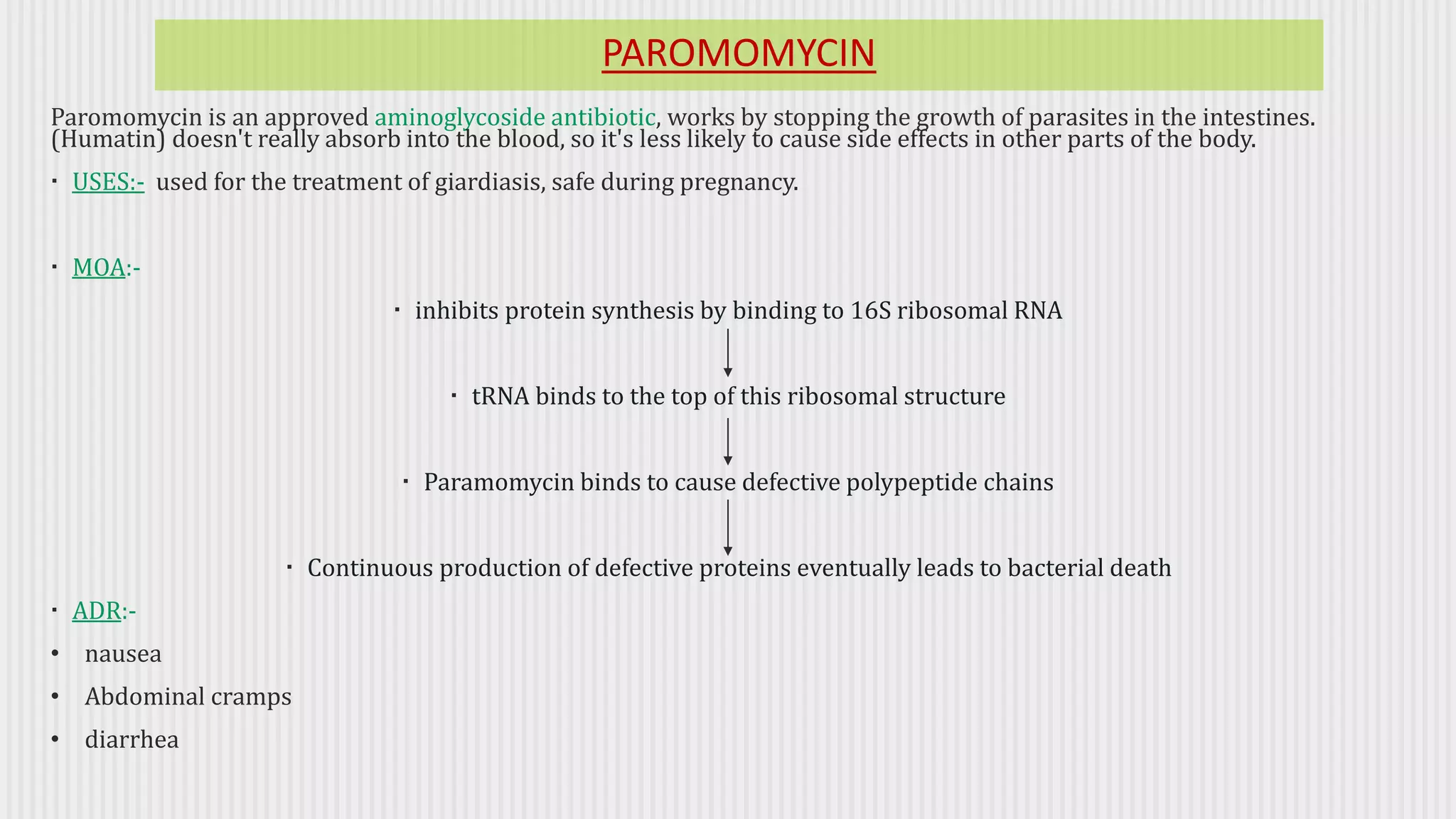
Paromomycin is an approved aminoglycoside antibiotic, works by stopping the growth of parasites in the intestines.
(Humatin) doesn't really absorb into the blood, so it's less likely to cause side effects in other parts of the body.
 USES:- used for the treatment of giardiasis, safe during pregnancy.
 MOA:-
 inhibits protein synthesis by binding to 16S ribosomal RNA
 tRNA binds to the top of this ribosomal structure
 Paramomycin binds to cause defective polypeptide chains
 Continuous production of defective proteins eventually leads to bacterial death
 ADR:-
• nausea
• Abdominal cramps
• diarrhea
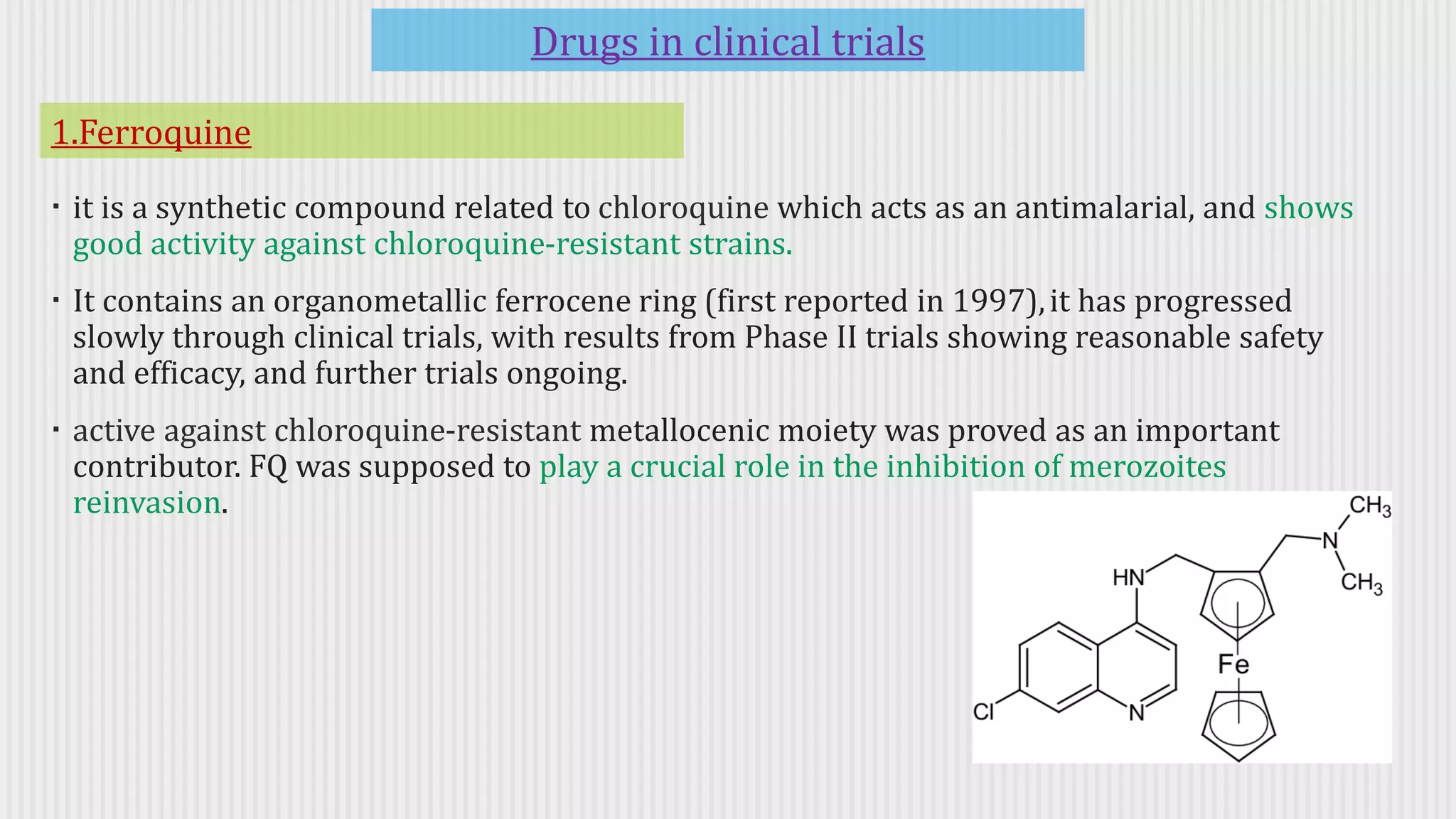
 it is a synthetic compound related to chloroquine which acts as an antimalarial, and shows
good activity against chloroquine-resistant strains.
 It contains an organometallic ferrocene ring (first reported in 1997),it has progressed
slowly through clinical trials, with results from Phase II trials showing reasonable safety
and efficacy, and further trials ongoing.
 active against chloroquine-resistant metallocenic moiety was proved as an important
contributor. FQ was supposed to play a crucial role in the inhibition of merozoites
reinvasion.
Drugs in clinical trials
1.Ferroquine
It is an antiparasitic drug used in combination with dihydroartemisinin to treat malaria.
Piperaquine kills parasites by disrupting the detoxification of host heme.
MOA:-
The mechanism of piperaquine inhibition of the haem detoxification pathway is unknown but is expected to be
similar to that of Chloroquine.
USES:-
• Used in combination with dihydroartemisin
(recommended by the WHO for the treatment of
uncomplicated malaria)
ADR:- headache, dizziness, vomiting, and diarrhea.
2.Piperaquine
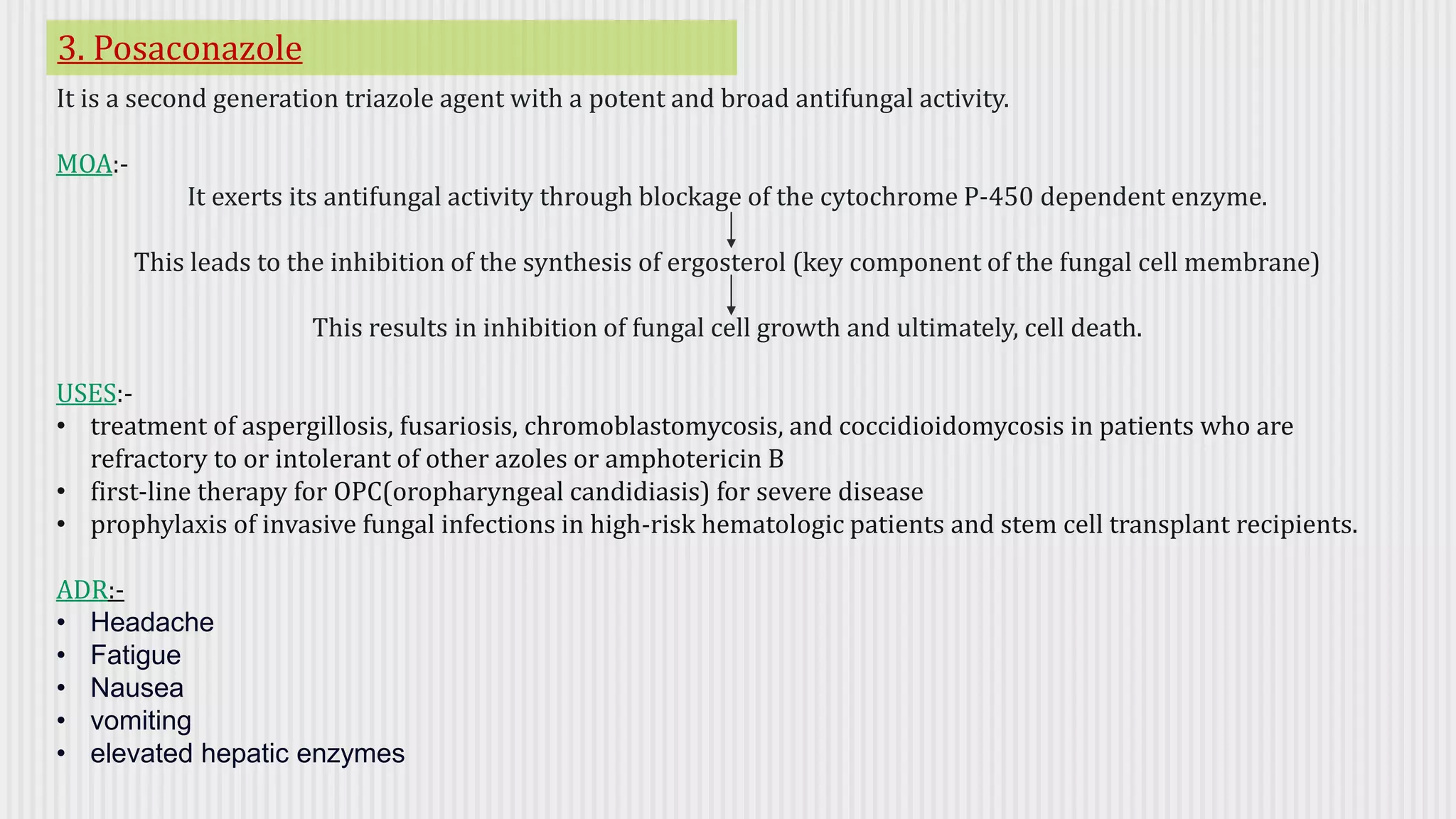
It is a second generation triazole agent with a potent and broad antifungal activity.
MOA:-
It exerts its antifungal activity through blockage of the cytochrome P-450 dependent enzyme.
This leads to the inhibition of the synthesis of ergosterol (key component of the fungal cell membrane)
This results in inhibition of fungal cell growth and ultimately, cell death.
USES:-
• treatment of aspergillosis, fusariosis, chromoblastomycosis, and coccidioidomycosis in patients who are
refractory to or intolerant of other azoles or amphotericin B
• first-line therapy for OPC(oropharyngeal candidiasis) for severe disease
• prophylaxis of invasive fungal infections in high-risk hematologic patients and stem cell transplant recipients.
ADR:-
• Headache
• Fatigue
• Nausea
• vomiting
• elevated hepatic enzymes
3. Posaconazole
 It is a new triazole drug with a potent broad-spectrum antifungal activity. The drug blocks a number
of CYP450 liver enzymes. (source: wikipedia)
 high oral bioavailability (Ramos et al., 1999; Capilla et al., 2001; Alves et al., 2006; Pasqualotto and Denning,
2008)
 exhibited high in vitro activity against pathogenic Candida species and filamentous fungi and showed
preliminary in vivo antifungal efficacy in a mice model of systemic candidiasis.
Drugs in Pre clinical trials
4. Albaconazole
REFERENCES
1. Goodman and Gilman’s – The pharmacological basis of therapeutics, 13th Edition, ch:54,
page 991-997
2. Anti-Infective Agents in Medicinal Chemistry, 2009, Vol. 8, No. 4 (Graebin et al)
3. https://www.tandfonline.com/doi/full/10.1080/13543776.2023.2201432
4. Trop. Med. Infect. Dis. 2021, 6(3), 128; https://doi.org/10.3390/tropicalmed6030128
5. https://pubs.acs.org/doi/abs/10.1021/ml300429p

Anti-protozoal.pptx

  • 1.
    ANTI-PROTOZOAL DRUGS Presented by:Srishti Bhargav M.Pharm (Department of Pharmacology)
  • 2.
    OVERVIEW Introduction Prevention of protozoalinfection Drug resistance in protozoal disease Challenges for novel drugs Drugs in Pre clinical or Clinical trials references
  • 3.
    INTRODUCTION  The immunesystem plays a crucial role in protecting against the pathological consequences of many protozoal infections.  Thus, opportunistic infections with protozoa are prominent in infants, individuals with cancer, transplant recipients, those receiving immunosuppressive drugs or extensive antibiotic therapy, and persons with advanced HIV infection.  chemotherapy has been the only practical way to both treat infected individuals and reduce transmission.  Satisfactory agents for treating important protozoal infections such as African trypanosomiasis (sleeping sickness) and chronic Chagas disease still are lacking. Many effective antiprotozoal drugs are toxic at therapeutic doses.
  • 5.
    ANTIBIOTICALSO EFFECTIVE INPROTOZOAL INFECTIONS  Eg – Metronidazole, Tinidazole is a standard antiamoebic drug for treating adults and children with invasive amoebiasis, but it cannot fully eliminate cysts from the intestine.  MOA - Inhibit the growth of protozoa at different stage of the parasitic cycle and inhibit their ability to reproduce. Hence, used to kill as well as prevent malaria.  They damage the protozoal DNA to limit the spread of infection (by inhibition of parasite dehydrogenase activity).  ADR - dizziness, convulsions, lack of coordination, and numbness of the extremities.
  • 6.
    TO CONTROL PROTOZOALINFECTION  Chemotherapy  Vector control But these strategies are also highly challenged by the phenomenon of drug resistance. i. limiting uptake of a drug ii. modification of a drug target iii. inactivation of a drug iv. active efflux of a drug.
  • 7.
    DRUG RESISTANCE INPROTOZOAL DISEASE Studies of resistance mechanisms cannot reverse the tide, but can help to handle the threat more rationally at three levels: 1. by developing tools to recognize resistance early in infection and prevent the loss of time with useless (and often toxic) chemotherapy 2. by pointing the way to more rational use of drugs and drug combinations to minimize development of resistance 3. by pinpointing intracellular drug targets and parasite defense mechanisms allowing the rational development of drug analogues not affected by the most common defenses.
  • 9.
    WHY IT’S DIFFICULTTOTREATPROTOZOAL DISEASE THAN BACTERIA?  Parasitic cells are Eukaryotic- more resemblance to human cells  Overuse of antibiotics creating more resistant genes to survive & re-infect  Produce some degree of host immunosuppression  Most of the drugs cause serious toxic effects & have not proved to be safe for pregnant patients.
  • 10.
    CHALLENGES 1) Increase drugresistance 2) Emerging cross resistance 3) Lack of new drugs with novel mechanism of action 4) Highly complicated life cycle (e.g.-plasmodia) & their inability to avoid innate immune defenses. 5) Challenges associated with culturing such organisms particularly in different phases of their growth & amplification. 6) Lack of investment in biomedical research aimed at developing treatments for tropical diseases that don't tend to affect more affluent countries.
  • 11.
    Source: Goodman andGilman’s –The pharmacological basis of therapeutics, 13th Edition, ch:54, page 996-997
  • 12.
    PAROMOMYCIN Paromomycin is anapproved aminoglycoside antibiotic, works by stopping the growth of parasites in the intestines. (Humatin) doesn't really absorb into the blood, so it's less likely to cause side effects in other parts of the body.  USES:- used for the treatment of giardiasis, safe during pregnancy.  MOA:-  inhibits protein synthesis by binding to 16S ribosomal RNA  tRNA binds to the top of this ribosomal structure  Paramomycin binds to cause defective polypeptide chains  Continuous production of defective proteins eventually leads to bacterial death  ADR:- • nausea • Abdominal cramps • diarrhea
  • 13.
     it isa synthetic compound related to chloroquine which acts as an antimalarial, and shows good activity against chloroquine-resistant strains.  It contains an organometallic ferrocene ring (first reported in 1997),it has progressed slowly through clinical trials, with results from Phase II trials showing reasonable safety and efficacy, and further trials ongoing.  active against chloroquine-resistant metallocenic moiety was proved as an important contributor. FQ was supposed to play a crucial role in the inhibition of merozoites reinvasion. Drugs in clinical trials 1.Ferroquine
  • 14.
    It is anantiparasitic drug used in combination with dihydroartemisinin to treat malaria. Piperaquine kills parasites by disrupting the detoxification of host heme. MOA:- The mechanism of piperaquine inhibition of the haem detoxification pathway is unknown but is expected to be similar to that of Chloroquine. USES:- • Used in combination with dihydroartemisin (recommended by the WHO for the treatment of uncomplicated malaria) ADR:- headache, dizziness, vomiting, and diarrhea. 2.Piperaquine
  • 15.
    It is asecond generation triazole agent with a potent and broad antifungal activity. MOA:- It exerts its antifungal activity through blockage of the cytochrome P-450 dependent enzyme. This leads to the inhibition of the synthesis of ergosterol (key component of the fungal cell membrane) This results in inhibition of fungal cell growth and ultimately, cell death. USES:- • treatment of aspergillosis, fusariosis, chromoblastomycosis, and coccidioidomycosis in patients who are refractory to or intolerant of other azoles or amphotericin B • first-line therapy for OPC(oropharyngeal candidiasis) for severe disease • prophylaxis of invasive fungal infections in high-risk hematologic patients and stem cell transplant recipients. ADR:- • Headache • Fatigue • Nausea • vomiting • elevated hepatic enzymes 3. Posaconazole
  • 16.
     It isa new triazole drug with a potent broad-spectrum antifungal activity. The drug blocks a number of CYP450 liver enzymes. (source: wikipedia)  high oral bioavailability (Ramos et al., 1999; Capilla et al., 2001; Alves et al., 2006; Pasqualotto and Denning, 2008)  exhibited high in vitro activity against pathogenic Candida species and filamentous fungi and showed preliminary in vivo antifungal efficacy in a mice model of systemic candidiasis. Drugs in Pre clinical trials 4. Albaconazole
  • 17.
    REFERENCES 1. Goodman andGilman’s – The pharmacological basis of therapeutics, 13th Edition, ch:54, page 991-997 2. Anti-Infective Agents in Medicinal Chemistry, 2009, Vol. 8, No. 4 (Graebin et al) 3. https://www.tandfonline.com/doi/full/10.1080/13543776.2023.2201432 4. Trop. Med. Infect. Dis. 2021, 6(3), 128; https://doi.org/10.3390/tropicalmed6030128 5. https://pubs.acs.org/doi/abs/10.1021/ml300429p