CALCIUM INFLUX ASSAY
SUMITRA PATEL
M.PHARM PHARMACOLOGY
WHY CALCIUM IS IMPORTANT??
• Calcium is an ubiquitous secondary messenger.
• It is involved - contractility of the cardiac and skeletal muscle
s

- Blood clotting
 

- Bone mineralisation
 

- Functioning of nervous syste
m

• Calcium ions contribute to signal transduction by affecting local electrostatic
fi
elds and interacting with proteins to alter their
conformations, and many receptors, channels, pumps, transporters, enzymes, and transcription factors play a role in the generation
and translation of calcium signals.
 

• It even acts as a cofactor for certain enzymes.
 

• The unique chemistry of calcium ions allows complex molecules to easily bind, even in the presence of large amounts of other ions.
This allows the intracellular concentration of Ca2+ to be maintained at the very low levels required for signalling.
 

• Even small calcium imbalances can therefore have pathogenic consequences, with links to neurological, endocrine, cardiovascular,
pulmonary, digestive, and metabolic diseases, as well as cancers
.
WHY CONDUCT CALCIUM ASSAYS?
• Calcium signalling can be studied in different cells and model organisms to gain a deeper understanding of the
mechanisms of a range of physiological processes, including the pathogenesis of diseases such as cancers and
neurodegenerative disorders
.

• Helps in determining the mechanism of action (MOA) of drugs prior to clinical trials.
 

• Such tests can assist in predicting potential unwanted drug side effects, and it is critical to have in vitro assays that
mimic the in vivo environment as accurately as possible to ensure reliable predictive data.
 

• Cell-based calcium assays allow the study of intracellular calcium levels, which are important indicators for the
activation state of ion channels and G-protein coupled receptors (GPCRs), as well as for following the cell damage
and apoptosis pathways5.
 

• GPCRs, in particular, are common targets for a variety of drugs, as they are implicated in a diverse range of
physiological processes and diseases. Although these processes may display different mechanisms and
mobilisation of calcium, there are common approaches to monitoring calcium levels
.
CALCIUM FLUX ASSAYS
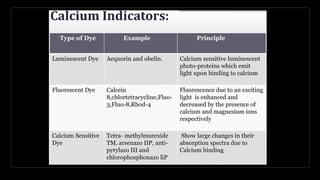
• Calcium
fl
ux assays detect intracellular calcium mobilisation in cells and follow the release of Ca2+ into the
cytoplasm.
 

• When studying events such as synaptic transmission at the neuromuscular junction, an action potential arrives at
the cell membrane, the membrane potential is depolarised, causing voltage-gated L-type calcium channels to open
to allow an in
fl
ux of Ca2+ into the cell.
 

• This leads to a release of Ca2+ from the sarcoplasmic reticulum, which also initiates a contraction by activating
Ca2+-dependent contractile proteins
.

• In particular, when Gaq/11 proteins are activated, they stimulate phospholipase C, leading to calcium release from
the endoplasmic reticulum.6 Increases in cytosolic calcium concentration can be detected by calcium-binding dyes
(e.g.,
fl
uo-4) by measuring the changes in
fl
uorescence emission intensity at a speci
fi
c wavelength.
TYPES OF CALCIUM ASSAYS
A. FLUORESCENCE ASSAYS
B. COLORIMETRIC ASSAYS
C. LUMINESCENCE ASSAY
FLUORESCENCE ASSAYS
• Ca2+ indicators based on
fl
uorescent proteins has assisted greatly in the study of cellular signalling
.

• Coupled with advances in micro-plate reader technologies, the progressive improvements in these
fl
uorescent
probes have signi
fi
cantly increased our understanding of cellular Ca2+ signalling
.

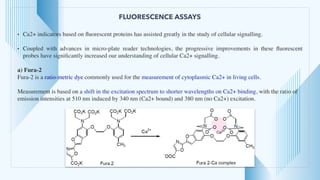
a) Fura-
2

Fura-2 is a ratio-metric dye commonly used for the measurement of cytoplasmic Ca2+ in living cells.
 

Measurement is based on a shift in the excitation spectrum to shorter wavelengths on Ca2+ binding, with the ratio of
emission intensities at 510 nm induced by 340 nm (Ca2+ bound) and 380 nm (no Ca2+) excitation.
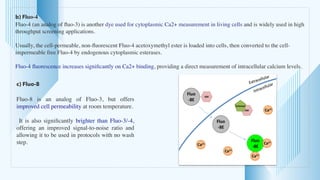
b) Fluo-
4

Fluo-4 (an analog of
fl
uo-3) is another dye used for cytoplasmic Ca2+ measurement in living cells and is widely used in high
throughput screening applications.
 

Usually, the cell-permeable, non-
fl
uorescent Fluo-4 acetoxymethyl ester is loaded into cells, then converted to the cell-
impermeable free Fluo-4 by endogenous cytoplasmic esterases.
 

Fluo-4
fl
uorescence increases signi
fi
cantly on Ca2+ binding, providing a direct measurement of intracellular calcium levels
.

c) Fluo-8
Fluo-8 is an analog of Fluo-3, but offers
improved cell permeability at room temperature
.

It is also signi
fi
cantly brighter than Fluo-3/-4,
offering an improved signal-to-noise ratio and
allowing it to be used in protocols with no wash
step.
COLORIMETRIC ASSAYS
• Colorimetric calcium assays use reagents that undergo a measurable colour change in the presence of an analyte.
 

• For instance, o-cresolphthalein reacts with Ca2+ in an alkaline environment to produce a violet-coloured complex,
where colour intensity is proportional to calcium concentration in the sample.
• This quick and easy assay can be used to determine the overall level of Ca2+ and can be performed in a number of
different sample types.
LUMINESCENCE ASSAY
Luminescence assays rely on a chemical or enzymatic reaction that gives off light as a by-product, with a number of
assays used to study calcium.
 

a) Aequori
n

The aequorin luminescence-based assay can be used to analyse Ca2+ levels in vivo, helping to elucidate G-protein
mediated Ca2+ signaling, as well as other pathways that are affected by changes in calcium level.
• This assay is based on the conversion of apo-
aequorin to aequorin with high calcium
af
fi
nity
.

• Activation of the GPCR will induce
intracellular Ca2+ release, which then binds to
the aequorin.
 

• The aequorin oxidizes a coelenterazine
substrate present in the cell suspension to
coelenteramide, which emits light.
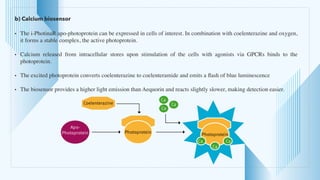
b) Calcium biosensor
• The i-PhotinaR apo-photoprotein can be expressed in cells of interest. In combination with coelenterazine and oxygen,
it forms a stable complex, the active photoprotein.
 

• Calcium released from intracellular stores upon stimulation of the cells with agonists via GPCRs binds to the
photoprotein.
 

• The excited photoprotein converts coelenterazine to coelenteramide and emits a flash of blue luminescence


• The biosensor provides a higher light emission than Aequorin and reacts slightly slower, making detection easier.
LUMINESCENT AEQUORIN ASSAY
PRINCIPLE
 

It is based on the conversion of apo-aequorin to aequorin
with high calcium af
fi
nity, with the addition of
coelenterazine in the cell suspension.
 

Activation of the GPCR will induce intracellular Ca2+
release which binds to the aequorin.
 

The aequorin oxidases the coelenterazine to coelenteramide,
which emits light at 470nm.
• Cultured Chinese hamster ovary (CHO) cells over expressing the GPCR of interest was detached
.

• It was then resuspended in serum- free medium, centrifuged and diluted to obtain 3 x 10⁵ cells/ml.
 

• Cells were loaded with 5μM coelenterazine by overnight (O/N) incubation at room temperature on a rolling
system in the dark.
 

• Subsequently, 25,000 cells/well were seeded in 50μL in a 384 well micro-plate.
 

• Chemical molecules were pre-diluted (single dose at 10μM
fi
nal concentration for the HTS or ten-point
serial dilutions ranging from 20μM to 1nM for hit con
fi
rmation)
.

• 10μL of diluted chemical molecules was added to the cells using the FDSS/μCELL and intracellular calcium
changes were measured immediately by recording luminescence for a three-minute period (agonist readout)
.

• After an incubation of 15 minutes at 37°C, following the agonist readout, the plates were transferred to the
FDSS/μCELL reader.
 

• Cells were stimulated with 10μL of EC80 of agonist and intracellular calcium changes were measured
immediately by recording luminescence for a three minute period (antagonist readout).
MATERIALS AND METHOD
FLUORESCENT BASED ASSAYS
PRINCIPLE
 

For the
fl
uorescent dye-based assay, the GPCR expressing
cells are pre-loaded with a
fl
uorescent dye combined with a
quencher dye (for example, Fluo-8, Tebu-bio).
 

The
fl
uorescent dye crosses the cell membrane and then binds
to the intracellular released Ca2+, enhancing the
fl
uorescence
intensity of the dye.
 

Upon agonist stimulation, intracellular calcium release will
enhance a
fl
uorescence signal.
 

A quencher dye will mask the extracellular calcium present in
the medium, thus reducing the background
fl
uorescence.
• 50μL CHO cells stably over-expressing the GPCR of interest were seeded in 384 well sterile micro-plates at 7,500
cells/well and were incubated O/N at 37°C under 5% CO2.
 

• Cells were subsequently washed twice with 25μL/well of serum-free medium.
 

• After one hour of starvation at 37°C and 5% CO2, cells were loaded with 25μL of Fluo-8 dye diluted in Hank’s
balanced salt solution (HBSS) buffer with 20mM Hepes, complemented with 5mM of probenecid and incubated
for one hour at 37°C and 5% CO2.
 

• Chemical molecules were added and the cells triggered with agonist as described above for the aequorin
technology.
 

• To measure the intracellular calcium changes, the
fl
uorescent signal was recorded for three minutes.
MATERIALS AND METHOD
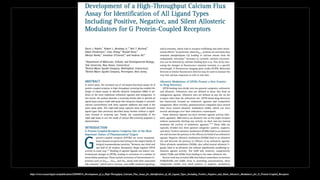
https://www.researchgate.net/publication/228098914_Development_of_a_High-Throughput_Calcium_Flux_Assay_for_Identi
fi
cation_of_All_Ligand_Types_Including_Positive_Negative_and_Silent_Allosteric_Modulators_for_G_Protein-Coupled_Receptors
REFERENCES….
• h t t p s : / / w w w . r e s e a r c h g a t e . n e t / p u b l i c a t i o n / 2 2 8 0 9 8 9 1 4 _ D e v e l o p m e n t _ o f _ a _ H i g h -
Throughput_Calcium_Flux_Assay_for_Identi
fi
cation_of_All_Ligand_Types_Including_Positive_Negative_and_Silent_Allos
teric_Modulators_for_G_Protein-Coupled_Receptors
• https://www.bmglabtech.com/en/blog/calcium-assays-at-the-centre-of-biology/
• h t t p s : / / w w w . r e s e a r c h g a t e . n e t / p u b l i c a t i o n / 2 2 8 0 9 8 9 1 4 _ D e v e l o p m e n t _ o f _ a _ H i g h -
Throughput_Calcium_Flux_Assay_for_Identi
fi
cation_of_All_Ligand_Types_Including_Positive_Negative_and_Silent_Allos
teric_Modulators_for_G_Protein-Coupled_Receptors
• https://doi.org/10.1042/bj20140931
THANK YOU….

calcium influx assay

  • 1.
    CALCIUM INFLUX ASSAY SUMITRAPATEL M.PHARM PHARMACOLOGY
  • 2.
    WHY CALCIUM ISIMPORTANT?? • Calcium is an ubiquitous secondary messenger. • It is involved - contractility of the cardiac and skeletal muscle s - Blood clotting - Bone mineralisation - Functioning of nervous syste m • Calcium ions contribute to signal transduction by affecting local electrostatic fi elds and interacting with proteins to alter their conformations, and many receptors, channels, pumps, transporters, enzymes, and transcription factors play a role in the generation and translation of calcium signals. • It even acts as a cofactor for certain enzymes. • The unique chemistry of calcium ions allows complex molecules to easily bind, even in the presence of large amounts of other ions. This allows the intracellular concentration of Ca2+ to be maintained at the very low levels required for signalling. • Even small calcium imbalances can therefore have pathogenic consequences, with links to neurological, endocrine, cardiovascular, pulmonary, digestive, and metabolic diseases, as well as cancers .
  • 3.
    WHY CONDUCT CALCIUMASSAYS? • Calcium signalling can be studied in different cells and model organisms to gain a deeper understanding of the mechanisms of a range of physiological processes, including the pathogenesis of diseases such as cancers and neurodegenerative disorders . • Helps in determining the mechanism of action (MOA) of drugs prior to clinical trials. • Such tests can assist in predicting potential unwanted drug side effects, and it is critical to have in vitro assays that mimic the in vivo environment as accurately as possible to ensure reliable predictive data.   • Cell-based calcium assays allow the study of intracellular calcium levels, which are important indicators for the activation state of ion channels and G-protein coupled receptors (GPCRs), as well as for following the cell damage and apoptosis pathways5. • GPCRs, in particular, are common targets for a variety of drugs, as they are implicated in a diverse range of physiological processes and diseases. Although these processes may display different mechanisms and mobilisation of calcium, there are common approaches to monitoring calcium levels .
  • 4.
    CALCIUM FLUX ASSAYS •Calcium fl ux assays detect intracellular calcium mobilisation in cells and follow the release of Ca2+ into the cytoplasm. • When studying events such as synaptic transmission at the neuromuscular junction, an action potential arrives at the cell membrane, the membrane potential is depolarised, causing voltage-gated L-type calcium channels to open to allow an in fl ux of Ca2+ into the cell. • This leads to a release of Ca2+ from the sarcoplasmic reticulum, which also initiates a contraction by activating Ca2+-dependent contractile proteins . • In particular, when Gaq/11 proteins are activated, they stimulate phospholipase C, leading to calcium release from the endoplasmic reticulum.6 Increases in cytosolic calcium concentration can be detected by calcium-binding dyes (e.g., fl uo-4) by measuring the changes in fl uorescence emission intensity at a speci fi c wavelength.
  • 5.
    TYPES OF CALCIUMASSAYS A. FLUORESCENCE ASSAYS B. COLORIMETRIC ASSAYS C. LUMINESCENCE ASSAY
  • 6.
    FLUORESCENCE ASSAYS • Ca2+indicators based on fl uorescent proteins has assisted greatly in the study of cellular signalling . • Coupled with advances in micro-plate reader technologies, the progressive improvements in these fl uorescent probes have signi fi cantly increased our understanding of cellular Ca2+ signalling . a) Fura- 2 Fura-2 is a ratio-metric dye commonly used for the measurement of cytoplasmic Ca2+ in living cells. Measurement is based on a shift in the excitation spectrum to shorter wavelengths on Ca2+ binding, with the ratio of emission intensities at 510 nm induced by 340 nm (Ca2+ bound) and 380 nm (no Ca2+) excitation.
  • 7.
    b) Fluo- 4 Fluo-4 (ananalog of fl uo-3) is another dye used for cytoplasmic Ca2+ measurement in living cells and is widely used in high throughput screening applications. Usually, the cell-permeable, non- fl uorescent Fluo-4 acetoxymethyl ester is loaded into cells, then converted to the cell- impermeable free Fluo-4 by endogenous cytoplasmic esterases. Fluo-4 fl uorescence increases signi fi cantly on Ca2+ binding, providing a direct measurement of intracellular calcium levels . c) Fluo-8 Fluo-8 is an analog of Fluo-3, but offers improved cell permeability at room temperature . It is also signi fi cantly brighter than Fluo-3/-4, offering an improved signal-to-noise ratio and allowing it to be used in protocols with no wash step.
  • 8.
    COLORIMETRIC ASSAYS • Colorimetriccalcium assays use reagents that undergo a measurable colour change in the presence of an analyte. • For instance, o-cresolphthalein reacts with Ca2+ in an alkaline environment to produce a violet-coloured complex, where colour intensity is proportional to calcium concentration in the sample. • This quick and easy assay can be used to determine the overall level of Ca2+ and can be performed in a number of different sample types.
  • 9.
    LUMINESCENCE ASSAY Luminescence assaysrely on a chemical or enzymatic reaction that gives off light as a by-product, with a number of assays used to study calcium. a) Aequori n The aequorin luminescence-based assay can be used to analyse Ca2+ levels in vivo, helping to elucidate G-protein mediated Ca2+ signaling, as well as other pathways that are affected by changes in calcium level. • This assay is based on the conversion of apo- aequorin to aequorin with high calcium af fi nity . • Activation of the GPCR will induce intracellular Ca2+ release, which then binds to the aequorin. • The aequorin oxidizes a coelenterazine substrate present in the cell suspension to coelenteramide, which emits light.
  • 10.
    b) Calcium biosensor •The i-PhotinaR apo-photoprotein can be expressed in cells of interest. In combination with coelenterazine and oxygen, it forms a stable complex, the active photoprotein. • Calcium released from intracellular stores upon stimulation of the cells with agonists via GPCRs binds to the photoprotein. • The excited photoprotein converts coelenterazine to coelenteramide and emits a flash of blue luminescence • The biosensor provides a higher light emission than Aequorin and reacts slightly slower, making detection easier.
  • 12.
    LUMINESCENT AEQUORIN ASSAY PRINCIPLE It is based on the conversion of apo-aequorin to aequorin with high calcium af fi nity, with the addition of coelenterazine in the cell suspension. Activation of the GPCR will induce intracellular Ca2+ release which binds to the aequorin. The aequorin oxidases the coelenterazine to coelenteramide, which emits light at 470nm.
  • 13.
    • Cultured Chinesehamster ovary (CHO) cells over expressing the GPCR of interest was detached . • It was then resuspended in serum- free medium, centrifuged and diluted to obtain 3 x 10⁵ cells/ml. • Cells were loaded with 5μM coelenterazine by overnight (O/N) incubation at room temperature on a rolling system in the dark. • Subsequently, 25,000 cells/well were seeded in 50μL in a 384 well micro-plate. • Chemical molecules were pre-diluted (single dose at 10μM fi nal concentration for the HTS or ten-point serial dilutions ranging from 20μM to 1nM for hit con fi rmation) . • 10μL of diluted chemical molecules was added to the cells using the FDSS/μCELL and intracellular calcium changes were measured immediately by recording luminescence for a three-minute period (agonist readout) . • After an incubation of 15 minutes at 37°C, following the agonist readout, the plates were transferred to the FDSS/μCELL reader. • Cells were stimulated with 10μL of EC80 of agonist and intracellular calcium changes were measured immediately by recording luminescence for a three minute period (antagonist readout). MATERIALS AND METHOD
  • 14.
    FLUORESCENT BASED ASSAYS PRINCIPLE For the fl uorescent dye-based assay, the GPCR expressing cells are pre-loaded with a fl uorescent dye combined with a quencher dye (for example, Fluo-8, Tebu-bio). The fl uorescent dye crosses the cell membrane and then binds to the intracellular released Ca2+, enhancing the fl uorescence intensity of the dye. Upon agonist stimulation, intracellular calcium release will enhance a fl uorescence signal. A quencher dye will mask the extracellular calcium present in the medium, thus reducing the background fl uorescence.
  • 15.
    • 50μL CHOcells stably over-expressing the GPCR of interest were seeded in 384 well sterile micro-plates at 7,500 cells/well and were incubated O/N at 37°C under 5% CO2. • Cells were subsequently washed twice with 25μL/well of serum-free medium. • After one hour of starvation at 37°C and 5% CO2, cells were loaded with 25μL of Fluo-8 dye diluted in Hank’s balanced salt solution (HBSS) buffer with 20mM Hepes, complemented with 5mM of probenecid and incubated for one hour at 37°C and 5% CO2. • Chemical molecules were added and the cells triggered with agonist as described above for the aequorin technology. • To measure the intracellular calcium changes, the fl uorescent signal was recorded for three minutes. MATERIALS AND METHOD
  • 16.
  • 17.
    REFERENCES…. • h tt p s : / / w w w . r e s e a r c h g a t e . n e t / p u b l i c a t i o n / 2 2 8 0 9 8 9 1 4 _ D e v e l o p m e n t _ o f _ a _ H i g h - Throughput_Calcium_Flux_Assay_for_Identi fi cation_of_All_Ligand_Types_Including_Positive_Negative_and_Silent_Allos teric_Modulators_for_G_Protein-Coupled_Receptors • https://www.bmglabtech.com/en/blog/calcium-assays-at-the-centre-of-biology/ • h t t p s : / / w w w . r e s e a r c h g a t e . n e t / p u b l i c a t i o n / 2 2 8 0 9 8 9 1 4 _ D e v e l o p m e n t _ o f _ a _ H i g h - Throughput_Calcium_Flux_Assay_for_Identi fi cation_of_All_Ligand_Types_Including_Positive_Negative_and_Silent_Allos teric_Modulators_for_G_Protein-Coupled_Receptors • https://doi.org/10.1042/bj20140931
  • 18.