
Antiviral drugs
Anti-Influenza agents
S. Parasuraman, M.Pharm., Ph.D.,
Associate Professor
Faculty of Pharmacy
AIMST University, Malaysia
Anti-Influenza agents - Learning Outcomes
• At the end of this session, the student would be able
to:
– list the drugs used for the management of influenza virus
infection. (CLO1)
– describe the mechanism of action, pharmacological
actions, pharmacokinetic features, therapeutic uses,
adverse effects, interaction and contraindications of anti-
influenza drugs. (CLO1)
Influenza virus and Anti-Influenza agents
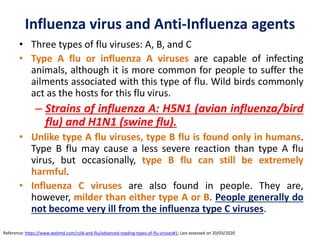
• Three types of flu viruses: A, B, and C
• Type A flu or influenza A viruses are capable of infecting
animals, although it is more common for people to suffer the
ailments associated with this type of flu. Wild birds commonly
act as the hosts for this flu virus.
– Strains of influenza A: H5N1 (avian influenza/bird
flu) and H1N1 (swine flu).
• Unlike type A flu viruses, type B flu is found only in humans.
Type B flu may cause a less severe reaction than type A flu
virus, but occasionally, type B flu can still be extremely
harmful.
• Influenza C viruses are also found in people. They are,
however, milder than either type A or B. People generally do
not become very ill from the influenza type C viruses.
Reference: https://www.webmd.com/cold-and-flu/advanced-reading-types-of-flu-viruses#1; Last assessed on 20/03/2020
Influenza virus and Anti-Influenza agents
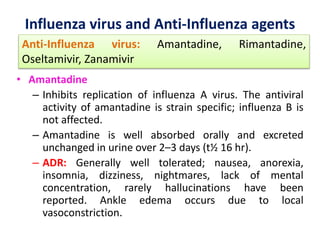
• Amantadine
– Inhibits replication of influenza A virus. The antiviral
activity of amantadine is strain specific; influenza B is
not affected.
– Amantadine is well absorbed orally and excreted
unchanged in urine over 2–3 days (t½ 16 hr).
– ADR: Generally well tolerated; nausea, anorexia,
insomnia, dizziness, nightmares, lack of mental
concentration, rarely hallucinations have been
reported. Ankle edema occurs due to local
vasoconstriction.
Anti-Influenza virus: Amantadine, Rimantadine,
Oseltamivir, Zanamivir
Influenza virus and Anti-Influenza agents
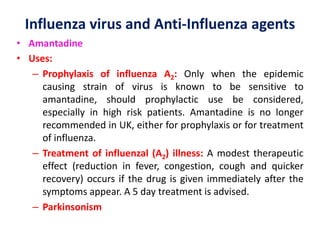
• Amantadine
• Uses:
– Prophylaxis of influenza A2: Only when the epidemic
causing strain of virus is known to be sensitive to
amantadine, should prophylactic use be considered,
especially in high risk patients. Amantadine is no longer
recommended in UK, either for prophylaxis or for treatment
of influenza.
– Treatment of influenzal (A2) illness: A modest therapeutic
effect (reduction in fever, congestion, cough and quicker
recovery) occurs if the drug is given immediately after the
symptoms appear. A 5 day treatment is advised.
– Parkinsonism
Influenza virus and Anti-Influenza agents
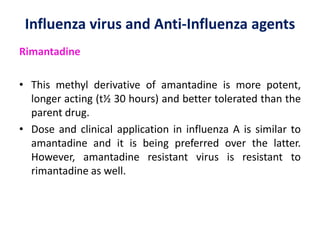
Rimantadine
• This methyl derivative of amantadine is more potent,
longer acting (t½ 30 hours) and better tolerated than the
parent drug.
• Dose and clinical application in influenza A is similar to
amantadine and it is being preferred over the latter.
However, amantadine resistant virus is resistant to
rimantadine as well.
Influenza virus and Anti-Influenza agents
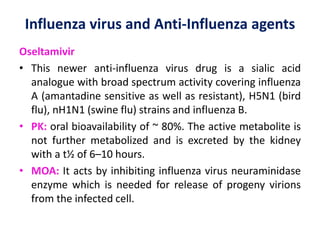
Oseltamivir
• This newer anti-influenza virus drug is a sialic acid
analogue with broad spectrum activity covering influenza
A (amantadine sensitive as well as resistant), H5N1 (bird
flu), nH1N1 (swine flu) strains and influenza B.
• PK: oral bioavailability of ~ 80%. The active metabolite is
not further metabolized and is excreted by the kidney
with a t½ of 6–10 hours.
• MOA: It acts by inhibiting influenza virus neuraminidase
enzyme which is needed for release of progeny virions
from the infected cell.
Influenza virus and Anti-Influenza agents
Oseltamivir
• Use:
– Oseltamivir is indicated both for prophylaxis as well as
treatment of influenza A, swine flu, bird flu and influenza
B.
– Prophylactic use for 5–10 days prevents illness in contacts
of influenza patients.
• ADR:
– Nausea, abdominal pain, headache, weakness, sadness,
diarrhoea, cough, insomnia, skin reactions
Influenza virus and Anti-Influenza agents
Zanamivir
• Zanamivir is influenza A (including amantadine-resistant,
nH1N1, H5N1 strains) and influenza B virus
neuraminidase inhibitor.
• Clinical utility and efficacy of zanamivir are similar to that
of oseltamivir.
• The inhaled powder can induce bronchospasm in some
individuals. Contraindicated in asthmatic patients.
Anti-influenza agents

Anti-influenza agents

  • 1.
    Antiviral drugs Anti-Influenza agents S.Parasuraman, M.Pharm., Ph.D., Associate Professor Faculty of Pharmacy AIMST University, Malaysia
  • 2.
    Anti-Influenza agents -Learning Outcomes • At the end of this session, the student would be able to: – list the drugs used for the management of influenza virus infection. (CLO1) – describe the mechanism of action, pharmacological actions, pharmacokinetic features, therapeutic uses, adverse effects, interaction and contraindications of anti- influenza drugs. (CLO1)
  • 3.
    Influenza virus andAnti-Influenza agents • Three types of flu viruses: A, B, and C • Type A flu or influenza A viruses are capable of infecting animals, although it is more common for people to suffer the ailments associated with this type of flu. Wild birds commonly act as the hosts for this flu virus. – Strains of influenza A: H5N1 (avian influenza/bird flu) and H1N1 (swine flu). • Unlike type A flu viruses, type B flu is found only in humans. Type B flu may cause a less severe reaction than type A flu virus, but occasionally, type B flu can still be extremely harmful. • Influenza C viruses are also found in people. They are, however, milder than either type A or B. People generally do not become very ill from the influenza type C viruses. Reference: https://www.webmd.com/cold-and-flu/advanced-reading-types-of-flu-viruses#1; Last assessed on 20/03/2020
  • 4.
    Influenza virus andAnti-Influenza agents • Amantadine – Inhibits replication of influenza A virus. The antiviral activity of amantadine is strain specific; influenza B is not affected. – Amantadine is well absorbed orally and excreted unchanged in urine over 2–3 days (t½ 16 hr). – ADR: Generally well tolerated; nausea, anorexia, insomnia, dizziness, nightmares, lack of mental concentration, rarely hallucinations have been reported. Ankle edema occurs due to local vasoconstriction. Anti-Influenza virus: Amantadine, Rimantadine, Oseltamivir, Zanamivir
  • 5.
    Influenza virus andAnti-Influenza agents • Amantadine • Uses: – Prophylaxis of influenza A2: Only when the epidemic causing strain of virus is known to be sensitive to amantadine, should prophylactic use be considered, especially in high risk patients. Amantadine is no longer recommended in UK, either for prophylaxis or for treatment of influenza. – Treatment of influenzal (A2) illness: A modest therapeutic effect (reduction in fever, congestion, cough and quicker recovery) occurs if the drug is given immediately after the symptoms appear. A 5 day treatment is advised. – Parkinsonism
  • 6.
    Influenza virus andAnti-Influenza agents Rimantadine • This methyl derivative of amantadine is more potent, longer acting (t½ 30 hours) and better tolerated than the parent drug. • Dose and clinical application in influenza A is similar to amantadine and it is being preferred over the latter. However, amantadine resistant virus is resistant to rimantadine as well.
  • 7.
    Influenza virus andAnti-Influenza agents Oseltamivir • This newer anti-influenza virus drug is a sialic acid analogue with broad spectrum activity covering influenza A (amantadine sensitive as well as resistant), H5N1 (bird flu), nH1N1 (swine flu) strains and influenza B. • PK: oral bioavailability of ~ 80%. The active metabolite is not further metabolized and is excreted by the kidney with a t½ of 6–10 hours. • MOA: It acts by inhibiting influenza virus neuraminidase enzyme which is needed for release of progeny virions from the infected cell.
  • 8.
    Influenza virus andAnti-Influenza agents Oseltamivir • Use: – Oseltamivir is indicated both for prophylaxis as well as treatment of influenza A, swine flu, bird flu and influenza B. – Prophylactic use for 5–10 days prevents illness in contacts of influenza patients. • ADR: – Nausea, abdominal pain, headache, weakness, sadness, diarrhoea, cough, insomnia, skin reactions
  • 9.
    Influenza virus andAnti-Influenza agents Zanamivir • Zanamivir is influenza A (including amantadine-resistant, nH1N1, H5N1 strains) and influenza B virus neuraminidase inhibitor. • Clinical utility and efficacy of zanamivir are similar to that of oseltamivir. • The inhaled powder can induce bronchospasm in some individuals. Contraindicated in asthmatic patients.