

OVERVIEW ANDOVERVIEW AND
CLINICALCLINICAL
CONSEDERATIONSCONSEDERATIONS
PART ONE:PART ONE:
 OVERVIEWOVERVIEW
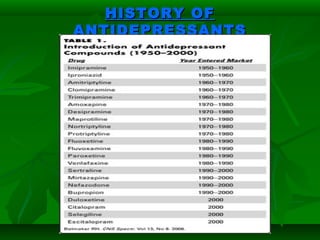
HISTORY OFHISTORY OF
ANTIDEPRESSANTSANTIDEPRESSANTS
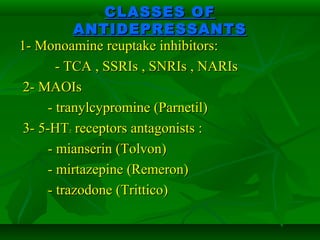
CLASSES OFCLASSES OF
ANTIDEPRESSANTSANTIDEPRESSANTS
1- Monoamine reuptake inhibitors:1- Monoamine reuptake inhibitors:
- TCA , SSRIs , SNRIs , NARIs- TCA , SSRIs , SNRIs , NARIs
2- MAOIs2- MAOIs
- tranylcypromine (Parnetil)- tranylcypromine (Parnetil)
3- 5-HT3- 5-HT22 receptors antagonists :receptors antagonists :
- mianserin (Tolvon)- mianserin (Tolvon)
- mirtazepine (Remeron)- mirtazepine (Remeron)
- trazodone (Trittico)- trazodone (Trittico)
CHOICE OFCHOICE OF
ANTIDEPRESSANTSANTIDEPRESSANTS
 IN THE BROAD RANGE OF MAJORIN THE BROAD RANGE OF MAJOR
DEPRESSION , ANTIDEPRESSANTDEPRESSION , ANTIDEPRESSANT
DRUGS ARE OF EQUIVALENTDRUGS ARE OF EQUIVALENT
EFFICACY. THE MAIN DISTINICTIONSEFFICACY. THE MAIN DISTINICTIONS
BETWEEN THEM ARE IN THEREBETWEEN THEM ARE IN THERE
ADVERSE EFFECTS , TOXICITY , ANDADVERSE EFFECTS , TOXICITY , AND
COST .COST .
Gelder M , Harrison P , Cowen P ( 2006) . Shorter Oxford textbook of psychiatry .Gelder M , Harrison P , Cowen P ( 2006) . Shorter Oxford textbook of psychiatry .
Oxford university press , N.Y.Oxford university press , N.Y.
1- Monoamine Oxidase1- Monoamine Oxidase
InhibitorsInhibitors
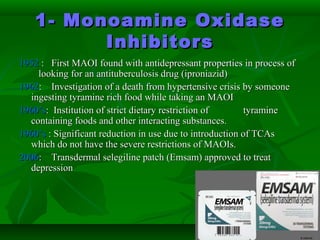
19521952 : First MAOI found with antidepressant properties in process of: First MAOI found with antidepressant properties in process of
looking for an antituberculosis drug (iproniazid)looking for an antituberculosis drug (iproniazid)
19621962: Investigation of a death from hypertensive crisis by someone: Investigation of a death from hypertensive crisis by someone
ingesting tyramine rich food while taking an MAOIingesting tyramine rich food while taking an MAOI
1960’s1960’s: Institution of strict dietary restriction of: Institution of strict dietary restriction of tyraminetyramine
containing foods and other interacting substances.containing foods and other interacting substances.
1960’s1960’s : Significant reduction in use due to introduction of TCAs: Significant reduction in use due to introduction of TCAs
which do not have the severe restrictions of MAOIs.which do not have the severe restrictions of MAOIs.
20062006: Transdermal selegiline patch (Emsam) approved to treat: Transdermal selegiline patch (Emsam) approved to treat
depressiondepression
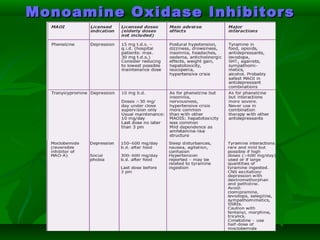
Monoamine Oxidase InhibitorsMonoamine Oxidase Inhibitors
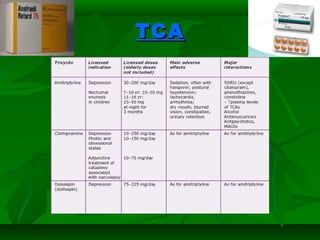
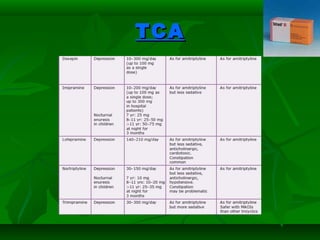
2- TCA2- TCA
19581958 : imipramine failed investigation as an: imipramine failed investigation as an
antipsychotic but found to have antidepressantantipsychotic but found to have antidepressant
properties.properties.
1960’s1960’s : multiple other TCA’s developed and placed: multiple other TCA’s developed and placed
into use.into use.
1990’s1990’s : significant reduction in use due to introduction: significant reduction in use due to introduction
of SSRIs which have fewer side effects.of SSRIs which have fewer side effects.
TCATCA
TCATCA
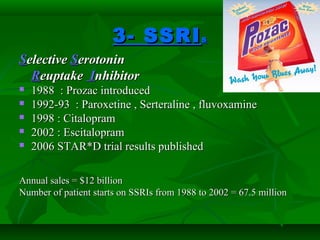
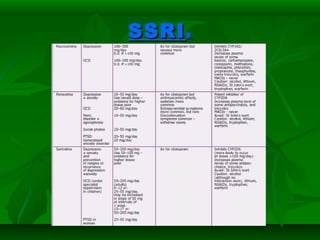
3- SSRI3- SSRIss
SSelectiveelective SSerotoninerotonin
RReuptakeeuptake IInhibitornhibitor
 1988 : Prozac introduced1988 : Prozac introduced
 1992-93 : Paroxetine , Serteraline , fluvoxamine1992-93 : Paroxetine , Serteraline , fluvoxamine
 1998 : Citalopram1998 : Citalopram
 2002 : Escitalopram2002 : Escitalopram
 2006 STAR*D trial results published2006 STAR*D trial results published
Annual sales = $12 billionAnnual sales = $12 billion
Number of patient starts on SSRIs from 1988 to 2002 = 67.5 millionNumber of patient starts on SSRIs from 1988 to 2002 = 67.5 million
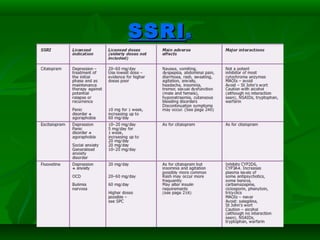
SSRISSRIss
SSRISSRIss
SSRISSRIss
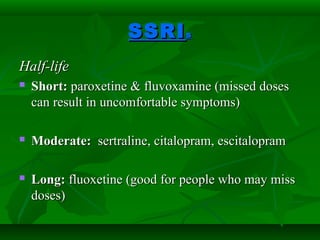
Half-lifeHalf-life
 Short:Short: paroxetine & fluvoxamine (missed dosesparoxetine & fluvoxamine (missed doses
can result in uncomfortable symptoms)can result in uncomfortable symptoms)
 Moderate:Moderate: sertraline, citalopram, escitalopramsertraline, citalopram, escitalopram
 Long:Long: fluoxetine (good for people who may missfluoxetine (good for people who may miss
doses)doses)
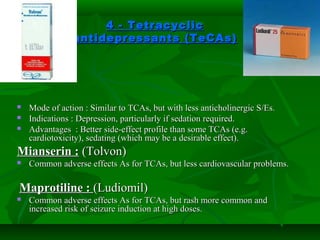
4 - Tetracyclic4 - Tetracyclic
antidepressants (TeCAs)antidepressants (TeCAs)
 Mode of action : Similar to TCAs, but with less anticholinergic S/Es.Mode of action : Similar to TCAs, but with less anticholinergic S/Es.
 Indications : Depression, particularly if sedation required.Indications : Depression, particularly if sedation required.
 Advantages : Better side-effect profile than some TCAs (e.g.Advantages : Better side-effect profile than some TCAs (e.g.
cardiotoxicity), sedating (which may be a desirable effect).cardiotoxicity), sedating (which may be a desirable effect).
Mianserin :Mianserin : (Tolvon)(Tolvon)
 Common adverse effects As for TCAs, but less cardiovascular problems.Common adverse effects As for TCAs, but less cardiovascular problems.
Maprotiline :Maprotiline : (Ludiomil)(Ludiomil)
 Common adverse effects As for TCAs, but rash more common andCommon adverse effects As for TCAs, but rash more common and
increased risk of seizure induction at high doses.increased risk of seizure induction at high doses.
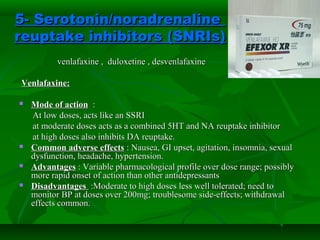
5- Serotonin/noradrenaline5- Serotonin/noradrenaline
reuptake inhibitors (SNRIs)reuptake inhibitors (SNRIs)
venlafaxine , duloxetine , desvenlafaxinevenlafaxine , duloxetine , desvenlafaxine
Venlafaxine:Venlafaxine:
 Mode of actionMode of action ::
At low doses, acts like an SSRIAt low doses, acts like an SSRI
at moderate doses acts as a combined 5HT and NA reuptake inhibitorat moderate doses acts as a combined 5HT and NA reuptake inhibitor
at high doses also inhibits DA reuptake.at high doses also inhibits DA reuptake.
 Common adverse effectsCommon adverse effects : Nausea, GI upset, agitation, insomnia, sexual: Nausea, GI upset, agitation, insomnia, sexual
dysfunction, headache, hypertension.dysfunction, headache, hypertension.
 AdvantagesAdvantages : Variable pharmacological profile over dose range; possibly: Variable pharmacological profile over dose range; possibly
more rapid onset of action than other antidepressantsmore rapid onset of action than other antidepressants
 DisadvantagesDisadvantages :Moderate to high doses less well tolerated; need to:Moderate to high doses less well tolerated; need to
monitor BP at doses over 200mg; troublesome side-effects; withdrawalmonitor BP at doses over 200mg; troublesome side-effects; withdrawal
effects common.effects common.
6- Noradrenaline reuptake6- Noradrenaline reuptake
inhibitors (NARIs)inhibitors (NARIs) : reboxetine: reboxetine
(Edronax)(Edronax)
 Mode of action : NA reuptake inhibition.Mode of action : NA reuptake inhibition.
 Common adverse effects : Insomnia, sweating, posturalCommon adverse effects : Insomnia, sweating, postural
hypotension/ dizziness, tachycardia, sexual dysfunction,hypotension/ dizziness, tachycardia, sexual dysfunction,
dysuria, urinary retention, dry mouth, constipation .dysuria, urinary retention, dry mouth, constipation .
 Indications : Depression (particularly with atypical features).Indications : Depression (particularly with atypical features).
 Usual dose 4mg bd, increased after 3-4 wks to 10mg/d ifUsual dose 4mg bd, increased after 3-4 wks to 10mg/d if
necessary (max. 12mg/d).necessary (max. 12mg/d).
 Advantages : Novel mode of action; alerting effects may beAdvantages : Novel mode of action; alerting effects may be
useful for patients with symptoms of fatigue or hypersomnia;useful for patients with symptoms of fatigue or hypersomnia;
may improve social functioning; relatively safe in overdose.may improve social functioning; relatively safe in overdose.
 Disadvantages : Mainly due to adverse effects.Disadvantages : Mainly due to adverse effects.
7- Serotonin antagonist/reuptake7- Serotonin antagonist/reuptake
inhibitors (SARIs)inhibitors (SARIs) ::trazodonetrazodone
 Mode of action : 5HT reuptake inhibition, 5HT2 antagonist (moreMode of action : 5HT reuptake inhibition, 5HT2 antagonist (more
sedating/anxiolytic, less sexual dysfunction), antihistamine (H1: sedationsedating/anxiolytic, less sexual dysfunction), antihistamine (H1: sedation
and weight gain).and weight gain).
 Common adverse effects : Priapism , sedation, fatigue, otherwise similar toCommon adverse effects : Priapism , sedation, fatigue, otherwise similar to
TCA but less antimuscarinic and cardiotoxic.TCA but less antimuscarinic and cardiotoxic.
 Indications : Depression (esp. with insomnia), anxiety disorders.Indications : Depression (esp. with insomnia), anxiety disorders.
 Usual dose 150mg/d (as divided dose or just at night), increased toUsual dose 150mg/d (as divided dose or just at night), increased to
300mg/d .300mg/d .
 Advantages : Sedation (may be used in low doses as an adjunct to otherAdvantages : Sedation (may be used in low doses as an adjunct to other
less sedating antidepressants or to counter sexual dysfunction), safer inless sedating antidepressants or to counter sexual dysfunction), safer in
epilepsy than TCAs.epilepsy than TCAs.
 Disadvantages : The higher doses necessary for antidepressant effects mayDisadvantages : The higher doses necessary for antidepressant effects may
not be tolerated.not be tolerated.
8- Noradrenergic and specific8- Noradrenergic and specific
serotonergic antidepressantserotonergic antidepressant
(NaSSA)(NaSSA) ::mirtazapinemirtazapine
 Common adverse effects : Sedation, increasedCommon adverse effects : Sedation, increased
appetite/weight gain .appetite/weight gain .
 Indications : Depression (with anxiety/panic,Indications : Depression (with anxiety/panic,
agitation, insomnia, weight loss) .agitation, insomnia, weight loss) .
 Usual dose : 15mg / d , increased if necessary to max.Usual dose : 15mg / d , increased if necessary to max.
45mg/d (divided dose or just at night).45mg/d (divided dose or just at night).
 Advantages: Low toxicity in overdose, less sexualAdvantages: Low toxicity in overdose, less sexual
dysfunction and GI upset.dysfunction and GI upset.
 Disadvantages : Weight gain, sedating effects may beDisadvantages : Weight gain, sedating effects may be
lost at higher doses (may be used to advantage).lost at higher doses (may be used to advantage).
9- Noradrenergic and9- Noradrenergic and
dopaminergic reuptake inhibitordopaminergic reuptake inhibitor
(NDRI)(NDRI) :: bupropion (Wellbutrin)bupropion (Wellbutrin)
 Mode of action : NA and DA reuptake inhibition.Mode of action : NA and DA reuptake inhibition.
 Indications : Depression (with marked psychomotorIndications : Depression (with marked psychomotor
retardation or hypersomnia); treatment of nicotine dependenceretardation or hypersomnia); treatment of nicotine dependence
..
 Usual dose : 150mg od, increased after 6d to 150mg bd .Usual dose : 150mg od, increased after 6d to 150mg bd .
 Common adverse effects : Agitation/insomnia, dry mouth, GICommon adverse effects : Agitation/insomnia, dry mouth, GI
upset , hypertension , risk of seizures (0.4%), disturbance ofupset , hypertension , risk of seizures (0.4%), disturbance of
taste.taste.
 Advantages : Unusual mode of action, alerting effects may beAdvantages : Unusual mode of action, alerting effects may be
useful for patients with symptoms of fatigue or hypersomnia .useful for patients with symptoms of fatigue or hypersomnia .
 Disadvantages : Possible seizure induction, hypersensitivityDisadvantages : Possible seizure induction, hypersensitivity
reactions (rare, but may be severe)reactions (rare, but may be severe)
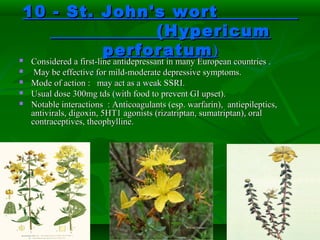
10 - St. John's wort10 - St. John's wort
(Hypericum(Hypericum
perforatumperforatum)) Considered a first-line antidepressant in many European countries .Considered a first-line antidepressant in many European countries .
 May be effective for mild-moderate depressive symptoms.May be effective for mild-moderate depressive symptoms.
 Mode of action : may act as a weak SSRI.Mode of action : may act as a weak SSRI.
 Usual dose 300mg tds (with food to prevent GI upset).Usual dose 300mg tds (with food to prevent GI upset).
 Notable interactions : Anticoagulants (esp. warfarin), antiepileptics,Notable interactions : Anticoagulants (esp. warfarin), antiepileptics,
antivirals, digoxin, 5HT1 agonists (rizatriptan, sumatriptan), oralantivirals, digoxin, 5HT1 agonists (rizatriptan, sumatriptan), oral
contraceptives, theophylline.contraceptives, theophylline.
Antidepressants in theAntidepressants in the
Egyptian MarketEgyptian Market
1-1- TCATCA : clomipramine , imipramine , amitriptiline ,: clomipramine , imipramine , amitriptiline ,
nortriptyline ,dothiepin (Prothiaden)nortriptyline ,dothiepin (Prothiaden)
2-2- TeCATeCA: mianserin (Tolvon), maprotiline (Ludiomil): mianserin (Tolvon), maprotiline (Ludiomil)
3-3- MAOIMAOI : tranylcypromine (Parnetil): tranylcypromine (Parnetil)
4-4- SSRISSRIss :: all the 6 drugs are available.all the 6 drugs are available.
5-5- SNRIsSNRIs : venlafaxine (Efexor): venlafaxine (Efexor)
6-6- NARIsNARIs : reboxetine (Edronax): reboxetine (Edronax)
7-7- SARIsSARIs : trazodone (Trittico): trazodone (Trittico)
8-8- NaSSANaSSA: mirtazapine (Remeron): mirtazapine (Remeron)
9-9- NDRINDRI : bupropion (Wellbutrin): bupropion (Wellbutrin)
10 -10 - St. John's wortSt. John's wort (Hypericum perforatum): (Hiperikan)(Hypericum perforatum): (Hiperikan)
11-11- TianeptineTianeptine : Stablon: Stablon
PART 2:PART 2:
CLINICALCLINICAL
CONSEDIRATIONSCONSEDIRATIONS
Taylor D. , Patron C., Kerwin R. (2007) :Taylor D. , Patron C., Kerwin R. (2007) :The South London
and Maudsley NHS Foundation Trust & Oxleas NHS
Foundation Trust Prescribing Guidelines. Informa
healthcare , London
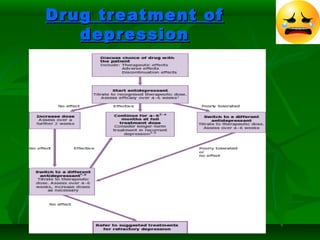
Drug treatment ofDrug treatment of
depressiondepression
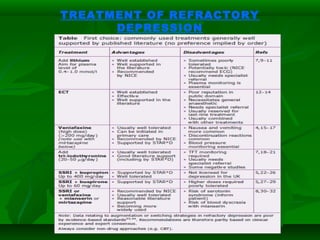
TREATMENT OF REFRACTORY
DEPRESSION
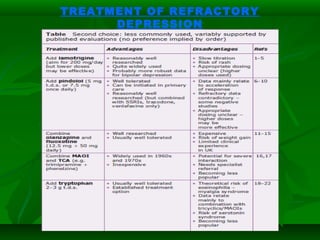
TREATMENT OF REFRACTORY
DEPRESSION
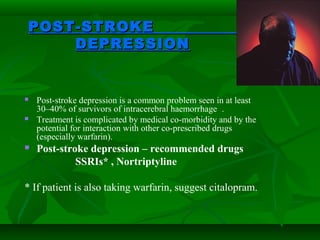
POST-STROKEPOST-STROKE
DEPRESSIONDEPRESSION
 Post-stroke depression is a common problem seen in at least
30–40% of survivors of intracerebral haemorrhage .
 Treatment is complicated by medical co-morbidity and by the
potential for interaction with other co-prescribed drugs
(especially warfarin).
 Post-stroke depression – recommended drugs
SSRIs* , Nortriptyline
* If patient is also taking warfarin, suggest citalopram.
SSRIs and Bleeding
 SSRIs increase the risk of bleeding.
 The effect is additive to that produced by
aspirin and NSAIDs.
 Gastroprotective acid-reducing drugs should
be considered in those patients taking SSRIs
with other risk factors for bleeding.
Antidepressants in liverAntidepressants in liver
diseasedisease
 First choice is citalopram and the second isFirst choice is citalopram and the second is
paroxetine.paroxetine.
 MAOI and TCA are best avoided.MAOI and TCA are best avoided.
 Mertazapine and Venlafaxine can be used withMertazapine and Venlafaxine can be used with
50% dose reduction.50% dose reduction.
Antidepressants and
diabetes mellitus
Recommendations:
 All patients with a diagnosis of depression should be screened for diabetes.
In those who are diabetic:
 Use SSRIs as first-line treatment; most data support fluoxetine.
 SNRIs are also likely to be safe, but there are fewer supporting data.
 Avoid TCAs and MAOIs if possible, due to their effects on weight and
glucose homeostasis.
 Monitor blood glucose carefully when antidepressant treatment is initiated,
the dose is changed and after discontinuation.
Antidepressants inAntidepressants in
elderlyelderly
 the elderly may take longer to respond
to antidepressants than younger adults.
 Dothiepin (Prothiaden )75 mg/day has
been shown to be effective in the
prophylaxis of depreesion after the first
episode in elderly.
 SSRIs are better tolerated with the risk
of bleeding .
Cardiac effects of
antidepressants
 SSRIs are generally recommended in cardiac disease but
beware with co-administered cardiac drugs.
 SSRIs may protect against myocardial infarction , and
untreated depression worsens prognosis in cardiovascular
disease.
 Treatment of depression with SSRIs should not therefore be
withheld post-MI. Protective effects of treatment of depression
post-MI appear to relate to antidepressant administration.
 The mild anticoagulant effect of SSRIs may have adverse
consequences : upper GI bleeding is more common in those
taking SSRIs.
Antidepressant-induced
arrhythmia
 Sertraline is recommended post MI, but other SSRIs
are also likely to be safe.
 Bupropion, citalopram, and venlafaxine should be
used with caution (preferably avoided) in those at risk
of serious arrhythmia (those with heart failure, left
ventricular hypertrophy; previous arrhythmia or MI).
 An ECG should be performed at baseline and 1week
after every increase in dose in high risk patients.
 TCAs are best avoided completely in patients at risk
of serious arrhythmia.
Antidepressants and
sexual dysfunction
 Both depression and the drugs used to treat it can cause
disorders of desire, arousal and orgasm.
 Baseline sexual functioning should be determined, if possible ,
because sexual function can affect quality of life and
compliance (sexual dysfunction is one of the major causes of
treatment dropout)
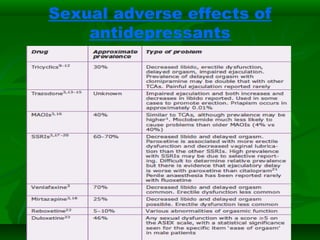
 Sexual dysfunction has been reported as a side-effect of all
antidepressants, although rates vary.
 Not all of the sexual side-effects of antidepressants are
undesirable : serotonergic antidepressants are effective in the
treatment of premature ejaculation and may also be beneficial
in paraphilias.
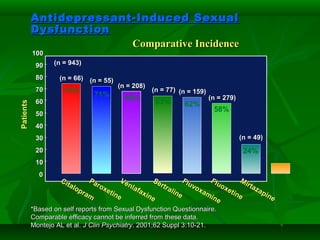
*Based on self reports from Sexual Dysfunction Questionnaire.*Based on self reports from Sexual Dysfunction Questionnaire.
Comparable efficacy cannot be inferred from these data.Comparable efficacy cannot be inferred from these data.
Montejo AL et al.Montejo AL et al. J Clin PsychiatryJ Clin Psychiatry. 2001;62 Suppl 3:10-21.. 2001;62 Suppl 3:10-21.
Antidepressant-Induced SexualAntidepressant-Induced Sexual
DysfunctionDysfunction
Comparative IncidenceComparative Incidence
00
1010
2020
3030
4040
5050
6060
7070
8080
9090
100100
PatientsPatients
Mirtazapine
Mirtazapine
24%
(n = 49)(n = 49)
Fluoxetine
Fluoxetine
58%
(n = 279)(n = 279)
Sertraline
Sertraline
63%
(n = 77)(n = 77)
Fluvoxamine
Fluvoxamine
62%
(n = 159)(n = 159)
Paroxetine
Paroxetine
71%
(n = 55)(n = 55)
Venlafaxine
Venlafaxine
68%
(n = 208)(n = 208)
Citalopram
Citalopram
73%
(n = 66)(n = 66)
(n = 943)(n = 943)
Sexual adverse effects of
antidepressants
Treatment
 Spontaneous remission occurs in approximately 10% of cases
and partial remission in a further 11% .
 If this does not happen, the dose may be reduced or the
antidepressant discontinued where appropriate.
 Switch to a different drug that is less likely to cause the
specific sexual problem experienced ,buproprion may have the
lowest risk of sexual dysfunction among newer
antidepressants.
 A Cochrane Review of the ‘Strategies for managing sexual
dysfunction induced by antidepressant medication’ found that
the addition of sildenafil, tadalafil or bupropion may improve
sexual function but that other augmentation strategies did not.
Antidepressants –
swapping and stopping
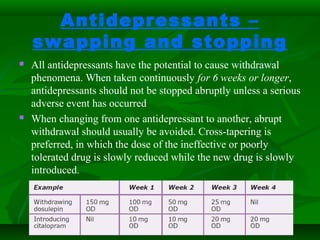
 All antidepressants have the potential to cause withdrawal
phenomena. When taken continuously for 6 weeks or longer,
antidepressants should not be stopped abruptly unless a serious
adverse event has occurred
 When changing from one antidepressant to another, abrupt
withdrawal should usually be avoided. Cross-tapering is
preferred, in which the dose of the ineffective or poorly
tolerated drug is slowly reduced while the new drug is slowly
introduced.
Antidepressant
discontinuation
symptoms
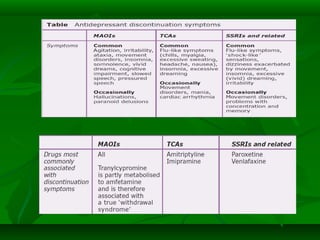
 The term ‘discontinuation symptoms’ is used to describe
symptoms experienced on stopping prescribed drugs that are
not drugs of dependence.
 They can be broadly divided into six categories: affective (e.g.
irritability); gastrointestinal (e.g. nausea); neuromotor (e.g.
ataxia); vasomotor (e.g. diaphoresis); neurosensory (e.g.
paraesthesia); and other neurological (e.g. increase dreaming).
 The symptoms of a discontinuation reaction may be mistaken
for a relapse of depressive illness or the emergence of a new
physical illness .
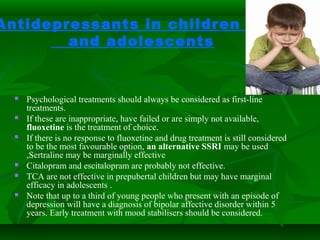
Antidepressants in children
and adolescents
 Psychological treatments should always be considered as first-line
treatments.
 If these are inappropriate, have failed or are simply not available,
fluoxetine is the treatment of choice.
 If there is no response to fluoxetine and drug treatment is still considered
to be the most favourable option, an alternative SSRI may be used
,Sertraline may be marginally effective
 Citalopram and escitalopram are probably not effective.
 TCA are not effective in prepubertal children but may have marginal
efficacy in adolescents .
 Note that up to a third of young people who present with an episode of
depression will have a diagnosis of bipolar affective disorder within 5
years. Early treatment with mood stabilisers should be considered.
Antidepressants andAntidepressants and
EpilepsyEpilepsy
Antidepressants andAntidepressants and
PregnancyPregnancy
 Patients who are already receiving antidepressants and are at
high risk of relapse are best maintained on antidepressants
during and after pregnancy.
 Those who develop a moderate or severe depressive illness
during pregnancy should be treated with antidepressant drugs
if psychological management has failed or is not available.
 There is most experience with amitriptyline, imipramine
and fluoxetine.
 Avoid paroxetine.
 The neonate may experience discontinuation symptoms such
as agitation and irritability, or even convulsions (with SSRIs).
Antidepressants

Antidepressants

  • 2.
  • 3.
    PART ONE:PART ONE: OVERVIEWOVERVIEW
  • 4.
  • 5.
    CLASSES OFCLASSES OF ANTIDEPRESSANTSANTIDEPRESSANTS 1-Monoamine reuptake inhibitors:1- Monoamine reuptake inhibitors: - TCA , SSRIs , SNRIs , NARIs- TCA , SSRIs , SNRIs , NARIs 2- MAOIs2- MAOIs - tranylcypromine (Parnetil)- tranylcypromine (Parnetil) 3- 5-HT3- 5-HT22 receptors antagonists :receptors antagonists : - mianserin (Tolvon)- mianserin (Tolvon) - mirtazepine (Remeron)- mirtazepine (Remeron) - trazodone (Trittico)- trazodone (Trittico)
  • 6.
    CHOICE OFCHOICE OF ANTIDEPRESSANTSANTIDEPRESSANTS IN THE BROAD RANGE OF MAJORIN THE BROAD RANGE OF MAJOR DEPRESSION , ANTIDEPRESSANTDEPRESSION , ANTIDEPRESSANT DRUGS ARE OF EQUIVALENTDRUGS ARE OF EQUIVALENT EFFICACY. THE MAIN DISTINICTIONSEFFICACY. THE MAIN DISTINICTIONS BETWEEN THEM ARE IN THEREBETWEEN THEM ARE IN THERE ADVERSE EFFECTS , TOXICITY , ANDADVERSE EFFECTS , TOXICITY , AND COST .COST . Gelder M , Harrison P , Cowen P ( 2006) . Shorter Oxford textbook of psychiatry .Gelder M , Harrison P , Cowen P ( 2006) . Shorter Oxford textbook of psychiatry . Oxford university press , N.Y.Oxford university press , N.Y.
  • 7.
    1- Monoamine Oxidase1-Monoamine Oxidase InhibitorsInhibitors 19521952 : First MAOI found with antidepressant properties in process of: First MAOI found with antidepressant properties in process of looking for an antituberculosis drug (iproniazid)looking for an antituberculosis drug (iproniazid) 19621962: Investigation of a death from hypertensive crisis by someone: Investigation of a death from hypertensive crisis by someone ingesting tyramine rich food while taking an MAOIingesting tyramine rich food while taking an MAOI 1960’s1960’s: Institution of strict dietary restriction of: Institution of strict dietary restriction of tyraminetyramine containing foods and other interacting substances.containing foods and other interacting substances. 1960’s1960’s : Significant reduction in use due to introduction of TCAs: Significant reduction in use due to introduction of TCAs which do not have the severe restrictions of MAOIs.which do not have the severe restrictions of MAOIs. 20062006: Transdermal selegiline patch (Emsam) approved to treat: Transdermal selegiline patch (Emsam) approved to treat depressiondepression
  • 8.
  • 9.
    2- TCA2- TCA 19581958: imipramine failed investigation as an: imipramine failed investigation as an antipsychotic but found to have antidepressantantipsychotic but found to have antidepressant properties.properties. 1960’s1960’s : multiple other TCA’s developed and placed: multiple other TCA’s developed and placed into use.into use. 1990’s1990’s : significant reduction in use due to introduction: significant reduction in use due to introduction of SSRIs which have fewer side effects.of SSRIs which have fewer side effects.
  • 10.
  • 11.
  • 12.
    3- SSRI3- SSRIss SSelectiveelectiveSSerotoninerotonin RReuptakeeuptake IInhibitornhibitor  1988 : Prozac introduced1988 : Prozac introduced  1992-93 : Paroxetine , Serteraline , fluvoxamine1992-93 : Paroxetine , Serteraline , fluvoxamine  1998 : Citalopram1998 : Citalopram  2002 : Escitalopram2002 : Escitalopram  2006 STAR*D trial results published2006 STAR*D trial results published Annual sales = $12 billionAnnual sales = $12 billion Number of patient starts on SSRIs from 1988 to 2002 = 67.5 millionNumber of patient starts on SSRIs from 1988 to 2002 = 67.5 million
  • 13.
  • 14.
  • 15.
    SSRISSRIss Half-lifeHalf-life  Short:Short: paroxetine& fluvoxamine (missed dosesparoxetine & fluvoxamine (missed doses can result in uncomfortable symptoms)can result in uncomfortable symptoms)  Moderate:Moderate: sertraline, citalopram, escitalopramsertraline, citalopram, escitalopram  Long:Long: fluoxetine (good for people who may missfluoxetine (good for people who may miss doses)doses)
  • 16.
    4 - Tetracyclic4- Tetracyclic antidepressants (TeCAs)antidepressants (TeCAs)  Mode of action : Similar to TCAs, but with less anticholinergic S/Es.Mode of action : Similar to TCAs, but with less anticholinergic S/Es.  Indications : Depression, particularly if sedation required.Indications : Depression, particularly if sedation required.  Advantages : Better side-effect profile than some TCAs (e.g.Advantages : Better side-effect profile than some TCAs (e.g. cardiotoxicity), sedating (which may be a desirable effect).cardiotoxicity), sedating (which may be a desirable effect). Mianserin :Mianserin : (Tolvon)(Tolvon)  Common adverse effects As for TCAs, but less cardiovascular problems.Common adverse effects As for TCAs, but less cardiovascular problems. Maprotiline :Maprotiline : (Ludiomil)(Ludiomil)  Common adverse effects As for TCAs, but rash more common andCommon adverse effects As for TCAs, but rash more common and increased risk of seizure induction at high doses.increased risk of seizure induction at high doses.
  • 17.
    5- Serotonin/noradrenaline5- Serotonin/noradrenaline reuptakeinhibitors (SNRIs)reuptake inhibitors (SNRIs) venlafaxine , duloxetine , desvenlafaxinevenlafaxine , duloxetine , desvenlafaxine Venlafaxine:Venlafaxine:  Mode of actionMode of action :: At low doses, acts like an SSRIAt low doses, acts like an SSRI at moderate doses acts as a combined 5HT and NA reuptake inhibitorat moderate doses acts as a combined 5HT and NA reuptake inhibitor at high doses also inhibits DA reuptake.at high doses also inhibits DA reuptake.  Common adverse effectsCommon adverse effects : Nausea, GI upset, agitation, insomnia, sexual: Nausea, GI upset, agitation, insomnia, sexual dysfunction, headache, hypertension.dysfunction, headache, hypertension.  AdvantagesAdvantages : Variable pharmacological profile over dose range; possibly: Variable pharmacological profile over dose range; possibly more rapid onset of action than other antidepressantsmore rapid onset of action than other antidepressants  DisadvantagesDisadvantages :Moderate to high doses less well tolerated; need to:Moderate to high doses less well tolerated; need to monitor BP at doses over 200mg; troublesome side-effects; withdrawalmonitor BP at doses over 200mg; troublesome side-effects; withdrawal effects common.effects common.
  • 18.
    6- Noradrenaline reuptake6-Noradrenaline reuptake inhibitors (NARIs)inhibitors (NARIs) : reboxetine: reboxetine (Edronax)(Edronax)  Mode of action : NA reuptake inhibition.Mode of action : NA reuptake inhibition.  Common adverse effects : Insomnia, sweating, posturalCommon adverse effects : Insomnia, sweating, postural hypotension/ dizziness, tachycardia, sexual dysfunction,hypotension/ dizziness, tachycardia, sexual dysfunction, dysuria, urinary retention, dry mouth, constipation .dysuria, urinary retention, dry mouth, constipation .  Indications : Depression (particularly with atypical features).Indications : Depression (particularly with atypical features).  Usual dose 4mg bd, increased after 3-4 wks to 10mg/d ifUsual dose 4mg bd, increased after 3-4 wks to 10mg/d if necessary (max. 12mg/d).necessary (max. 12mg/d).  Advantages : Novel mode of action; alerting effects may beAdvantages : Novel mode of action; alerting effects may be useful for patients with symptoms of fatigue or hypersomnia;useful for patients with symptoms of fatigue or hypersomnia; may improve social functioning; relatively safe in overdose.may improve social functioning; relatively safe in overdose.  Disadvantages : Mainly due to adverse effects.Disadvantages : Mainly due to adverse effects.
  • 19.
    7- Serotonin antagonist/reuptake7-Serotonin antagonist/reuptake inhibitors (SARIs)inhibitors (SARIs) ::trazodonetrazodone  Mode of action : 5HT reuptake inhibition, 5HT2 antagonist (moreMode of action : 5HT reuptake inhibition, 5HT2 antagonist (more sedating/anxiolytic, less sexual dysfunction), antihistamine (H1: sedationsedating/anxiolytic, less sexual dysfunction), antihistamine (H1: sedation and weight gain).and weight gain).  Common adverse effects : Priapism , sedation, fatigue, otherwise similar toCommon adverse effects : Priapism , sedation, fatigue, otherwise similar to TCA but less antimuscarinic and cardiotoxic.TCA but less antimuscarinic and cardiotoxic.  Indications : Depression (esp. with insomnia), anxiety disorders.Indications : Depression (esp. with insomnia), anxiety disorders.  Usual dose 150mg/d (as divided dose or just at night), increased toUsual dose 150mg/d (as divided dose or just at night), increased to 300mg/d .300mg/d .  Advantages : Sedation (may be used in low doses as an adjunct to otherAdvantages : Sedation (may be used in low doses as an adjunct to other less sedating antidepressants or to counter sexual dysfunction), safer inless sedating antidepressants or to counter sexual dysfunction), safer in epilepsy than TCAs.epilepsy than TCAs.  Disadvantages : The higher doses necessary for antidepressant effects mayDisadvantages : The higher doses necessary for antidepressant effects may not be tolerated.not be tolerated.
  • 20.
    8- Noradrenergic andspecific8- Noradrenergic and specific serotonergic antidepressantserotonergic antidepressant (NaSSA)(NaSSA) ::mirtazapinemirtazapine  Common adverse effects : Sedation, increasedCommon adverse effects : Sedation, increased appetite/weight gain .appetite/weight gain .  Indications : Depression (with anxiety/panic,Indications : Depression (with anxiety/panic, agitation, insomnia, weight loss) .agitation, insomnia, weight loss) .  Usual dose : 15mg / d , increased if necessary to max.Usual dose : 15mg / d , increased if necessary to max. 45mg/d (divided dose or just at night).45mg/d (divided dose or just at night).  Advantages: Low toxicity in overdose, less sexualAdvantages: Low toxicity in overdose, less sexual dysfunction and GI upset.dysfunction and GI upset.  Disadvantages : Weight gain, sedating effects may beDisadvantages : Weight gain, sedating effects may be lost at higher doses (may be used to advantage).lost at higher doses (may be used to advantage).
  • 21.
    9- Noradrenergic and9-Noradrenergic and dopaminergic reuptake inhibitordopaminergic reuptake inhibitor (NDRI)(NDRI) :: bupropion (Wellbutrin)bupropion (Wellbutrin)  Mode of action : NA and DA reuptake inhibition.Mode of action : NA and DA reuptake inhibition.  Indications : Depression (with marked psychomotorIndications : Depression (with marked psychomotor retardation or hypersomnia); treatment of nicotine dependenceretardation or hypersomnia); treatment of nicotine dependence ..  Usual dose : 150mg od, increased after 6d to 150mg bd .Usual dose : 150mg od, increased after 6d to 150mg bd .  Common adverse effects : Agitation/insomnia, dry mouth, GICommon adverse effects : Agitation/insomnia, dry mouth, GI upset , hypertension , risk of seizures (0.4%), disturbance ofupset , hypertension , risk of seizures (0.4%), disturbance of taste.taste.  Advantages : Unusual mode of action, alerting effects may beAdvantages : Unusual mode of action, alerting effects may be useful for patients with symptoms of fatigue or hypersomnia .useful for patients with symptoms of fatigue or hypersomnia .  Disadvantages : Possible seizure induction, hypersensitivityDisadvantages : Possible seizure induction, hypersensitivity reactions (rare, but may be severe)reactions (rare, but may be severe)
  • 22.
    10 - St.John's wort10 - St. John's wort (Hypericum(Hypericum perforatumperforatum)) Considered a first-line antidepressant in many European countries .Considered a first-line antidepressant in many European countries .  May be effective for mild-moderate depressive symptoms.May be effective for mild-moderate depressive symptoms.  Mode of action : may act as a weak SSRI.Mode of action : may act as a weak SSRI.  Usual dose 300mg tds (with food to prevent GI upset).Usual dose 300mg tds (with food to prevent GI upset).  Notable interactions : Anticoagulants (esp. warfarin), antiepileptics,Notable interactions : Anticoagulants (esp. warfarin), antiepileptics, antivirals, digoxin, 5HT1 agonists (rizatriptan, sumatriptan), oralantivirals, digoxin, 5HT1 agonists (rizatriptan, sumatriptan), oral contraceptives, theophylline.contraceptives, theophylline.
  • 23.
    Antidepressants in theAntidepressantsin the Egyptian MarketEgyptian Market 1-1- TCATCA : clomipramine , imipramine , amitriptiline ,: clomipramine , imipramine , amitriptiline , nortriptyline ,dothiepin (Prothiaden)nortriptyline ,dothiepin (Prothiaden) 2-2- TeCATeCA: mianserin (Tolvon), maprotiline (Ludiomil): mianserin (Tolvon), maprotiline (Ludiomil) 3-3- MAOIMAOI : tranylcypromine (Parnetil): tranylcypromine (Parnetil) 4-4- SSRISSRIss :: all the 6 drugs are available.all the 6 drugs are available. 5-5- SNRIsSNRIs : venlafaxine (Efexor): venlafaxine (Efexor) 6-6- NARIsNARIs : reboxetine (Edronax): reboxetine (Edronax) 7-7- SARIsSARIs : trazodone (Trittico): trazodone (Trittico) 8-8- NaSSANaSSA: mirtazapine (Remeron): mirtazapine (Remeron) 9-9- NDRINDRI : bupropion (Wellbutrin): bupropion (Wellbutrin) 10 -10 - St. John's wortSt. John's wort (Hypericum perforatum): (Hiperikan)(Hypericum perforatum): (Hiperikan) 11-11- TianeptineTianeptine : Stablon: Stablon
  • 24.
    PART 2:PART 2: CLINICALCLINICAL CONSEDIRATIONSCONSEDIRATIONS TaylorD. , Patron C., Kerwin R. (2007) :Taylor D. , Patron C., Kerwin R. (2007) :The South London and Maudsley NHS Foundation Trust & Oxleas NHS Foundation Trust Prescribing Guidelines. Informa healthcare , London
  • 25.
    Drug treatment ofDrugtreatment of depressiondepression
  • 26.
  • 27.
  • 28.
    POST-STROKEPOST-STROKE DEPRESSIONDEPRESSION  Post-stroke depressionis a common problem seen in at least 30–40% of survivors of intracerebral haemorrhage .  Treatment is complicated by medical co-morbidity and by the potential for interaction with other co-prescribed drugs (especially warfarin).  Post-stroke depression – recommended drugs SSRIs* , Nortriptyline * If patient is also taking warfarin, suggest citalopram.
  • 29.
    SSRIs and Bleeding SSRIs increase the risk of bleeding.  The effect is additive to that produced by aspirin and NSAIDs.  Gastroprotective acid-reducing drugs should be considered in those patients taking SSRIs with other risk factors for bleeding.
  • 30.
    Antidepressants in liverAntidepressantsin liver diseasedisease  First choice is citalopram and the second isFirst choice is citalopram and the second is paroxetine.paroxetine.  MAOI and TCA are best avoided.MAOI and TCA are best avoided.  Mertazapine and Venlafaxine can be used withMertazapine and Venlafaxine can be used with 50% dose reduction.50% dose reduction.
  • 31.
    Antidepressants and diabetes mellitus Recommendations: All patients with a diagnosis of depression should be screened for diabetes. In those who are diabetic:  Use SSRIs as first-line treatment; most data support fluoxetine.  SNRIs are also likely to be safe, but there are fewer supporting data.  Avoid TCAs and MAOIs if possible, due to their effects on weight and glucose homeostasis.  Monitor blood glucose carefully when antidepressant treatment is initiated, the dose is changed and after discontinuation.
  • 32.
    Antidepressants inAntidepressants in elderlyelderly the elderly may take longer to respond to antidepressants than younger adults.  Dothiepin (Prothiaden )75 mg/day has been shown to be effective in the prophylaxis of depreesion after the first episode in elderly.  SSRIs are better tolerated with the risk of bleeding .
  • 33.
    Cardiac effects of antidepressants SSRIs are generally recommended in cardiac disease but beware with co-administered cardiac drugs.  SSRIs may protect against myocardial infarction , and untreated depression worsens prognosis in cardiovascular disease.  Treatment of depression with SSRIs should not therefore be withheld post-MI. Protective effects of treatment of depression post-MI appear to relate to antidepressant administration.  The mild anticoagulant effect of SSRIs may have adverse consequences : upper GI bleeding is more common in those taking SSRIs.
  • 34.
    Antidepressant-induced arrhythmia  Sertraline isrecommended post MI, but other SSRIs are also likely to be safe.  Bupropion, citalopram, and venlafaxine should be used with caution (preferably avoided) in those at risk of serious arrhythmia (those with heart failure, left ventricular hypertrophy; previous arrhythmia or MI).  An ECG should be performed at baseline and 1week after every increase in dose in high risk patients.  TCAs are best avoided completely in patients at risk of serious arrhythmia.
  • 35.
    Antidepressants and sexual dysfunction Both depression and the drugs used to treat it can cause disorders of desire, arousal and orgasm.  Baseline sexual functioning should be determined, if possible , because sexual function can affect quality of life and compliance (sexual dysfunction is one of the major causes of treatment dropout)  Sexual dysfunction has been reported as a side-effect of all antidepressants, although rates vary.  Not all of the sexual side-effects of antidepressants are undesirable : serotonergic antidepressants are effective in the treatment of premature ejaculation and may also be beneficial in paraphilias.
  • 36.
    *Based on selfreports from Sexual Dysfunction Questionnaire.*Based on self reports from Sexual Dysfunction Questionnaire. Comparable efficacy cannot be inferred from these data.Comparable efficacy cannot be inferred from these data. Montejo AL et al.Montejo AL et al. J Clin PsychiatryJ Clin Psychiatry. 2001;62 Suppl 3:10-21.. 2001;62 Suppl 3:10-21. Antidepressant-Induced SexualAntidepressant-Induced Sexual DysfunctionDysfunction Comparative IncidenceComparative Incidence 00 1010 2020 3030 4040 5050 6060 7070 8080 9090 100100 PatientsPatients Mirtazapine Mirtazapine 24% (n = 49)(n = 49) Fluoxetine Fluoxetine 58% (n = 279)(n = 279) Sertraline Sertraline 63% (n = 77)(n = 77) Fluvoxamine Fluvoxamine 62% (n = 159)(n = 159) Paroxetine Paroxetine 71% (n = 55)(n = 55) Venlafaxine Venlafaxine 68% (n = 208)(n = 208) Citalopram Citalopram 73% (n = 66)(n = 66) (n = 943)(n = 943)
  • 37.
    Sexual adverse effectsof antidepressants
  • 38.
    Treatment  Spontaneous remissionoccurs in approximately 10% of cases and partial remission in a further 11% .  If this does not happen, the dose may be reduced or the antidepressant discontinued where appropriate.  Switch to a different drug that is less likely to cause the specific sexual problem experienced ,buproprion may have the lowest risk of sexual dysfunction among newer antidepressants.  A Cochrane Review of the ‘Strategies for managing sexual dysfunction induced by antidepressant medication’ found that the addition of sildenafil, tadalafil or bupropion may improve sexual function but that other augmentation strategies did not.
  • 39.
    Antidepressants – swapping andstopping  All antidepressants have the potential to cause withdrawal phenomena. When taken continuously for 6 weeks or longer, antidepressants should not be stopped abruptly unless a serious adverse event has occurred  When changing from one antidepressant to another, abrupt withdrawal should usually be avoided. Cross-tapering is preferred, in which the dose of the ineffective or poorly tolerated drug is slowly reduced while the new drug is slowly introduced.
  • 40.
    Antidepressant discontinuation symptoms  The term‘discontinuation symptoms’ is used to describe symptoms experienced on stopping prescribed drugs that are not drugs of dependence.  They can be broadly divided into six categories: affective (e.g. irritability); gastrointestinal (e.g. nausea); neuromotor (e.g. ataxia); vasomotor (e.g. diaphoresis); neurosensory (e.g. paraesthesia); and other neurological (e.g. increase dreaming).  The symptoms of a discontinuation reaction may be mistaken for a relapse of depressive illness or the emergence of a new physical illness .
  • 42.
    Antidepressants in children andadolescents  Psychological treatments should always be considered as first-line treatments.  If these are inappropriate, have failed or are simply not available, fluoxetine is the treatment of choice.  If there is no response to fluoxetine and drug treatment is still considered to be the most favourable option, an alternative SSRI may be used ,Sertraline may be marginally effective  Citalopram and escitalopram are probably not effective.  TCA are not effective in prepubertal children but may have marginal efficacy in adolescents .  Note that up to a third of young people who present with an episode of depression will have a diagnosis of bipolar affective disorder within 5 years. Early treatment with mood stabilisers should be considered.
  • 43.
  • 44.
    Antidepressants andAntidepressants and PregnancyPregnancy Patients who are already receiving antidepressants and are at high risk of relapse are best maintained on antidepressants during and after pregnancy.  Those who develop a moderate or severe depressive illness during pregnancy should be treated with antidepressant drugs if psychological management has failed or is not available.  There is most experience with amitriptyline, imipramine and fluoxetine.  Avoid paroxetine.  The neonate may experience discontinuation symptoms such as agitation and irritability, or even convulsions (with SSRIs).