Ehab Elbaz, MD,MBA
Consultant Psychiatrist
Director of psychiatry hospital, Maadi Military Medical Complex
Lecturer of psychiatry, Military Medical Academy
Objectives
• What is the definition of impulsivity?
• What is the history of impulsivity concept in scientific literature ?
• What is the epidemiology of impulsivity ?
• How can we measure impulsivity ?
• What are the psychiatric aspects of impulsivity ?
• What are the associated factors of impulsivity in forensic population?
• What are the evidence-based interventions for impulsivity ?
Meaning of impulsive in English language
• Showing behaviour in which, you do things suddenly without any
planning and without considering the effects they may have
(Definition of impulsive from the Cambridge Advanced Learner's Dictionary & Thesaurus © Cambridge University Press)
Etymology
• Latin impulsus, from impellere
to impel ( to push)
• First known use in 1611
Merriam-Webster. (n.d.). Impulse. In Merriam-Webster.com
dictionary. Retrieved September 11, 2023, from
https://www.merriam-webster.com/dictionary/impulse
Definition
• According to DSM-V, impulsivity is defined in
terms of an aspect of disinhibition
• an immediate reaction to stimuli, unplanned
reaction on the spur of the moment or with no
regard for its consequences, problem in
programming or adhering to programs, sense
of urgency and self-harming behavior in the
time of emotional turmoil
American Psychiatric Association, D. S. M. T. F., & American Psychiatric Association.
(2013). Diagnostic and statistical manual of mental disorders: DSM-5 (Vol. 5, No. 5).
Washington, DC: American psychiatric association.
What is
Impulsivity
?
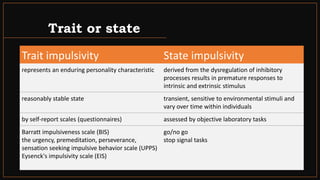
Trait or state
Trait impulsivity State impulsivity
represents an enduring personality characteristic derived from the dysregulation of inhibitory
processes results in premature responses to
intrinsic and extrinsic stimulus
reasonably stable state transient, sensitive to environmental stimuli and
vary over time within individuals
by self-report scales (questionnaires) assessed by objective laboratory tasks
Barratt impulsiveness scale (BIS)
the urgency, premeditation, perseverance,
sensation seeking impulsive behavior scale (UPPS)
Eysenck's impulsivity scale (EIS)
go/no go
stop signal tasks
CONCEPTUALIZATION OF IMPULSIVITY
Historical aspects of the
concept of impulsivity
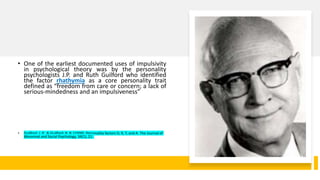
• One of the earliest documented uses of impulsivity
in psychological theory was by the personality
psychologists J.P. and Ruth Guilford who identified
the factor rhathymia as a core personality trait
defined as “freedom from care or concern; a lack of
serious-mindedness and an impulsiveness”
• Guilford, J. P., & Guilford, R. B. (1939). Personality factors D, R, T, and A. The Journal of
Abnormal and Social Psychology, 34(1), 21.
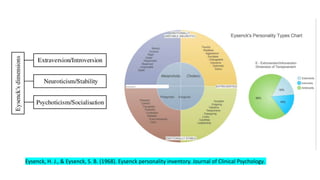
Eysenck, H. J., & Eysenck, S. B. (1968). Eysenck personality inventory. Journal of Clinical Psychology.
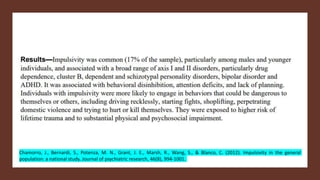
Epidemiology of
impulsivity
Chamorro, J., Bernardi, S., Potenza, M. N., Grant, J. E., Marsh, R., Wang, S., & Blanco, C. (2012). Impulsivity in the general
population: a national study. Journal of psychiatric research, 46(8), 994-1001.
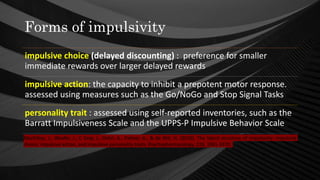
Forms of impulsivity
impulsive choice (delayed discounting) : preference for smaller
immediate rewards over larger delayed rewards
impulsive action: the capacity to inhibit a prepotent motor response.
assessed using measures such as the Go/NoGo and Stop Signal Tasks
personality trait : assessed using self-reported inventories, such as the
Barratt Impulsiveness Scale and the UPPS-P Impulsive Behavior Scale
MacKillop, J., Weafer, J., C Gray, J., Oshri, A., Palmer, A., & de Wit, H. (2016). The latent structure of impulsivity: impulsive
choice, impulsive action, and impulsive personality traits. Psychopharmacology, 233, 3361-3370.
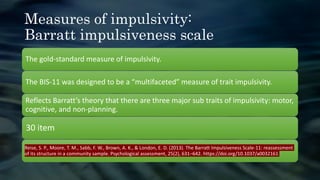
Measures of impulsivity:
Barratt impulsiveness scale
The gold-standard measure of impulsivity.
The BIS-11 was designed to be a “multifaceted” measure of trait impulsivity.
Reflects Barratt’s theory that there are three major sub traits of impulsivity: motor,
cognitive, and non-planning.
30 item
Reise, S. P., Moore, T. M., Sabb, F. W., Brown, A. K., & London, E. D. (2013). The Barratt Impulsiveness Scale-11: reassessment
of its structure in a community sample. Psychological assessment, 25(2), 631–642. https://doi.org/10.1037/a0032161
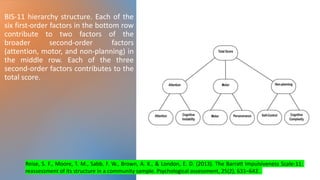
BIS‐11 hierarchy structure. Each of the
six first‐order factors in the bottom row
contribute to two factors of the
broader second‐order factors
(attention, motor, and non‐planning) in
the middle row. Each of the three
second‐order factors contributes to the
total score.
Reise, S. P., Moore, T. M., Sabb, F. W., Brown, A. K., & London, E. D. (2013). The Barratt Impulsiveness Scale-11:
reassessment of its structure in a community sample. Psychological assessment, 25(2), 631–642.
Measures of impulsivity
(UPPS-P) impulsive behavior
scale
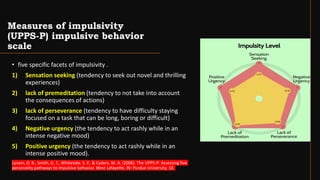
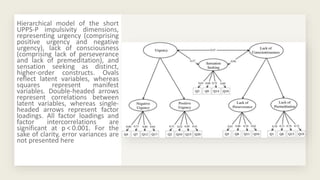
• five specific facets of impulsivity .
1) Sensation seeking (tendency to seek out novel and thrilling
experiences)
2) lack of premeditation (tendency to not take into account
the consequences of actions)
3) lack of perseverance (tendency to have difficulty staying
focused on a task that can be long, boring or difficult)
4) Negative urgency (the tendency to act rashly while in an
intense negative mood)
5) Positive urgency (the tendency to act rashly while in an
intense positive mood).
Lynam, D. R., Smith, G. T., Whiteside, S. P., & Cyders, M. A. (2006). The UPPS-P: Assessing five
personality pathways to impulsive behavior. West Lafayette, IN: Purdue University, 10.
Functional impulsivity
• Functional impulsivity is a tendency to make
quick decisions when it is optimal and
beneficial. This impulsivity is in contrast with
dysfunctional impulsivity, which is a tendency to
make quick decisions when it is not optimal.
Dickman, S. J. (1990). Functional and dysfunctional impulsivity: personality and
cognitive correlates. Journal of personality and social psychology, 58(1), 95.
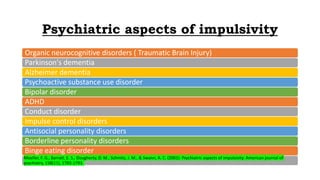
Psychiatric aspects of impulsivity
Organic neurocognitive disorders ( Traumatic Brain Injury)
Parkinson's dementia
Alzheimer dementia
Psychoactive substance use disorder
Bipolar disorder
ADHD
Conduct disorder
Impulse control disorders
Antisocial personality disorders
Borderline personality disorders
Binge eating disorder
Moeller, F. G., Barratt, E. S., Dougherty, D. M., Schmitz, J. M., & Swann, A. C. (2001). Psychiatric aspects of impulsivity. American journal of
psychiatry, 158(11), 1783-1793.
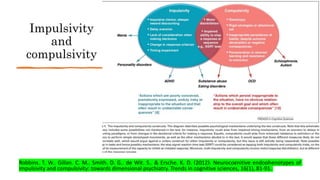
Impulsivity
and
compulsivity
Robbins, T. W., Gillan, C. M., Smith, D. G., de Wit, S., & Ersche, K. D. (2012). Neurocognitive endophenotypes of
impulsivity and compulsivity: towards dimensional psychiatry. Trends in cognitive sciences, 16(1), 81-91.
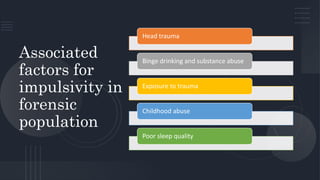
Associated
factors for
impulsivity in
forensic
population
Head trauma
Binge drinking and substance abuse
Exposure to trauma
Childhood abuse
Poor sleep quality
61 independent studies Sleep quality and sleep duration
are related to self control on both
the state and trait level
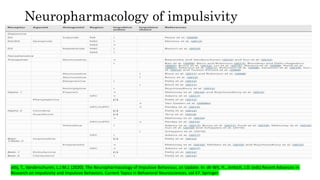
Neuropharmacology of impulsivity
attij, T., Vanderschuren, L.J.M.J. (2020). The Neuropharmacology of Impulsive Behaviour, an Update. In: de Wit, H., Jentsch, J.D. (eds) Recent Advances in
Research on Impulsivity and Impulsive Behaviors. Current Topics in Behavioral Neurosciences, vol 47. Springer
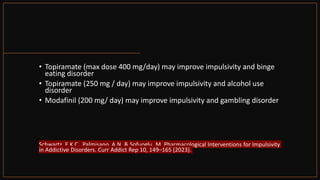
• Topiramate (max dose 400 mg/day) may improve impulsivity and binge
eating disorder
• Topiramate (250 mg / day) may improve impulsivity and alcohol use
disorder
• Modafinil (200 mg/ day) may improve impulsivity and gambling disorder
Schwartz, E.K.C., Palmisano, A.N. & Sofuoglu, M. Pharmacological Interventions for Impulsivity
in Addictive Disorders. Curr Addict Rep 10, 149–165 (2023).
Evidence based
pharmacological
interventions
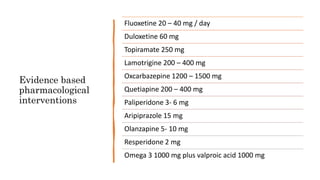
Fluoxetine 20 – 40 mg / day
Duloxetine 60 mg
Topiramate 250 mg
Lamotrigine 200 – 400 mg
Oxcarbazepine 1200 – 1500 mg
Quetiapine 200 – 400 mg
Paliperidone 3- 6 mg
Aripiprazole 15 mg
Olanzapine 5- 10 mg
Resperidone 2 mg
Omega 3 1000 mg plus valproic acid 1000 mg
Evidence
based
psychological
interventions
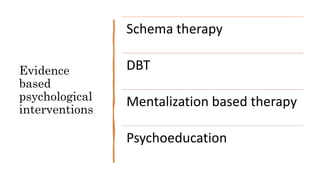
Schema therapy
DBT
Mentalization based therapy
Psychoeducation
Conclusion
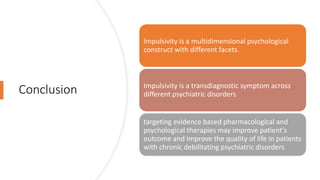
Impulsivity is a multidimensional psychological
construct with different facets.
Impulsivity is a transdiagnostic symptom across
different psychiatric disorders
targeting evidence based pharmacological and
psychological therapies may improve patient's
outcome and improve the quality of life in patients
with chronic debilitating psychiatric disorders
multidimensional approach to impulsivity.pptx

multidimensional approach to impulsivity.pptx

  • 1.
    Ehab Elbaz, MD,MBA ConsultantPsychiatrist Director of psychiatry hospital, Maadi Military Medical Complex Lecturer of psychiatry, Military Medical Academy
  • 2.
    Objectives • What isthe definition of impulsivity? • What is the history of impulsivity concept in scientific literature ? • What is the epidemiology of impulsivity ? • How can we measure impulsivity ? • What are the psychiatric aspects of impulsivity ? • What are the associated factors of impulsivity in forensic population? • What are the evidence-based interventions for impulsivity ?
  • 3.
    Meaning of impulsivein English language • Showing behaviour in which, you do things suddenly without any planning and without considering the effects they may have (Definition of impulsive from the Cambridge Advanced Learner's Dictionary & Thesaurus © Cambridge University Press)
  • 4.
    Etymology • Latin impulsus,from impellere to impel ( to push) • First known use in 1611 Merriam-Webster. (n.d.). Impulse. In Merriam-Webster.com dictionary. Retrieved September 11, 2023, from https://www.merriam-webster.com/dictionary/impulse
  • 5.
    Definition • According toDSM-V, impulsivity is defined in terms of an aspect of disinhibition • an immediate reaction to stimuli, unplanned reaction on the spur of the moment or with no regard for its consequences, problem in programming or adhering to programs, sense of urgency and self-harming behavior in the time of emotional turmoil American Psychiatric Association, D. S. M. T. F., & American Psychiatric Association. (2013). Diagnostic and statistical manual of mental disorders: DSM-5 (Vol. 5, No. 5). Washington, DC: American psychiatric association.
  • 6.
  • 7.
    Trait or state Traitimpulsivity State impulsivity represents an enduring personality characteristic derived from the dysregulation of inhibitory processes results in premature responses to intrinsic and extrinsic stimulus reasonably stable state transient, sensitive to environmental stimuli and vary over time within individuals by self-report scales (questionnaires) assessed by objective laboratory tasks Barratt impulsiveness scale (BIS) the urgency, premeditation, perseverance, sensation seeking impulsive behavior scale (UPPS) Eysenck's impulsivity scale (EIS) go/no go stop signal tasks
  • 8.
  • 9.
    Historical aspects ofthe concept of impulsivity
  • 11.
    • One ofthe earliest documented uses of impulsivity in psychological theory was by the personality psychologists J.P. and Ruth Guilford who identified the factor rhathymia as a core personality trait defined as “freedom from care or concern; a lack of serious-mindedness and an impulsiveness” • Guilford, J. P., & Guilford, R. B. (1939). Personality factors D, R, T, and A. The Journal of Abnormal and Social Psychology, 34(1), 21.
  • 12.
    Eysenck, H. J.,& Eysenck, S. B. (1968). Eysenck personality inventory. Journal of Clinical Psychology.
  • 13.
  • 14.
    Chamorro, J., Bernardi,S., Potenza, M. N., Grant, J. E., Marsh, R., Wang, S., & Blanco, C. (2012). Impulsivity in the general population: a national study. Journal of psychiatric research, 46(8), 994-1001.
  • 15.
    Forms of impulsivity impulsivechoice (delayed discounting) : preference for smaller immediate rewards over larger delayed rewards impulsive action: the capacity to inhibit a prepotent motor response. assessed using measures such as the Go/NoGo and Stop Signal Tasks personality trait : assessed using self-reported inventories, such as the Barratt Impulsiveness Scale and the UPPS-P Impulsive Behavior Scale MacKillop, J., Weafer, J., C Gray, J., Oshri, A., Palmer, A., & de Wit, H. (2016). The latent structure of impulsivity: impulsive choice, impulsive action, and impulsive personality traits. Psychopharmacology, 233, 3361-3370.
  • 16.
    Measures of impulsivity: Barrattimpulsiveness scale The gold-standard measure of impulsivity. The BIS-11 was designed to be a “multifaceted” measure of trait impulsivity. Reflects Barratt’s theory that there are three major sub traits of impulsivity: motor, cognitive, and non-planning. 30 item Reise, S. P., Moore, T. M., Sabb, F. W., Brown, A. K., & London, E. D. (2013). The Barratt Impulsiveness Scale-11: reassessment of its structure in a community sample. Psychological assessment, 25(2), 631–642. https://doi.org/10.1037/a0032161
  • 17.
    BIS‐11 hierarchy structure.Each of the six first‐order factors in the bottom row contribute to two factors of the broader second‐order factors (attention, motor, and non‐planning) in the middle row. Each of the three second‐order factors contributes to the total score. Reise, S. P., Moore, T. M., Sabb, F. W., Brown, A. K., & London, E. D. (2013). The Barratt Impulsiveness Scale-11: reassessment of its structure in a community sample. Psychological assessment, 25(2), 631–642.
  • 18.
    Measures of impulsivity (UPPS-P)impulsive behavior scale • five specific facets of impulsivity . 1) Sensation seeking (tendency to seek out novel and thrilling experiences) 2) lack of premeditation (tendency to not take into account the consequences of actions) 3) lack of perseverance (tendency to have difficulty staying focused on a task that can be long, boring or difficult) 4) Negative urgency (the tendency to act rashly while in an intense negative mood) 5) Positive urgency (the tendency to act rashly while in an intense positive mood). Lynam, D. R., Smith, G. T., Whiteside, S. P., & Cyders, M. A. (2006). The UPPS-P: Assessing five personality pathways to impulsive behavior. West Lafayette, IN: Purdue University, 10.
  • 20.
    Functional impulsivity • Functionalimpulsivity is a tendency to make quick decisions when it is optimal and beneficial. This impulsivity is in contrast with dysfunctional impulsivity, which is a tendency to make quick decisions when it is not optimal. Dickman, S. J. (1990). Functional and dysfunctional impulsivity: personality and cognitive correlates. Journal of personality and social psychology, 58(1), 95.
  • 21.
    Psychiatric aspects ofimpulsivity Organic neurocognitive disorders ( Traumatic Brain Injury) Parkinson's dementia Alzheimer dementia Psychoactive substance use disorder Bipolar disorder ADHD Conduct disorder Impulse control disorders Antisocial personality disorders Borderline personality disorders Binge eating disorder Moeller, F. G., Barratt, E. S., Dougherty, D. M., Schmitz, J. M., & Swann, A. C. (2001). Psychiatric aspects of impulsivity. American journal of psychiatry, 158(11), 1783-1793.
  • 22.
    Impulsivity and compulsivity Robbins, T. W.,Gillan, C. M., Smith, D. G., de Wit, S., & Ersche, K. D. (2012). Neurocognitive endophenotypes of impulsivity and compulsivity: towards dimensional psychiatry. Trends in cognitive sciences, 16(1), 81-91.
  • 24.
    Associated factors for impulsivity in forensic population Headtrauma Binge drinking and substance abuse Exposure to trauma Childhood abuse Poor sleep quality
  • 26.
    61 independent studiesSleep quality and sleep duration are related to self control on both the state and trait level
  • 27.
    Neuropharmacology of impulsivity attij,T., Vanderschuren, L.J.M.J. (2020). The Neuropharmacology of Impulsive Behaviour, an Update. In: de Wit, H., Jentsch, J.D. (eds) Recent Advances in Research on Impulsivity and Impulsive Behaviors. Current Topics in Behavioral Neurosciences, vol 47. Springer
  • 29.
    • Topiramate (maxdose 400 mg/day) may improve impulsivity and binge eating disorder • Topiramate (250 mg / day) may improve impulsivity and alcohol use disorder • Modafinil (200 mg/ day) may improve impulsivity and gambling disorder Schwartz, E.K.C., Palmisano, A.N. & Sofuoglu, M. Pharmacological Interventions for Impulsivity in Addictive Disorders. Curr Addict Rep 10, 149–165 (2023).
  • 31.
    Evidence based pharmacological interventions Fluoxetine 20– 40 mg / day Duloxetine 60 mg Topiramate 250 mg Lamotrigine 200 – 400 mg Oxcarbazepine 1200 – 1500 mg Quetiapine 200 – 400 mg Paliperidone 3- 6 mg Aripiprazole 15 mg Olanzapine 5- 10 mg Resperidone 2 mg Omega 3 1000 mg plus valproic acid 1000 mg
  • 32.
  • 33.
    Conclusion Impulsivity is amultidimensional psychological construct with different facets. Impulsivity is a transdiagnostic symptom across different psychiatric disorders targeting evidence based pharmacological and psychological therapies may improve patient's outcome and improve the quality of life in patients with chronic debilitating psychiatric disorders