Leut.Col.Dr.Yasser AbdEl-Ghany El-Ghazzawy
PsychiatricHospital, Maadi Armed Forces MedicalComplex
Addiction Replacement
Therapy
AddictionReplacementTherapy
Objectives
Magnitudeoftheproblem
1
2
3 AddictionReplacementTherapy(OpioidSubstitutionTherapy)
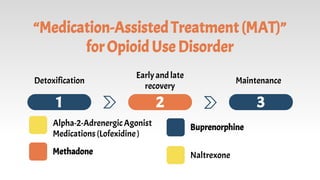
“Medication-AssistedTreatment(MAT)”forOpioidusedisorder
Agonist/ Antagonistpharmacology
4 OpioidSubstitutionTherapy(OST):
 Methadone
 Buprenorphine
 Comparison / Flowchart for assessment and management
 Harm reduction concept
 History of OST
 The perfect drug
 Benefits of OST
 Myth about substitution therapy/ challengesand threats.
 Inclusion Criteria and special groups.
Magnitude of theproblem
Worldwide:
1
In Egypt:
2
Magnitudeof theProblem
Consequences of theopioid crisis:
• Increased HIVand HCV.
• Risingincidenceofinfants born dependentonopioidsas a result of
opioiduse duringpregnancy.
Worldwide
In2020, 2.7 million peopleaged 12 orolder, inU.S with
OUD
OpioidUseDisorder:
Overdose deaths:
• The UnitedNations attributes76% of addiction-related
deaths worldwidetoopioids
• More than quadrupled from 1999
Magnitude of theProblem
In Egypt:
All indicatorspoint to an increaseinthebehaviorof drugabuse by
injection,whichis accompanied by an increasein the rates of
infection(HIV,HBV, HCV)
• By the end of2020, the
cumulativenumber of people
infectedwithHIV/AIDS was:
18,196,ofwhom 6,080 are
injectingdrug users, representing
33.5 %ofthe total number of
cases detectedfrom 1986to
2020.
• Out of the total6080,in
the last fiveyears only:
4803, or 79%.
• In 2019and 2020alone, the
percentageof HIV through
injectingdrugs increased by
31% compared tothe previous
twoyears.
Magnitude of theProblem
In Egypt:
• A Survey bythe
government shows that the
narcotic problem costs the
country’s economy $800
millionannually
• According to theUNODC
51% of injecting drug users are
infectedwith HCV with the
highestNumbers in Egypt
globally(10%) .
• In additionto 150,000 new
infections annually.
UNOCD= UnitedNationsOffice onDrugs and Crime
“Medication-AssistedTreatment(MAT)”
for Opioid Use Disorder
1
Detoxification
2
Early and late
recovery
3
Maintenance
Methadone
Buprenorphine
Naltrexone
Alpha-2-AdrenergicAgonist
Medications (Lofexidine)
Agonist/Antagonist
o Affinityfor
binding plus
efficacy
o Methadone
PureAgonist
o Affinityfor
binding butlow
efficacy
o Buprenorphine
PartialAgonist
o Affinityfor
binding butno
efficacy;blocks
action of
endogenous
andexogenous
ligands.
o Naltrexone
PureAntagonist
Heroin/Methadone Buprenorphine Naloxone/Naltrexone
FullAgonist PartialAgonist Antagonist
Activity
Zone
Affinity
Zone
Patternof OpioidReceptorActivation
HarmReduction
WhatisHarm
Reduction?
Can be viewedas the preventionof adverse
consequencesofillicitdrug use without
necessarilyreducingtheirconsumption.
A range of different strategies withthe goal
of minimizingthe riskof the patient
contractinginfectiousdiseases,overdosing,
orsufferingother consequencesrelated to
the use of substances.
The increasingnumbers of patients
infectedwithbloodbornediseases
through sharing injectingequipment,
the model ofharm reductionhas been
adaptedinEgypt
HarmReduction
Vaccinationagainst
HBV
ProtectedSex
Harmreduction
strategies:
Overdose reversal
medications supply
(Naloxone)
Treatmentfor
infectiousdiseases
(HCV/HIV)
Reducestigmaassociated
with substanceuseand
co-occurringdisorders
NotSharing
Needles
OpioidSubstitution
therapy(OST)
History
During world War II Asa synthetic alternative 1960s
The supplyof
Opiumwas cutoff
from Germany. As
a resultpainkilling
Morphine became a
medicinein short
supply.
Methadone was developed as
a pain killing alternative by
German chemist as an Opioid
receptoragonist successfully
relievedpain.
• Methadone used as
a treatment for opioid
dependenceas a
response topost- world
War IIHeroinepidemic
inNew YorkCity.
• FDA approved for
opioiduse disorder
in1972
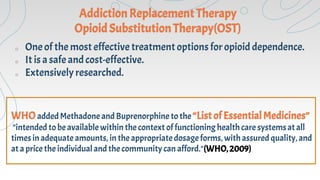
o One of the most effective treatment options for opioid dependence.
o It is a safe andcost-effective.
o Extensively researched.
AddictionReplacementTherapy
OpioidSubstitutionTherapy(OST)
WHO addedMethadone and Buprenorphine tothe “Listof EssentialMedicines”
"intended to beavailablewithinthecontext of functioning health care systemsat all
times in adequate amounts, in the appropriatedosageforms,with assured quality,and
at a pricetheindividualand the community can afford."(WHO,2009)
“ThePerfectDrug”Characteristics:
• Slowonset of Action. • Relieves withdrawalsymptoms.
• Longduration of action.
• Prevents relapse.
• Slowoffset of action.
• Has impact onnegative
reinforcement generated by stress
neural circuits.
• Oral orpreferable depot form.
• Inhibitsthe reinforcing
properties(Euphoria) by drugs and
associated cues.
Benefitsof implementing Opioid Substitution
Therapy (OST)
1
4
2
3
The reductionorcessation of opioiduse,andopioidusedisorder-related
symptoms withLessharmrelated tomode of use /impurity of substance.
The reductionorcessation of opioid-relatedoverdosedeaths.
The reductionorcessation of opioid-relatedcriminalactivity
The reductionof injectionand the associated risk of transmission of blood-
borne viruses(HIV),(HBV)and(HCV).
Benefitsof implementing Opioid Substitution
Therapy (OST)
5
8
6
7
OST Increases socialfunctioningandretentionintreatment.
Treatment of opioid-dependentpregnant womenwith methadone or
buprenorphineImproves birthOutcomesfortheirbabies
Reduces suicidalityandco-morbidpsychiatricsymptoms
Decreasescraving,Resetstolerance,Relapseprevention,Safeand
comfortablewithdrawal,Controlleduse givenundermedical supervision.
Benefitsof OST
Abuse SubstitutionTherapy
vs.
 High chances of HIV & other blood
borne infections
 Not prescribed medically
 Severe withdrawal symptoms
 High chances of overdose and
intoxication injuries
 Craving
 Criminal activity
 Lost productivity
 Infants born dependentson
opioids.
 High cost of medical service
 Low chances of HIV & other blood
borne infections
 Given under medical supervision
 Mild withdrawal symptoms if
discontinued
 Low chances of overdose
 Less Craving
 Less Criminal activity
 More productivity
 less cost of medical service
Misconceptions/ Mythabout OST
Patientsare stillAddicted
Addictionis the pathologicaluse of a
substance
OST is medicallysupervised and regulated
Myth
#1
Mythabout
OST
OSTis simplya substituteof
illegaldrugs
OST ensures commitment torecovery
programs that allows persons to function
normally
Myth
#2
Providingmedicationsaloneis
sufficient:
Combiningpharmacotherapy and other
recoveryservicesis mandatory.
Myth
#3
Posters in the Media :
Methadoneis A Narcotic
Thatkills
MainrelevantthreatsagainstOST programin Egyptare:
 Risksin caseof a negativeviewandperception by themedia/community,
dependingon the stigmaand low knowledgeofthe harm-related injected drug
use.
 The relatively strong stigmaanddiscriminationagainst peoplewhouse drugs,
as( it is the casein several Arab countries).
 Lack of fundingpossibilitiesand sustainability.
 The riskof diversionis the case ofnon-control and insufficientmonitoring
throughout thewholeprogram.
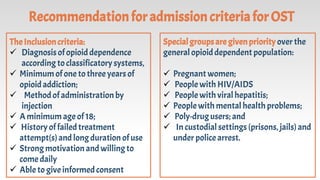
RecommendationforadmissioncriteriaforOST
TheInclusioncriteria:
 Diagnosisofopioiddependence
according toclassificatorysystems,
 Minimumof one tothree yearsof
opioidaddiction;
 Methodofadministration by
injection
 A minimumageof18;
 Historyoffailedtreatment
attempt(s)and long duration ofuse
 Strong motivation and willingto
come daily
 Ableto giveinformedconsent
Specialgroupsare givenpriority over the
general opioiddependent population:
 Pregnant women;
 Peoplewith HIV/AIDS
 Peoplewith viralhepatitis;
 Peoplewith mental health problems;
 Poly-drugusers; and
 In custodial settings (prisons, jails)and
under policearrest.
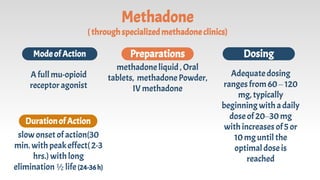
Methadone
( throughspecializedmethadoneclinics)
Modeof Action
Durationof Action
Preparations Dosing
A fullmu-opioid
receptor agonist
methadoneliquid, Oral
tablets, methadonePowder,
IV methadone
Adequate dosing
ranges from60 – 120
mg,typically
beginning with adaily
doseof20–30mg
with increases of5 or
10mguntil the
optimaldoseis
reached
slowonset of action(30
min. withpeakeffect(2-3
hrs.) with long
elimination ½ life(24-36h)
SideEffects
Deaths
1
Respiratory
depression
2
Cardiac
( QTcprolongation) ECG as
baseline andfollow-up during
treatment
3
The mainthreat is
theriskof
overdosing,
especiallyatthe
start oftreatment
and when
methadoneis
combined with other
sedativemedications
or illicitdruguse
Abuseispossible
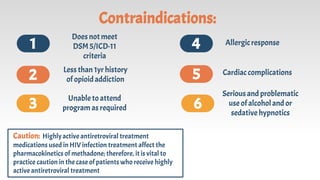
Contraindications:
1 4
2 5
3 6
Does notmeet
DSM 5/ICD-11
criteria
Seriousand problematic
use of alcoholand or
sedative hypnotics
Less than 1yr history
of opioidaddiction
Unable to attend
program as required
Allergicresponse
Cardiac complications
Caution: Highlyactive antiretroviral treatment
medications used in HIV infection treatment affect the
pharmacokinetics of methadone; therefore, it is vital to
practice caution in the case of patients who receive highly
active antiretroviral treatment
Buprenorphine
Modeof Action
Durationof Action
Preparations Dosing
History
Partial agonist at
the mu receptor. It
has lowactivitybut
high affinity.
o Poorbioavailabilitywhen
taken orallyand must be
dissolvedsublingually
o Co-administration
withnaloxone (Suboxone®)
(not absorbed sublingually)to
preventthe buprenorphine from
beinginjected(Abuse)
o Other forms : 6-month
subdermal implant and
a once-monthly buprenorphine
injection
o Discoveredin1966
o (FDA) approved in2002
o Onset of effect in 30–
60minutes.
o Peak effect inabout 1–
4 hours.
o Half-life 20–72hours
(36hours onaverage).
Tolerabledose range (4to 24
mg )
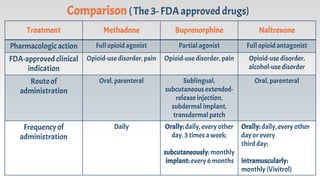
Comparison( The 3- FDAapproved drugs)
Treatment Methadone Buprenorphine Naltrexone
Pharmacologic action Full opioid agonist Partial agonist Full opioid antagonist
FDA-approved clinical
indication
Opioid-use disorder, pain Opioid-use disorder, pain Opioid-use disorder,
alcohol-use disorder
Routeof
administration
Oral, parenteral Sublingual,
subcutaneous extended-
release injection,
subdermal implant,
transdermal patch
Oral, parenteral
Frequencyof
administration
Daily Orally: daily,every other
day, 3 times a week;
subcutaneously:monthly
implant: every 6 months
Orally: daily,every other
day or every
third day;
intramuscularly:
monthly (Vivitrol)
Treatment Methadone Buprenorphine Naltrexone
Challenges • Potentialfor abuse
• cardiac
complications in
cardiac patients
• Higherriskof
overdose
• More severein
withdrawal
Safe in pregnancy and
breastfeeding
• Potentialfor abuse if
not combined with
naloxone
• saferfor peoplewith
cardiacproblems
• Better for modestly
motivated patients
• low risk of overdose
• Less severe
withdrawal so easier
transition in and out
of treatment
Not recommended in
pregnancy
• No potential for
abuse but Less
complianceyet better
in long acting
injections
• Betterfor highly
motivatedpatients
• Hepatic
complications in
hepatic patients
Contraindicated in
pregnancy
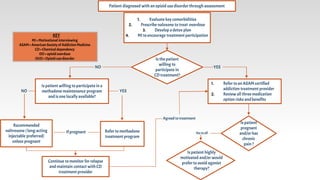
Is the patient
willing to
participate in
CD treatment?
Is patient
pregnant
and/or has
chronic
pain ?
1. Evaluate key comorbidities
2. Prescribe naloxone to treat overdose
3. Develop a detox plan
4. MI to encourage treatment participation
YES
1. Refer to an ASAM certified
addiction treatment provider
2. Review all three medication
option risks and benefits
NO
Is patient willing to participate in a
methadone maintenance program
and is one locally available?
YES
Refer to methadone
treatment program
NO
Recommended
naltrexone (long-acting
injectable preferred)
unless pregnant
Ifpregnant
MI= Motivational interviewing
ASAM=American Societyof Addiction Medicine
CD=Chemical dependency
OO=opioid overdose
OUD= Opioid-usedisorder
KEY
Continue to monitor for relapse
and maintain contact withCD
treatment provider
No toall
Is patient highly
motivated and/or would
preferto avoid agonist
therapy?
Agreed to treatment
Patient diagnosed with an opioid use disorderthrough assessment
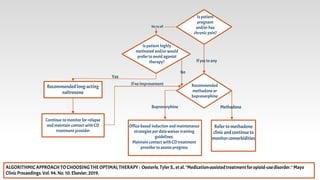
No toall
Is patient highly
motivated and/or would
preferto avoid agonist
therapy? Ifyes to any
Recommended
methadone or
buprenorphine
No
Methadone
Buprenorphine
Refertomethadone
clinic and continueto
monitorcomorbidities
Office-based induction and maintenance
strategies perdata waiver training
guidelines.
Maintain contact with CDtreatment
provider to assess progress
Yes
Recommendedlong-acting
naltrexone
Continue to monitor for relapse
and maintain contact withCD
treatment provider
Ifno improvement
Is patient
pregnant
and/or has
chronic pain?
ALGORITHMICAPPROACH TO CHOOSINGTHE OPTIMAL THERAPY : Oesterle,TylerS., et al. "Medication-assistedtreatmentforopioid-usedisorder." Mayo
ClinicProceedings.Vol. 94. No. 10.Elsevier,2019.
Thank
You 

Opioid replacement therapy.pptx

  • 1.
    Leut.Col.Dr.Yasser AbdEl-Ghany El-Ghazzawy PsychiatricHospital,Maadi Armed Forces MedicalComplex Addiction Replacement Therapy
  • 2.
  • 3.
    Objectives Magnitudeoftheproblem 1 2 3 AddictionReplacementTherapy(OpioidSubstitutionTherapy) “Medication-AssistedTreatment(MAT)”forOpioidusedisorder Agonist/ Antagonistpharmacology 4OpioidSubstitutionTherapy(OST):  Methadone  Buprenorphine  Comparison / Flowchart for assessment and management  Harm reduction concept  History of OST  The perfect drug  Benefits of OST  Myth about substitution therapy/ challengesand threats.  Inclusion Criteria and special groups.
  • 4.
  • 5.
    Magnitudeof theProblem Consequences oftheopioid crisis: • Increased HIVand HCV. • Risingincidenceofinfants born dependentonopioidsas a result of opioiduse duringpregnancy. Worldwide In2020, 2.7 million peopleaged 12 orolder, inU.S with OUD OpioidUseDisorder: Overdose deaths: • The UnitedNations attributes76% of addiction-related deaths worldwidetoopioids • More than quadrupled from 1999
  • 6.
    Magnitude of theProblem InEgypt: All indicatorspoint to an increaseinthebehaviorof drugabuse by injection,whichis accompanied by an increasein the rates of infection(HIV,HBV, HCV) • By the end of2020, the cumulativenumber of people infectedwithHIV/AIDS was: 18,196,ofwhom 6,080 are injectingdrug users, representing 33.5 %ofthe total number of cases detectedfrom 1986to 2020. • Out of the total6080,in the last fiveyears only: 4803, or 79%. • In 2019and 2020alone, the percentageof HIV through injectingdrugs increased by 31% compared tothe previous twoyears.
  • 7.
    Magnitude of theProblem InEgypt: • A Survey bythe government shows that the narcotic problem costs the country’s economy $800 millionannually • According to theUNODC 51% of injecting drug users are infectedwith HCV with the highestNumbers in Egypt globally(10%) . • In additionto 150,000 new infections annually. UNOCD= UnitedNationsOffice onDrugs and Crime
  • 8.
    “Medication-AssistedTreatment(MAT)” for Opioid UseDisorder 1 Detoxification 2 Early and late recovery 3 Maintenance Methadone Buprenorphine Naltrexone Alpha-2-AdrenergicAgonist Medications (Lofexidine)
  • 9.
    Agonist/Antagonist o Affinityfor binding plus efficacy oMethadone PureAgonist o Affinityfor binding butlow efficacy o Buprenorphine PartialAgonist o Affinityfor binding butno efficacy;blocks action of endogenous andexogenous ligands. o Naltrexone PureAntagonist
  • 10.
    Heroin/Methadone Buprenorphine Naloxone/Naltrexone FullAgonistPartialAgonist Antagonist Activity Zone Affinity Zone
  • 11.
  • 12.
    HarmReduction WhatisHarm Reduction? Can be viewedasthe preventionof adverse consequencesofillicitdrug use without necessarilyreducingtheirconsumption. A range of different strategies withthe goal of minimizingthe riskof the patient contractinginfectiousdiseases,overdosing, orsufferingother consequencesrelated to the use of substances. The increasingnumbers of patients infectedwithbloodbornediseases through sharing injectingequipment, the model ofharm reductionhas been adaptedinEgypt
  • 13.
  • 14.
    History During world WarII Asa synthetic alternative 1960s The supplyof Opiumwas cutoff from Germany. As a resultpainkilling Morphine became a medicinein short supply. Methadone was developed as a pain killing alternative by German chemist as an Opioid receptoragonist successfully relievedpain. • Methadone used as a treatment for opioid dependenceas a response topost- world War IIHeroinepidemic inNew YorkCity. • FDA approved for opioiduse disorder in1972
  • 15.
    o One ofthe most effective treatment options for opioid dependence. o It is a safe andcost-effective. o Extensively researched. AddictionReplacementTherapy OpioidSubstitutionTherapy(OST) WHO addedMethadone and Buprenorphine tothe “Listof EssentialMedicines” "intended to beavailablewithinthecontext of functioning health care systemsat all times in adequate amounts, in the appropriatedosageforms,with assured quality,and at a pricetheindividualand the community can afford."(WHO,2009)
  • 16.
    “ThePerfectDrug”Characteristics: • Slowonset ofAction. • Relieves withdrawalsymptoms. • Longduration of action. • Prevents relapse. • Slowoffset of action. • Has impact onnegative reinforcement generated by stress neural circuits. • Oral orpreferable depot form. • Inhibitsthe reinforcing properties(Euphoria) by drugs and associated cues.
  • 17.
    Benefitsof implementing OpioidSubstitution Therapy (OST) 1 4 2 3 The reductionorcessation of opioiduse,andopioidusedisorder-related symptoms withLessharmrelated tomode of use /impurity of substance. The reductionorcessation of opioid-relatedoverdosedeaths. The reductionorcessation of opioid-relatedcriminalactivity The reductionof injectionand the associated risk of transmission of blood- borne viruses(HIV),(HBV)and(HCV).
  • 18.
    Benefitsof implementing OpioidSubstitution Therapy (OST) 5 8 6 7 OST Increases socialfunctioningandretentionintreatment. Treatment of opioid-dependentpregnant womenwith methadone or buprenorphineImproves birthOutcomesfortheirbabies Reduces suicidalityandco-morbidpsychiatricsymptoms Decreasescraving,Resetstolerance,Relapseprevention,Safeand comfortablewithdrawal,Controlleduse givenundermedical supervision.
  • 19.
    Benefitsof OST Abuse SubstitutionTherapy vs. High chances of HIV & other blood borne infections  Not prescribed medically  Severe withdrawal symptoms  High chances of overdose and intoxication injuries  Craving  Criminal activity  Lost productivity  Infants born dependentson opioids.  High cost of medical service  Low chances of HIV & other blood borne infections  Given under medical supervision  Mild withdrawal symptoms if discontinued  Low chances of overdose  Less Craving  Less Criminal activity  More productivity  less cost of medical service
  • 20.
    Misconceptions/ Mythabout OST PatientsarestillAddicted Addictionis the pathologicaluse of a substance OST is medicallysupervised and regulated Myth #1 Mythabout OST OSTis simplya substituteof illegaldrugs OST ensures commitment torecovery programs that allows persons to function normally Myth #2 Providingmedicationsaloneis sufficient: Combiningpharmacotherapy and other recoveryservicesis mandatory. Myth #3 Posters in the Media : Methadoneis A Narcotic Thatkills
  • 21.
    MainrelevantthreatsagainstOST programin Egyptare: Risksin caseof a negativeviewandperception by themedia/community, dependingon the stigmaand low knowledgeofthe harm-related injected drug use.  The relatively strong stigmaanddiscriminationagainst peoplewhouse drugs, as( it is the casein several Arab countries).  Lack of fundingpossibilitiesand sustainability.  The riskof diversionis the case ofnon-control and insufficientmonitoring throughout thewholeprogram.
  • 22.
    RecommendationforadmissioncriteriaforOST TheInclusioncriteria:  Diagnosisofopioiddependence according toclassificatorysystems, Minimumof one tothree yearsof opioidaddiction;  Methodofadministration by injection  A minimumageof18;  Historyoffailedtreatment attempt(s)and long duration ofuse  Strong motivation and willingto come daily  Ableto giveinformedconsent Specialgroupsare givenpriority over the general opioiddependent population:  Pregnant women;  Peoplewith HIV/AIDS  Peoplewith viralhepatitis;  Peoplewith mental health problems;  Poly-drugusers; and  In custodial settings (prisons, jails)and under policearrest.
  • 23.
    Methadone ( throughspecializedmethadoneclinics) Modeof Action DurationofAction Preparations Dosing A fullmu-opioid receptor agonist methadoneliquid, Oral tablets, methadonePowder, IV methadone Adequate dosing ranges from60 – 120 mg,typically beginning with adaily doseof20–30mg with increases of5 or 10mguntil the optimaldoseis reached slowonset of action(30 min. withpeakeffect(2-3 hrs.) with long elimination ½ life(24-36h)
  • 24.
    SideEffects Deaths 1 Respiratory depression 2 Cardiac ( QTcprolongation) ECGas baseline andfollow-up during treatment 3 The mainthreat is theriskof overdosing, especiallyatthe start oftreatment and when methadoneis combined with other sedativemedications or illicitdruguse Abuseispossible
  • 25.
    Contraindications: 1 4 2 5 36 Does notmeet DSM 5/ICD-11 criteria Seriousand problematic use of alcoholand or sedative hypnotics Less than 1yr history of opioidaddiction Unable to attend program as required Allergicresponse Cardiac complications Caution: Highlyactive antiretroviral treatment medications used in HIV infection treatment affect the pharmacokinetics of methadone; therefore, it is vital to practice caution in the case of patients who receive highly active antiretroviral treatment
  • 26.
    Buprenorphine Modeof Action Durationof Action PreparationsDosing History Partial agonist at the mu receptor. It has lowactivitybut high affinity. o Poorbioavailabilitywhen taken orallyand must be dissolvedsublingually o Co-administration withnaloxone (Suboxone®) (not absorbed sublingually)to preventthe buprenorphine from beinginjected(Abuse) o Other forms : 6-month subdermal implant and a once-monthly buprenorphine injection o Discoveredin1966 o (FDA) approved in2002 o Onset of effect in 30– 60minutes. o Peak effect inabout 1– 4 hours. o Half-life 20–72hours (36hours onaverage). Tolerabledose range (4to 24 mg )
  • 27.
    Comparison( The 3-FDAapproved drugs) Treatment Methadone Buprenorphine Naltrexone Pharmacologic action Full opioid agonist Partial agonist Full opioid antagonist FDA-approved clinical indication Opioid-use disorder, pain Opioid-use disorder, pain Opioid-use disorder, alcohol-use disorder Routeof administration Oral, parenteral Sublingual, subcutaneous extended- release injection, subdermal implant, transdermal patch Oral, parenteral Frequencyof administration Daily Orally: daily,every other day, 3 times a week; subcutaneously:monthly implant: every 6 months Orally: daily,every other day or every third day; intramuscularly: monthly (Vivitrol)
  • 28.
    Treatment Methadone BuprenorphineNaltrexone Challenges • Potentialfor abuse • cardiac complications in cardiac patients • Higherriskof overdose • More severein withdrawal Safe in pregnancy and breastfeeding • Potentialfor abuse if not combined with naloxone • saferfor peoplewith cardiacproblems • Better for modestly motivated patients • low risk of overdose • Less severe withdrawal so easier transition in and out of treatment Not recommended in pregnancy • No potential for abuse but Less complianceyet better in long acting injections • Betterfor highly motivatedpatients • Hepatic complications in hepatic patients Contraindicated in pregnancy
  • 29.
    Is the patient willingto participate in CD treatment? Is patient pregnant and/or has chronic pain ? 1. Evaluate key comorbidities 2. Prescribe naloxone to treat overdose 3. Develop a detox plan 4. MI to encourage treatment participation YES 1. Refer to an ASAM certified addiction treatment provider 2. Review all three medication option risks and benefits NO Is patient willing to participate in a methadone maintenance program and is one locally available? YES Refer to methadone treatment program NO Recommended naltrexone (long-acting injectable preferred) unless pregnant Ifpregnant MI= Motivational interviewing ASAM=American Societyof Addiction Medicine CD=Chemical dependency OO=opioid overdose OUD= Opioid-usedisorder KEY Continue to monitor for relapse and maintain contact withCD treatment provider No toall Is patient highly motivated and/or would preferto avoid agonist therapy? Agreed to treatment Patient diagnosed with an opioid use disorderthrough assessment
  • 30.
    No toall Is patienthighly motivated and/or would preferto avoid agonist therapy? Ifyes to any Recommended methadone or buprenorphine No Methadone Buprenorphine Refertomethadone clinic and continueto monitorcomorbidities Office-based induction and maintenance strategies perdata waiver training guidelines. Maintain contact with CDtreatment provider to assess progress Yes Recommendedlong-acting naltrexone Continue to monitor for relapse and maintain contact withCD treatment provider Ifno improvement Is patient pregnant and/or has chronic pain? ALGORITHMICAPPROACH TO CHOOSINGTHE OPTIMAL THERAPY : Oesterle,TylerS., et al. "Medication-assistedtreatmentforopioid-usedisorder." Mayo ClinicProceedings.Vol. 94. No. 10.Elsevier,2019.
  • 31.