
Ehab Elbaz, MD,MBA
Consultant Psychiatrist
Director of psychiatry hospital, Maadi Military Medical Complex
Lecturer of psychiatry, Military Medical Academy
Objectives
• Try to answer the following questions:
1) Where did the concept of formulation in psychiatry
come from?
2) How did formulation evolve over time?
3) Do psychiatrists understand formulation all the
same?
4) What are the basic contents of formulation?
5) What is the function of formulation?
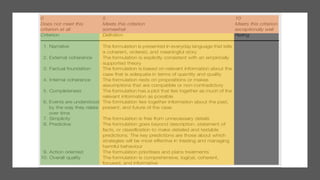
6) How can we assess the quality of case formulation?
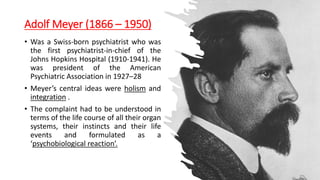
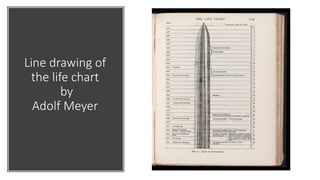
Adolf Meyer (1866 – 1950)
• Was a Swiss-born psychiatrist who was
the first psychiatrist-in-chief of the
Johns Hopkins Hospital (1910-1941). He
was president of the American
Psychiatric Association in 1927–28
• Meyer’s central ideas were holism and
integration .
• The complaint had to be understood in
terms of the life course of all their organ
systems, their instincts and their life
events and formulated as a
‘psychobiological reaction’.
Line drawing of
the life chart
by
Adolf Meyer
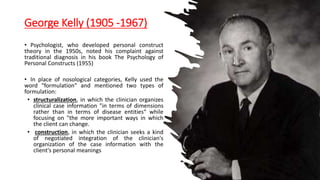
George Kelly (1905 -1967)
• Psychologist, who developed personal construct
theory in the 1950s, noted his complaint against
traditional diagnosis in his book The Psychology of
Personal Constructs (1955)
• In place of nosological categories, Kelly used the
word "formulation" and mentioned two types of
formulation:
• structuralization, in which the clinician organizes
clinical case information "in terms of dimensions
rather than in terms of disease entities“ while
focusing on "the more important ways in which
the client can change.
• construction, in which the clinician seeks a kind
of negotiated integration of the clinician's
organization of the case information with the
client's personal meanings
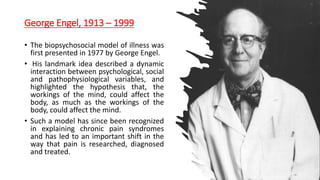
George Engel, 1913 – 1999
• The biopsychosocial model of illness was
first presented in 1977 by George Engel.
• His landmark idea described a dynamic
interaction between psychological, social
and pathophysiological variables, and
highlighted the hypothesis that, the
workings of the mind, could affect the
body, as much as the workings of the
body, could affect the mind.
• Such a model has since been recognized
in explaining chronic pain syndromes
and has led to an important shift in the
way that pain is researched, diagnosed
and treated.
Confusing concepts
• Case formulation
• Diagnostic formulation
• Psychiatric formulation
• Psychological formulation
• Biopsychosocial formulation
• Psychotherapy case formulation
• Clinical formulation
• Problem formulation
Definition
• It is the process or product of
gathering and integrating diverse
clinical information to develop a
concise account of the relevant
variables affecting a person’s mental
health to guide decision-making.
McMurran, M., & Bruford, S. (2016). Case formulation quality
checklist: a revision based upon clinicians' views. Journal of
Forensic Practice, 18(1), 31-38.
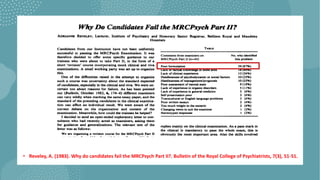
• Reveley, A. (1983). Why do candidates fail the MRCPsych Part II?. Bulletin of the Royal College of Psychiatrists, 7(3), 51-51.
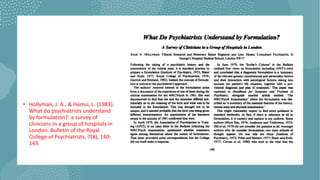
• Hollyman, J. A., & Hemsi, L. (1983).
What do psychiatrists understand
by formulation?: a survey of
clinicians in a group of hospitals in
London. Bulletin of the Royal
College of Psychiatrists, 7(8), 140-
143.
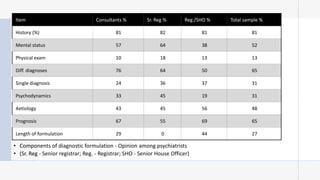
• Components of diagnostic formulation - Opinion among psychiatrists
• (Sr. Reg - Senior registrar; Reg. - Registrar; SHO - Senior House Officer)
Item Consultants % Sr. Reg % Reg./SHO % Total sample %
History (%) 81 82 81 81
Mental status 57 64 38 52
Physical exam 10 18 13 13
Diff. diagnoses 76 64 50 65
Single diagnosis 24 36 37 31
Psychodynamics 33 45 19 31
Aetiology 43 45 56 48
Prognosis 67 55 69 65
Length of formulation 29 0 44 27
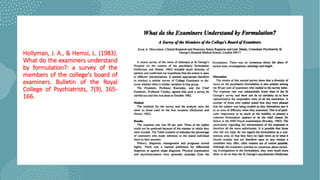
Hollyman, J. A., & Hemsi, L. (1983).
What do the examiners understand
by formulation?: a survey of the
members of the college's board of
examiners. Bulletin of the Royal
College of Psychiatrists, 7(9), 165-
166.
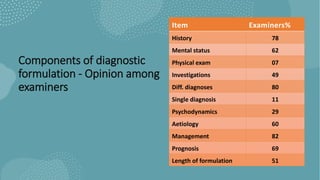
Components of diagnostic
formulation - Opinion among
examiners
Item Examiners%
History 78
Mental status 62
Physical exam 07
Investigations 49
Diff. diagnoses 80
Single diagnosis 11
Psychodynamics 29
Aetiology 60
Management 82
Prognosis 69
Length of formulation 51
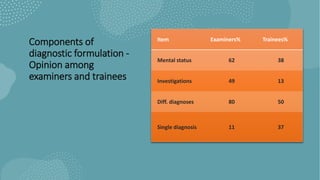
Components of
diagnostic formulation -
Opinion among
examiners and trainees
Item Examiners% Trainees%
Mental status 62 38
Investigations 49 13
Diff. diagnoses 80 50
Single diagnosis 11 37
FUNCTION OF FORMULATION
“In neurosis and personality disorders,
formulation is a clearer guide to aetiology,
prognosis and treatment than is categorical
diagnosis”
Aveline M: The advantages of formulation over categorical diagnosis in explorative psychotherapy
and psychodynamic management. Eur J Psychother Couns Health 1999, 2(Suppl 2):199-206.
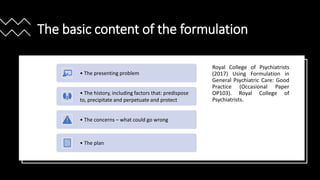
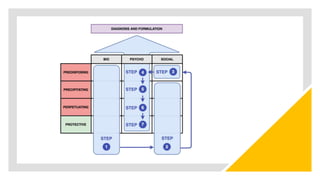
The basic content of the formulation
• The presenting problem
• The history, including factors that: predispose
to, precipitate and perpetuate and protect
• The concerns – what could go wrong
• The plan
Royal College of Psychiatrists
(2017) Using Formulation in
General Psychiatric Care: Good
Practice (Occasional Paper
OP103). Royal College of
Psychiatrists.
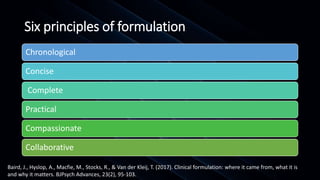
Six principles of formulation
Chronological
Concise
Complete
Practical
Compassionate
Collaborative
Baird, J., Hyslop, A., Macfie, M., Stocks, R., & Van der Kleij, T. (2017). Clinical formulation: where it came from, what it is
and why it matters. BJPsych Advances, 23(2), 95-103.
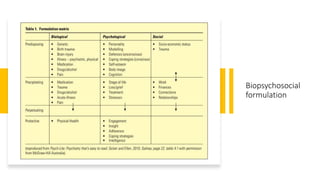
Biopsychosocial
formulation
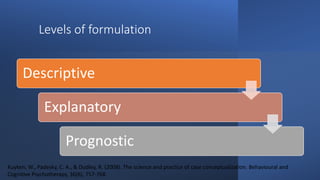
Levels of formulation
Descriptive
Explanatory
Prognostic
Kuyken, W., Padesky, C. A., & Dudley, R. (2008). The science and practice of case conceptualization. Behavioural and
Cognitive Psychotherapy, 36(6), 757-768.
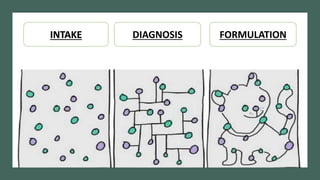
INTAKE DIAGNOSIS FORMULATION
CONCLUSION
• As early as the last century , psychiatrists had
recognized the importance of case formulation in
psychiatry
• Case formulation still a confusing concepts and poorly
understood by psychiatrists
• No formal standardization of how to teach and use it.
• It is a core competency skill for all trainees in the field
Formulation in psychiatry.pptx

Formulation in psychiatry.pptx

  • 1.
    Ehab Elbaz, MD,MBA ConsultantPsychiatrist Director of psychiatry hospital, Maadi Military Medical Complex Lecturer of psychiatry, Military Medical Academy
  • 2.
    Objectives • Try toanswer the following questions: 1) Where did the concept of formulation in psychiatry come from? 2) How did formulation evolve over time? 3) Do psychiatrists understand formulation all the same? 4) What are the basic contents of formulation? 5) What is the function of formulation? 6) How can we assess the quality of case formulation?
  • 4.
    Adolf Meyer (1866– 1950) • Was a Swiss-born psychiatrist who was the first psychiatrist-in-chief of the Johns Hopkins Hospital (1910-1941). He was president of the American Psychiatric Association in 1927–28 • Meyer’s central ideas were holism and integration . • The complaint had to be understood in terms of the life course of all their organ systems, their instincts and their life events and formulated as a ‘psychobiological reaction’.
  • 5.
    Line drawing of thelife chart by Adolf Meyer
  • 6.
    George Kelly (1905-1967) • Psychologist, who developed personal construct theory in the 1950s, noted his complaint against traditional diagnosis in his book The Psychology of Personal Constructs (1955) • In place of nosological categories, Kelly used the word "formulation" and mentioned two types of formulation: • structuralization, in which the clinician organizes clinical case information "in terms of dimensions rather than in terms of disease entities“ while focusing on "the more important ways in which the client can change. • construction, in which the clinician seeks a kind of negotiated integration of the clinician's organization of the case information with the client's personal meanings
  • 7.
    George Engel, 1913– 1999 • The biopsychosocial model of illness was first presented in 1977 by George Engel. • His landmark idea described a dynamic interaction between psychological, social and pathophysiological variables, and highlighted the hypothesis that, the workings of the mind, could affect the body, as much as the workings of the body, could affect the mind. • Such a model has since been recognized in explaining chronic pain syndromes and has led to an important shift in the way that pain is researched, diagnosed and treated.
  • 9.
    Confusing concepts • Caseformulation • Diagnostic formulation • Psychiatric formulation • Psychological formulation • Biopsychosocial formulation • Psychotherapy case formulation • Clinical formulation • Problem formulation
  • 10.
    Definition • It isthe process or product of gathering and integrating diverse clinical information to develop a concise account of the relevant variables affecting a person’s mental health to guide decision-making. McMurran, M., & Bruford, S. (2016). Case formulation quality checklist: a revision based upon clinicians' views. Journal of Forensic Practice, 18(1), 31-38.
  • 11.
    • Reveley, A.(1983). Why do candidates fail the MRCPsych Part II?. Bulletin of the Royal College of Psychiatrists, 7(3), 51-51.
  • 12.
    • Hollyman, J.A., & Hemsi, L. (1983). What do psychiatrists understand by formulation?: a survey of clinicians in a group of hospitals in London. Bulletin of the Royal College of Psychiatrists, 7(8), 140- 143.
  • 13.
    • Components ofdiagnostic formulation - Opinion among psychiatrists • (Sr. Reg - Senior registrar; Reg. - Registrar; SHO - Senior House Officer) Item Consultants % Sr. Reg % Reg./SHO % Total sample % History (%) 81 82 81 81 Mental status 57 64 38 52 Physical exam 10 18 13 13 Diff. diagnoses 76 64 50 65 Single diagnosis 24 36 37 31 Psychodynamics 33 45 19 31 Aetiology 43 45 56 48 Prognosis 67 55 69 65 Length of formulation 29 0 44 27
  • 14.
    Hollyman, J. A.,& Hemsi, L. (1983). What do the examiners understand by formulation?: a survey of the members of the college's board of examiners. Bulletin of the Royal College of Psychiatrists, 7(9), 165- 166.
  • 15.
    Components of diagnostic formulation- Opinion among examiners Item Examiners% History 78 Mental status 62 Physical exam 07 Investigations 49 Diff. diagnoses 80 Single diagnosis 11 Psychodynamics 29 Aetiology 60 Management 82 Prognosis 69 Length of formulation 51
  • 16.
    Components of diagnostic formulation- Opinion among examiners and trainees Item Examiners% Trainees% Mental status 62 38 Investigations 49 13 Diff. diagnoses 80 50 Single diagnosis 11 37
  • 17.
    FUNCTION OF FORMULATION “Inneurosis and personality disorders, formulation is a clearer guide to aetiology, prognosis and treatment than is categorical diagnosis” Aveline M: The advantages of formulation over categorical diagnosis in explorative psychotherapy and psychodynamic management. Eur J Psychother Couns Health 1999, 2(Suppl 2):199-206.
  • 18.
    The basic contentof the formulation • The presenting problem • The history, including factors that: predispose to, precipitate and perpetuate and protect • The concerns – what could go wrong • The plan Royal College of Psychiatrists (2017) Using Formulation in General Psychiatric Care: Good Practice (Occasional Paper OP103). Royal College of Psychiatrists.
  • 19.
    Six principles offormulation Chronological Concise Complete Practical Compassionate Collaborative Baird, J., Hyslop, A., Macfie, M., Stocks, R., & Van der Kleij, T. (2017). Clinical formulation: where it came from, what it is and why it matters. BJPsych Advances, 23(2), 95-103.
  • 20.
  • 24.
    Levels of formulation Descriptive Explanatory Prognostic Kuyken,W., Padesky, C. A., & Dudley, R. (2008). The science and practice of case conceptualization. Behavioural and Cognitive Psychotherapy, 36(6), 757-768.
  • 25.
  • 26.
    CONCLUSION • As earlyas the last century , psychiatrists had recognized the importance of case formulation in psychiatry • Case formulation still a confusing concepts and poorly understood by psychiatrists • No formal standardization of how to teach and use it. • It is a core competency skill for all trainees in the field