WELCOME
DISCOVERY of
ANTIBIOTICS
What is Antibiotics?
• Antibiotics (Greek anti, “against”; bios, “life”) are chemical compounds used to
kill or inhibit the growth of infectious organisms.
• Originally the term antibiotic referred only to organic compounds, produced by
bacteria or molds, that are toxic to other microorganisms.
• First antibiotic was penicillin, discovered accidentally from a mold culture.
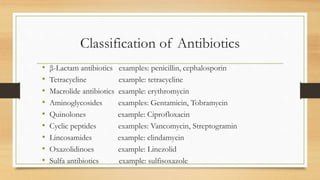
Classification of Antibiotics
• β-Lactam antibiotics examples: penicillin, cephalosporin
• Tetracycline example: tetracycline
• Macrolide antibiotics example: erythromycin
• Aminoglycosides examples: Gentamicin, Tobramycin
• Quinolones example: Ciprofloxacin
• Cyclic peptides examples: Vancomycin, Streptogramin
• Lincosamides example: clindamycin
• Oxazolidinoes example: Linezolid
• Sulfa antibiotics example: sulfisoxazole
How Antibiotics were discover?
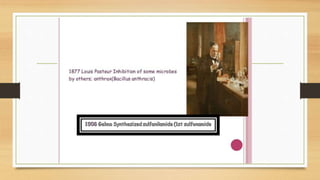
• Luis Pasteur and Robert Koch are widely recognized as having played a
critical role in formulating and developing the germ theory of disease.
• In 1892, Koch’s postulates spelled out the criteria for proving that a
particular bacterium was responsible for a specific disease.
Ehrlich’s Discovery of Salvarsan
• Paul Ehrlich, a German physician, noted that certain chemical dyes colored some
bacterial cells but not others.
• In 1909, he discovered that a chemical called salvarsan was an effective treatment
for syphilis. This became the first modern antibiotic.
• It is interesting to note that all the activity screening had out be carried out with an
in vivo rabbit model since there was no in vitro test system available, which is still
the case today.
• Ehrlich was awarded the Nobel Prize for his work on immunology in 1908.
Discovery of Penicillin
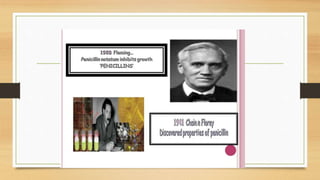
• Alexander Fleming was, it seems, a bit disorderly in his work and accidentally
discovered penicillin in 1928.
• He noticed that a fungus, Penicillium notatum, had contaminated a culture plate
of Staphylococcus bacteria he had accidentally left uncovered. The fungus had created
bacteria-free zones wherever it grew on the plate. Fleming isolated and grew the mould
in pure culture
• Fleming’s contaminating mold was identified as belonging to the genus Penicillium ,
which led to the name penicillin for the substance responsible for the antibacterial
activity observed on the agar plate. Fleming published his work on penicillin in 1929.
Development of Penicillin
• Day in 1944, penicillin was being widely used to treat troops for infections
both in the field and in hospitals throughout Europe. By the end of World
War II, penicillin was nicknamed 'the wonder drug' and had saved many lives.
• Ernst Chain, working as part of Howard Florey’s team at Oxford, had taken
on the task of isolating penicillin and solving its structure. The first results
of this effort were published in 1940, and by 1945, penicillin had
demonstrated its amazing curative properties in the clinic and was being
produced and distributed on a large scale. For their seminal work Florey,
Chain, and Fleming were awarded the Nobel Prize in 1945.
The Discovery of Streptomycin
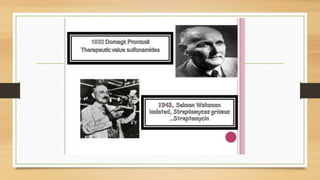
• In 1943, Albert Schatz, a graduate in Waksman’s lab found Streptomycin, which was active
against gram negative bacteria and most importantly against Mycobacterium tuberculosis,
the pathogen responsible for TB (tuberculosis). It was quickly shown to be active in animal
models
• Waksman was awarded the Nobel Prize in 1952 for his pioneering work with actinomycetes
and for the discovery of streptomycin.
• Sadly the story of streptomycin’s discovery was clouded by a court case in which Dr Schatz
claimed that he had not received the recognition he deserved for the early pivotal role that
he had played. He had initially been excluded from royalty payments that Waksman had been
receiving for streptomycin.
• His work led to the golden era of antibiotic discovery.
The Discovery of Gentamycin
• The story of gentamicin’s discovery is unusually well-documented.
• In 1958, Schering with Micromonospora isolates and he set up a small
laboratory in his own basement to do this work. These isolates were all collected
locally. Cultures were screened at Schering as potential producers of antibiotic
activity. Out of the more than 300 cultures sent to Schering over the next couple
of years, 15 produced novel antibiotics, by far the most important of which was
Gentamicin, a new complex of closely related aminoglycosides.
The Discovery of Cephalosporin C
• In a departure from the typical screening of soil isolates, he decided to examine cultures isolated from the
seawater close to a local sewage outlet. He reasoned that the purifi cation of the seawater that occurred
could be due in some measure to microbial antagonism. In 1945, he isolated a fungus, Cephalosporium
acremonium, which produced broad-spectrum antibacterial activity.
• In 1948, he published his results on crude extracts made from C. acremonium cultures that included data
from patients who had their boils and abscesses caused by staphylococci and streptococci successfully
treated by a topical application of this complex mixture.
• Examination of extracts of C. acremonium soon revealed that it contained multiple components
possessing antibacterial activity. The first component to be identified was only active against gram-positive
bacteria and was called cephalosporin P.
• The third component of the C. acremonium culture was noticed as an impurity isolated during.
The Discovery of Chloramphenicol
• In 1943 the Parke Davis Company set up a research collaboration with Paul Burckholder to
screen potential antibiotic-producing microbes isolated 7,000 soil samples that were screened
• Venezuela yielded a broad-spectrum orally active antibiotic: chloramphenicol.
• It was the first broad-spectrum antibiotic to be marketed that could be used orally or
systemically.
• By the end of 1947, it had already undergone preliminary clinical evaluation with impressive
results.
• Unfortunately, after testing in eight million or so patients, a rare but frequently lethal side
effect was revealed. Although only as few as 1 in 100,000 patients treated, suffered from the
aplastic anemia that it caused, this was enough to dramatically curtail its use.
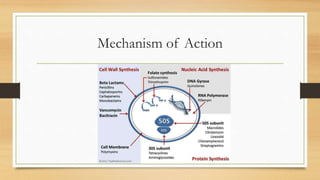
Mechanism of Action
Inappropriate prescription
*In analysis of prescribing practices in teaching hospitals worldwide,more than
40% of all antimicrobials prescribed were considered as inappropriate.
*Some 150 million prescriptions are annually written in the USA & of those,
50 million are absolutely unnecessary or inappropriate.
Antibiotics side effects
*Diarrhoea
* Bloating & indigestion
* Abdominal pain
*Loss of appetite
*Being & feel sick
* Itchy rash skin
*Life threatening allergic reaction
Rules of pharmacists
*The pharmacist should review the previous history of diseases of the patient.
* Hypersensitivity reaction of drug.
*Drug -drug interaction.
*Suggests not to stop the antibiotics without complete the course even feel better.
My Opinion
* The doctor must be concern about the disease whether it viral or bacterial.
*They should not prescribed drug without test or over sure.
*The pharmacist should more conscious about the dose,drug interaction,resistant
of the drug.
*The patient should strictly maintain the suggestion of the pharmacist.

Antibiotics

  • 1.
  • 2.
  • 3.
    What is Antibiotics? •Antibiotics (Greek anti, “against”; bios, “life”) are chemical compounds used to kill or inhibit the growth of infectious organisms. • Originally the term antibiotic referred only to organic compounds, produced by bacteria or molds, that are toxic to other microorganisms. • First antibiotic was penicillin, discovered accidentally from a mold culture.
  • 4.
    Classification of Antibiotics •β-Lactam antibiotics examples: penicillin, cephalosporin • Tetracycline example: tetracycline • Macrolide antibiotics example: erythromycin • Aminoglycosides examples: Gentamicin, Tobramycin • Quinolones example: Ciprofloxacin • Cyclic peptides examples: Vancomycin, Streptogramin • Lincosamides example: clindamycin • Oxazolidinoes example: Linezolid • Sulfa antibiotics example: sulfisoxazole
  • 5.
    How Antibiotics werediscover? • Luis Pasteur and Robert Koch are widely recognized as having played a critical role in formulating and developing the germ theory of disease. • In 1892, Koch’s postulates spelled out the criteria for proving that a particular bacterium was responsible for a specific disease.
  • 7.
    Ehrlich’s Discovery ofSalvarsan • Paul Ehrlich, a German physician, noted that certain chemical dyes colored some bacterial cells but not others. • In 1909, he discovered that a chemical called salvarsan was an effective treatment for syphilis. This became the first modern antibiotic. • It is interesting to note that all the activity screening had out be carried out with an in vivo rabbit model since there was no in vitro test system available, which is still the case today. • Ehrlich was awarded the Nobel Prize for his work on immunology in 1908.
  • 8.
    Discovery of Penicillin •Alexander Fleming was, it seems, a bit disorderly in his work and accidentally discovered penicillin in 1928. • He noticed that a fungus, Penicillium notatum, had contaminated a culture plate of Staphylococcus bacteria he had accidentally left uncovered. The fungus had created bacteria-free zones wherever it grew on the plate. Fleming isolated and grew the mould in pure culture • Fleming’s contaminating mold was identified as belonging to the genus Penicillium , which led to the name penicillin for the substance responsible for the antibacterial activity observed on the agar plate. Fleming published his work on penicillin in 1929.
  • 10.
    Development of Penicillin •Day in 1944, penicillin was being widely used to treat troops for infections both in the field and in hospitals throughout Europe. By the end of World War II, penicillin was nicknamed 'the wonder drug' and had saved many lives. • Ernst Chain, working as part of Howard Florey’s team at Oxford, had taken on the task of isolating penicillin and solving its structure. The first results of this effort were published in 1940, and by 1945, penicillin had demonstrated its amazing curative properties in the clinic and was being produced and distributed on a large scale. For their seminal work Florey, Chain, and Fleming were awarded the Nobel Prize in 1945.
  • 11.
    The Discovery ofStreptomycin • In 1943, Albert Schatz, a graduate in Waksman’s lab found Streptomycin, which was active against gram negative bacteria and most importantly against Mycobacterium tuberculosis, the pathogen responsible for TB (tuberculosis). It was quickly shown to be active in animal models • Waksman was awarded the Nobel Prize in 1952 for his pioneering work with actinomycetes and for the discovery of streptomycin. • Sadly the story of streptomycin’s discovery was clouded by a court case in which Dr Schatz claimed that he had not received the recognition he deserved for the early pivotal role that he had played. He had initially been excluded from royalty payments that Waksman had been receiving for streptomycin. • His work led to the golden era of antibiotic discovery.
  • 13.
    The Discovery ofGentamycin • The story of gentamicin’s discovery is unusually well-documented. • In 1958, Schering with Micromonospora isolates and he set up a small laboratory in his own basement to do this work. These isolates were all collected locally. Cultures were screened at Schering as potential producers of antibiotic activity. Out of the more than 300 cultures sent to Schering over the next couple of years, 15 produced novel antibiotics, by far the most important of which was Gentamicin, a new complex of closely related aminoglycosides.
  • 14.
    The Discovery ofCephalosporin C • In a departure from the typical screening of soil isolates, he decided to examine cultures isolated from the seawater close to a local sewage outlet. He reasoned that the purifi cation of the seawater that occurred could be due in some measure to microbial antagonism. In 1945, he isolated a fungus, Cephalosporium acremonium, which produced broad-spectrum antibacterial activity. • In 1948, he published his results on crude extracts made from C. acremonium cultures that included data from patients who had their boils and abscesses caused by staphylococci and streptococci successfully treated by a topical application of this complex mixture. • Examination of extracts of C. acremonium soon revealed that it contained multiple components possessing antibacterial activity. The first component to be identified was only active against gram-positive bacteria and was called cephalosporin P. • The third component of the C. acremonium culture was noticed as an impurity isolated during.
  • 15.
    The Discovery ofChloramphenicol • In 1943 the Parke Davis Company set up a research collaboration with Paul Burckholder to screen potential antibiotic-producing microbes isolated 7,000 soil samples that were screened • Venezuela yielded a broad-spectrum orally active antibiotic: chloramphenicol. • It was the first broad-spectrum antibiotic to be marketed that could be used orally or systemically. • By the end of 1947, it had already undergone preliminary clinical evaluation with impressive results. • Unfortunately, after testing in eight million or so patients, a rare but frequently lethal side effect was revealed. Although only as few as 1 in 100,000 patients treated, suffered from the aplastic anemia that it caused, this was enough to dramatically curtail its use.
  • 16.
  • 17.
    Inappropriate prescription *In analysisof prescribing practices in teaching hospitals worldwide,more than 40% of all antimicrobials prescribed were considered as inappropriate. *Some 150 million prescriptions are annually written in the USA & of those, 50 million are absolutely unnecessary or inappropriate.
  • 18.
    Antibiotics side effects *Diarrhoea *Bloating & indigestion * Abdominal pain *Loss of appetite *Being & feel sick * Itchy rash skin *Life threatening allergic reaction
  • 19.
    Rules of pharmacists *Thepharmacist should review the previous history of diseases of the patient. * Hypersensitivity reaction of drug. *Drug -drug interaction. *Suggests not to stop the antibiotics without complete the course even feel better.
  • 20.
    My Opinion * Thedoctor must be concern about the disease whether it viral or bacterial. *They should not prescribed drug without test or over sure. *The pharmacist should more conscious about the dose,drug interaction,resistant of the drug. *The patient should strictly maintain the suggestion of the pharmacist.