ANGINA PECTORIS
DEFINITION
Antianginaldrugs are those that prevent, abort or terminate attacks of angina pectoris.
Angina pectoris Is a pain syndrome due to induction of an adverse oxygen supply/ demand
situation in a portion of the myocardium ie It is the primary symptom of ischemic heart
disease, caused by transient episodes of myocardial ischemia that are due to an imbalance in
the myocardial oxygen supply-demand relationship.
CLASSIFICATION: Two principal forms are recognized:
1. Classical angina
2. Variant/Prinzmetal’s angina
Classical angina (common form) Attacks are predictably provoked (stable angina) by exercise,
emotion, eating or coitus and subside when the increased energy demand is withdrawn.
The underlying pathology is—severe arteriosclerotic affliction of larger coronary arteries
(conducting vessels),
Due to inadequacy of ischaemic left ventricle, the end diastolic left ventricular pressure rises
from 5 to about 25 mm Hg—produces subendocardial ‘crunch’
3.
CLASSIFICATION:
Variant/Prinzmetal’s angina(uncommon form) Attacks occur at rest or during
sleep and are unpredictable. They are due to recurrent localized (occasionally
diffuse) coronary vasospasm
Unstable angina with rapid increase in duration and severity of attacks is mostly due
to rupture of an atheromatous plaque attracting platelet deposition and progressive
occlusion of the coronary artery; occasionally with associated coronary vasospasm.
Chronically reduced blood supply causes atrophy of cardiac muscle with fibrous
replacement (reduced myocardial work capacity → CHF) and may damage
conducting tissue to produce unstable cardiac rhythms.
Antianginal drugs relieve cardiac ischaemia but do not alter the course of coronary
artery pathology
Drugs are aimed at preventing and relieving the coronary vasospasm.
4.
CLASSIFICATION
1. Nitrates
(a)Short acting: Glyceryl trinitrate (GTN, Nitroglycerine)
(b) Long acting: Isosorbide dinitrate (short acting by sublingual route), Isosorbide mononitrate,
Erythrityl tetranitrate, Pentaerythritol tetranitrate
2. β Blockers Propranolol, Metoprolol, Atenolol and others.
3. Calcium channel blockers
(a) Phenyl alkylamine:Verapamil
(b) Benzothiazepine: Diltiazem
(c) Dihydropyridines: Nifedipine, Felodipine, Amlodipine, Nitrendipine, Nimodipine, Lacidipine, Lercanidipine, Benidipine
4. Potassium channel opener Nicorandil
5. Others Dipyridamole, Trimetazidine, Ranolazine, Oxyphedrine
Clinical classification
A. Used to abort or terminate attack GTN, Isosorbide dinitrate (sublingually).
B. Used for chronic prophylaxis, All other drugs.
5.
NITRATES (GTN asprototype
All organic nitrates share the same action; differ only in time course. The only major action is direct
nonspecific smooth muscle relaxation.
Preload reduction . The most prominent action is exerted on vascular smooth muscle. Nitrates dilate
veins more than arteries →peripheral pooling of blood →decreased venous return i.e. preload on
heart is reduced → →decreased cardiac work
Wall tension = intraventricular pressure × ventricular radius
Thus, reduction in ventricular radius decreases the tension that must be generated in the ventricular
wall—hence decreased O2 consumption.
6.
NITRATES (cont)
Afterloadreduction Nitrates also produce some arteriolar dilatation →slightly decrease total
peripheral resistance (t.p.r.) or afterload on heart . This action contributes to the reduction in
cardiac work
With large doses and if the mean BP falls significantly, reflex sympathetic
stimulation occurs tachycardia, increased cardiac contractility increased
→ →
cardiac work angina may be precipitated.
→
Redistribution of coronary flow In the arterial tree, nitrates preferentially relax bigger
conducting (angiographically visible) coronary arteries than arterioles or resistance vessels.
Mechanism of relief of angina The dilator effect on larger coronary vessels is the
principal action of nitrates benefiting variant angina by counteracting coronary
spasm. In classical angina undoubtedly the primary effect is to reduce cardiac
work by action on peripheral vasculature, through increased blood supply to
ischaemic area
7.
NITRATES (cont)
Heartand peripheral blood flow Nitrates have no direct stimulant or depressant
action on the heart. They dilate cutaneous (especially over face and neck flushing)
→
and meningeal vessels headache.
→
Other smooth muscles Bronchi, biliary tract and esophagus are relaxed; effect
Mechanism of action Organic nitrates are rapidly denitrated enzymatically in the
smooth muscle cell to release the reactive free radical nitric oxide (NO) which
activates cytosolic guanylyl cyclase →increased cGMP →causes dephos-phorylation
of myosin light chain kinase (MLCK). Reduced availability of phosphorylated (active)
MLCK interferes with activation of myosin →it fails to interact with actin to cause
contraction. Consequently relaxation occurs.
Platelets The NO generated from nitrates activates cGMP production in platelets as
well, leading to a mild antiaggregatory effect
8.
NITRATES : Pharmacokinetics
Pharmacokinetics Organic nitrates are lipidsoluble: well absorbed from buccal mucosa,
intestines and skin. All except isosorbide mononitrate undergo extensive and variable
first pass metabolism in liver. They are rapidly denitrated
Nitrates have been traditionally classified into short-acting and long-acting, it is the
rate of absorption from the site of administration and the rate of metabolism that
govern the duration of action of a particular nitrate. For example, GTN and isosorbide
dinitrate are both short-acting from sublingual but longer-acting from oral route
Adverse effects These are mostly due to vasodilatation.
Fullness in head, throbbing headache;(tolerance develops on continued use)
Flushing, weakness, sweating, palpitation,dizziness and fainting; these are mitigated by
lying down and accentuated by erect posture and alcohol.
Methemoglobinemia: is not marked with clinically used doses. However, it can
reduce O2 carrying capacity of blood in severe anaemia.
Rashes are rare,(common with pentaerythritol tetranitrate)
9.
NITRATES: Pharmacokinetics/INDIVIDUAL DRUGS
Tolerance Attenuation of haemodynamic and anti-ischaemic effect of nitrates occurs if
they are continuously present in the body
Clinically, no significant tolerance develops on intermittent use of sublingual GTN
for attacks of angina.
Cross tolerance occurs among all nitrates. Tolerance occurs more readily with higher
doses
The mechanism of nitrate tolerance is not well understood
Dependence On organic nitrates is now well recognized. Sudden withdrawal after
prolonged exposure has resulted in spasm of coronary and peripheral blood vessels.
INDIVIDUAL DRUGS
1. Glyceryl trinitrate (GTN, Nitroglycerine) It is a volatile liquid
adsorbed on the inert matrix of the tablet and rendered non-explosive.
The sublingual route is used when terminating an attack or aborting an imminent one is
the aim
10.
INDIVIDUAL DRUGS: Glyceryltrinitrate (GTN, Nitroglycerine
The tablet may be crushed under the teeth and spread over buccal mucosa. It
acts within 1–2 min (peak blood level in 3–6 min) because of direct absorption
into systemic circulation (bypassing liver where almost 90% is metabolized).
Plasma t½ is 2 min, duration of action depends on the period it remains
available for absorption from buccal mucosa.
A sublingual spray formulation has been recently marketed—acts more rapidly
than sublingual tablet
Nitroglycerine is readily absorbed from the skin.
Intravenous infusion of GTN provides rapid, steady, titratable plasma
concentration for as long as desired It has been successfully used for unstable
angina, coronary vasospasm, LVF accompanying MI, hypertension during
cardiac surgery, etc
11.
INDIVIDUAL DRUGS:
Isosorbidedinitrate: It is a solid but similar in properties to GTN; can be
used sublingually at the time of attack (slightly slower in action than GTN,
peak in 5–8 min) as well as orally for chronic prophylaxis.
Presystemic metabolism on oral administration is pronounced and variable. The t½
is 40 min, but sustained release formulation may afford protection for 6–10
hours.
Last dose should not be taken later than 6 PM to allow nitrate level to fall
during sleep at night.
Isosorbide mononitrate :This is an active metabolite of isosorbide dinitrate.
When administered orally it undergoes little first pass metabolism: bioavailability is
high, interindividual differences are minimal and it is longer acting (t½ 4–6 hr). Last
dose is to be taken in the afternoon; SR tablet once a day in the morning.
Erythrityl tetranitrate and pentaerythritol tetranitrate : These
are longer-acting nitrates used only for chronic prophylaxis
β - BLOCKERs
These drugs do not dilate coronaries or other blood vessels; total
coronary flow is rather reduced due to blockade of dilator β2-
receptors
They act by reducing cardiac work and O2 consumption (decreased
heart rate, inotropic state and mean BP).
β - blockers limit increase in these modalities
All β-blockers are nearly equally effective in decreasing frequency
and severity of attacks and in increasing exercise tolerance in
classical angina,
cardioselective agents ( atenolol, metoprolol ) are preferred over
nonselective β 1 + β 2 blockers (e.g. propranolol), which may worsen
variant angina due to unopposed α1- receptor mediated coronary
constriction that may accentuate the coronary spasm.
Long term β - blocker therapy lowers risk of sudden cardiac death a
mong ischaemic heart disease patients.
In angina pectoris, β -blockers are to be taken on a regular schedule;
not on ‘as and when required’ basis.
14.
β - BLOCKERs/CALCIUMCHANNEL BLOCKERS
Abrupt discontinuation after chronic use may precipitate severe attacks, even
MI.
β blockers are routinely used in UA/NSTEMI. However, they should be given
only after starting nitrate ± calcium channel blocker to counteract coronary
vasospasm,
CALCIUM CHANNEL BLOCKERS
CLASSIFICATION
Verapamil—a phenyl alkylamine, hydrophilic papaverine congener.
Nifedipine—a dihydropyridine (lipophilic).
Diltiazem—a hydrophilic benzothiazepine.
The dihydropyridines (DHPs) are the most potent Ca2+ channel blockers, and
this subclass has proliferated exceptionally
15.
CCB’S/PHARMACOLOGICAL ACTIONS /ADVERSEEFFECTS
inhibit Ca2+ mediated slow channel component of action potential (AP) in
smooth/cardiac muscle cell. The two most important
PHARMACOLOGICAL ACTIONS AND ADVERSE EFFECTS
Actions of CCBs are:
(i) Smooth muscle (especially vascular) relaxation.
(ii) Negative chronotropic, inotropic and dromotropic action on heart.
Smooth muscle: SM depolarise primarily by inward Ca2+ movement
through voltage sensitive channel
Ca2+ ions bring about excitation-contraction coupling through phosphorylation
of myosin light chain
CCBs cause relaxation by decreasing intracellular availability of Ca2+
The dihydropyridines (DHPs) have the most marked smooth muscle relaxant and
vasodilator action; verapamil is somewhat weaker followed by diltiazem.
16.
PHARMACOLOGICAL ACTIONS /ADVERSEEFFECTS
Heart: In the working atrial and ventricular fibres, Ca2+ moves in during plateau phase of
AP releases more Ca2+ from sarcoplasmic reticulum contraction through binding to
→ →
troponin— allowing interaction of myosin with actin.
Cardiac effects
Decrease contractility
(negative inotropy)
Decrease heart rate
(negative chronotropy)
Decrease conduction velocity
(negative dromotropy)
but not by DHPs (they have no negative chronotropic/dromotropic action).
Vascular effects
Smooth muscle relaxation
(vasodilation)
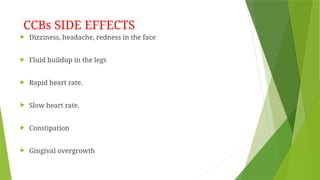
CCBs SIDE EFFECTS
Dizziness, headache, redness in the face
Fluid buildup in the legs
Rapid heart rate.
Slow heart rate.
Constipation
Gingival overgrowth
19.
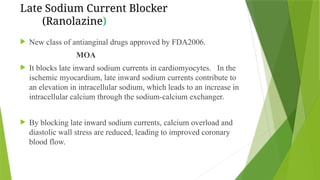
Late Sodium CurrentBlocker
(Ranolazine)
New class of antianginal drugs approved by FDA2006.
MOA
It blocks late inward sodium currents in cardiomyocytes. In the
ischemic myocardium, late inward sodium currents contribute to
an elevation in intracellular sodium, which leads to an increase in
intracellular calcium through the sodium-calcium exchanger.
By blocking late inward sodium currents, calcium overload and
diastolic wall stress are reduced, leading to improved coronary
blood flow.
20.
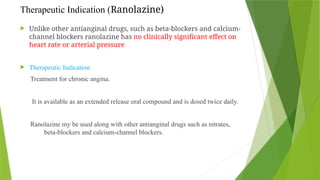
Therapeutic Indication (Ranolazine)
Unlike other antianginal drugs, such as beta-blockers and calcium-
channel blockers ranolazine has no clinically significant effect on
heart rate or arterial pressure
Therapeutic Indication
Treatment for chronic angina.
It is available as an extended release oral compound and is dosed twice daily.
Ranolazine my be used along with other antianginal drugs such as nitrates,
beta-blockers and calcium-channel blockers.
21.
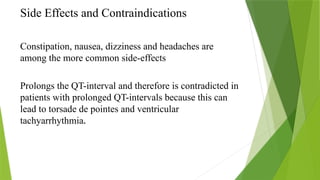
Side Effects andContraindications
Constipation, nausea, dizziness and headaches are
among the more common side-effects
Prolongs the QT-interval and therefore is contradicted in
patients with prolonged QT-intervals because this can
lead to torsade de pointes and ventricular
tachyarrhythmia.
 Most read
 Most read