 The alkylating agents are a class of drugs that are capable of
forming covalent bonds with important biomolecules. The major
targets of drug action are nucleophilic groups present on DNA
(especially the 7-position of guanine); however, proteins and RNA
among others may also be alkylated.
 Alkylation of DNA is thought to lead to cell death, although the
exact mechanism is uncertain. Potential mechanisms of cell death
include activation of apoptosis caused by p53 activation and
disruption of the template function of DNA.
 In many cases, however, the cancer cells have dysfunctional p53 so
that even though the cell has been unable to replicate DNA error
free, cell death via apoptosis does not occur. In this way, cancer
cells may become resistant to the effects of alkylating agents.
Another possibility is that the cancer cells, like normal cells, have
various mechanisms by which alkylated DNA bases can be
excised.
 Disruption of the template function of DNA may
have several effects. There are several potential
nucleophilic sites on DNA, which are
susceptible to electrophilic attack by an
alkylating agent (N-2, N-3, and N-7 of guanine,
N-1, N-3, and N-7 of adenine, 0–6 of thymine, N-3
of cytosine). The most important of these for
many alkylating agents is the N-7 position of
guanine whose nucleophilicity may be
enhanced by adjacent guanine residues.
Alkylation converts the base to an effective
leaving group so that attack by water leads to
depurination and the loss of genetic information
if the resulting depurination is not repaired by
the cell .
• Additionally, alkylation has been proposed to result in altered
base pairing away from the normal G-C: A-T hydrogen bonds
because of alterations in tautomerization. The alkylation also
leads to increased acidity of the N-1 nitrogen reducing the pKa
from 9 to 7 to 8 giving rise to a zwitterionic form that may also
mispair.
• For those agents that possess two reactive functionalities, both
interstrand and intrastrand cross-linking becomes possible.
When interstrand links occur, separation of the two strands
during replication is prevented and therefore replication is
blocked., Most of the currently used alkylating agents are
nonselective regarding the sequence of DNA with which they
react. Therefore, it is uncertain whether alkylation will lead to a
cytotoxic event. Some alkylation reactions may lead to
inconsequential results, and others may be easily repaired by the
cell. .
 Recent efforts have been directed at
producing more sequence-selective
alkylators that could be used at lower
concentrations in an effort to reduce the
significant side effects associated with this
group of agents.The general mechanism for
alkylation involves nucleophilic attack by
MNB, MNH2, MOH, MOMPO3H of DNA and
RNA, while additional nucleophiles (MSH,
COOH, etc.) present on proteins may also
react .
 The nitrogen mustards are compounds that are chemically similar
to sulfur mustard or mustard gas developed and used in World War
I. The term “mustard” comes from the similarity in the blisters
produced by the compound and those seen upon exposure to the
oil of black mustard seeds. Investigation of sulfur mustard
revealed that it possessed antineoplastic properties but because
the compound existed as a gas at room temperature, handling and
administration of the material were difficult. Conversion of the
sulfide to a tertiary amine allowed for the formation of salts, which
exist as solids at room temperature allowing for easier handling
and dosing. The term mustard was then extended to the nitrogen
analogs (nitrogen mustards) given their chemical similarity.
 Mustards such as mechlorethamine are classified as dialkylating
agents in that one mustard molecule can alkylate two
nucleophiles.
• The initial acid–base reaction is
necessary to release the lone pair of
electrons on nitrogen, which
subsequently displaces chloride to give
the highly reactive aziridinium cation.
Nucleophilic attack can then occur at the
aziridinium carbon to relieve the small
ring strain and neutralize the charge on
nitrogen. This process can then be
repeated provided a second leaving
group is present
 Mechlorethamine is highly reactive, in fact, too reactive and
therefore nonselective, making it unsuitable for oral
administration and necessitating direct injection into the
tumor. In cases of extravasation (drug escapes from the
tumor into the underlying tissue), the antidote sodium
thiosulfate (Na2S2O3), a strong nucleophile, may be
administered.
 It is capable of reacting with electrophilic sites on the
mustard, and once reaction has occurred, the resulting
adduct has increased water solubility and may be readily
eliminated . Cancer patients are at an increased risk of
extravasation because of the fragility of their veins resulting
from radiation, previous chemotherapy treatments, or
malnutrition
 The lack of selectivity of mechlorethamine led to attempts to
improve on the agent. One rationale was to reduce the reactivity
by reducing the nucleophilicity of nitrogen, thereby slowing
aziridinium cation formation. This could be accomplished by
replacement of the weakly electron-donating methyl group with
groups that were electron withdrawing (-I). This is seen in the case
of chlorambucil and melphalan by attachment of nitrogen to a
phenyl ring .
 Reactivity was reduced such that these compounds could be
administered orally. In the case of melphalan, attachment of the
mustard functionality to a phenylalanine moiety was not only an
attempt to reduce reactivity but also an attempt to increase entry
into cancer cells by utilization of carriermediated uptake.8
Melphalan was found to utilize active transport to gain entry into
cells, but selective uptake by cancer cells has not been
demonstrated. Attachment of more highly electron-withdrawing
functionalities was utilized in the case of cyclophosphamide and
ifosfamide . In these cases, aziridinium cation formation is not
possible until the electron-withdrawing
 Anion formation increases the reactivity of the
nucleophile compared with the un-ionized form
(MO is more nucleophilic than OH). Reaction with
water is also possible, because it represents the
nucleophile in greatest abundance in the body
and this becomes more likely as the electrophile
becomes more reactive. Reaction involves
displacement of a leaving group
 on the electrophile by the nucleophile. The
reactivity of the, electrophile is dependent in
part on the ability of the leaving group to
stabilize a negative charge
 The alkylating agents are thought to be
effective from G0-M and are, therefore, not
considered cell cycle–specific agents. Many
of the toxicities seen with the various agents
are similar.
 Myelosuppression and gastrointestinal (GI)
disruption, which often present as nausea
and vomiting are commonly seen and are
caused by the highly proliferative nature of
these tissues,
and therefore susceptibility to the effects of
the alkylating agents.
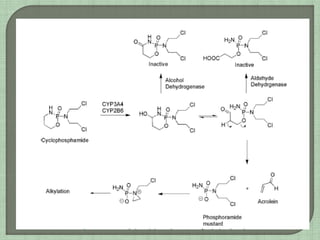
 Ifosfamide contains similar functionality and also requires
activation by CYP2B6 and CYP3A4/5 (Scheme 10.7).
Although the agents are similar, there are differences in the
metabolism and activity of the agents.12,13 Both are
administered as racemic mixtures as a result of the presence
of a chiral phosphorus atom.
 There appears to be little difference in the metabolic fate of
the R- and S-isomers of cyclophosphamide, but in the case of
ifosfamide, the R-isomer is converted to the required 4-
hydroxy-ifosfamide 2 to 3 times faster than the S-isomer.14
The S-isomer undergoes preferential oxidation of the side
chain to give N-dechloroethylation, which removes the ability
of the agent to cross-link DNA and also produces the
neurotoxic and urotoxic chloroacetaldehyde.
 The reactive form of ifosfamide having a
higher affinity for DNA than the analogous
form of cyclophosphamide and differences
in the interstrand and intrastrand links that
ultimately result.
 The differential metabolism also results in
increased formation of the urotoxic
chloroacetaldehyde in the case of
ifosfamide such that bladder toxicity that
normally presents as
hemorrhagic cystitis becomes dose
limiting with this agent
 The early success of the nitrogen mustards led researchers to
investigate other compounds that contained a preformed aziridine
ring, and thiotepa resulted from this work. Thiotepa containing the
thiophosphoramide functionality was found to be more stable than
the oxa-analog (TEPA) but is metabolically converted to TEPA by
desulfuration in vivo. Thiotepa incorporates a less reactive
aziridine ring compared with that formed in mechlorethamine.
 The adjacent thiophosphoryl is electron withdrawing and,
therefore, reduces the reactivity of the aziridine ring system.
Although thiotepa is less reactive than many other alkylating
agents, it has been shown to form cross-links. This is believed to
occur by sequential reactions of thiotepa itself with DNA
.Monoalkylation is also possible as a result of aziridine formation
via Hydrolysis of thiotepa. Thiotepa is also metabolized by
oxidative desulfurization mediated by CYP2B1 and CYP2C11. The
decreased stability of the resulting TEPA undergoes hydrolysis to
give aziridine, which may function to monoalkylate DNA.
 The first of these, cisplatin, was discovered by Barnett
Rosenberg as a result of experiments investigating the role
of electrical current on cell division.
 Escherichia coli cells in an ammonium chloride solution had
an electrical current applied through platinum electrodes. It
was subsequently found that cell division was inhibited but
not as a result of the current but from the reaction of the
ammonium chloride with what was thought to be an inert
platinum electrode. Further investigation led to the
identification of cis-[PtCl2(NH3)2] as the active species and
mechanistic studies revealed that after administration of the
agent to mammals, the dichloro species is maintained in the
blood stream as a result of the relatively high chloride
concentration
 The nitrosoureas were discovered as a result of
drug screening by the Cancer Chemotherapy
National Service Center, which identified N-
methyl-N-nitroguanidine as having activity against
L1210 leukemia. Further development of this
lead compound was based on the idea that its
chemical decomposition was leading to the
formation of diazomethane (CH2N2) and
subsequent alkylation of DNA.
 This led to the nitrosoureas, where it was found
that activity could be enhanced by attachment of
a 2-haloethyl substituent to both nitrogens.
 These compounds are reasonably stable at pH 4.5 but
undergo both acid and base catalyzed decomposition at
lower and higher pH, respectively. There are several
pathways of decomposition that are possible for these
compounds, but the one that appears to be most important
for alkylation of DNA involves abstraction of the NH proton,
which is relatively acidic (pKa 8–9), followed by
rearrangement to give an isocyanate and a diazohydroxide.
 The diazohydroxide, upon protonation followed by loss of
water, yields a diazo species that decomposes to a reactive
carbocation . The isocyanate functions to carbamylate
proteins and RNA, whereas the carbocation is believed to be
the agent responsible for DNA alkylation.
 The first of these involves dechlorination,
which is facilitated by CYP participation and
involves cyclization to give 4,5-dihydro-
[1,2,3]oxadiazole and the isocyanate, which
is still capable of carbamylating proteins.
 The oxadiazole can be further degraded by
hydrolysis to give several inactive products.
 The second route involves denitrosation,
which in the case of BCNU (carmustine) has
been shown to be catalyzed by CYP
monooxygenases and glutathione-S-
reductase
 Procarbazine is an antineoplastic agent that was
originally developed as a result of efforts to find new
inhibitors of monoamine oxidase. Subsequent
screening revealed antineoplastic activity.35 It was
initially believed that the cytotoxicity was related to the
ability of the compound to undergo auto-oxidation to
give hydrogen peroxide, which in the presence of Fe2
would produce hydroxide radicals capable of cleaving
DNA. Subsequent work showed that although this did
occur, sufficient amounts of hydrogen peroxide were
not produced to account for the observed effects.
Metabolism studies revealed that oxidation of
procarbazine does occur in the liver and is mediated
by CYP and monoamine oxidase to give azo-
procarbazine. This compound may also be generated
nonenzymatically in an aerobic environment .There are
several chemical and metabolic pathways that
procarbazine may then undergo, and there is some disagreement
regarding the exact structure of the active alkylating species. One
such route involves CYP-mediated oxidation of the benzylic
methylene carbon with subsequent decomposition to give
methyldiazine and the aldehyde. The methyldiazine may then
decompose by homolytic bond cleavage to give methyl and
hydrogen radicals along with nitrogen gas or be further oxidized
to give the diazo compound, which can decompose to give the
methyl carbocation. Methyldiazine may also be produced by a
minor route involving isomerization of azo-procarbazine to give
the hydrazone, which subsequently undergoes hydrolysis to give
the aldehyde and methylhydrazine.
• Methylhydrazine may react with oxygen to give
methyldiazine, which then decomposes as before.
Studies utilizing radiolabeled procarbazine indicated
that the terminal methyl group was found covalently
bound to the N-7 position of guanine especially on
tRNA disrupting its function and preventing protein,
RNA, and DNA synthesis.There was also a small
amount of methylation at the O-6 position of
guanine.42 Hydrazines are also capable of inhibiting
monoamine oxidase as seen with isocarboxazid and
phenelzine; however, procarbazine is only a weak
inhibitor of this enzyme.The agent is also capable of
inhibiting aldehyde
 Somewhat related is dacarbazine, which was initially thought to
act as an inhibitor of purine biosynthesis, but latter was shown to
be an alkylating agent. Activation of the agent occurs through the
action of CYP (isozymes 1A1, 1A2, and 2E1) to give the
demethylated product monomethyl triazeno imidazole
carboxamide (MTIC) . Tautomerization allows for decomposition
to give the aminocarboxamido- imidazole and diazomethane,
which is capable of alkylating DNA. An alternative pathway
involves acid catalyzed or photoinduced loss of dimethylamine to
give an alternative diazo compound (diazo-IC), which may not
only generate a carbocation but also undergoes internal
cyclization to give 2-azo-hypoxanthine.46 Formation of diazo-IC
has been associated with pain at the injection site, which is often
seen during dacarbazine administration. Methylation of DNA
occurs at N-7, N-3 and O-6 of guanine among other sites.
Dacarbazine proved to be more active against murine tumors than
against human tumors.
• This was attributed to the enhanced ability of
mice to metabolize the agent to MTIC and the
subsequent conversion to a methylating species.
Building on this idea was temozolomide, which
undergoes conversion to the same intermediate,
MTIC, as dacarbazine, but it does not require
metabolic activation to do so. Hydrolysis of
temozolomide gives the carboxy-triazene, which
spontaneously loses CO2 to give MTIC.
Dacarbazine must be administered intravenously;
however, the related temozolomide may be
administered orally.
 Antimetabolites are compounds closely related in structure to a cellular
precursor molecule, yet these imposter substances are capable of
preventing the proper use or formation of the normal cellular product.
These antimetabolites are similar enough in structure in many cases to
interact with the normal cellular process but differ in a manner sufficient
to alter the outcome of that pathway. Most antimetabolites are effective
cancer chemotherapeutic agents via interaction with the biosynthesis of
nucleic acids. Therefore, several of the useful drugs used in
antimetabolite therapy are purines, pyrimidines, folates, and related
compounds. The antimetabolite drugs may exert their effects by several
individual mechanisms involving enzyme inhibition at active, allosteric, or
related sites. Most of these targeted enzymes and processes are involved
in the regulatory steps of cell division and cell/tissue growth. Often the
administered drug is actually a prodrug form of an antimetabolite and
requires activation in vivo to yield the active inhibitor. The administration
of many purine and pyrimidine antimetabolites requires the formation of
the nucleoside and finally the corresponding nucleotide for
antimetabolite activity. An antimetabolite and its transformation products
may inhibit several different enzymes involved in tissue growth. These
substances are generally cell cycle specific with activity in the S phase.
 The purine and pyrimidine antimetabolites are often
compounds incorporated into nucleic acids and the nucleic
acid polymers (DNA, RNA, etc.). The antifolates are
compounds designed to interact at cofactor sites for
enzymes involved in the biosynthesis of nucleic acid bases.
The biosynthesis of these nucleic acid bases depend heavily
on the availability of folate cofactors, hence antimetabolites
of the folates find utility as antineoplastic agents. The
antitumor effects of all these compounds attempting to
masquerade as the natural precursor compound may occur
because of a malfunction in the biosynthesis of the
corresponding macromolecules.
 Classic examples of pyrimidine and purine antimetabolites
are 5-fluorouracil and 6-mercaptopurine, respectively, and
the classic antifolate is methotrexate.
 The anticancer drugs based on pyrimidine structure
have been shown. The pyrimidine derivative 5-
fluorouracil (5-FU) was designed to block the
conversion of uridine to thymidine. The normal
biosynthesis of thymidine involves methylation of the
5-position of the pyrimidine ring of uridine. The
replacement of the hydrogen at the 5-position of
uracil with a fluorine results in an antimetabolite
drug, leading to the formation of a stable covalent
ternary complex composed of 5-FU, thymidylate
synthase (TS), and cofactor (a tetrahydrofolate
species). The normal pathway for the formation of
thymidine from uridine catalyzed by the enzyme TS.
Anticancer drugs targeting this enzyme should selectively
inhibit the formation of DNA because thymidine is not a
normal component of RNA. TS is responsible for the reductive
methylation of deoxyuridine monophosphate (dUMP) by 5,10-
methylenetetrahydrofolate to yield dTMP and dihydrofolate.54
Because thymine is unique to DNA, the TS enzyme system
plays an important role in replication and cell division. The
tetrahydrofolate cofactor species serves as both the one-
carbondonor and the hydride source in this system. The initial
step of the process involves the nucleophilic attack by a
sulfhydryl group of a cystine residue at the 6-position of dUMP.
The resulting enolate adds to the methylene of 5,10-CH2-THF
perhaps activated via the very reactive N-5- iminium ion . The
iminium ion likely forms at N-5 and only after 5,10-CH2-THF
binds to TS
 The iminium ion is likely formed at N-5 because it is the more
basic of the two nitrogens, whereas N-10 is the better leaving
group. The loss of the proton at the 5-position of dUMP and
elimination of folate yields the exocyclic methylene uracil species.
The final step involves hydride transfer from THF and elimination
to yield the enzyme, DHF, and dTMP. 5-Fluorouracil is activated by
conversion to the corresponding nucleotide species,53 5-fluoro-2-
deoxyuridylic acid (see Scheme 10.18). The resulting 5-fluoro-2-
deoxyuridylic acid is a powerful inhibitor of thymidylate
synthetase, the enzyme that converts 2-deoxyuridylic acid to
thymidylic acid. In the inhibiting reaction, the sulfhydryl group of
TS adds via conjugate addition to the 6-position of the fluorouracil
moiety (Scheme 10.19). The carbon at the 5-position then binds to
the methylene group of 5,10- methylenetetrahydrofolate following
initial formation of the more electrophilic form of folate the N-5-
iminium ion. In the normal process, this step is followed by the
elimination of dihydrofolate from the ternary complex,
regeneration of the active enzyme species, and the product
thymidine.
Central to this process is the loss of the proton at the 5- position of
uracil to form the exocyclic methylene uracil species. The 5-fluorine
is stable to elimination, and a terminal product results, involving the
enzyme, cofactor, and substrate, all covalently bonded (Scheme
10.19).
The chemical mechanism of inhibition of thymidylate synthetase by
5-fluorouracil is shown in Scheme 10.19. This process clearly shows
that in order to inactivate the TS enzyme, both 5-FU and the
tetrahydrofolate species are required to form the ternary complex.
Some clinical studies have shown that administration of a
tetrahydrofolate source prior to treatment with 5-FU results in
greater inhibition of total TS activity. The administered source of
active 5,10- methylenetetrahydrofolate is leucovorin, N-5-
formyltetrahydrofolate.
Thank you

cancer - anticancer agents

  • 17.
     The alkylatingagents are a class of drugs that are capable of forming covalent bonds with important biomolecules. The major targets of drug action are nucleophilic groups present on DNA (especially the 7-position of guanine); however, proteins and RNA among others may also be alkylated.  Alkylation of DNA is thought to lead to cell death, although the exact mechanism is uncertain. Potential mechanisms of cell death include activation of apoptosis caused by p53 activation and disruption of the template function of DNA.  In many cases, however, the cancer cells have dysfunctional p53 so that even though the cell has been unable to replicate DNA error free, cell death via apoptosis does not occur. In this way, cancer cells may become resistant to the effects of alkylating agents. Another possibility is that the cancer cells, like normal cells, have various mechanisms by which alkylated DNA bases can be excised.
  • 18.
     Disruption ofthe template function of DNA may have several effects. There are several potential nucleophilic sites on DNA, which are susceptible to electrophilic attack by an alkylating agent (N-2, N-3, and N-7 of guanine, N-1, N-3, and N-7 of adenine, 0–6 of thymine, N-3 of cytosine). The most important of these for many alkylating agents is the N-7 position of guanine whose nucleophilicity may be enhanced by adjacent guanine residues. Alkylation converts the base to an effective leaving group so that attack by water leads to depurination and the loss of genetic information if the resulting depurination is not repaired by the cell .
  • 22.
    • Additionally, alkylationhas been proposed to result in altered base pairing away from the normal G-C: A-T hydrogen bonds because of alterations in tautomerization. The alkylation also leads to increased acidity of the N-1 nitrogen reducing the pKa from 9 to 7 to 8 giving rise to a zwitterionic form that may also mispair. • For those agents that possess two reactive functionalities, both interstrand and intrastrand cross-linking becomes possible. When interstrand links occur, separation of the two strands during replication is prevented and therefore replication is blocked., Most of the currently used alkylating agents are nonselective regarding the sequence of DNA with which they react. Therefore, it is uncertain whether alkylation will lead to a cytotoxic event. Some alkylation reactions may lead to inconsequential results, and others may be easily repaired by the cell. .
  • 23.
     Recent effortshave been directed at producing more sequence-selective alkylators that could be used at lower concentrations in an effort to reduce the significant side effects associated with this group of agents.The general mechanism for alkylation involves nucleophilic attack by MNB, MNH2, MOH, MOMPO3H of DNA and RNA, while additional nucleophiles (MSH, COOH, etc.) present on proteins may also react .
  • 24.
     The nitrogenmustards are compounds that are chemically similar to sulfur mustard or mustard gas developed and used in World War I. The term “mustard” comes from the similarity in the blisters produced by the compound and those seen upon exposure to the oil of black mustard seeds. Investigation of sulfur mustard revealed that it possessed antineoplastic properties but because the compound existed as a gas at room temperature, handling and administration of the material were difficult. Conversion of the sulfide to a tertiary amine allowed for the formation of salts, which exist as solids at room temperature allowing for easier handling and dosing. The term mustard was then extended to the nitrogen analogs (nitrogen mustards) given their chemical similarity.  Mustards such as mechlorethamine are classified as dialkylating agents in that one mustard molecule can alkylate two nucleophiles.
  • 25.
    • The initialacid–base reaction is necessary to release the lone pair of electrons on nitrogen, which subsequently displaces chloride to give the highly reactive aziridinium cation. Nucleophilic attack can then occur at the aziridinium carbon to relieve the small ring strain and neutralize the charge on nitrogen. This process can then be repeated provided a second leaving group is present
  • 26.
     Mechlorethamine ishighly reactive, in fact, too reactive and therefore nonselective, making it unsuitable for oral administration and necessitating direct injection into the tumor. In cases of extravasation (drug escapes from the tumor into the underlying tissue), the antidote sodium thiosulfate (Na2S2O3), a strong nucleophile, may be administered.  It is capable of reacting with electrophilic sites on the mustard, and once reaction has occurred, the resulting adduct has increased water solubility and may be readily eliminated . Cancer patients are at an increased risk of extravasation because of the fragility of their veins resulting from radiation, previous chemotherapy treatments, or malnutrition
  • 27.
     The lackof selectivity of mechlorethamine led to attempts to improve on the agent. One rationale was to reduce the reactivity by reducing the nucleophilicity of nitrogen, thereby slowing aziridinium cation formation. This could be accomplished by replacement of the weakly electron-donating methyl group with groups that were electron withdrawing (-I). This is seen in the case of chlorambucil and melphalan by attachment of nitrogen to a phenyl ring .  Reactivity was reduced such that these compounds could be administered orally. In the case of melphalan, attachment of the mustard functionality to a phenylalanine moiety was not only an attempt to reduce reactivity but also an attempt to increase entry into cancer cells by utilization of carriermediated uptake.8 Melphalan was found to utilize active transport to gain entry into cells, but selective uptake by cancer cells has not been demonstrated. Attachment of more highly electron-withdrawing functionalities was utilized in the case of cyclophosphamide and ifosfamide . In these cases, aziridinium cation formation is not possible until the electron-withdrawing
  • 30.
     Anion formationincreases the reactivity of the nucleophile compared with the un-ionized form (MO is more nucleophilic than OH). Reaction with water is also possible, because it represents the nucleophile in greatest abundance in the body and this becomes more likely as the electrophile becomes more reactive. Reaction involves displacement of a leaving group  on the electrophile by the nucleophile. The reactivity of the, electrophile is dependent in part on the ability of the leaving group to stabilize a negative charge
  • 31.
     The alkylatingagents are thought to be effective from G0-M and are, therefore, not considered cell cycle–specific agents. Many of the toxicities seen with the various agents are similar.  Myelosuppression and gastrointestinal (GI) disruption, which often present as nausea and vomiting are commonly seen and are caused by the highly proliferative nature of these tissues, and therefore susceptibility to the effects of the alkylating agents.
  • 33.
     Ifosfamide containssimilar functionality and also requires activation by CYP2B6 and CYP3A4/5 (Scheme 10.7). Although the agents are similar, there are differences in the metabolism and activity of the agents.12,13 Both are administered as racemic mixtures as a result of the presence of a chiral phosphorus atom.  There appears to be little difference in the metabolic fate of the R- and S-isomers of cyclophosphamide, but in the case of ifosfamide, the R-isomer is converted to the required 4- hydroxy-ifosfamide 2 to 3 times faster than the S-isomer.14 The S-isomer undergoes preferential oxidation of the side chain to give N-dechloroethylation, which removes the ability of the agent to cross-link DNA and also produces the neurotoxic and urotoxic chloroacetaldehyde.
  • 34.
     The reactiveform of ifosfamide having a higher affinity for DNA than the analogous form of cyclophosphamide and differences in the interstrand and intrastrand links that ultimately result.  The differential metabolism also results in increased formation of the urotoxic chloroacetaldehyde in the case of ifosfamide such that bladder toxicity that normally presents as hemorrhagic cystitis becomes dose limiting with this agent
  • 38.
     The earlysuccess of the nitrogen mustards led researchers to investigate other compounds that contained a preformed aziridine ring, and thiotepa resulted from this work. Thiotepa containing the thiophosphoramide functionality was found to be more stable than the oxa-analog (TEPA) but is metabolically converted to TEPA by desulfuration in vivo. Thiotepa incorporates a less reactive aziridine ring compared with that formed in mechlorethamine.  The adjacent thiophosphoryl is electron withdrawing and, therefore, reduces the reactivity of the aziridine ring system. Although thiotepa is less reactive than many other alkylating agents, it has been shown to form cross-links. This is believed to occur by sequential reactions of thiotepa itself with DNA .Monoalkylation is also possible as a result of aziridine formation via Hydrolysis of thiotepa. Thiotepa is also metabolized by oxidative desulfurization mediated by CYP2B1 and CYP2C11. The decreased stability of the resulting TEPA undergoes hydrolysis to give aziridine, which may function to monoalkylate DNA.
  • 40.
     The firstof these, cisplatin, was discovered by Barnett Rosenberg as a result of experiments investigating the role of electrical current on cell division.  Escherichia coli cells in an ammonium chloride solution had an electrical current applied through platinum electrodes. It was subsequently found that cell division was inhibited but not as a result of the current but from the reaction of the ammonium chloride with what was thought to be an inert platinum electrode. Further investigation led to the identification of cis-[PtCl2(NH3)2] as the active species and mechanistic studies revealed that after administration of the agent to mammals, the dichloro species is maintained in the blood stream as a result of the relatively high chloride concentration
  • 44.
     The nitrosoureaswere discovered as a result of drug screening by the Cancer Chemotherapy National Service Center, which identified N- methyl-N-nitroguanidine as having activity against L1210 leukemia. Further development of this lead compound was based on the idea that its chemical decomposition was leading to the formation of diazomethane (CH2N2) and subsequent alkylation of DNA.  This led to the nitrosoureas, where it was found that activity could be enhanced by attachment of a 2-haloethyl substituent to both nitrogens.
  • 45.
     These compoundsare reasonably stable at pH 4.5 but undergo both acid and base catalyzed decomposition at lower and higher pH, respectively. There are several pathways of decomposition that are possible for these compounds, but the one that appears to be most important for alkylation of DNA involves abstraction of the NH proton, which is relatively acidic (pKa 8–9), followed by rearrangement to give an isocyanate and a diazohydroxide.  The diazohydroxide, upon protonation followed by loss of water, yields a diazo species that decomposes to a reactive carbocation . The isocyanate functions to carbamylate proteins and RNA, whereas the carbocation is believed to be the agent responsible for DNA alkylation.
  • 46.
     The firstof these involves dechlorination, which is facilitated by CYP participation and involves cyclization to give 4,5-dihydro- [1,2,3]oxadiazole and the isocyanate, which is still capable of carbamylating proteins.  The oxadiazole can be further degraded by hydrolysis to give several inactive products.  The second route involves denitrosation, which in the case of BCNU (carmustine) has been shown to be catalyzed by CYP monooxygenases and glutathione-S- reductase
  • 49.
     Procarbazine isan antineoplastic agent that was originally developed as a result of efforts to find new inhibitors of monoamine oxidase. Subsequent screening revealed antineoplastic activity.35 It was initially believed that the cytotoxicity was related to the ability of the compound to undergo auto-oxidation to give hydrogen peroxide, which in the presence of Fe2 would produce hydroxide radicals capable of cleaving DNA. Subsequent work showed that although this did occur, sufficient amounts of hydrogen peroxide were not produced to account for the observed effects. Metabolism studies revealed that oxidation of procarbazine does occur in the liver and is mediated by CYP and monoamine oxidase to give azo- procarbazine. This compound may also be generated nonenzymatically in an aerobic environment .There are several chemical and metabolic pathways that
  • 50.
    procarbazine may thenundergo, and there is some disagreement regarding the exact structure of the active alkylating species. One such route involves CYP-mediated oxidation of the benzylic methylene carbon with subsequent decomposition to give methyldiazine and the aldehyde. The methyldiazine may then decompose by homolytic bond cleavage to give methyl and hydrogen radicals along with nitrogen gas or be further oxidized to give the diazo compound, which can decompose to give the methyl carbocation. Methyldiazine may also be produced by a minor route involving isomerization of azo-procarbazine to give the hydrazone, which subsequently undergoes hydrolysis to give the aldehyde and methylhydrazine.
  • 51.
    • Methylhydrazine mayreact with oxygen to give methyldiazine, which then decomposes as before. Studies utilizing radiolabeled procarbazine indicated that the terminal methyl group was found covalently bound to the N-7 position of guanine especially on tRNA disrupting its function and preventing protein, RNA, and DNA synthesis.There was also a small amount of methylation at the O-6 position of guanine.42 Hydrazines are also capable of inhibiting monoamine oxidase as seen with isocarboxazid and phenelzine; however, procarbazine is only a weak inhibitor of this enzyme.The agent is also capable of inhibiting aldehyde
  • 54.
     Somewhat relatedis dacarbazine, which was initially thought to act as an inhibitor of purine biosynthesis, but latter was shown to be an alkylating agent. Activation of the agent occurs through the action of CYP (isozymes 1A1, 1A2, and 2E1) to give the demethylated product monomethyl triazeno imidazole carboxamide (MTIC) . Tautomerization allows for decomposition to give the aminocarboxamido- imidazole and diazomethane, which is capable of alkylating DNA. An alternative pathway involves acid catalyzed or photoinduced loss of dimethylamine to give an alternative diazo compound (diazo-IC), which may not only generate a carbocation but also undergoes internal cyclization to give 2-azo-hypoxanthine.46 Formation of diazo-IC has been associated with pain at the injection site, which is often seen during dacarbazine administration. Methylation of DNA occurs at N-7, N-3 and O-6 of guanine among other sites. Dacarbazine proved to be more active against murine tumors than against human tumors.
  • 55.
    • This wasattributed to the enhanced ability of mice to metabolize the agent to MTIC and the subsequent conversion to a methylating species. Building on this idea was temozolomide, which undergoes conversion to the same intermediate, MTIC, as dacarbazine, but it does not require metabolic activation to do so. Hydrolysis of temozolomide gives the carboxy-triazene, which spontaneously loses CO2 to give MTIC. Dacarbazine must be administered intravenously; however, the related temozolomide may be administered orally.
  • 56.
     Antimetabolites arecompounds closely related in structure to a cellular precursor molecule, yet these imposter substances are capable of preventing the proper use or formation of the normal cellular product. These antimetabolites are similar enough in structure in many cases to interact with the normal cellular process but differ in a manner sufficient to alter the outcome of that pathway. Most antimetabolites are effective cancer chemotherapeutic agents via interaction with the biosynthesis of nucleic acids. Therefore, several of the useful drugs used in antimetabolite therapy are purines, pyrimidines, folates, and related compounds. The antimetabolite drugs may exert their effects by several individual mechanisms involving enzyme inhibition at active, allosteric, or related sites. Most of these targeted enzymes and processes are involved in the regulatory steps of cell division and cell/tissue growth. Often the administered drug is actually a prodrug form of an antimetabolite and requires activation in vivo to yield the active inhibitor. The administration of many purine and pyrimidine antimetabolites requires the formation of the nucleoside and finally the corresponding nucleotide for antimetabolite activity. An antimetabolite and its transformation products may inhibit several different enzymes involved in tissue growth. These substances are generally cell cycle specific with activity in the S phase.
  • 57.
     The purineand pyrimidine antimetabolites are often compounds incorporated into nucleic acids and the nucleic acid polymers (DNA, RNA, etc.). The antifolates are compounds designed to interact at cofactor sites for enzymes involved in the biosynthesis of nucleic acid bases. The biosynthesis of these nucleic acid bases depend heavily on the availability of folate cofactors, hence antimetabolites of the folates find utility as antineoplastic agents. The antitumor effects of all these compounds attempting to masquerade as the natural precursor compound may occur because of a malfunction in the biosynthesis of the corresponding macromolecules.  Classic examples of pyrimidine and purine antimetabolites are 5-fluorouracil and 6-mercaptopurine, respectively, and the classic antifolate is methotrexate.
  • 59.
     The anticancerdrugs based on pyrimidine structure have been shown. The pyrimidine derivative 5- fluorouracil (5-FU) was designed to block the conversion of uridine to thymidine. The normal biosynthesis of thymidine involves methylation of the 5-position of the pyrimidine ring of uridine. The replacement of the hydrogen at the 5-position of uracil with a fluorine results in an antimetabolite drug, leading to the formation of a stable covalent ternary complex composed of 5-FU, thymidylate synthase (TS), and cofactor (a tetrahydrofolate species). The normal pathway for the formation of thymidine from uridine catalyzed by the enzyme TS.
  • 60.
    Anticancer drugs targetingthis enzyme should selectively inhibit the formation of DNA because thymidine is not a normal component of RNA. TS is responsible for the reductive methylation of deoxyuridine monophosphate (dUMP) by 5,10- methylenetetrahydrofolate to yield dTMP and dihydrofolate.54 Because thymine is unique to DNA, the TS enzyme system plays an important role in replication and cell division. The tetrahydrofolate cofactor species serves as both the one- carbondonor and the hydride source in this system. The initial step of the process involves the nucleophilic attack by a sulfhydryl group of a cystine residue at the 6-position of dUMP. The resulting enolate adds to the methylene of 5,10-CH2-THF perhaps activated via the very reactive N-5- iminium ion . The iminium ion likely forms at N-5 and only after 5,10-CH2-THF binds to TS
  • 62.
     The iminiumion is likely formed at N-5 because it is the more basic of the two nitrogens, whereas N-10 is the better leaving group. The loss of the proton at the 5-position of dUMP and elimination of folate yields the exocyclic methylene uracil species. The final step involves hydride transfer from THF and elimination to yield the enzyme, DHF, and dTMP. 5-Fluorouracil is activated by conversion to the corresponding nucleotide species,53 5-fluoro-2- deoxyuridylic acid (see Scheme 10.18). The resulting 5-fluoro-2- deoxyuridylic acid is a powerful inhibitor of thymidylate synthetase, the enzyme that converts 2-deoxyuridylic acid to thymidylic acid. In the inhibiting reaction, the sulfhydryl group of TS adds via conjugate addition to the 6-position of the fluorouracil moiety (Scheme 10.19). The carbon at the 5-position then binds to the methylene group of 5,10- methylenetetrahydrofolate following initial formation of the more electrophilic form of folate the N-5- iminium ion. In the normal process, this step is followed by the elimination of dihydrofolate from the ternary complex, regeneration of the active enzyme species, and the product thymidine.
  • 63.
    Central to thisprocess is the loss of the proton at the 5- position of uracil to form the exocyclic methylene uracil species. The 5-fluorine is stable to elimination, and a terminal product results, involving the enzyme, cofactor, and substrate, all covalently bonded (Scheme 10.19). The chemical mechanism of inhibition of thymidylate synthetase by 5-fluorouracil is shown in Scheme 10.19. This process clearly shows that in order to inactivate the TS enzyme, both 5-FU and the tetrahydrofolate species are required to form the ternary complex. Some clinical studies have shown that administration of a tetrahydrofolate source prior to treatment with 5-FU results in greater inhibition of total TS activity. The administered source of active 5,10- methylenetetrahydrofolate is leucovorin, N-5- formyltetrahydrofolate.
  • 65.