A little brain teaser….
• Case Scenario 1:
• A 45 years male, having history of oral cancer is under chemotherapy
• He has been co-prescribed with metoclopramide as a prophylaxis for
chemotherapy induced nausea and vomiting
• Case Scenario 2:
• A 5 years child is about to travel to a hill station. As he feels sick every time he
travels, he was given dicyclomine as a prophylactic
• Case Scenario 3:
• A 28 years female, primigravida, visited to general practitioner for nausea and
vomiting in early morning. The doctor prescribed her promethazine
A little brain teaser….
• Case Scenario 4:
• A 6 month child presented in your OPD for some dental procedure. Following
the procedure, he somehow starts to have vomiting.
• To control the new symptom, you have prescribed him some anti-emetic.
• The mother of the child returns to you with complains of abnormal tone of
the limbs (dystonia)
• Which drug could have lead to this symptom?
• Case Scenario 5:
• You are planning to go on a cruise with your friends, but you are afraid of
having sea sickness. What drug would you use as a prophylactic?
Anti-emetics
Dr. Pravin Prasad
MBBS, MD Clinical Pharmacology
Assistant Professor, Department of Clinical Pharmacology
Maharajgunj Medical Campus
20 February 2020 (8 Falgun 2076)
By the end of this discussion, BDS 2nd year
students will be able to:
• Outline the neural mechanism and chemicals involved in
vomiting
• Classify drugs used as anti-emetics
• Explain the therapeutic basis of different drugs used as ant-
emetics
Neural circuits leading to vomiting
Ototoxic drugs
Neural circuits leading to vomiting
• Receptors and endogenous
chemicals responsible:
• Serotonin (5-HT) on 5-HT3
receptors
• Histamine on H1 receptors
• Dopamine on D2 receptors
• Acetylcholine on M receptors
• Substance P on NK1 receptors
• Cannabinoid on CB1 receptors
• Opioids on μ receptors
Ototoxic drugs
Vomiting pathways with pharmacological
twist!!
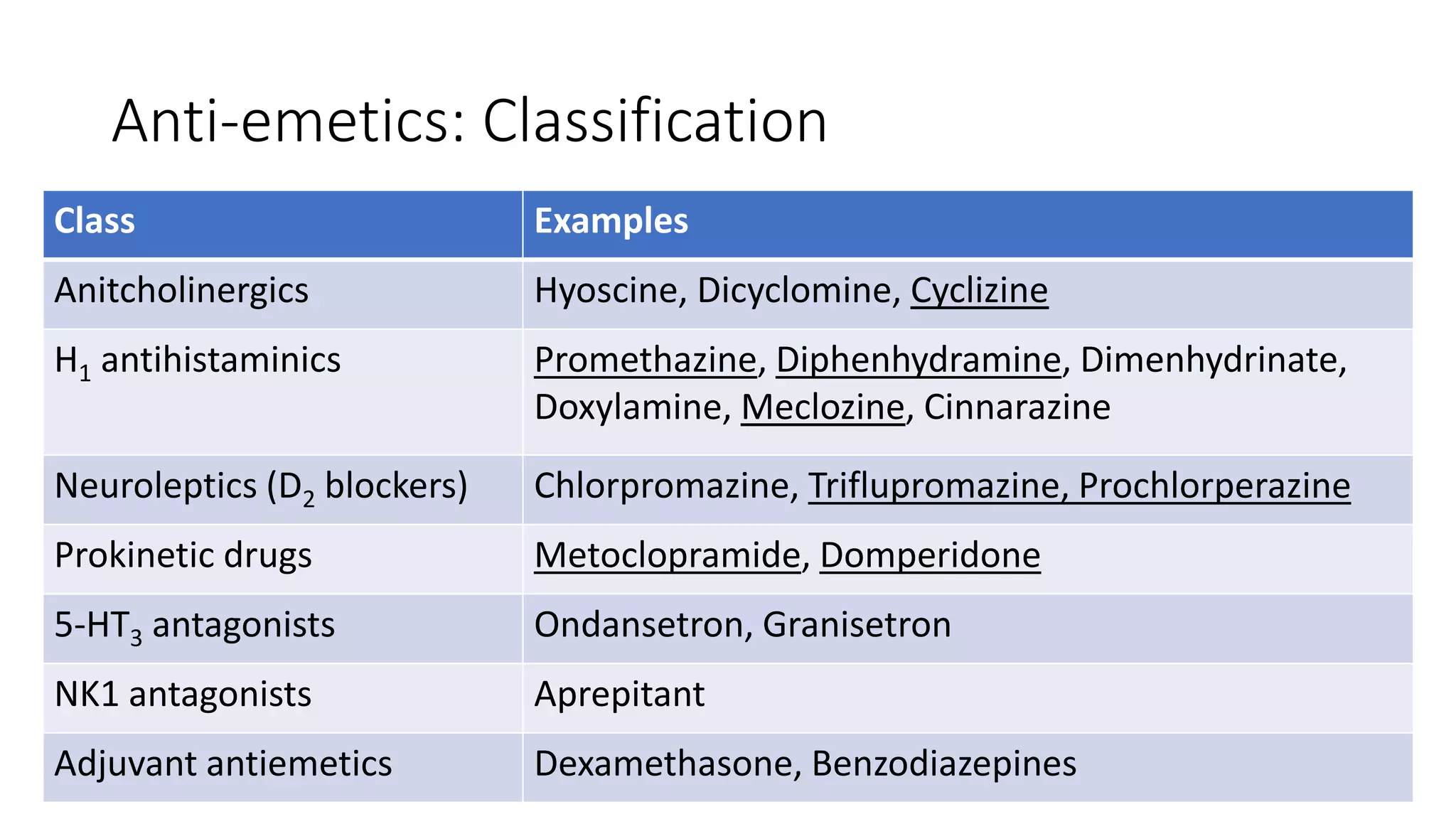
Anti-emetics: Classification
Class Examples
Anitcholinergics Hyoscine, Dicyclomine, Cyclizine
H1 antihistaminics Promethazine, Diphenhydramine, Dimenhydrinate,
Doxylamine, Meclozine, Cinnarazine
Neuroleptics (D2 blockers) Chlorpromazine, Triflupromazine, Prochlorperazine
Prokinetic drugs Metoclopramide, Domperidone
5-HT3 antagonists Ondansetron, Granisetron
NK1 antagonists Aprepitant
Adjuvant antiemetics Dexamethasone, Benzodiazepines
Anti-cholinergic drugs as antiemetics
• Hyoscine, Dicyclomine, Cyclizine
• Acts by blocking cholinergic transmission of nerve impulse from
vestibular apparatus to vomiting center
• Dicyclomine: additional direct smooth muscle relaxation
• Effective in vomiting due to motion sickness
• Should be given prophylactically
• Action lasts for 4-6 hours (hyoscine), transdermal patch acts for 3 days
• Dicyclomine also used for morning sickness (pregnancy)
• Side effects: dry mouth, sedation
• Should be avoided in children below 6 months
H1 anti-histaminic as anti-emetics
• Promethazine, Diphenhydramine, Dimenhydrinate, Doxylamine,
Meclozine, Cinnarazine
• Anti-emetic action exerted by:
• Anticholinergic, antihistaminic action
• Additional weak anti-dopaminergic and sedative properties
• Also blocks extrapyramidal side effects of metoclopramide
• Mainly useful in motion sickness
• Effective for 4-6 hours
• Also used in morning sickness*, chemotherapy induced nausea and
vomiting (in combination with metoclopramide)
• Side effects: sedation, dryness of mouth
Neuroleptics (D2 blockers) as anti-emetics
• Chlorpromazine, Triflupromazine, Prochlorperazine
• Older D2 blockers: potent anti-emetics
• Acts by blocking D2 receptors in CTZ
• Additional anti-muscuranic, anti-histaminic action
• Prochlorperazine: labyrinthine suppressant (anti-vertigo as well)
• Useful in:
• Drug induced, post-operative nausea and vomiting
• Disease induced vomiting: gastroenteritis, uraemia, liver disease, migraine
• Malignancy associated and cancer chemotherapy induced N/V
• Radiation sickness vomiting
• Hyperemesis gravidarum
• Side effects: sedation, acute muscle dystonia (children, girls), other
extrapyramidal side effects
Prokinetic drugs as anti-emetics
• Metoclopramide, Domperidone
• Acts by:
• Serotonin agonism at 5-HT4 receptors
• Increased ACh release from
myenteric motor neurons
• Faster gastric emptying
• Enhanced lower oesophageal
sphincter tone
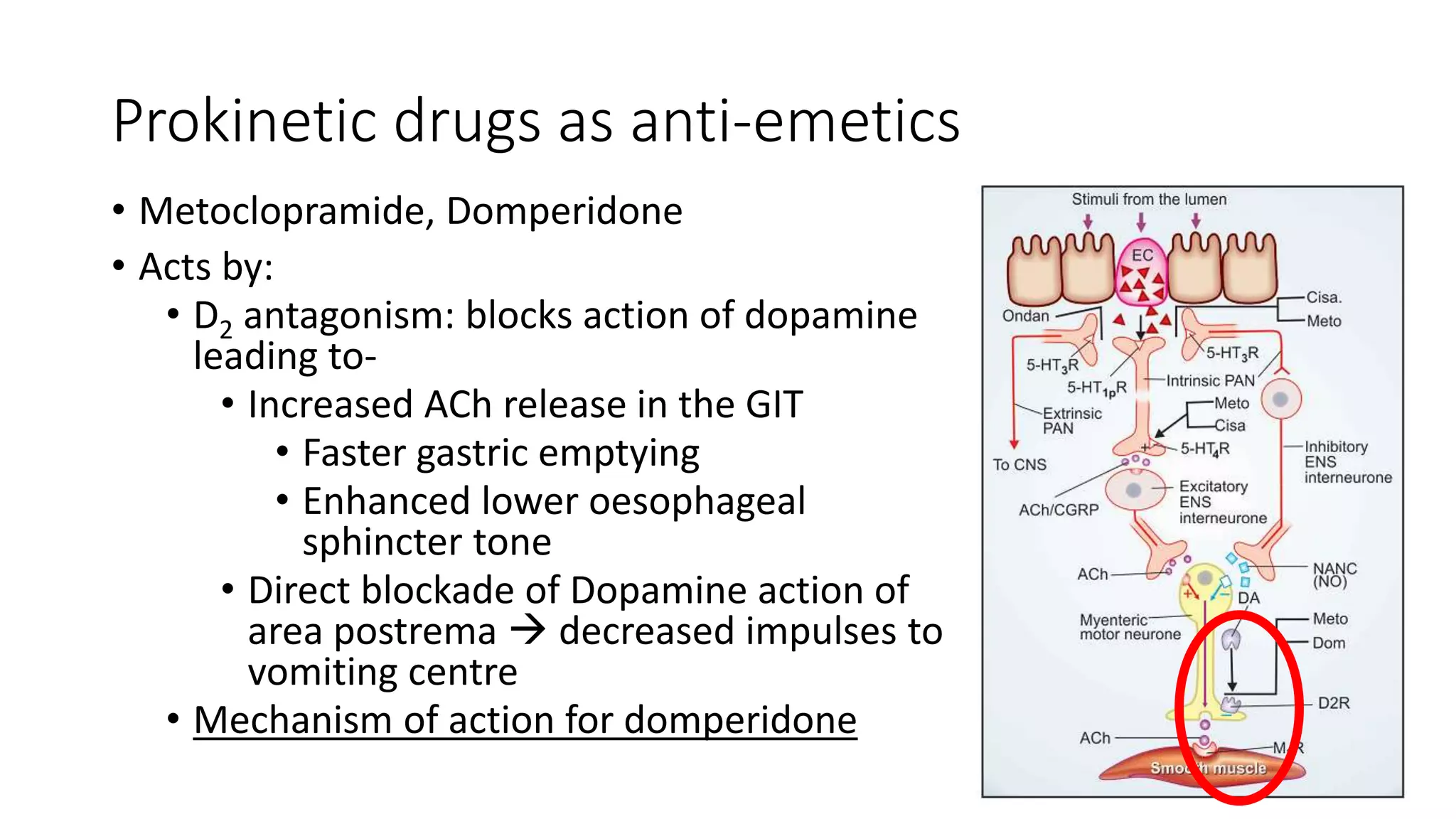
Prokinetic drugs as anti-emetics
• Metoclopramide, Domperidone
• Acts by:
• D2 antagonism: blocks action of dopamine
leading to-
• Increased ACh release in the GIT
• Faster gastric emptying
• Enhanced lower oesophageal
sphincter tone
• Direct blockade of Dopamine action of
area postrema  decreased impulses to
vomiting centre
• Mechanism of action for domperidone
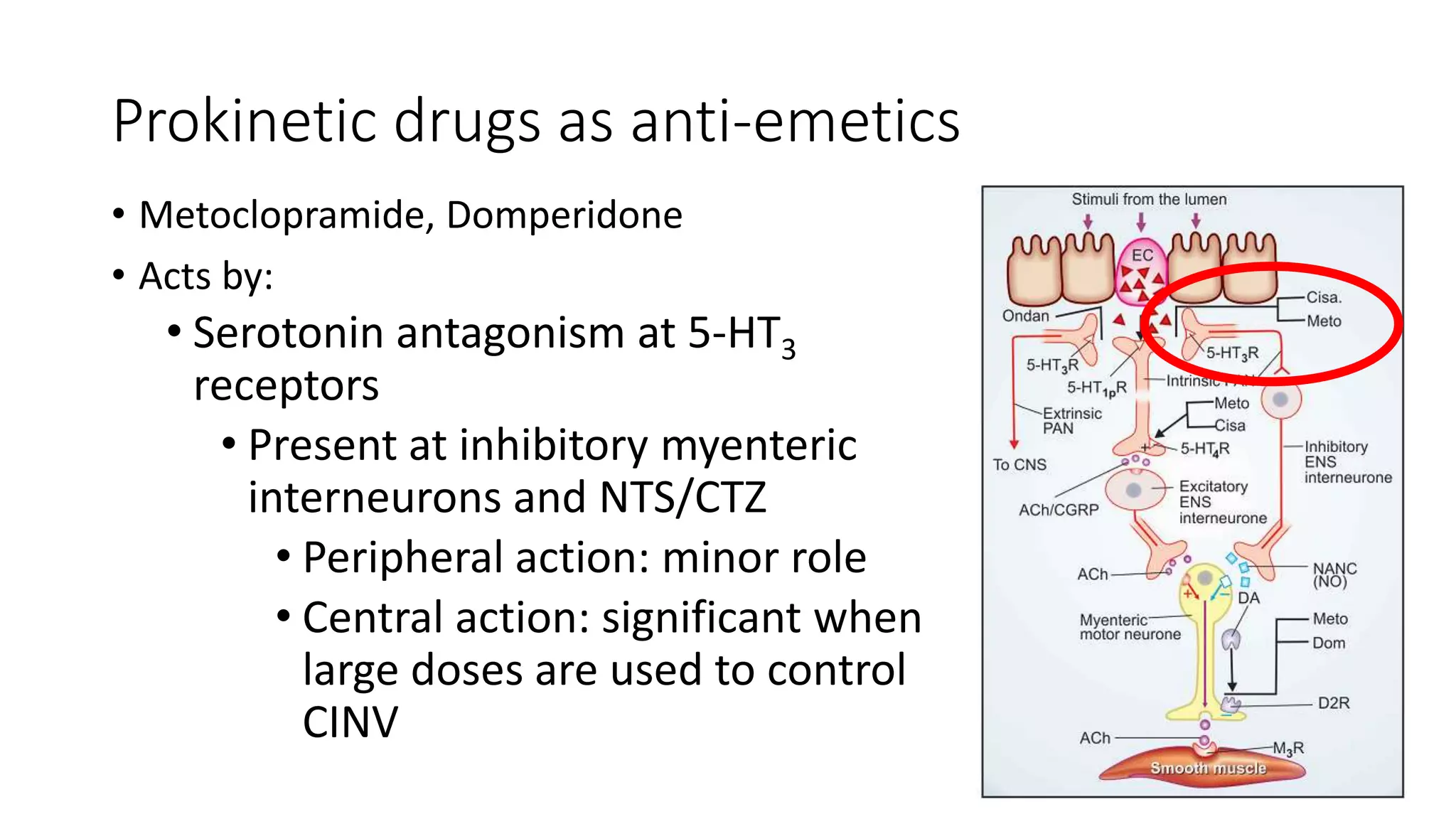
Prokinetic drugs as anti-emetics
• Metoclopramide, Domperidone
• Acts by:
• Serotonin antagonism at 5-HT3
receptors
• Present at inhibitory myenteric
interneurons and NTS/CTZ
• Peripheral action: minor role
• Central action: significant when
large doses are used to control
CINV
Prokinetic drugs as anti-emetics
Pharmacokinetics:
• Metoclopramide:
• Crosses blood brain barrier
• Crosses placenta
• Secreted in milk
• Action starts in 0.5 – 1 hr (oral), 10 mins (i.m.) 2 mins (i.v.), lasts for 4-6 hours
• Domperidone:
• Poor oral bioavailability
• Crosses blood-brain barrier poorly
• Plasma half life: 7.5 hrs
Prokinetic drugs as anti-emetics
Indications:
• Metoclopramide:
• Anti-emetic: post operative, drug induced, disease associated, radiation
sickness
• As gastrokinetic agent
• Dyspepsia and other functional g.i. disorders (persistent hiccups)
• Gastroesophageal reflux disease: as adjuvant
• Domperidone:
• Similar to metoclopramide
• Less effective gastrokinetic and not useful in highly emetogenic chemotherapy
• Levodopa/ bromocriptine induced vomiting in PD
Prokinetic drugs as anti-emetics
Side effects:
• Metoclopramide:
• Sedation, dizziness, loose stools, muscle dystonia (children)
• Long term use: Parkinson’s Disease, galactorrhoea, gynaecomastia
• Effects may be seen in suckling infant
• Domperidone:
• Cardiac arrhythmia on rapid i.v. injection
• Dry mouth, loose stools, headache, rashes, galactorrhoea: mild
Conclusion
• Vomiting is synchronized by an orchestra of chemicals through
multiple neural mechanisms
• Seven classes of drugs are used for the treatment of vomiting
• Anticholinergic and anti-histaminic agents are used mainly for motion
sickness and morning sickness; neuroleptics and prokinetics are used
for vomiting due to multiple causes

Anti emetics

  • 1.
    A little brainteaser…. • Case Scenario 1: • A 45 years male, having history of oral cancer is under chemotherapy • He has been co-prescribed with metoclopramide as a prophylaxis for chemotherapy induced nausea and vomiting • Case Scenario 2: • A 5 years child is about to travel to a hill station. As he feels sick every time he travels, he was given dicyclomine as a prophylactic • Case Scenario 3: • A 28 years female, primigravida, visited to general practitioner for nausea and vomiting in early morning. The doctor prescribed her promethazine
  • 2.
    A little brainteaser…. • Case Scenario 4: • A 6 month child presented in your OPD for some dental procedure. Following the procedure, he somehow starts to have vomiting. • To control the new symptom, you have prescribed him some anti-emetic. • The mother of the child returns to you with complains of abnormal tone of the limbs (dystonia) • Which drug could have lead to this symptom? • Case Scenario 5: • You are planning to go on a cruise with your friends, but you are afraid of having sea sickness. What drug would you use as a prophylactic?
  • 3.
    Anti-emetics Dr. Pravin Prasad MBBS,MD Clinical Pharmacology Assistant Professor, Department of Clinical Pharmacology Maharajgunj Medical Campus 20 February 2020 (8 Falgun 2076)
  • 4.
    By the endof this discussion, BDS 2nd year students will be able to: • Outline the neural mechanism and chemicals involved in vomiting • Classify drugs used as anti-emetics • Explain the therapeutic basis of different drugs used as ant- emetics
  • 5.
    Neural circuits leadingto vomiting Ototoxic drugs
  • 6.
    Neural circuits leadingto vomiting • Receptors and endogenous chemicals responsible: • Serotonin (5-HT) on 5-HT3 receptors • Histamine on H1 receptors • Dopamine on D2 receptors • Acetylcholine on M receptors • Substance P on NK1 receptors • Cannabinoid on CB1 receptors • Opioids on μ receptors Ototoxic drugs
  • 7.
    Vomiting pathways withpharmacological twist!!
  • 8.
    Anti-emetics: Classification Class Examples AnitcholinergicsHyoscine, Dicyclomine, Cyclizine H1 antihistaminics Promethazine, Diphenhydramine, Dimenhydrinate, Doxylamine, Meclozine, Cinnarazine Neuroleptics (D2 blockers) Chlorpromazine, Triflupromazine, Prochlorperazine Prokinetic drugs Metoclopramide, Domperidone 5-HT3 antagonists Ondansetron, Granisetron NK1 antagonists Aprepitant Adjuvant antiemetics Dexamethasone, Benzodiazepines
  • 9.
    Anti-cholinergic drugs asantiemetics • Hyoscine, Dicyclomine, Cyclizine • Acts by blocking cholinergic transmission of nerve impulse from vestibular apparatus to vomiting center • Dicyclomine: additional direct smooth muscle relaxation • Effective in vomiting due to motion sickness • Should be given prophylactically • Action lasts for 4-6 hours (hyoscine), transdermal patch acts for 3 days • Dicyclomine also used for morning sickness (pregnancy) • Side effects: dry mouth, sedation • Should be avoided in children below 6 months
  • 10.
    H1 anti-histaminic asanti-emetics • Promethazine, Diphenhydramine, Dimenhydrinate, Doxylamine, Meclozine, Cinnarazine • Anti-emetic action exerted by: • Anticholinergic, antihistaminic action • Additional weak anti-dopaminergic and sedative properties • Also blocks extrapyramidal side effects of metoclopramide • Mainly useful in motion sickness • Effective for 4-6 hours • Also used in morning sickness*, chemotherapy induced nausea and vomiting (in combination with metoclopramide) • Side effects: sedation, dryness of mouth
  • 11.
    Neuroleptics (D2 blockers)as anti-emetics • Chlorpromazine, Triflupromazine, Prochlorperazine • Older D2 blockers: potent anti-emetics • Acts by blocking D2 receptors in CTZ • Additional anti-muscuranic, anti-histaminic action • Prochlorperazine: labyrinthine suppressant (anti-vertigo as well) • Useful in: • Drug induced, post-operative nausea and vomiting • Disease induced vomiting: gastroenteritis, uraemia, liver disease, migraine • Malignancy associated and cancer chemotherapy induced N/V • Radiation sickness vomiting • Hyperemesis gravidarum • Side effects: sedation, acute muscle dystonia (children, girls), other extrapyramidal side effects
  • 12.
    Prokinetic drugs asanti-emetics • Metoclopramide, Domperidone • Acts by: • Serotonin agonism at 5-HT4 receptors • Increased ACh release from myenteric motor neurons • Faster gastric emptying • Enhanced lower oesophageal sphincter tone
  • 13.
    Prokinetic drugs asanti-emetics • Metoclopramide, Domperidone • Acts by: • D2 antagonism: blocks action of dopamine leading to- • Increased ACh release in the GIT • Faster gastric emptying • Enhanced lower oesophageal sphincter tone • Direct blockade of Dopamine action of area postrema  decreased impulses to vomiting centre • Mechanism of action for domperidone
  • 14.
    Prokinetic drugs asanti-emetics • Metoclopramide, Domperidone • Acts by: • Serotonin antagonism at 5-HT3 receptors • Present at inhibitory myenteric interneurons and NTS/CTZ • Peripheral action: minor role • Central action: significant when large doses are used to control CINV
  • 15.
    Prokinetic drugs asanti-emetics Pharmacokinetics: • Metoclopramide: • Crosses blood brain barrier • Crosses placenta • Secreted in milk • Action starts in 0.5 – 1 hr (oral), 10 mins (i.m.) 2 mins (i.v.), lasts for 4-6 hours • Domperidone: • Poor oral bioavailability • Crosses blood-brain barrier poorly • Plasma half life: 7.5 hrs
  • 16.
    Prokinetic drugs asanti-emetics Indications: • Metoclopramide: • Anti-emetic: post operative, drug induced, disease associated, radiation sickness • As gastrokinetic agent • Dyspepsia and other functional g.i. disorders (persistent hiccups) • Gastroesophageal reflux disease: as adjuvant • Domperidone: • Similar to metoclopramide • Less effective gastrokinetic and not useful in highly emetogenic chemotherapy • Levodopa/ bromocriptine induced vomiting in PD
  • 17.
    Prokinetic drugs asanti-emetics Side effects: • Metoclopramide: • Sedation, dizziness, loose stools, muscle dystonia (children) • Long term use: Parkinson’s Disease, galactorrhoea, gynaecomastia • Effects may be seen in suckling infant • Domperidone: • Cardiac arrhythmia on rapid i.v. injection • Dry mouth, loose stools, headache, rashes, galactorrhoea: mild
  • 18.
    Conclusion • Vomiting issynchronized by an orchestra of chemicals through multiple neural mechanisms • Seven classes of drugs are used for the treatment of vomiting • Anticholinergic and anti-histaminic agents are used mainly for motion sickness and morning sickness; neuroleptics and prokinetics are used for vomiting due to multiple causes

Editor's Notes

  • #6 Area postrema and Nucleus tractus solitarius: impulses arising from git, throat, other viscera CTZ: directly by drugs, hormones circulating in blood Serotonin (5-HT) on 5-HT3 receptors of enterochromaffin cells: stimulates extrinsic primary afferent neurons (sympathethic, vagi)  vomiting Neurokinin = NK1 receptors Impulses from vestibular apparatus: muscuranic and H1 receptor mediated
  • #7 Area postrema and Nucleus tractus solitarius: impulses arising from git, throat, other viscera CTZ: directly by drugs, hormones circulating in blood Serotonin (5-HT) on 5-HT3 receptors of enterochromaffin cells: stimulates extrinsic primary afferent neurons (sympathethic, vagi)  vomiting Neurokinin = NK1 receptors Impulses from vestibular apparatus: muscuranic and H1 receptor mediated
  • #8 5-HT3: ligand gated ion channel (Na+)- stimulatory 5-HT4: Gs coupled D2: Gi/Go coupled- inhibitory M: muscuranic- stimulatory H1: IP3/DAG, increase cGMP- stimulatory NK1: PLC-IP3-Ca2+ -- stimulatory Opioid(mu): inhibitory (Gi coupled) CB1 receptors: gi coupled- inhibitory
  • #11 Also useful in morning sickness, post-operative nausea/vomiting Meclozine/Meclizine: longer acting, approx. 24 hours Avoid due to risk of teratogenic potential
  • #13 Dopamine : binds to D2 receptor present pre-synaptically on myenteric motor neuron  inhibits ACh release  smooth muscle relaxation, gastric dilatation, LES relaxation, delay gastric emptying 5-HT4: Gs coupled
  • #14 Dopamine : binds to D2 receptor present pre-synaptically on myenteric motor neuron  inhibits ACh release  smooth muscle relaxation, gastric dilatation, LES relaxation, delay gastric emptying 5-HT4: Gs coupled
  • #15 Dopamine : binds to D2 receptor present pre-synaptically on myenteric motor neuron  inhibits ACh release  smooth muscle relaxation, gastric dilatation, LES relaxation, delay gastric emptying 5-HT4: Gs coupled
  • #17 Metoclopramide: motion sickness- not useful, morning sickness- reserved drug Gastrokinetic: To accelerate gastric emptying: (a) When emergency general anaesthesia has to be given and the patient has taken food less than 4 hours before. (b) To relieve postvagotomy or diabetic gastroparesis associated gastric stasis. (c) To facilitate duodenal intubation. Clinical efficacy is moderate. Domperidone: does not block the action of levodopa and bromocriptine, blocks the emetic action of these drugs and supplements the action of these drugs in PD