PROPAGATION TECHNIQUES
IN HORTICULTURAL CROPS
Dr. K. VANANGAMUDI
Former Dean (Agriculture),
Tamil Nadu Agricultural University,
Coimbatore, Tamil Nadu, India.
 Propagation is the process of multiplying plants and preserving their essential
characteristics.
 In horticulture, propagation can be done by sexual and asexual (vegetative) methods.
1. Sexual Propagation (By Seeds)
 Involves the use of seeds for plant multiplication.
 It promotes genetic variation.
Advantages
 Easy and economical
 Genetic diversity improves adaptability
 Long storage life of seeds
Disadvantages
 Long juvenile phase (slow maturity)
 Genetic variation leads to non-uniformity
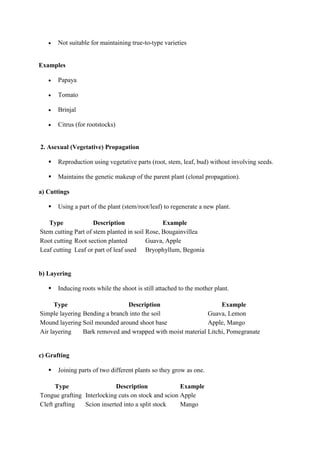
 Not suitable for maintaining true-to-type varieties
Examples
 Papaya
 Tomato
 Brinjal
 Citrus (for rootstocks)
2. Asexual (Vegetative) Propagation
 Reproduction using vegetative parts (root, stem, leaf, bud) without involving seeds.
 Maintains the genetic makeup of the parent plant (clonal propagation).
a) Cuttings
 Using a part of the plant (stem/root/leaf) to regenerate a new plant.
Type Description Example
Stem cutting Part of stem planted in soil Rose, Bougainvillea
Root cutting Root section planted Guava, Apple
Leaf cutting Leaf or part of leaf used Bryophyllum, Begonia
b) Layering
 Inducing roots while the shoot is still attached to the mother plant.
Type Description Example
Simple layering Bending a branch into the soil Guava, Lemon
Mound layering Soil mounded around shoot base Apple, Mango
Air layering Bark removed and wrapped with moist material Litchi, Pomegranate
c) Grafting
 Joining parts of two different plants so they grow as one.
Type Description Example
Tongue grafting Interlocking cuts on stock and scion Apple
Cleft grafting Scion inserted into a split stock Mango
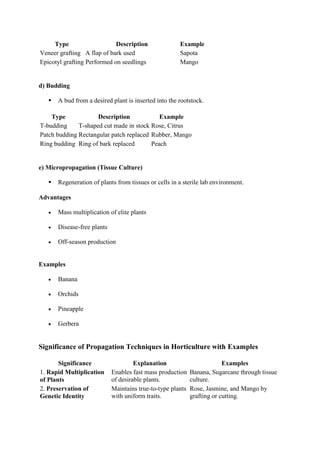
Type Description Example
Veneer grafting A flap of bark used Sapota
Epicotyl grafting Performed on seedlings Mango
d) Budding
 A bud from a desired plant is inserted into the rootstock.
Type Description Example
T-budding T-shaped cut made in stock Rose, Citrus
Patch budding Rectangular patch replaced Rubber, Mango
Ring budding Ring of bark replaced Peach
e) Micropropagation (Tissue Culture)
 Regeneration of plants from tissues or cells in a sterile lab environment.
Advantages
 Mass multiplication of elite plants
 Disease-free plants
 Off-season production
Examples
 Banana
 Orchids
 Pineapple
 Gerbera
Significance of Propagation Techniques in Horticulture with Examples
Significance Explanation Examples
1. Rapid Multiplication
of Plants
Enables fast mass production
of desirable plants.
Banana, Sugarcane through tissue
culture.
2. Preservation of
Genetic Identity
Maintains true-to-type plants
with uniform traits.
Rose, Jasmine, and Mango by
grafting or cutting.
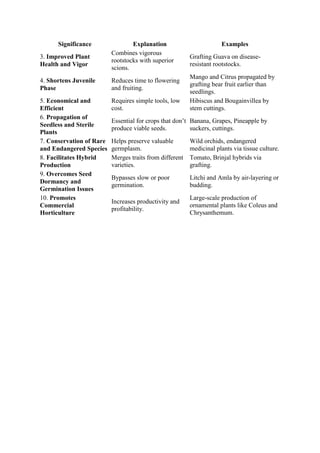
Significance Explanation Examples
3. Improved Plant
Health and Vigor
Combines vigorous
rootstocks with superior
scions.
Grafting Guava on disease-
resistant rootstocks.
4. Shortens Juvenile
Phase
Reduces time to flowering
and fruiting.
Mango and Citrus propagated by
grafting bear fruit earlier than
seedlings.
5. Economical and
Efficient
Requires simple tools, low
cost.
Hibiscus and Bougainvillea by
stem cuttings.
6. Propagation of
Seedless and Sterile
Plants
Essential for crops that don’t
produce viable seeds.
Banana, Grapes, Pineapple by
suckers, cuttings.
7. Conservation of Rare
and Endangered Species
Helps preserve valuable
germplasm.
Wild orchids, endangered
medicinal plants via tissue culture.
8. Facilitates Hybrid
Production
Merges traits from different
varieties.
Tomato, Brinjal hybrids via
grafting.
9. Overcomes Seed
Dormancy and
Germination Issues
Bypasses slow or poor
germination.
Litchi and Amla by air-layering or
budding.
10. Promotes
Commercial
Horticulture
Increases productivity and
profitability.
Large-scale production of
ornamental plants like Coleus and
Chrysanthemum.

Propagation Techniques in Horticultural.pdf Crops

  • 1.
    PROPAGATION TECHNIQUES IN HORTICULTURALCROPS Dr. K. VANANGAMUDI Former Dean (Agriculture), Tamil Nadu Agricultural University, Coimbatore, Tamil Nadu, India.  Propagation is the process of multiplying plants and preserving their essential characteristics.  In horticulture, propagation can be done by sexual and asexual (vegetative) methods. 1. Sexual Propagation (By Seeds)  Involves the use of seeds for plant multiplication.  It promotes genetic variation. Advantages  Easy and economical  Genetic diversity improves adaptability  Long storage life of seeds Disadvantages  Long juvenile phase (slow maturity)  Genetic variation leads to non-uniformity
  • 2.
     Not suitablefor maintaining true-to-type varieties Examples  Papaya  Tomato  Brinjal  Citrus (for rootstocks) 2. Asexual (Vegetative) Propagation  Reproduction using vegetative parts (root, stem, leaf, bud) without involving seeds.  Maintains the genetic makeup of the parent plant (clonal propagation). a) Cuttings  Using a part of the plant (stem/root/leaf) to regenerate a new plant. Type Description Example Stem cutting Part of stem planted in soil Rose, Bougainvillea Root cutting Root section planted Guava, Apple Leaf cutting Leaf or part of leaf used Bryophyllum, Begonia b) Layering  Inducing roots while the shoot is still attached to the mother plant. Type Description Example Simple layering Bending a branch into the soil Guava, Lemon Mound layering Soil mounded around shoot base Apple, Mango Air layering Bark removed and wrapped with moist material Litchi, Pomegranate c) Grafting  Joining parts of two different plants so they grow as one. Type Description Example Tongue grafting Interlocking cuts on stock and scion Apple Cleft grafting Scion inserted into a split stock Mango
  • 3.
    Type Description Example Veneergrafting A flap of bark used Sapota Epicotyl grafting Performed on seedlings Mango d) Budding  A bud from a desired plant is inserted into the rootstock. Type Description Example T-budding T-shaped cut made in stock Rose, Citrus Patch budding Rectangular patch replaced Rubber, Mango Ring budding Ring of bark replaced Peach e) Micropropagation (Tissue Culture)  Regeneration of plants from tissues or cells in a sterile lab environment. Advantages  Mass multiplication of elite plants  Disease-free plants  Off-season production Examples  Banana  Orchids  Pineapple  Gerbera Significance of Propagation Techniques in Horticulture with Examples Significance Explanation Examples 1. Rapid Multiplication of Plants Enables fast mass production of desirable plants. Banana, Sugarcane through tissue culture. 2. Preservation of Genetic Identity Maintains true-to-type plants with uniform traits. Rose, Jasmine, and Mango by grafting or cutting.
  • 4.
    Significance Explanation Examples 3.Improved Plant Health and Vigor Combines vigorous rootstocks with superior scions. Grafting Guava on disease- resistant rootstocks. 4. Shortens Juvenile Phase Reduces time to flowering and fruiting. Mango and Citrus propagated by grafting bear fruit earlier than seedlings. 5. Economical and Efficient Requires simple tools, low cost. Hibiscus and Bougainvillea by stem cuttings. 6. Propagation of Seedless and Sterile Plants Essential for crops that don’t produce viable seeds. Banana, Grapes, Pineapple by suckers, cuttings. 7. Conservation of Rare and Endangered Species Helps preserve valuable germplasm. Wild orchids, endangered medicinal plants via tissue culture. 8. Facilitates Hybrid Production Merges traits from different varieties. Tomato, Brinjal hybrids via grafting. 9. Overcomes Seed Dormancy and Germination Issues Bypasses slow or poor germination. Litchi and Amla by air-layering or budding. 10. Promotes Commercial Horticulture Increases productivity and profitability. Large-scale production of ornamental plants like Coleus and Chrysanthemum.