Strain Hardening and Annealing
Chapter 7 – 4th Edition
Chapter 8 – 5th Edition
Strain Hardening in Metals
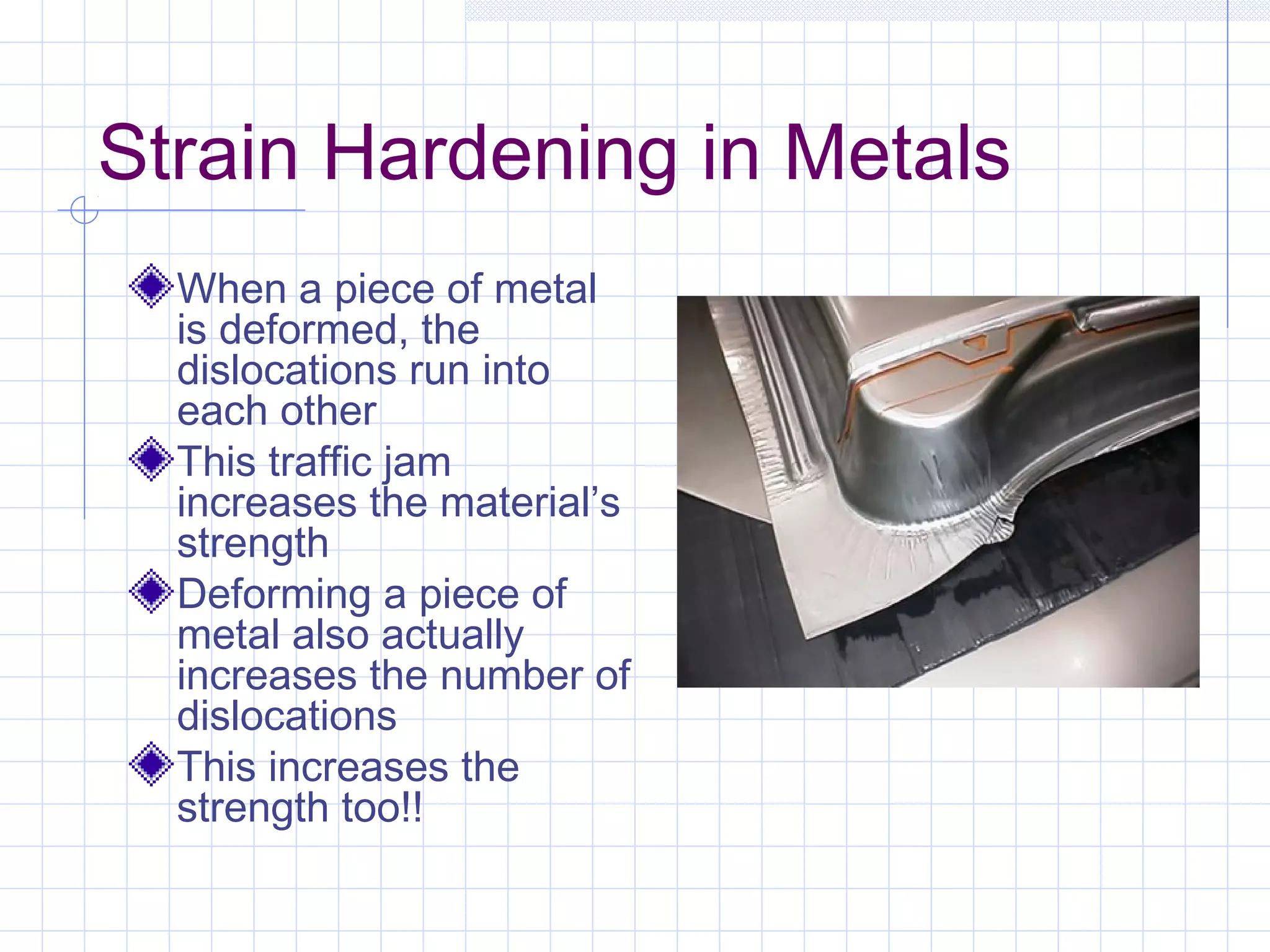
When a piece of metal
is deformed, the
dislocations run into
each other
This traffic jam
increases the material’s
strength
Deforming a piece of
metal also actually
increases the number of
dislocations
This increases the
strength too!!
Tensile Test
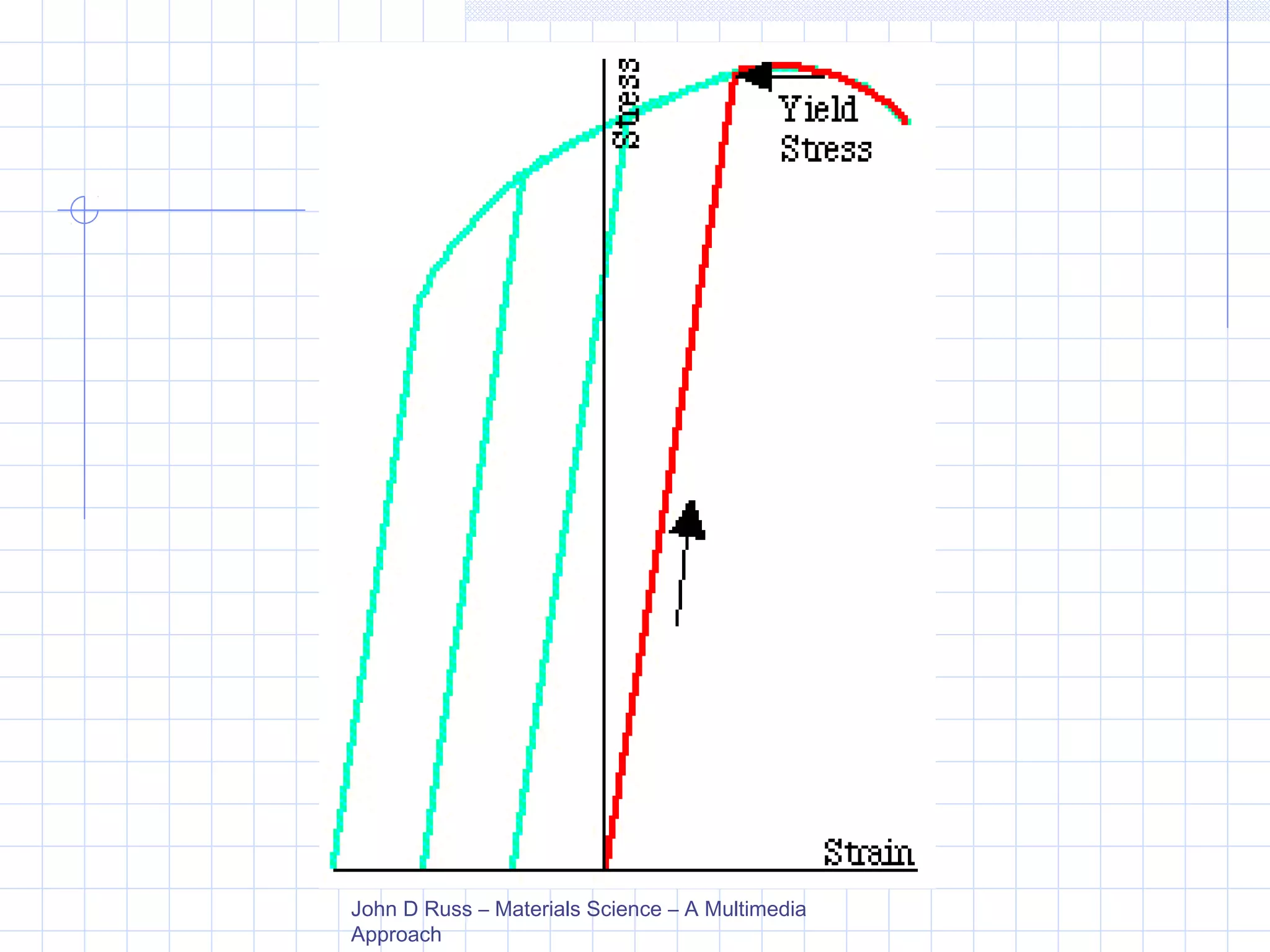
You can understand this better by
relating it to the results of the tensile
test.
John D Russ – Materials Science – A Multimedia
Approach
Try it!!
Strain harden a piece of copper tubing.
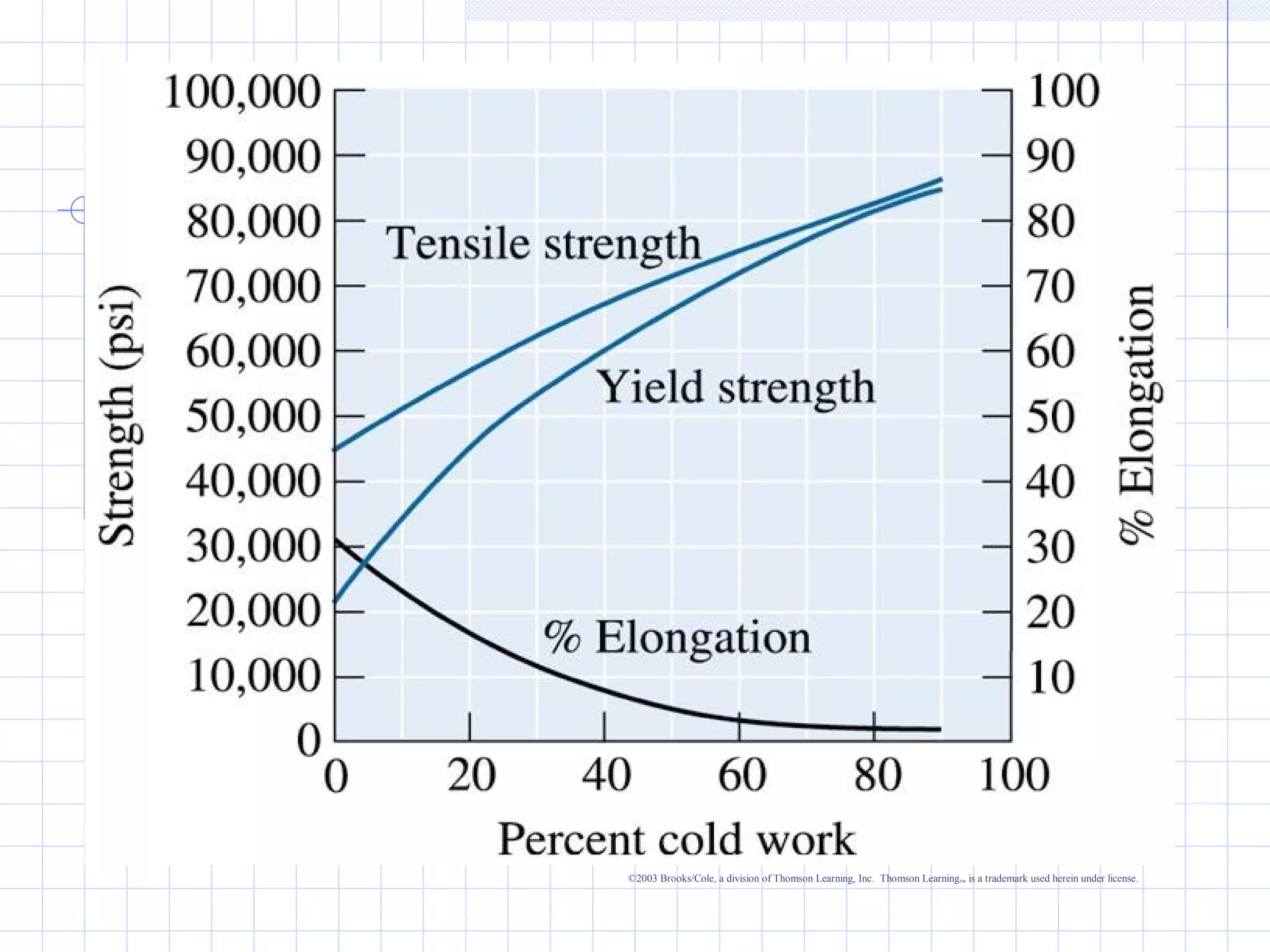
Effects of Strain Hardening
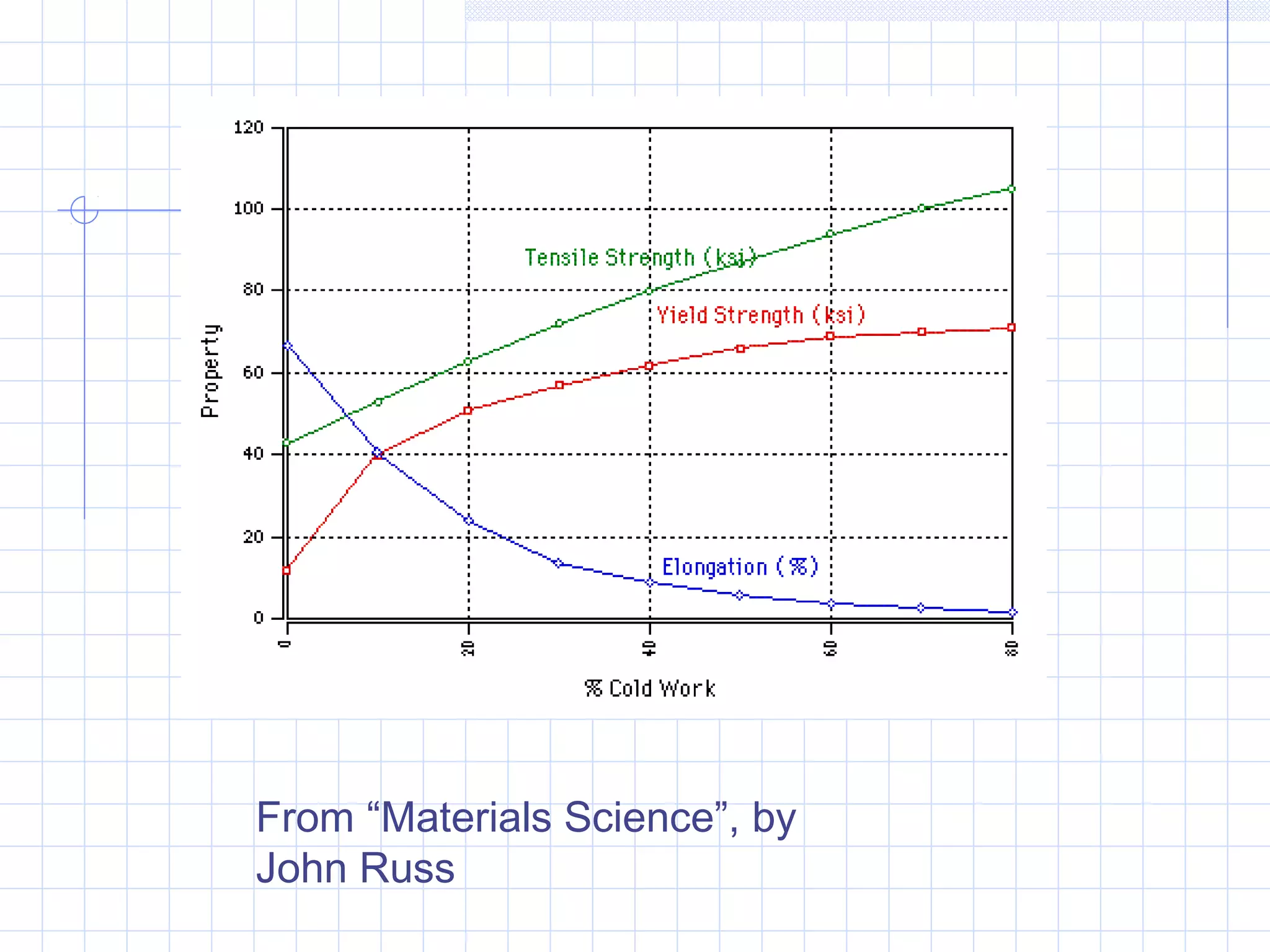
Yield Strength goes up
Tensile Strength goes up
Ductility goes down


The material becomes brittle
©2003 Brooks/Cole, a division of Thomson Learning, Inc. Thomson Learning™ is a trademark used herein under license.
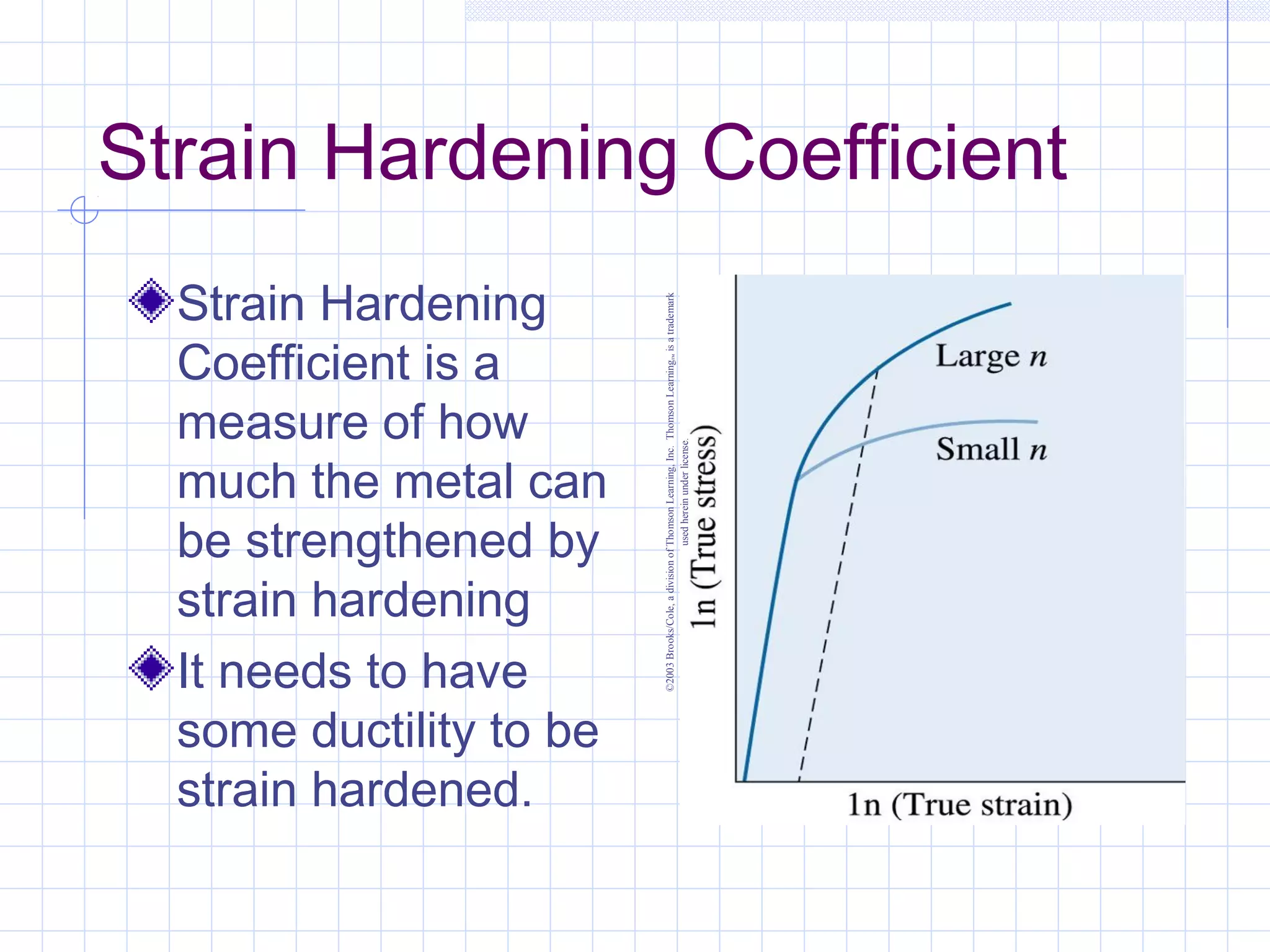
Strain Hardening
Coefficient is a
measure of how
much the metal can
be strengthened by
strain hardening
It needs to have
some ductility to be
strain hardened.

©2003 Brooks/Cole, a division of Thomson Learning, Inc. Thomson Learning™ is a trademark
used herein under license.

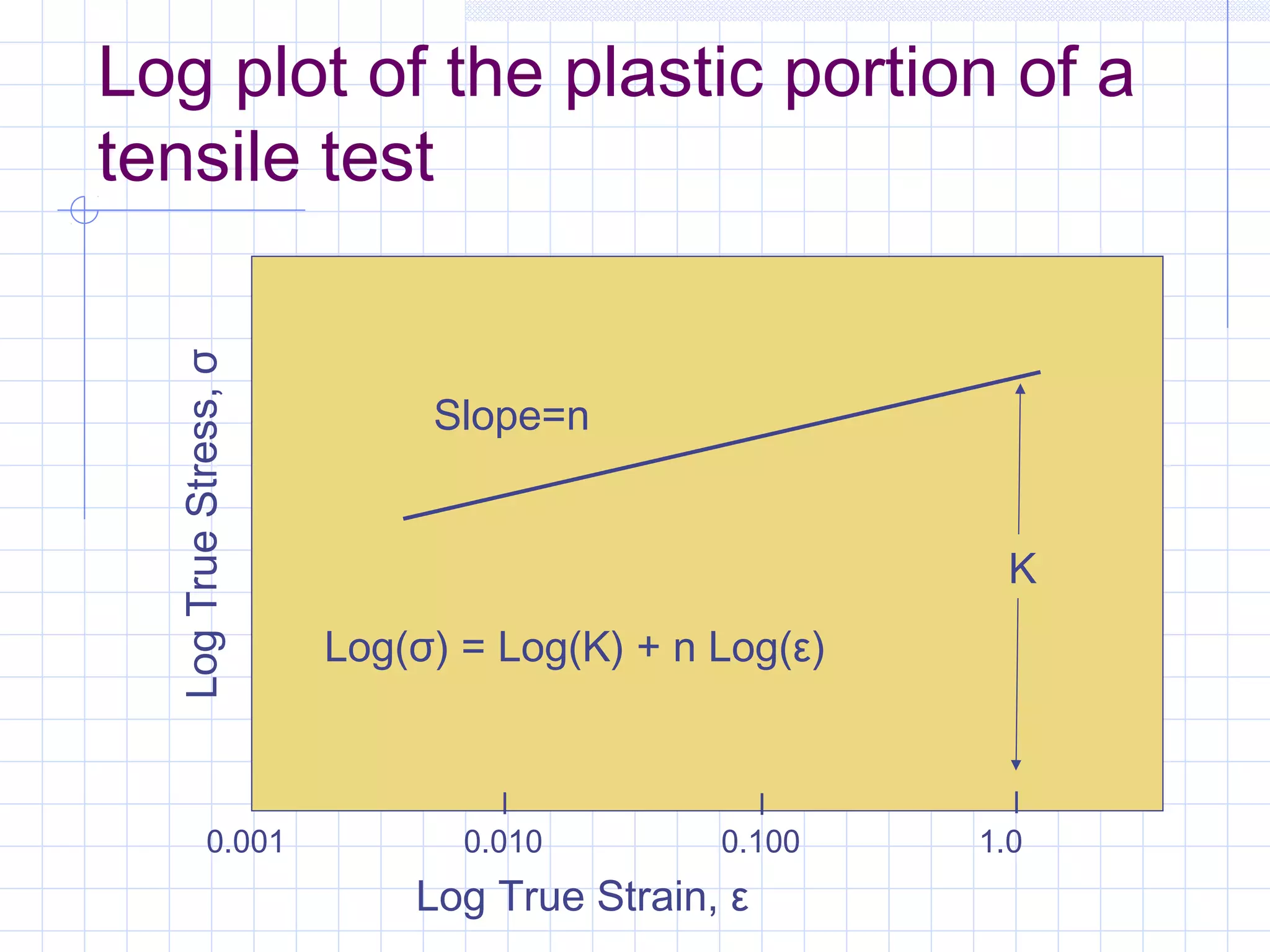
Strain Hardening Coefficient
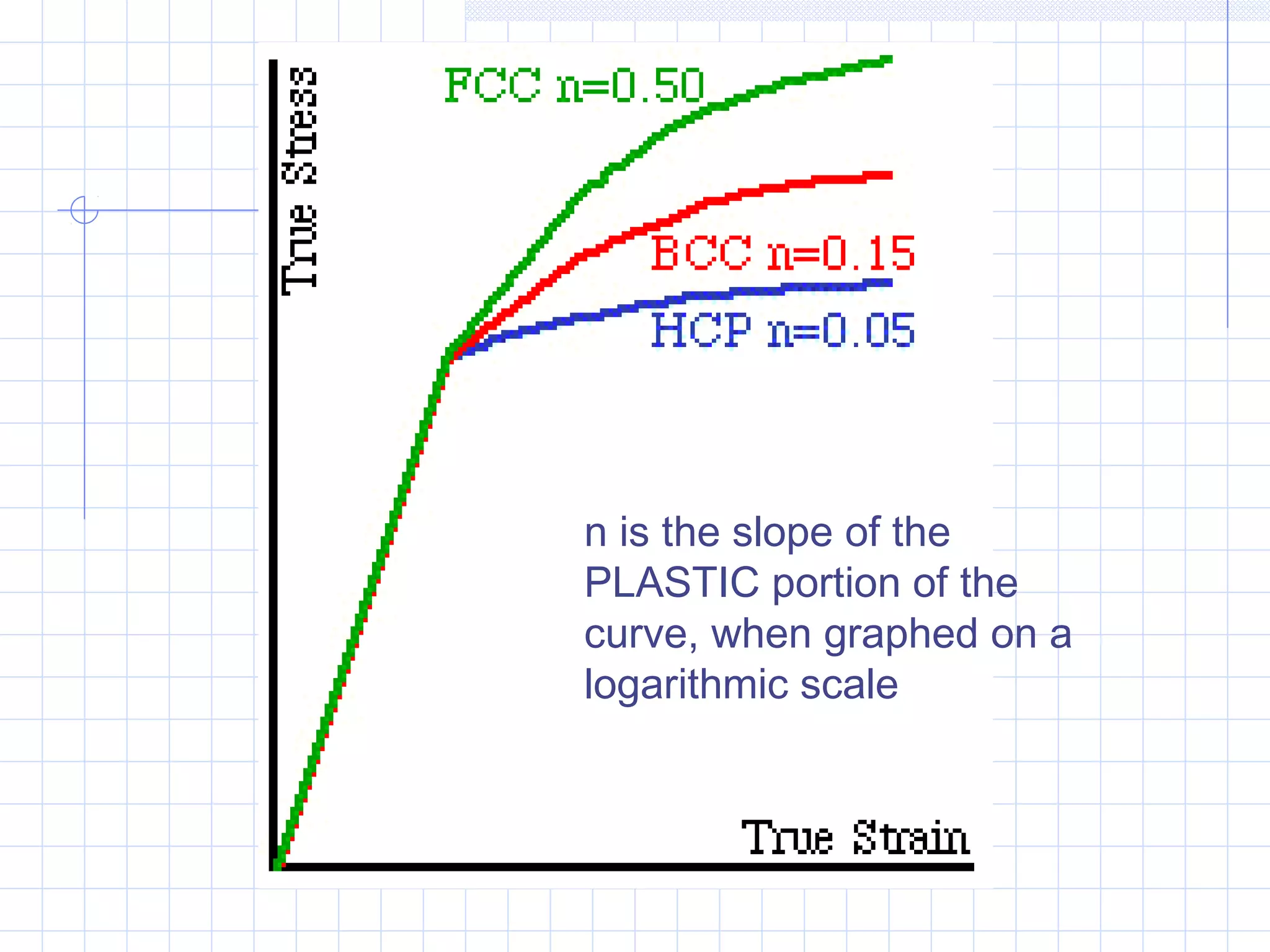
n is the slope of the
PLASTIC portion of the
curve, when graphed on a
logarithmic scale
Log True Stress, σ

Log plot of the plastic portion of a
tensile test

0.001

Slope=n
K
Log(σ) = Log(K) + n Log(ε)

0.010

0.100

Log True Strain, ε

1.0
Effect of Crystal Structure
HCP metals are already brittle



Little strain hardening is possible
Strain hardening coefficient around 0.05

BCC metals are less brittle than HCP



Some strain hardening is possible
N around 0.15

FCC metals are ductile



Strain hardening is easy
N around 0.5
Frank-Read Source
Strain hardening actually increases the
strength of a material PAST its original
tensile strength
Why?
Additional dislocations are formed as
dislocations run into point defects
Strain Hardening – The effect of
dislocation generation

Yield Point
Tensile
Strength
From “Materials Science – A Multimedia
Approach”, by John Russ
Frank-Read Source

Point Defect

Point Defect

Dislocation

http://www.tf.uni-kiel.de/matwis/amat/def_en/kap_5/backbone/r5_3_2.html
Frank-Read Source
Frank-Read Source
Before deformation
a typical dislocation
density is about 106
cm of dislocation per
cm3 of metal
After strain
hardening it may
increase to as much
as 1012 cm per cm3 of
metal
Strain Hardening in Polymers
When you pull on a polymer, the chains
line up
Van der Waal bonds form between the
chains
The polymer becomes stronger

Try it with a 6-pack ring!!
The mechanism for strain hardening in plastics is different
from the mechanism in metals
©2003 Brooks/Cole, a division of Thomson Learning, Inc. Thomson Learning™ is a trademark used herein under license.
PET
Bottles
and
Preform
s

http://www.indiamart.com/amd-metplast/pcat-gifs/products-small/bottel-preform.jpg
Strain Hardening in
Ceramics?
Ceramics are already brittle – so strain
hardening is not usually possible
Ceramics break because of flaws – the
mechanism of deformation is different
Annealing ceramics causes grain
growth


May or may not be bad
Back to Metals
Cold Work
There is only a certain amount you can
deform a material before it breaks
Cold work is strain hardening measured
in % - The percent change in cross
sectional area of the material
Different materials have varying %
allowable cold work
Wire Drawing
Initial
diameter
d0

% Cold Work =

Final
diameter
F

d

Initial Cross Sectional Area - Final Cross Sectional Area
Initial Cross Sectional Area
Rod
Deformation of a rod (or a piece of wire)
Initial cross sectional area minus
Final cross sectional area
Over the initial cross sectional area

 A0 − A 

 *100
 A0 
2
2
 Π * r02 − Π * r 2   r0 − r   d 02 − d 2 
=
=

%CW = 

  r2   d 2 
Π * r02
0

  0  


All times 100 of course
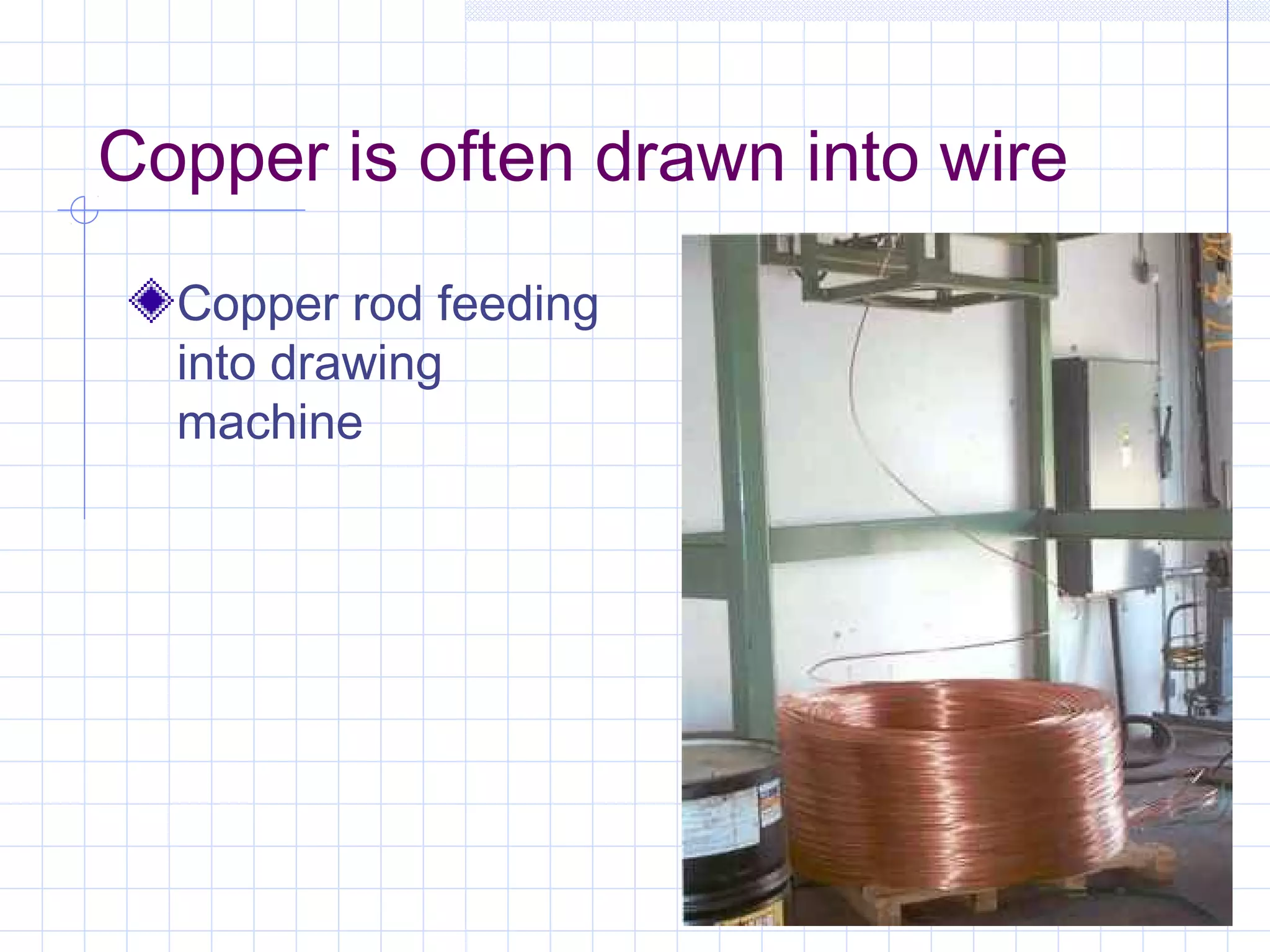
Copper is often drawn into wire
Copper rod feeding
into drawing
machine
Plate Rolling
Initial
thickness
h0

% Cold Work =

Final
thickness
h

Initial Cross Sectional Area - Final Cross Sectional Area
Initial Cross Sectional Area
Cold Rolling
Metal is often rolled into sheets from
thicker stock
The width of the sheet is usually kept
the same, and only the thickness varies
 A0 − A  W ( h0 − h ) h0 − h
=
%CW = 
=
 A 
Wh0
ho
0


Cold Rolled Steel
Cold Work
What if you want to deform the sample
more than is “possible?
For example, what if you want to draw a
piece of wire, from a rod of copper?
You can anneal the material, and
“undo” the strain hardening

Annealing is a heat treatment
Problem
Propose a series of steps to reduce a
rod of copper-zinc alloy from 1 “
diameter to .1”diameter.
The maximum cold work allowable for
this copper zinc alloy is 85%.
You will have to draw the copper, then
anneal it several times.
One solution
Draw the 1” rod to 0.5”
Anneal
Draw the 0.5” rod to 0.25”

12 − 0.52
CW =
= 0.75
2
1
The maximum cold
work is not
0.52 − 0.252
exceeded

CW =

0.5

2

= 0.75

Anneal
Draw the 0.25” rod to
0.125”
Anneal

0.252 − 0.1252
CW =
= 0.75
2
0.25
Final Step
Draw the 0.125” rod
to 0.1”

The final cold work is 36%

0.1252 − 0.12
CW =
= 0.36
2
0.125
Problem
What if you want a certain tensile
strength in your final product?
Look at one of the graphs of properties
vs. cold work from the book.
Make sure that your final cold work step
is the right size to give you the
properties you want.
From “Materials Science”, by
John Russ
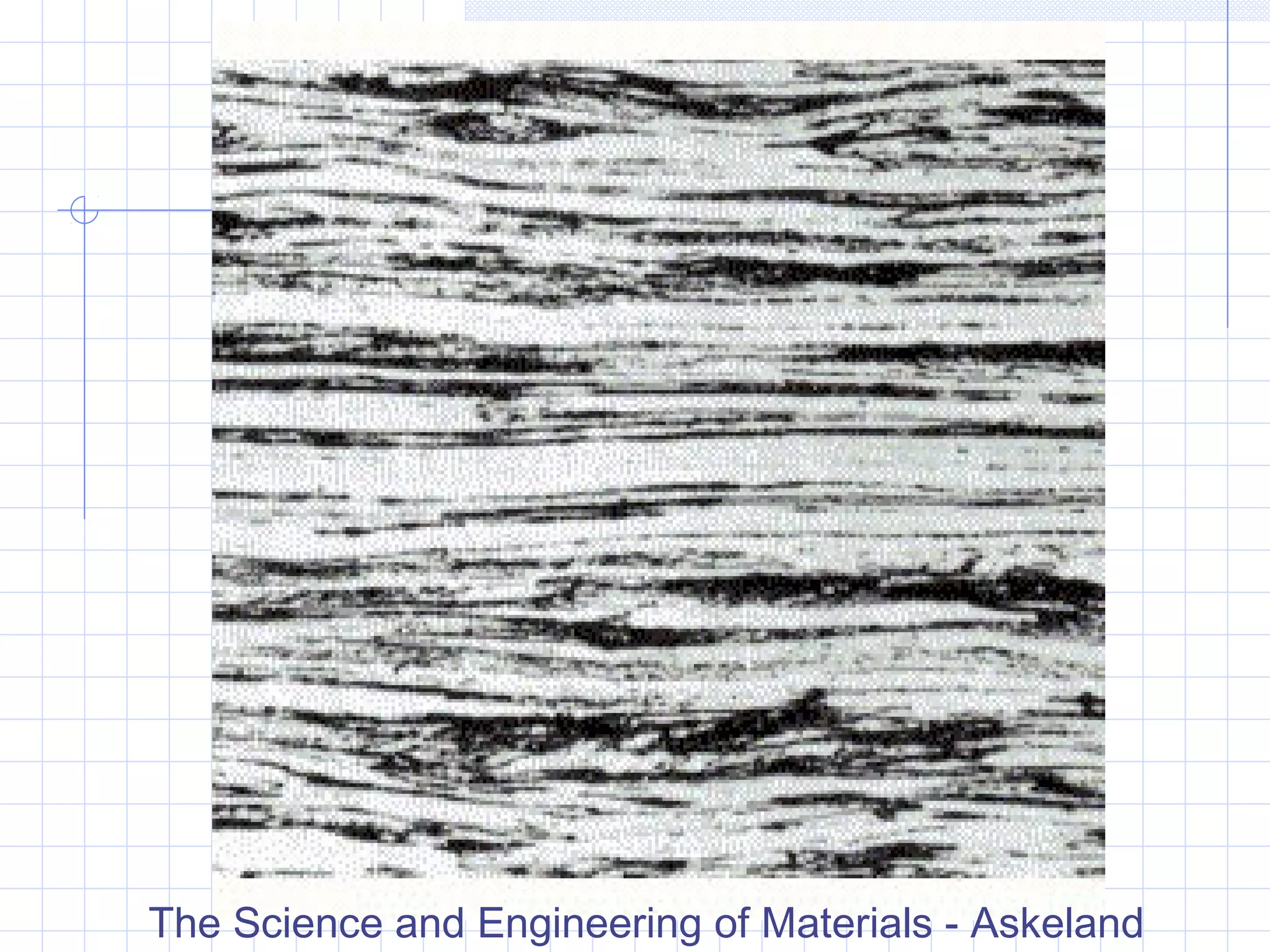
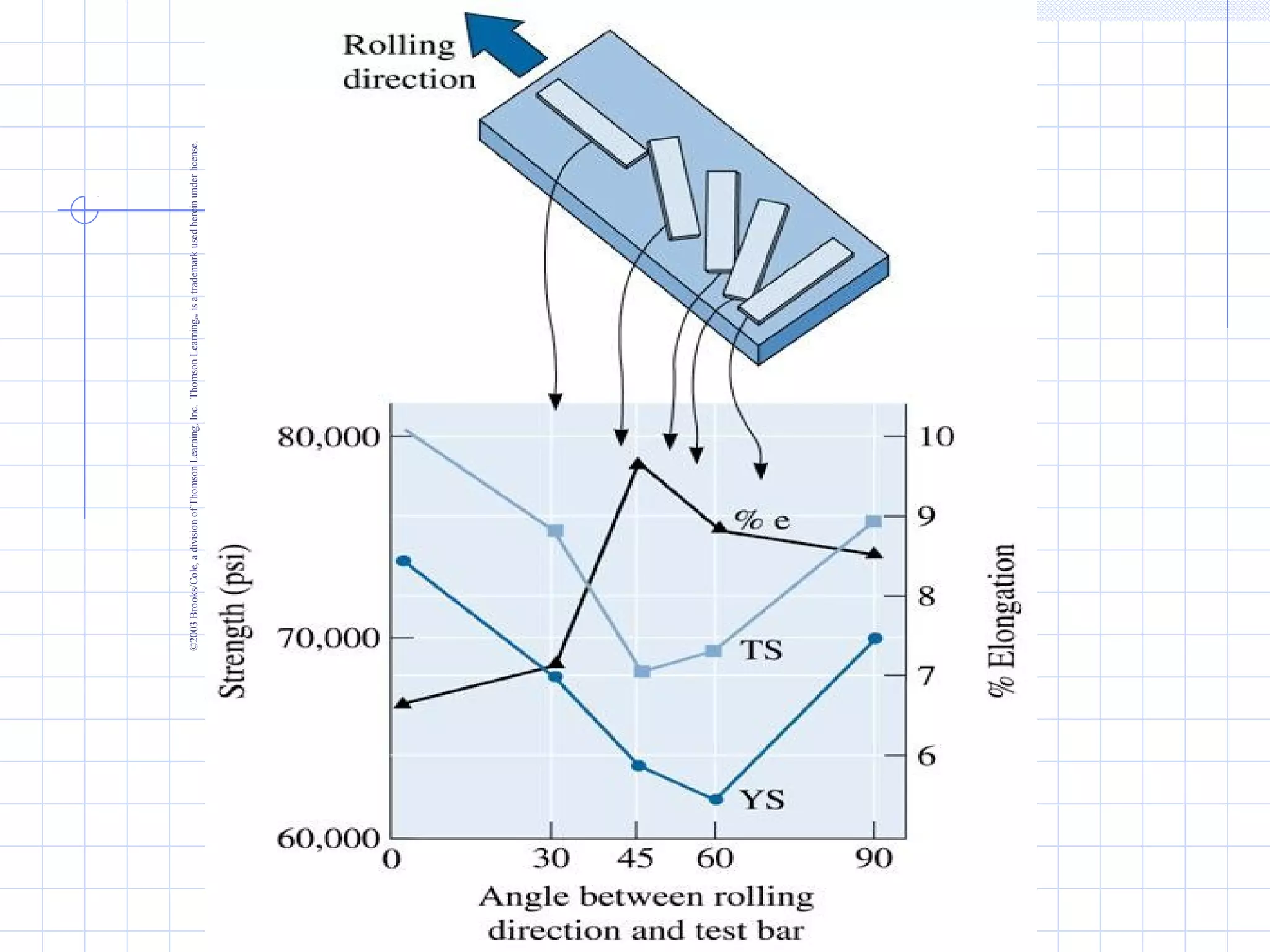
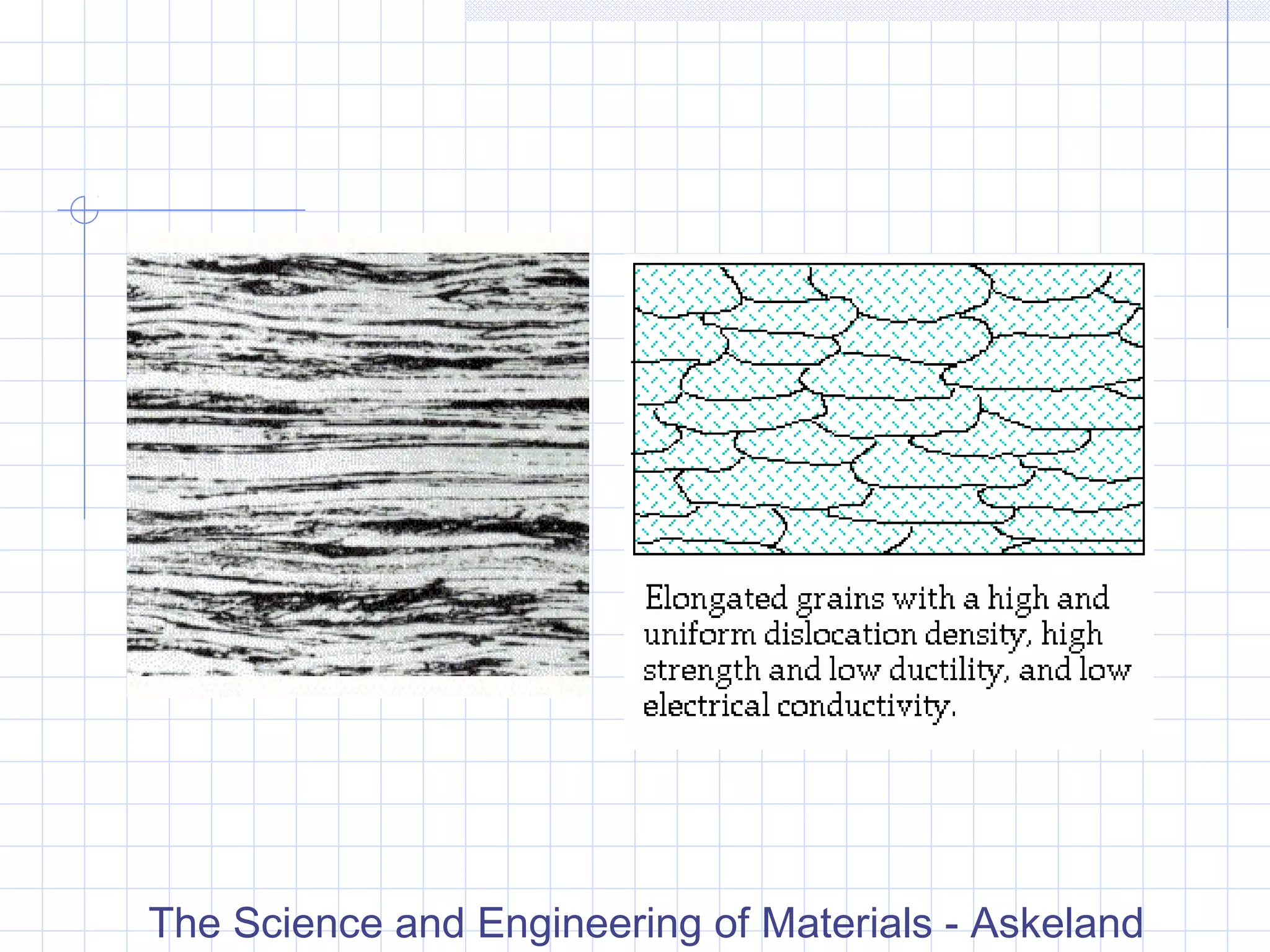
Cold Work is Anisotropic
When you deform a piece of metal you
elongate the grain.
Slip occurs only in the favored
directions
You strengthen the material in the
direction it is deformed, but properties in
the other directions do not change as
much.
The Science and Engineering of Materials - Askeland
©2003 Brooks/Cole, a division of Thomson Learning, Inc. Thomson Learning™ is a trademark used herein under license.
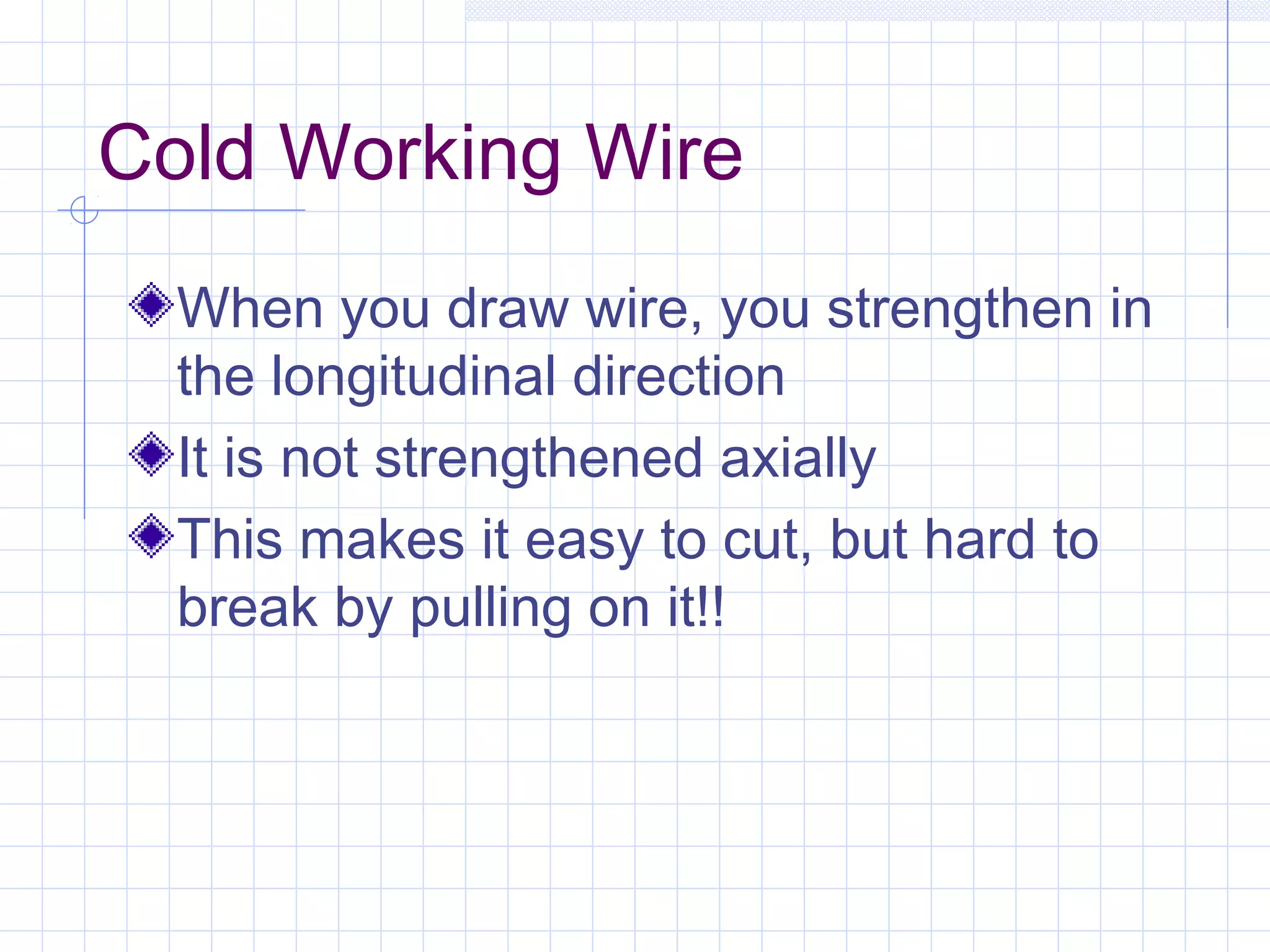
Cold Working Wire
When you draw wire, you strengthen in
the longitudinal direction
It is not strengthened axially
This makes it easy to cut, but hard to
break by pulling on it!!
Annealing
You can’t just haphazardly heat up a
piece of metal to “undo” the strain
hardening
It’s a temperature dependent process
Annealing
Recovery
Recrystallization
Grain Growth

http://www.all-sourceheattreating.com/img/home_nologob.jpg
Recovery or Stress Relief
If you only add a small amount of
thermal energy (heat it up a little) the
dislocations rearrange themselves
into networks to relieve residual
stresses
Polyganized subgrain structure
Ductility is improved
Strength does not change
The Science and Engineering of Materials - Askeland
Three EBSD maps
of the stored energy
in an Al-Mg-Mn alloy
after exposure to
increasing
recrystallization
temperature. The
volume fraction of
recrystallized grains
(light) increases with
temperature for a
given time.
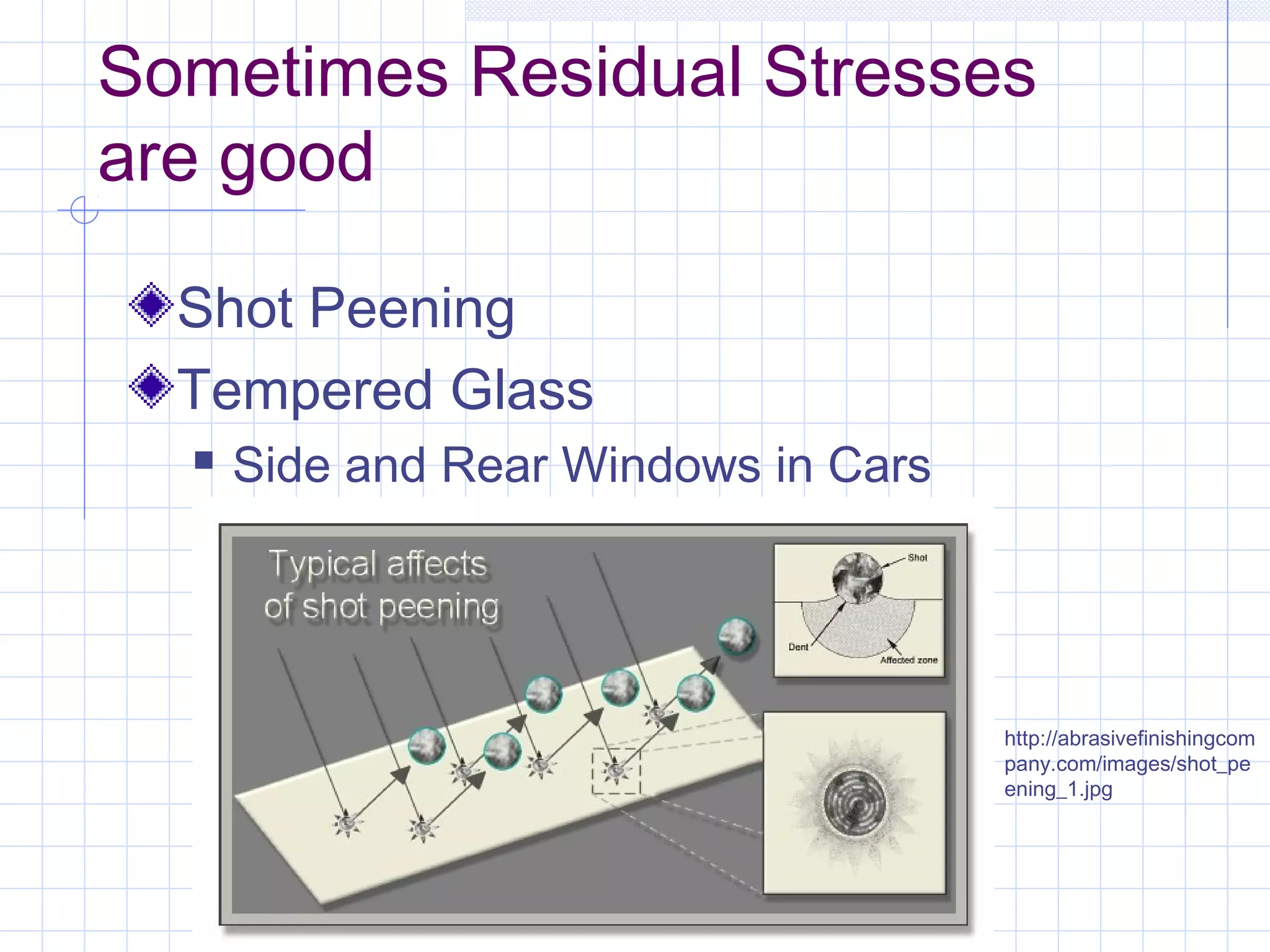
Sometimes Residual Stresses
are good
Shot Peening
Tempered Glass


Side and Rear Windows in Cars

http://abrasivefinishingcom
pany.com/images/shot_pe
ening_1.jpg
Recrystallization
Add more heat, and new grains start to
grow at the grain boundaries.
The new grains have not been strain
hardened
The recrystallized metal is ductile and
has low strength
The Science and Engineering of Materials - Askeland
Grain Growth
If you keep the metal hot too long, or
heat it up too much, the grains become
large
Usually not good
Low strength
Also brittle
The Science and Engineering of Materials - Askeland
Check out the CD animations
Try the quiz on the CD!!
On the next page explore how
properties change during the annealing
process
The whole process depends not only on
the temperature, but on how long you
keep the metal hot.
John Russ

Materials Science –
A Multimedia Approach
Sometimes annealing
happens by itself!!
Is cold working a good way to
strengthen a metal used at high
temperatures?
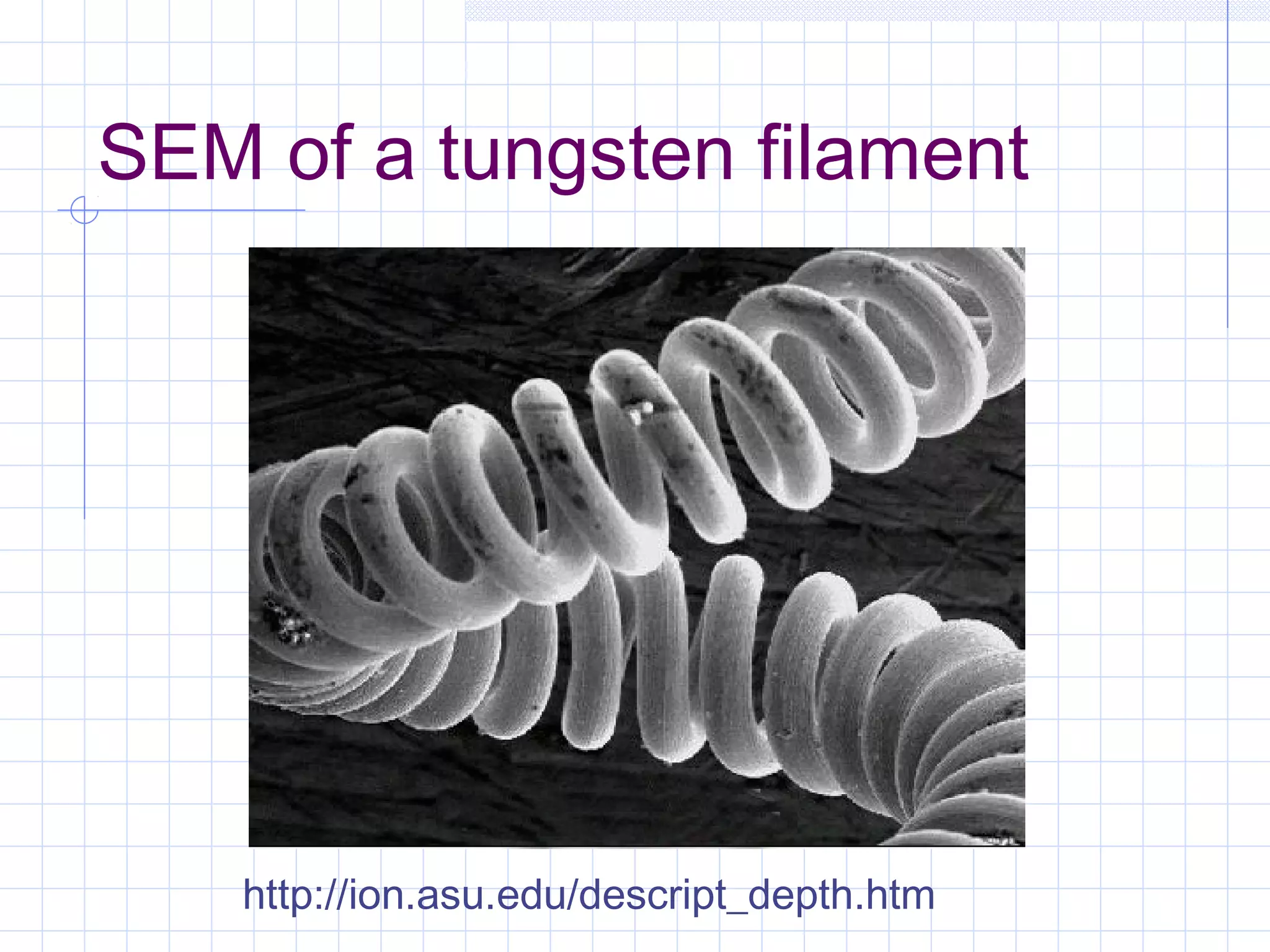
What about a tungsten filament in a
light bulb?
SEM of a tungsten filament

http://ion.asu.edu/descript_depth.htm
How hot is hot?
Most metals have a recrystallization
temperature equal to about 40% of the
melting point measured in Kelvin

Tr = 0.4Tm
For Example
If a metal melts at 1000K, it’s
recrystallization temperature is
approximately 400K
If the metal is exposed to temperatures
above the recrystallization temperature
while in service, the strengthening
achieved with cold work will be
eliminated
Factors Contributing to
Recrystallization Temperature
Melting Point
Original Grain Size
Amount of Cold Work
Pure metals recrystallize at lower
temperatures than alloys
Time at temperature
Typical Recrystallization
Temperatures
Metal

Melting Temperature
0
C

Recrystallization
Temperature 0C

Sn

232

-4

Pb

327

-4

Zn

420

10

Al

660

150

Mg

650

200

Ag

962

200

Cu

1085

200

Fe

1538

450

Ni

1453

600

Mo

2610

900

W

3410

1200

These
metals
recrystallize
below room
temperature
– so cold
work is not
possible
under normal
conditions

The Science and Engineering of Materials - Askeland
What should you do if cold
working isn’t applicable?
Try solid solution strengthening
Try hot working

http://www.bbc.co.uk/shropshire/content/image_galleries/friendshi
p_through_iron_gallery.shtml
Hot Working
Shape the metal while it is hot.


Above the recrystallization temperature

Blacksmiths use a combination of hot work
and cold work.
Can not fine tune the final properties this way
Dimensional control is hard
Surface finishes may be hard to produce
©2003 Brooks/Cole, a division of Thomson Learning, Inc. Thomson Learning™ is a trademark used herein under license.

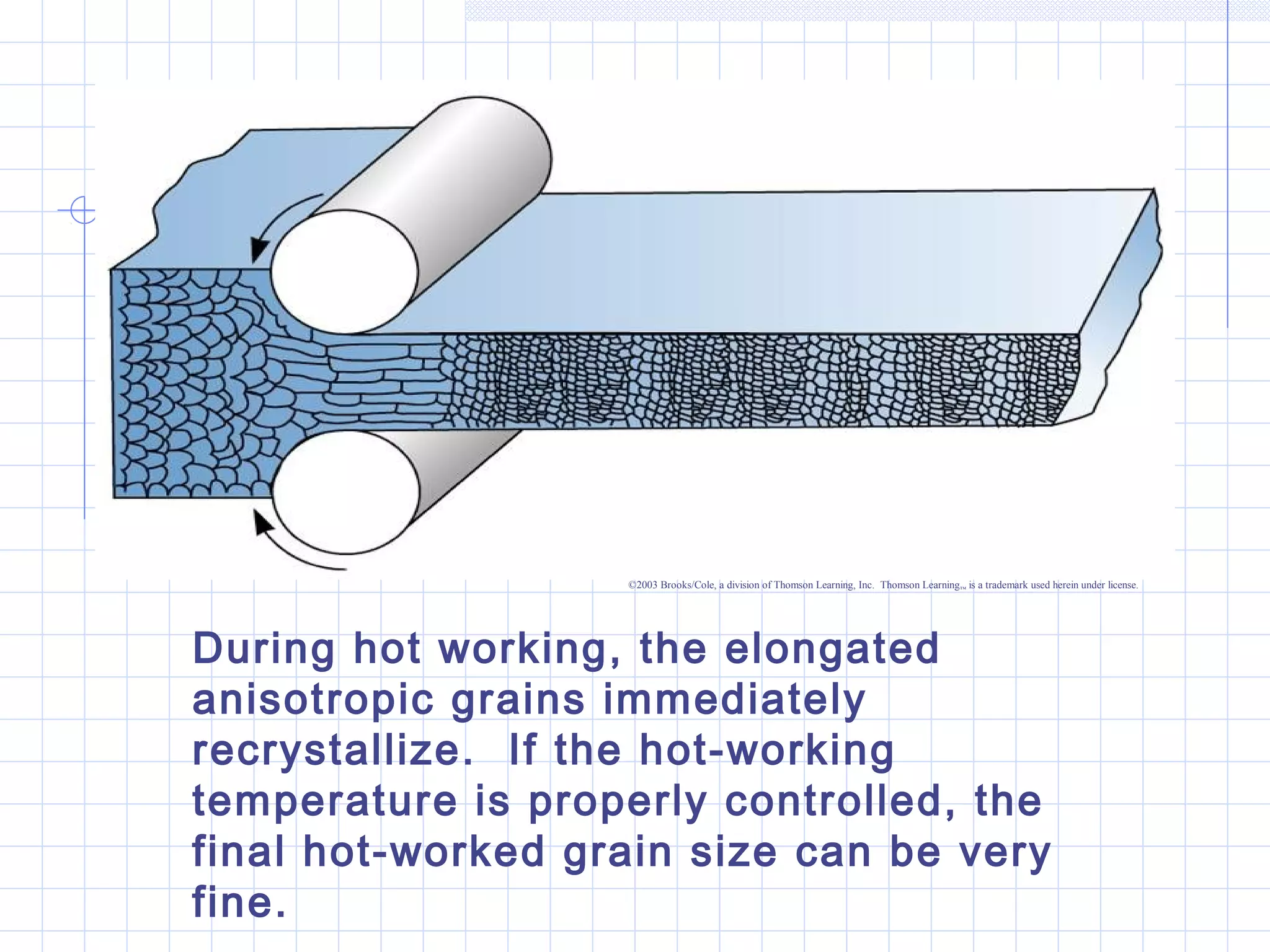
During hot working, the elongated
anisotropic grains immediately
recrystallize. If the hot-working
temperature is properly controlled, the
final hot-worked grain size can be very
fine.
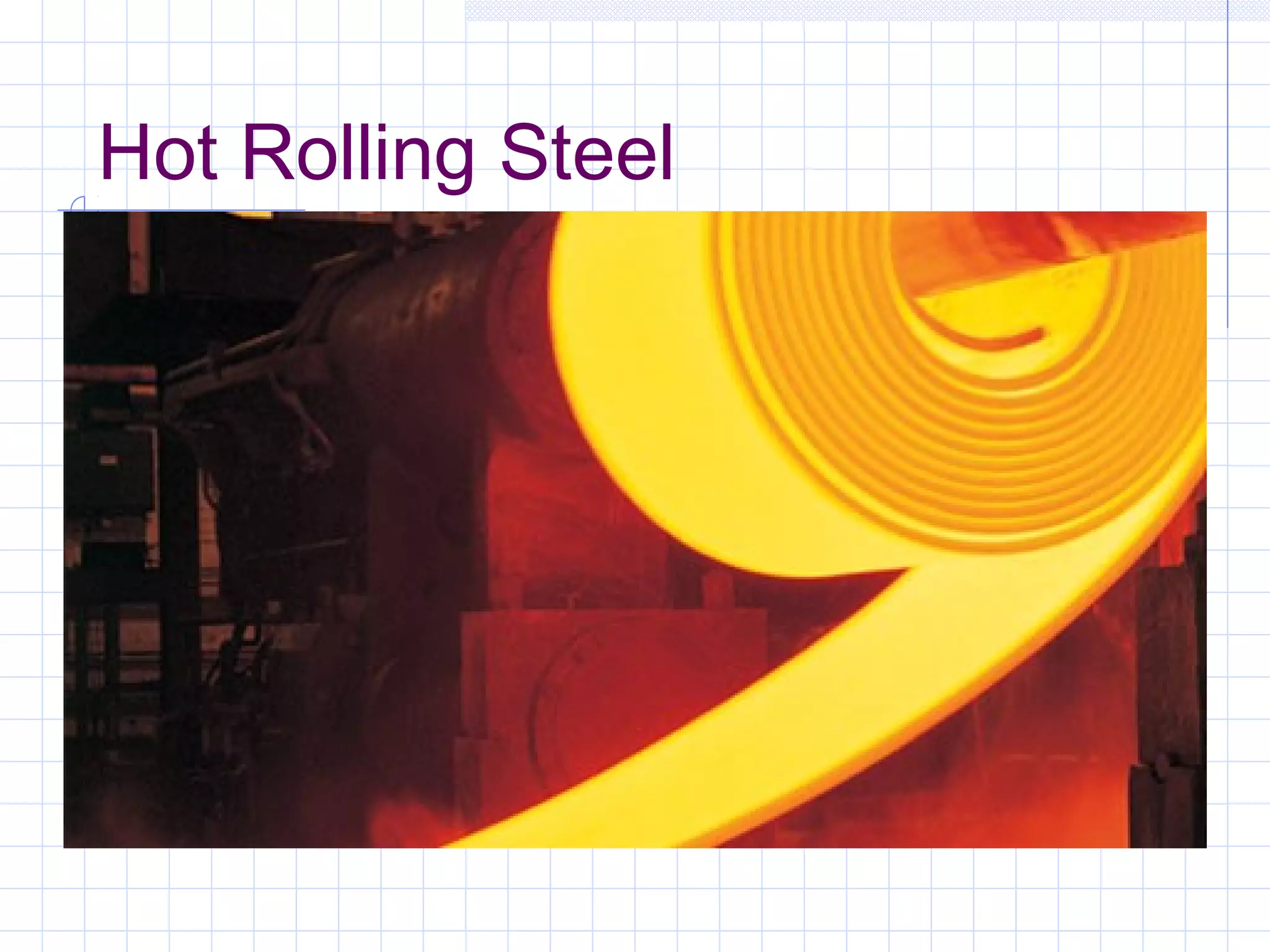
Hot Rolling Steel
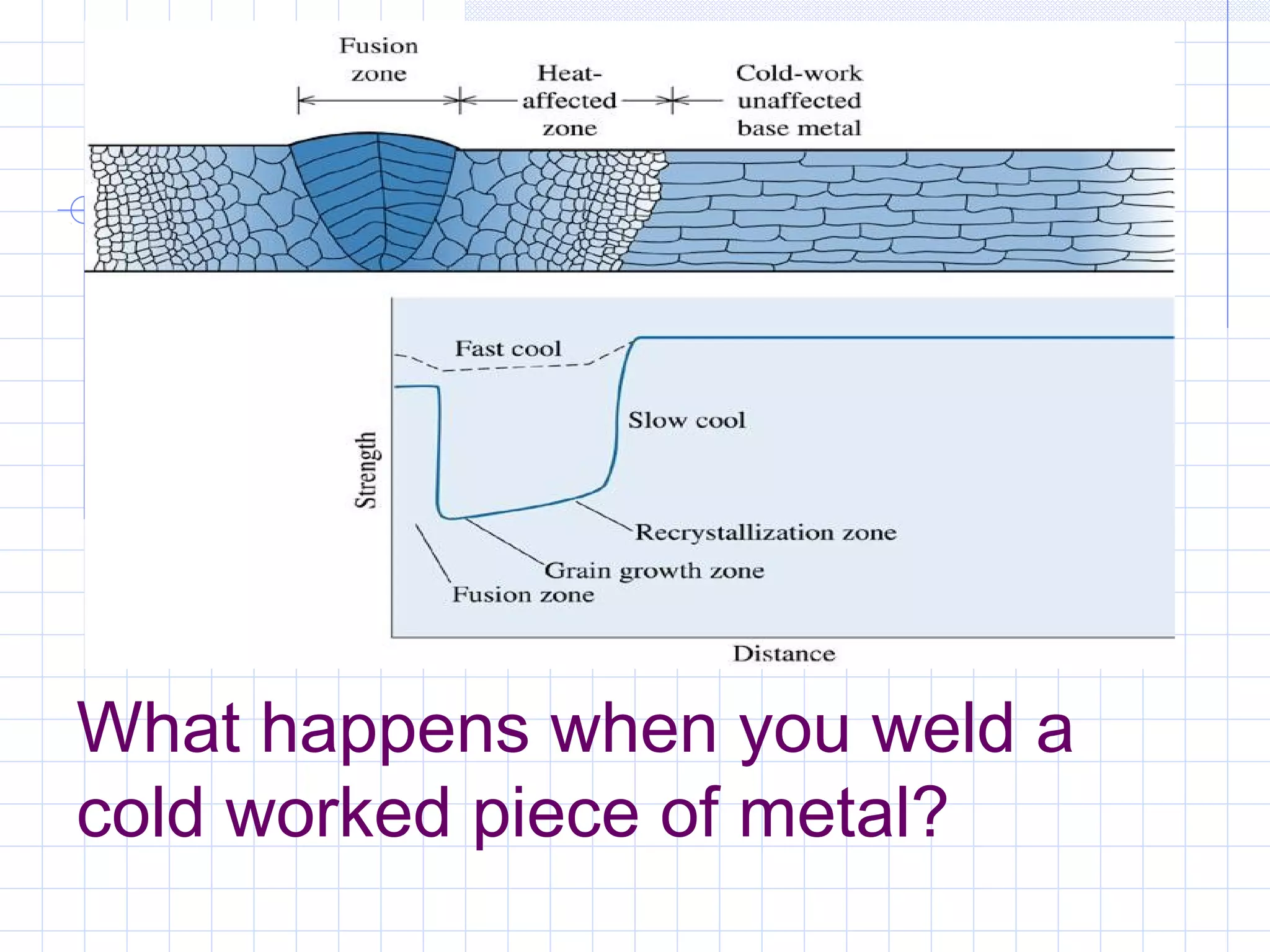
What happens when you weld a
cold worked piece of metal?
Welding affects the surrounding
material
An incomplete weld
of a bike frame
which failed.
Apparent in the image
is the bright weld
material in the center,
the surrounding lighter
heat affected zone
(HAZ), and dark outer
unaffected base metal.
Field of view is
approximately 15 mm.

Used by Permission of Ruth Kramer
http://www.mse.mtu.edu/slides/slide_2.html
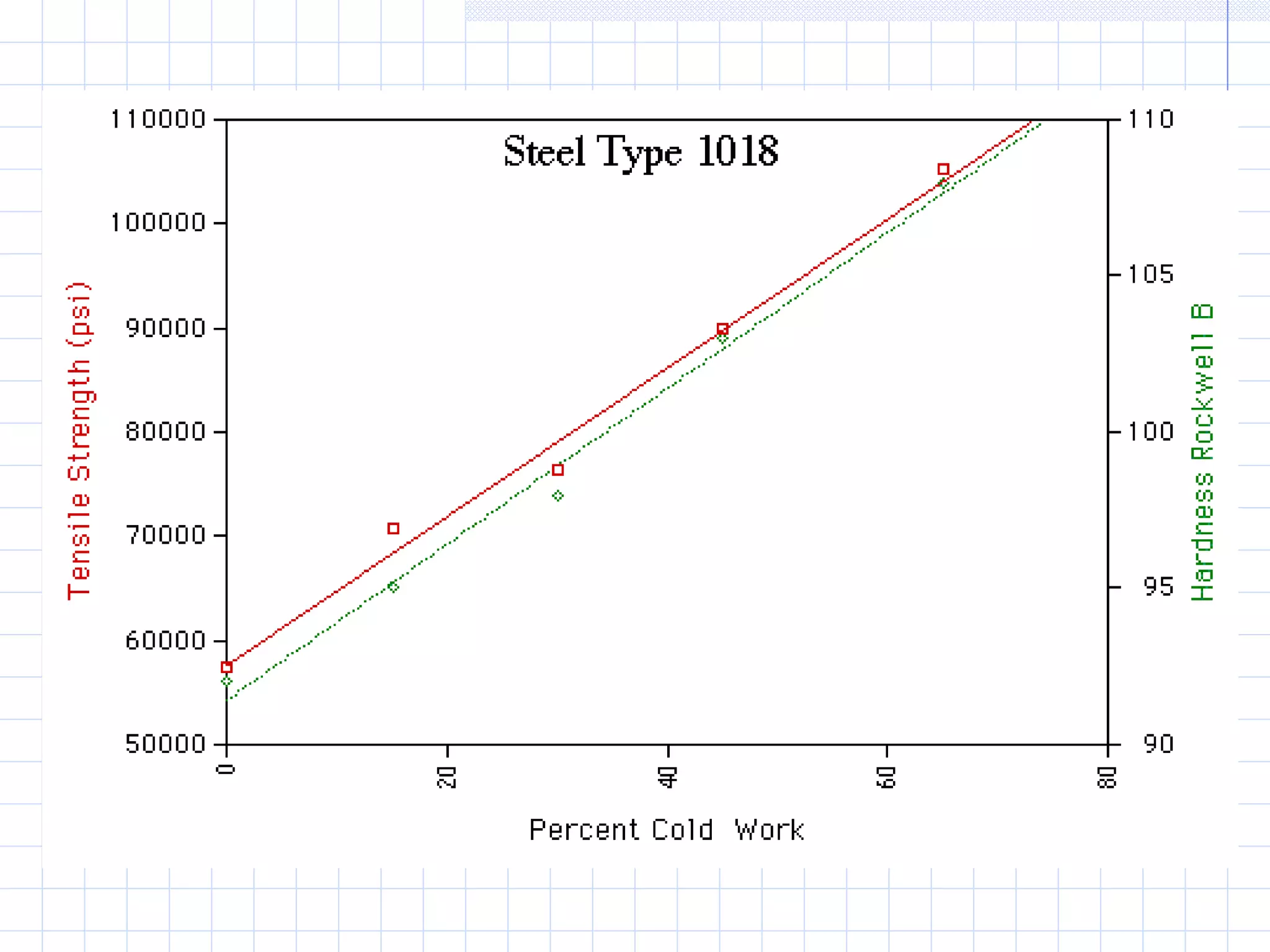
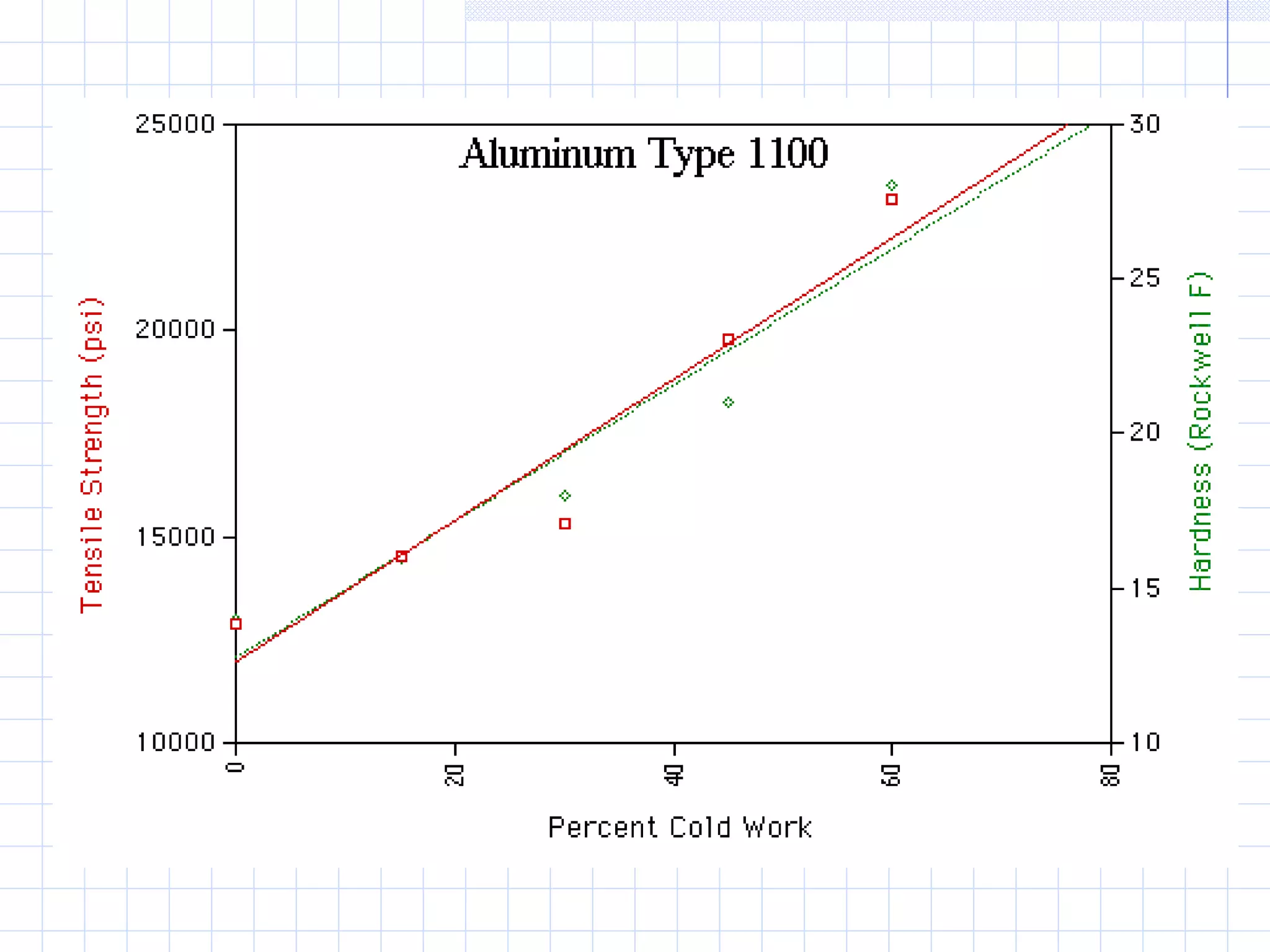
The following slides show the effect of
cold working on various metals
Annealing (sobi)
Annealing (sobi)
Annealing (sobi)

Annealing (sobi)

  • 1.
    Strain Hardening andAnnealing Chapter 7 – 4th Edition Chapter 8 – 5th Edition
  • 2.
    Strain Hardening inMetals When a piece of metal is deformed, the dislocations run into each other This traffic jam increases the material’s strength Deforming a piece of metal also actually increases the number of dislocations This increases the strength too!!
  • 3.
    Tensile Test You canunderstand this better by relating it to the results of the tensile test.
  • 4.
    John D Russ– Materials Science – A Multimedia Approach
  • 5.
    Try it!! Strain hardena piece of copper tubing.
  • 6.
    Effects of StrainHardening Yield Strength goes up Tensile Strength goes up Ductility goes down  The material becomes brittle
  • 7.
    ©2003 Brooks/Cole, adivision of Thomson Learning, Inc. Thomson Learning™ is a trademark used herein under license.
  • 8.
    Strain Hardening Coefficient isa measure of how much the metal can be strengthened by strain hardening It needs to have some ductility to be strain hardened. ©2003 Brooks/Cole, a division of Thomson Learning, Inc. Thomson Learning™ is a trademark used herein under license. Strain Hardening Coefficient
  • 9.
    n is theslope of the PLASTIC portion of the curve, when graphed on a logarithmic scale
  • 10.
    Log True Stress,σ Log plot of the plastic portion of a tensile test 0.001 Slope=n K Log(σ) = Log(K) + n Log(ε) 0.010 0.100 Log True Strain, ε 1.0
  • 11.
    Effect of CrystalStructure HCP metals are already brittle   Little strain hardening is possible Strain hardening coefficient around 0.05 BCC metals are less brittle than HCP   Some strain hardening is possible N around 0.15 FCC metals are ductile   Strain hardening is easy N around 0.5
  • 12.
    Frank-Read Source Strain hardeningactually increases the strength of a material PAST its original tensile strength Why? Additional dislocations are formed as dislocations run into point defects
  • 13.
    Strain Hardening –The effect of dislocation generation Yield Point Tensile Strength
  • 14.
    From “Materials Science– A Multimedia Approach”, by John Russ
  • 15.
    Frank-Read Source Point Defect PointDefect Dislocation http://www.tf.uni-kiel.de/matwis/amat/def_en/kap_5/backbone/r5_3_2.html
  • 16.
  • 17.
    Frank-Read Source Before deformation atypical dislocation density is about 106 cm of dislocation per cm3 of metal After strain hardening it may increase to as much as 1012 cm per cm3 of metal
  • 18.
    Strain Hardening inPolymers When you pull on a polymer, the chains line up Van der Waal bonds form between the chains The polymer becomes stronger Try it with a 6-pack ring!! The mechanism for strain hardening in plastics is different from the mechanism in metals
  • 19.
    ©2003 Brooks/Cole, adivision of Thomson Learning, Inc. Thomson Learning™ is a trademark used herein under license.
  • 20.
  • 21.
    Strain Hardening in Ceramics? Ceramicsare already brittle – so strain hardening is not usually possible Ceramics break because of flaws – the mechanism of deformation is different Annealing ceramics causes grain growth  May or may not be bad
  • 22.
    Back to Metals ColdWork There is only a certain amount you can deform a material before it breaks Cold work is strain hardening measured in % - The percent change in cross sectional area of the material Different materials have varying % allowable cold work
  • 23.
    Wire Drawing Initial diameter d0 % ColdWork = Final diameter F d Initial Cross Sectional Area - Final Cross Sectional Area Initial Cross Sectional Area
  • 24.
    Rod Deformation of arod (or a piece of wire) Initial cross sectional area minus Final cross sectional area Over the initial cross sectional area  A0 − A    *100  A0 
  • 25.
    2 2  Π *r02 − Π * r 2   r0 − r   d 02 − d 2  = =  %CW =     r2   d 2  Π * r02 0    0    All times 100 of course
  • 26.
    Copper is oftendrawn into wire Copper rod feeding into drawing machine
  • 27.
    Plate Rolling Initial thickness h0 % ColdWork = Final thickness h Initial Cross Sectional Area - Final Cross Sectional Area Initial Cross Sectional Area
  • 28.
    Cold Rolling Metal isoften rolled into sheets from thicker stock The width of the sheet is usually kept the same, and only the thickness varies  A0 − A  W ( h0 − h ) h0 − h = %CW =  =  A  Wh0 ho 0  
  • 29.
  • 30.
    Cold Work What ifyou want to deform the sample more than is “possible? For example, what if you want to draw a piece of wire, from a rod of copper? You can anneal the material, and “undo” the strain hardening Annealing is a heat treatment
  • 31.
    Problem Propose a seriesof steps to reduce a rod of copper-zinc alloy from 1 “ diameter to .1”diameter. The maximum cold work allowable for this copper zinc alloy is 85%. You will have to draw the copper, then anneal it several times.
  • 32.
    One solution Draw the1” rod to 0.5” Anneal Draw the 0.5” rod to 0.25” 12 − 0.52 CW = = 0.75 2 1 The maximum cold work is not 0.52 − 0.252 exceeded CW = 0.5 2 = 0.75 Anneal Draw the 0.25” rod to 0.125” Anneal 0.252 − 0.1252 CW = = 0.75 2 0.25
  • 33.
    Final Step Draw the0.125” rod to 0.1” The final cold work is 36% 0.1252 − 0.12 CW = = 0.36 2 0.125
  • 34.
    Problem What if youwant a certain tensile strength in your final product? Look at one of the graphs of properties vs. cold work from the book. Make sure that your final cold work step is the right size to give you the properties you want.
  • 35.
  • 36.
    Cold Work isAnisotropic When you deform a piece of metal you elongate the grain. Slip occurs only in the favored directions You strengthen the material in the direction it is deformed, but properties in the other directions do not change as much.
  • 37.
    The Science andEngineering of Materials - Askeland
  • 38.
    ©2003 Brooks/Cole, adivision of Thomson Learning, Inc. Thomson Learning™ is a trademark used herein under license.
  • 39.
    ©2003 Brooks/Cole, adivision of Thomson Learning, Inc. Thomson Learning™ is a trademark used herein under license.
  • 40.
    Cold Working Wire Whenyou draw wire, you strengthen in the longitudinal direction It is not strengthened axially This makes it easy to cut, but hard to break by pulling on it!!
  • 41.
    Annealing You can’t justhaphazardly heat up a piece of metal to “undo” the strain hardening It’s a temperature dependent process
  • 42.
  • 43.
    Recovery or StressRelief If you only add a small amount of thermal energy (heat it up a little) the dislocations rearrange themselves into networks to relieve residual stresses Polyganized subgrain structure Ductility is improved Strength does not change
  • 44.
    The Science andEngineering of Materials - Askeland
  • 45.
    Three EBSD maps ofthe stored energy in an Al-Mg-Mn alloy after exposure to increasing recrystallization temperature. The volume fraction of recrystallized grains (light) increases with temperature for a given time.
  • 46.
    Sometimes Residual Stresses aregood Shot Peening Tempered Glass  Side and Rear Windows in Cars http://abrasivefinishingcom pany.com/images/shot_pe ening_1.jpg
  • 47.
    Recrystallization Add more heat,and new grains start to grow at the grain boundaries. The new grains have not been strain hardened The recrystallized metal is ductile and has low strength
  • 48.
    The Science andEngineering of Materials - Askeland
  • 49.
    Grain Growth If youkeep the metal hot too long, or heat it up too much, the grains become large Usually not good Low strength Also brittle
  • 50.
    The Science andEngineering of Materials - Askeland
  • 51.
    Check out theCD animations Try the quiz on the CD!! On the next page explore how properties change during the annealing process The whole process depends not only on the temperature, but on how long you keep the metal hot.
  • 52.
    John Russ Materials Science– A Multimedia Approach
  • 53.
    Sometimes annealing happens byitself!! Is cold working a good way to strengthen a metal used at high temperatures? What about a tungsten filament in a light bulb?
  • 55.
    SEM of atungsten filament http://ion.asu.edu/descript_depth.htm
  • 57.
    How hot ishot? Most metals have a recrystallization temperature equal to about 40% of the melting point measured in Kelvin Tr = 0.4Tm
  • 58.
    For Example If ametal melts at 1000K, it’s recrystallization temperature is approximately 400K If the metal is exposed to temperatures above the recrystallization temperature while in service, the strengthening achieved with cold work will be eliminated
  • 59.
    Factors Contributing to RecrystallizationTemperature Melting Point Original Grain Size Amount of Cold Work Pure metals recrystallize at lower temperatures than alloys Time at temperature
  • 60.
    Typical Recrystallization Temperatures Metal Melting Temperature 0 C Recrystallization Temperature0C Sn 232 -4 Pb 327 -4 Zn 420 10 Al 660 150 Mg 650 200 Ag 962 200 Cu 1085 200 Fe 1538 450 Ni 1453 600 Mo 2610 900 W 3410 1200 These metals recrystallize below room temperature – so cold work is not possible under normal conditions The Science and Engineering of Materials - Askeland
  • 61.
    What should youdo if cold working isn’t applicable? Try solid solution strengthening Try hot working http://www.bbc.co.uk/shropshire/content/image_galleries/friendshi p_through_iron_gallery.shtml
  • 62.
    Hot Working Shape themetal while it is hot.  Above the recrystallization temperature Blacksmiths use a combination of hot work and cold work. Can not fine tune the final properties this way Dimensional control is hard Surface finishes may be hard to produce
  • 63.
    ©2003 Brooks/Cole, adivision of Thomson Learning, Inc. Thomson Learning™ is a trademark used herein under license. During hot working, the elongated anisotropic grains immediately recrystallize. If the hot-working temperature is properly controlled, the final hot-worked grain size can be very fine.
  • 64.
  • 65.
    What happens whenyou weld a cold worked piece of metal?
  • 66.
    Welding affects thesurrounding material An incomplete weld of a bike frame which failed. Apparent in the image is the bright weld material in the center, the surrounding lighter heat affected zone (HAZ), and dark outer unaffected base metal. Field of view is approximately 15 mm. Used by Permission of Ruth Kramer http://www.mse.mtu.edu/slides/slide_2.html
  • 67.
    The following slidesshow the effect of cold working on various metals