{
Cold Working & Hot
Working & Annealing
KMÜ 479 – Materials Science and Tech II
Fall 2010 / Seminar
Presentation by:
Çağatay Yaylacı #20723163
Gökhan Uzun #20622962
Göktuğ Ural #20622957
Hacettepe University | Department of Chemical Engineering | December 29, 2010
OUTLINE
Cold Working
o Definition
o Example Methods
o Why/Why not Cold Working
Hot Working
o Definition
o Basic Mechanism
o Application Areas
o Advantages & Disadvantages
Annealing
o Definition
o Physical Properties
o Stages of Annealing
o Examples
Çağatay Yaylacı
Gökhan Uzun
Göktuğ Ural
Following will be discussed:
 The properties and process steps of cold & hot
working, annealing
 Examples of Application Areas
 Advantages and Disadvantages
Goals of the Presentation
Cold Working
Plastic deformation which is carried out
in a temperature region and over a time
interval such that the strain hardening is
not relieved is called cold working.
Cold working produces additional
dislocations within the metal structure.
• Initially the dislocations can move
through the metal structure.
• As the working continues, however, the
movement of the dislocations becomes
more difficult.
• The metal becomes less malleable and
ductile.
Cold Working
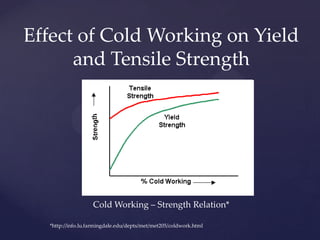
What Does Cold Working Effect?
The following properties are affected by cold
work significantly:
Tensile Strength
Hardness
Yield Strength
Ductility
Effect of Cold Working on Yield
and Tensile Strength
*http://info.lu.farmingdale.edu/depts/met/met205/coldwork.html
Cold Working – Strength Relation*
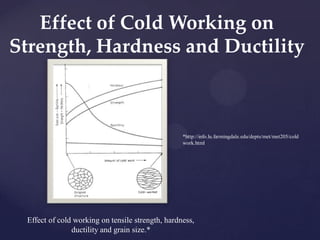
Effect of Cold Working on
Strength, Hardness and Ductility
Effect of cold working on tensile strength, hardness,
ductility and grain size.*
*http://info.lu.farmingdale.edu/depts/met/met205/cold
work.html
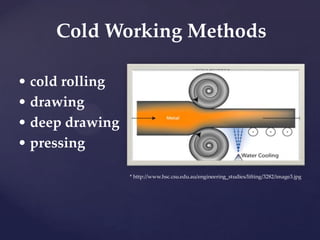
Cold Working Methods
• cold rolling
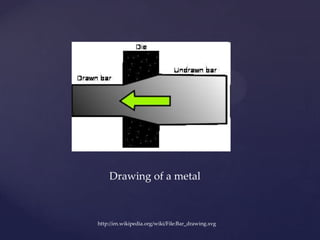
• drawing
• deep drawing
• pressing
* http://www.hsc.csu.edu.au/engineering_studies/lifting/3282/image3.jpg
Drawing of a metal
http://en.wikipedia.org/wiki/File:Bar_drawing.svg
Deep Drawing of a Metal
http://demonstrations.wolfram.com/DeepDrawingOfMetals/
Why Cold Working?
• Good dimensional control
• Good surface finish of the component.
• Strength and hardness of the metal are
increased.
• An ideal method for increasing hardness
of those metals which do not respond to
the heat treatment.
Why not?
• Only ductile metals can be shaped
through cold working.
• Over-working of metal.
• Subsequent heat treatment is mostly
needed
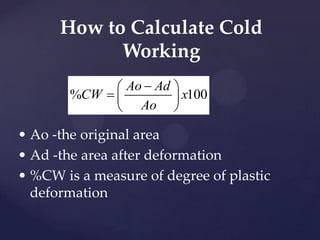
How to Calculate Cold
Working
• Ao -the original area
• Ad -the area after deformation
• %CW is a measure of degree of plastic
deformation
% 100
Ao Ad
CW x
Ao
 
  
 
Hot working is plastically deforming of the metallic
material at a temperature above the recrystallization
temperature.
 No Strain Hardening
 Usually performed at elevated temperatures
 Lead and Tin are exceptions (low melting point)
 Lower limit of the hot working temperature: 60%
of the melting temperature
Hot Working
The temperature at which atomic mobility can
repair the damage caused by the working process.
Recrystallization Temperature
Metal Recrystallization Temperature [°C]
Lead, tin 10 °C (below room temperature)
Zinc 25
Magnesium, aluminium 150
Gold, copper and silver 200
Iron, low-alloy steels 450
Tungsten 1400
Table: Recrystallization Temperatures of Some Metals *
* http://school.mech.uwa.edu.au/unit/MECH2402/lectures/hot_cold_working/
 No strengthening occurs during hot working
 Elimination of Imperfections
 Gas pores can be closed
 Composition differences can be reduced
 Anisotropic behaviour is gained
 Surface has a finer grain size than the center.
 Metal remains soft and ductile during process
Hot Working Mechanism
Forging is one of the oldest known
metalworking processes. Traditionally, hammers
are used for production of medieval weapons
(swords, armors, etc.)
Statue of Liberty in New York City is builded
(1886) from Strain-Hardened copper which is
supported by a frame of iron bars.*
Historical Applications
*http://corrosion-doctors.org/Landmarks/statue-construction.htm
Courtesy of Wikimedia Commons
Ref: Getty Images
Some processes involving hot
working:
 Hot Rolling
 Extrusion
 Forging
 Hot Drawing
Application Areas
of Hot Working
http://www.americaslibrary.gov/assets/es/pa/es_pa_steel_1_e.jpg
Hot Rolling
Aluminum is hot rolled into a coil
of desired thickness.*
Schematic of Hot Rolling.***
* http://aluminum-foil.alexanderhiggins.com/aluminum-foil-manufacturing.aspx
** http://en.wikipedia.org/wiki/File:HengereltTekercs10.jpg
*** http://school.mech.uwa.edu.au/unit/MECH2402/lectures/hot_cold_working/degarmo_18-2.jpg
Coil of Hot Rolled Steel**
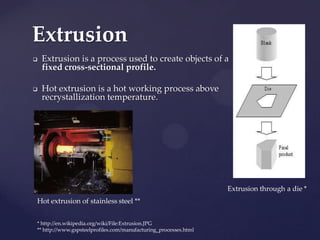
 Extrusion is a process used to create objects of a
fixed cross-sectional profile.
 Hot extrusion is a hot working process above
recrystallization temperature.
Extrusion
Extrusion through a die *
Hot extrusion of stainless steel **
* http://en.wikipedia.org/wiki/File:Extrusion.JPG
** http://www.gspsteelprofiles.com/manufacturing_processes.html
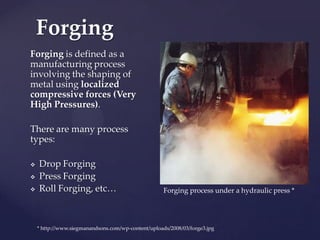
Forging is defined as a
manufacturing process
involving the shaping of
metal using localized
compressive forces (Very
High Pressures).
There are many process
types:
 Drop Forging
 Press Forging
 Roll Forging, etc…
Forging
Forging process under a hydraulic press *
* http://www.siegmanandsons.com/wp-content/uploads/2008/03/forge3.jpg
 Drawing is a metalworking
process which uses tensile
forces to stretch metal.
 Hot drawing above
recrystallization
temperature.
 Various types for processed
material:
 Bar Drawing
 Tube Drawing
 Wire Drawing
Hot Drawing
The basic drawing process for a
metal bar *
*http://en.wikipedia.org/wiki/File:Bar_drawing.svg
 Hardness and ductility of metal is not changed.
 Porosity is eliminated.
 Grain structure of the metal is refined and physical
properties improved.
 Large shape changes are possible without ruptures.
 Smaller, faster acting machines.
 Impurities are broken up and distributed
throughout material.
 Surfaces need not be clean and scale free.
Advantages of Hot Working
 Metal loss due to high temperature a rapid
oxidation or scale formation takes place during
process.
 Weakening of surface due to metal loss
 This weakening may cause fatigue failures.
 Close tolerances cannot be maintained.
 High cost of tooling for some processes
(High temperature & High Energy Consumption)
Disadvantages of Hot Working
ANNEALING
• Heat Process
• Heating to specific temperature(generally until
glowing) / colour
• Cool very slowly
 Bend with pressure
 Deformed easily than Hardened
Metals
 Low hardness, yield strength,
tensile strength of the steel
 Annealing induce ductility
 Homogenised structure
Physical Properties of
Annealed Materials
Hardened Materials
*Difficult to cut and shape.
*Impossible to bend
*Heated,then cooled very quickly
reverse of annealing!!
*http://www.technologystudent.com/equip1/heat3.htm
1. Recovery phase
***softening metal through removal
of crystal defects (dislocation) and the
internal stresses
***covers all annealing phenomena that
occur before the appearance of new
strain-free grains
Stages of Annealing
2. Recrystallization
***new strain-free grains nucleate and
grow to replace those deformed by
internal stresses
3. If annealing is allowed to continue,
grain growth will occur, in which the
microstructure starts to coarsen and
may cause the metal to have less than
satisfactory mechanical properties.
Stages of Annealing / 2
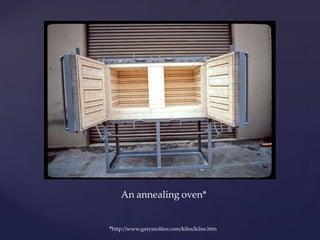
 Large ovens
 The inside of the oven is large enough to place
the workpiece in a position to receive
maximum exposure to the circulating heated
air
 the workpieces are sometimes left in the oven
in order for the parts to have a controlled
cooling process
Setup and Equipment
http://americanglassresearch.com/content.
asp?id=12&title=Annealing%20and%20Tempering
Annealed glass
 While some workpieces are left in the
oven to cool in a controlled fashion, other
materials and alloys are removed from
the oven,
 After being removed from the oven, the
workpieces are often quickly cooled off in
a process known as quench hardening
Setup and Equipment II
An annealing oven*
*http://www.garymolitor.com/kilns/kilns.htm
 Softens the material.
 Increases the ductility
 Enhances the toughness
 Improves the homogeneity
 The grain size of the material is refined a lot by annealing
Advantages
 Bridges
 Skyscrapers
 Example: Coin
Application Areas
http://goldprice.org/buy-silver/uploaded_images/us-silver-coin-values-714624.jpg
A Traditional Coin*
Some types of annealing;
 Full Annealing
 Process Annealing
 Stress Relief Annealing
 Isothermal Annealing
 Sub-critical Annealing
Types of Annealing
*http://heattreatment.linde.com/International/Web/LG/HT/like35lght.nsf/repositorybyalias/apps_annealing/$file/
Annealing.pdf
Process annealing and sub-critical annealing cycles*
Conclusion
 What is cold working & hot working &
annealing?
 Mechanisms of these processes
 Some Examples of Application Areas
 Advantages / Disadvantages
Thank You For Your Attention
: ))
Questions?
Hacettepe University | Department of Chemical Engineering | December 29, 2010
Presentation® by: Çağatay Yaylacı | Gökhan Uzun | Göktuğ Ural
By the way, we wish you a;

Cold hot working_annealing

  • 1.
    { Cold Working &Hot Working & Annealing KMÜ 479 – Materials Science and Tech II Fall 2010 / Seminar Presentation by: Çağatay Yaylacı #20723163 Gökhan Uzun #20622962 Göktuğ Ural #20622957 Hacettepe University | Department of Chemical Engineering | December 29, 2010
  • 2.
    OUTLINE Cold Working o Definition oExample Methods o Why/Why not Cold Working Hot Working o Definition o Basic Mechanism o Application Areas o Advantages & Disadvantages Annealing o Definition o Physical Properties o Stages of Annealing o Examples Çağatay Yaylacı Gökhan Uzun Göktuğ Ural
  • 3.
    Following will bediscussed:  The properties and process steps of cold & hot working, annealing  Examples of Application Areas  Advantages and Disadvantages Goals of the Presentation
  • 4.
    Cold Working Plastic deformationwhich is carried out in a temperature region and over a time interval such that the strain hardening is not relieved is called cold working. Cold working produces additional dislocations within the metal structure.
  • 5.
    • Initially thedislocations can move through the metal structure. • As the working continues, however, the movement of the dislocations becomes more difficult. • The metal becomes less malleable and ductile. Cold Working
  • 6.
    What Does ColdWorking Effect? The following properties are affected by cold work significantly: Tensile Strength Hardness Yield Strength Ductility
  • 7.
    Effect of ColdWorking on Yield and Tensile Strength *http://info.lu.farmingdale.edu/depts/met/met205/coldwork.html Cold Working – Strength Relation*
  • 8.
    Effect of ColdWorking on Strength, Hardness and Ductility Effect of cold working on tensile strength, hardness, ductility and grain size.* *http://info.lu.farmingdale.edu/depts/met/met205/cold work.html
  • 9.
    Cold Working Methods •cold rolling • drawing • deep drawing • pressing * http://www.hsc.csu.edu.au/engineering_studies/lifting/3282/image3.jpg
  • 10.
    Drawing of ametal http://en.wikipedia.org/wiki/File:Bar_drawing.svg
  • 11.
    Deep Drawing ofa Metal http://demonstrations.wolfram.com/DeepDrawingOfMetals/
  • 12.
    Why Cold Working? •Good dimensional control • Good surface finish of the component. • Strength and hardness of the metal are increased. • An ideal method for increasing hardness of those metals which do not respond to the heat treatment.
  • 13.
    Why not? • Onlyductile metals can be shaped through cold working. • Over-working of metal. • Subsequent heat treatment is mostly needed
  • 14.
    How to CalculateCold Working • Ao -the original area • Ad -the area after deformation • %CW is a measure of degree of plastic deformation % 100 Ao Ad CW x Ao       
  • 15.
    Hot working isplastically deforming of the metallic material at a temperature above the recrystallization temperature.  No Strain Hardening  Usually performed at elevated temperatures  Lead and Tin are exceptions (low melting point)  Lower limit of the hot working temperature: 60% of the melting temperature Hot Working
  • 16.
    The temperature atwhich atomic mobility can repair the damage caused by the working process. Recrystallization Temperature Metal Recrystallization Temperature [°C] Lead, tin 10 °C (below room temperature) Zinc 25 Magnesium, aluminium 150 Gold, copper and silver 200 Iron, low-alloy steels 450 Tungsten 1400 Table: Recrystallization Temperatures of Some Metals * * http://school.mech.uwa.edu.au/unit/MECH2402/lectures/hot_cold_working/
  • 17.
     No strengtheningoccurs during hot working  Elimination of Imperfections  Gas pores can be closed  Composition differences can be reduced  Anisotropic behaviour is gained  Surface has a finer grain size than the center.  Metal remains soft and ductile during process Hot Working Mechanism
  • 18.
    Forging is oneof the oldest known metalworking processes. Traditionally, hammers are used for production of medieval weapons (swords, armors, etc.) Statue of Liberty in New York City is builded (1886) from Strain-Hardened copper which is supported by a frame of iron bars.* Historical Applications *http://corrosion-doctors.org/Landmarks/statue-construction.htm Courtesy of Wikimedia Commons Ref: Getty Images
  • 19.
    Some processes involvinghot working:  Hot Rolling  Extrusion  Forging  Hot Drawing Application Areas of Hot Working http://www.americaslibrary.gov/assets/es/pa/es_pa_steel_1_e.jpg
  • 20.
    Hot Rolling Aluminum ishot rolled into a coil of desired thickness.* Schematic of Hot Rolling.*** * http://aluminum-foil.alexanderhiggins.com/aluminum-foil-manufacturing.aspx ** http://en.wikipedia.org/wiki/File:HengereltTekercs10.jpg *** http://school.mech.uwa.edu.au/unit/MECH2402/lectures/hot_cold_working/degarmo_18-2.jpg Coil of Hot Rolled Steel**
  • 21.
     Extrusion isa process used to create objects of a fixed cross-sectional profile.  Hot extrusion is a hot working process above recrystallization temperature. Extrusion Extrusion through a die * Hot extrusion of stainless steel ** * http://en.wikipedia.org/wiki/File:Extrusion.JPG ** http://www.gspsteelprofiles.com/manufacturing_processes.html
  • 22.
    Forging is definedas a manufacturing process involving the shaping of metal using localized compressive forces (Very High Pressures). There are many process types:  Drop Forging  Press Forging  Roll Forging, etc… Forging Forging process under a hydraulic press * * http://www.siegmanandsons.com/wp-content/uploads/2008/03/forge3.jpg
  • 23.
     Drawing isa metalworking process which uses tensile forces to stretch metal.  Hot drawing above recrystallization temperature.  Various types for processed material:  Bar Drawing  Tube Drawing  Wire Drawing Hot Drawing The basic drawing process for a metal bar * *http://en.wikipedia.org/wiki/File:Bar_drawing.svg
  • 24.
     Hardness andductility of metal is not changed.  Porosity is eliminated.  Grain structure of the metal is refined and physical properties improved.  Large shape changes are possible without ruptures.  Smaller, faster acting machines.  Impurities are broken up and distributed throughout material.  Surfaces need not be clean and scale free. Advantages of Hot Working
  • 25.
     Metal lossdue to high temperature a rapid oxidation or scale formation takes place during process.  Weakening of surface due to metal loss  This weakening may cause fatigue failures.  Close tolerances cannot be maintained.  High cost of tooling for some processes (High temperature & High Energy Consumption) Disadvantages of Hot Working
  • 26.
    ANNEALING • Heat Process •Heating to specific temperature(generally until glowing) / colour • Cool very slowly
  • 27.
     Bend withpressure  Deformed easily than Hardened Metals  Low hardness, yield strength, tensile strength of the steel  Annealing induce ductility  Homogenised structure Physical Properties of Annealed Materials
  • 28.
    Hardened Materials *Difficult tocut and shape. *Impossible to bend *Heated,then cooled very quickly reverse of annealing!! *http://www.technologystudent.com/equip1/heat3.htm
  • 29.
    1. Recovery phase ***softeningmetal through removal of crystal defects (dislocation) and the internal stresses ***covers all annealing phenomena that occur before the appearance of new strain-free grains Stages of Annealing
  • 30.
    2. Recrystallization ***new strain-freegrains nucleate and grow to replace those deformed by internal stresses 3. If annealing is allowed to continue, grain growth will occur, in which the microstructure starts to coarsen and may cause the metal to have less than satisfactory mechanical properties. Stages of Annealing / 2
  • 31.
     Large ovens The inside of the oven is large enough to place the workpiece in a position to receive maximum exposure to the circulating heated air  the workpieces are sometimes left in the oven in order for the parts to have a controlled cooling process Setup and Equipment http://americanglassresearch.com/content. asp?id=12&title=Annealing%20and%20Tempering Annealed glass
  • 32.
     While someworkpieces are left in the oven to cool in a controlled fashion, other materials and alloys are removed from the oven,  After being removed from the oven, the workpieces are often quickly cooled off in a process known as quench hardening Setup and Equipment II
  • 33.
  • 34.
     Softens thematerial.  Increases the ductility  Enhances the toughness  Improves the homogeneity  The grain size of the material is refined a lot by annealing Advantages
  • 35.
     Bridges  Skyscrapers Example: Coin Application Areas http://goldprice.org/buy-silver/uploaded_images/us-silver-coin-values-714624.jpg A Traditional Coin*
  • 36.
    Some types ofannealing;  Full Annealing  Process Annealing  Stress Relief Annealing  Isothermal Annealing  Sub-critical Annealing Types of Annealing
  • 37.
  • 38.
    Conclusion  What iscold working & hot working & annealing?  Mechanisms of these processes  Some Examples of Application Areas  Advantages / Disadvantages
  • 39.
    Thank You ForYour Attention : )) Questions? Hacettepe University | Department of Chemical Engineering | December 29, 2010 Presentation® by: Çağatay Yaylacı | Gökhan Uzun | Göktuğ Ural
  • 40.
    By the way,we wish you a;