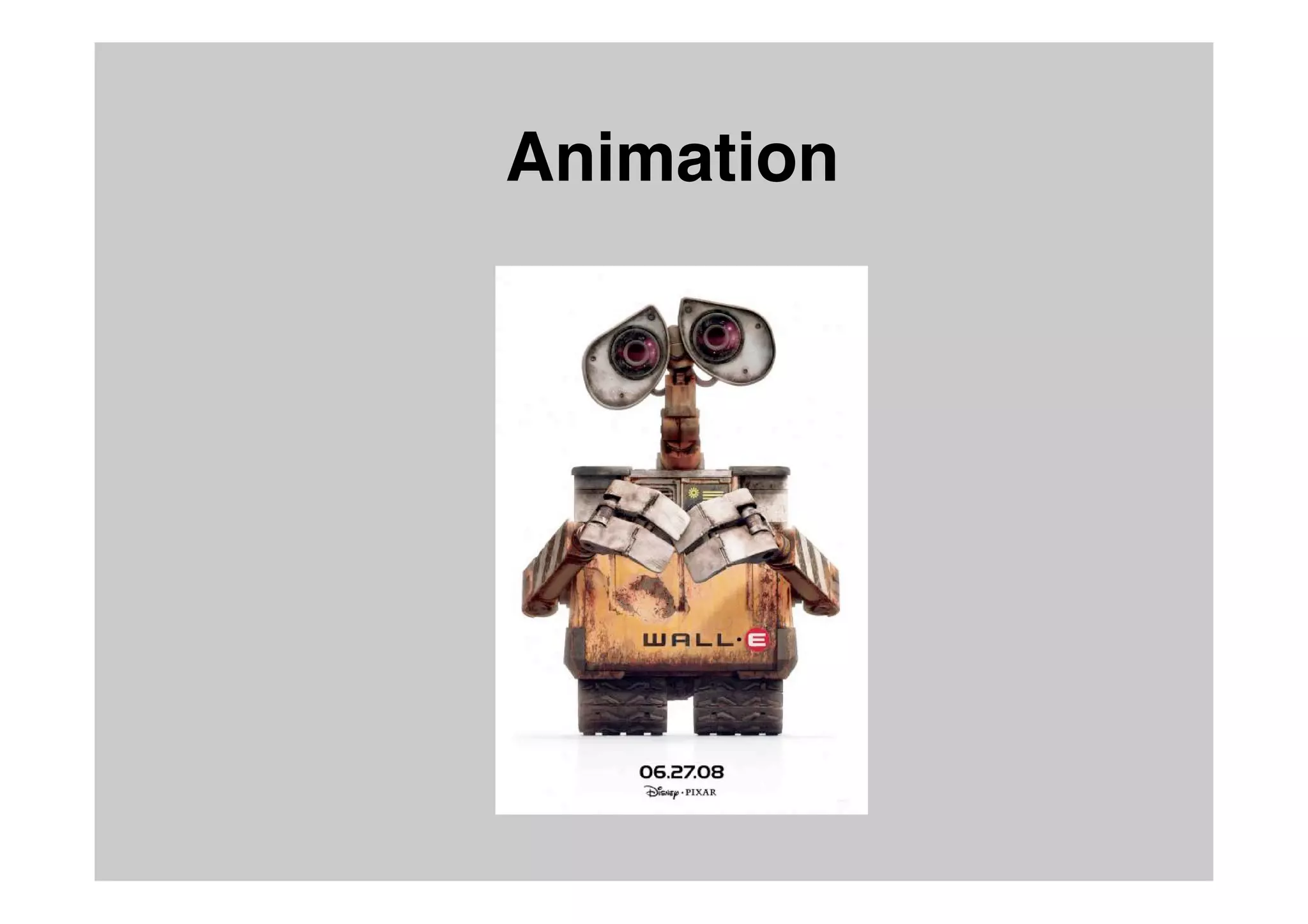
Animation
Hand Drawn Animation
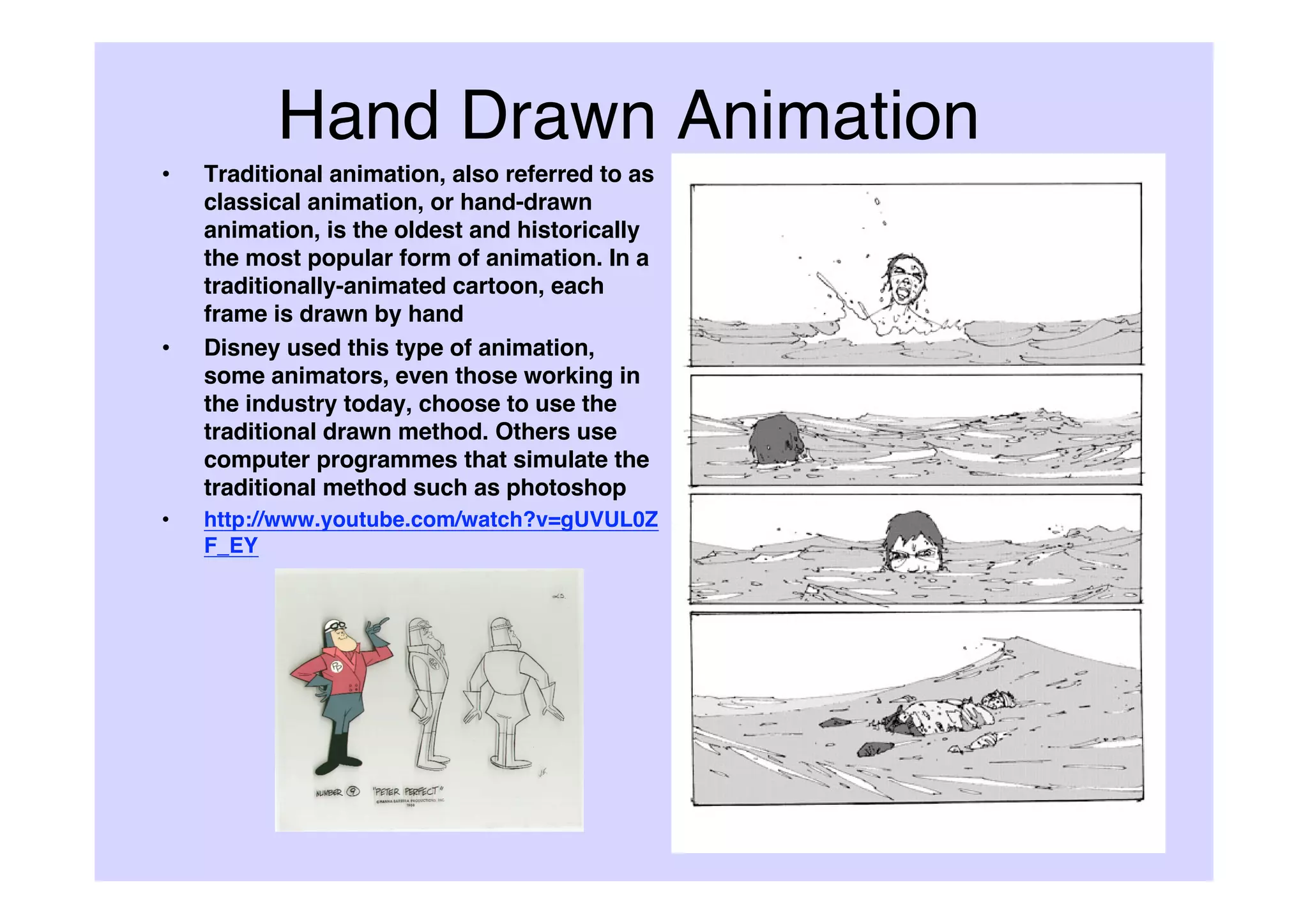
• Traditional animation, also referred to as
classical animation, or hand-drawn
animation, is the oldest and historically
the most popular form of animation. In a
traditionally-animated cartoon, each
frame is drawn by hand
• Disney used this type of animation,
some animators, even those working in
the industry today, choose to use the
traditional drawn method. Others use
computer programmes that simulate the
traditional method such as photoshop
• http://www.youtube.com/watch?v=gUVUL0Z
F_EY
Stop Motion Animation
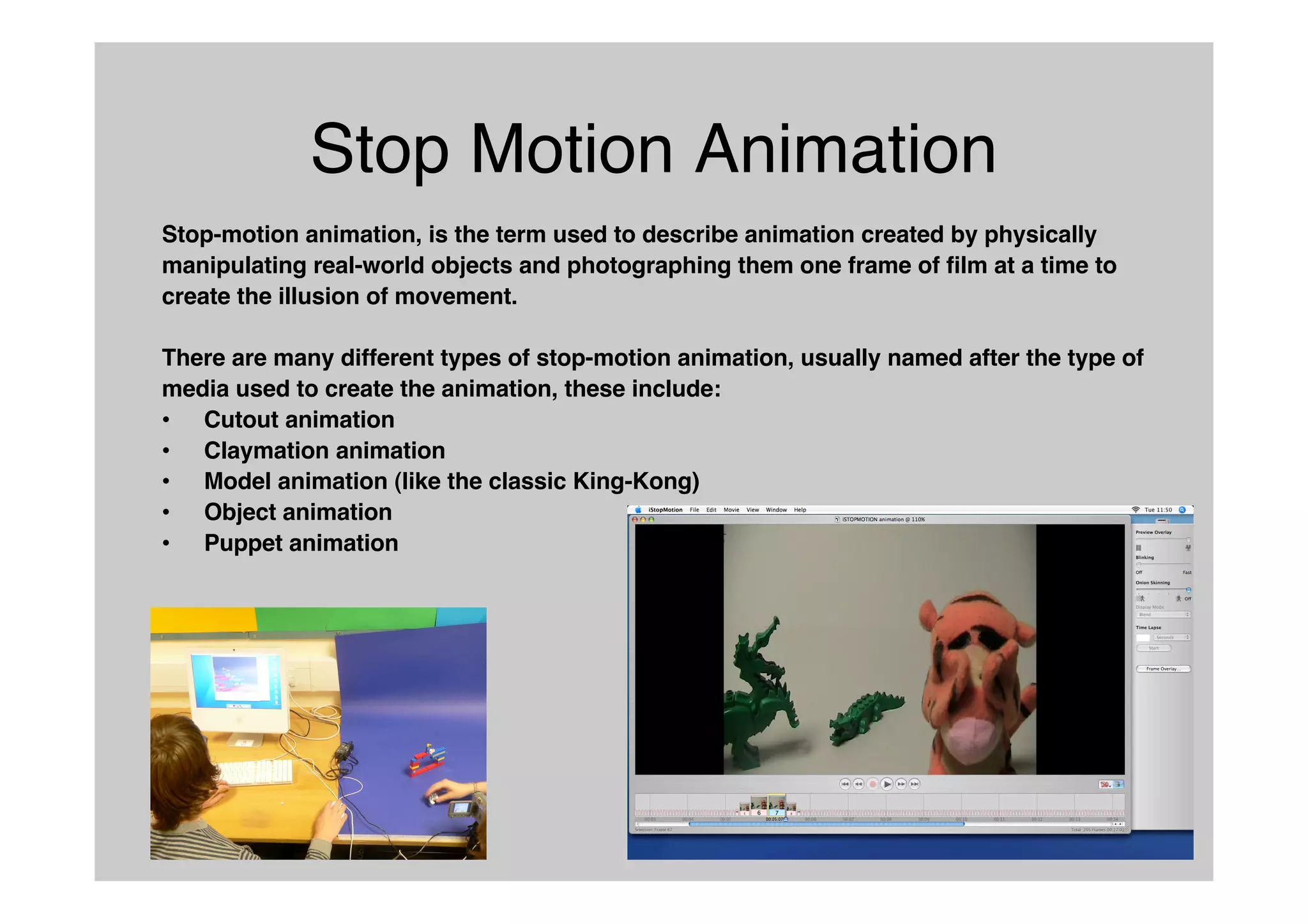
Stop-motion animation, is the term used to describe animation created by physically
manipulating real-world objects and photographing them one frame of film at a time to
create the illusion of movement.
There are many different types of stop-motion animation, usually named after the type of
media used to create the animation, these include:
• Cutout animation
• Claymation animation
• Model animation (like the classic King-Kong)
• Object animation
• Puppet animation
Cutout Animation
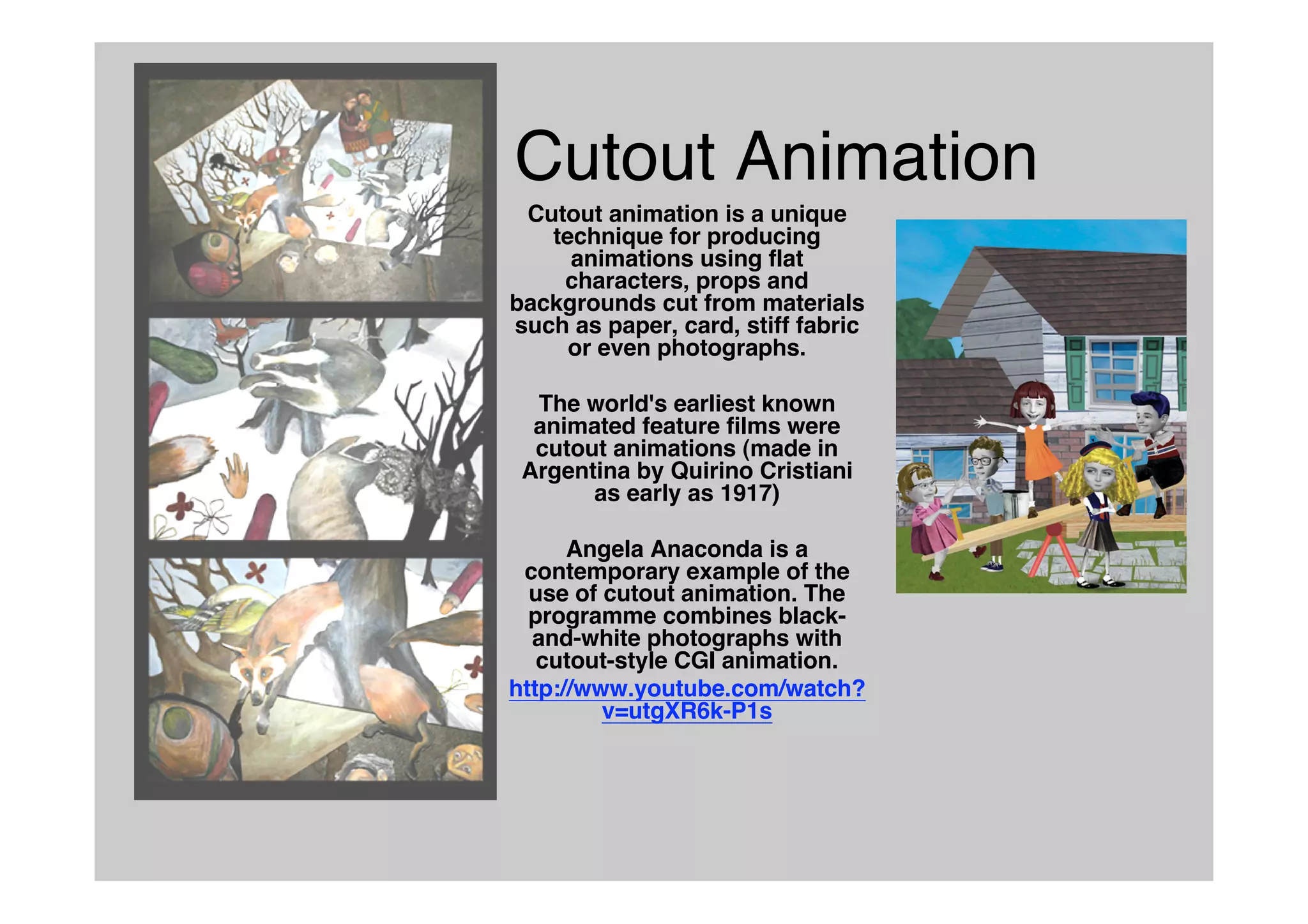
Cutout animation is a unique
technique for producing
animations using flat
characters, props and
backgrounds cut from materials
such as paper, card, stiff fabric
or even photographs.
The world's earliest known
animated feature films were
cutout animations (made in
Argentina by Quirino Cristiani
as early as 1917)
Angela Anaconda is a
contemporary example of the
use of cutout animation. The
programme combines black-
and-white photographs with
cutout-style CGI animation.
http://www.youtube.com/watch?
v=utgXR6k-P1s
Clay Animation/Claymation
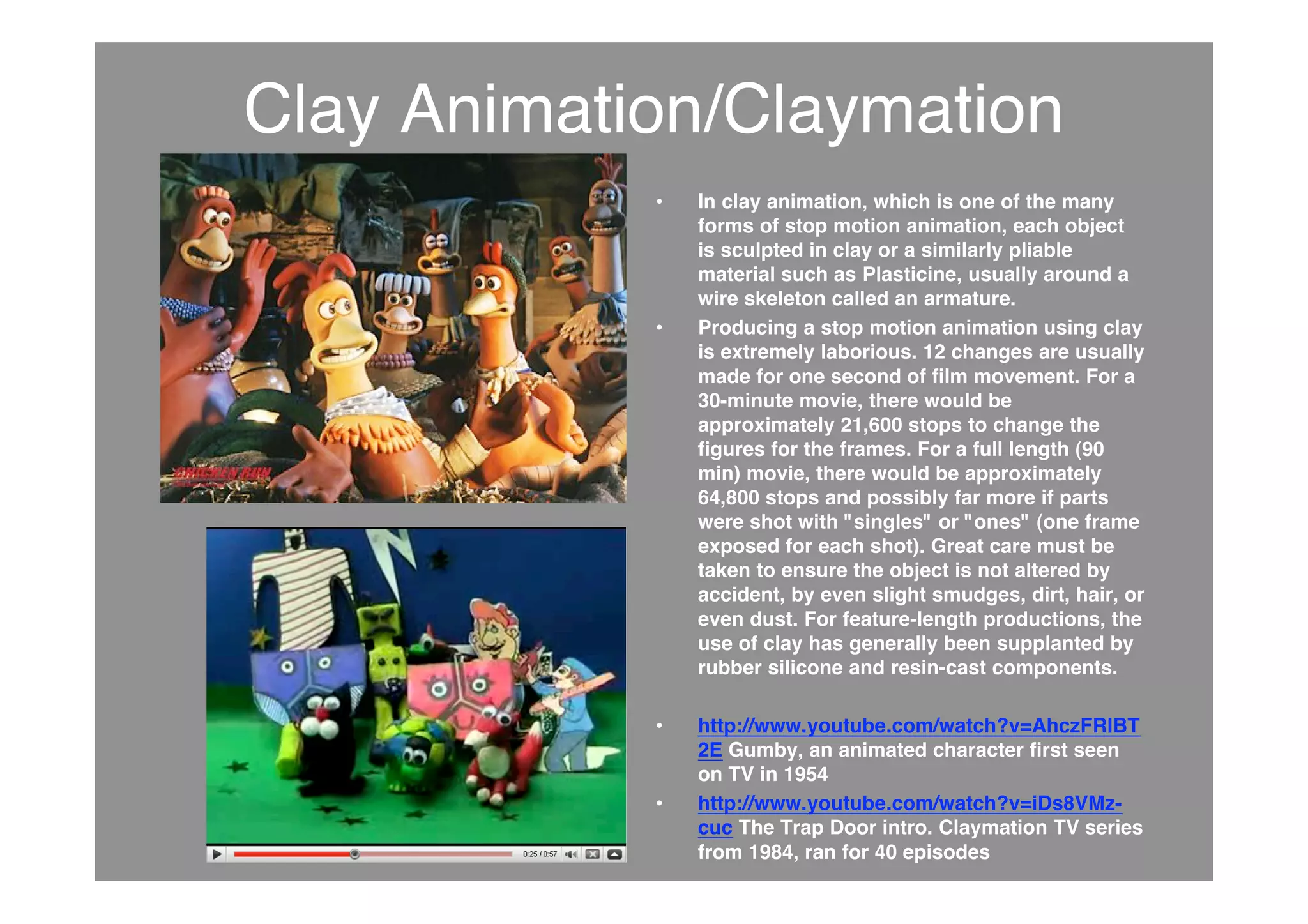
• In clay animation, which is one of the many
forms of stop motion animation, each object
is sculpted in clay or a similarly pliable
material such as Plasticine, usually around a
wire skeleton called an armature.
• Producing a stop motion animation using clay
is extremely laborious. 12 changes are usually
made for one second of film movement. For a
30-minute movie, there would be
approximately 21,600 stops to change the
figures for the frames. For a full length (90
min) movie, there would be approximately
64,800 stops and possibly far more if parts
were shot with "singles" or "ones" (one frame
exposed for each shot). Great care must be
taken to ensure the object is not altered by
accident, by even slight smudges, dirt, hair, or
even dust. For feature-length productions, the
use of clay has generally been supplanted by
rubber silicone and resin-cast components.
• http://www.youtube.com/watch?v=AhczFRlBT
2E Gumby, an animated character first seen
on TV in 1954
• http://www.youtube.com/watch?v=iDs8VMz-
cuc The Trap Door intro. Claymation TV series
from 1984, ran for 40 episodes
Computer animation
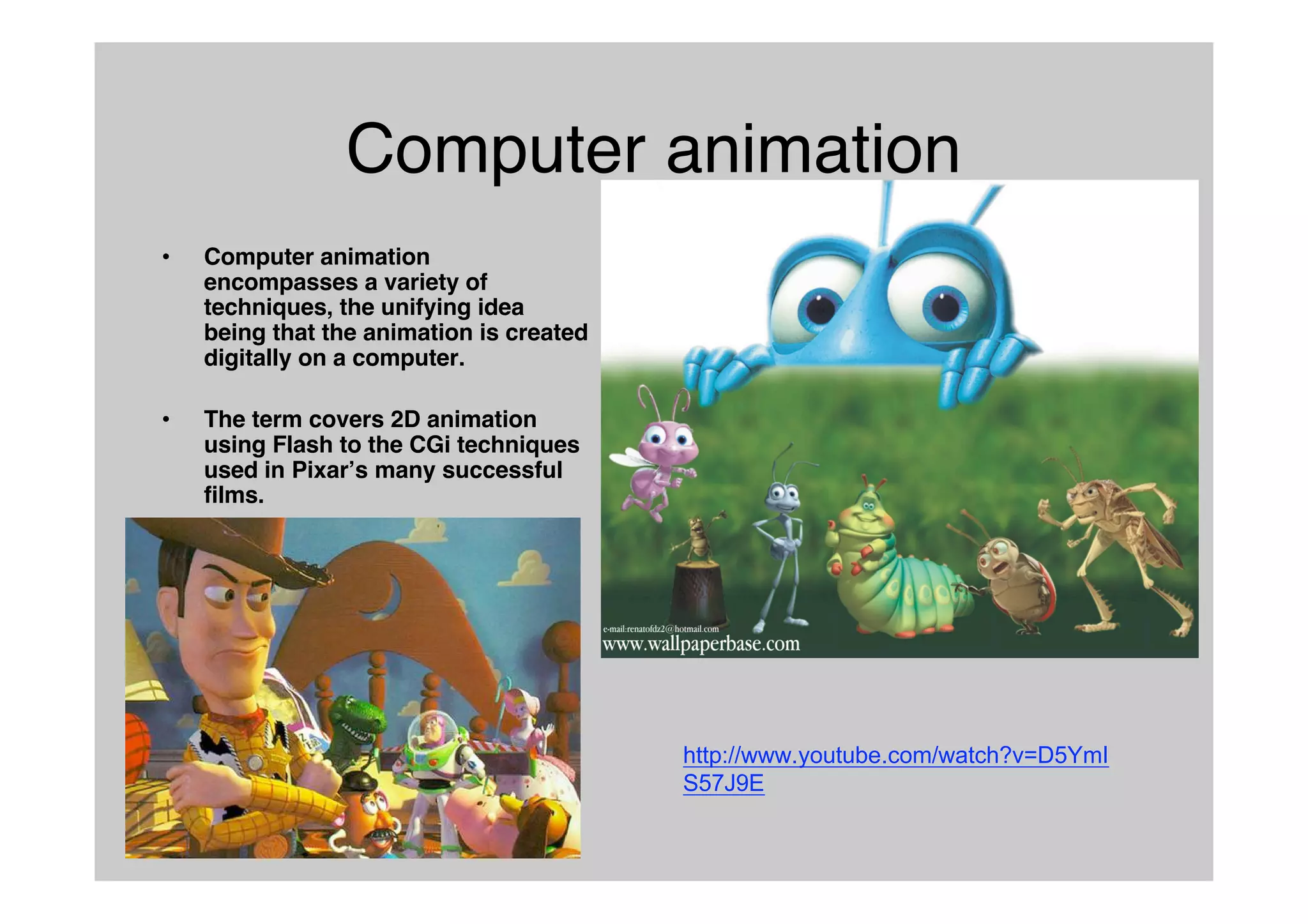
• Computer animation
encompasses a variety of
techniques, the unifying idea
being that the animation is created
digitally on a computer.
• The term covers 2D animation
using Flash to the CGi techniques
used in Pixarʼs many successful
films.
http://www.youtube.com/watch?v=D5YmI
S57J9E

Animation Techniques

  • 1.
  • 2.
    Hand Drawn Animation •Traditional animation, also referred to as classical animation, or hand-drawn animation, is the oldest and historically the most popular form of animation. In a traditionally-animated cartoon, each frame is drawn by hand • Disney used this type of animation, some animators, even those working in the industry today, choose to use the traditional drawn method. Others use computer programmes that simulate the traditional method such as photoshop • http://www.youtube.com/watch?v=gUVUL0Z F_EY
  • 3.
    Stop Motion Animation Stop-motionanimation, is the term used to describe animation created by physically manipulating real-world objects and photographing them one frame of film at a time to create the illusion of movement. There are many different types of stop-motion animation, usually named after the type of media used to create the animation, these include: • Cutout animation • Claymation animation • Model animation (like the classic King-Kong) • Object animation • Puppet animation
  • 4.
    Cutout Animation Cutout animationis a unique technique for producing animations using flat characters, props and backgrounds cut from materials such as paper, card, stiff fabric or even photographs. The world's earliest known animated feature films were cutout animations (made in Argentina by Quirino Cristiani as early as 1917) Angela Anaconda is a contemporary example of the use of cutout animation. The programme combines black- and-white photographs with cutout-style CGI animation. http://www.youtube.com/watch? v=utgXR6k-P1s
  • 5.
    Clay Animation/Claymation • Inclay animation, which is one of the many forms of stop motion animation, each object is sculpted in clay or a similarly pliable material such as Plasticine, usually around a wire skeleton called an armature. • Producing a stop motion animation using clay is extremely laborious. 12 changes are usually made for one second of film movement. For a 30-minute movie, there would be approximately 21,600 stops to change the figures for the frames. For a full length (90 min) movie, there would be approximately 64,800 stops and possibly far more if parts were shot with "singles" or "ones" (one frame exposed for each shot). Great care must be taken to ensure the object is not altered by accident, by even slight smudges, dirt, hair, or even dust. For feature-length productions, the use of clay has generally been supplanted by rubber silicone and resin-cast components. • http://www.youtube.com/watch?v=AhczFRlBT 2E Gumby, an animated character first seen on TV in 1954 • http://www.youtube.com/watch?v=iDs8VMz- cuc The Trap Door intro. Claymation TV series from 1984, ran for 40 episodes
  • 6.
    Computer animation • Computeranimation encompasses a variety of techniques, the unifying idea being that the animation is created digitally on a computer. • The term covers 2D animation using Flash to the CGi techniques used in Pixarʼs many successful films. http://www.youtube.com/watch?v=D5YmI S57J9E