Definition
Persistence of Vision: How Animation
Works
Types of Animations & Examples
How to Create an Animation
Storyboard and comparison with Comic
Strips
Use and Impact ofAnimation
WHAT YOU NEED TO KNOW
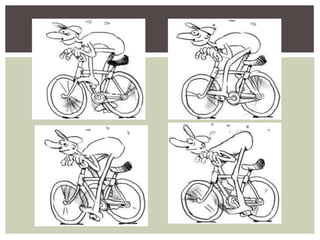
Animation is the creation of
the “illusion of movement”
using a series of still images
A DEFINITION…
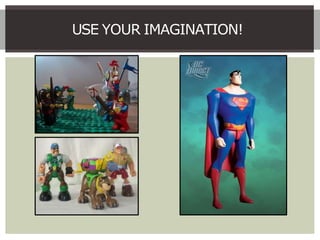
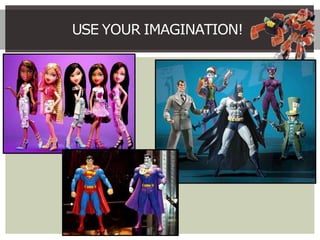
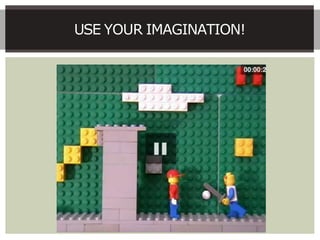
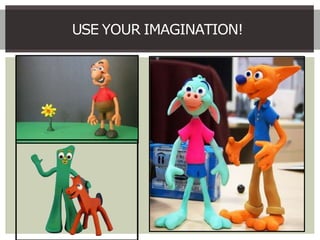
USE YOUR IMAGINATION!
When the characters and scenes are
made from clay the term used to
describe the animation is
“Claymation”
CLAYMATION
USE YOUR IMAGINATION!
Refers to brain retaining the image
of what eyes see even after the
image is no longer visible.
The brain can only process a certain
number or images at a time.
Brain can recognize images as
separate images if they are viewed
at 12 or fewer images per second.
PERSISTENCE OF VISION
Ifthe pictures appear faster than
12 per second they begin to merge
into each other creating the illusion
of movement.
Television and movies are usually
created at 24 to 30 images per
second
PERSISTENCE OF VISION
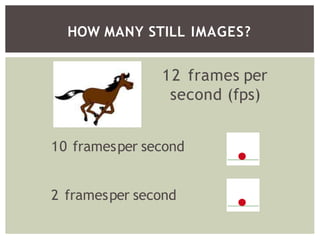
12 frames per
second (fps)
HOW MANY STILL IMAGES?
10 framesper second
2 framesper second
Historically there are 3 major types
of animation:
1.Hand Drawn Animation
2.Stop Motion Animation
3.Computer Animation
3 TYPES OF ANIMATION
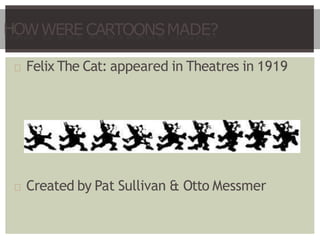
HOWWERECARTOONSMADE?
Felix The Cat: appeared in Theatres in 1919
Created by Pat Sullivan & Otto Messmer
Done by an artist who draws each character and
movement individually
Very time consuming to have to draw, then
colour, then photograph each picture
Draw pictures first, then colour them on
celluloid, then they take pictures and animate
them
Very expensive due to hours of labour involved
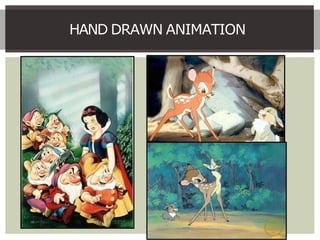
Examples: Older Disney Movies i.e. Bambi, Fox
and Hound, Cinderella etc.
HAND DRAWN ANIMATION
Can be done by virtually anyone, with no
extensive training
Does not take that much time relative to the
other 2 methods
Uses jointed figures or clay figures that can
be moved to make motions
Take still pictures of the individual
movements, then use relatively inexpensive
computer software to animate
STOP MOTION ANIMATION
Weuse Movie Maker Software to
complete our animations
Not very expensive because all you
need is a digital camera and the
software comes with Windows XP
operating system
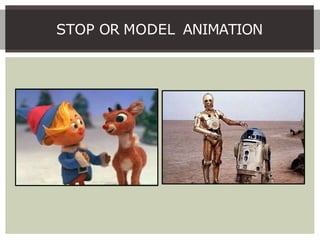
Examples: Star Wars, Robot Chicken,
Old Rudolph the Red Nosed Reindeer
STOP MOTION ANIMATION
STOP OR MODEL ANIMATION
All characters and movements are
generated using computer
animation software
Can also be very time consuming as
they can get very complicated in
movements and effects
All characters are fully animated
with no still pictures
COMPUTER ANIMATION
Can be very expensive because of
the complexity of the stunts and
animations being done
Huge budgets because the
animation sequences more
complicated these days eg. the war
scenes in Lord of the Rings etc.
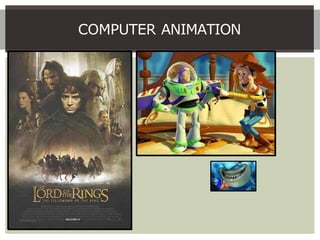
Examples: Toy Story, Finding Nemo,
Matrix, Lord of the Rings
COMPUTER ANIMATION
COMPUTER ANIMATION
Astoryboard is a series of sketches
that can be used as a guide for
making a film or video
Itcontains the action and dialogue
of the film
Can also include the music,
narration, special effects
information etc. for the person to
guide them in creating the film
ANIMATION STORYBOARDS
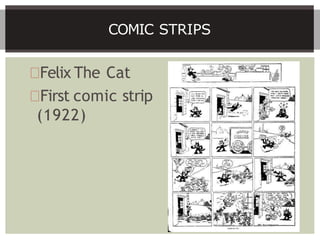
Felix The Cat
First comic strip
(1922)
COMIC STRIPS
Are they more like an animation
sequence or a storyboard?
They are more like a storyboard because they
DO NOT SHOW CONTINUOUS MOVEMENT
It shows the person or object in one
place and then in another and the
sequence between is left to the
imagination to make the link from one
picture to the other
COMIC BOOKS AND COMICSTRIPS
Animation is NOT just for kids
Ithas become mainstream and kids,
teenagers, adults and seniors.
When most teachers today were kids it
was very odd for a parent to be sitting
with their children and watching an
animated show.
Now adults take their kids to the
movies and watch with them and there
are often “inside jokes” for adults too
GREATEST IMPACT FOR TODAY?
Animated Movies: Million dollar industry;
1- 20 millions spent on each movie
Animation & Computer Graphics Effects
are used in movies frequently
ANIMATION USES
Video games
TV Programs (e.g. Weather, News)
Used online (images, ads, chatting)
Simulations (Science & Engineering)
Virtual reality (e.g. second life)
ANIMATION USES

short-vista-animation-120430122352-phpapp02.pptx

  • 2.
    Definition Persistence of Vision:How Animation Works Types of Animations & Examples How to Create an Animation Storyboard and comparison with Comic Strips Use and Impact ofAnimation WHAT YOU NEED TO KNOW
  • 3.
    Animation is thecreation of the “illusion of movement” using a series of still images A DEFINITION…
  • 6.
  • 7.
  • 8.
  • 9.
    When the charactersand scenes are made from clay the term used to describe the animation is “Claymation” CLAYMATION
  • 10.
  • 11.
    Refers to brainretaining the image of what eyes see even after the image is no longer visible. The brain can only process a certain number or images at a time. Brain can recognize images as separate images if they are viewed at 12 or fewer images per second. PERSISTENCE OF VISION
  • 12.
    Ifthe pictures appearfaster than 12 per second they begin to merge into each other creating the illusion of movement. Television and movies are usually created at 24 to 30 images per second PERSISTENCE OF VISION
  • 13.
    12 frames per second(fps) HOW MANY STILL IMAGES? 10 framesper second 2 framesper second
  • 14.
    Historically there are3 major types of animation: 1.Hand Drawn Animation 2.Stop Motion Animation 3.Computer Animation 3 TYPES OF ANIMATION
  • 15.
    HOWWERECARTOONSMADE? Felix The Cat:appeared in Theatres in 1919 Created by Pat Sullivan & Otto Messmer
  • 16.
    Done by anartist who draws each character and movement individually Very time consuming to have to draw, then colour, then photograph each picture Draw pictures first, then colour them on celluloid, then they take pictures and animate them Very expensive due to hours of labour involved Examples: Older Disney Movies i.e. Bambi, Fox and Hound, Cinderella etc. HAND DRAWN ANIMATION
  • 17.
  • 18.
    Can be doneby virtually anyone, with no extensive training Does not take that much time relative to the other 2 methods Uses jointed figures or clay figures that can be moved to make motions Take still pictures of the individual movements, then use relatively inexpensive computer software to animate STOP MOTION ANIMATION
  • 19.
    Weuse Movie MakerSoftware to complete our animations Not very expensive because all you need is a digital camera and the software comes with Windows XP operating system Examples: Star Wars, Robot Chicken, Old Rudolph the Red Nosed Reindeer STOP MOTION ANIMATION
  • 20.
    STOP OR MODELANIMATION
  • 21.
    All characters andmovements are generated using computer animation software Can also be very time consuming as they can get very complicated in movements and effects All characters are fully animated with no still pictures COMPUTER ANIMATION
  • 22.
    Can be veryexpensive because of the complexity of the stunts and animations being done Huge budgets because the animation sequences more complicated these days eg. the war scenes in Lord of the Rings etc. Examples: Toy Story, Finding Nemo, Matrix, Lord of the Rings COMPUTER ANIMATION
  • 23.
  • 24.
    Astoryboard is aseries of sketches that can be used as a guide for making a film or video Itcontains the action and dialogue of the film Can also include the music, narration, special effects information etc. for the person to guide them in creating the film ANIMATION STORYBOARDS
  • 25.
    Felix The Cat Firstcomic strip (1922) COMIC STRIPS
  • 26.
    Are they morelike an animation sequence or a storyboard? They are more like a storyboard because they DO NOT SHOW CONTINUOUS MOVEMENT It shows the person or object in one place and then in another and the sequence between is left to the imagination to make the link from one picture to the other COMIC BOOKS AND COMICSTRIPS
  • 27.
    Animation is NOTjust for kids Ithas become mainstream and kids, teenagers, adults and seniors. When most teachers today were kids it was very odd for a parent to be sitting with their children and watching an animated show. Now adults take their kids to the movies and watch with them and there are often “inside jokes” for adults too GREATEST IMPACT FOR TODAY?
  • 28.
    Animated Movies: Milliondollar industry; 1- 20 millions spent on each movie Animation & Computer Graphics Effects are used in movies frequently ANIMATION USES
  • 29.
    Video games TV Programs(e.g. Weather, News) Used online (images, ads, chatting) Simulations (Science & Engineering) Virtual reality (e.g. second life) ANIMATION USES